
From a reader…
QUAERITUR:
I’ve lost all desire and motivation to pray, fast, etc. I’ve become apathetic towards the spiritual life. It all seems so pointless. God stopped listening and caring about me years ago, and I feel as though my time would be better spent actually doing things that will help me rather than spend the time in prayer asking God to help me (which he never does). At the same time, I don’t want to go to hell, but I just can’t motivate myself to pray or do anything related to the spiritual life. It all seems so pointless. I feel like God just doesn’t care about me anymore. Pray or don’t pray, my life is still the *****. What do you recommend?
This sounds rather like the affliction of acedia or accidie (from Greek akedía, “I don’t care-ishness”). This is “spiritual sloth”, which is one of the seven capital or deadly sins. It has to do with lack of concern for or regret about one’s spiritual well-being especially because of the obligations it involves. In many cases this is a venial sin but it can be a mortal sin if this lack of care or regret leads to omitting grave duties of one’s state of life and the duties of religion.
Rather than address this at length here, allow me to recommend some good reading.
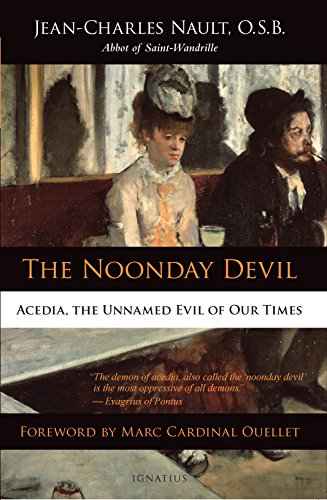
First, The Noonday Devil: Acedia, the Unnamed Evil of Our Times by Jean-Charles Nault.
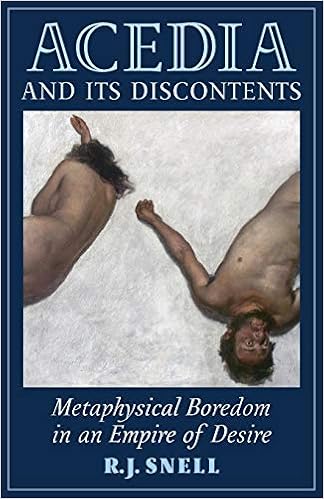
Also, Acedia and Its Discontents: Metaphysical Boredom in an Empire of Desire by R.J. Snell.
As we move deeper into the Passion that the Church is bound to undergo now, I suspect that this will be an affliction for many good people who, in anxiety and frustration, may retreat into acedia in a kind of self-afflicting self-defense choice. But it is a dead end. We were made for glory and God always and constantly offers us the graces we need. There are times when He will withdraw consolations from us, or a sense of His presence, for the sake of testing our love and will to persevere. Even when we have fallen into mortal sin, God extends to us those prevenient graces which work to stir within us the wherewithal to seek Him again through interior conversion and the sacraments.
God truly is like the father in the Lord’s parable about prodigal son. Eventually the thought of home and the wretchedness of his condition moves the son. But the father’s role is foundational, because he provided in the first place the home which becomes the object of his longing. Also, the father was watching watching watching the road for the son and then rushed to meet him. “But while he was yet at a distance, his father saw him and had compassion, and ran and embraced him and kissed him.” Luke 15:20.
Since you’ve asked for help, probably under the guidance of God, here’s some help. Use the reading and say to yourself, often, to the point of memorization, the Acts of Faith, Hope, Love and Contrition. Try these at least three times a day, to start.
I like the versions with “Thees and Thous”!
ACT OF FAITH
O MY GOD, I firmly believe that Thou art one God in Three Divine Persons, Father, Son and Holy Ghost. I believe that Thy Divine Son became Man, and died for our sins, and that He will come to judge the living and the dead. I believe these and all the truths which the Holy Catholic Church teaches, because Thou hast revealed them, Who canst neither deceive nor be deceived.
ACT OF HOPE
O MY GOD, relying on Thy almighty power and infinite mercy and promises, I
hope to obtain pardon of my sins, the help of Thy grace, and Life Everlasting, through the merits of Jesus Christ, my Lord and Redeemer.
ACT OF CHARITY
O MY GOD, I love Thee above all things, with my whole heart and soul, because Thou art all-good and worthy of all love. I love my neighbor as myself for the love of Thee. I forgive all who have injured me, and ask pardon of all whom I have injured.
ACT OF CONTRITION
O MY GOD, I am heartily sorry for having offended Thee, and I detest all my sins because I dread the loss of Heaven and the pains of Hell; but most of all because they offend Thee, my God, Who art all-good and deserving of all my love. I firmly resolve, with the help of Thy grace, to confess my sins, to do penance, and to amend my life. Amen.

 Expediti, is from expedio meaning,“to extricate, disengage, set free”, and when applied to persons, “to be without baggage”. Thus, an expeditus, is “a soldier lightly burdened, a swiftly marching soldier.” You might have heard of St Expeditus (feast day 19 April), patron saint of procrastinators and, for reasons perfectly clear to me, computer programmers. St Expeditus is depicted as a Roman solider holding aloft a Cross, upon which is written, “HODIE…. TODAY”, and below his feet, “CRAS… TOMORROW”. I am sure you are now praying to Expeditus that I will stop this digression and swiftly march on.
 By grueling and repetitious training, their bodies are strengthened and hardened. Because of tedious drills, their minds are freed up (liberis mentibus).
 Soldiers, sailors, marines gripe during basic training and entertain homicidal thoughts about their drill instructors. Not a few return to their instructors later and thank them. When the time came for that skill or tool or piece of knowledge to be used in a critical moment, they had it.

 From a reader…
 From a reader…
 Archbp. Viganò gave an interview to Diane Montagna of
  From a reader…
 Happily, I had not sullied my eyes with a glimpse of the Fishwrap (aka National Schismatic Reporter) for some time. Then I received a message from a priest friend asking if I had seen the opinion piece there about the Traditional Latin Mass and the people who attend it.
 With that in mind, if you do head over to Fishwrap – with eye wash close at hand – to read any or all (good luck with that) of her piece, you might use it as a negatively charged point in your own examination of conscience. It won’t hurt people who frequent Traditional Latin Mass chapels and churches to examine their own attitudes and actions. Correction is needed if they are in any way guilty of over-emphasizing some aspect of their practices. They must constantly strive to excel in being charitably solicitous toward new-comers. Charity is, of course, the sacrificial love that considers first the true good of another, rather than imposition of one’s own preferences under the guise of concern.




























