Photo by The Great Roman™
Daily Fervorino HERE
Easter will soon be here…

OPPORTUNITY
10% off with code:
FATHERZ10

From Chess.com
Black to move
Photo by The Great Roman™
Daily Fervorino HERE
Easter will soon be here…
OPPORTUNITY
10% off with code:
FATHERZ10
From Chess.com
Black to move
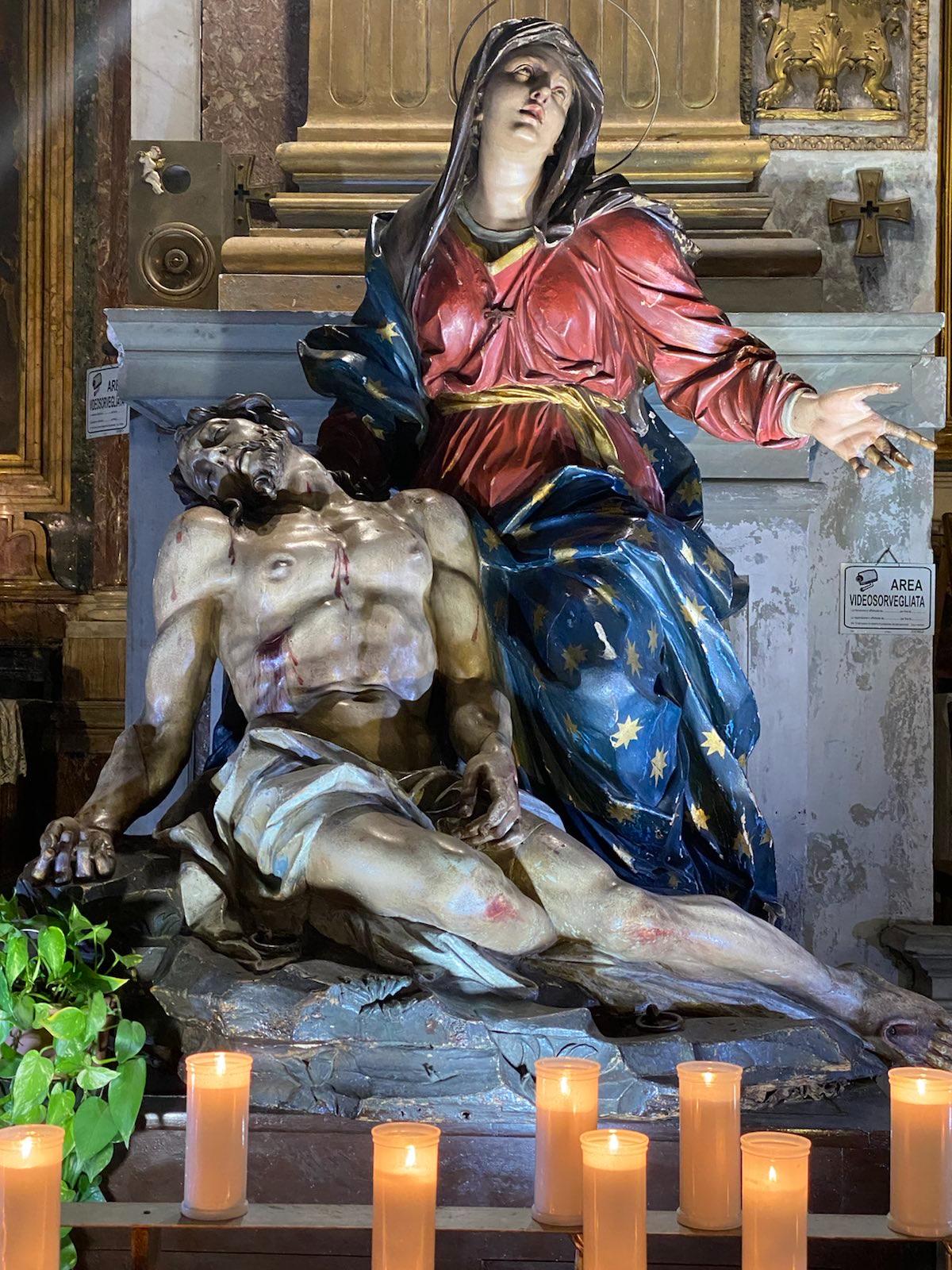
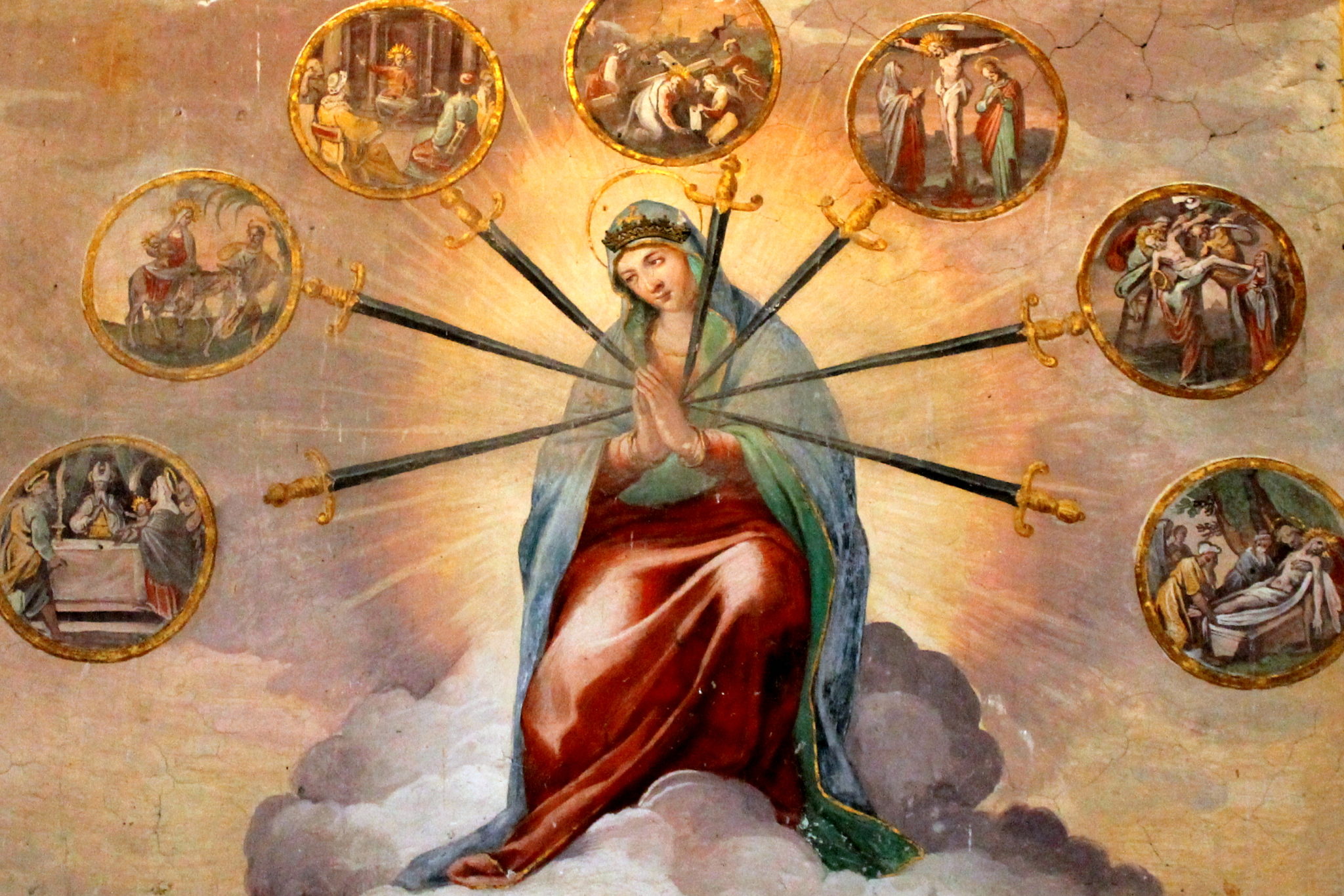 We are today one week from Good Friday. As such it is the feast of our lady of Sorrows.
I wrote seven posts on the Seven Sorrows of the Blessed Virgin. Please visit my “Our Lady of Sorrows Project” page: HERE
Today it is possible in the older form of the Roman Rite to celebrate Mass for the feast of Our Lady, counter intuitively with white vestments and even a Gloria.
Mary as Sorrowful mother is often depicted in art as being pierced through the heart with daggers or swords, (rhomphaia – a curved, long-handled Thracian blade) as an echo to the prophecy made by Simeon at the time of the presentation of the Lord in the temple. He foresaw that in the passion of the Lord, our lady would be so much in union with her divine son’s will, that she too would feel great anguish.
The Collect of the Our Lady of Sorrows
Orémus.
Deus, in cujus passióne, secúndum Simeónis prophétiam, dulcíssimam ánimam gloriósæ Vírginis et Matris Maríæ dolóris gladius pertransívit: concéde propítius; ut, qui transfixiónem ejus et passiónem venerándo recólimus, gloriósis méritis et précibus ómnium Sanctórum Cruci fidéliter astántium intercedéntibus, passiónis tuæ efféctum felícem consequámur:Let us pray.
O God, in Whose Passion the sword, according to the prophecy of blessed Simeon, pierced through the soul of Mary, the glorious Virgin and Mother, mercifully grant that we, who reverently commemorate her piercing through and her suffering, may, by the interceding glorious merits of all the saints faithfully standing by the Cross, obtain the abundant fruit of Your passion. Through Jesus Christ, thy Son our Lord, Who liveth and reigneth with thee, in the unity of the Holy Ghost, ever one God, world without end.R. Amen.
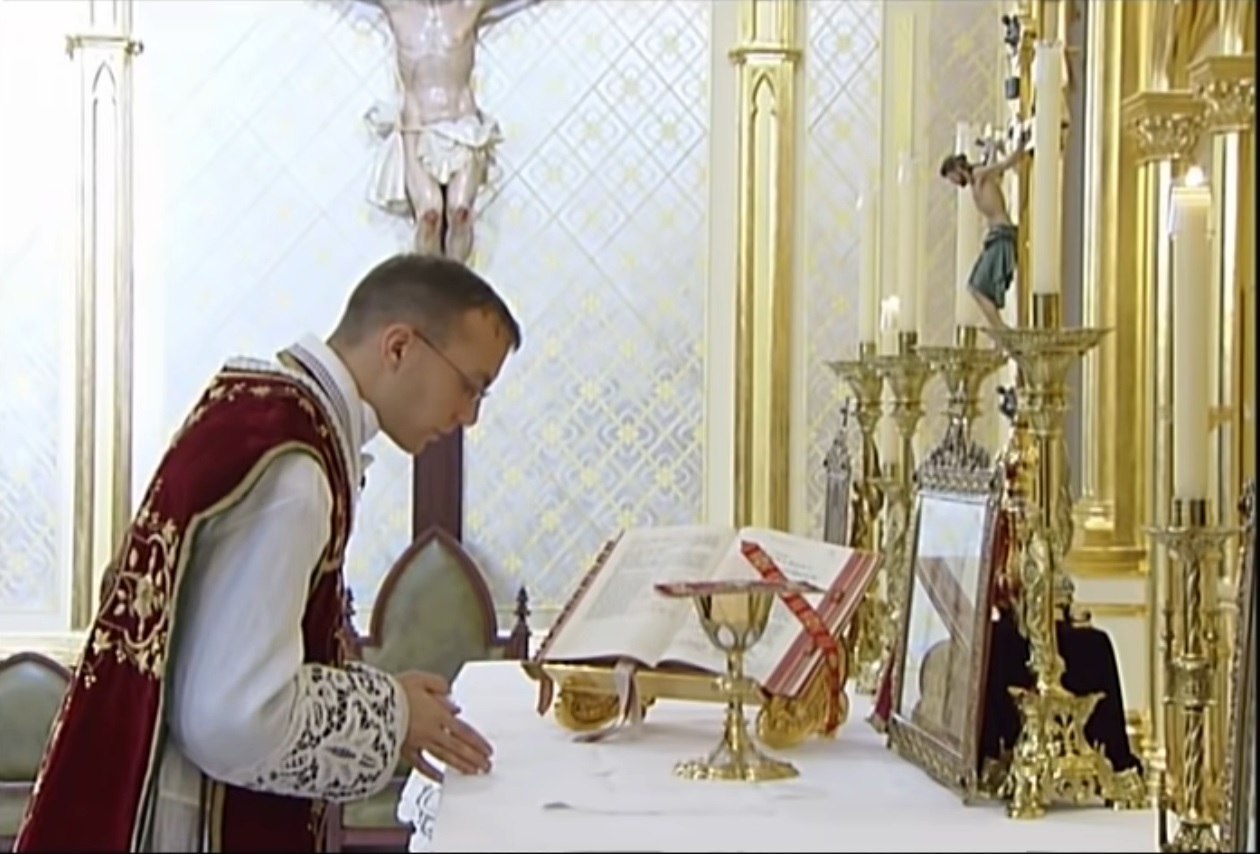 This is Thursday in Passion Week. Today in the Gospel a penitent woman washes Christ feet with her tears. One week from today is Holy Thursday when Christ washed the feet of his Apostles.
The first reading today is from Daniel (3:25, 34-45.). The people are penitent in the 70 year exile of Babylon.
This is the chapter about the fiery furnace and Shadrach, Meshach, and Abednego (the Babylonian names of Hananiah, Mishael, and Azariah). The Mass reading is the deuterocanonical Prayer of Azariah which is before the Canticle of the Three Children (recited for Lauds of Sundays and feasts).
One of the things that strikes you as a priest when reading this first lesson from Daniel 3 is the attitude of self-recognition as priest who is victim, sinful intercessor and the necessity of humble submission to God. The passage in Daniel 3 describes the humble, broken heart attitude of one who longs to fulfil the sacrifices prescribed by God, but who cannot; their Babylonian overlords are their jailers of tradition. Azariah, who would not worship the pagan idol, now in the midst of the flames of the furnace raises his broken heart to God for the sake of the entire people who have sinned.
There are familiar words in the passage…. familiar if you celebrate the Traditional Latin Mass.
In Daniel 3 today we read the phrase: “in ánimo contríto et spíritu humilitátis suscipiámur… and … “sic fiat sacrifícium nostrum in conspéctu tuo hódie, ut pláceat tibi…”.
During Mass, just before the priest invokes the Holy Spirit over the gifts on the altar, the bread and wine, he says:
“In spíritu humilitátis et in ánimo contríto suscipiámur a te, Dómine: et sic fiat sacrifícium nostrum in conspéctu tuo hódie, ut pláceat tibi, Dómine Deus.
Let us, in the spirit of humility and contrite heart, be taken up by You, O Lord, and thusly let it our sacrifice be made in Your sight today that it pleases You, O Lord God.
The early use of this prayer is attested in the Amiens Sacramentary (9th c.) which is a scion of the Gregorian Sacramentary (7th).
This prayer does remain in the Novus Ordo, and a shorter version of the Daniel 3 reading is on Tuesday of the 3rd Week of Lent, but unless the priest is saying the Novus Ordo and the readings in Latin, he isn’t going to make the connection with the offertory prayer.
Finally, the offertory prayers of the Novus Ordo are one of the most dramatic examples of how innovations were forced into the Novus Ordo. This, in spite of the fact that in Sacrosanctum Concilium the Council Fathers commanded nothing should be changed that was not a) organically a development from previous rites and b) truly for the good of the people.
An immense blow was delivered to priestly identity through the changes to the offertory.
Hence, great strengthening of priestly identity comes from priests learning the TLM.
That’s why certain people behave so cruelly towards the people who desire the TLM.
Meanwhile…
… be a Custos Traditionis.
From Fr. Gihr’s great commentary on the Mass about the offertory prayer of “self-offering of the Priest and Faithful”:
In order perfectly to appreciate the full sense of these words, and to recite them in the proper spirit, we should remember by whom and in what place they were spoken for the first time. They are taken from a longer, humble, penitential prayer, recited by the three young men in the Babylonian furnace. Since, faithful to God’s law, they would not adore the statue of the king, they were cast into a furnace heated seven-fold. Praising God, they walked about in the flames which did them not the least harm. And because they were prevented from offering exterior legal sacrifices, they offer themselves as a propitiatory sacrifice for their sins and for those of their people, in order to obtain mercy. “In a contrite heart and humble spirit let us be accepted (in animo contrito et spiritu humili tatis suscipiamur); so let our sacrifice be made in Thy sight this day, that it may please Thee (sic fiat sacrificium nostrum in conspectu tuo hodie, ut placeat tibi)” (Dan. 3, 39—40). In similar words, the celebrant here prays that the Lord would graciously receive him and the faithful people, for the sake of their humble, penitential sentiments, as a spiritual sacrifice; and if so accepted, then the Eucharistic Sacrifice, when offered by them, in the sight of God, with these dispositions will be such as God will behold and accept with pleasure from their hands.
The three young men were ready to offer their lives cheerfully in sacrifice to God by a bloody martyrdom; after their example we should present ourselves to God to suffer a life of perpetual sacrifice and an unbloody martyrdom. “As gold in the furnace He hath proved them and as a victim of a holocaust He hath received them” (Wis. 3, 6). Thus should we also, filled with humility and compunction, offer ourselves to God as a holocaust in the furnace of suffering and tribulation, of persecution and temptations. A sacrifice to God is an afflicted spirit; a contrite and humbled heart He does not despise (Ps. 50, 19). Yes, a heart penetrated with penitential love and sorrow, a mind bowed down with compunction will always be favorably received and accepted by the Lord. It is the best disposition that we should bring with us to the altar. When the Lord breathed forth His spirit amid the darkness that enshrouded Mount Calvary, many of the beholders were seized with such fear and sorrow, that they returned to their homes striking their breast (Luke 23, 48). Should not we also be penetrated with regret and contrition, with a penitential sorrow, as often as we celebrate in the Mass the remembrance of Christ’s bloody death? “During this holy function,” writes St. Gregory the Great,1 “we must offer ourselves with compunction of heart as a sacrifice ; for when we commemorate the mystery of the passion of our Iyord, we must imitate that which we celebrate. The Mass will be a sacrifice for us to God, when we have made an offering of ourselves. But we should, moreover, after retirement from prayer, endeavor as far as we are able with God’s assistance, to keep our mind in recollection and renewed strength, so that passing thoughts may not distract it, nor vain joy find its way into the heart, and that thus our soul may not, by carelessness and fickleness, again lose the spirit of compunction it has acquired.” Our entire life should be a cheerful, uninterrupted offertory. We should present ourselves in body and soul2 as a living sacrifice, holy, pleasing to God (Rom. 12, 1). “All the prayers and acts of divine worship, all the charitable and benevolent works, all the practices of mortification and penance, all the labor and fatigue, all the trials and sufferings of her militant children; all the pains and torments, all the patience and longing of her children suffering in the other world; all the virtues and merits, all the holiness and glory of her children already in heaven; the fruitful sweat of the Apostles, the vivifying blood of the martyrs, the devout tears of the anchorets, the chaste, loving sighs of the virgins, the great deeds and still greater fortitude of all the saints, — all these the Church places on her Divine Victim, all these she pours into the chalice of His holy sacrificial Blood” (Laurent).
The Holy Mass is the great heart of the whole body of the Church: whatever the Church, with her members, believes and hopes and loves and suffers and cares and prays for, all this she collects in Holy Mass into the common heart, and in and with the selfsame Sacrifice she carries it up to the throne of God. Whatever moves and affects the soul in joy and sorrow, in prosperity and adversity, in distress and death — we place upon the altar during the Holy Sacrifice of the Mass, we place it directly upon the Heart of our Redeemer who is present, and we are sure of consolation and relief. Yes, all the children of the Church should unite in the offering, all the faithful should be incorporated into and offered along with the one, great and eternal Sacrifice. To all the events in the life of her children the Church would, by this Sacrifice, impart consecration, and there by increase the happiness of her children, alleviate their distress, bless and sanctify their whole life and their death, so that at all times they may live unto the Lord and die in the Lord (Rom. 14, 8).1
 PLEASE use the sharing buttons! Thanks!
Registered here or not, will you in your charity please take a moment look at the requests and to pray for the people about whom you read?
Continued from THESE.
Let’s remember all who are ill, who will die soon, who have lost their jobs, and who are afraid.
I get many requests by email asking for prayers. Some are heart-achingly grave and urgent.
As long as my blog reaches so many readers in so many places, let’s give each other a hand. We should support each other in works of mercy.
If you have some prayer requests, feel free to post them below.
You have to be registered here to be able to post.
I ask a prayer for myself. I’m dealing with a lot of challenges right now.
Sometimes I receive items from my wishlist and there is no gift slip or indication who sent them. That has recently occurred, to my great frustration.
That said, thanks to the person recently sent a helpful powertool.
I did find the slip for the tomatoes and the jam. Thanks, GS! They are always appreciated. As a matter of fact, yesterday for lunch I had a PBJ and I used tomatoes in the evening for supper with guests from out of town.
His etiam scriptis, I saw that the ironing board that was on the list seems to be on its way. Thank you. I don’t know who you are… yet. But thanks in advance. The table wasn’t working for me any more. Also, I seriously hate ironing, and not having the proper gear for it makes it all that much more onerous.
While I may not enjoy the ironing board in the way that I will enjoy the tomatoes, I also solemnly promise not to do the following.
Did you know that there is something called extreme ironing? Yes… this is a thing. HERE

From a reader…
QUAERITUR:
Now that canon law allows for females to be instituted acolytes, is it possible, prudential, for a female to be a straw subdeacon in a solemn high mass?
Listen here wise guy. You are probably not a biologist… or maybe a biologian. So, you are unqualified to know what a woman is, much less a woman acolyte!
We are bound by the current – always changing – Code of Canon Law, but we are also bound by the grammar of the rubrics, which refer to the subdiaconus not the subdiacona much less a subdiaconx.
Straw subdeaconettes? No. As with deaconettes… a sin that would cry to Heaven.
From a reader….
QUAERITUR:
I generally fulfill my Sunday obligation by assisting at a Mass said at a nearby SSPX chapel. We have an opportunity to attend a family reunion in a few months. Given how far away we live and how scattered the family has become, and how old certain members have become, we are not confident that we will have another opportunity to see all of them again. Here is the catch: it is over a Sunday, and the nearest Mass (TLM or NO) is over four hours away.
SSPX priests have chapels, and not parishes because they lack the canonical jurisdiction to establish parishes within dioceses. Is a dispensation to miss Mass required under these circumstances? Can the pastor of my SSPX chapel grant it, or must I go to the nearest diocesan parish to ask permission not to go to Mass from a place I never go to Mass?
Firstly, we have to clarify a couple of things.
You are correct on the point that the SSPX isn’t a parish and the priest in charge at that chapel, whom I’m sure is a fine, diligent priest, is not a pastor (parochus… “the parish priest… pastor”). Hence, the SSPX priest there doesn’t have the ability to dispense. The ability to dispense requires jurisdiction. Sadly, the SSPX priests do not have jurisdiction… yet. We can pray, hope and work towards that day, but for now they don’t.
The dispensation would have to come from your territorial pastor (or if you are a true member of a personal parish, from that pastor). REMEMBER: Being REGISTERED at a some parish that is not your territorial pastor does NOT make you a member of that parish! Registration provides little more than names and addresses for them to send you envelopes or perhaps to provide some services for you. This is part of the reality of having wildly differing priests and parishes in a highly mobile society.
Contact your local, territorial parish priest, the pastor. If he gives you any grief, contact your diocesan vicar general and ask for the dispensation. Not all of them are jerks, and you will probably obtain what you need.


Coat of Arms by D Burkart
 Francisco12 on ROME 26/10– Day 14: Great scissors: “What a beautiful church! One doesn’t usually hear about the Barnabites much. I only found out about them a few…”
 on This is what I get when I procrastinate… UPDATED: “Apropos of nothing, when I hear “Gaylord” I always think of Gaylord Perry, Hall of Fame pitcher who pretty much…”
 on ROME 26/10– Day 12: “A church that cannot worship must be entertained, and …”: “This is the solution for the Oct 13 problem as comments seem to be turned off for that post. Black…”
 on From “The Private Diary of Bishop F. Atticus McButterpants” – 26-10-06 – Chester And Bp. Dozer: “Thanks, Father. I needed that.”
 on ROME 26/10– Day 12: “A church that cannot worship must be entertained, and …”: “Back in the day, corrupt Roman senators kept their power through “bread and circuses”; it seems that some in Church…” on ROME 26/10– Day 12: “A church that cannot worship must be entertained, and …”: “1. Re8+ Kh7 2. Ng3+ If 2. …. Kg7 3. Nh5# So 2. …. f6-f5 3. Bxf5+ Kg7 4. Nh5#”
 on ROME 26/10– Day 12: “A church that cannot worship must be entertained, and …”: “The chandelier and the wall of the Newburgh NY church look like they were stolen from Evil’s lair at the…” on ROME 26/10– Day 12: “A church that cannot worship must be entertained, and …”: “waalaw: Unless I’m missing something, after 4 R-g8+ black has Kf6.”
A Daily Prayer for Priests





They find you a pro-life agent in your area who commits to giving a portion of the fee to a pro-life group!

PLEASE subscribe via PayPal if it is useful. Zelle and Wise are better, but PayPal is convenient.
A monthly subscription donation means I have steady income I can plan on. I put you my list of benefactors for whom I pray and for whom I often say Holy Mass.
In view of the rapidly changing challenges I now face, I would like to add more $10/month subscribers. Will you please help?
For a one time donation...

Help Monks in Wyoming (coffee – UPDATED LINK) and Norcia (beer) and the wonderful "Soap Sisters" of Summit, NJ!
Please follow me on Twitter!






Visits tracked by Statcounter
since Sat., 25 Nov. 2006: