ASK FATHER: Near occasions of sin when dating

From a reader…

QUAERITUR:

Fr. Donald F. Miller C.S.R.R. wrote in the pamphlet “Questions Young People Ask About Marriage” among other things that dating with no intention of marriage in a reasonable time is a near occasion of sin [high risk of a loss of chastity in that situation]. Is this true? If it is, should kids stop dating in grade and high school? If it is, why have virtually no priests said a word about this, save Fr. Miller in this pamphlet from the ’50s?

GUEST PRIEST RESPONSE: Fr. Tim Ferguson

Fr. Donald Miller was a Redemptorist priest and author active in the middle part of the 20th century. He appears to have written a number of good books and pamphlets, particularly dealing with moral questions. I can’t say that I’ve read his works, or am familiar with them, but on the surface, things seem pretty solid. His books have nihil obstats and imprimaturs.

However, Fr. Miller is not the magisterium. It’s important to note that, when a censor gives a book a nihil obstat, he is merely saying that nothing in the book contradicts Church teaching. It is not necessarily an endorsement of the book or the ideas therein.

When Fr. Miller wrote his pamphlet on dating, in the 1950’s, the cultural scene was much different than it is today – mostly it was better, but there were some things that were worse. Fr. Miller may have had some solid arguments for stating that dating without an intention to marry is a near occasion of sin, because such relationships might lead to being in danger of unchaste activity. While putting oneself in a situation that is, for one, a near occasion of sin is a morally questionable act, there was not then, nor has there been since, any solid magisterial pronouncement on the propriety or not of dating.

Putting the question into the context of today’s situation, I think we have to clarify exactly what “dating” means today. Among young people, so I hear, there is great pressure at a very young age, to put oneself in unchaste situations. As tragic as sexual activity within the dating scene of the 1950’s was, things have gotten so bad in many places that there is very little “dating” – merely sex, or “hooking up” as the current phrase goes. Thanks for this goes to the sexual revolution, the omnipresence of contraception, and the Hollywood culture that regularly broadcasts sex without consequences. Our young people navigate a world fraught with great dangers.

In this situation, there are some bright spots. Many good, virtuous young people are standing up to the culture that tries to get them to believe that this most intimate physical activity of which we humans are capable is nothing more than some enjoyable sport. There are young people who “date” – who see each other socially, spend time together, go out to decent movies or engage in sporting activities together and strive to remain chaste and virtuous as they discern God’s will in their lives. I think, since there is not any clear magisterial teaching on the matter, we are called to use our judgment – in conversation with our pastors, our parents, and other wise people in our lives.

As long as one is mindful of avoiding near occasions of sin, I think that appropriate dating can be a good way for young people to learn social skills, to discern God’s will, and even grow in holiness. At the same time, I do think that dating someone whom one would never marry can be a dangerous thing. Especially with teens, parents absolutely have a say in whom their children can and cannot date. Dating someone who does not share our Catholic faith, someone who is not interested in living a life of holiness and chastity, someone who has a history of past bad behavior – all of these things should be carefully examined by the parents as well as the one interested in dating. A common interest in a certain kind of music, or an attractive physique, or a mutual hatred of the Chicago Bears might be an attractant, but do not provide a solid foundation for a a potential marriage.

Posted in "How To..." - Practical Notes, ASK FATHER Question Box, One Man & One Woman | Tagged
26 Comments

Benedict XVI SPEAKS: “With Cardinal Sarah, a master of silence and of interior prayer, the liturgy is in good hands.

In the spirit of GMTA… Great Minds Think Alike… I offer you the following.

Benedict XVI has written a brief essay as an afterword for a future re-printing of Robert Card. Sarah’s great book The Power of Silence: Against the Dictatorship of Noise.  US HERE – UK HERE

The essay is provided by First Things.

My emphases and comments:

Ever since I first read the Letters of Saint Ignatius of Antioch in the 1950s, one passage from his Letter to the Ephesians has particularly affected me: “It is better to keep silence and be [a Christian] than to talk and not to be. Teaching is an excellent thing, provided the speaker practices what he teaches. Now, there is one Teacher who spoke and it came to pass. And even what He did silently is worthy of the Father. He who has truly made the words of Jesus his own is able also to hear His silence, so that he may be perfect: so that he may act through his speech and be known through his silence” (15, 1f.). What does that mean: to hear Jesus’s silence and to know him through his silence? We know from the Gospels that Jesus frequently spent nights alone “on the mountain” in prayer, in conversation with his Father. We know that his speech, his word, comes from silence and could mature only there. So it stands to reason that his word can be correctly understood only if we, too, enter into his silence, if we learn to hear it from his silence.

Certainly, in order to interpret Jesus’s words, historical knowledge is necessary, which teaches us to understand the time and the language at that time. But that alone is not enough if we are really to comprehend the Lord’s message in depth. Anyone today who reads the ever-thicker commentaries on the Gospels remains disappointed in the end. He learns a lot that is useful about those days and a lot of hypotheses that ultimately contribute nothing at all to an understanding of the text. [For more on his thought see his introduction to his Jesus of Nazareth, Vol 1. US HERE – UK HERE] In the end you feel that in all the excess of words, something essential is lacking: entrance into Jesus’s silence, from which his word is born. If we cannot enter into this silence, we will always hear the word only on its surface and thus not really understand it.

As I was reading the new book by Robert Cardinal Sarah, all these thoughts went through my soul again. Sarah teaches us silence—being silent with Jesus, true inner stillness, and in just this way he helps us to grasp the word of the Lord anew. Of course he speaks hardly at all about himself, but now and then he does give us a glimpse into his interior life. In answer to Nicolas Diat’s question, “At times in your life have you thought that words were becoming too cumbersome, too heavy, too noisy?,” he answers: “In my prayer and in my interior life, I have always felt the need for a deeper, more complete silence. … The days of solitude, silence, and absolute fasting have been a great support. They have been an unprecedented grace, a slow purification, and a personal encounter with … God. … Days of solitude, silence, and fasting, nourished by the Word of God alone, allow man to base his life on what is essential.” These lines make visible the source from which the cardinal lives, which gives his word its inner depth. From this vantage point, he can then see the dangers that continually threaten the spiritual life, of priests and bishops also, and thus endanger the Church herself, too, in which it is not uncommon for the Word to be replaced by a verbosity that dilutes the greatness of the Word. I would like to quote just one sentence that can become an examination of conscience for every bishop: “It can happen that a good, pious priest, once he is raised to the episcopal dignity, quickly falls into mediocrity and a concern for worldly success. Overwhelmed by the weight of the duties that are incumbent on him, worried about his power, his authority, and the material needs of his office, he gradually runs out of steam.”  [What an awesome few dozen words for priests and bishops from none less than Benedict XVI quoting Card. Sarah!]

Cardinal Sarah is a spiritual teacher, who speaks out of the depths of silence with the Lord, out of his interior union with him, and thus really has something to say to each one of us. [!]

We should be grateful to Pope Francis for appointing such a spiritual teacher as head of the congregation that is responsible for the celebration of the liturgy in the Church. With the liturgy, too, as with the interpretation of Sacred Scripture, it is true that specialized knowledge is necessary. But it is also true of the liturgy that specialization ultimately can talk right past the essential thing unless it is grounded in a deep, interior union with the praying Church, which over and over again learns anew from the Lord himself what adoration is. With Cardinal Sarah, a master of silence and of interior prayer, the liturgy is in good hands.

Benedict XVI writes from Vatican City.

There is a great deal to say about this essay.

First, it is of great interest that Benedict XVI should write this and should speak so clearly about Card. Sarah’s role as Prefect of the Congregation for Divine Worship.  This is a manifest endorsement.

Moreover, Benedict stresses the role of silence, which strikes me also as a deft warning about those who… well… don’t.  That could include members of the Curia who are set against Card. Sarah and, indeed, are working to clear the Curia and other institutions of the influence of Pope Benedict.

We should pray for Benedict.  He gave the Church a tremendous gift with both Summorum Pontificum and with his long-time reflection on the benefits of ad orientem worship.  I am grateful that Benedict as remained engaged.

Our liturgical worship is our starting point and our goal.  No initiative which we enter into as a Church will succeed and bear fruit unless first we have a revitalization of our sacred liturgical worship.  Our Catholic identity depends on it.

How important is the role of silence in our revitalization?


Posted in Benedict XVI, Francis, Liturgy Science Theatre 3000, Patristiblogging | Tagged , ,
9 Comments

Marian Procession in Chicago

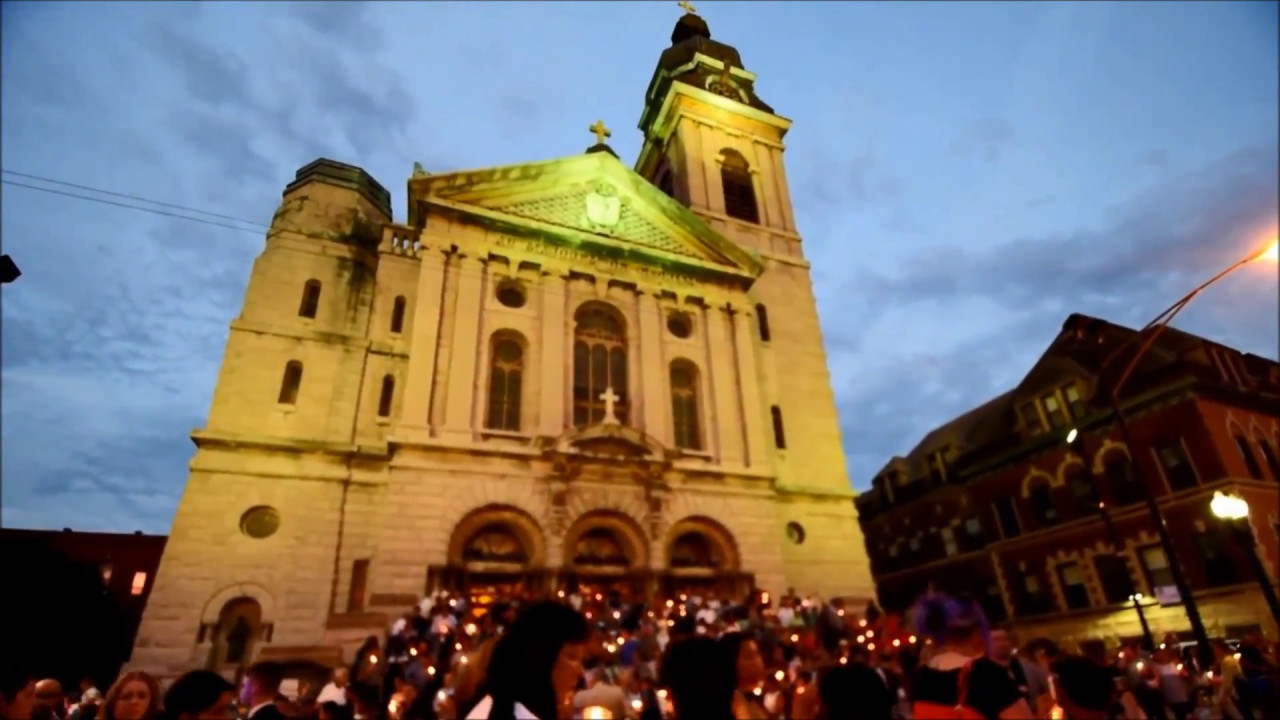
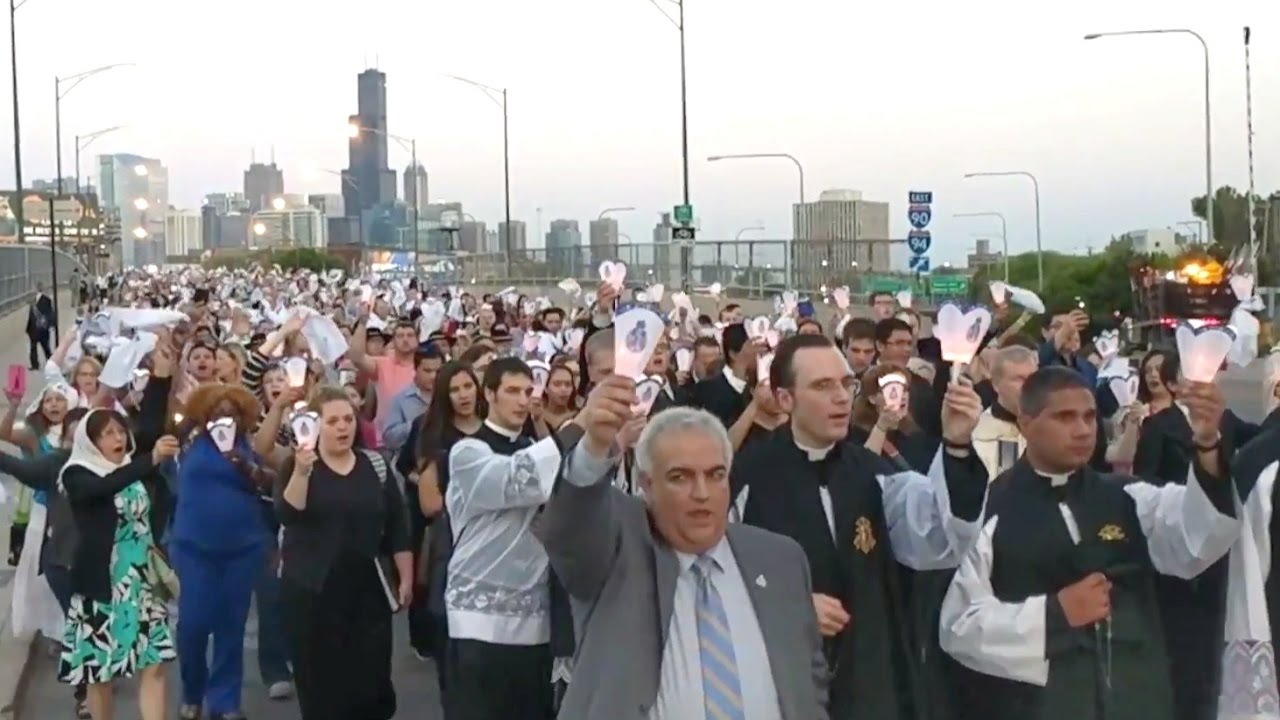
Our friends at St. John Cantius in Chicago had a wonderful opening to their observances of the 100th anniversary of the apparitions of Our Lady at Fatima.  Among the other festivities, they had a procession.

Here are a couple of videos.

YouTube thumbnailYouTube icon

YouTube thumbnailYouTube icon

Posted in Our Catholic Identity, Our Solitary Boast | Tagged , ,
2 Comments

European Parliament now has … *gasp*… a TLM!

I picked this up at Agenda Europe.

NEW: Traditional Latin Mass at the European Parliament

Thanks to the initiative of a Polish MEP, former Sejm Marshal Marek Jurek, there is now a Catholic Mass in the so-called “extraordinary rite” (i.e. the rite that was in common use prior to 1969, and which was defined as the universally valid rite of the Catholic Church by Pope Pius V following the Council of Trent) on the premises of the European Parliament in Brussels. A first such celebration took place on 4 May, and a second is scheduled this week on Thursday 18th May at 8 a.m. in the “meditation room” ASP 00H152 (located behind the desk of the Office of Tourism, on the ground floor).

This is truly important. The Christian faith is at the center of European culture and identity, [NB] and the traditional mass is the quintessential expression of Christian faith. [Hence, of Europe!] With these celebrations, if they assume a regular character, the European Parliament will at long last be re-establishing a linkage to Europe’s true fundaments.

We will not repeat these announcements here on a regular basis, but trust that interested readers will manage to inform themselves, including by directly making contact with the organizers.

Posted in Brick by Brick, Hard-Identity Catholicism, Just Too Cool | Tagged ,
4 Comments

More love from the Religion of Peace

16_05_13_OLFatima_200From Jihad Watch:

Mexico: Muslim stabs priest at the altar of Mexico City’s Metropolitan Cathedral

[…]

“A French Muslim stabs a priest in the cathedral of Mexico,” translated from “Un musulmán francés apuñala a un sacerdote en la catedral de México,” by Ana Fuentes, Actuall, May 16, 2017 (thanks to C.):

A priest who officiated at the Metropolitan Cathedral in Mexico City was stabbed last Monday at 6:00 pm by a middle-aged man who went up to the altar and stabbed a blade into his neck.

According to the archdiocese, the attacker, named John Rene Rockschiil, of Muslim faith according to the Mexican media, was arrested after carrying out the attack with a knife.

After calling the police, a Condor unit from the capital’s public security secretariat arrived in the vicinity of the cathedral, located in the historic city center, to transfer the clergyman to San Miguel Chapultepec hospital.

Some of the testimonies of the parishioners who were in the cathedral emphasize that some of those present detained the 35-year-old man, in addition to providing medical care to the parish priest Miguel Angel Machorro, until the aid services arrived.

This year is the 100th anniversary of the apparitions of Our Lady at Fatima.

Ven. Fulton Sheen once wrote:

“This brings us to our second point, namely, why the Blessed Mother, in this twentieth century, should have revealed herself in the insignificant little village of Fatima, so that to all future generations she would be known as ‘Our Lady of Fatima’. Since nothing ever happens out of heaven except with a finesse of all details, I believe that the Blessed Virgin chose to be known as ‘Our Lady of Fatima’ as a pledge and a sign of hope to the Moslem people, and as an assurance that they, who show her so much respect, will one day accept her Divine Son, too.

Evidence to support these views is found in the historical fact that the Moslems occupied Portugal for centuries. At the time when they were finally driven out, the last Moslem chief had a beautiful daughter by the name of Fatima. A Catholic boy fell in love with her, and for him she not only stayed behind when the Moslems left, but even embraced the faith. The young husband was so much in love with her that he changed the name of the town where he lived to Fatima. Thus, the very place where Our Lady appeared in 1917 bears a historical connection to Fatima, the daughter of Mohammed.”

Food for thought.

Sts. Nunilo and Alodia, pray for us.
St. Lawrence of Brindisi, pray for us.
St. Pius V, pray for us.
Martyrs of Otranto, pray for us.
St. Michael the Archangel, defend us in battle.
Our Lady of Fatima, pray for us.

Posted in The Coming Storm, The future and our choices, The Religion of Peace | Tagged , ,
10 Comments

A visit to a great parish

I was recently in Grand Rapids, MI at Sacred Heart parish. I observed there some impressive things which confirm other experiences I’ve had.

First, what they have done with the school – rather, Academy – there could be a model for pastors with struggling schools to think about. They developed a classical curriculum and a relationship with homeschoolers which has produced amazing results. I walked through the school yesterday with the pastor, Fr. Sirico, and we visited classrooms, including two rooms where Latin studies were underway. The kids seemed really to be into it, which was encouraging. They have daily Mass, often in Latin and ad orientem.  The growth of attendance over the last couple years is astonishing.  They have been adding a grade each year.  Next year they start an 11th grade.

The parish Masses are great. They have the TLM and a Novus Ordo with good music, chant, Latin. Confessions are heard during the 10 and 12:30 TLM. I heard confessions pretty much as quickly as I could during the 10AM Novus Ordo: they were well-prepared, which is a sign of consistently solid preaching and use of the confessional.

All, I have noticed a great growth in attendance at Masses. I’ve been visiting the place for several years now.

One thing that very much caught me attention, is the deepening of reverence at the time of Holy Communion. After hearing confessions, I helped with Communion at the Novus Ordo Mass. Even though they don’t yet have a Communion rail (I think there are plans to reinstall one) people knelt along the step to the sanctuary where the rail once was. Virtually everyone received on the tongue. This is a big change from the last time I was there. The pastor told me that they haven’t pushed this very hard. They made some adjustments to their liturgical worship and … it just happened.

This confirms what I have seem at the parish where I usually am on Sundays. All Masses are ad orientem. There is a “dialogue” between the NO and TLM. A Communion rail was installed. People just started using it. Now, virtually no one receives in the hand. The time of Communion at the NO has a sharply different atmosphere than it did a few years ago. Some of the change is due to music at the time Communion.

In any event, what I am driving at is that careful reintroduction of traditional practices can make a huge difference.

I have little doubt that the pastor, Fr. Sirico, would welcome a call and friendly chat about what he has been doing there.

¡Hagan lío!

Posted in ¡Hagan lío!, "How To..." - Practical Notes, Hard-Identity Catholicism, Liturgy Science Theatre 3000 |
10 Comments

Lightning … from above!

No, you are above the lightning for a change.

I found this at APOD.  Very cool.

YouTube thumbnailYouTube icon

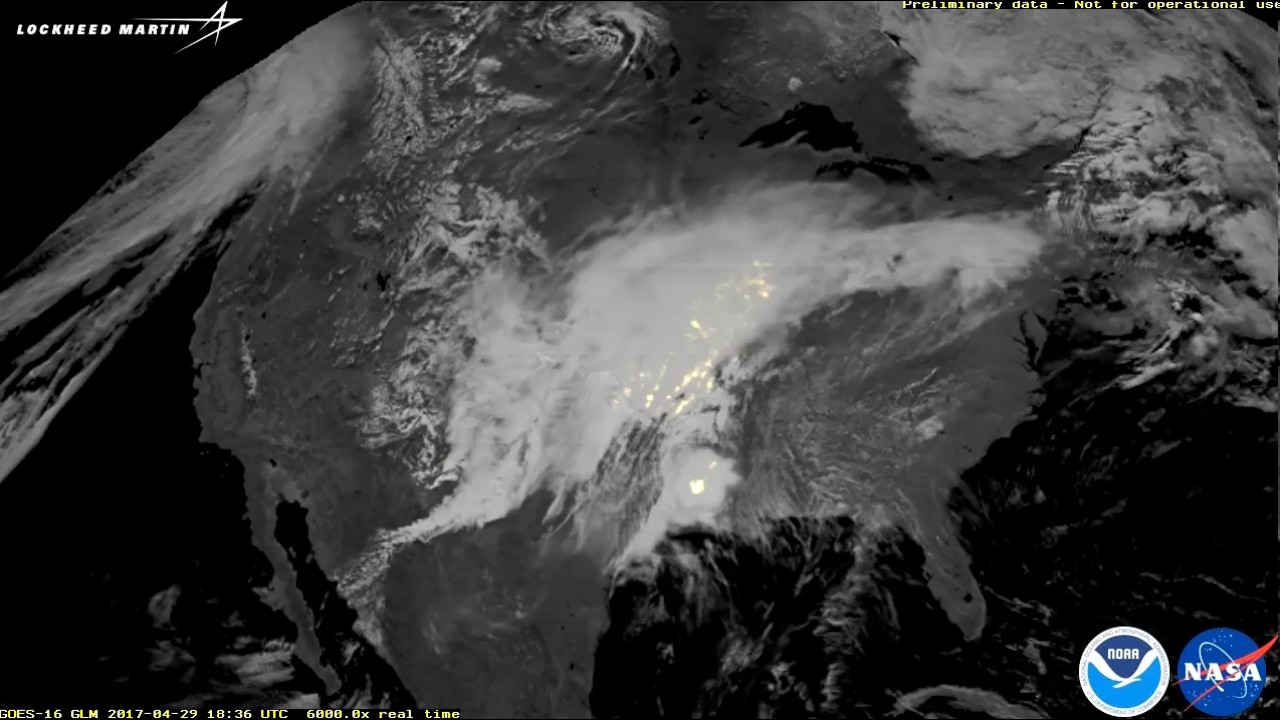
Explanation: Watch a huge lightning storm move across the eastern USA. The huge storm caused much damage and unfortunately some loss of life for people in its path. Seen from space, the lightning is seen as momentary flashes in the featured time-lapse video recorded last month by the Geostationary Lightning Mapper (GLM) aboard the GOES-16 satellite. The outline of North America is most evident during the day, while the bright lightning strikes are most evident at night. Inspection of the video shows that much of the lightning occurred at the leading edge of the huge tail of the swirling storm. Because lightning frequently precedes a storm’s most violent impact, lightning data from GLM holds promise to help reduce the harm to humans from future storms.

Posted in Just Too Cool, Look! Up in the sky! | Tagged , ,
2 Comments

An “imperialism of novelty”

Peter Kwasniewski at NLM has a thoughtful piece, with which I agree, about trend over time in the celebration of the Novus Ordo.  When there are options provided, there seems to be an expectation that the least traditional option will be chosen, with the result that tradition is opted out of sight and mind.  He called this this an “imperialism of novelty”.

It’s a manifestation of the hermeneutic of disrupture.  “Optionitis”… “Tinkeritis”….

Think about it…

  • The Roman Canon (Eucharistic Prayer I)
  • Black vestments
  • Gregorian chant
  • Latin
  • Pipe Organ
  • ad orientem worship

Summorum Pontificum is so important.

A sample:

I was once talking with a priest about the strange phenomenon of options in the new rite of Mass and the other sacraments. He made the observation that whenever there are multiple options, one of which is traditional and the others more recent inventions, there seems to be a subtle pressure to choose the more recent inventions, with the consequence that, as he put it, the traditional practice is “optioned out of existence.”

Now we know that this happens a great deal when it comes to anything that’s longer or more complex, or requires a special effort. For example, if the lectionary provides optional readings for a particular saint or category of saint, chances are they’ll be skipped, just because it’s so much easier to march through the daily cycle page by page rather than being bothered to look up the optional reading. An example of length would be the Confiteor: it takes a little longer to pray the Confiteor and the Kyrie than to use the pseudo-troped Kyrie. And so the Confiteor often falls by the wayside.

A dangerous tendency is at work here. Although theoretically many options are put at the celebrant’s disposal, in reality there is a certain pressure against choosing the traditional option precisely because it is traditional and a certain pressure in favor of choosing the modern option because it’s modern, because it can be done, because perhaps it’s more politically correct, or it’s more feminist, or whatever it might be. One is reminded here of the arrogant vanity of modern applied science, which seems to function by the technobarbaric principle of “If we can do, we should do it.” No matter the larger questions of right or wrong, the nuclear bombs must be built, the organs must be harvested, the test tube babies produced, the embryos frozen, the animals cloned, or whatever it might be.

An excellent example would be how the missal says that the priest can say “Pray, brethren.” Nobody ever says “Pray, brethren”; they always say “Pray, brothers and sisters” (or sometimes “Pray, sisters and brothers,” although that’s not an option given in the missal).

[…]
What we see in the world of the reformed liturgy, in short, is a continual drift towards a more and more meaningless, vestigial, paper-thin permission for traditional practices — as if the traditional practices were a rare and dangerous species of delicate flower that’s being pressured out of its ecosystem by an aggressive, invasive species of noxious weeds or foreign frogs.

As a name for the phenomenon, I suggest “the imperialism of novelty,” [a manifestation of the hermeneutic of disrupture] a kind of unseeing, undiscerning, indiscriminate favoritism or advancement of all that is new and recent and shiny, the latest model rolling off the production line. Tradition has no voice with which to defend itself; it has no armies, no force. [It has Summorum Pontificum.] It compels solely by its inner rationale, its beauty, its value as something passed down to us. But because modern people don’t care about what has been passed down to us, tradition’s voice is muted; the moral force that it should have is tempered, if not suppressed altogether. Modernity is fundamentally anti-traditional: recall Thomas Jefferson talking about how the enlightened governments of his day will at last throw off medieval priestcraft and monkery and superstition as we embark on a new Age of Reason, Novus Ordo Seclorum. The only positions that have any clout are those that are espoused by people today — not surprisingly, because the people today who espouse them are alive, with muscles and vocal chords, and they will do what they want to do because they are in charge and they’re alive right now.

[…]

Read the rest there.

Posted in "How To..." - Practical Notes, Hard-Identity Catholicism, Liturgy Science Theatre 3000, The future and our choices, Turn Towards The Lord |
26 Comments

IN THE WILD: on a muscle car

I enjoy getting “In The Wild” pics with Z-Swag.

Here’s a great one… from a reader… via Twitter…

Screen Shot 2017-05-15 at 15.26.56

I have car magnets to support our priests and bishops.

>>HERE<<

Check them out!

Example:

Posted in In The Wild | Tagged , ,
3 Comments

Glaswegians! ACTION ITEM!

Some time ago I asked the readership if anyone had ever seen a stained glass window of Moses at the cleft in the rock from Exodus 33.

Someone came through and I am deeply grateful!

From a reader…

I remember a while back you asked if anyone had seen a stained glass of Moses in the cleft of the rock. We’re visiting in Scotland and I saw this at the Cathedral of St. Mungo in Glasgow. Not the greatest quality, but the best I could do.

window Moses cleft Exodus

May I ask any Glaswegians out there to get a really good image?

Posted in ACTION ITEM!, Just Too Cool | Tagged , ,
3 Comments