Clever Clogs at Rorate

Rorate today has a rather unflattering piece about His Holiness of Our Lord, Pope Francis.  You might be saying, “In more news today, water is still wet!”

I point to today’s offering, however, not for the sake of its negative content about Francis, but because it has some really clever stuff in it, provided by Fr. Richard G. Cipolla (who has the courage to sign what he writes at Rorate).

This bit was particularly amusing.  Context, during the pontificates of John Paul II and Benedict XVI, the liberal aging-hippies went to ground.  With the election of Francis, they came out again (ehem… in more than one way).  Thus, Cipolla with my emphases:

And they all reappeared:  a little older, a little grayer, but just as filled with the bell-bottom trouser theology that confused God’s justice with human justice and that turned Jesus into a revolutionary fighter for the poor, the poor defined in their own terms.  They came back like the cast of “Hair” in a bad revival on Broadway and took out their 8 track tapes of “Jesus Christ Superstar” and started mooning over Mary Magdalene singing:    “I don’t know how to love him. What to do, how to move him. I’ve been changed, yes really. “

Dead on target.

Cipolla might have added that, under their bell-bottoms, they wear jackboots and under their Nehru jackets they have brown-shirts and cross-belts.

And there is this bit, too.   NB: There is something wrong with the text (it happens!), but the point is clear enough, with my emphases and comments:

Four Cardinals, now famously, asked the Pope for a clarification of points in chapter 8 that could be taken as denying the Church’s teaching on the Sacraments and the meaning of marriage.  The Pope has been silent doe months. . [sic – “for months” for sure] He refuses to answer and to clarify. And lately, using his sermons in Santa Marta like a Twitter account, he is taking the spotlight away from the marriage question by turning to another of his targets of reform: traditional Catholics. He fulminates in his daily homilies against traditional religious orders and labels them all as rigid and taking refuge in a false security, having all the answers.

First, Francis has refused to respond, and he does fulminate against rigid traditionalists, so Fr. Cipolla is not saying anything lacking in decorum or defective in respect toward the Roman Pontiff.  However, the gem there is the subtle comparison of Pope Francis’ daily fervorini with President Trump’s daily tweets.  Gotta love that.  Neither the fervorini or the presidential tweets are authoritative in any way, and yet they signal, hint, trigger and dog-whistle and give us endless grist for our mills (to mix metaphors brutally). Things are funny because they contain kernels of truth and, regardless of how one might see HH or POTUS, this is funny.

These are strange new times, with strange new methods of communication.  World leaders now bypass the MSM with their own social media strategies.

Finally, please follow me on Twitter!

o{];¬)

Posted in Lighter fare | Tagged
6 Comments

ASK FATHER: Mortar board (cap) etiquette during academic Mass

black-mortar-boardFrom a reader…

QUAERITUR:

What is the appropriate etiquette for those wearing academic dress during an OF Baccalaureate Mass? I understand that academic dress is not in any sense equivalent to the priestly garments, be it liturgical vestments or choir dress, despite academic dress deriving from the latter. I ask this because I will be reading the First Reading during this Mass. Perhaps I’m (stupidly) getting confused because academic dress is ceremonial in nature, but not liturgical in nature (unless of course, it is the academic dress of a cleric, which seems to be a long forgotten tradition since the 1970s).

Like I said, I feel like I may be blurring the lines here simply because academic dress derives from choir dress and there is such a thing as clerical choir dress that has elements of academic dress when necessary, but I am a layman. Should I assume the etiquette of any normal layman wearing a cap in church (thus taking it off when I enter) and should my female classmates leave their caps on? Do I leave it on when I read the First Reading, and should my female classmate who is reading the Second Reading leave hers on?

I haven’t given this much thought.  So…

… off the top of my head….

If the Blessed Sacrament is there, men should not wear caps.  However, if everyone else does, wear it.  Also, remove your cap to enter the sanctuary to read, genuflect, etc., and put it back on when you leave the sanctuary.   I think the females could leave their caps on.

Clerics should wear their house cassock, with a feraiuolo and academic biretta with proper color of trim.  I suppose they could substitute the academic hood.

Posted in Our Catholic Identity | Tagged
12 Comments

Fr. Z’s prayers for before and after making confessions

Pope Francis confession san Pietro 940A while back I posted prayers in Latin and English which a priest confessor might use before and after hearing sacramental confessions.  These prayers are from an old prayerbook for priests which I’ve had since before my ordination.  They are dense with old wisdom.

Here are two more prayers, in Latin and English, again for priests, and again for before and after confession.  This time, however, the prayers are for before and after the priest’s own confession.

In this time before Holy Week begins, I suspect many priests will head off to make their own confessions.  I hope these prayers could be of use.

I’ve added accent marks.  In the translations I used an archaic style.  The content might seem a little flowery in our age of tweets and dumbed-down prose, but… there’s nothing wrong with that!  There are a couple tricky bits in the Latin, but I believe I’ve found the right solutions.

ORATIO ANTE CONFESSIONEM SACRAMENTALEM

Súscipe Confessiónem meam, piísime ac clementíssime Dómine Iesu Christe, única spes salútis ánimae méae, et da mihi, óbsecro, contritiónem cordis, et lácrimas óculis meis, ut dé?eam diébus ac nóctibus omnes neglegéntias meas cum humilitáte et puritáte cordis.  Dómine, Deus meus, súscipe preces meas.  Salvátor mundi, Iesu bone, qui te crucis morti dedísti, ut peccatóres salvos fáceres, réspice me míserum peccatórem invocántem nomen tuum, et noli sic atténdere malum meum, ut obliviscáris bonum tuum; et si commísi unde me damnáre potes, tu non amisísti, unde salváre soles.  Parce ergo mihi, qui es Salvátor meus, et miserére peccatríci ánimae meae.  Solve víncula eius, sana vúlnera.  Emítte ígitur, piíssime Dómine, méritis puríssimae et immaculátae semper Víriginis Genitrícis tuae Maríae, et Sánctorum tuórum, lucem tuam, veritátem tuam in ánimam meam, quae omnes deféctus meos opórtet, atque iuvet et dóceat ipsos plene et contríto corde explicáre. Qui vivis et regnas Deus per ómnia saécula saeculórum.  Amen.

Accept my confession, O most merciful and most gentle Lord Jesus Christ, sole hope of the salvation of my soul, and grant to me, Thy priest, I beg, contrition of heart and tears for my eyes, that day and night I might beweep all my failures with humility and purity of heart.  O Lord, my God, accept my prayers.  Savior of the world, good Jesus, who gave Thyself to the death of the Cross so that Thou mightst make sinners to be saved, look upon me, a miserable sinner invoking Thy Name, and heed not my evil in such a way that Thou shouldst forget Thy goodness. And if I have committed that by which Thou canst condemn me, Thou hast not lost that by which Thou art accustomed to save me.  Spare me, therefore, Thou who art my Savior, and be merciful to my sinful soul.  Free its bonds, heal its wounds.  Hence, most merciful Lord, by the merits of Thy Mother, the most pure and immaculate ever-Virgin Mary, whom Thou didst entrust as a Mother especially to priests, and by the merits of Thy Saints, into my soul send forth Thy light, Thy truth which all my defects require, and assist and teach me to unfold them fully and with a contrite heart. Who livest and reignest, God, forever and ever. Amen.

ORATIO POST CONFESSIONEM

Sit tibi, Dómine, óbsecro, méritis beatae semper Vírginis Genetrícis tuae Maríae et ómnium Sanctórum, grata et accépta ista conféssio mea, et quidquid mihi défuit nunc, et de suf?ciéntia contritiónis, de puritáte et integritáte confessiónis, súppleat píetas et misericórdia tua et secúndum illam dignéris me habére plénius et perféctius absolútum in caelo. Qui vivis et regnas cum Deo Patre in unitáte Spíritus Sancti, Deus, per ómnia saécula saeculórum. Amen.

O Lord, I beseech Thee, by the merits of Thy Mother, the ever-Virgin Mary, and of all the saints, let this my confession to have been pleasing and acceptable to Thee, and whatsoever was now lacking in me and in the sufficiency of my contrition, and in the purity and completeness of my confession, may Thy mercy and compassion make whole and, thereafter, deign to hold me fully and perfectly absolved in Heaven.  Who livest and reignest with God the Father in the unity of the Holy Spirit, forever and ever.  Amen.

This post is intended for bishops and priests and perhaps seminarians.  I have the moderation queue ON for them.

Posted in "How To..." - Practical Notes, GO TO CONFESSION, Hard-Identity Catholicism, Liturgy Science Theatre 3000, Mail from priests, Priests and Priesthood, Seminarians and Seminaries | Tagged ,
1 Comment

AUDIO and VIDEO: @ArchbishpSample – outstanding address in Germany

Archbp_Alexander_K_Sample_sm¡Hagan lío!

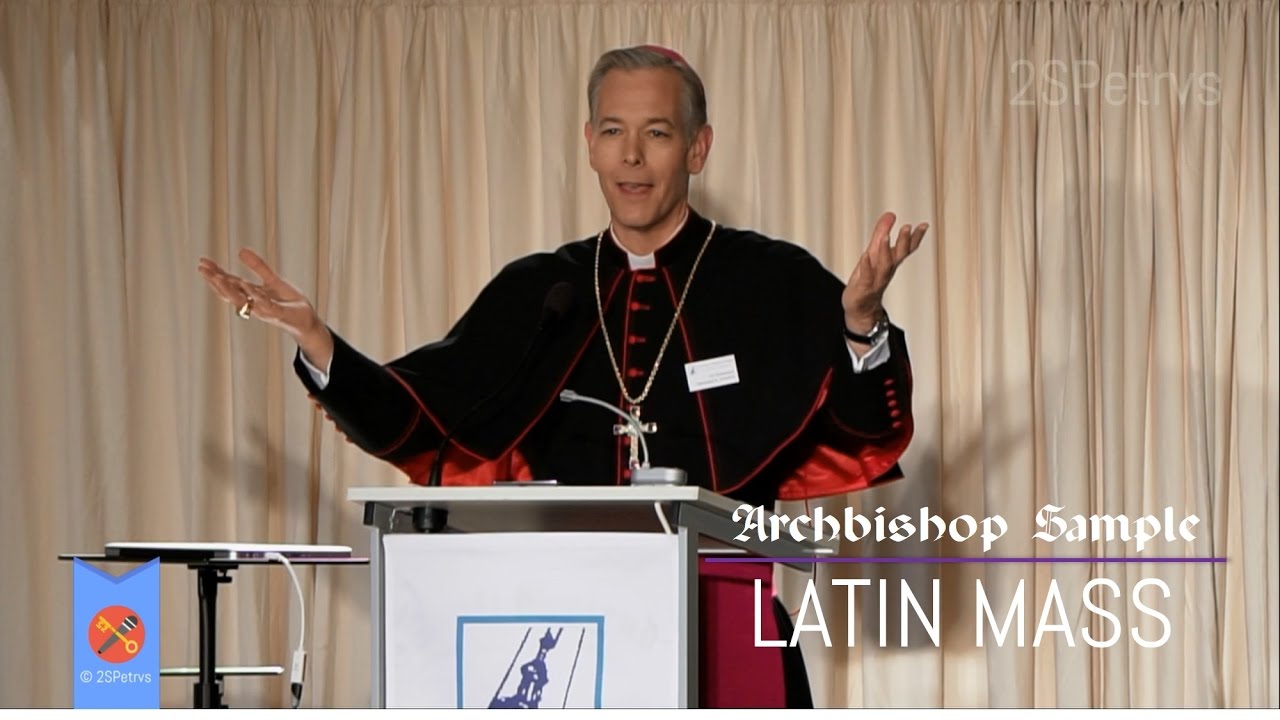
His Excellency Most Reverend (and I sincerely mean both of those honorifics), Alexander K. Sample, Archbishop of Portland, gave an outstanding address to liturgy conference in Germany.

He includes some personal reflections and analysis of the situation we are in, and where we need to go.  It is very good.  He received applause many times.

Archbp. Sample relates a moment during an ad limina visit with Benedict XVI.

He touches on ad orientem worship, the destruction of churches, the elimination of Latin and Gregorian chant.  What the Council Fathers wanted is not what we got.

I’ve know the Archbishop since the mid 80’s.  Both he and I were deeply influenced by the late Msgr. Richard Schuler.

This is the New Evangelization.

In his address, Archbishop Sample speaks ve-ry de-lib-er-ate-ly since he is speaking from a text which sounds, given the audio, as if it was being simultaneously translated.  So, I will provide the video from YouTube as well as the audio accelerated 2x to make it a little shorter and easier for English speakers to listen to.

Make sure to visit the site of 2SPetrus which made the video.

YouTube thumbnailYouTube icon

The faster audio, 2x – twice as fast – as the video.  Remember, the Archbishop was speaking deliberately slowly to the audience in Germany.

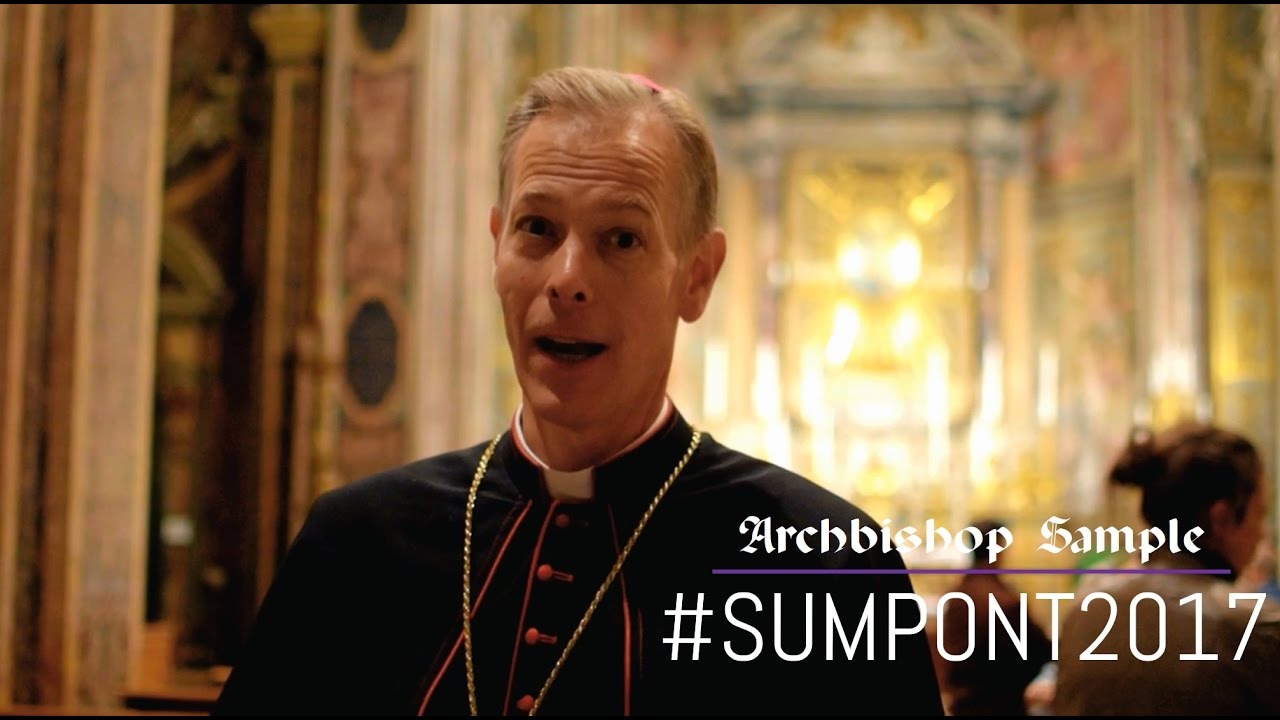
Here’s a shot of Archbp. Sample celebrating Holy Mass in the Basilica of St. Peter last fall for the Summorum Pontificum Pilgrimage.  Your’s truly is the deacon to the right.

Archbp Sample Zuhsdorf Summorum Pontificum

Make sure you listen to Card. Sarah’s address HERE.

UPDATE:

I believe this is the video to which Archbp. Sample refers in his talk.

YouTube thumbnailYouTube icon

The video that first opened my eyes to the Traditional Roman Rite was also on VHS (back in the day before the internet… hard to imagine):

YouTube thumbnailYouTube icon

And here is another 2SPetrus short video of events during the 2016 Summorum Pontificum pilgrimage:

YouTube thumbnailYouTube icon

Posted in ¡Hagan lío!, "How To..." - Practical Notes, Benedict XVI, Hard-Identity Catholicism, Liturgy Science Theatre 3000, New Evangelization | Tagged ,
12 Comments

Scientific connection between the Shrouds of Turin and Oviedo?

Shrouds Turin OviedoHere is something of great interest, especially as Passiontide begins.

Via Pewsitter I read that it has been determined that the Shroud of Turin and the Shroud of Oviedo were likely wrapped around the same person.   BTW… did you know that there is such a thing as the Shroud of Oviedo?

(MURCIA, Spain) – A new scientific study conducted by researchers at the Catholic University of Murcia in Spain has confirmed [sort of… maybe] that the Shroud of Turin and the Shroud of Oviedo [the sudarium or cloth around the head] were wrapped around the same person, following up on previously unpublished medical and forensic research. Furthermore, the study has identified [on, I think, the Turin Shroud] a spear wound made in the corpse, which according to the study’s authors “agrees with what is reflected in the Gospel of Saint John.”

The study, led by forensic medical researcher Dr. Alfonso Sánchez Hermosilla, took up the lead of previous research from the same university which had identified a pollen grain on the Oviedo Shroud. This grain, upon examination, was confirmed to belong to the plant Helichrysum Sp., material from which had previously been discovered on the Shroud of Turin. While developing this line of investigation, the research team made an exciting new discovery: the existence of a previously unknown spear incision. [On the Shroud of Turin.]

“The bloodstains … have always been there, but no one had studied them,” said Sánchez Hermosilla. “Previously they had been attributed to marks caused by flogging wounds.” The wound was determined to have been made after death, while the corpse was in a standing position, passing between two ribs near the spine in an upwards direction. The forensic team were further able to declare that the wound had been made by “someone with experience,” because the blade had not scored the rib bones in its passing. A Roman soldier tasked to execution detail would plausibly have had this skill.

Very interesting stuff, this.

Pewsitter links to their original source.   ACI Prensa is HERE

FWIW – I earnestly implore Pewsitter to STOP linking to a google translated page.  Grrrr.  Annoying.

Posted in Just Too Cool | Tagged , ,
14 Comments

ASK FATHER: Family member baptized children without parents knowledge

12_11_23_sac-baptism-headFrom a reader…

QUAERITUR:

I recently learned that one of my family members took the initiative to illicitly baptize two “infants” (one under the age of one and the other almost 4 years old) herself because my brother refused to have his children baptized (his wife is not baptized and they are not validly married according to Canon Law).

Now what? Telling my brother and his wife would do more harm than good right now [Maybe not!] (he lets my mom take them to church on Sunday, and the oldest attends a Catholic pre-school, and my mom teaches him his prayers when she baby-sits for them, which would all likely stop if he found out about this), but eventually someone will have to let the cat out of the bag. [Yes.]

I’m assuming the parish my mom attends needs to know and make a record of it, but should the rest of the Rite be finished? Am I morally obligated to inform the parish if she doesn’t do it?

I’ve been praying and having Masses offered for them to be baptized, but this is not what I had in mind.

GUEST “FATHER” RESPONSE (slightly edited):

The questioner did not perform the baptisms, so she does not have direct knowledge of the validity of the administration of baptism.

Given that, it would be the decision of the person who did the baptisms to tell the parents that he or she administered the baptism validly.  Before doing so, it might be a good idea to talk this out with the local priest.  It’s hard to now in this too brief email/blog format what the situation is on the ground.

That said, should such information be communicated?

I would say yes, but the father should be strongly encouraged to have the children conditionally baptized at the local parish to insure the validity and to insure that the baptism is registered in the parish records.

The moderation queue is ON.

Posted in "How To..." - Practical Notes, ASK FATHER Question Box, Liturgy Science Theatre 3000, Mail from priests | Tagged ,
12 Comments

Bad news on the “deaconette” front!

fishwrapThis day it seems that the news goes from bad to worse.  You can see what results from the ambiguities of Amoris laetitia.

You have heard, I’m sure, about the quixotic attempts to pry open Holy Orders for women (an impossibility… or is it?) through their admission to ordination to the diaconate.

Unfortunately, I picked this up from that purveyor of bad news, the National Schismatic Reporter (aka Fishwrap), which soon will be scheduling conga line dances in dissident parishes near and far.

Keep in mind, friends, before you slit your wrists, that this is based on rumor.  I want to see the Pope’s decree in black on white.  Meanwhile, because I am trying… trying… to be fair and obedient… I am going to work with this.  My emphases and comments.

Francis decrees: Women to be ordained deacons in the “internal forum”

VATICAN CITY — It has been reported that the special Commission established by Pope Francis to study the question of the ordination of female deacons met last month. A well-placed source disclosed that the Commission, which meets under the aegis of the Congregation for the Doctrine of the Faith, made sufficient progress in March to be able to submit a recommendation to the Holy Father. [It boggles the imagination that they could get any work done this quickly, but… hey!  Stranger things have happened.  Maybe someone came up with a key insight or piece of information.]

According to a report in the Münchener Beobachter, a member of the special papal study group, Petra Henkys-Asmussen, professor of historicity and theology at the University of Immenstedt, revealed [Of course the Commission’s members aren’t supposed to be talking to the press… but I digress…] that the Commission had recommended that women could indeed be ordained deaconesses. [Please, O Lord, return NOW!]

This positive response from the Commission was then studied by the theological experts of the Congregation who, in turn, made their recommendation to the Holy Father for his final judgment.

Pope Francis, it is reported, accepted the Commission’s recommendation, apparently in contradiction to the Congregation’s determination. [I can believe that.  Card. Müller must be going crazy.]

However, the Holy Father determined that, while the ordination of women to the diaconate could, in fact, go forward, it would at first be conferred in the “internal forum”.  [Behold, the fruits of Amoris laetitia!  But… why not?  If penitents who are not really penitents can, according to their own consciences, be admitted to the sacraments of Penance and to the Eucharist, then why not ordination?  More and more people claim that conscience is supreme.]

The Pope sidesteps the question of the ordination of a woman by suggesting that, [NB] if the woman herself, in prayer with Jesus, concluded that she could be ordained, then she can be ordained. This is because conscience is supreme, [SEE?!?] and the Magisterium has not infallibly closed the issue of ordination of women to the diaconate. Bishops, however, [This is where it gets worse… oh yes, they can always hurt us more…] would not be free in the matter.

It is probable, Henkys-Asmussen related, that if women are convinced that they are called to the diaconate, then bishops and priests must abide by their decision or be suspended a divinis, that is, from exercising their ministry.  [Okay, that’s it.  I’m not waiting anymore.  I now declare  that, in my conscience, I am officially an ‘internal forum’ Monsignor.  I’m getting my new gear the next time I am at Gammarelli.]

It is expected that a decree to this effect will be forthcoming once the Congregations for Clergy, Divine Worship and the Doctrine of the Faith have completed the necessary liturgical texts. [Imagine that nightmare.]

Prof. Henkys-Asmussen affirmed that, while this was certainly going to go forward, she expected that the inter-dicasterial preparations between the Congregations might proceed very slowly. [We can only hope.]

“There are many people, mainly men,” she said, “clerics of the Roman Curia of course, who are set firmly against this determination of the Pope to bring the church forward into the light of equality of all genders.” She continued, “It is good news, but they will try to block it.”

When asked about the very unique method of “internal forum” ordination, Henkys-Asmussen declared, “But naturally, this is a compromise path to avoid what some will see as a shock and even ‘scandal’, as they would put it.  But it is a logical bridge from the Pope’s revolutionary post-synodal apostolic exhortation Amoris Laetitia.

Fr Tullio Tomassini, SJ, an instructor of biblical exegesis at the Pontifical Gregorian University and an expert of the Pontifical Theological Commission, which did work on the topic of deacons in 2002, reacted to the news.

“The phrase in the New Testament, ‘Many are called, but few are chosen’, must be reinterpreted in light of history and through the signs of the times.  We, having greater insight now, sense the Christ’s meaning to really have been – if you’ll excuse levity in such a serious matter – ‘many are called, few are chosen, but some push their way in!'”  [Card. Kasper would be proud.]

Tomassini, continued, “When we inter-text that Matthean passage with ‘Go out into the highways and byways and force them to come in’ of Luke 14 we must conclude that the Holy Father discerned the right choice.”

When pressed on the possibility of opening up the ordination of  women to the priesthood as the next step, Tomassini was dismissive.

“In truth”, he said, “the next logical step must be the ordination of the trans-gendered. Now that the Church has made this definitive determination about deaconesses, [HA!] we look more closely at the figure of Phoebe in Romans 16:1. Given the needs of our age, we must ask if the Phoebe of the Bible was really a woman? Or was Phoebe, in fact, a man? What was Phoebe? This is not clear. This biblical ambiguity reminds us that gender itself is not a fixed reality.”  [What did you expect.  He’s a Jesuit biblical scholar, right?]

A well-placed Vatican source, who requested anonymity, reacted to the news saying, “This is obviously what these days in the media is being called ‘fake news'”. He continued, “[A decision] can’t possibly have happened this quickly. But, on the other hand, these days, who can say? What’s the phrase? ‘Who am I to judge’?[The phrase that keeps on giving.]

Cardinal Ludwig Gerhard Müller, Prefect of the Doctrine Congregation, and Greg Burke, the papal spokesman, were unavailable for comment.

The moderation queue is definitely ON.

Due to the highly flammable and dire nature of this story, at first I will let lots of comments stack up in the queue.  In that way I can trim the extreme stuff and keep people from hacking each other to bits.

I’m sure more details about this dreadful turn of events will hit the interwebs soon in force.  In the meantime, pray, keep your head in Lent and…

GO TO CONFESSION!

UPDATE:

For the sake of clarity, one of you readers asked via email:

Fr. Zuhlsdorf,

Could you explain in your post what NB means?

Yes, this is an abbreviation for the Latin phrase “Nota bene“, often also written “N.B.”, which means, “note, heed well”, or else, “pay close attention to what follows”.  It’s pretty standard now in writing in English.  However, this is not one of those medieval abbreviations that everyone who studies paleography has to learn.  It’s more like i.e. for id est, “that is to say”, or e.g. for exempli gratia, “for the sake of an example”), PS or P.S. for “post scriptum”, “after having written… added after having written what is above”, …. etc.

That leads me to digress on et cetera… but it’s a welcome digression, a good distraction from the nasty news above.  Et cetera is, was, sometimes rendered &c.  That & is called an “ampersand”.  It is, in fact, one of those medieval abbreviations, or ligatures (more than one letter or symbol bound together from Latin ligare). As a matter of fact, the symbol goes all the way back to ancient Rome.  The & is a combination, or ligature, of the letters of Latin et, e-t.  It was once, in English anyway, memorized with the entire alphabet, following z.  When the alphabet was recited, upon reaching the “and” symbol, you would say instead, “and, per se, and”.   Per se … i.e…. “by itself”.  And with that, I’ll leave the cetera for another time.

Posted in Deaconettes, Liberals, Lighter fare | Tagged ,
175 Comments

PODCAzT 153: Card. Sarah’s 2017 ‘Summorum Pontificum’ Address – URGENT

17_03_31_CWR_SarahHis Eminence Robert Card. Sarah, Prefect of the CDW, gave an fantastic talk in Germany on the occasion of a colloquium held for the 10th Anniversary of Summorum Pontificum, Benedict’s XVI’s “emancipation proclamation” for the older, traditional form of the Roman Rite.

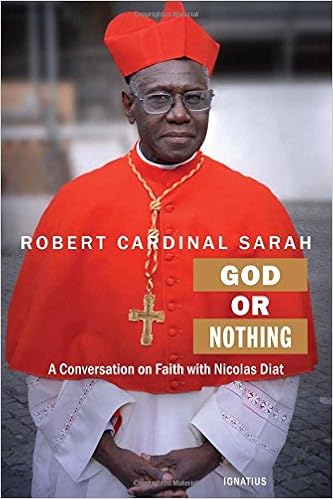
You can find the exclusive English translation at Catholic World Report.   I warmly urge you to check it out.

This talk by Card. Sarah will be precious tool for renewal of our Catholic identity.

I recommend that you give a copy to every priest you know and that you send one to your bishop and the director of liturgy for your dioceses, with and cheerful note of encouragement, of course.

I was going to post excerpts, but I found myself wanting to post the whole thing.  That wouldn’t do.  Therefore, I contacted CWR and they gave me leave to record it for a podcast.

Check out Card. Sarah’s book, now in English,  The Power of Silence: Against the Dictatorship of Noise.

US HERE – UK HERE

And don’t forget also…

US HERE – UK HERE

Posted in ¡Hagan lío!, Hard-Identity Catholicism, Liturgy Science Theatre 3000, Our Catholic Identity, PODCAzT, SUMMORUM PONTIFICUM | Tagged , ,
17 Comments

ASK FATHER: Dispensation or commutation of Mass obligation, penance

ask_father_q_box_title_smFrom a reader…

QUAERITUR:

Can a bishop give the priests under his authority the faculty to dispense or commute a Mass obligation in the confessional? If I was unable to contact my pastor or out of town would I be able to ask for a dispensation or commutation during my confession?

Canon 1245 gives to pastors the right to dispense or commute the obligation of observing Sunday, a Holy Day of obligation, or a day of penance.

Canon 136 clarifies that the exercise of executive power (that’s  what a dispensation is) is valid over one’s subjects. even when they are outside of one’s territory, as well as over travelers who are present in one’s territory.

Many bishops grant this dispensing power to all priests, not just to pastors of parishes.

Hence, if you are looking for a dispensation or commutation, you generally need not look too far.

If you are outside of your parish, or not able to contact your parish priest for whatever reason, you might inquire of another priest.  Ask if he has the faculty to dispense or commute.  Otherwise, you can call the local chancery office and speak to the vicar general (who would have power to dispense), the chancellor (who would either have it or would know who does), or someone in the tribunal (who would usually know who has dispensing power).

This dispensation need not be done in the confessional.  As a matter of fact, dispensations aren’t strictly a matter for the confessional, which is the tribunal of mercy for sin, not for transacting other business like getting dispensations, seeking advice on local restaurants, obtaining sports updates, or engaging in social media commentary such as your thoughts about this blog.

Everyone: When you are in the confessional, stick to making a confession of your own sins. Be brief.

I hope this helps.

Posted in "How To..." - Practical Notes, ASK FATHER Question Box, Canon Law | Tagged , ,
12 Comments

Concerning Jesuit brains

UPDATE 1 April:

I’ve been thinking about this story in light of some current trends in the MSM (mainstream media).

What if….

What if zombies were to eat Jesuit brains?  Would they, too, have significant positive changes?  I can’t imagine that.  Can anything positive come from eating Jesuit brains?  However, once some Jesuits had had their brains eaten, they too would become zombies!  But, and here’s the rub, they wouldn’t have their positive Ignatian retreat brains anymore!   Right?  So, I suppose if they were merely bitten by zombies, and they retained their brains, then they might be happier zombies and wouldn’t need to lurch around looking for intracranial repasts.  They would probably just continue to teach in their schools, write in their publications and, in effect, carry on as before.

____ Originally Published on: Mar 31, 2017

My first reaction after my first glance would be, “That explains a lot.”

Some wag might rewrite this, taking a cue from just the headline.

17_03_31_CH_screenshot_03

I’ll tell you what changes my brain: Mystic Monk Coffee in my Clement XIV Papa Ganganelli mug!

Clement_XVI_Mug_01 Clement_XVI_Mug_02

For all the selections click

>HERE<<

Mystic Monk Coffee!  It’s swell!

Did I mention that Pope Clement suppressed the Jesuits?

Oh, yes… the story is in this week’s print edition of The Catholic Herald, the UK’s best Catholic weekly.

Meanwhile, don’t miss Sandro Magister’s piece today about the theological memorandum sent to the Holy Father about the antics of the present General of the aforementioned Jesuits. HERE  The General, Arturo Sosa Abascal, SJ, uttered some incredible comments a while back which, if taken on face value, gut Christianity of an essential characteristic: Christ.


Posted in ¡Hagan lío!, Lighter fare | Tagged ,
17 Comments