ASK FATHER: How to pray the “Cursing Psalms” against our enemies?

From a reader…

QUAERITUR:

Can you once again address the maledictory Psalms and how to use them? I think you last did so over 3 years ago. Thank you!

Wow.  Another third rail question today.

This is what I wrote three years ago in post #87060.


How to pray the “Cursing Psalms” against our enemies

field daySaturdays are my field days.  I field strip my computers (scan, defrag, update etc.), police the Cupboard Under The Stairs, do laundry, try to fill up a garbage bag or two (that’s satisfaction), police both the fridge (especially on a wake-up) and my conscience.  Well, that last one I do everyday.  Which it ain’t easy in these days of political electioneering and ecclesiastical goat rodeos on nearly every front.

This morning a couple friends with whom I have an instant message group going – often hilarious – mentioned the “maledictory psalms”, also known as the “cursing psalms” and “imprecatory psalms”. They call for judgment and disaster to fall upon the enemies of God and God’s people.

Since I’ve been using the Bux Protocol™ a lot these days, the reference to the maledictory psalms got me thinking about posting on this difficult topic: how to pray for enemies.

Christ the Lord commanded us to love our enemies (Matthew 5:44).  And yet a couple dozen or so psalms – which all Christians can use for prayer – seem to wish some pretty dire things on our enemies.  And, yes, we have enemies.

Love for “enemy” can be expressed different ways.  Love for our enemies does not mean that we must hope that they prosper or succeed in their wicked ways.  Love, charity, means that we will their true good. We pray for their salvation.  We ask God to use the necessary corrections, chastisements, whatever, to punch through their pride and turn their minds and hearts, even if that means suffering unto loss of limb and life.

A standard list of the maledictory psalms will include – and alert that Psalms are numbered differently in various editions of Scripture and in newer and older books you might consult – 5, 6, 11, 12, 35, 37, 40 52, 54, 56, 58, 69, 79, 83, 137, 139, and 143.  Many of these psalms were “edited” or even wholly excluded from the revised Psalter used in the Liturgy of the Hours.   However, there are lot’s of maledictions, curses and imprecations throughout the Psalter: 5:10; 6:10; 7:9-16; 10:15; 17:13; 18:40-42; 18:47; 26:4-5; 28:4; 31:17, 18; 35:3-8; 40:14; 54:5; 55:9, 19; 56:7; 58:6-10; 59:ll-15; 68:2; 69 (most of the psalm); 70:2-3; 71:13; 79:6, 12; 83:9-17; 104:35; 109:6-20; 129:5; 137:7-9; 140:8-11; 141: 10; 143:12; 149:6-9.

Of special note are Ps 55, 108, and 136 which give libs a serious case of the collywobbles (except perhaps if they use it against defenders of doctrine and law).

So, what to make of these psalms?

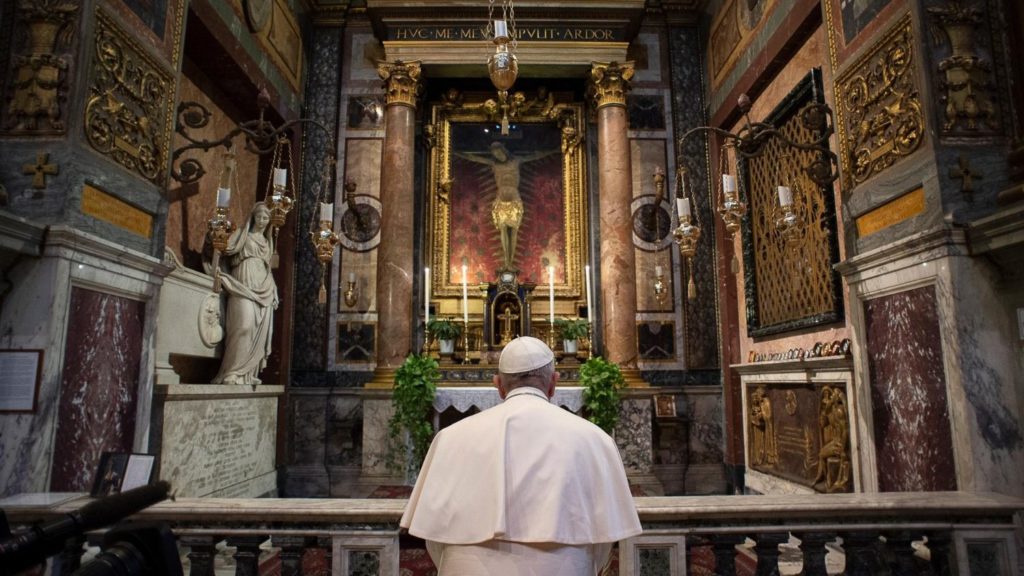
First, since they are the inspired word of Almighty God, we can safely say that they are not bad and they can be used for prayer.   St. Augustine believed that every word of the Psalms was Christ speaking to the Father, but in different voices, as the Head, the Body and both together, Christus Totus.  I’ll go with Augustine.

That said, it might make the Christian scratch her head when we pray “Blessed be he that shall take and dash thy little ones against the rock” (Ps 137:9).

How to use these psalms in prayer in a way that is pleasing to God and that does not imperil our own salvation by spurring us to soul killing hatred?  Isn’t this a serious consideration in these times of aforementioned political circuses and ecclesial misadventure?

One of the best explanations of the maledictory psalms – and therefore how to pray for our enemies – I’ve run across came in a comment made on this very blog under another entry I wrote about the maledictory psalms (thanks Henry Edwards!). Namely, …

In the Introduction (by Pius Parsch) to the Baronius edition of the 1962 Roman Breviary [US HERE – UK HERE], we read that

As Christians we may never wish evil upon a sinner directly and personally, but [NB] these [curse] psalms have nothing to do with personal enmities. The theme of all our praying is God’s kingdom and sin, and the curse passages in the psalms are expressions of absolute protest against evil, sin and hell. Try changing the curses into an expression of divine justice and you pronounce them no longer with your own mouth, but with the mouth of Christ and the Church. The curse thus resembles the woes that our Lord addressed against the Pharisees. There is something quite stirring and grand about these curses. The all-just God steps before us as we pray and warns us of the punishments of hell.  [NB: warns us!]

In regard to Psalm 108 (109)—perhaps the most maledictory of all the so-called curse psalms and omitted entirely from the LOH psalter—he says that

Psalm 108 is a curse formula and very difficult to reconcile with the Christian idea of prayer. Let us suppose that the Church or Christ Himself is praying this psalm. Then the curses become no longer wishes, but rather the solemn sentence of divine justice upon unwillingness to repent. With tears in her eyes the Church prays these terrible words–just as Jesus once declaimed his eightfold “Woe is you . . .” against the Pharisees. At the opening of the psalm, the Church laments. In the following two sections, where curses and punishments are asked for, a picture of the everlasting hell is painted for us. The petition which comprises the fourth part of the psalm can be a prayer of the individual soul; I stand terrified before the picture I have seen: “Have mercy on me, a poor weak mortal!”.

While there is a great deal more to be said about the maledictory psalms, that seems a good place to pause so that I can do my job and admonish you.

We members of the Church Militant have enemies.  There are the relentless, ineluctable foes which are the world, the flesh and the Devil.  There are also the agents of the Devil among us, outside the Church and, verily, inside.

We must strive not to hate enemies, to love enemies with the love that is charity, the love that desires what is truly good for them.  If they are doing great harm to our persons, families, nation and Church, yes, we can pray for their conversion or for their ruin lest they continue to do harm and lest they go to Hell.  For example, HERE. And while we pray for and against our enemies (and bear wrongs patiently), we must see to it that we don’t go to Hell, either.

As we soldier on through this vale of tears, we must constantly field strip our consciences while asking God for all the graces we need to do His will and to conform ourselves to His will and ways.

And now, from St. Paul’s Second Letter to Timothy 3:11-17:

Persecutions, afflictions: such as came upon me at Antioch, at Iconium, and at Lystra: what persecutions I endured, and out of them all the Lord delivered me.  And all that will live godly in Christ Jesus, shall suffer persecution.  But evil men and seducers shall grow worse and worse: erring, and driving into error.  But continue thou in those things which thou hast learned, and which have been committed to thee: knowing of whom thou hast learned them;  And because from thy infancy thou hast known the holy scriptures, which can instruct thee to salvation, by the faith which is in Christ Jesus. All scripture, inspired of God, is profitable to teach, to reprove, to correct, to instruct in justice, That the man of God may be perfect, furnished to every good work.

Finally, since I am trying to fulfill my mission to keep as many of you out of Hell as I can…

GO TO CONFESSION!

Posted in "How To..." - Practical Notes, ASK FATHER Question Box, Linking Back | Tagged , , , ,
7 Comments

ASK FATHER: “I utterly reject Bergoglio, so how can I remain a Catholic?” Fr. Z’s rant and beatdown.

From a reader…

QUAERITUR:

Now, to the point: How can I remain a Catholic when I UTTERLY reject Jorge Bergoglio as a false prophet of the devil? I can in no way continue to acknowledge him during Mass. Going to TLM doesn’t alleviate my doubts. My conscience absolutely forbids me from ever again listening to or acknowledging that man.

This is quite a dilemma for me. I am seriously considering heading to the Orthdox Church or finding a conservative evangelical church.

Hmmm.  That seems like a “No” vote for Bergoglio.

I am not going to get into the arguments for or against Francis as pope or antipope. For what I have to say to the idea of leaving the Church because of him, one way or another, I don’t have to get into that controversy.

Why?  Holy Catholic Church is indefectible.  This is one of the three attributes of the Church, along with authority and infallibility.

Your question holds two possible implications.  First, “I don’t like Bergoglio, so I’m going somewhere else.”  That’s just whining, like a kid who doesn’t like broccoli and goes hungry.

Otherwise, your implication is that if Francis isn’t really the pope, the Vicar of Christ, then somehow the Church is now defective and you might as well go some place else.

No.  And NO!   And HELL NO!

If we believe Christ’s promises – and I sure do – then we hold that the Church will not fail even to the end of the world when He returns to take all things to Himself and submit them to the Father.

The Petrine Ministry is part of the fabric of the Church as the Lord designed.  Somehow, until the ending of the world, the Church – and hence the papacy – cannot fail, even though we don’t know how.

As necessary as the papacy is, a pope is Christ’s VICAR, not Christ himself. As the sardonic Latin acrostic puts it, a VICARIUS is Vir Inutilis Carens Auctoritate Rare Intelligentiae Umbra Superioris, that is, “A useless man, lacking authority, rarely of intelligence, the shadow of his superior.”  That’s every pope, compared to Christ.

It is dangerous to place too much emphasis on any pope.

Look, friend, popes come and popes go.  There have been long periods of time between popes.  There have been long periods of time when there was terrible confusion about who was the real pope.  Even saints got it wrong and backed the wrong guy.  For centuries people had no idea who the pope was, even his name, and they lived good Catholic lives, minding their own business and trying to be holy in their vocations.

Popes can be good.  Popes can be bad.  Popes can have short or long pontificates.  Popes can be talented or doddering.  Popes can be charming or jerks.  Popes can be holy of sinful.   Popes can be important or insignificant.

Only one thing is clear about popes, and the Romans get this right: Muore un papa se ne fa un altro… A pope dies, you make another.  We make another until Christ returns.  Somehow that’s the way our Church will always be even if we don’t like the choice.

As for your chicken-livered notion about going outside the Church, I’ll offer what Lumen gentium 14 teaches:

14. This Sacred Council wishes to turn its attention firstly to the Catholic faithful. Basing itself upon Sacred Scripture and Tradition, it teaches that the Church, now sojourning on earth as an exile, is necessary for salvation. Christ, present to us in His Body, which is the Church, is the one Mediator and the unique way of salvation. In explicit terms He Himself affirmed the necessity of faith and baptism and thereby affirmed also the necessity of the Church, for through baptism as through a door men enter the Church. Whosoever, therefore, knowing that the Catholic Church was made necessary by Christ, would refuse to enter or to remain in it, could not be saved.

Refuse to enter or refuse to remain in the Church knowing that the Catholic Church is necessary?   Bad odds.

These are hard times.  Confusing.  Fearful.  Dangerous.  But these are the times into which God called us to live.   That means he offers us the graces we will need to live our vocations well.   It could be that you have to completely tune out of the larger churchy news and put your nose to your personal grindstone and live your vocation well.

God didn’t call us into existence at random, but rather with a plan and a purpose for every one of us.  He called YOU, friend, into this life HERE and NOW, not at some other time and place.  These are the circumstances of our lives.  We are the soldiers of the Church Militant God wants NOW.  Are you suffering? Embrace it.  Offer it in reparation.  Are you afraid?  Throw yourself at the feet of the Mother of God and beg her protective mantle.   Clasp onto St. Joseph, Defender of the Church.

Fast.  Give alms.  Pray.  But don’t be a coward.

Either pick up your Cross and your sword and get your ass back to the lines or go crawling off somewhere.  We’ll do your duty along with our own.  Run for the hills.  Good luck with that.

I will not run.


Posted in "How To..." - Practical Notes, ASK FATHER Question Box, Be The Maquis, Francis, Hard-Identity Catholicism, Si vis pacem para bellum!, The Coming Storm, The future and our choices, Wherein Fr. Z Rants | Tagged , , , , , ,
54 Comments

ASK FATHER: For the TLM does the tabernacle have to be in the center?

From a reader…

QUAERITUR:

Fr. Z, are there some sorts of specified rubrics for the celebration of Mass in the Extraordinary Form if the tabernacle is off on the side, in what might be termed a side chapel, but is still visible from the pews all the way on the left?

I ask on the basis that the National Shrine of the Immaculate Conception has the tabernacle in a chapel on the side, though this seems to be not an identical case.  [Separated by an ambulatory aisle and, hence, not morally present in to the sanctuary.]

Is there hopes for having a TLM without having to have the tabernacle repositioned? (This seems to be a bit of a hang-up point on trying to bring the TLM to the parish, and the pastor has told me that it would be immensely expensive to move.)

Given what you wrote, this is no problem whatsoever.  There are no special rubrics.

First, if the tabernacle is for some reason not in the center, but in a side chapel, then the Blessed Sacrament is not “present”, even though the chapel might be visible from some parts of the church.

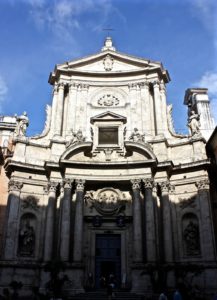
For example, at the great church of the FSSP in Rome, the traditional parish of the City SS. Trinità dei Pellegrini, when there is a bishop as celebrant, the Blessed Sacrament is quite properly removed from the main tabernacle at the altar in the sanctuary, to a tabernacle at one of the side altars, half way up the nave of the church.  Those congregants who would pass before that tabernacle would want to pay their respects to the Eucharistic Lord, but the action in the sanctuary goes on as usual, that is, without the presence of the Blessed Sacrament.  At Communion time, one of the priests goes with servers to the side chapel altar and retrieves the Eucharist for distribution.  They process back to the sanctuary with the ombrellino over the priest with the ciboria.

The TLM does not require the presence of the Blessed Sacrament in the tabernacle.  As a matter of fact, for many hundreds of years Holy Mass was celebrated daily by thousands upon thousands of priests at side altars of churches.  Moreover, even as priests celebrated privately at their side altars, it could be that the Blessed Sacrament was in the tabernacle at the main altar and that Mass was also, simultaneously, at the main altar.  That is often the state of affairs when I have said Mass in the afternoon at SS. Trinità dei Pellegrini.

No, this is not a problem.

If the tabernacle is not in the center, you can have the Traditional Latin Mass with no problem at all.   Anyone going close to where the tabernacle is, however, should reverence the Eucharistic Lord, but it sounds as if that’s not a problem in what you described.

Posted in "How To..." - Practical Notes, ASK FATHER Question Box | Tagged
6 Comments

The importance of saying the black and doing the red

A cautionary tale. If you don’t know what you are doing, don’t just charge ahead. Wait for the MC. Say the black. Do the red.

That was painful.

The video of the whole Mass. For that snippet, start at about 1:31:00.

YouTube thumbnailYouTube icon

Click!

UPDATE

By way of a contrast…

Here is the TLM celebrated during the 2019 NCYC in Indianapolis on 22 November at St. John’s Catholic Church. The church was full. One of my correspondents wrote that they’ve had a TLM for several years and each year the attendance has grown. They now have to go to a large church for it.

The music was Palestrina’s Missa Brevis.

YouTube thumbnailYouTube icon

Posted in "How To..." - Practical Notes | Tagged
6 Comments

What’s happening to Catholics in China?

The Vatican changed its stance toward the Church’s presence in China.  What fruits have come from this change?

The following piece has lots of photos at the original page, which you can visit.

From Bitter Winter:

Xi Jinping Portraits Replace Catholic Symbols in Churches

Places of worship refusing to be controlled by the state are being shut down, while government-run churches are used to worship the Chinese Communist Party.
by Tang Zhe

A Catholic Church in Ji’an, a prefecture-level city in the southeastern province of Jiangxi, was built this year at the cost of more than one million RMB (over $ 140,000), which had been raised by believers. It was named “The True and Original Source of the Universe” (萬有真原), a reference to the name inscribed in 1711 on a plaque the Kangxi Emperor (Xuanje, 1654–1722) donated to a Catholic church in Beijing. Not long after it opened its doors, the church became the target of the local government’s persecution.

In late September, local officials ordered the congregation to paint over the sign with the name of the church, replace it with “Follow the Party, Obey the Party, and Be Grateful to the Party,” and display the national flag at the entrance.

What has hurt the congregations the most was the removal of a painting of the Virgin Mary with the Christ Child, later discarded into a dark corner of the church. Instead, a portrait of president Xi Jinping was hung in the center of one of the walls, surrounded by propaganda slogans on both sides.

A few days later, officials confiscated the keys to the church and locked all its doors and windows. The congregation lost their place of worship.

The same month, a Catholic meeting venue that is not part of the Chinese Patriotic Catholic Association in Jiangxi’s Poyang county was ordered to cease religious activities. Local officials threatened to revoke retirement pensions of elderly congregation members if another meeting were to be held. The church’s cross, a painting of the Virgin Mary, and religious couplets were removed, and portraits of Xi Jinping and Mao Zedong were displayed instead.

[…]

May God help our brothers and sisters.

Posted in Modern Martyrs, Our Catholic Identity, Pò sì jiù |
5 Comments

Fr. Z’s Kitchen: Christmas Pudding 2019

A few people asked me to post about making this year’s Christmas Pudding.   Yesterday was “Stir Up Sunday” (¡Hagan lío! Sunday?), the last of the liturgical year.  It is so-called because of the first words of the Collect.  But I’ve written on that elsewhere.

Putting together my mise en place.  I’m using Delia’s recipe, with variations.  That requires measurement by weight and volume for liquids, thus, the graduated cylinder.

The least pleasant aspect of the recipe is the preparation of the suet.  I lopped some o’ this here hunk off and made sure it were froze some.

Grate the suet.  Add the bread crumbs and blend together. As it was I had to use a multi-bladed pastry cutter.

Adding all the ingredients and ticking them off the list, so that I don’t miss any.  I couldn’t find my usual zester for the orange and lemon, so I zested with an erzatz zester, I tested before hand, then rested and zested the aforesaid lemon.  Here is the bested orange, zested.

Into the eggs beaten with bourbon (not rum this year) goes the stout.  There is also barleywine.

Now it goes to the fridge for the night.  The next morning, that is this morning, in went the self-rising flour.  I had to concoct some, with baking soda and salt.

Yes, if you were about to ask, I added more bourbon.

To grease the pudding basins, I used pure lard.

The toughest part of the whole process is tying the string around the basins.  I made loops to facilitate their removal from the large pot where they are, as I write this, being steamed.

I’ll give them about 8 hours.

You can help me with the ingredients and win my gratitude as well as remembrance among the benefactors I pray for at Mass.

Thanks in advance!

In the meantime, as I posted in years past, here are images from a book I recall from my ever more distant childhood, depicting “Max” preparing what I now – at long last – understand to be a Christmas Pudding!  As a ‘Mer’can kid I had no idea what he was making – meatloaf? – or why he was trying to light it on fire.

Max was created by Pericle Giovannetti for Punch.

MAX's Christmas Pudding

MAX's Christmas Pudding

MAX's Christmas Pudding

MAX's Christmas Pudding

MAX's Christmas Pudding

MAX's Christmas Pudding

MAX's Christmas Pudding

MAX's Christmas Pudding

MAX's Christmas Pudding

Yes, sometimes our best plans and efforts blow up in our faces.

UPDATE

The puddings steamed for about 8 hours.

And they are ready for storage.

I found an old pudding, several years old, when I went to put the new ones away. I wonder if it okay. I suppose if you steam it long enough….

Posted in Fr. Z's Kitchen | Tagged
9 Comments

ACTION ITEM! Helmet for one of the Swiss Guards – UPDATES

We’ve all had the experience at some time of spending time in poorly fitting clothing, perhaps with little opportunity to move about for relief.  We just have to bear it.

Now imagine that the ill-fitting clothing is completely unyielding, because it is made out of steel.

Try to get your mind around wearing for hours steel armor that doesn’t fit.

Some of you will remember the fundraiser we had to have “bespoke” armor made for one of the Pontifical Swiss Guards.  Back in 2015, we raised money so that CPL Bergamin could have armor made that fit him… rather than armor that once fit someone else.  The project was successful and he was able to have his armor before the important “swearing in” ceremony which is the anniversary of the great stand made by the Swiss at the Sack of Rome.   Engraved on the breastplate are images of St. Joan and St. Joseph.

Lot’s of great photos HERE, including his bride, Joanne, a friend of mine.  I spoke with both Dominic and Joanne about this project when I was in Rome during October.

That completed project in 2015 included the breastplate and shoulder pieces.

It did NOT include a helmet.

Again, I ask you to imagine wearing, for hours, perhaps in the sun, a steel helmet – not kevlar with liners – that doesn’t fit and during the ceremonies not being able to adjust.  Some of you may resonate with that.

NEW PROJECT

A GoFundMe page has been created to make 15-year veteran CPL Bergamin a helmet that will fit.

The goal is

€5,000

We can do this.

HERE

The motto to be engraved:

Transit dolor, manet honor.

Pain passes, honor remains.

The helmet is worn with the body armor on multiple days throughout the Swiss Guard calendar – over the 6 May swearing in ceremony and surrounding events, Easter, Christmas and other special occasions in the Vatican and the Swiss Guard. It is vital to capture the artisan tradition of metal-working while it still exists. The Swiss Guard armor has been made by a family of blacksmiths in upper Austria since the 18th century. This family will produce the first helmet of this kind in the traditional style of the Swiss Guard with the family crest of their founder, Pope Julius II.

Remember: These guys put their lives on the line.  And they are real targets because they are so visible.   And they are pretty devout, given my conversations with them.  The Swiss I’ve spoken to really appreciate the Combat Rosaries they get.

A helmet that fits is a good thing.

Here’s where we are now.

UPDATE

After a few hours.

Well on our way.   C’mon!   By day’s end!

UPDATE 23 Nov

UPDATE 24 Nov

Alright folks, let’s move this!

UPDATE 25 Nov

Can we make this the LAST day for this project? We are almost there!

UPDATE 25 Nov

WE DID IT! Thank you, everyone who contributed!

Posted in ACTION ITEM!, Linking Back | Tagged
1 Comment

Your Sunday Sermon Notes: Last Sunday after Pentecost – Christ the King 2019

Was there a good point made in the sermon you heard at the Mass that fulfilled your Sunday Obligation?

What was it?

For my part, I spoke of the beauty of the Christian soul in the state of grace and then moved to correptio optimi pessima, corruption of the best thing is the worst kind of corruption.  The Christian soul in the state of grace is so very beautiful, but the soul in the state of mortal sin….

Posted in SESSIUNCULA |
10 Comments

24 Nov 2018: Bp. Morlino – 1st anniversary – R.I.P.

Today, 24 November, is the 1st anniversary of the death of Madison’s former Bishop, Robert C. Morlino, the Extraordinary Ordinary.

While I am confident in his eternal destiny, for he was deeply devout and he received the Last Sacraments with the Apostolic Pardon, and he has had many Masses said for him, nevertheless, please pray for the repose of his soul.

Frankly, I think that it was partly – mostly? – through his intercession with Mary, Queen of the Clergy … and maybe St. Ann, to whom he was devoted… that we received the wonderful new bishop, Bp. Hying.

Here is a video made just before, and obviously after, the death of Bp. Morlino, reposted for today.

YouTube thumbnailYouTube icon

Posted in Linking Back | Tagged ,
5 Comments

ASK FATHER: Visiting priest says don’t receive Communion on the tongue because of colds and influenza

From a reader:

Today at Mass, a visiting retired priest sat down after communion and proceeded to admonish those of us who receive the Holy Communion on the tongue saying that we should cease to do so because it is unsanitary especially in flu season. I felt quite dejected after this and wondered why he would feel it necessary to do so…at a parish he is simply visiting because one of our parish priests is gone. What are your thoughts about the health issues of receiving on the tongue? He represents my spiritual father, but I wonder what my responsibility is to obey him.

Firstly, what he said was absurd.   However, it is a good moment to remind people how to receive well directly on the tongue.   I can’t do better than this great old graphic from an old, dependable catechism.

Mind you, in different parts of the world there are slightly different customs, such as taking the Host with the teeth.  I don’t think that a very good practice.  If you put your tongue out, and stay still, the priest has a good target.  He will know how to place the Host on your tongue without touching you.

You don’t have to reach with your tongue for your chin, like that oddball in that ridiculous big-hair rock band.  Just put out enough so the priest has a good target surface.  And stay still.

Also, if the visiting priest did that on his own, without consulting with the true parish priest, then he overstepped himself.  It has always been cold and flu season.

Also, Redemptionis Sacramentum 92 reiterates your right to receive on the tongue.

Lastly, and most important, don’t be dejected.  These are times we have been given.  Turning the sock inside out, you have been given to these times.  God wants us to be active now.  You were given an opportunity to be, in this Church Militant, on the “front line” for a moment.  This is not a matter for dejection.  This is a matter to feel honored but the experience of the ongoing struggle for reverence for the Blessed Sacrament.

Go the next step now.

Pray and fast for that priest.  Make some act of reparation.


Posted in "How To..." - Practical Notes, ASK FATHER Question Box, Liturgy Science Theatre 3000 | Tagged ,
34 Comments