Just watch and laugh.

And of course there wasn’t a lab in China… nah…
….
!

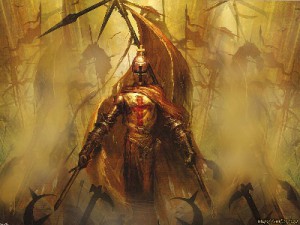
What priests must be!
I want to pass along to my brother priests and bishops this great email. Dear readers, would you consider printing it out and giving it to your local priests or sending them an email with a link to this post?
From a priest with my emphases and comments:
I”m sure this has crossed your mind, and that you’ll be saying a bit on this anyway, but I wanted to reinforce: Without public Masses, it seems to me that now is the time for priests to ramp up saying their daily Missa solitaria. [Private Mass… alone.]
I live in a monastic community with a daily Conventual Mass; even for priests who celebrate only the Ordinary Form and think [wrongly] that canon 906 limits their ability to celebrate Mass alone, the requisite conditions of a “just and reasonable cause” is more than satisfied in our present situation. I hope we can encourage our brother priests to do just this. [Count on me! I’ll do my part.]
For my part, I think that the prayers of the Extraordinary Form–since they are far more robust and ‘in-your-face’–more than meets the meaning of “approach[ing] with boldness the throne of grace…” (Heb 4:16).
And, while we’re at it, how about the Seven Penitential Psalms? [OORAH!] We would be derelict as priests to not allow the Lord to search our hearts in revealing to us why His permissive Providence has given reign to Wuhan virus. After all, Hebrews 12:5-13, yes? With cancelled meetings and suspended parish functions, we have more time to do PRIESTLY things. I dare to say we ought even to pray the minor exorcisms–at least against those who have hardened their hearts against the Lord on account of the pandemic.
If I may rant just a little, one piece of Modernism is a ‘scepticism about the immanence of the supernatural‘ and many priests who are reluctant to think that frequent celebrations of the Mass are unwittingly falling prey to the Modernist heresy.
Now’s the time for serious spiritual combat and an abundance of GRACE, not squishy Pelagian assuaging.
Father, you are right!
Let’s recap:
UPDATE: 17 March 2020
The PDF has been updated, improved, and slightly corrected.
Feel free to download, print, and give it your your priests.
___ Originally Published on: Mar 16, 2020
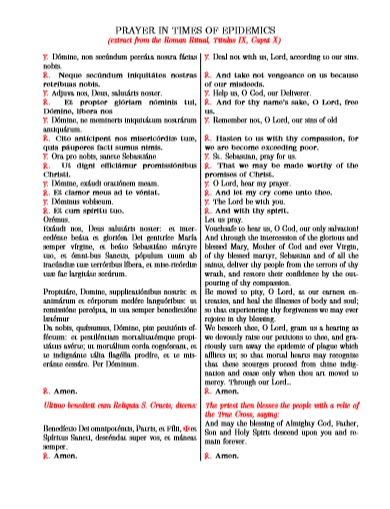
I saw that the FSSP put out a PDF with some prayers extracted from the traditional Rituale Romanum against pestilence.
It concludes, if possible, with a blessing using a relic of the True Cross.
Here at the Tridentine Mass Society of the Diocese of Madison, we took that PDF and improved it a little, adding red for rubrics.
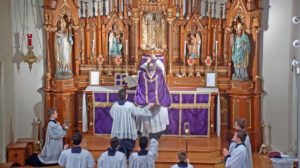
I did this yesterday after Holy Mass, with a relic of the Cross. We will continue to do so. Also, the pastor at the parish I’m at on Sundays will do so after daily Masses (in English).
Technically, this should be done in Latin, according to the legislation in effect in 1962.
 Over at First Things there is a piece by Joseph Epstein about his decision, later in life, to learn Latin. It’s engaging. Read it there.
However, he mentions some sources for learning Latin, which I will countersign. For example, when people ask for a book for self-instruction, I usually mention Wheelock.
It is tried and true, available, with good ancillary materials.
Wheelock’s Latin 7th Edition (The Wheelock’s Latin Series)
And to go deeper…
Reginald Foster’s Ossa Latinitatis Solas
BTW… the 2nd Volume of Foster’s work is due to come out in August 2020. Ossium Carnes Multae e Marci Tullii Ciceronis epistulis: The Bones’ Meats Abundant from the epistles of Marcus Tullius Cicero
 I am not sure where I heard this, in the ongoing scrum of COVID-19 news coverage and discussion. I often multitask when the news is on. I don’t even remember if this was the exact phrase that was used, but somehow it stuck in my head.
Pay It Backwards.
Remember the movie “Pay It Forward”? The idea is simple. Think of a good thing to for someone else with the hope that they will do the same, and so on and so on.
In this time of the virus, and the vulnerability that older people have, think about paying it backwards. There are older people out there who worked so that we could have to good things and comforts that we have. Many of them, due to age, have fewer and fewer people with whom they are engaged. Most of them, I suspect, are in no way prepared for the sort of isolation that is probably coming down the pike… fast.
I have in mind especially older priests. They often don’t have a lot of family, near or far. Some are really alone.
They baptized you, heard your confessions, married you, said Mass for you, anointed you or your loved ones when sick or dying, taught you, encouraged you.
Some of them are not so diligent in their vocations. They, too, still need attention, which could move their hearts.
I imagine that all of you out there can think of a couple good things to do for others who are older than you. Pay it backwards, in that sense, as well as paying it forward.
In this PODCAzT I read for you the Latin version of the extract from the traditional Rituale Romanum of A Prayer In Times of Epidemics (RR Tit. IX. Ch. X).
It really should be done in Latin.
Listen & subscribe: Apple Podcasts Overcast Pocket Casts RSS feed
These devotions and the use of Latin slipped away. I can’t help but think that this was systematically and purposely stripped out of the church’s life to weaken our Catholic identity and to make us more susceptible to the winds of the world with its shifting fads and mores. It won’t be easy to recover ourselves and our sense of ourselves. That’s why I try to help by reading the Latin of some of these rites, such as traditional baptism or exorcism and blessings of holy water and the like. If you need help with something, Fathers, let me know.
Meanwhile, let’s beat this damned virus down into the dust with self-discipline and mighty prayers.
We hear some music by Giovanni Gabrieli, Music For San Rocco. San Rocco is a great patron of the sick and an intercessor in time of plague. And, for music, there’s a surprise at the end.

 From a reader…
QUAERITUR:
I hope you are doing well today. My pastor is the dean for the archdiocese of ___. He wanted to know if he has the competent authority to allow himself to offer Mass of the Féria of lent with votive collects against plague and epidemic or if he needs to apply to our Archbishop.
When there is a grave and public cause – which there clearly is right now – and there is no time or the Ordinary of the place can’t be reached, the parish priest (pastor, parochus) can determine that a Votive Mass, even a Class IV on a Class III Feria of Lent, can be used.
Although this is in theory an age of rapid communication, it can take a surprisingly long time to get a message through to a bishop or a vicar general (a VG is a “local ordinary” who can permit just about everything a bishop can permit). Hence, if it is a matter of making a rapid decision, then the pastor can make the decision without contacting the bishop.
However, if this is going to be an ongoing thing, then an ordinary should give permission for a period of time.
Where I am, I asked the local bishop for permission to use appropriate Votive Masses through June. He willingly granted the permission.
Also, a bishop can establish for Masses in his diocese an oratio imperata, which must be said. In the traditional Rite, it is said with its own conclusion. It is prohibited on Class I and II feasts and Votive Mass as “high Masses”. It is said on Mondays, Wednesday, and Fridays, only.
Again, if a pastor of a parish for some reason can’t reach the bishop in a timely way to request permission – and bishops are quite busy, aren’t they? – the pastor can make the call about the use of Class IV Votive Masses on Class III Ferias of Lent.
We are both body and soul. The Church’s mighty prayers of Mass and blessings of sacramentals refer to their effects as being both bodily and spiritual.
Let’s use ALL our spiritual weaponry to aid the well-being of the body!
Si vis pacem para bellum!
From a reader…
QUAERITUR:
As our diocese has cancelled all Masses until further notice which includes our TLM parish would it be disobedient and/or sinful to attend the local SSPX Mass which goes against both our local ordinary and our city which has forbidden all public gatherings?
Provided you follow local civil laws,… NO.
 The shape of things to come?
I was texting with The Great Roman™ today. He’s fine and so is his family, but he’s frustrated, as you can imagine. Everyone is in lockdown. You can’t go anywhere except a nearby church or store without written permission.
He told us of a situation in the nearby Diocese of Porto. I found a news story about it HERE
Police disperse Catholics at Sunday Mass in Italy
Italian police on Sunday dispersed Catholics attending a Mass being celebrated in a parish outside of Rome. The Italian government has prohibited public gatherings in response to the coronavirus pandemic.
The Mass was being offered at St Francis of Assisi Parish in the Italian town of Cerveteri, some 27 miles northwest of Rome. Earlier this month, the Italian bishops’ conference confirmed government measures against public gatherings, effectively prohibiting the public celebration of Mass anywhere in the country.
Some 15 people were present at the March 15 Mass, several of them seated outside of the church, whose doors were opened as Mass was offered. The Mass was being live streamed on Facebook.
Police entered the Church after the distribution of Holy Communion, and before the final prayers of the Mass. The priest was permitted to conclude the Mass after parishioners dispersed.
[…]
The priest was at the altar in church and the people were outside the church.
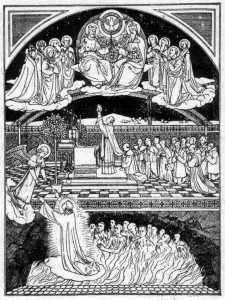 From a reader…
QUAERITUR:
Can you please clarify the conditions to gain an indulgence? My
diocese thankfully has not yet closed churches but my archbishop has forbidden communion on the tongue. In obedience, my TLM pastor is continuing to say Mass but is not distributing communion. If I make a spiritual communion at Mass, does that qualify as one of the usual conditions for me to gain an indulgence?
Oh, boy. This virus thing keeps pulling the rock up and exposing problems.
One gains indulgences “under the usual conditions”, which includes, within some 20 days of the work performed, reception of Holy Communion, that is Eucharistic Communion, preceded by sacramental confession.
Enter the devout Catholic who, as a matter of conscience, will not receive Communion on the hand.
Enter the devout Catholic who cannot travel to a place where Mass is held.
Enter the priest who refuses to give Communion on the tongue.
What to do to gain indulgences, which are needed even more in these times than in others?
The “usual conditions” for a plenary indulgence means reception of Eucharistic Communion (No. 20 §1), rather than a “spiritual Communion”.
The indulgence would be partial without the three conditions (along with exclusion of attachment even to venial sin), that is,
1) sacramental confession,
2) Eucharistic Communion, and
3) prayer for the Sovereign Pontiff’s intentions.
SOLUTION.
No. 24 in the Handbook of Indulgences says:
Confessors can commute either the prescribed work or the conditions in favor of those for whom these are impossible because of a legitimate impediment.
So, priests who have the faculty to hear confessions can, for a good reason, commute the conditions. That means that a confessor say, “Make a good Spiritual Communion, in the state of grace, of course, rather than a Eucharistic Communion.”
No. 25 in the Handbook of Indulgences says:
Hierarchs or local ordinaries can grant permission to the faithful over whom they exercise legitimate authority and who live in places where it is impossible or at least very difficult to go to confession or Communion to gain a plenary indulgence without confession and Communion, provided they have contrition for their sins and have the intention of receiving these Sacraments as soon as possible.
If individual confessors can handle individual cases, the diocesan bishop or the vicar general (also a “local ordinary”) could issue a decree for all the subjects in that diocese regarding how to receive a plenary indulgence.
That would take some of the pressure off of this issue for a lot of people who want to gain plenary indulgences. Otherwise, what to do? Find a priest who will give you Communion on the tongue either during or, perhaps, after Mass? That’s an option.
I think using the laws laid down as they are is a pretty good solution. Hopefully, dioceses will remember also indulgences and issue some decrees.


Coat of Arms by D Burkart
 waalaw on ROME 26/10– Day 22: Colors and courses and Coco: “Thank you, pestolover. I made sure that my solution was correct before posting it; but, as is my fatal flaw,…”
 on Summorum Pontificum Pilgrimage 2026… *sigh*… Vatican Bars Annual TLM Pilgrimage from ENTERING St. Peter’s Basilica: “@gaudete – give me a break. The pilgrimage has been done for 15 years. It’s always on the same date.…”
 on Summorum Pontificum Pilgrimage 2026… *sigh*… Vatican Bars Annual TLM Pilgrimage from ENTERING St. Peter’s Basilica: “The refusal to hold Leo accountable for the relentless and ongoing abuses toward the people of God has grown intolerable.…”
 on Summorum Pontificum Pilgrimage 2026… *sigh*… Vatican Bars Annual TLM Pilgrimage from ENTERING St. Peter’s Basilica: “How about a People’s Invasion of the Vatican City and installing a People’s Committee to rule the Vatican. Nice commie…”
 on Summorum Pontificum Pilgrimage 2026… *sigh*… Vatican Bars Annual TLM Pilgrimage from ENTERING St. Peter’s Basilica: “Respect to all, and could somebody make a t shirt? The three crosses on a hill, and then the logo:…”
 on From “The Private Diary of Bishop F. Atticus McButterpants” – 26-10-12 – Brainstorming!: “I would like to laugh at the bishop’s situation and ideas; unfortunately, it is far too close to the truth…”
 on Summorum Pontificum Pilgrimage 2026… *sigh*… Vatican Bars Annual TLM Pilgrimage from ENTERING St. Peter’s Basilica: “Okay, let’s presume for a moment that the spin being put on this is correct – it was a scheduling…”
 on Summorum Pontificum Pilgrimage 2026… *sigh*… Vatican Bars Annual TLM Pilgrimage from ENTERING St. Peter’s Basilica: “The attitude of the Ecclesia Dei groups (I don’t know how they are referred to now) is puzzling to me.…”
A Daily Prayer for Priests








They find you a pro-life agent in your area who commits to giving a portion of the fee to a pro-life group!

PLEASE subscribe via PayPal if it is useful. Zelle and Wise are better, but PayPal is convenient.
A monthly subscription donation means I have steady income I can plan on. I put you my list of benefactors for whom I pray and for whom I often say Holy Mass.
In view of the rapidly changing challenges I now face, I would like to add more $10/month subscribers. Will you please help?
For a one time donation...



Help Monks in Wyoming (coffee – UPDATED LINK) and Norcia (beer) and the wonderful "Soap Sisters" of Summit, NJ!


Please follow me on Twitter!










Visits tracked by Statcounter
since Sat., 25 Nov. 2006:
