For a one time donation…

 A terrible thing happened recently. A young priest, almost certainly reacting badly to medication, committed suicide. Fr. Evan Harkins, of the Diocese of Kansas City – St. Joseph, had been on medication for an ailment. It seems to have affected him in a profoundly negative way.
I know I can count on you readers to pray for him and for his family and friends.
There is a lesson that comes from this. Medications can do really strange things to your mind.
In the wake of Fr. Harkins’ death, the Abbess of Gower – you will remember the great consecration of the Abbey and Abbess – sent out a letter which described the bad experience of some of the sisters who had some medication. HERE She writes about how medications for other things induced in her sisters suicidal thoughts.
Also, I recommend that you read the sermon given by the Bishop of Kansas City, Most. Rev. James Johnston, at the funeral Mass for Fr. Harkins. It is exceptional. HERE The bishop spoke, with permission of the family, about how medication for stomach problems worked negatively on Fr. Harkins.
Will you please pray for your priests? Some of your priests are having a hard time. Stress, medication, the deteriorating state of the Church, other factors can weigh heavily on them. May I recommend, please, a prayer for priests daily? I posted a link to such a prayer on the sidebar of this blog. Also, ladies, please consider the Seven Sisters Apostolate.
Daily Prayer for Priests
O Almighty Eternal God, look upon the face of Thy Christ, and for the love of Him who is the Eternal High Priest, have pity on Thy priests. Remember, O most compassionate God, that they are but weak and frail human beings. Stir up in them the grace of their vocation which is in them by the imposition of the bishop’s hands. Keep them close to Thee, lest the Enemy prevail against them, so that they may never do anything in the slightest degree unworthy of their sublime vocation.
O Jesus, I pray Thee for Thy faithful and fervent priests; for Thy unfaithful and tepid priests; for Thy priests laboring at home or abroad in distant mission fields; for Thy tempted priests; for Thy lonely and desolate priests; for Thy young priests; for Thy aged priests; for Thy sick priests, for Thy dying priests; for the souls of Thy priests in Purgatory.
But above all I commend to Thee the priests dearest to me; the priest who baptized me; the priests who absolved me from my sins; the priests at whose Masses I assisted, and who gave me Thy Body and Blood in Holy Communion; the priests who taught and instructed me, or helped and encouraged me; all the priests to whom I am indebted in any other way, particularly N. O Jesus, keep them all close to Thy Heart, and bless them abundantly in time and in eternity. Amen.
IMPRIMATUR
+Robert C. Morlino, Bishop of Madison, 6 September 2018
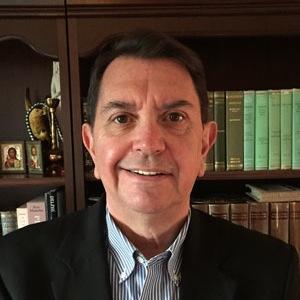 My good friend Prof. Robert Royal has a highly useful essay at Claremont Review of Books, Winter – 2019 – entitled “Is The Pope Catholic?” [UPDATE: Prof. Royal wrote this during during the Synod of October 2018! It is still fresh.]
This is one that you should both download and print. There are options for both on that site! You will want to read it more than once.
The books he writes about.
In addition to being a good overview of books in English about Francis, this essay is also a status quaestionis piece.
Royal is fair to the books. For example, about Ivereigh’s work: “It would be wrong to say that the book is pure hagiography” and about Neumayr’s, “relentlessly ideological reading”. He points to what is factual, underscores what is just rumor or unsubstantiated, and gently calls out prevarication.
Royal is also fair to the pontificate. Hence, his review is unvarnished. Therefore, it is neither simple nor is it a pretty picture, because this pontificate is manifestly anything but.
I suspect that the Papalatrous Left and the New catholic Red Guards, when they find this essay and grumble their way through it, will set out for Royal in a spittle-flecked nutty of verbal tar and feathers.
Here are some snips from Royals piece…
[…]
In one of the early, defining moments of his papacy, Francis told the 3 million young people assembled in Rio de Janeiro for World Youth Day 2013, “hagan lío,” a phrase from his native Argentina that means “raise a ruckus” or, more literally, “make a mess.” He presumably wanted them to bring fresh energy into the daily life of the Church and the world. The prudence of asking young people to do what they are already inclined to do anyway—knowing little, as they do, of the Church or the world—is debatable.
[…]
The great disadvantage of Ivereigh’s work, however, is already clear from the title. It would be wrong to say that the book is pure hagiography; it admits Bergoglio made mistakes. But even the most admiring biographer cannot make much of a case that the future pope was highly successful—as a reformer or anything else—in Argentina.
[…]
When the Vatican was considering making Bergoglio a cardinal in 2001, then Jesuit Superior General Peter Hans Kolvenbach wrote a letter to John Paul II advising against it because of the controversies Bergoglio had provoked over many years and, it is said, because of psychological instability. (The letter, it is also said, has disappeared from the archives.) The basic facts here are not in dispute. Francis has admitted that he saw a psychiatrist during a troubled period in his life, and he did not really repair his relationship with his religious order—which remained broken for 37 years—until he became pope.
[…]
Whatever his track record in Argentina, Francis was elected to be a reformer, yet in the six years since he became pope, the rot in the Church has only become worse. Vatican finances, despite promises and early steps to make them more transparent, are still a murky—sometimes criminal—mess. The Roman curia (the Vatican offices charged with running a church of 1.2 billion people all over the globe) tell any visitor willing to listen these days that they are confused about their mission. The pope has shown himself quite willing to blur several Catholic teachings in order to meet halfway some of the worst developments in modern culture—a popular move with liberals and non-Catholics, but a betrayal for serious Catholics.
[…]
Like Perón, he boldly tells different groups what they want to hear, even if he often contradicts himself.
[…]
In politics a certain amount of studied ambiguity can be a useful tool. But in religion—especially when it comes to some of the most burning current issues—ambiguity can look like confusion, or even surrender.
[…]
His many colorful insults (“fomentor of coprophagia,” “museum mummy,” “creed-reciting, parrot Christian,” “sourpuss,” etc.)—so many, in fact, that a “Pope Francis Little Book of Insults” has been compiled online—are amusing in a way, if you aren’t Catholic or don’t think they ill befit the vicar of Christ. But they also contradict the much celebrated softer, gentler side of the pope: he frequently preaches that to insult a person violates his or her dignity.
[…]
The emphasis here has to be on the spirit of renewal because the expected bump in the number of people participating in Church, the sacraments, and religious activities of all kinds has not happened: in fact, the numbers continue to worsen. Part of the “Francis effect” is to have exacerbated existing divisions and tensions within the Church, sometimes producing strong opposition to the Holy Father among Catholics themselves. Attendance at the pope’s Wednesday audiences in Saint Peter’s Square and visitors to the Vatican more generally are at record lows compared to his two predecessors’.
[…]
The “change” that Francis is pursuing necessarily involves dismantling the work of his two great predecessors, especially their efforts to restore an emphasis on truth and natural-law thinking.
[…]
I could pull so much more. Again, read it, download it, print it. You should even distribute it to friends.
At Claremont Review of Books, Rombert Royal’s “Is The Pope Catholic?”
Fr. Z kudos.
Last October I involved you in a project at at Ss. Trinità dei Pellegrini, the FSSP parish and my adoptive home parish in Rome. Historically, the place had never been a parish church. Therefore, it didn’t have a baptistry or font. Now that they are a parish, they needed a font for baptisms. They had a fundraiser which I – and you – got involved in, and we quickly raised the money they needed.
I had an update on the baptismal font. Here’s a photo. The font is “on the way”!
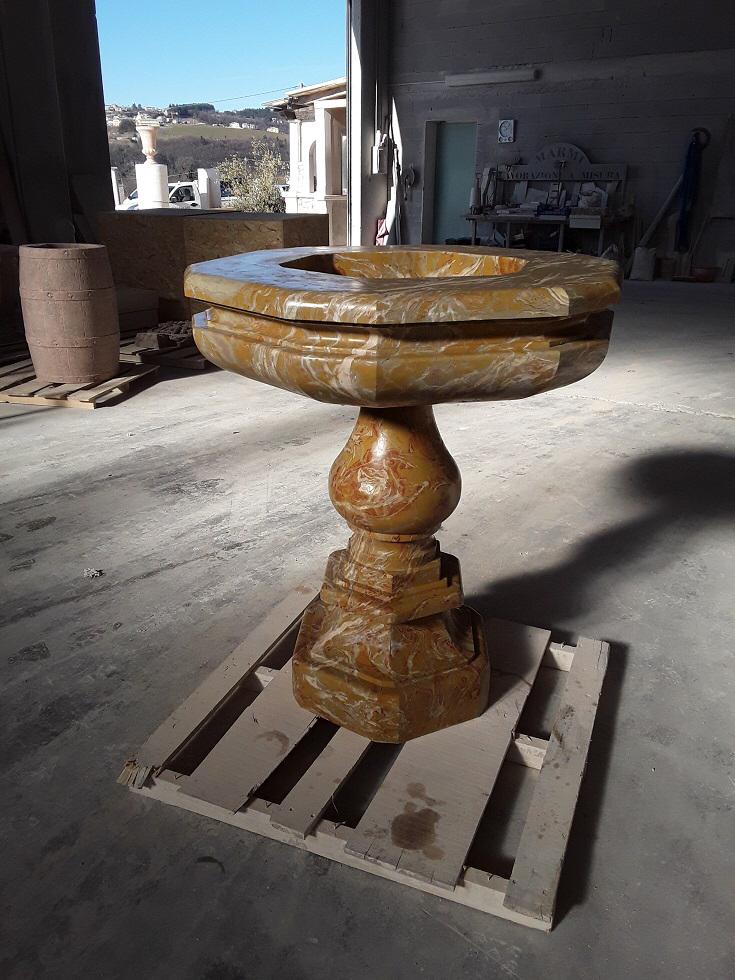
Thanks to all of you who stepped up last October.
Meanwhile, my old friend, the mighty Archbishop of Portland, Most Rev. Alexander Sample, is in Rome for his ad limina visit. He celebrated Holy Mass for the Feast of the Purification on Sunday at Ss. Trinità … or as the Romans might say Tirnità.
Here are some shots from their page.
Some comments along the way. First, note the folded chasubles on the deacon and subdeacon.
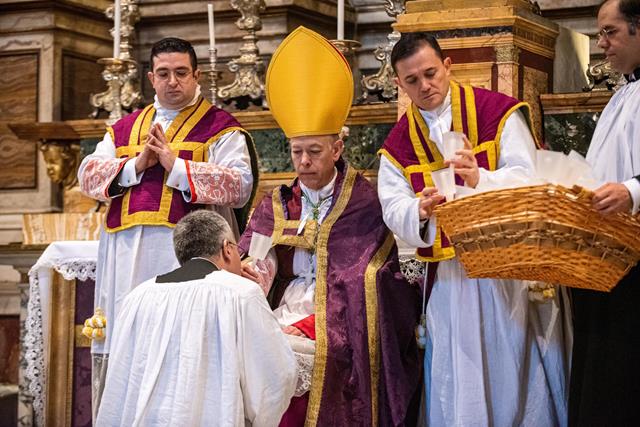
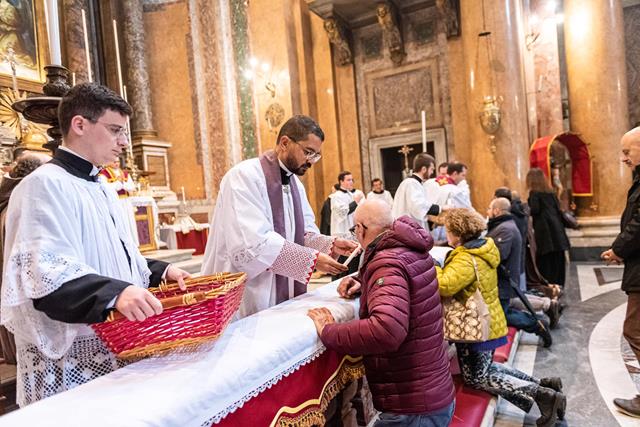
In the traditional distribution of candles, you kiss the candle and the priest’s hand as you receive it. It is, therefore, a liturgical act, far more than, “Here. Have a candle.”
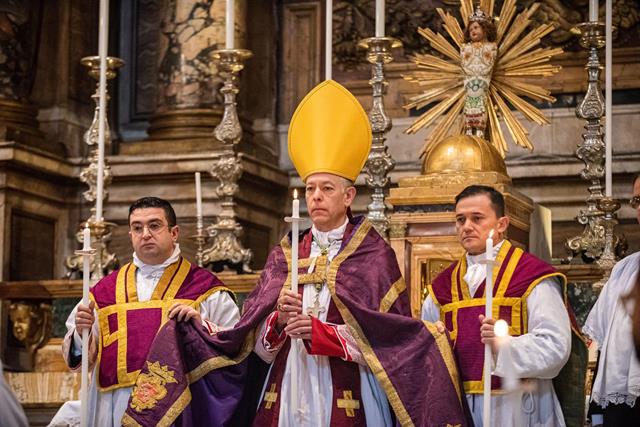
Ready for the procession. Note that Bambino Gesù is in the house. The Feast of the Purification is the last hurrah of the Advent/Christmas/Epiphany cycle. This is the last time we sing Alma Redemptoris Mater, for example.
At Ss. Trinità dei Pellegrini they have, with the help of The Great Roman™, revived the ancient Archconfraternity set up by the Co-patron of Rome, St. Philip Neri. Their original mission was to minister to pilgrims to Rome. Today they are also working to promote a more zealous practice of the Faith through liturgy, processions and devotions.
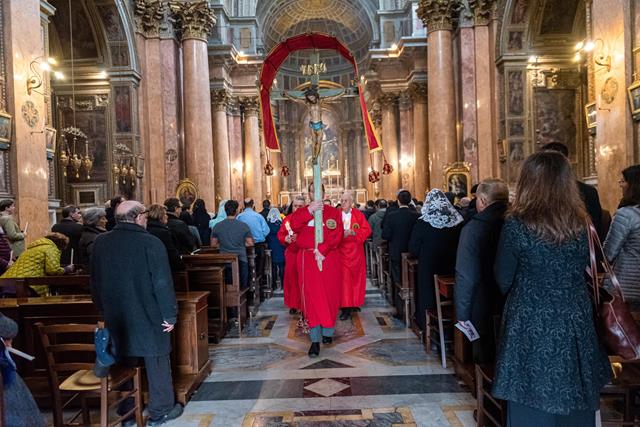
Out into the streets.
“Meno chiacchiera! Più processioni!”
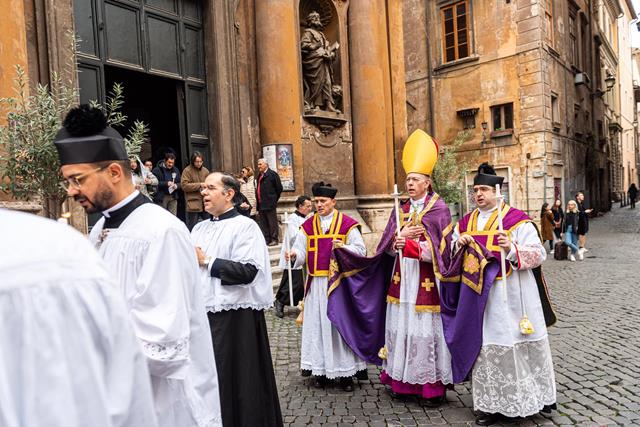
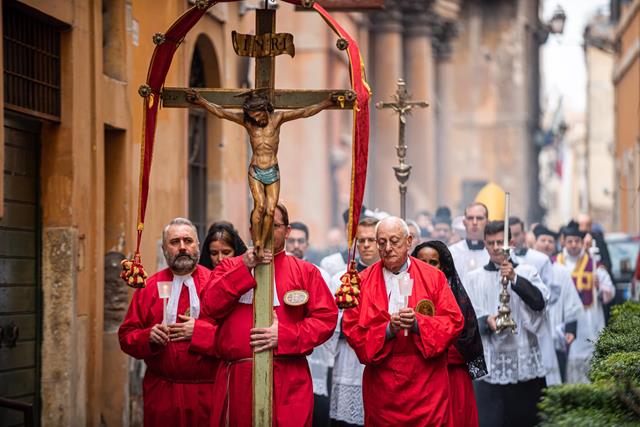
Back in the church, it’s time for Mass. The ministers and altar change to white. The blessing of candles and procession take the place of the prayers at the foot of the altar. After reverencing the altar, they go straight up for the incensation.
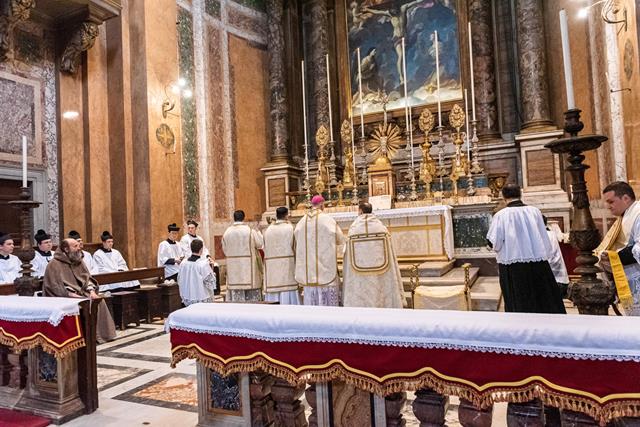
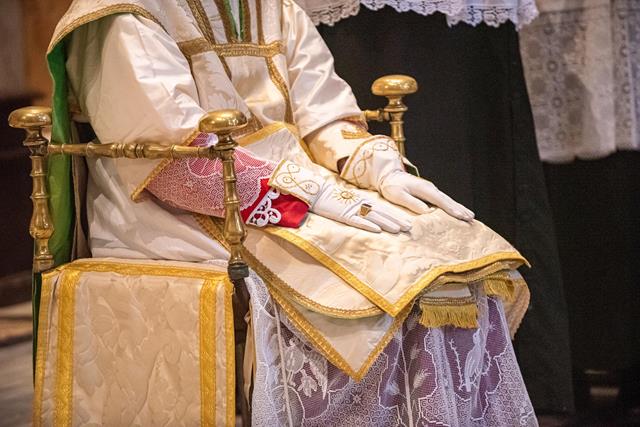
How a celebrating bishop ought to dress and to sit. It is also an old custom for the ministers to sit with their right foot slightly ahead of the other, in the old Roman manner of ancient holder of imperium seated in his curule chair.
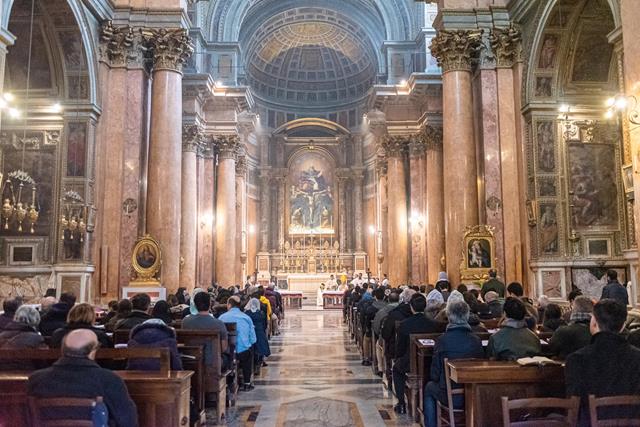
As usual the church was full.
They used a pax brede. This gadget is used to carry the kiss of peace from the altar to those in choir.
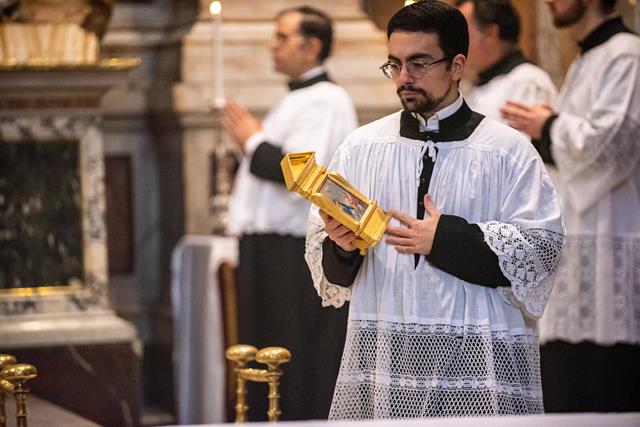
A truly Roman Mass has a lot going on.
I am please to see these photos of the font and of Archbp. Sample and the crew at Ss. Trinità.
 From a reader…
QUAERITUR:
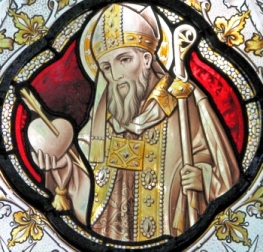
I have a number of volumes of St. Augustine’s writings, almost entirely English translations. However, I recently acquired a volume of his writings in Latin and the title page refers to him as “Sancti Aurelii Augustini.” I was wondering if you could explain the significance of “Aurelii” and why it is added to his name. I believe it is the Latin word for golden and therefore assume it is some sort of title of honor, but I was curious about its origin and significance.
Thanks for all the good work you do for our Church!
Thanks for the interesting question.
Auctores scinduntur… authors are divided about the great saint’s name.
The main line is that Augustine belonged to the Roman family, gens, the Aurelia. The gens Aurelia were Roman citizens. Thus, his name, Aurelius Augustinus.
On the other hand, some suggest that Augustine acquired Aurelius along the way because Augustinus was on lists of participants of Councils in N. Africa immediately after that of the great Primate of Africa and Bishop of Carthage, Aurelius. So, as Lancel puts it in terms of modern orthography, was the conciliar list really “Aurelius Augustinus” or was it “Aurelius, Augustinus”.
But, as I said, it is pretty much accepted that Augustine was from the gens Aurelia.
As Gerald Bonner says, the saint’s nomen is Aurelius, his cognomen is Augustus, and there is no information about a praenomen.
Of course we could have a little fun and take this another step.
How is the saint’s name pronounced?
Is it
AuGUStin
ɔːɡʌs’tiːn
or
AUgusteen
ɔːɡʌsˈtiːn
We could have a poll!
Think about it. There is another Augustine, of Canterbury. Is his name pronounced differently from that of the Doctor from N. Africa? How about the city in Florida? Aby analogy, what about the name of the Emperor Constantine?
Everyone can vote, but only registered users can post comments. And please do!
I think there is a correct answer, by the way.
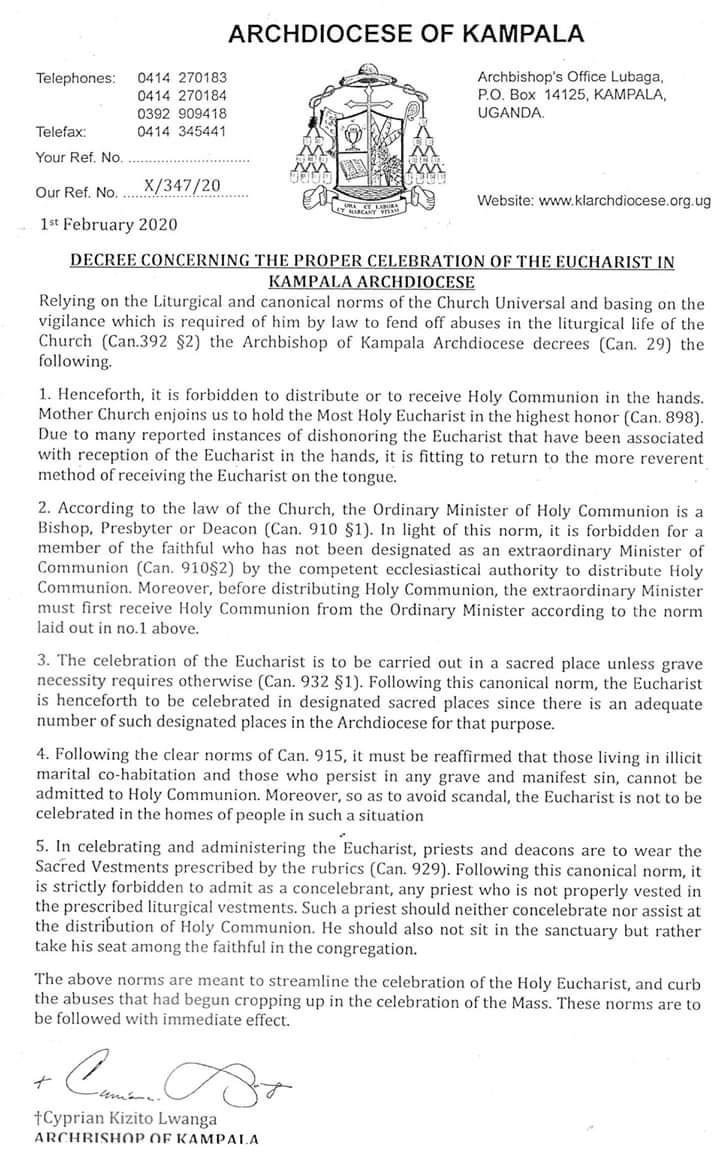
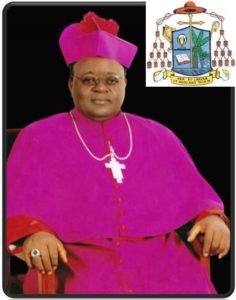 From PML (Post Media Ltd in Uganda) comes this story. HERE
The Archbishop of Kampala, Most Rev. Cyprian Kizito Lwanga (age 67), has issued some decrees.
First, he has decreed on 1 Feb 2020 that “every priest, be it a curate or parish priest, will be required to serve for three years in any given parish, school or area. From there, his contract can then be renewed for another three years, after which he will transferred to another area. He said no priest will be allowed to serve beyond two three-year terms at a parish.”
I suspect what this is a similar to the (I think bad) practice in these USA of assigning priests for a 6 year term, renewable. Instead, it is a three year term.
Moreover, Masses are not to be celebrated in homes.
Moreover, he has admonished cohabiting (unmarried) couples not to receive Communion.
Moreover, he has said that priests should avoid having lay people distribute Communion at Mass.
Moreover, priests and deacons are to wear proper vestments.
Moreover, and this is the big one, he has forbidden Communion in the hand. Separate story HERE
“Henceforth, it is forbidden to distribute or to receive Holy Communion In the hands. Mother Church enjoins US to hold the Most Holy Eucharist in the highest honor (Can. 898). Due to many reported instances of dishonoring the Eucharist that have been associated with reception of the Eucharist in the hands, it is lilting to return to the more reverent method of receiving the Eucharist on the tongue,…”
Hopefully this can be a model for decrees by other bishops across the world.
Tomorrow, Monday 3 February 2020, is the Feast of St. Blaise, upon which we traditionally have the blessing of throats.
However, in some places, because so many are in church today for Sunday Mass, the St. Blaise blessing was given.
Let’s have a poll.
Did you receive a St. Blaise Day blessing of the throat on Sunday or on Sunday 2 February, or Monday 3 February?
Pick your best answer. You are registered and approved, use the combox to explain what happened.
NB: ALSO, today I have a setting that should allow you, tomorrow, to come back and click ALSO the BONUS option if you wind up getting the blessing on both days. (In other words, check two boxes.) But be aware: if you vote today, and click submit, then you won’t be able to add your BONUS tomorrow. If you think you will be at Mass also tomorrow, you might wait until tomorrow to vote.
Meanwhile, if you are registered here, then both today and tomorrow, you can add a comment! You don’t have to be registered to vote… sort of like Chicago. Unlike Chicago, you do have to be alive.
Was there a good point made in the sermon you heard at the Mass that fulfilled your Sunday Obligation? What was it?
There are a lot of people who don’t get many good points in the sermons they must endure.
For my part…

 From a reader…
QUAERITUR:
Some of us have a hard time getting to Mass on Feb 3rd for the Saint Blaise throat blessing with the candles.
Would it be okay for a priest to give that blessing on another day?
Frankly, I can’t think of a reason why a priest couldn’t give that blessing on, say 2 February, or 4 February, or 4 July, or some other time, if needed.
I like things tidy and I think that the calendar is important. But, a greater good than sticking only to 3 February as the sole day for that blessing is that people receive the blessing. Remember that the traditional Rituale Romanum itself says that it is intended as a starting point for practice and even local rituals. Since I seriously doubt that it is an easy matter to come up with something better than what the Rituale provides, just stick to it.
It is best that you make the effort to get it on St. Blaise Day, since that is the day prescribed. However, well… get it when you can.
Let’s review the blessing for the candles.
God, almighty and all-mild, by your Word alone you created the manifold things in the world, and willed that that same Word by whom all things were made take flesh in order to redeem mankind; you are great and immeasurable, awesome and praiseworthy, a worker of marvels. Hence in professing his faith in you the glorious martyr and bishop, Blaise, did not fear any manner of torment but gladly accepted the palm of martyrdom. In virtue of which you bestowed on him, among other gifts, the power to heal all ailments of the throat. And now we implore your majesty that, overlooking our guilt and considering only his merits and intercession, it may please you to bless + and sanctify + and impart your grace to these candles. Let all men of faith whose necks are touched with them be healed of every malady of the throat, and being restored in health and good spirits let them return thanks to you in your holy Church, and praise your glorious name which is blessed forever; through Christ our Lord.
Lovely.
So, that is the prayer for the blessing, which must be done in Latin. Remember, in 1962 we still had to use Latin for blessings of objects. Latin. Not Weller’s English. Latin.
How about the blessing of throats?
The Rituale says that the priest holds these candles in the form of a cross under the chin and against the throat of each person who are kneeling before the altar.
He says, in Latin, “Per intercessionem Sancti Blasii, Episcopi et Martyris, liberet te Deus a malo gutturis et a quolibet alio malo. In nomine… Through the intersession of St. Blaise, bishop and martyr, may God preserve you from throat troubles and every other evil. In the Name of the Father, and of the Son, and of the Holy Spirit. Amen.”
But wait! There’s more.
Did you know that there is yet another thing to bless on St. Blaise Day?
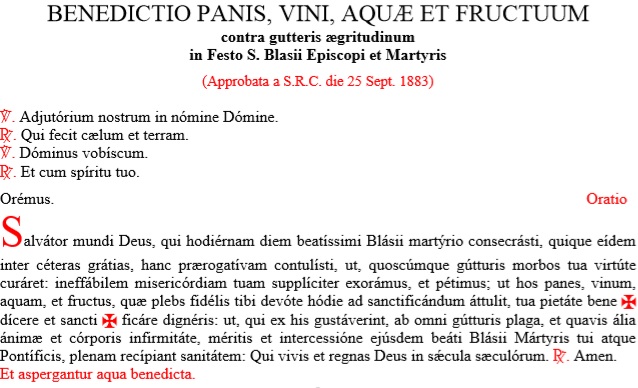
On 3 February Father can also bless bread, wine, water and fruit.
Here is the English
God, Savior of the world, who consecrated this day by the martyrdom of blessed Blaise, granting him among other gifts the power of healing all who are afflicted with ailments of the throat; we humbly appeal to your boundless mercy, begging that these fruits, bread, wine, and water brought by your devoted people be blessed + and sanctified + by your goodness. May those who eat and drink these gifts be fully healed of all ailments of the throat and of all maladies of body and soul, through the prayers and merits of St. Blaise, bishop and martyr. We ask this of you who live and reign, God, forever and ever.
So, you can take some fruit, bread, wine and water… good things for a person who isn’t feeling well, to church for a special blessing. Here is the Latin. Father has to use Latin, not English. Latin. You can get the Rituale online at this site, very handy for resources. HERE
ZedNet is operational. More HERE. We should figure out some schedules.
Meanwhile, a local Elmer sent me something the other day. He captured a shot of the QRZ page which featured my call that day! Fun.

That’s about it.
If you are DMRing, think about ZedNet.


Coat of Arms by D Burkart
 Discerning Altar Boy on Your Sunday Sermon Notes – Feast of Christ the King (N.O.: 30th Ordinary): “NO. Pastor preached on setting a good example, riffing on Saint Josemaria and the Epistle to the Thessalonians. Challenge people…”
 on Summorum Pontificum Pilgrimage 2026… *sigh*… Vatican Bars Annual TLM Pilgrimage from ENTERING St. Peter’s Basilica: “The ironic thing – if Pope Leo was so worried that allowing another Latin Mass in St. Peter’s would be…”
 on Summorum Pontificum Pilgrimage 2026… *sigh*… Vatican Bars Annual TLM Pilgrimage from ENTERING St. Peter’s Basilica: “There was great hope by many of us on the trad side that Pope Leo would either undo or scale…”
 on ROME 26/10– Day 22: Colors and courses and Coco: “Thank you, pestolover. I made sure that my solution was correct before posting it; but, as is my fatal flaw,…” on Summorum Pontificum Pilgrimage 2026… *sigh*… Vatican Bars Annual TLM Pilgrimage from ENTERING St. Peter’s Basilica: “@gaudete – give me a break. The pilgrimage has been done for 15 years. It’s always on the same date.…”
 on Summorum Pontificum Pilgrimage 2026… *sigh*… Vatican Bars Annual TLM Pilgrimage from ENTERING St. Peter’s Basilica: “The refusal to hold Leo accountable for the relentless and ongoing abuses toward the people of God has grown intolerable.…”
 on Summorum Pontificum Pilgrimage 2026… *sigh*… Vatican Bars Annual TLM Pilgrimage from ENTERING St. Peter’s Basilica: “How about a People’s Invasion of the Vatican City and installing a People’s Committee to rule the Vatican. Nice commie…”
 on Summorum Pontificum Pilgrimage 2026… *sigh*… Vatican Bars Annual TLM Pilgrimage from ENTERING St. Peter’s Basilica: “Respect to all, and could somebody make a t shirt? The three crosses on a hill, and then the logo:…”
A Daily Prayer for Priests







They find you a pro-life agent in your area who commits to giving a portion of the fee to a pro-life group!

PLEASE subscribe via PayPal if it is useful. Zelle and Wise are better, but PayPal is convenient.
A monthly subscription donation means I have steady income I can plan on. I put you my list of benefactors for whom I pray and for whom I often say Holy Mass.
In view of the rapidly changing challenges I now face, I would like to add more $10/month subscribers. Will you please help?
For a one time donation...



Help Monks in Wyoming (coffee – UPDATED LINK) and Norcia (beer) and the wonderful "Soap Sisters" of Summit, NJ!


Please follow me on Twitter!










Visits tracked by Statcounter
since Sat., 25 Nov. 2006:
