ASK FATHER: Different kinds of Holy Water

ASK FATHER: Different kinds of Holy Water

From a reader…

QUAERITUR:

To prevent the potential spread of coronavirus, my parish in Tokyo has temporarily discontinued the use of Holy Water upon entrance to the chapel. This has me thinking about the various types of Holy Water. Can you explain the difference between ordinary Holy Water, Epiphany Water, Easter Water, Old Rite Water and their relative merits/uses/capabilities?

Tokyo!  It was about 1 year ago that I was there and celebrated the TLM for a wonderful group of people.  I met the late Fr. Augustin Toship Ikeda at that time.  Prayers for him.

Holy waters!  A great topic.

Here are a few notes about different blessed waters we Catholics use and enjoy.  This is not meant to be exhaustive.  I just want to give a snapshot to those of you who haven’t heard of these things before.

The blessing and use of Holy Water goes back to very early Christian times.  Using the traditional Roman Ritual, the water for Holy Water is first exorcised.  Exorcised salt is mixed with the water.  In both exorcisms the water and salt are addressed directly, as if they were almost sentient, “O you creature of salt, be thou a blessed salt”, and so forth.  The salt has symbolic value, of course, and the saltiness of the water helps retard algae growth.    The prayers for blessing the salt include the biblical image of Eliseus (Elisha) healing the barrenness of the land and water of Jericho with salt, which is counter-intuitive.  God can do all things through his chosen instruments.

The blessing for the water and salt tell us what the Church is doing and what we should do with it:

 May this creature of yours, when used in your mysteries and endowed with your grace, serve to cast out demons and to banish disease. May everything that this water sprinkles in the homes and gatherings of the faithful be delivered from all that is unclean and hurtful; let no breath of contagion hover there, no taint of corruption; let all the wiles of the lurking enemy come to nothing. By the sprinkling of this water may everything opposed to the safety and peace of the occupants of these homes be banished, so that in calling on your holy name they may know the well-being they desire, and be protected from every peril

[…]

wherever it is sprinkled and your holy name is invoked, every assault of the unclean spirit may be baffled, and all dread of the serpent’s venom be cast out.

You see, this is a powerful spiritual tool against the enemy.

Remember that this world has its “prince”, the Enemy, the Devil.  By blessings and consecrations by the priest material things are torn away from the prince and given over to the King, Christ.  We use these sacramental against the Enemy for the sake of body and soul, which are interconnected in this life.

ASK FATHER: Different kinds of Holy WaterEaster Water is blessed at Easter and at Pentecost.  As you might surmise it is used for baptisms.  Easter Water is blessed while mixing in Oil of Catechumens and Sacred Chrism.  The Paschal Candle is also held in the water.   There is a rite for blessing Baptismal Water apart from Easter or Pentecost.  This is the water we generally use for baptism, though in a pinch, other true water may be used.  We use Baptismal Water for much the same reason as regular Holy Water.  The bonus is the lovely fragrance of the Chrism in the water.

There is a blessing of a rare water used for the reconciliation of a church building, or for the blessing of an altar at the time of the consecration of a church called Gregorian Water, which involves the admixture of blessed ashes and blessed salt and blessed wine.  This water is also used in the rite of “reconciliation” of a church.  A church is a sacred place, normally consecrated.  If something bad happens in the building, say the priest is attacked during Mass or someone breaks in and does a terrible thing inside, then the building should be “reconciled” so that it can be used again for sacred purposes.  We don’t just ignore evil acts, because demons attach through evil acts.  Hence, we exorcise things and people before we bless or baptize.  Gregorian Water, with its use of ash, is a cleansing water.  Ash is an element of ancient soap, after all.   The blessing of Gregorian Water is in the Pontificale Romanum, used by bishops only. The rite for Gregorian Water is particular.  Even the exorcism and blessing of salt is unlike that of the normal Holy Water.  It talks about the reason for its use, the expulsion of demons and temptations from demons.  Similarly, the exorcism of the water describes how it is to be used to drive demons from the even the shadowy places of the church and around the altar.  He blesses ashes without exorcising them, with the image of ourselves confessing our faults.  The wine is blessed invoking the image of Cana.  I’ve never seen this rite.  I’d sure like to.  I hope it will be for the consecration of a church, rather than for its reconciliation!

There is also a blessing of water at Epiphany which involves the basic salt and water combination of Holy Water.  This make Epiphany Water.  The rite is amazing.  I refer you to my post HERE.  However, there is a nice rite which can be performed in the context of, say, Vespers which involves solemn exorcisms of the place and singing psalms, the Litany and Te Deum.  This water would be used to bless houses, along with the blessed chalk, of course.  It is an amazing rite.  This year’s photos HERE.

On different feast days priests could bless water in honor of such and such a saint, for example, St. Raymond Nonnatus or St. Ignatius.  Lots of these.

And we mustn’t forget the Benedictio maris, blessing of the sea, wherein, I believe God has already mixed in the salt.  Spectacular prayers.  I’d love to do that one sometime, preferably with a procession with a statue of the Blessed Mother to the shoreline, with the city’s oompa band.  There are blessings of a spring and a well, as well.  When you don’t get your water from a tap, a state to which we may all soon be returning, you want a priest around to bless your water source.  The blessing for the well includes the serious “repulsis hinc phantasmaticis collusionibus, ac diabolicis insidiis, purificatus atque emendatus semper hic puteus perseveret.”  Nice clausula.

Anyway, we Catholics are deeply interested in water and we like our water blessed, thank you very much.  A thousand and one uses!  Especially against the Enemy of our soul.

The Devil really hates this stuff.

A note.

Newer rite v. traditional rite.

I have never, in almost 30 years as a priest, even once use the post-Conciliar Book of Blessings to bless anything, much less Holy Water.

As a matter of fact, I don’t think that the prayers in that book intend to bless anything.  There is one, I think, which is the traditional prayer for blessing a rosary, tucked in with other options that might bless a person who might use a Rosary.  The book’s preface attempts to change the Church’s theology about blessings.  There are, to be quick, two kinds of blessings, invocative, by which we call down God’s blessing on a person or animal, and constitutive, which ask God to make a thing or place a blessed thing or place with an enduring blessing.   The new book eliminates that distinction.  Hence, I will never, ever, EH-VUR, use the Book of Blessings, which I consider to be a travesty that should never have been promulgated.

I use the older, traditional Rituale Romanum.  I always have and I always will.  The rite tells you what it is doing.  There are the important exorcisms of the elements of the Holy Water (salt, water – in the case of Easter water the oils are consecrated by a bishop).  The prayers say what is going on, the Church’s intention in blessing regular Holy Water.

“God’s creature, salt, I cast out the demon from you…”

“Almighty everlasting God, we humbly appeal to your mercy and goodness to graciously bless + this creature, salt…”

“God’s creature, water, I cast out the demon from you…”

“… pour forth your blessing + on this element now being prepared with various purifying rites.”

“… we beg you, Lord, to regard with favor this creature thing of salt and water, to let the light of your kindness shine upon it, and to hallow it with the dew of your mercy; so that…”

Our rites should describe what we want them to do.  This is also important because

WE ARE OUR RITES.

Use Holy Water.  Sprinkle it around your dwelling. Bless yourself with it.

Posted in "How To..." - Practical Notes, ASK FATHER Question Box, Liturgy Science Theatre 3000, Our Catholic Identity | Tagged
11 Comments

ASK FATHER: Pay the German “Church Tax” or not, given what the German Church is doing?

ASK FATHER: Pay the German "Church Tax" or not, given what the German Church is doing?From a GERMAN reader…

QUAERITUR:

Currently, I am required to pay my income tax in Germany, which also includes the “Church Tax” as I have declared that I am a Roman Catholic.

It appears one cannot just opt-out of this tax, as far as I can tell, one needs to declare not longer being Roman Catholic (and the German bishops threaten with Excommunication).

However, seeing what is going on in Germany, I’ve reached a point where I cannot, in good conscience, fund those activities anymore.

Aside the fact that we’d rather spend the money for something useful, e.g. funding another seminarian at the FSSP seminary, this touches on actively funding activities that are, IMO, openly anti-Catholic and I fear that I am engaging in a sinful activities by continuing to pay the tax.

Do you have any advise for me on what to do?

Since this is a little apart from my wheelhouse, I asked a trusted German priest, a friend of many years and absolutely solid.

GUEST PRIEST RESPONSE:

The system is broken. I understand your correspondent’s doubts and frustration.

It is interesting how in Germany even the language used by the church often has to do with membership rather than faith in God. The contribution based system leaves deep traces in how the local church thinks and acts.

At the same time, the individual Catholic is not “guilty” of supporting bad and questionable things by paying the tax, as all my relatives do.

In reality, most of the Church activities funded by the tax are not evil.
Ultimately, donors can never avoid totally that their money will be used unwisely, or even sinfully. Such scruples are unreasonable, IMHO: that responsibility lies with someone else.

The fact is that in the US the faithful have other means of influencing how the Church spends its money. In Germany this is much more complicated. Practically, the faithful have less immediate influence.

The fact is that, even today, opting out (Kirchenaustritt) is not generally seen as an acceptable option by the faithful or by the clergy in Germany.

I do not see how the act as such can be considered an act of schism, apostasy such as to incur excommunication.  As I read the bishops, the act, because it is public and official, is currently rather something like manifest grave sin.  Therefore, can. 915 is to be applied.

What your questioner could do now is make his difficulties known to his own pastor, and to the competent bishop.  Let them know that this constitutes a huge problem for him, and that he is unsure how he can resolve it under the present conditions.

Get on their nerves: ¡Hagan lío!

Posted in ¡Hagan lío!, "How To..." - Practical Notes, 1983 CIC can. 915, ASK FATHER Question Box, HONORED GUESTS, Our Catholic Identity | Tagged ,
34 Comments

Lest BREXIT go unnoticed, a Martyrology entry: “Pridie Kalendas Februarii Luna sexta Anno Domini 2020…”

I received this from a reader.

Pridie Kalendas Februarii Luna sexta Anno Domini 2020

Britanniae, anno LXVIII regni Elizabethae Reginae, Imperium, splendore radians, ab illo comitio diabolico scilicet, Unione Europaea, post annos dolorosos XLVII, (br)exiit.

‘In Britain, the 65th year in the reign of Elizabeth Regina, the Empire, bedecked with splendour, after 47 dolorous years, left that diabolical assembly, the European Union.’

This is what Beans tweeted today, in a fit of Euronostalgia.

Perhaps the best thing that he could do is return to Europe, there to help his fellow Europeans get over their loss.

Next… Uscitalia?

Posted in Lighter fare | Tagged
33 Comments

ASK FATHER: In time of high risk contagion, nitrile gloves for distribution of Communion?

ASK FATHER: In time of high risk contagion, nitrile gloves for distribution of Communion?From a reader…

QUAERITUR:

Are disposable nitrile gloves acceptable of a Priest distributing the Eucharist? Nitrile gloves are proven to help prevent the spread of pathogens.

Yes, this can be done.  Should it be done is another thing.

Holy Communion can be delivered by means of an inanimate object, such as a tweezers or forceps or tube.  I don’t see a problem with a nitrile glove, other than aesthetics.

Perhaps the color of the day would help?    Blue gloves… hmmm.

It is easy to purify metal objects, but less easy to purify the gloves.  They could be put into water, to dissolve particles of the Host, and then eventually burned.

This brings in several points.  Would the people receiving, and receiving in the hand (blech), wear nitrile gloves?   What would that look like (other than increased risk of profanation of the Eucharist… as every Communion in the hand obviously is)?

I suppose that the gloves would have to be immediately stripped off, dropped into water for a bit, the water drained into the sacrarium or onto the ground, and then the gloves burned.  Would there now have to be a Minister of the Glove Bucket?

Of course if tongs can be used, why use the gloves?

I wonder if it would get to this point.

In a case where the disease is that dangerous and easily transmitted, I suspect you won’t have many people in church for Masses.  Some will want to pray, naturally, and have Mass.

The more urgent question is the procedure for the priest giving last rites including Viaticum.  In that case, Fathers, yes, you can use a nitrile glove or a tong or a metal fistula or straw or an eyedropper to give Communion.    Also, it is possible to anoint using a tweezers or forceps to avoid contact or also simply to reach a person.  I had to do that once in a hospital.

It is an interesting question and I am glad that it came up.

We need questions and information to help us game things out in our heads, which ought to be a constant, commonsense, practice of situational awareness.

Posted in "How To..." - Practical Notes, ASK FATHER Question Box, Liturgy Science Theatre 3000, Semper Paratus | Tagged ,
20 Comments

Getting a boost. Thanks.

I am grateful today for a new monthly donor.  AO  UPDATE: Also,  MB, RS, QJ, JB, DH, ML, MM

Today is one of those lean days of the month, when not so many people have subscribed to a monthly donation. One reason why, perhaps, is because not all month’s have a 31st day. In the case of those that have only 30, I think the 31sters get bumped forward. I have to see what happens on 29 February, since it is a leap year!

The last year, 2019, was leaner than 2018, which is a problem.  Hence, having notifications about new subscribers is a morale boost when they come in.

I consider it a duty and an honor to pray for benefactors.  I remember you daily and I, regularly, say Mass for your intentions.  If there are notes with the donations, I also stop and pray for those intentions.

If the blog is useful to you, please consider signing up.


Some options


Getting a boost. Thanks.

Thanks. And when shopping online, please use my Amazon link. HERE

Finally, for those of you who have qualifications, remember that I and others are trying to form a Catholic Signal Corps.

Posted in "How To..." - Practical Notes |
Comments Off on Getting a boost. Thanks.

MAP and Stats: track the spread of Coronoavirus

Johns Hopkins has a live map and site that show the spread of Coronovirus.  HERE

A screenshot:

MAP and Stats: track the spread of Coronoavirus

I refer you also to a post with some fiction and, in the comments, great fiction and non-fiction reading.  HERE

How fact can a virus get out and then mutate?  Do you really want to know?

Posted in SESSIUNCULA | Tagged
8 Comments

Strong tonic to bishops and priests: “If I can’t endure the cold shower, … maybe I’m not fit for heaven.”

Strong tonic to bishops and priests: "If I can’t endure the cold shower, ... maybe I’m not fit for heaven.”At LifeSite there is a a superb opinion piece (frankly, most of LifeSite is opinion) by Kevin Wells, author of The Priests We Need to Save the Church.

Wells describes a program that some men are undertaking, a kind of spiritual S.E.R.E. training called Exodus 90, 90 days of physical denial and penances, cold showers, daily Mass, Rosary, etc. to “lift the mind up to Christ, strengthen virtue, and subdue the flesh”.

BTW… there is a difference between cold showers in Florida and in Minnesota.

Here are some snips from the piece, which I hope all the male readers here, and Jesuits, will read.

Time for bishops to be faithful and shut down renegade priests who champion homosexuality

[…]

A single American bishop (that I’m aware of) is participating in Exodus 90. Interestingly, this is the same bishop who addresses, by name, the progressive toxicity of Fr. James Martin and his seemingly unimpeded march to normalize homosexuality. This shepherd (who will go unnamed because he would not want the attention) presses for answers on the Vatican’s stagnated McCarrick report. He’s condemned the United Nations for its anti-life stance and urges the hierarchy to maintain, enshrine, and proclaim difficult Church teachings and doctrine. He’s given Strong tonic to bishops and priests: "If I can’t endure the cold shower, ... maybe I’m not fit for heaven.”over his diocese to veneration of the Eucharist.

During these days of muted courageous leadership within our Church, many American Catholics today regard this bishop as a warrior or some sort of sanctified cowboy — a solitary figure attuned to the multitudinous troubles that have broken into his Church. He’s masculine — a shepherd who often regards parts of his weathervane-wind-whipped Church simply as loose stallions needing to be meeked.

Many regard his way as too rigid or overly pious. Thankfully, for this bishop, there is only the fight for souls — his own, those in his diocese, and the troubled soul of what seems an increasingly balkanized Church. Red martyrdom, he’s mentioned to me, is not something he regards as seldom read passages from old small-fonted Catholic books on saints; he believes that Mary is leading him to it. He knows that the burden of his identity includes an embrace of a certain death to help guard the travailed Church. This awareness became clear during his daily Holy Hour.

[…]

Wells goes on to describe the opposite of that bishop, an embarrassment of a priest, Fr. Peter Daly, who conducts affirming retreats for the homosexual inclinations of priests, sponsored by the condemned New Ways Ministry, etc.   Wells doesn’t spare the scorn.

He calls on bishops to do something.

[…]

When the stampeding Fr. James Martin begins to be slowed by a few courageous shepherds, your flock will begin to heal. When you rise up and speak against the “synodal” heresies of German bishops, a salve will begin to stretch into harmed souls — and the laity will trust you again — because it is then that you’ll be acting like a father.

Until then, though, I’ll place my trust in my own little fraternity, which each day puts in the sweat equity that fathers must. These fathers really are like hero cowboys, men who happily embrace discomforts, sacrifices, and worldly rejection so that one day, God willing, they’ll gather with their families for endless length of days in their true native land.

On the sidebar, I have a quote from the late Fulton J. Sheen:

“Who is going to save our Church? Not our bishops, not our priests and religious. It is up to you, the people. You have the minds, the eyes, and the ears to save the Church. Your mission is to see that your priests act like priests, your bishops act like bishops.”

UPDATE:

Thanks to acardnal, in the comments.

Play video

Posted in ¡Hagan lío!, Cri de Coeur, Fr. Z KUDOS, Hard-Identity Catholicism, Jesuits, Just Too Cool, One Man & One Woman, Priests and Priesthood, Si vis pacem para bellum!, Sin That Cries To Heaven, The Coming Storm, The future and our choices | Tagged ,
20 Comments

The church of England apologizes for its temporary lapse into Christianity – UPDATED

UPDATED 1 Feb 2020:

I have an apology to make.  Not to the cofE.

Yesterday, before I had read anything else, I checked my mail.   A couple of friends with whom I often exchange news, both dire and ironic, for the blog had included me in this.

The church of England apologizes for its temporary lapse into Christianity - UPDATED

As you can see, my corresponded wrote, not as part of a link, “Th [sic] Church of England apologizes for it’s temporary lapse into Christianity.”

I thought that was a pretty snappy line. I did a post with it. I did not know that the origin of the outstandingly sardonic quip was the perennially funny Eccles is saved. I hadn’t seen that blog yesterday. Had I known, I absolutely would have given attribution. My sincere apology for stepping on Eccles feet. I didn’t get the phrase directly from his blog, but indirectly.  In any event, that’s where it came from and he deserves the credit.

That said, there is another issue. The blog Rorate.

One of the writers at Rorate has for some time now often posted truly nasty things about me. For a long time that bothered me because I had no idea why the hostile turn. I have on quite a few occasions reached out on the blog toward them with an olive branch. To no avail. The fragmentation of the traditional side of the blogosphere does nothing but to harm our common cause, the restoration of worthy sacred liturgical worship, without which no other project in the Church will succeed.

In the wake of Eccles alert that I had used his line (again, sorry about that) Rorate, again, used the occasion again to attack me publicly in a Tweet.

That’s the “only problem”.  That’s good.  At least, now I know it.

Here’s the deal.

Firstly, I am glad at least to know something about the rough parameter of Rorate’s “problem” with me. Someone there – he wrote “we” but I know writers for Rorate  – who seems to be the main contributor, believes that I have taken their lines without attribution.

Frankly, I am not aware that I have done that. I searched back in my email and found a puzzling exchange from 2013 – yes, 2013 – in which the Rorate chap refers to something I don’t any longer recall anything about, something have to do with Card. Bergoglio perhaps approving hybrid Masses in Argentina.  It was

2013 – Seven years – Perhaps it’s time to bury the hatchet?

Even the Bible says that seven years is a time of grace.

I am happy to clear the air in private way, if that will help.

Meanwhile, I send my cordial regards to Eccles, hoping that he is still saved, even after my inadvertent posting of his seriously funny line.

My apologies for that, to Eccles, and thanks for his lighter touch in pointing it out.

Maybe we can bring something out of this to help souls, which is more important than clicks.

___ Originally Published on: Jan 31, 2020 at 09:17

The church of England apologizes for its temporary lapse into Christianity - UPDATED

The late Fr. Richard John Neuhaus said that the Anglican Church existed in order to make irony redundant.

Today I read that the church of England apologized for its temporary lapse into Christianity.

From The Guardian…

Church sorry for saying that sex is just for married heterosexuals
Church of England archbishops acknowledge pastoral guidance ‘jeopardised trust’

The archbishops of Canterbury and York have apologised over a statement issued by Church of England bishops last week which declared that only married heterosexuals should have sex.

Justin Welby and John Sentamu said they took responsibility for releasing the statement which “jeopardised trust”. They added: “We are very sorry and recognise the division and hurt this has caused.”

The archbishops’ statement did not retract the substance of the “pastoral guidance” issued by the bishops, but implied it should not have been issued while the C of E is in the midst of a review of its teaching on sexuality and marriage.

[…]

Hey, let’s not be too hard on the “c“hurch of England.

Do you remember a few years back the disastrous Card. Kasper and his appalling “tolerated, but not accepted” kabuki dance whereby objective adulterers with no purpose of amendment would be admitted to Communion?

In effect, Kasper infamously suggested to the bishops in the Extraordinary Synod (“walking together”) on the Family, during his looooong, flimsy ramble about Communion for the “remarried”, that there could/should be a “tolerated, but not accepted” solution. That is: “The Church won’t accept your new status, because you are obviously committing adultery and Christ made it clear that you couldn’t ‘marry’ again with your spouse still on this side of the grass, but – hey! – we will hold our noses and watch you go to Communion anyway. You can be a kind of pity case or second class Catholic. We will tolerate you, but not accept you.”

I remind all my readers who are perhaps mired in the cofE and its other branches, that there is something called Anglicanorum coetibus.   If you can’t stand it anymore, cross the Tiber.

Benedict XVI!  The Pope of Christian Unity!

On the flip side, I still think the cofE should issue a response to Anglicanorum coetibus.  They should issue Romanorum coetibus by which they can welcoming into their “ecclesial community” (remember, according to Dominus Iesus they don’t have a real Church because they don’t have valid apostolic succession), all the dissident Catholics who, rebelling against the Magisterium, desire to keep their most treasured customs.  There in the embrace of the Anglicans they can have their clay pot chalices and burlap banners, their ditties and rainbow stoles, and gender free sex, free from the interferenceThe church of England apologizes for its temporary lapse into Christianity - UPDATED of patriarchal oppression.

Perhaps this is a good moment for a bunch of Jesuits – irony much? – to leave and join the cofE.

Posted in One Man & One Woman, You must be joking! | Tagged ,
6 Comments

Lovely poetry about Candlemas, the beautiful Feast of the Purification, Presentation of the Lord

Lovely poetry about Candlemas, the beautiful Feast of the Purification, Presentation of the LordCandlemas is coming up, the Feast of the Purification, as it is traditionally called. 

We call it Candlemas because, with the references to light in the liturgy, we bless candles.

Candlemas is the conclusion of the Advent/Christmas cycle.  We are 40 days from the Nativity of our Lord.  Liturgically, the Marian Antiphon and response changes.  We have been singing Alma Redemptoris Mater since the beginning of Advent.  This ends on Candlemas.   Hereafter we sing Ave Regina Caelorum through Lent until Spy Wednesday of Holy Week.

Because of the antiquity of the feast, there are many cultural traditions for its celebration.  For example, in some French speaking regions it is customary to eat crêpes, in Mexico tamales.   I am contemplating the other Christmas pudding I made this year.

Also, I now have a beautiful crêpe pan sent some time ago from my wishlist by a kind reader.

Here are some poems for Candlemas.

First and foremost, making a reference to the removal of Christmas decorations, is a lovely poem by Robert Herrick (+1674).  In some places, people take down their decorations on Twelfth Night.  In others, Candlemas.

This poem traces something of the shifting seasons of the liturgical year and reminds us of the bitter and sweet passing of time.

Ceremony Upon Candlemas Eve
by Robert Herrick

Down with the rosemary, and so
Down with the bays and misletoe ;
Down with the holly, ivy, all,
Wherewith ye dress’d the Christmas Hall :
That so the superstitious find
No one least branch there left behind :
For look, how many leaves there be
Neglected, there (maids, trust to me)
So many goblins you shall see.

And the longer version of the same…

Down with the rosemary and bays,
Down with the mistletow;
Instead of holly now upraise
The greener box for show.

The holly hitherto did sway,
Let box now domineer,
Until the dancing Easter day,
Or Easter’s Eve appear.

Then youthful box which now hath grace
Your houses to renew,
Grown old, surrender must his place
Unto the crisped yew.

When yew is out, then birth comes in,
And many flowers beside,
Both of a fresh and fragrant kin,
To honour Whitsuntide. [Pentecost]

Green rushes then, and sweetest bents,
With cooler oaken boughs,
Come in for comly ornaments,
To readorn the house.

Thus times do shift;
Each thing his turn doth hold;
New things succeed,
As former things grow old.

I do like that last stanza, which is taken up in a lovely rendering of the poem, by Kate Rusby from a Christmas album – US HERE – UK HERE.

Play video

Next, something quite old and in an ancestor of Modern English.  It is from a manuscript in the Bodleian Library (MS Eng. poet. e. I, f. 38 f.).  To pronounce it you have to get some of the Norman French back into your tongue.  Here it is with a cheat version.

When I hear that Latin revértere, I immediately call to mind two moments in the Old Testament.  First, in the Lamentations of Jeremiah, Jerusalem is called to “turn about and go back” to the Lord.  Also, and more important for this carol, the Song of Songs comes up: Revertere revertere Sulamitis revertere revertere ut intueamur te HERE

Revertere, revertere
The queen of blysse and of beaute.
Revertere, revertere,
The queen of bliss and of beauty.
Behold what lyfe that we ryne ine,
Frayl to fale and ever lyke to syne
Thorow owr enmys entysyng;
Therefor we syng and cry to the:
Revertere…
Behold what life that we run in,
Frail to fall and ever like to sin
Through our enemy’s enticing;
Therefore we sing and cry to thee:
Revertere…
Come hyder, Lady, fayryst floure,
And kepe us, Lady, from doloure;
Defend us, Lady, and be owr socoure,
For we cease not to cal to the:
Revertere…
Come hither, Lady, fairest flower,
And keep us, Lady, from dolour;
Defend us, Lady, and be our succour,
For we cease not to call to thee:
Revertere…
Torne owr lyfe, Lady, to Goddys luste,
Syne to fle and fleschly luste,
For aftur hym in the we trust
To kep us frome adversyte.
Revertere…
Turn our life, Lady, to God’s lust, [pleasure]
Sin to flee and fleshly lust,
For, after him, in thee we trust
To keep us from adversity.
Revertere…
Thys holy day of Puryfycacyon
To the temple thou bare owr salvacyon
Jhesu Cryst, thin own swet Sone,
To whome thefor now syng we:
Revertere…
This holy day of Purification
To the temple thou bare our salvation,
Jesu Christ, thine own sweet Son,
To whom therefore now sing we:
Revertere…
Farwell, Crystmas gayer and fre!
Farwell, Newers Day with the!
Farwell, the holy Epyphane!
And to Mary now syng we:
Revertere…
Farewell, Christmas fair and free!
Farewell, New Year’s Day with thee!
Farewell, the holy Epiphany!
And to Mary now sing we:
Revertere…

Revertere… turn around and for the last time gaze back at the joy of Christmas.

Of course we have to have something from Rossetti (+1894)

A Candlemas Dialogue

by Christina Georgina Rossetti (after 1891)

‘Love brought Me down: and cannot love make thee
Carol for joy to Me?
Hear cheerful robin carol from his tree,
Who owes not half to Me
I won for thee.’

‘Yea, Lord, I hear his carol’s wordless voice;
And well may he rejoice
Who hath not heard of death’s discordant noise.
So might I too rejoice
With such a voice.’

‘True, thou hast compassed death: but hast not thou
The tree of life’s own bough?
Am I not Life and Resurrection now?
My Cross, balm-bearing bough
For such as thou.’

‘Ah me, Thy Cross! – but that seems far away;
Thy Cradle-song to-day
I too would raise and worship Thee and pray:
Not empty, Lord, to-day
Send me away.’

‘If thou wilt not go empty, spend thy store;
And I will give thee more,
Yea, make thee ten times richer than before.
Give more and give yet more
Out of thy store.’

‘Because Thou givest me Thyself, I will
Thy blessed word fulfil,
Give with both hands, and hoard by giving still:
Thy pleasure to fulfil,
And work Thy Will.’


How about a couple more?

Mary’s Purification

Sr. M. Bernetta, O.S.F. Robert, Cyril. Our Lady’s Praise In Poetry.
Poughkeepsie, New York: Marist Press, 1944.

Out went the stupid to wash the snow,
To cleanse the lily of Christ.
Wouldn’t you think that they all should know
The pearl who couldn’t be priced?
Wiser to purify the crystal stone,
To call the tulip unclean,
Than to wash the rose that God’s hand had sown,
Young Mary, the innocent Queen.

Candlemas

Francesca Franciscan Magazine – February 1960

The Mother brings her Candle
To the Temple of Desire,
In wax of flesh and weakness
But soul-wick full of fire!
A light to pierce the darkness,
Redemption for our race,
The gift of expiation
Before our Father’s face!
A flame of contradiction
To tyrant, Gentile, Jew,
But holocaust for ages,
Each dawn will see anew!
O take your Candle, Mary,
Too soon you’ll suffer loss
In Love’s great conflagration
On the altar of the Cross!

Finally… St. John Henry Newman’s 1849 poem “Candlemas”:

The Angel-lights of Christmas morn,
Which shot across the sky,
Away they pass at Candlemas,
They sparkle and they die.

Comfort of earth is brief at best,
Although it be divine;
Like funeral lights for Christmas gone,
Old Simeon’s tapers shine.

And then for eight long weeks and more,
We wait in twilight grey,
Till the high candle sheds a beam
On Holy Saturday.

We wait along the penance-tide
Of solemn fast and prayer;
While song is hush’d, and lights grow dim
In the sin-laden air. {280}

And while the sword in Mary’s soul
Is driven home, we hide
In our own hearts, and count the wounds
Of passion and of pride.

And still, though Candlemas be spent
And Alleluias o’er,
Mary is music in our need,
And Jesus light in store.

Posted in Poetry | Tagged , , ,
7 Comments

ASK FATHER: Father had his dog with him at the altar during Mass

From a reader…

QUAERITUR:

Hi Father-     I attended an N.O. Mass this morning, along with about 50 others, and I was shocked to see the priest allow his dog on the altar!  During the sermon, the priest stopped, looked up and asked if the sound coming from outside the church was his dog barking.  Some people in the back said yes.  (Helloooooo, the Mass?)  I barely heard it, but apparently the dog barked a couple times.   He then told them to let the dog in, and “it would be okay.  The dog would just come down to the altar.”  (That’s “okay?”)  So someone let the dog in, and pretty soon, an older golden retriever came down a side aisle and went right up ONTO the altar. The dog did its thing, sniffing around, chasing its tail a couple times, and then plopping down next to the priest who started with consecration as though nothing was out of the norm.  At one point, the dog sat up and barked once at something he saw in the congregation.  He roamed around while on the altar, and stepped off the altar to lie in the main aisle at one point.  At the recession, he followed the priest out, and when I exited, I noticed parishioners petting the dog in the back, and giving him all kinds of attention.

Am I wrong to think this is beyond disrespectful and inappropriate?  And am I wrong to be even more horrified that the parishioners didn’t seem to take issue with it…?  I think I need a sanity check….

Believe me, I have heard some pretty crazy stories about what eccentric priests have done during Masses.   While their antics are more or less reverent depending on the circumstances, they have the same impact when viewed through the lens of our humanity.

In the words of the immortal Gracie Allen, people are funnier than anyone.

Just because a priest is ordained, that is no guarantee that the priest is smart.

That should be consoling.  God does not choose those who are worthy of priesthood, He chooses those whom it pleaseth Him to choose.  The very fact that there are eccentric or thick priests demonstrates on a daily basis that Christ is the true High Priest.  Validity of sacraments do not depend on how smart, or how holy, or how refined a priest is.

It might be the case that the priest has a deep problem with PTSD because of the hideous formation inflicted on him in the hellish seminary he had to attend.  Maybe he has to have Fido there as a therapy animal.

Personally, I would prefer to deal with my Post Seminary Traumatic Stress Disorder though the proximity of a emotional support therapy pangolin named Jerry.

It is highly unlikely that the priest in question is doing something that he considers wrong, with the intent to irritate or be irreverent.  He probably just thinks that it is cute to have his dog up there or that it shows just how wonderful he is in his casual approach to the most awe-inspiring thing that any human can do: say Mass.   Isn’t he amazing?

You would be within your rights to let the priest know, in a kind way, that you find the presence of his dog – in the sanctuary for Mass – both distracting and inappropriate.

At the same time, there is nothing per se wrong with an animal in church, but our sensibilities don’t generally wrap around their presence as a good thing.   However, I have in mind a story from Italy some years ago.  A man who was a daily Mass goer and dog owner died.  From that time on, that faithful old dog – now homeless – went to the church every day for Mass, in the church.  The people there took it in stride because they knew the background and adopted it, taking care of it.

Finally, I can think of a great reason for trained dogs in church, and not just for taking down an active shooter.  I can imagine a couple of dogs near the Communion rail, trained to growl ominously every time someone stuck her hand out for Communion.

UPDATE:

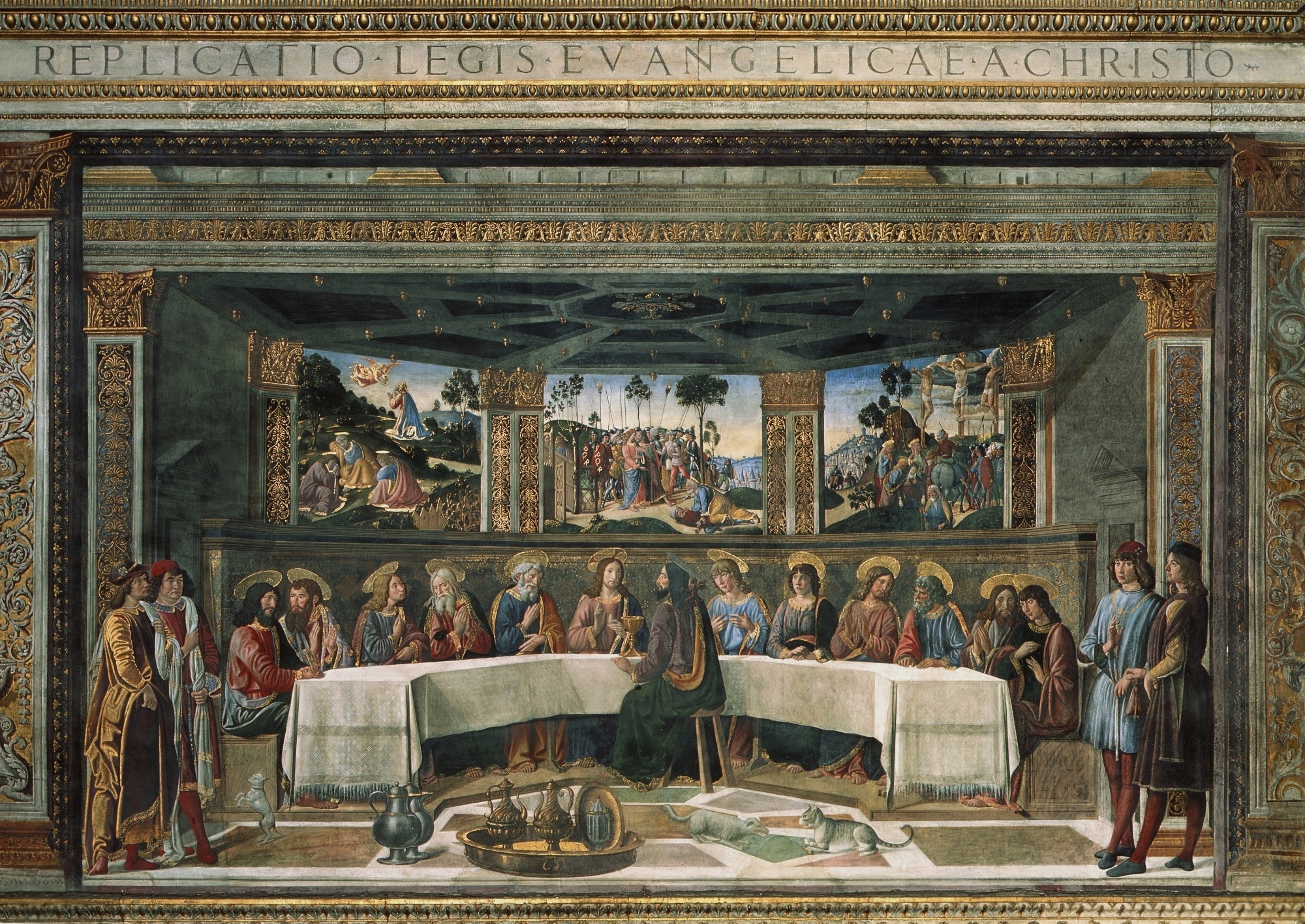
I suddenly remembered, after posting, that there are various depictions of the Last Support in Renaissance art which feature companion animals.   For example, in Rosselli’s beautiful painting on the wall of the Sistine Chapel, you find a dog.

ASK FATHER: Father had his dog with him at the altar during Mass

Dogs in these paintings are often a sign of fidelity.  Thus, the nickname, “fido” for dogs.

On the other hand, near Judas, who has a little black “halo” and a miniature demon on his back, there is a dog facing off with a sneaky looking cat.  Just sayin’.

Jacopo Bassano does the same in his Last Supper, with the dog near the center with Christ and the cat near Judas.  HERE

Also check out the beautifully painted dog in Tintoretto’s “Washing of Feet” which was at the Last Supper.  HERE  It’s a fantastic painting in the Prado.

Once you start to notice these critters in Last Supper depictions, they start popping out at you.


Posted in "How To..." - Practical Notes, ASK FATHER Question Box | Tagged
44 Comments