Detroit’s crafty new tax on churches

From the Detroit News:

A balanced budget in Detroit might be something only prayed for, but few could imagine Motor City managers raiding church offering plates for revenue.

Yet new drainage fees from the city’s Water and Sewerage Department may do just that.  [drainage fees … sigh]

Come October, the department will begin charging property owners differently. Some of those property owners currently pay an antiquated fixed rate, and others haven’t paid a storm water fee at all. But all property owners in Detroit will now pay based on acreage, which means fees will likely go up.

Eric Rothstein, a department program director, told The Detroit News last week that this type of charge is “commonly now used” to finance storm water management programs. Billing by acreage is a “trend (in) water resources financing,” he said.

More than 400 properties will see “a significant increase in billing of more than 200 percent per month,” says department director Gary Brown.

And several of those properties, Brown said, are owned by the Archdiocese of Detroit.

“It’s impacting us, and it’s not good news,” says Joe Kohn, the archdiocese’s director of public relations. The archdiocese owns 80 properties in Detroit, and 18 parishes have received letters from the water department with likely more to come. Five churches will have to come up with more than $1,000 extra per month. Two parishes will be billed an additional $2,000.

St. Charles Lwanga parish in Grand Meyer, for example, has an additional $2,385 to come up with every month. Its pastor, the Rev. Theodore Parker, says the new charge is an “injustice.” Because of the higher monthly water bill, the good priest worries, the parish’s soup kitchen may be forced to close its doors.  [Intended or unintended consequences?  When liberals run things, they want to force you into their paradigm or take over what you are doing.]

[…]

“I don’t know any city in America that does not charge for water,” Brown says.

But for decades, Chicago has offered a water waiver for churches and other nonprofits. [Even in such a crazy place.]

It was an estimated $20 million annual bill that in 2011 Mayor Rahm Emanuel said the city could no longer afford. But the late Cardinal Francis George, [RIP] previously the archbishop of Chicago, implied the mayor’s move may have had more to do with shutting down church services than tightening the city’s belt.  [Yep.]

If you don’t want a city that only has government institutions,” [There it is.] he said during negotiations over the exemption in April 2013, “then you have to see to the solvency of religious institutions and other nonprofits.”

Chicago councilmen were forced to work out a fair compromise with clergy. Churches with net adjusted assets of less than $1 million would be granted a 100 percent exemption. The waiver would decrease for parishes with bigger wallets.

[…]

Read the rest there.

This is an interesting new angle of attack on churches.

Posted in Liberals, Religious Liberty, The Coming Storm, The future and our choices, The Last Acceptable Prejudice | Tagged , , ,
10 Comments

22 August: Immaculate Heart and Queenship of Mary

Here are a few thoughts I wrote for my weekly column at the UK’s best Catholic weekly, the Catholic Herald:

On 22 August we observe, in the traditional Roman calendar, the Feast of the Immaculate Heart of Mary.  In the newer calendar it will be the Queenship of the Blessed Virgin Mary.

When the angel Gabriel came to Mary he told her that her Son would have the throne of David and that His kingdom would have no end (Luke 1:32-33). If our Lord is our King, then His Mother is our Queen.  In ancient Israel, the mothers of the House of David’s kings were crowned, addressed as Gebirah, “Great Lady”. They sat beside the throne of their royal sons.

Mary’s Queenship is intimately tied to the Kingship of her Son just as Her Immaculate Heart beats in harmony with His Sacred Heart, for she conceived her King within her Heart, before she carried Him below her Heart, and Her Queenship rests not on her own merits alone, but rather it rests upon the majesty of her divine Son.  At the conclusion of Dante’s Divina Commedia St Bernard sings of Heaven’s Queen that she is the “daughter of her Son”. But she will always remain, as Saint Thérèse observed, “more Mother than Queen”.

Speaking of addressing Mary, we name her Queen in many prayers, such as the Salve, Regina. We invoke her in the Litany of Loreto as Queen of Angels, Patriarchs, Prophets, Apostles, Martyrs, Confessors, Virgins, All Saints and, so important these days, Families.  St John Paul, taking stock of our times, added that last title to the Litany in 1995.  She is the Queen conceived without original sin, assumed into Heaven, Queen of the Most Holy Rosary and Queen of Peace.

May I suggest, dear readers, that you offer your day to the King of Fearful Majesty through our Queen’s intercession?  I ask also a prayer for myself.

O my God, in union with the Immaculate Heart of Mary, I offer Thee the Precious Blood of Jesus from all the altars throughout the world, joining with It the offering of my every thought, word, and action of this day. O my Jesus, I desire today to gain every indulgence and merit I can and I offer them, together with myself, to Mary Immaculate, that she may best apply them in the interests of Thy Most Sacred Heart. Precious Blood of Jesus, save us! Immaculate Heart of Mary, pray for us! Sacred Heart of Jesus, have mercy on us!

Posted in Our Solitary Boast | Tagged ,
2 Comments

Must. Have. One.

Here is an example of how we can see something and instantly desire it!

There’s not a moment to lose, for all love!

IMG_2387


Alas, this person seems to be confused.  I don’t mean the choice of color of car, which I don’t think I would drive unless it surrounded a 1969 Camaro ZL-1.  I mean the choice of a Hillary sticker on the window.  It’s small, but it is… there, like a … wart.

Of course I would vote for the corpse of Millard Fillmore if someone ran it against Hillary.

Posted in O'Brian Tags |
28 Comments

The USA Solar Eclipse of 2017 – signs in the heavens

And there shall be signs in the sun, and in the moon, and in the stars…. Luke 21:25.

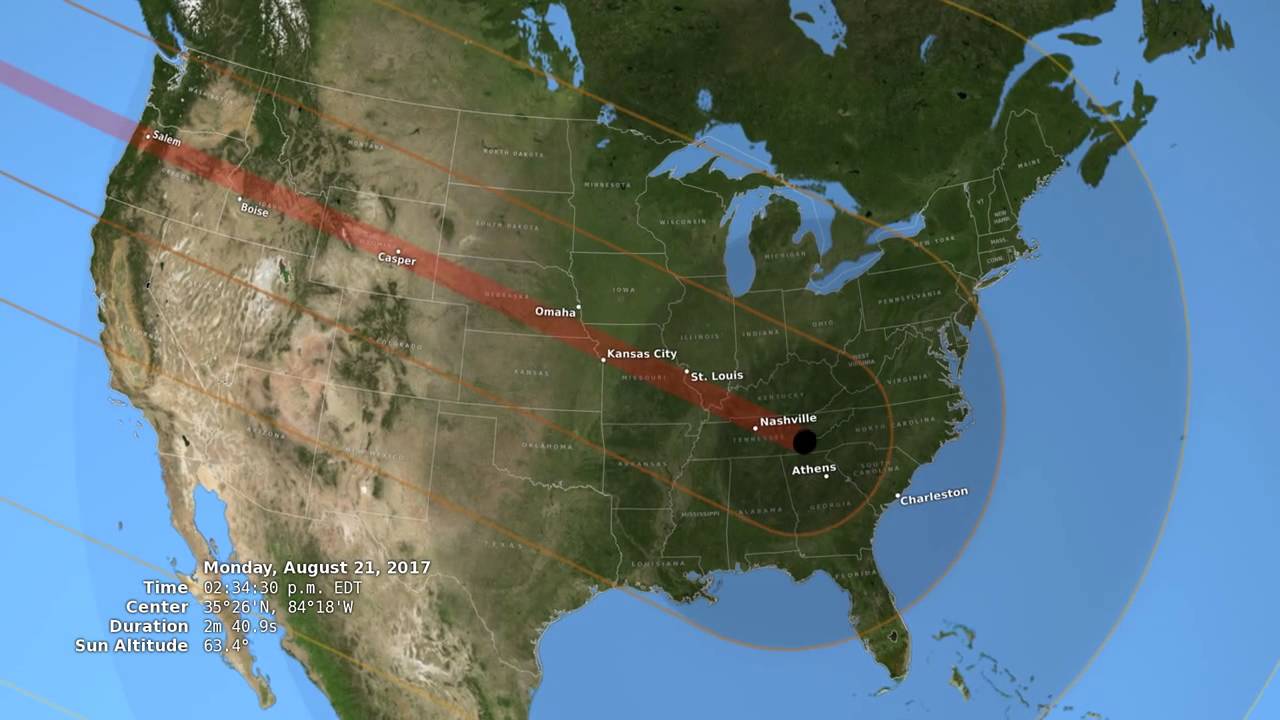
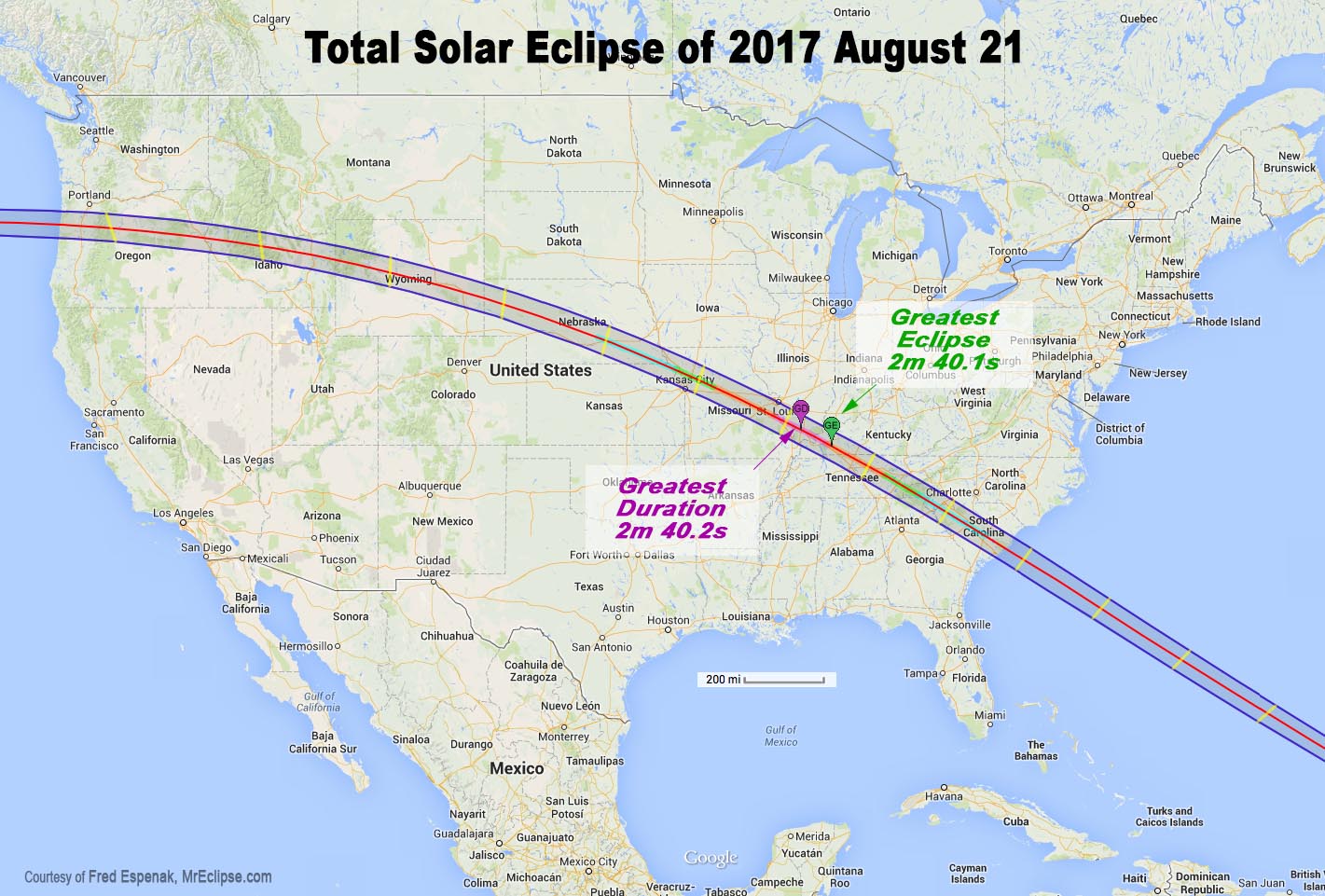
At NASA I see that, one year from today, 21 August 2017, the shadow of your planet’s moon, in a great total eclipse of your planets yellow sun, will sweep across the North American continent.  200 million people will be within one day’s drive from the umbra of totality.

YouTube thumbnailYouTube icon

When I wrote about this in the past, I opined that it would be fun to have a reader gathering, perhaps at some parish along the path, for Solemn (or Pontifical?) Mass.  21 August 2017 will be a Monday.  The next day, 22 August, is the Feast of the Immaculate Heart of Mary.

Another interesting thing about this eclipse was pointed out by my friend Fr. Richard Heilman.  I spoke to him in the sacristy this morning.  He pointed out that the eclipse occurs 54 days, including the end date, before the 100th anniversary of the Miracle of the Sun at Fatima, 13 October 2017.  The “54 days” will immediately strike Catholics as significant for it is the number of days of a special kind of “novena”.

A precise novena is nine days. However, the term has been applied to other ongoing devotions to obtain certain petitions.  Praying a 54 day novena generally involves saying a chaplet of the Holy Rosary (five mysteries) every day for twenty-seven days in petition followed by a chaplet each day for an another twenty-seven days in thanksgiving.  Traditionally, you would use the classic mysteries for your chaplets, the Joyful, Sorrowful and Glorious.  There are ways to do this with the Luminous Mysteries, but I don’t generally use them.

Some people add a prayer to their chaplets:

Petition Prayer (27 Days): Blessed Mother, hear my plea and bring it before the throne of your Son, my Lord, Jesus Christ. Please look with favor on this devotion, and grant me [say your intention here.] I ask these things of you, my Mother, in the name of the Father, and of the Son, and of the Holy Spirit. Amen.

Thanksgiving Prayer (27 Days): Blessed Mother, thank you for hearing my prayer and and interceding on my behalf. Mary, Mother of my Soul, be with me all my days, and accept my humble thanks for your many gifts, which I accept in the name of the Father, and of the Son, and of the Holy Spirit. Amen.

Our Lady of Fatima asked for the Rosary daily.  It is a mighty tool and weapon of the spiritual life and battle in which we are engaged.

I’ve been hearing some dire things from priests.  I’ve been experiencing some rough times as well.  I have the sense that something big is on the move, as it were.

I am not at this point saying that I think the 2017 eclipse portends a SHTF catalyst and TEOTWAWKI event.   I am saying that it is really interesting that this takes place, over this nation, 54 days before the 100th anniversary of the Miracle of the Sun.  Just as I think that the argument about the Star of Bethlehem and the eclipse at the time of the Crucifixion were compelling enough to pay attention to our celestial clock, I think this merits keeping an eye on.

Pope Leo XIII on 13 October 1884 had a mystical experience after reading his daily Mass. He froze, turned pale, and immediately penned the Prayer to St. Michael. He told people that he heard two voices, one Satan’s, the other God’s. Satan said that he could destroy the Church in 100 years. However, some have calculated that the 100 years didn’t begin at that very moment. Instead it started 33 years later on 13 October 1917 with the Miracle of the Sun. The opening salvo of Satan’s pogrom could have been on what was 7 November 1917 in the Gregorian calendar (25 October in the Julian) the October Revolution in St. Petersburg. Russia would switch to the Gregorian calendar in February 2018. (Interestingly enough, in these USA on 19 March 1918 time zones and daylight savings time were approved, which went into effect on 31 March. Lots of tinkering with time back then.) In any event, atheistic Communism – an ideology direct from Hell – begins to rear its head like the dragon of Revelation 12 right after Fatima. Our Lady warned the children that Russia would spread errors throughout the world.

If the 100 years of Pope Leo’s vision began on 13 October 1917….

Another sky event linked to Fatima, was probably the incredible aurora that occurred on 25 January 1938. Our Lady of Fatima had said on 13 July 1917: “”When you shall see a night illuminated by an unknown light, know that it is the great sign that God gives you that He is going to punish the world for its crimes by means of war, of hunger, and of persecution of the Church and of the Holy Father.” This seems to have heralded WWII. That same night St. Faustina Kowalska wrote in her diary about a message from the Lord: “I saw the anger of God hanging heavy over Poland. And now I see that if God were to visit our country with the greatest chastisements, that would still be great mercy because, for such grave transgressions, He could punish us with eternal annihilation. I was paralyzed with fear when the Lord lifted the veil a little for me. Now I see clearly that chosen souls keep the world in existence to fulfill the measure [of justice].

Events in the sky seemed important to Our Lady.

I’m just sayin’.

Posted in Just Too Cool, Look! Up in the sky!, Semper Paratus, The Coming Storm, The future and our choices | Tagged , , ,
21 Comments

A blast from the not too distant past

The other day Pope Francis made some appointments to the new Dicastery for Laity, Family, and Life, established ad experimentum.  It will probably be made into a congregation, at least I guess it will be, since Pastor bonus is still in force.  Who knows?

An a related appointment, Francis appointed to be President of the “Giovanni Paolo II” Institute for the Family, Msgr. Pierangelo Sequeri, who has been the President of the Theological Faculty of Northern Italy of Milan.

Sequeri… Sequeri… how do we know that name?

Here’s how!  He wrote this!  AKA “Symbolon ’77”.

YouTube thumbnailYouTube icon

I can’t say how many times I heard this. There is no priest in Italy who has not suffered with this racket.

He has some other hits like “Madre io vorrei” and “E sono solo un Uomo”.

This enervating… stuff… is still heard in parishes and, gulp, seminaries all over Italy, with the predictable long-term, epicene effects.

Posted in Lighter fare | Tagged
8 Comments

Pope Francis’ Angelus: “our life is not a video game or a soap opera; our life is serious”

Here is Vatican Radio‘s translation of Pope Francis’ Angelus address today:

Vatican Radio translation of the Pope’s Angelus address:

“Dear brothers and sisters, good morning! [He said, “Buon giorno”. We are after noon, of course.]

Today’s Gospel passage invites us to meditate on the theme of salvation. The Evangelist Luke tells us that Jesus is on the way to Jerusalem and along the way is approached by a man who asks him this question: “Lord, will only a few people be saved?” (Luke 13:23). Jesus does not give a direct answer, but takes the discussion to another level, with suggestive language that at first, the disciples don’t understand:   “Strive to enter through the narrow door; for many, I say unto you, will seek to enter, but they will not succeed” (v.24 ). [“many… πύλης… many… “] With the image of the door, He wants to explain to his listeners that it is not a question of numbers – how many people will be saved.   It doesn’t matter how many, but it is important that everyone knows which is the path that leads to salvation: the door.

To go along this path, one must pass through a door. But where is the door?  What is it like?  Who is the door?  Jesus himself is the door (cf. Jn 10,9).  He himself says it, ‘I am the door’ in John’s Gospel.  He leads us in communion with the Father, where we find love, understanding and protection. But why is this door narrow? One can ask. Why is it narrow?  It is a narrow door not because it is oppressive – no, but because it asks us to restrict and limit our pride and our fear, to open ourselves with humble and trusting heart to Him, recognizing ourselves as sinners, in need of his forgiveness.  [Another reason why it is narrow is because HE is the ONLY path to salvation.  Anyone who is saved, is saved through Him and that salvation is mediated through the Church.]  For this, it is narrow: to contain our pride, which bloats us.  The door of God’s mercy is narrow but always wide open, wide open for everyone! God has no favorites, but always welcomes everyone, without distinction. [Everyone can repent and believe the Gospel, confess her sins and be baptized!] A door, that is narrow to restrict our pride and our fear.  Open because God welcomes us without distinction.   And the salvation that He gives us is an unceasing flow of mercy…which breaks down every barrier and opens up surprising perspectives of light and peace.  The narrow but always open door:  do not forget this.  Narrow door, but always open.

Jesus offers us today, once again, a pressing invitation to go to him, to cross the threshold of a full life, reconciled and happy. He waits for each of us, no matter what sin we have committed, no matter what!  To embrace us, to offer us his forgiveness. [Which means, for the baptized, confession of our mortal sins in kind and number.] He alone can transform our hearts, He alone can give full meaning to our existence, giving us true joy. Upon entering the door of Jesus, the door of faith and of the Gospel, we can leave behind worldly attitudes, bad habits, selfishness and the closing ourselves off. When there is contact with the love and mercy of God, there is real change. And our life is illuminated by the light of the Holy Spirit: an inextinguishable light!”

Pope invites faithful to examine their consciences

“I’d like to make you a proposal,” the Pope said to the pilgrims in the square, and invited them to think in silence  for a moment about the things they have inside that prevent them from passing over the threshold: pride, arrogance, sin. “And then, let us think about that other door, the one open to God’s mercy and He is waiting on the other side to forgive us,” Francis added.  [Let’s make good examinations of conscience, remembering also sins of OMISSION.]

“The Lord offers us many opportunities to save ourselves and to enter through the door of salvation,” the Pope continued.  “This door is an opportunity that must not be wasted: we must not make an academic discourse of salvation, as did the man who questioned Jesus, but we must seize the opportunities for salvation. [GO TO CONFESSION!] Because at a certain moment “the landlord got up and locked the door” (v.25), as mentioned in the Gospel. But if God is good and loves us, why does he close the door – he will close the door at a certain point? Because our life is not a video game or a soap opera; our life is serious and the goal to achieve is important: eternal salvation.  [You can LOSE what Christ won for you!  You really can.  Salvation isn’t automatic.  Remember the horrific words the foolish virgins heard from the other side of the locked door: “I do not know you.” Is that what you want to hear from the other side of the door?]

To the Virgin Mary, Door of Heaven, [one of her titles in the Litany of Loreto] we ask help so that we seize the opportunities that the Lord gives us to cross the threshold of faith and thus to enter into a wide road: [Convert!  Enter the CATHOLIC CHURCH, which is the only Church Christ, the Door, founded!] it is the path of salvation that can accommodate all those who allow themselves to love and be loved (it: si lasciano coinvolgere dall’amore). It is love which saves;  the love that is already here on earth is a source of happiness to those who, in meekness, patience and justice, forget themselves and give themselves to others, especially the weakest.”

Here’s the video.  The Pope shows up around 3:50. Small crowd, but it is August. And, frankly, perhaps the Pope should be out at Castel Gandolfo having some “relax”, as we say in Italian.

YouTube thumbnailYouTube icon

Posted in Francis | Tagged ,
2 Comments

ASK FATHER: People say Mass prayers together with the priest

priestFrom a reader…

QUAERITUR:

I’ve been attending daily mass when I can at a particular parish. When at Mass I often hear some people in the pews who whisper to themselves every single word the priest says at mass.

I would like to know what these people are getting out of repeating everything the priest is saying? Does it help their spirituality?

Perhaps the best way to know what they are getting out of it would be to ask them.  Your planet’s yellow sun didn’t give me the power to read their minds from this distance.

But for those who may be doing this, let’s drill in a bit.

In the rubrics of the Mass, there are directions, rubrics, texts (the priest says thus and so, the people respond thus and so).

For someone who is not a priest to presume to verbalize the priest’s prayers would seem to involve either some hubris or a lack of understanding of what is going on.  To offer those prayers mentally along with the priest, while praying with one’s hand missal, could be a holy and wholesome thing to do. But to verbalize…. that seems a step too far in my mind.

“But Father! But Father!”, you pseudo-Lutherans wail, “You are just lording it over us! Haven’t you ever heard what the Spirit of Vatican II says? By baptism we are all priests! Next year is the big Lutheran year when we will honor Luther and he said that every man is his own priest! NO WAIT… every person is a priest!  And we aren’t speciesist either: our pets and the butterflies are priests of Mother Earth!  You are trying to keep prayers away from us because YOU HATE VATICAN II!”

Luther (failed priest and heretic) didn’t, in fact, write that every man is his own priest, but that phrase summarizes both his view and that of most of the writers of the National Schismatic Reporter (aka Fishwrap) and probably also the LCWR.  His radical view of the priesthood of all believers effectively reduces ordained priesthood to a role that community gives to him to do various things.  This is what modernists such as Edward Schillebeeckx wrote, which infected a generation of seminary profs and, hence, priests and, subsequently, people in the pews.

Back to Vatican II. I have actually read the documents of the Second Vatican Ecumenical Council, as Card. Burke unfailingly calls it.  Let’s look at Lumen gentium, a document which obliges every Catholic to believe that there is a divinely instituted hierarchy:

10. … Though they differ from one another in essence and not only in degree, the common priesthood of the faithful and the ministerial or hierarchical priesthood are nonetheless interrelated: each of them in its own special way is a participation in the one priesthood of Christ. The ministerial priest, by the sacred power he enjoys, teaches and rules the priestly people; acting in the person of Christ, he makes present the eucharistic sacrifice, and offers it to God in the name of all the people. But the faithful, in virtue of their royal priesthood, join in the offering of the Eucharist. They likewise exercise that priesthood in receiving the sacraments, in prayer and thanksgiving, in the witness of a holy life, and by self-denial and active charity.

Note first that the priesthood we have is Christ’s, who shares it with us in two different ways.  All the baptized share in Christ’s priesthood, but by ordination the priest is a priest in a way that is qualitatively different.  It is not just an “add on” which gives him the role or authorization to say the prayers up there.  The sacrament of Orders changed him in an essential way so that when he acts in and for the Church, it is Christ who is acting.  By his ordination he is alter Christus, another Christ.   But, as LG 10 points out, his priesthood is enmeshed with the priesthood of the laity.  The laity, with their baptismal priesthood can offer spiritual sacrifices that are pleasing to God.  Also, they are enabled to receive the Eucharist, especially, from the priest.  “They likewise exercise that priesthood in receiving the sacraments…”.  The Church has its Head and its Body, together they are, as Augustine would put it in writing about who speaks in the psalms, Christus totus.  But in the Church, for her sacred liturgical worship when we are gathered as a Church, the priest speaks those things which pertain to his role as the Head and the people speak those things which pertain to their role as the Body.  Sometimes they speak together, Christus totus.  And in that supreme moment of actual participation when the Body moves forward to receive from the Head, they are at the deeply significant meeting place, the Communion rail.  Remember that the most perfect form of active actual participation is the reception of Communion by the baptized person in the state of grace.  Even in his own reception of Communion, the priest, who is simultaneously the victim at the altar, acknowledges his total reliance as a pardoned sinner on God.

Oh, and another thing: Lay people, any number of lay people, a stadium full of lay people, could whisper, shout, or Siberian throat sing the words of consecration for days, weeks, months, years, until the bitter end.  What would be on the altar would still be just bread and just wine until such time as the least worthy, least eloquent or clever, even perhaps unrepentant, validly ordained priest stumbled in and muttered them a single time with intention to consecrate.

Priests aren’t personally holier by Holy Orders.  They are, though unworthy, simply chosen by Christ to do His work for you, especially in administration of the sacrament and teaching and governing.  As Augustine said, I am a bishop for you but a Christian with you.

So, recitation of the priest’s prayers by the laity….

Could it be piety run amok.

Is it an erroneous misunderstanding of priesthood.

Perhaps they just haven’t been told any better.

Posted in "How To..." - Practical Notes, ASK FATHER Question Box, Liturgy Science Theatre 3000, Our Catholic Identity, Priests and Priesthood | Tagged , , ,
30 Comments

POLL: For whom will you vote in the 2016 Presidential Election?

I’m curious.  How are you denizens of these USA (who can vote legally) leaning right now regarding the upcoming presidential election.

Make your best choice.  If you wish to comment, the combox is open to registered and approved participants here.  However, THINK before commenting because I have short fuse right now.  Stick to ISSUES, not personal attacks if you respond to someone else.  This isn’t the National Schismatic Reporter, where libs and dissenters spew their dreck at will.

And if you don’t see some candidate who is running for, say, the Rent Is Too Damn High Party, spare me.  If I haven’t even heard of the candidate, forget it.

As of right now, I am inclined to vote on the US presidential ticket for...

View Results

Posted in POLLS, The future and our choices | Tagged ,
280 Comments

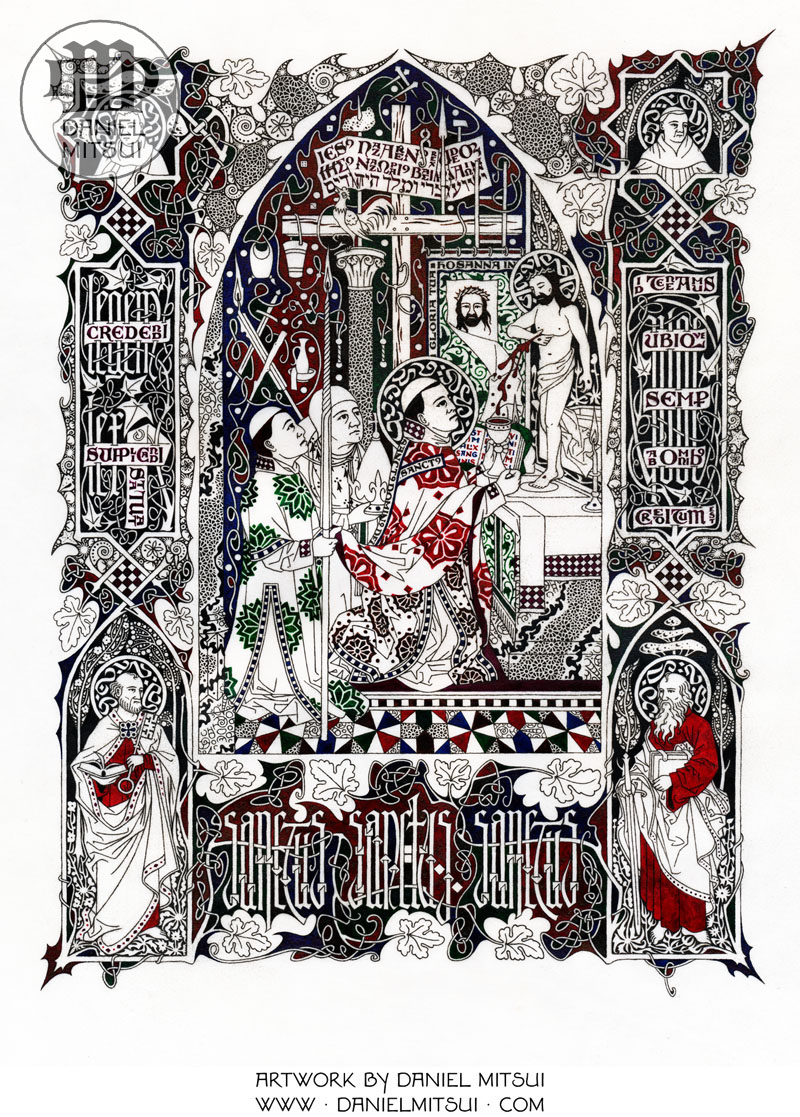
New art from Daniel Mitsui: The Mass of St Gregory

The “Mass of Saint Gregory” is a common subject of art across many centuries, beginning in mid-14th c, though the subject matter dates back to the 8th c with variations.  The essentials are these: Pope Gregory I, “the Great” (+604) is saying Mass.  He has asked God for a sign to help the lack of faith of a deacon concerning the doctrine of transubstantiation.  Christ appears as the “Man of Sorrows” over the altar.  You will see very many depictions of this theme when you visit well-stocked museums and many European churches.

Daniel Mitsui, whom I feature here occasionally – really like his stuff – has his own rendering of the Mass of St. Gregory.

Please pardon me, but I left the print in its protective plastic.  You can see more HERE.

This is 8″x 10 2/3.

In the bottom corners are Sts. Peter and Paul.  In the upper corners are Proper of Aquitaine and Vincent of Lerins.

Notice that on the left, he inscribes Legem credendi lex statuat supplicandi elsewise Lex Orandi Lex Credendi.  You see on the right:  Id teneamus quod ubique, quod semper, quod ab omnibus creditum est.

As usual, the details are marvelous.

He connects visually the Lord’s Passion and Resurrection with the Eucharist.

It is a great Counter-Reformation image, too.  It stresses the doctrine and also papal primacy.

This would be a great gift for a priest or a convert.

Larger right click and open in a new tab.

I haven’t given up hope that Daniel will, one day, do QSO cards!

Posted in Just Too Cool, The Campus Telephone Pole | Tagged , ,
9 Comments

WDTPRS – 21st Sunday of Ordinary Time: When “values” replace “virtues”

Let’s look at the Collect for the upcoming 21st Sunday of Ordinary Time:

Deus, qui fidelium mentes unius efficis voluntatis, da populis tuis id amare quod praecipis, id desiderare quod promittis, ut, inter mundanas varietates, ibi nostra fixa sint corda, ubi vera sunt gaudia.

A master crafted this prayer.

In the 1962 Missale Romanum we use it on the 4th Sunday after Easter. It is also in the ancient Gelasian Sacramentary.  Listen to those “eee”s produced by the Latin “i”. Savor those parallels.

Varietas means “difference, diversity, variety.”  It is commonly used to indicate “changeableness, fickleness, inconstancy.”  I like “vicissitude”.  The adjective mundanus is “of or belonging to the world”.

LITERAL RENDERING:

O God, who make the minds of the faithful to be of one will, grant unto Your people to love that thing which You command, to desire that which You promise, so that, amidst the vicissitudes of this world, our hearts may there be fixed where true joys are.

CURRENT ICEL (2011):

O God, who cause the minds of the faithful to unite in a single purpose, grant your people to love what you command and to desire what you promise, that, amid the uncertainties of this world, our hearts may be fixed on that place where true gladness is found.

Let us revisit that id…quod. We can accurately say “love that which you command,” or “love what you command”, but that strikes me as vague.  Can we be more concrete and say “love the thing you command… desire the thing you promise”?

We are called to love and desire God’s will in concrete situations, in the details of life, especially when those details are little to our liking.  We must love God in this beggar, this annoying creep, not in beggars and creeps in general.  We must love Him in this act of fasting, this basket of laundry, this illness.

We must not reduce God’s will to an abstraction or a dreamy ideal. “Thy will (voluntas) be done on earth as it is in heaven”… or so it has been said.

Lest we forget why we needed new translation….

OBSOLETE ICEL (1973):

Father, help us to seek the values that will bring us lasting joy in this changing world. In our desire for what you promise make us one in mind and heart.

Good riddance!  “Values”.  Very slippery.  Typical of the obsolete translation.

To my ear, “values” has a shifting, subjective starting point. In 1995 Gertude Himmelfarb wrote in The De-Moralization of Society: From Victorian Virtues to Modern Values that “it was not until the present century that morality became so thoroughly relativized that virtues ceased to be ‘virtues’ and became ‘values.’”

In this post-Christian, post-modern world, “values” seems to indicate little more than our own self-projection.

John Paul II taught about “values”, but in contradiction to the way “values” are commonly understood today.  For example, we read in Evangelium vitae 71 (emphasis added):

“It is urgently necessary, for the future of society and the development of a sound democracy, to rediscover those essential human and moral values which flow from the very truth of the human being and express and safeguard the dignity of the person: values which no individual, no majority, and no state can ever create, modify, or destroy, but must only acknowledge, respect, and promote.”

In his 1985 letter to young people Dilecti amici 4, John Paul II taught:

“Only God is the ultimate basis of all values…. in Him and Him alone all values have their first source and final completion… Without Him – without the reference to God – the whole world of created values remains as it were suspended in an absolute vacuum.”

Benedict XVI taught about the threats we face from the “dictatorship of relativism”, from the reduction of the supernatural to the natural, from caving in to “the world”.

Christ warned His Apostles about “the world”, saying said: “The world cannot hate you, but it hates me because I testify of it that its works are evil” (John 7:7).  He spoke about this world’s “prince” (John 12:31; 14:30 16:11).  St Paul wrote: “Do not be conformed to this world but be transformed by the renewal of your mind, that you may prove what is the will of God, what is good and acceptable and perfect” (Romans 12:2).

If what “the world” offers gets priority over what God offers the world through His Holy Church, we produce the situation Paul VI described on 29 June 1972, the 9th anniversary of his coronation:

“Through some crack the smoke of Satan has entered into the temple of God.”

Our Collect today asks God to grant that His will be the basis of our “values” in concrete terms, not in mere dreamy good intentions or this world’s snares.

Posted in Hard-Identity Catholicism, Our Catholic Identity, WDTPRS | Tagged ,
10 Comments