ASK FATHER: During sick call, tea and biscuits before administering Communion

From a reader…

QUAERITUR:

When a priest arrives at a sick person’s house in order to provide Communion, should the Communion rite happen immediately upon arrival?

I presume that tea, biscuits and chatting should certainly not happen beforehand?

I was recently put into this situation: bonhomie taking place for at least an hour before Communion. I wasn’t sure that the Blessed Sacrament was present at first, but when this was made apparent I was shocked and upset.

I raised this with the assistant priest, one of the two who had visited. He said that the parish priest (he was the other who had visited) likes to give Communion at the end so all can leave in silence (which on my recollection didn’t happen anyway.) The assistant priest conveyed my thoughts to the parish priest, and apparently his suggestion was that they leave the Blessed Sacrament in the glove box of the car until it’s time.

I have to commend the priests on their pastoral care; I’ve seen priests with no attention to this whatsoever and I think it’s important, but not at the expense of proper treatment of the Blessed Sacrament.

Thanks for also adding your positive comments about your priests.

“tea, bicuits beforehand”

“leave the Blessed Sacrament in the glove box”

I am sure that these priests have no intention of showing a lack of respect for Christ in the Eucharist.

However, as soon as I read this, a phrase flooded into my mind:

Nihil anteponendum dilectioni Christi.

Flooded with this phrase, I had to look it up.  I had it almost right.  The true phrase is: “dilectioni Dei et Christi nihil praeponendum … nothing is to be set before/preferred to the love of God and Christ”.  This is St. Cyprian of Carthage (+258) Ad Quirinum 3, 18.

One of the things priests learn when they use the traditional forms of our sacred liturgical rites is that, indeed, nihil anteponendum when it comes to the Eucharist.  This principle guides even the order in which a priest carries out certain tasks.

For example, after Holy Communion he must purify vessels.  First, he consumes whatever of the Precious Blood might be in the chalice.  Then he begins the ablutions.  If there is a ciborium to be purified, he pours the ablutions into the ciborium and consumes everything from it.  In reposing the Blessed Sacrament after exposition, the lunette is handled as little as possible.  Therefore, tabernacle is opened, pyx is readied, etc.  Then the Host is removed, put into the pyx, reposed in the tabernacle, door closed before anything is done with the monstrance, etc.  Everything is readied so that when it is time to do something with the Blessed Sacrament, no other object or activity interrupts.   Anything having to do with the Eucharist has priority of attention and action.

Nihil anteponendum.

Another clue is taken from the rite of visiting the sick itself.  The very first thing that the priest does when he arrives at the place and enters, he says, “Pax huic domui!  Peace to his house!”  The rite continues from there without interruption… for biscuit or chats or anything.  Also, knowing that the priest is coming, people should have everything ready for the visit.  Households had sick call sets.   I’ve written about them HERE.  Everything should be ready for the arrival of the King.  With all things set out beforehand, when the priest arrives he should be brought directly, without delay, to the person who will receive Communion.  There’s time for other things after the more important things are completed.

Nihil anteponendum.

Hence, I cannot go along with anything that is put before proper attention to the Blessed Sacrament when it comes to sick calls.

This must must must also be hammered into any lay people who take the Eucharist to the sick or shut it.   If you are given the tremendous task, do nothing to interfere with your duty.  Don’t stop for gas (get it beforehand.  Don’t go through the Taco Bell drive-thru (go later).  Don’t … don’t… don’t.   Just go straight to the place you must go and carry out your task.  The same then applies to purification of the pyx.  Christ is present even in small fragments of the Host.

Nihil anteponendum.

Posted in "How To..." - Practical Notes, ASK FATHER Question Box, Liturgy Science Theatre 3000 | Tagged , , ,
8 Comments

Another look at Catholic/Islamic statement: “diversity of religions … are willed by God in His wisdom”

What about that joint document of Francis and the Imam?

Francis signed something that very strongly suggested that God wills, in his active/positive will, a diversity of religions.  This is impossible.   The only way to interpret that in a Christian sense is to say that by God’s permissive will there is a plurality/diversity of religions.   I wrote about that before in an attempt to make what was signed not be male sonans… at least.

At the end of my post I wrote that I didn’t know what the writers of the document had in mind.  We only have the text of what was signed.

People are still talking about it.  I had originally thought that – since tens of people had read it, it would vanish into the big cabinet into which ecumenical documents vanish.   No so.  People are still on it.

For example, over at Rorate a smart fellow, Dr. John R. T. Lamont (a Canadian philosopher and theologian), wrote about it referencing me and disagreeing with what I wrote.  He agreed with me too, in that he wrote, regarding my examination of the English Francis/Imam text:

“Applying the distinction between God’s active will and God’s permissive will to Pope Francis’s words, and interpreting the words as asserting that the plurality of religions is the object of God’s permissive will rather than of His active will, is the only way of understanding them in a Christian sense.”

Then he went on to explain how we can’t interpret the bad phrase from the point of view of God’s permissive will.   I was not wholly convinced, but he had a strong case.   One point I found that was good, that contradicted what I wrote, was something I had planned to include in my own piece… but I left it out lest my post be too complicated.  He wrote:

“The context makes it clear that Pope Francis’s words state that God does will religious pluralism itself. Religious pluralism is classed together with other differences such as colour, sex, race, and language that are not evil in themselves, and that are positively willed by God.”

I actually had worked on a post that dealt with whether or not these other things – race, language, etc. – were willed by God positively or they were permitted in His permissive will.  But… life took over and I didn’t finish it.

Taken by itself, taking the claim only about religions, we can more easily apply God’s permissive will as an interpretive lens.  Taken with the other items, that gets really hard.

I would add another angle.

We also have translations in several languages of the text that was signed.  I don’t know what language was the language of authorship.  Which language did the Imam’s people and Francis’ people use?  Perhaps English or Portuguese… there were Portuguese and English influences in the UAE.  Who knows?

Are there differences in the texts?  Let’s look!

ENGLISH

Freedom is a right of every person: each individual enjoys the freedom of belief, thought, expression and action. The pluralism and the diversity of religions, colour, sex, race and language are willed by God in His wisdom, through which He created human beings. This divine wisdom is the source from which the right to freedom of belief and the freedom to be different derives. Therefore, the fact that people are forced to adhere to a certain religion or culture must be rejected, as too the imposition of a cultural way of life that others do not accept;

  • The pluralism and the diversity of religions, … are willed by God in His wisdom

ITALIAN

La libertà è un diritto di ogni persona: ciascuno gode della libertà di credo, di pensiero, di espressione e di azione. Il pluralismo e le diversità di religione, di colore, di sesso, di razza e di lingua sono una sapiente volontà divina, con la quale Dio ha creato gli esseri umani. Questa Sapienza divina è l’origine da cui deriva il diritto alla libertà di credo e alla libertà di essere diversi. Per questo si condanna il fatto di costringere la gente ad aderire a una certa religione o a una certa cultura, come pure di imporre uno stile di civiltà che gli altri non accettano.

  • Il pluralismo e le diversità di religione, … sono una sapiente volontà divina,
  • The pluralism and diversity of religions… are one divine will

FRENCH

La liberté est un droit de toute personne: chacune jouit de la liberté de croyance, de pensée, d’expression et d’action. Le pluralisme et les diversités de religion, de couleur, de sexe, de race et de langue sont une sage volonté divine, par laquelle Dieu a créé les êtres humains. Cette Sagesse divine est l’origine dont découle le droit à la liberté de croyance et à la liberté d’être différents. C’est pourquoi on condamne le fait de contraindre les gens à adhérer à une certaine religion ou à une certaine culture, comme aussi le fait d’imposer un style de civilisation que les autres n’acceptent pas.

  • Le pluralisme et les diversités de religion, … sont une sage volonté divine,
  • The pluralism and diversity of religions… are one divine will

GERMAN

Die Freiheit ist ein Recht jedes Menschen: ein jeder genießt Bekenntnis-, Gedanken-, Meinungs-, und Handlungsfreiheit. Der Pluralismus und die Verschiedenheit in Bezug auf Religion, Hautfarbe, Geschlecht, Ethnie und Sprache entsprechen einem weisen göttlichen Willen, mit dem Gott die Menschen erschaffen hat. Diese göttliche Weisheit ist der Ursprung, aus dem sich das Recht auf Bekenntnisfreiheit und auf die Freiheit, anders zu sein, ableitet. Deshalb wird der Umstand verurteilt, Menschen zu zwingen, eine bestimmte Religion oder eine gewisse Kultur anzunehmen wie auch einen kulturellen Lebensstil aufzuerlegen, den die anderen nicht akzeptieren.

  • Der Pluralismus und die Verschiedenheit in Bezug auf Religion, … entsprechen einem weisen göttlichen Willen,
  • The pluralism and diversity of religion… corresponds to a wise divine will

SPANISH

La libertad es un derecho de toda persona: todos disfrutan de la libertad de credo, de pensamiento, de expresión y de acción. El pluralismo y la diversidad de religión, color, sexo, raza y lengua son expresión de una sabia voluntad divina, con la que Dios creó a los seres humanos. Esta Sabiduría Divina es la fuente de la que proviene el derecho a la libertad de credo y a la libertad de ser diferente. Por esto se condena el hecho de que se obligue a la gente a adherir a una religión o cultura determinada, como también de que se imponga un estilo de civilización que los demás no aceptan.

  • El pluralismo y la diversidad de religión, … son expresión de una sabia voluntad divina
  • The pluralism and diversity of religion, … are expressions of a wise divine will

PORTUGUESE

A liberdade é um direito de toda a pessoa: cada um goza da liberdade de credo, de pensamento, de expressão e de ação. O pluralismo e as diversidades de religião, de cor, de sexo, de raça e de língua fazem parte daquele sábio desígnio divino com que Deus criou os seres humanos. Esta Sabedoria divina é a origem donde deriva o direito à liberdade de credo e à liberdade de ser diferente. Por isso, condena-se o facto de forçar as pessoas a aderir a uma determinada religião ou a uma certa cultura, bem como de impor um estilo de civilização que os outros não aceitam.

  • O pluralismo e as diversidades de religião, …fazem parte daquele sábio desígnio divino
  • Pluralism and diversities of religion, … are part of that wise divine design

Interesting, no?

So, in English it is far easier to think in terms of God’s permissive will.

When you get out of English… it isn’t so easy to find permissive will.  The statement sounds very much like the pluralism of religions (and other things) is a result of God’s active and positive will.   Until we have a clear statement from the Holy See about the meaning of this phrase, it is very hard indeed – all the translations considered – to apply permissive will.  It is not impossible to include permissive will, because the whole paragraph is about human freedom.  After the statement in question, the text goes on about things that people do to other people.

Again, I don’t know what the writers intended.  And yet, there are signatures on it.

We sure need Latin, don’t we.

When we hear or read something strange, we should try to apply the best interpretation and not automatically go to the worst interpretation.  At the same time, it doesn’t do any good to ignore the obvious.  I don’t think that it is entirely obvious what is meant in that document.  Not entirely.  But it doesn’t look good.  And I think teachers in the Church are obliged to bring clarity rather than confusion.

But with documents these days… it’s as if they don’t want us to know what they really mean.

BTW… in case you are wondering about that phrase I used above, male sonans, this is a category of the theological censures.  These censures were applied to protect the integrity of the Faith and to prevent people from being mislead (in the case of falsehood) and confused (in the case of fuzziness).  One of the labels was male sonans… evil-sounding.    Anyway, here are the categories in descending order of gravity

  • hæretica (heretical)
  • erronea (erroneous)
  • hæresi proxima (next to heresy)
  • errori proxima (next to error)
  • temeratia (rash)
  • ambigua (ambiguous)
  • captiosa (captious)
  • male sonans (evil-sounding)
  • piarum aurium offensiva (offensive to pious ears)

Male sonans and piarum aurium offensiva were low on the list of censures, but that doesn’t mean that they weren’t taken seriously.

The badly worded phrase in that document are at the very least piarum aurium offensiva and even male sonans.  Note that there is also ambigua.

Salvo meliori iudicio!

I’ve turned on the moderation queue for the sake of helpful comments, well-considered.
Posted in Francis, The Drill, The Religion of Peace, What are they REALLY saying? | Tagged , ,
26 Comments

Your Good News

It has been a while since we’ve heard your good news.

What’s up?

For my part, I am still on the mend.   I’ve also been delving more into the Old Testament.

Posted in SESSIUNCULA |
22 Comments

“Rumors that a certain prelate threatens his orthodox priests with institutionalization or laicization are not rumors… they are truth”

Back in August 2018 I posted one of the hardest things I’ve ever written for this blog.  HERE

This just came from a reader.  I’ve anonymized it a little.

Dear Fr. Z.,

I hope these days find you better in body and soul. Years ago you saw my blog comments under the moniker___. These days I live in ___ and, having just read your powerful post, wanted to respond to you personally.

When the Pennsylvania report broke for reasons only He knows, God willed that several “whistleblower” priests from across the country cross my path in their moments of extreme need and vulnerability. Persecuted, frightened, alone, cutoff by the episcopacy from their brethren, their natural families, the people of God they served… some literally with no place to stay, no money, no transportation, not even food.

And rumors that a certain prelate threatens his orthodox priests with institutionalization or laicization are not rumors… they are truth. I was called to the assistance of two priests facing this threat that has become the M.O. of this prelate. That’s the thuggery of how the Church under the influence of lawless men has treated its faithful, orthodox priests.

I have listened to faithful priests cry in fear and isolation. And I have tried to get them better help than me through godly priests. But when I sought help for them from religious orders or other orthodox parish priests, every last one refused. Some said they refused for fear of losing their ministries, but worse, some refused for fear of eternal damnation for not keeping quiet and staying out of it in some twisted notion that to aid their brothers is disobedience to the Pope and therefore disobedient to – or even wounding – Christ. I was told my assisting whistleblowers was grievously adding to Christ’s wounds. Spiritual extortion. How unbearably painful to see good priests struggle against it, and other good priests succumb to being compromised by it.

In fact the only men of God who were willing to come to the aid of priests immediately, without hesitation and without agenda were Protestant ministers. Let that sink in for a moment. Only those free from the perverted imposition of “obedience” were free to serve their Catholic brothers in the Name of Jesus.

For myself, Fr. Z., my aid to these good men has come at a price. I left my ___, ___ and the ___ with which I was associated not to bring down the heat of scandal upon them, to be a stumbling block to their “obedience,” or to be myself compromised by the heat of a villainous cadre within the episcopacy. Anyone who walks this path, priest or laity, is likely to walk it alone.

“Remember, they killed the prophets,” one Evangelical pastor told me. So they did. But, sir, I would see Jesus, just as the prophets longed to do.

Please pray for the whistleblowers. I pray for you. You are welcome to use any part of my email but I ask not to be named so I may continue to help these good men.

Posted in Cri de Coeur, Linking Back, The Coming Storm, The future and our choices |
36 Comments

BREAKING: Rubrics and color-blindness

From the often amusing Eye Of The Tiber:

Explaining his frustrations at not being able to properly do the red and say the black in his missal during Mass, local color blind priest Father Richard Wendell asked congregants to try as best as they can to just ignore him.

“…quia peccavi nimis cogitatione, verbo, et opera strike breast three times, mea culpa, mea culpa, mea maxima culpa,” Wendell said aloud, realizing he had made yet another mistake as people began to murmur.

“You gotta feel for the guy,” local parishioner Brenden Horn told EOTT after Mass. “At one point he said, ‘Kyrie eleison. the Gloria is omitted on Sundays in Advent and Lent. Stand at High Mass. Gloria in excelsis Deo.’ Yeah, it was painful to watch.”

Everyone, get stuff for your priests!


Posted in Lighter fare, Liturgy Science Theatre 3000 | Tagged
6 Comments

Card. Kasper attacks Card. Müller who publicly proclaimed Catholic doctrine

Be sure to check out these important posts and podcasts:
PODCAzT 169: Bp. Athanasius Schneider on “the only God-willed religion”
PODCAzT 170: Card. Müller – Manifesto of Faith: “Let not your heart be troubled!”

The second of those presents Gerhard Card. Müller “Manifesto”.  He addresses some point of confusion coming from highly placed clerics in the hierarchy and some of the libs who echo them.

At CNA I saw that one of the very inveterate promoters of confusion, who has exercised great influence begin in 2013, Walter Card. Kasper, has compared Card. Müller to – wait for it – Martin Luther.

My emphases and comments.

Cardinal Kasper says Mueller’s manifesto spreads ‘confusion and division’

.- Cardinal Walter Kasper has released a criticism of Cardinal Gerhard Müller’s “Manifesto of Faith,” accusing it of containing half-truths and blanket statements that could lead to division and confusion in the Church[This from the guy who wants adulterers to receive Communion.  Matthew 7:3-5]

In a statement on katholisch.de, Kasper said that while the manifesto “contains many statements of faith that every upright Catholic can wholeheartedly affirm,” some of the truths in it “are pointed out so pointedly that it fades out the other half.” [See what he did there?]

[…]

Kasper, who has been an outspoken advocate of the admission of the divorced-and-remarried to Holy Communion, accused Müller of making “unacceptable blanket statements,” such as the assertion that “the conscience of the faithful is not sufficiently formed.”  [Considering that polls – and our experience – show that Catholics use contraception at the same rate as everyone else, cohabit, resort to abortion, etc., can anyone take Kasper seriously?  But what did Kasper do in the German piece?  He pivoted to … wait for it… clerical sexual abuse!  “And what will many say when they think of priests who are accused of abuse? Is their conscience adequately formed?”  You can’t make this stuff up.]

“It is undoubtedly true that the confession of the Triune God constitutes a fundamental difference in belief in God and the image of man from other religions. But are there not similarities, especially with the Jews and the Muslims, in the belief in the one God? [There are also similarities between crabs and snakes.  There are some pretty obvious differences, too.] And are not these similarities today fundamental to peace in the world and in society? Half the truth is not the Catholic truth!” Kasper charged.  [un-believable]

He also said that he was “totally horrified” to read Müller’s statement that failing to teach the truths of the Catholic faith “it is the fraud of Antichrist.”

Kasper suggested that Müller was following the path of Martin Luther: “One who rightly advocates reforms in the Church, but wants to pursue these behind the Pope’s back and enforce them in opposition to him? I would find that hard to believe. For that could only lead to confusion and  division. That could unhinge the Catholic Church.”  [Speaking of unhinged.]

Kasper, in the German original, also picks on a couple CCC references, but not very effectively.  Pretty feeble, really, especially if you do what he says he did: look up the references.

I am reminded of the Aesop fable of the Crab and the Snake (not that I think that Müller is either one).   This is an Greek way of referring to “the pot calling the kettle black”.   If there is anyone who has excelled in the presentation of “half truths”, it is Card. Kasper.  Just review his arguments for Communion for the divorced and remarried.

Next, the comparison of Müller to Luther is hilarious.  In the German he actually said, “Steht hinter dem Manifest ein Luther redivivus? Is there a Luther redivivus standing behind the manifesto?” Kasper himself has promoted some of the best Lutheran Christology you will ever read.   Kasper is wholly into kenotic theology, of which Luther, on the basis of Phil 2:7, was the progenitor.  Aquinas explained that Christ’s self-emptying referred to defects assumed by Christ’s Body.  Christ took our passible flesh and, hence, became subject to suffering and death. On the other hand, Christ was perfect in knowledge and virtue.  Kenotic theology extends Christ’s kenosis beyond His Body.  Christ is, for example, in the dark about His identity, mission, etc.  This is Luther’s “theology of the cross… Kreuzestheologie theologia crucis” (contrasting a theologia gloriae) that emphasizes Christ as victim, but not so much as the priestly victim who offers Himself in sacrifice.  I read Kasper in seminary, which was 30 years ago.  However, as a former Lutheran, his work bothered me.  It has been quite a long time, but I remember Kasper avoiding mention of Christ’s priesthood and how he seemed to ignore the priestly/sacrificial dimension of his mission.   I am certainly open to correction, if someone out there has a truer handle on Kasper’s Christology.

Kasper, incredibly, says he is worried that Müller’s Manifesto might sow confusion in the Church.  Just read that again and think about it.

In any event, if they aren’t shooting at you, you aren’t over the target.

Müller’s offering is going to tweak a lot of consciences.

UPDATE:

Fr. Finigan may be ailing – PLEASE pray for him! – but he hasn’t lost a step:

UPDATE:

See Robert Royal’s take at The Catholic Thing.


Posted in Liberals, The Drill | Tagged ,
19 Comments

Thoughts about ‘ad orientem’ worship and priests being bullied

The rubrics of the Novus Ordo Missale Romanum and the tradition of many centuries have the priest at the altar facing liturgical East.  That is to say, as he celebrates Holy Mass with a congregation present, there are moments when the priest is instructed to turn to the people and then to turn back to the altar.  Hence, the congregation and the priest, when he is at the altar, together face liturgical East.

This arrangement reveals that the priest is the “head” of the congregation, “body.  He stands at the head of the physical church as the people are in that church’s body.  All of this reflects the invisible reality that Christ is the Head of the Body the Church.

From Church’s earliest days, and in keeping with the prayer practices of the Jews,  our forebears thought Christ would return in glory from the East.  Moreover, if I remember correctly, after her apparitions at Fatima, Our Lady disappeared into the East.

Celebrating towards the East, ad orientem, is symbolic.  It doesn’t have to be the literal geographic East.  It is ideal to be able to face the literal geographic East, but we can create a liturgical East in any direction.  So long as you are all facing the same direction, you are symbolically facing the East.  Thus, we turn to the Lord who is coming.

Those of you will access to a good academic library might look up an article by M.J. Moreton: “Εἰς ἀνατολας βλεψατε: Orientation as a Liturgical Principle”, Studia Patristica 17.2 (1982) 575–90.  Moreton demonstrates it was the universal custom of the early Church to face East, even if that meant that at a certain point the congregation itself had to turn around to the East.  The great liturgical scholar Klaus Gamber wrote about this as well in The Reform of the Roman Liturgy: Its Problems and Background.

There are great resources on ad orientem worship which also explore the spiritual dimension, the deeper significance of this entirely Catholic way to pray together.

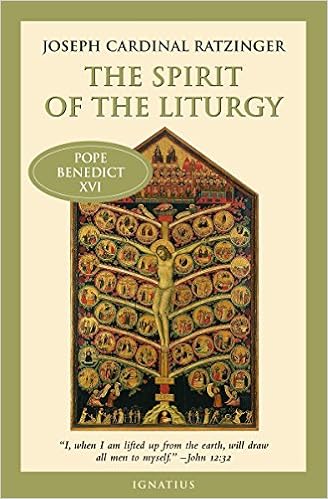
Try the indispensable The Spirit of the Liturgy, by Pope Benedict XVI, aka Joseph Ratzinger.  US HERE – UK HERE

Ratzinger has a deep reflection on the meaning of worship ad orientem.

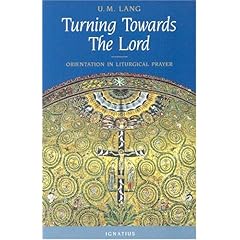
Also useful is  “Turning Toward the Lord: Orientation in Liturgical Prayer” by my friend the Oratorian Father Uwe Michael Lang. US HERE – UK HERE

And one should also read Card. Sarah’s important London speech.  He talks about the importance of ad orientem worship.  He asked priests – not officially of course – to consider saying Mass ad orientem.  HERE

Card. Sarah made the invitation and Lib World threw an authentic spittle-flecked nutty, thus proving the solid-gold value of his vision.

Gamber, by the way, said that of all the harmful things that came from the post-Conciliar reform, turning altars around was the most damaging.

Ad orientem worship is perhaps the single most important (initial) change that can be made in an effort to revitalize our sacred liturgical worship.

Moreover, priests don’t need permission to celebrate ad orientem and, according to law, they cannot be legally prevented.   They can, however, be bullied.

I turn now to a pastor’s page in a parish bulletin from St. Edward on the Lake in Lakeport, MI.   Fr. Lee Acervo took his parish ad orientem.  There was strong positive support.  However, there was one complaint and the bishop forced the priest to go backwards to versus populum worship.   Fr. Acervo explained the situation in his bulletin.  HERE

For your convenience:

Posted in "How To..." - Practical Notes, Hard-Identity Catholicism, Liturgy Science Theatre 3000, The future and our choices, Turn Towards The Lord | Tagged ,
16 Comments

How many baptist pastors are married?

Sometimes you hear the argument that, if only priests could marry, the problem of abuse of minors would be solved.

One is tempted to ask…

QUAERITUR: How many baptist pastors are married?

I read at FNC:

Hundreds of Southern Baptist leaders, volunteers accused of sexual misconduct in bombshell investigation

Hundreds of leaders and volunteers within Southern Baptist churches across the nation have been accused of sexual misconduct against young churchgoers for decades – many of them quietly returning to church roles even after being convicted for sex crimes.

A bombshell investigation by the Houston Chronicle and the San Antonio Express-News found that over the last 20 years, about 380 Southern Baptist church leaders and volunteers have faced credible accusations of sexual misconduct. Of those, roughly 220 were convicted of sex crimes or received plea deals, in cases involving more than 700 victims in all, the report found. Many accusers were young men and women, who allegedly experienced everything from exposure to pornography to rape and impregnation at the hands of church members.

The newspapers reported that the Southern Baptist Convention (SBC) largely treated the accusations as isolated issues, and took on an “out of sight, out of mind” mentality, even amid growing pressures to create a registry so the accusations wouldn’t disappear as alleged perpetrators moved from city to city. The Chronicle and Express-News created a database of convicted sexual abusers with documented connections to the SBC.

[…]

Read the rest there.

Do you suppose this story will get a lot of MSM coverage?

Posted in Biased Media Coverage, Clerical Sexual Abuse, You must be joking! | Tagged
10 Comments

Fr. Z’s Kitchen: Coda alla Vaccinara with digressions into Roman stuff, like a new old confraternity

Last night I had another Supper For The Promotion of Clericalism.  Of course you get what I mean.  There is a good clericalism, too, the sort whereby priests support each other in their identity, etc.   There’s a lot of hooey out there today about “clericalism” being the root of all problems in the Church, including but not limited to, too much or too little use of incense, plants in the sanctuary, bad sound systems, and a lack of adequate parking.  But I digress.

Last night’s clerical supper – served for six – presented as the main course the great Roman quinto quarto dish Coda alla vaccinara, oxtail stew.  This is a typical Roman dish, especially of the area from Testaccio, through Ghetto, Trastevere and Regola, hence, exactly the area of Roma where I learned to speak in the streets and land on my feet, running. When I go back to Rome, I usually stay in the Regola zone, around Campo de’ Fiori where I know every paving stone by name. The denizens of that area, Regola, were sometimes called mangiacode, because they ate so much coda.  There were, still are, lots of butchers around the place.  Regola, by they way, comes from the older renula, referring to banks of the Tiber (before the embankments).  This word is preserved in the Via Arenula which leads to the big bridge that crosses over into Trastevere.

I’ve never made coda alla vaccinara, but I’ve eaten it many times over the decades.  With a lot of kitchen experience under my belt and some consultation, I plunged in.  Mind you, I had seen the some great oxtails in the store, which got me thinking.  Hence, I texted back and forth with The Great Roman™ for tips about how “granny” made it.   This isn’t rocket science, but… but… you want to get it right, try to capture that Roman Thing.

I wrote about eating coda in Rome back in 2014.  I remember that meal, which was at Osteria La Quercia, again in Regola, and close to Ss. Trinità dei Pelegrini.   Mine was much better, I have to say. BTW… the ancient Confraternity that St. Philip Neri founded is being revived at Ss. Trinità!   HERE

Card. Burke blessed some habits recently, in January, for investiture.

Dear reader, please understand that this is … how to put this… this is part of romanità.  What follows is and isn’t a digression.  IT is something of the feel, taste, ethos of every bite of coda alla vaccinara.

Churches, confraternities, the revival of the Roman Rite, the light in the streets in late afternoon, uneven pavement, and so many other elements of life there, form a whole, each seasoning and flavoring the others.   And, mind you, since The Great Roman™ is involved also in the resuscitation of this Venerabile Arciconfraternita della Santissima Trinità dei pellegrini e convalescenti, which was founded by the co-patron of Rome to perform spiritual and corporal works of mercy, the new confratelli and consorelle are going to be involved in works of mercy as well.

This is not for dress up.  This is for real.

Anyway, when I make Roman food, I strive to get something of … all of that into it.

Get your tails cut into pieces of 2-3 inches.

Season and put some color on them.

Pancetta…

With your basics of carrot, onion and celery.  There will be a LOT more celery down the line.  That’s a key to good coda.  Here we color up some veg and tomato paste.

This was a point of discussion with The Great Roman™.  Red wine or white?  TGR convinced me that a dry white would be best, lest it too strongly influence the final flavor palette.  So, dry white it was.  About a half bottle went in, which deglazed and then reduced to a thick gravy.

Then I added the tails, brick by brick, as it were.  First, providing a layer of San Marzano (thank you to the reader who sent the tomatoes from my amazon wish list!  I remembered you with a quick prayer and a sip of wine while cooking).

This dish needs bay leaves.

After that, I filled in the cracks with the juice from the tomatoes and more crushed tomato, with a bit more white wine.  And, what you can’t see, the tricky part… a few nails of clove and a sprinkling of cinnamon.

Then… it needed some hours to cook.  I got it good and hot on the stove, then ovened it for a couple hours at 425F and then backed the heat off to 225F until it was time to go into the space where we were set up for dinner (my co (place is way to small).

There was no primo, such as a pasta.  I debated caccio e pepe, but figured that the coda was going to be quite filling.  Ergo, we had prosecco and various nuts and slices of calabrese and soppressata and, of course, peccorino.  This was the weak link.  It is really difficult to get the good stuff here.

Meanwhile, we had lots to talk about.  This meme came in during our preprandial gab.

Time to add the rest of the celery.  Coda is usually served with big chunks of celery.   However, celery can be overwhelming.  I waited till about an hour from serving to add large pieces… and carrots.  I really like carrots.

Patate al forno.

Here is the disappointing bit.  I forget to take a photo of a prepared plate!  I was busy.  I had bread to bake, potatoes to extract, wine to pour – a good Barbera with acidity and sufficient tannin, great for a rustic dish.  However, this photo from the interwebs looks very much like my final production, sans potatoes.

The meat literally fell from the blades of the tail bones.   The whole place was roused with the robust fragrance of the celery and, underneath it, the clove and cinnamon.  Sometimes coda is sprinkled with pine nuts, but, after all the nuts during our pre-prandials, I left them aside.

This was followed by a mixed green salad with a garlic and tomato vinaigrette dressing.

My desserts are simple:  mini Dove bars and, this time, wonderfully tart clementines, supplemented with amaro Braulio.

I have some sauce left over and pieces of the tail, which I’ve put away in the freezer: they’ll garnish some rigatoni someday soon.

I very much enjoy making these suppers for the brethren.  They are also a way of my showing appreciation for their participation in – and promotion of – celebrations of the Traditional Latin Mass.  They work with my Society and we do good things together.


Posted in "How To..." - Practical Notes, Fr. Z's Kitchen, Priests and Priesthood | Tagged
8 Comments

TRANS-NEPTUNIAN COMET APPROACHES EARTH

One of the best titles ever…

From SpaceWeather:

TRANS-NEPTUNIAN COMET APPROACHES EARTH: In only a few days, newly-discovered Comet Iwamoto will split the orbits of Earth and Mars, making a relatively close approach to our planet visible through small telescopes. This is a rare visit. The comet comes from the realm of Extreme Trans-Neptunian Objects, a distant region of the solar system inhabited by strange objects such as “Sedna” and “the Goblin.” Get the full story on Spaceweather.com.

Trans-Neptunian Comet!  Very cool.

But there’s more!

“The Goblin”?

And there’s something out there called “Biden”.

I can hear your minds going whrrrr-pop to assign “The Goblin” to some political figure.


Posted in Just Too Cool, Look! Up in the sky! | Tagged ,
3 Comments