Archbp. Chaput to #Synod2018 – no “LGBTQ” in any Church document

Some people are concerned that the 2018 Synod (“walking together”) on Youth will be rigged to create unheard of new openings toward the normalization of homosexual acts and homosexualist identity.

Today I read at the Catholic Herald, the UK’s best Catholic weekly, that Philadelphia’s increasingly outspoken Archbishop Charles Chaput gave his intervention at the Synod and warned that the moniker “LGBT” should not be used in any Church document.

To which I say, “Bravo!”

You might recall that Archbp. Viganò, in his “Testimony” related that Francis said extremely unflattering things about Chaput.  Just the other day, a key member of Team Francis, Card. Baldisseri, Chief Rigger of the Synod of Bishops, took an oblique swipe at Chaput in his opening speech at this Synod because Chaput dared to make critical observations about the Synod’s working document, the Instrumentum LaborisWeigel said it best:

The IL is a 30,000-plus-word brick: a bloated, tedious doorstop full of sociologese but woefully lacking in spiritual or theological insight. Moreover, and more sadly, the IL has little to say about “the faith” except to hint on numerous occasions that its authors are somewhat embarrassed by Catholic teaching—and not because that teaching has been betrayed by churchmen of various ranks, but because that teaching challenges the world’s smug sureties about, and its fanatical commitment to, the sexual revolution in all its expressions.

Back to Chaput’s intervention.  The CH provides the text.  Here is his peroration:

Finally, what the Church holds to be true about human sexuality is not a stumbling block. It is the only real path to joy and wholeness. There is no such thing as an “LGBTQ Catholic” or a “transgender Catholic” or a “heterosexual Catholic”, as if our sexual appetites defined who we are; as if these designations described discrete communities of differing but equal integrity within the real ecclesial community, the body of Jesus Christ. This has never been true in the life of the Church, and is not true now. It follows that LGBTQ” and similar language should not be used in Church documents, because using it suggests that these are real, autonomous groups, and the Church simply doesn’t categorize people that way.

Explaining why Catholic teaching about human sexuality is true, and why it’s ennobling and merciful, seems crucial to any discussion of anthropological issues. Yet it’s regrettably missing from this chapter and this document. I hope revisions by the Synod Fathers can address that.

Fr. Z kudos.

UPDATE:

Right on cue, homosexualist and #sodoclericism activist Jesuit James Martin, LGBTQSJ reacts on Twitter:

The last tweet, embedded.

Note that what Martin does is promote division in the Church by emphasizing a small subgroup for which he claims special treatment.   Mind you, he is not claiming equal treatment.  He is claiming special treatment.   Ultimately, he is calling for normalization of sinful homosexual acts.    Forcing and forcing and forcing this label “LGBTQ” etc. is part of a long-term strategy.  And that strategy doesn’t end with normalization of homosexual acts.  The next goal is the lowering of the age of consent.  HERE

Posted in Fr. Z KUDOS, Sin That Cries To Heaven, Synod | Tagged , ,
19 Comments

ESOLEN: The prelates of sodom – #sodoclericalism

A The Catholic Thing the scholar and translator of Dante’s Divine Comedy uses this most important of works to unpack a central issue in The Present Crisis.

There are those today, such as highly tattooed gang of Team Francis, who work assiduously to distract people’s attention away from the true cause of The Present Crisis of clerical, indeed prelatial sexual victimization of mostly post-pubescent males, including even something that looks very much like sex trafficking and covering up these sins and crimes or looking the other way.   They would have us believe that “clericalism” is the root of The Present Crisis.   No.  Sure there is a clericalist dimension since this is a problem among clerics.   The real evil root is a homosexual subculture among clerics.  Hence, we should call it #sodoclericalism – let’s call it what it is.

In his piece, Esolen describes something of Dante’s layout of Hell.  Remember that La Divina Commedia is not primarily intended to describe Hell, Pugatory or Heaven.  This works is a vehicle for Dante’s presentation of a new political theory and a new poetic theory, both concerning the relationship of the sacred and the profane.   That said, Esolen gives a brief description of how certain kinds of sinners wind up where they do – it is rigorously logical, by the way.

Then he gets to sodomy.

Let’s turn now to Esolen, with my emphases:

[…]

The violent are divided into three groups, according to the victim of the violence: worst are the violent against God Himself.  These suffer the punishment of a rain of fire-flakes that spark the burning sands beneath them.  They must take that fire lying down (blasphemers), sitting at the brink of the gulf of the fraudulent (the usurers), or racing about continually (the sodomites).

*

If Nature is the daughter of God, Dante reasons, then those who violate Nature in their sexual deeds, meant for the bringing of new life into the world, show their contempt of the Creator Himself.  If human industry is the daughter of Nature, then those who do nothing for their wealth but rub coins together to make them breed are blasphemers too, as are the sodomites.

It is not pleasant to ask where in this scheme the wicked prelates of our time belong.  Perhaps the question is too narrow.  In our age of easy travel, after all, people can get around.  Bishop Black might touch down in Sodom, in scorn of God, but only after he has supinely accepted the heresies that make Sodom conceivable to him; and then he takes the Eucharist in hands that smell of that foul city in an act of blasphemy.

But he cannot rest there.  His fundamental “creative” sin must remain always in act; there is in fact no end to it, nor can there be.  So he weaves about himself a web of sinners of like mind, and this is preeminently the sin of simony, which in this instance is to replace the bride of Christ with a male in drag, and set him about to pander and procure.

It would be cleaner just to sell the mitre and crozier for good old ill-gotten money.  But all of this is to commit treason against Christ, who gave His life for the Church, to have her as his bride, pure and without spot.

It appears that if we pull at one string of the rats’ nest we will catch the rest too.  I am not saying that all of the bad bishops have been formal heretics, or that they have all been sodomites or men who condoned that sin in others, or that they have all made a habit of putting priests and other bishops in their hip pockets, or that they have all built their lives upon betraying Christ and His Church at every pass.

There is no need to make that claim.  Nor do I say that we should always expect to find, among the prelates of Sodom, plenty of the other two ways that Dante identifies of being violent against God – in our time, the blasphemy of gross liturgical abuses, and the laundering of millions of dollars pressed from the hearts of the faithful.

Not always, not always. ?  I do not make any universal claim.  One sinner is not the same as another.  The great general claim will do.

Nor do I say that the people in the pews have been paragons of orthodoxy, charity, truth, and fidelity.  We have not.  But now we know why some of our superiors have treated the most faithful of the laity with irritated indifference at best, and thinly veiled hatred at worst.

It is hard to take divorce seriously, I suppose, or cohabitation, or the smutty stuff peddled to children in many a Catholic school, when you have your hands down a seminarian’s pants, or when you seat your homosexual lover in the front pew, or when you cannot bring yourself to call God “He,” because the pronoun is too personal for comfort.

Perhaps the scandal will have this immediate effect:  The next time you find a prelate who treats the Mass with blithe innovation, or who pushes a rainbow of sexual wickedness in the schools, or who seems allergic to the masculine character of Christ Himself, or who hedges himself with yes-priests and yes-nuns who promote these things, you will wonder perhaps where he is and what he does on a Friday evening.

That may not be fair.  But what in this scandal has been fair?

Blistering to be sure.

Note what in the past he wrote about James Martin, LGBTSJ. HERE  What he wrote about killing vocations by feminizing everything.  HERE

Esolen translated Dante’s Divine Comedy into English and did a great job of it.

If you have never read the Divine Comedy, you should.  You could start with Esolen (Part 1, Inferno US HERE – UK HERE) or perhaps with Dorothy Sayer’s fine version (Part 1, Inferno, US HERE – UK HERE).  There are many renderings to choose from.  I would very much like to teach on Dante someday.  Maybe it’ll happen.

When you make the excellent choice to read the Divine Comedy, here are a couple tips.  First and foremost, make the decision that you will read the whole thing.  Don’t read just the Inferno.  The really great stuff comes in Purgatorio and Paradiso.  Also, read through a canto to get the line of thought and story and then go back over it looking at the notes in your edition.

Dante was, perhaps, the last guy who knew everything (with the possible exception of Erasmus).  Each Canto is dense with references.  You will need notes to help with the history, philosophy, cosmology, poetic theory, politics, theology, etc.  Really.  You will need help.

Posted in Sin That Cries To Heaven | Tagged , , , ,
7 Comments

The bones of St. Ambrose examined and verified

I put on my patristicist cap today with super excitement.  I saw at NLM Greg DiPippo’s spiffy post which conveys news from Italian media about forensic analysis of the bones of St. Ambrose, Bishop and Doctor, who died in 397.  Italian source HERE.

As reported yesterday in several Italian newspapers, a forensic analysis recently performed on the relics of St Ambrose has not only confirmed their authenticity, but also the accuracy of the most ancient portrait of the Saint. In a letter to his elder sister Marcellina (also a Saint), Ambrose speaks of an intense pain which he experienced in his right shoulder, and difficulty of movement, caused by a fracture of the right clavicle which he suffered in his youth, and which never properly healed. The presence of this fracture is confirmed by the examination of his skeleton, and, as explained by the head of the forensic team, Dr Cristina Cattaneo, accounts for the notable asymmetry of his face, as seen in this mosaic portrait of him from the early 5th century, in the chapel of St Victor in Ciel d’Oro within the famous basilica where his relics are kept. The Saint’s age of the time of his death is also confirmed, around 60 years old.

Analysis was also performed on the relics of the Ss Gervasius and Protasius. In 386 A.D., St Ambrose uncovered the relics of these two Milanese brothers and martyrs, after been shown the place of their long-forgotten burial in a dream. He had them brought to a newly built basilica, then called simply “the Basilica of the Martyrs”, and laid in the place he had originally intended for his own burial; he also attests to the miraculous healings which accompanied the translation, as do his secretary, Paulinus, who would later write his Life, and St Augustine. Ambrose himself died on April 4th, 397 (which was Holy Saturday that year), and was laid to rest next to Ss Protasius and Gervasius; the basilica is now officially named after him. In the mid-ninth century, the abbot of the attached monastery placed the relics of all three saints in a large porphyry sarcophagus, which was later sunk into the floor and covered over; it was rediscovered in 1864 during a major restoration project, and the three bodies are now seen in the Confession of the church under the altar.

The relics of St Ambrose, in the middle, in the white of Confessors, and Ss Gervasius and Protasius, in the red of the martyrs, to either side of him. Photograph by Shawn Tribe, from this article published in 2012.

The forensic analysis shows that the two Saints were unusually tall for their era, about 5’10”, in their mid-20s, definitely brothers, most likely twins, since they suffered from the same congenital defect of the vertebrae, and have very similar faces. (This disproves the claims of some hagiographical skeptics that the skeletons were not those of two brothers, but that one was much older than the other.) One of them was decapitated, and has signs of injury on the ankle, the other was wounded on the hand with a small weapon of some sort.

Posted in Just Too Cool, Patristiblogging | Tagged
3 Comments

A Visual Image of Years of Priesthood – or – Good Clericalism

I really enjoyed this email, which is a kind of visual testimony about priesthood.

Please allow me to share with you a photo I think you will enjoy.

Last week, while in Rome, I took the opportunity to buy a new biretta tascabile.  The old one still worked, but was beginning to show its age.  It is my “working biretta,” which means I wear it more for protection from the elements, outside the church or at the cemetery, so it takes more abuse than my ceremonial biretta rigida.

When I brought home the new one, the difference was striking.  I guess two decades takes a toll!

Here’s to an another exciting month –

With all the B as B and S as in S going on about “clericalism” being the omnium caput malorum.  The real problem, that they want to direct you away from, is #sodoclericalism.

Hence, I will remind you of our

BIRETTAS FOR SEMINARIANS PROJECT 

Check it out and…

… stand up for good clericalism!

Posted in Mail from priests, Priests and Priesthood, Seminarians and Seminaries | Tagged ,
3 Comments

Fun video from Rome!

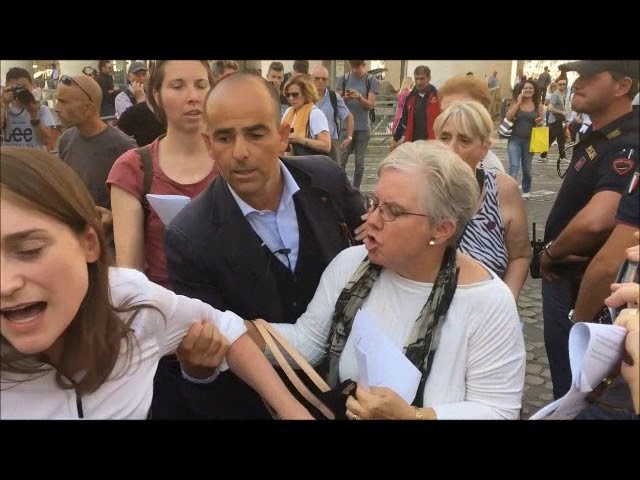
From the loons of the Fishwrap comes this amusing moment.  Some loons went to Rome to “protest” about the ordination of women.   They were, it seems, harassing Synod members. The police got interested.

Note the caption: Roman pilice clash with peaceful protesters”. First, there was no “clash” and they weren’t peaceful, since they were making a racket, which is rude. Note also who made it. LOL!

YouTube thumbnailYouTube icon

I want a video of them being dragged off across the sampietrini, perhaps being pursed by someone with that stick thing that Francis had.  No wait, perhaps Francis got the stick thing from one of them?

Posted in Lighter fare |
13 Comments

Taking on “Grievance Studies”. Hilarious and frightening.

Although I am irritated with Rod Dreher, he published something in equal measures hilarious and alarming.

It just goes to show how fast our society is devolving into imbecilic madness.

A taste:

You have GOT to read this, from Quillette!  It starts with this editor’s note:

Editor’s note: For the past year scholars James Lindsay, Helen Pluckrose, and Peter Boghossian have sent fake papers to various academic journals which they describe as specialising in activism or “grievance studies.” Their stated mission has been to expose how easy it is to get “absurdities and morally fashionable political ideas published as legitimate academic research.”

To date, their project has been successful: seven papers have passed through peer review and have been published, including a 3000 word excerpt of Adolf Hitler’s Mein Kampf, rewritten in the language of Intersectionality theory and published in the Gender Studies journal Affilia.

[…]

In a press release, the three scholars say:

Because the scholarship we infiltrated represents a view that currently has a great deal of cultural power (though very little political power, at least in the United States in most districts), and because that power is nearly absolute within the universities (and seems to be going that way in media and many businesses, including large corporations), one conclusion this project provides is a permission slip for academics and others to openly doubt the scholarship that seems to legitimize and institutionalize these conclusions as factual.

Because this is just one project, however, with limited scope and duration, we want it to be a starting point to a proper and thorough review of the fields, journals, disciplines, and scholarship that has allowed this to be possible.

Here’s a link to the fake papers they submitted successfully to Grievance Studies journals.

At one point the piece gets a little raw, but it is a thorough savaging of prevailing academia.

Posted in ¡Hagan lío!, Liberals, Lighter fare |
8 Comments

Scottish young people’s Letter to a Synod bishop

The UK’s best Catholic weekly, the Catholic Herald, has the text of a letter signed by 107 “young people” (18-35) in Scotland, to Archbp. Cushley of St Andrews and Edinburgh in Scotland.

Some of their statements are, I think, not what the riggers … organizers of the Synod want to hear.

The full letter to Archbishop Cushley.  My emphases and comments:

Your Grace,

We write to you in advance of the upcoming Synod of Bishops on “Young People, the Faith and Vocational Discernment”. As young Catholics across Scotland, we would like to express our hopes and concerns for the future of the Church in this country.

In some of the discourse surrounding the synod, we have noted a trend of suggesting that difficult aspects of the Church’s teaching, in matters of morals and matters of faith, need to be downplayed, or even put aside, in order to be relevant to people’s lives and sensitive to their difficulties. Some even imply that priests who hold to orthodox teaching are out of touch with the lives of lay people, and of young people especially. However, it is in fact this line of thought that is utterly in contradiction to our lived experience. What made us become and/or remain Catholic, against ever increasing cultural pressure, are those aspects of the faith that are uniquely Catholic, not things that can be found in social clubs, in NGOs, or in political parties. What matters is precisely the Church’s claim to truth; Her liturgy and Sacraments; Her transcendent doctrine, communicated in teaching but also through beauty and goodness; Her understanding of the human person, laid out so powerfully for the modern world by St John Paul II; [whose body of teaching this pontificate’s Team seems bent on erasing] and Her moral teaching, that while so very challenging, also offers the only path to true joy and human flourishing as we see in the lives of the saints. These are the things that convince us that here is something worth the sacrifice, something good for us and for every human being.

Young Catholics are inspired by the heroic virtue espoused by the Church, in opposition to the cynicism and pessimism of postmodern culture. A faith that merely legitimises the habits we would otherwise have anyway is simply not worth it. Far from being “out of touch”, it is those priests who proclaim orthodox teaching in its fullness with joy and courage who have brought the light of Christ into our lives, and really offered us His Mercy – the remedy for a broken world, which does not pretend human brokenness is irremediable, but truly heals and gives the grace we need to live new lives of virtue. To those priests, we are unendingly grateful.

Sadly, far too few young people have encountered this fullness of the faith lived out visibly and confidently. A young Catholic father in America recently wrote to Archbishop Chaput [He’s that guy whom Francis warned against in his conversation with Archbp. Viganò.  He’s the guy who dared to raise his voice in the last Synod and who has commented on the Instrumentum Laboris of this Synod.] that “The disastrous effect that Beige Catholicism (as Bishop Robert Barron aptly describes it) has had on my generation can’t be overstated.” (“From the Heart of a Young Father”, Charles Chaput, First Things, 18th  April 2018). God has, in His mysterious ways, providentially and gratuitously blessed us with encounters, pastors, and formation that many of our peers have not had. [The implication is that there are not enough priests of the kind they describe.  Why is that, I wonder.] We desperately want to share this great gift with so many lapsed and non-Catholics among our family, friends, and colleagues, who have not rejected Catholicism but a poorly-understood shadow of it. If the synod is to bear fruit, it is with this task that it must help us.

We need to ensure that our local Catholic communities are permeated with a Catholic worldview, and unashamed that such an orientation is very different from the prevailing cultural trends. The sacramental life, beyond just Sunday Mass, needs to be obviously and visibly the foundation of Catholic existence. We must draw on our rich heritage to ensure the liturgy is celebrated with beauty and splendour [Like the stick Francis carried at the opening of the Synod?] so as to reveal and draw us into the profound mysteries taking place. We need to see the various vocations lived out fully and joyfully, with parishes and dioceses forming a living iconography of faith, so that we can discern God’s will for our own lives, not in isolation but in an ecclesial context.

Young people need the chance to get to know our priests as priests – not just as administrators, nor presiders rushing from church to church, nor again merely as pals, but as fathers, whose fatherhood is rooted in their sacramental identity as men called and set apart to absolve and to offer the Holy Sacrifice. [Set apart?!?  Like… yikes!… clerics?!?] Young Catholics find priests who live their vocation to celibacy faithfully and joyfully to be highly credible witnesses to the joys and challenges of life in Christ.

The Church must be proactive and not merely reactive in facing the crisis affecting marriage and the family. To a large extent, Catholic married life has come to be treated as little different from secular relationships. Our economic and social structures are based almost entirely around a presumption of contraception, and this makes it extremely difficult for any couples who live faithfully according to God’s commandments. So many of our generation are living with the consequences of broken families, and this has engendered a cynicism about marriage. However, these young people have never been shown an alternative and therefore the Church has a great opportunity and obligation to clearly, confidently, and joyfully proclaim the truth about marriage. Young Catholics have a right to hear these truths at a local level so that our parishes are consciously supportive of the vocation to holiness in married life. This is vital since it is firstly in the family that vocations are fostered and it is on this foundation that an authentic renewal of Catholic culture and the life of the Church will be built.

There is no doubt that discovering and living out one’s vocation is very difficult in the modern world, as indeed it has been in every age. However, we know that God’s grace is enough for us and we hope and pray that a renewed faith and confidence in this will suffuse the Church and inspire young people to discern and live out their vocations faithfully.

Entrusting the synod to the intercession of St John, youngest of the Apostles, we assure you of our prayers.

Yours sincerely in Christ,

SIGNATORIES

Posted in Our Catholic Identity, Synod | Tagged ,
8 Comments

What the H is up with that? Does this have bearing on The Present Crisis?

Go to minute 2:00

YouTube thumbnailYouTube icon

Posted in SESSIUNCULA | Tagged
16 Comments

ASK FATHER: 2018 traditional Confirmation in @MadisonDiocese ?

From a reader…

QUAERITUR:

The last two years about this time of year you have posted a letter from the Extraordinary Ordinary, Bp. Morlino, announcing that he will do Confirmations in the EF. Do you know if he will do them again this fall? (My 8 year old son and I have spent the summer going through the Baltimore Catechism in the hopes that he will do it again.) Thanks for all you do for our Holy Mother Church!

Yes!  That’s right.  Thanks for thinking of it.  We’ve had quite a few confirmands over the last couple of years in November.  People were so happy and grateful and they came from all around.

We’ve been working on a date for traditional confirmation.   From what I understand now, His Excellency has considered May 2019 rather than this November, as in the past.

I’ve had quite a few inquiries, actually.

Posted in "How To..." - Practical Notes, Liturgy Science Theatre 3000 | Tagged , , ,
6 Comments

Fr. Z’s Kitchen: Roman comfort food on a chilly, rainy, depressing evening

Reading the news and my email can get to me once in a while. Like many of the denizens of your planet I, too, will occasionally have some comfort food. For example, I may have breakfast in the evening: a couple of eggs, toast, bacon.  That’s a good one.

However, this time I decided to do a variation of eggs, carbs and bacon.

Since I am pining a bit for Rome I made Rigatoni alla carbonara. This is one of the classic Roman dishes, pre-Columban, tried and true and not the easiest to make well.

The problem with working with eggs in hot preparations is to keep them from simply turning into scrambled eggs, with hard curd, rather than staying creamy as a sauce.

Today’s variations included, elicoidali instead of rigatoni, pancetta instead of guanciale.  I used what I had.  I keep some pancetta in slices in the freezer, very carefully wrapped and sealed with olive oil to prevent any burn.

Get your salted water going for the pasta and get the pasta cooking.  You will want it al dente.

Timing is important for this dish.  Lots of things happen in a short period of time.

Get your guanciale/pancetta going in a little oil.  Tastes vary, but just short of crunchy is standard.  Get it to the right point and take the pan off the heat.  It has to cook so that the eggs don’t harden.

When you are ready to rock and roll – sorry, I could do photos – save a bit of water from your pasta and drain.  Put a dash of the cooking water into the pan with the guanciale give it a tap of heat.  Put in the pasta, give it a little stir about and a tap of heat and let it rest a moment off the heat.

Beat together your grated pecorino and, perhaps, grana, with your egg yolks.  I use 2 yolks of small eggs per person and about 15-16 g of grated cheese along with fresh ground pepper.   If you have some cream or panna or crème fraîche handy, you might add a touch, but that’s either cheating or a rescue strategy, when people are at the table.

Add your egg and cheese mix to your pan with the guanciale, pasta and cooking water and start blending – quickly.  You have to work fast, perhaps giving it a tap of heat if it is too loose or a dash of the cooking water if too thick.

You are aiming for a creamy texture, not scrambled eggs.   You might have to do this a few times to get your own technique down.    It is also easier to make about 4 portions than 1.  A lot easier.

More fresh ground pepper and parsley.

This is such a simple preparation that, apart from the timing of your blending the ingredients and your control of heat, everything… everything… depends on the quality of your pig product (true guanciale is optimal but you can work with other things so long as they are truly flavorful) and your cheeses.   In these USA it is hard to get that Roman flavor just right because of the ingredients available here.  They are not the same.  They almost always disappoint, once you have Rome in your marrow.

In any event, I thought it would be good to have some “bacon and eggs” yesterday, to raise my spirits as I read one dreadful thing after another.  And, I must say, it was pretty darn good, for being domestic.

The only thing that would have made it better would have been some company to cook for.

No, wait.  The other thing that would have made it better: a white wine that wasn’t worthy only of being used to clean bug debris off the grill of my car.   Kenwood – Sonoma – Sauv Blanc… just say, “No! Per l’amor del cielo!”  Uck.  One sip and I was done.  I now am trying to think of something other than bug part removal for it.

Posted in Fr. Z's Kitchen | Tagged
15 Comments