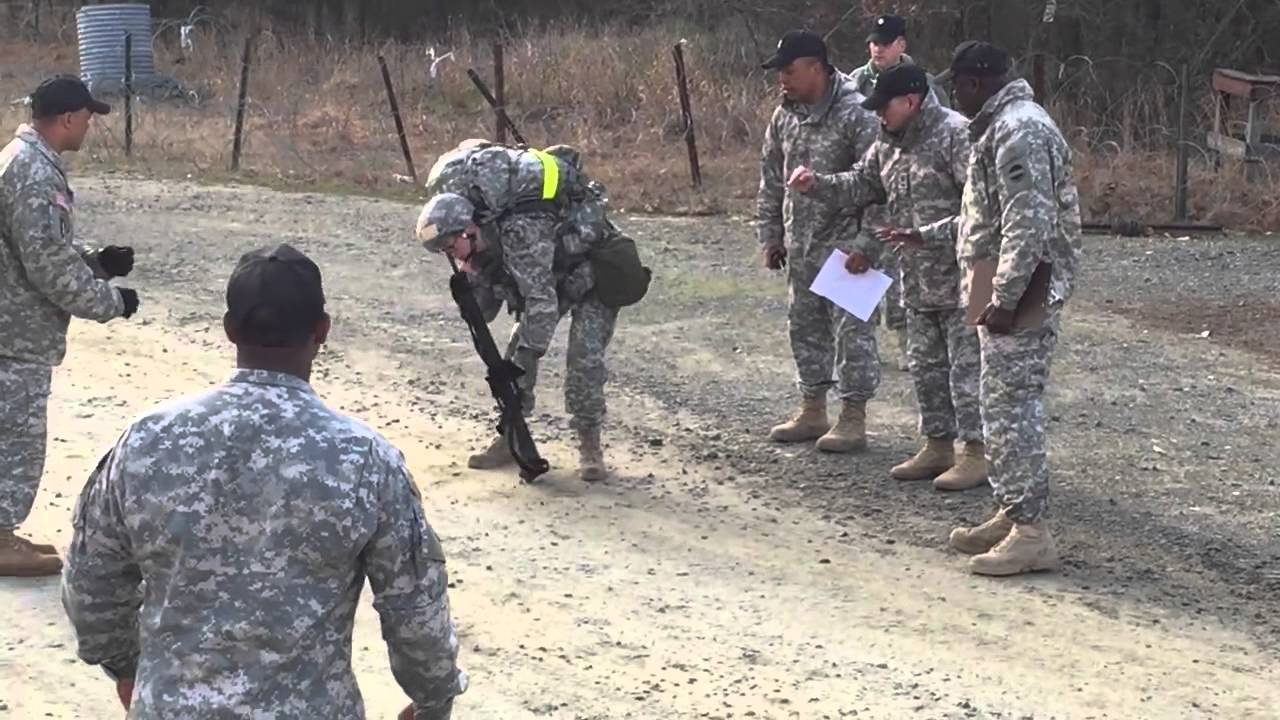
The next time you are tempted to quit…

I had to share this video, which I understand has been “viral”.

Consider this demonstration of determination and desire the next time you are challenged with a task and want to quit.

Via WaPo:

Mason said [Army Capt. Sarah Cudd] with Army Public Health Command at Fort Knox, Ky. The march was the last event required to earn the Army’s Expert Field Medical Badge, a decoration awarded to those who pass a rigorous battery of tests for medical professionals in the Army. Less than 25 percent of those who attempt the required course typically pass.

The Public Health Command shared the video May 1, and confirmed Cudd earned the badge. Forty-five other soldiers did the same day — but 80 percent of those who attempted the course fell short.

[…]

In the closing moments of a grueling 12-mile road march, Army Capt. Sarah Cudd fell to her knees. She was exhausted, bowed over by the heavy pack on her back and seemingly unable to continue.

The soldier pressed on, however. Using her rifle to prop herself up, she stumbled to her feet and made it another nine steps before falling again. Other soldiers gathered around her, cheering her on. She rose again, and gritted it out another 50 feet or so until she made it across the finish line while her colleagues erupted in excitement.

[…]

YouTube thumbnailYouTube icon

Posted in Just Too Cool | Tagged
26 Comments

A dose of reality from Milwaukee’s Sheriff

I really like this Wisconsin sheriff.

From LifeSite:

Black Sheriff Says if Black Lives Mattered They’d Protest at Abortion Clinics

CNN’s Poppy Harlow interviewed Milwaukee Sheriff David Clarke about the recent protests that some in the Black Community have sparked after the police related deaths of Michael Brown and Eric Garner.

Harlow asked the Sheriff, who has been on several news shows on Fox and others, about a tweet he sent out implying that if Black lives mattered the protesters would be outside abortion clinics because of the high numbers of black babies killed by abortion.

[…]

Go check out the story.

Posted in Emanations from Penumbras, The Drill | Tagged , ,
8 Comments

ASK FATHER: Is divorce a sin? Should I confront priest who said it isn’t?

From a reader…

A local, newly Ordained, Priest has told my wife that it is NOT a sin to divorce me so long as she does not remarry. I believe that it is a sin to divorce since there is no abuse, physical or emotional, no addictions on my end, etc… Should I confront this priest or is he correct?

First, I don’t know what the priest said, and it sounds like you don’t either.  You should ask the priest what exactly he said.  Note: I said “ask” not “confront”.  The priest may respond that he is not free to say. So confronting the priest may not provide opportunity to clarify the matter.  More on that later.

Now to another point.

Is divorce a sin?

The Catholic Church certainly seems to think so.

“But Father!  But Father!”, ….

SHHH!  Be still for a moment.

The Catechism of the Catholic Church 2383 says:

“If civil divorce remains the only possible way of ensuring certain legal rights, the care of the children, or the protection of inheritance, it can be tolerated and does not constitute a moral offense.”

But wait! There’s more!

Par. 2384 says:

“Divorce is a grave offense against the natural law. It claims to break the contract, to which the spouses freely consented, to live with each other till death…Divorce is immoral also because it introduces disorder into the family and into society.”

Canon law has a little known procedure called “separation while the bond remains“. Canons 1151-1155 outline the reasons and the logic behind the process. Canons 1692-1696 outline the process.

There are certain times and situations that warrant drastic measures.

Divorce is always awful. It means that an attempt to build a bond of marriage failed. Yet, there are situations and circumstances that warrant a couple separating and even seeking a civil divorce.

Sometimes these circumstances are apparent to one spouse, and not at all apparent to the other.

What damage “no fault” divorced caused, back when!

It is impossible for me to diagnose from afar the situation mentioned by the questioner.  I can’t determine if there is a need for a divorce or if one party is committing sin either by seeking a divorce where none is warranted, or behaving in such a manner that the other spouse thinks divorce is the only recourse.

But please note well: The interlocutor brings up the notion of “confronting” the newly ordained priest about his advice to the young woman.

Instead of “confronting” the priest, who allegedly told your wife that it’s not sinful to divorce, perhaps the best thing to do would be to seek out some spiritual guidance for yourself. Seek some objective feedback about your situation.  Pray for your wife!  Pray for your whole family if you have children.  Ask the intervention of the Holy Family. Trust the Lord.

UPDATE:

I see I have to turn on the moderation queue. I should have done that from the onset, I suppose.

Posted in "How To..." - Practical Notes, ASK FATHER Question Box, One Man & One Woman, Our Catholic Identity | Tagged , , ,
33 Comments

ASK FATHER: “We don’t go to Mass to adore Jesus…”?

four-endsFrom a reader…

QUAERITUR:

Last summer I heard a bishop say, “We don’t go to Mass to adore Jesus…” (I was too shocked to hear why we do go.) Last week, my own priest in his homily, said something to the effect that we go to Mass to support each other in our journey as Christians.

I can support my friends over coffee; they aren’t why I come to Mass.

Am I wrong to have adoration as my primary focus?? Doesn’t Adoration, Contrition, Thanksgiving, Supplication still apply?

Is this confusion why we have to sing constantly during the Communion procession? There is no silence for personal prayers of gratitude and love.

I’ve tried to ask for clarification, but those who are committed to this community model become very agitated when I question. It’s pretty much the universal model in our diocese. Am I really that far off base? Please some direction or explanation. If I’m wrong, I will do my best to go along with this, but the best spin I can put on it is that it’s rude to ignore our Lord, and I believe it’s probably a lot worse than rude.

We don’t go to Mass to adore Jesus?

Huh!  Who knew?

The first of the “Four Ends” for Mass comes to mind.  The Four Ends (reasons/aims/purposes) are:

  1. Adoration [Hey!  It’s the first!]
  2. Thanksgiving
  3. Atonement
  4. Petition

A wag once said,

“To pray the liturgy is to really enter into the mystery of God, to allow ourselves to be brought to the mystery, and to be in the mystery. [We are all] gathered here to enter into the mystery: this is the liturgy. It is God’s time, it is God’s space, it is the cloud of God that surrounds all of us. To celebrate the liturgy is to have this availability to enter into the mystery of God, to enter into His space, His time, to entrust ourselves to this mystery. We would do well today to ask the Lord to give to each of us this ‘sense of the sacred’ — this sense that makes us understand that it is one thing to pray at home, to pray in Church, to pray the Rosary, to pray so many beautiful prayers, to make the Way of the Cross, so many beautiful things, to read the Bible — [but] the Eucharistic celebration is something else. In the celebration we enter into the mystery of God, into that street that we cannot control: only He is the unique One — the glory, the power — He is everything. Let us ask for this grace: that the Lord would teach us to enter into the mystery of God.”

Entering into that mystery is another way of saying adoration.

In the Holy Mass, God touches earth and gives us a glimpse of heaven. The Second Person of the Blessed Trinity becomes truly present in the Eucharistic elements.

God is really there.

Adoration seems like a reasonable response.

Adoration of the God who made us could be among the reasons for going to Mass.

So, keep adoring. And keep ignoring silly things that some people say, even if they wear pointy hats and rings.

Oh… and that wag?  That was Pope Francis on 10 February 2014.

Posted in "How To..." - Practical Notes, ASK FATHER Question Box, Francis, Liturgy Science Theatre 3000 | Tagged , ,
45 Comments

ASK FATHER: Is saying “God bless you!” a blessing?

From a reader…

QUAERITUR:

I was just at a “seminar” that took place in a catholic church this past weekend and I knew right away that I was in the wrong place (thus the lower case c) when the parish priest introduced the speaker and asked all of us to extend our hand in blessing over this speaker, as though we had the power vested in us to confer blessing!

I spoke to my friends about this, and why it was so inappropriate, but it got me to thinking: I have long been in the habit of saying “God Bless” instead of “Good Bye” both in speaking and in writing…but if it’s inappropriate for me to bless someone in the way this priest was asking us to, then wouldn’t it be just as inappropriate for me to use this phrase? Of course, it is just me asking God to bless them, not pretending that I have the faculty to actually confer a blessing, but still…would it just be more appropriate for me to avoid saying this?

Saying “God bless you,” when someone sneezes has a long history in Christian civilization – spoken by cleric and laity alike. It’s a kind wish and a good thing to do. Similarly, saying “God bless you,” at the end of a conversation, or when tucking a child into bed at night, is laudable.

It’s an entirely different category to pretend one is a priest, extend one’s hands and attempt to “bless” another person. That’s something which the Church rightly reserves to Her ordained ministers, who act in persona Christi.

“But Father! But Father!”, some of you are now gurgling.  “Pope Francis himself asked people to bless him when he was elected and he’s the most wonderfulest, fluffiest Pope ehvur!  He’s the first Pope who ever smiled or kissed a baby!  You hate Vatican II, don’t you?!”

Yes, we all recall that awkward moment at the election of Pope Francis when on the balcony he said:

And now I would like to give the blessing. But first I want to ask you a favour. Before the Bishop blesses the people I ask that you would pray to the Lord to bless me – the prayer of the people for their Bishop. Let us say this prayer – your prayer for me – in silence.

Note that the Pope asked people to pray for the Lord to bless him, not that they would extend hands or make the sign of the Cross and bless him as priests might.   Just to be clear about that.  It was, however, confusing … for the easily confused

Avoid at all costs the silliness of simulating a priestly blessing. This veers close to sacrilege.  I think it smacks of an effort by a certain element in the Church to downplay the ordained priesthood.

Keep on saying “God bless you” when someone sneezes, and keep on asking God to bless friends and family members in your conversations.

Posted in "But Father! But Father!", "How To..." - Practical Notes, ASK FATHER Question Box, Our Catholic Identity |
23 Comments

Pope Francis did two really cool things

First, yesterday, Pope Francis went to a parish near Ostia (Rome’s ancient port where St. Augustine’s mother, St. Monica, died – today is her feast in the traditional calendar). Before saying Mass, His Holiness heard confessions!

Fathers… hear confession!

Second, the Pope sent a message for the 750th anniversary of the death of Dante.

If you haven’t read the Divine Comedy you just haven’t read enough yet. It is key.

I recommend the translations by either…

Dorothy Sayers


or…

Anthony Esolen


And don’t just read the Inferno and stop.  Go on and read also Purgatorio and Paradiso.

Posted in Francis, GO TO CONFESSION | Tagged , ,
9 Comments

ACTION ITEM! US CLERGY! Sign letter urging Synod to uphold Catholic teaching on marriage and family!

15_04_25_Credo_priestsI want to bump this to the top so that more priests will see it after a busy weekend.

____

Published on: Apr 25, 2015 @ 9:58

_____
You will recall that hundreds of priests in England signed a letter, published in the Catholic Herald, urging the upcoming Synod to uphold Catholic doctrine and discipline concerning marriage and the family.  HERE

That letter created a stir.

I now see that there is an American initiative for Catholic priests to sign a similar letter!

HERE

Signers, be patient.  It seems that your names will not post automatically.  I think that someone must verify the names, which is a good idea.  There will be a delay.

Lay people, please let your priests know about this initiative and ask them to sign it.  Tell them you’ll be watching the list.

I urge all the priestly readers to sign this letter.  I have.

To the Synod Fathers:

In union with our brother priests in the United Kingdom (conforming to the teachings summarized in the Catechism of the Catholic Church, 1650-51), we make our own the petition they signed urging the Synod Fathers in the upcoming Synod to stand firm on the Church’s traditional understanding of marriage, human sexuality and pastoral practices:

Following the Extraordinary Synod of Bishops in Rome in October 2014 much confusion has arisen concerning Catholic moral teaching. In this situation we wish, as Catholic priests, to re-state our unwavering fidelity to the traditional doctrines regarding marriage and the true meaning of human sexuality, founded on the Word of God and taught by the Church’s Magisterium for two millennia.

We commit ourselves anew to the task of presenting this teaching in all its fullness, while reaching out with the Lord’s compassion to those struggling to respond to the demands and challenges of the Gospel in an increasingly secular society. Furthermore we affirm the importance of upholding the Church’s traditional discipline regarding the reception of the sacraments, and the millennial conviction that doctrine and practice remain firmly and inseparably in harmony.

We urge all those who will participate in the second Synod in October 2015 to make a clear and firm proclamation of the Church’s unchanging moral teaching, so that confusion may be removed, and faith confirmed.

Yours faithfully,

Signed:

The priests are listed over there.  So far there are 2 bishops and 119 priests at the time of this posting, but I imagine there is a long queue.

Heh heh… the person doing the verification is about to get an avalanche.

Fr. Z Kudos and ¡Hagan lío!

UPDATE: 

We need a #hashtag for twitter.

#USPriests2Synod

UPDATE 24 April 2311 GMT:

Priests 191
Bishops 2

UPDATE 26 April 1854 GMT

Priests 260
Bishops 2

UPDATE 27 April 1445 GMT

Priests 330
Bishops 2

UPDATE 28 April 1816 GMT

Priests 441
Bishops 2

UPDATE 29 April 2236 GMT

Priests 594
Bishops 3

The newest Bishop to sign is the great Paprocki of Springfield in Illinois.

I see a lot of names of priests I know.

UPDATE 30 April 

Priests 697
Bihsops 4

The newest Bishop is no surprise.

UPDATE 3 May 1601 GMT:

Priests 775
Bishops 4

Posted in ¡Hagan lío!, ACTION ITEM!, Fr. Z KUDOS, Mail from priests, One Man & One Woman, Our Catholic Identity, Priests and Priesthood, Si vis pacem para bellum!, The Coming Storm | Tagged , ,
57 Comments

WDTPRS Secret and Prayer over Offerings – the SAME in both Novus Ordo and TLM!

Today I had a text from the Great Roman Fabrizio™ about the fact that the word commercium is in the Secret for today’s Mass in the Extraordinary Form.

So, let’s drill into that wonderful prayer…. and be sure to get the bit at the end.

This Sunday’s Secret is found in ancient Liber Sacramentorum Engolismensis, on the 3rd Sunday after Octave of Easter (in other words today the 4th Sunday after Easter). It survived Fr. Bugnini’s liturgical experts of the Consilium to live on in the Novus Ordo as the Super Oblata for 5th Sunday of Easter (in other words today).

This is a rare instance of the prayer remaining in its place over the reforms of the centuries.

In the 1962MR this prayer is also the Secret for the 18th Sunday after Pentecost.

SECRET (1962MR):

Deus, qui nos, per huius sacrificii veneranda commercia, unius summaeque divinitatis participes effecisti: praesta, quaesumus; ut, sicut tuam cognovimus veritatem, sic eam dignis moribus assequamur.

Let’s look at vocabulary using the mighty Lewis & Short Dictionary. Since my computer’s automatic spelling checker is simply with child to change commercia into “commercial”, let’s start there. Commercium means, as you might suspect, “trade, traffic, commerce” but also “intercourse, communication, correspondence, fellowship.” Every student of Latin knows that epistolarum commercium is an exchange of letters, back and forth correspondence. You might know the phrase “O admirabile commercium … O wondrous exchange!”, the antiphon of the Octave of Christmas, set to music many times. In the Vulgate for the Old Testament commercium describes the covenant between man and God, a contract or exchange (though between very unequal partners). The new covenant with God is also commercium, the mysterious participation of the Second Person of the Trinity in our humanity. As some of the Fathers of the Church say, the Son of God became the Son of Man so that we might be the sons of God. There is also a strong juridical overtone to commercium. Ancient Romans classified people in roughly three different categories, cives, latini, and peregrini. The civis had the rights, among other things, of connubium et commercium, the rights to contract legal marriage and to conduct business and commerce (Latini had commercium and the peregrini had neither). Eventually in the dissolution of the Republic into the Empire these were the only two rights in the civitas (think of St. Augustine’s City of God…De civitate Dei) that were really valuable.

And to think that in our day, the liberals, with their twisted values, and others who share deviant notions or appetites, want to destroy marriage and they have made it harder and harder to conduct business so that people can prosper.  Augustine and the Romans had to deal with Alaric the Visigoth, we have liberals and homosexualists.  But I digress….

That was a very secular, earthly commercium. We want insight into the mysterious and sacred exchange, especially as it applies to today’s prayer.

Augustine explains often (cf esp. his commentary on Ps 30(2)) that Christ, as the Head of the body who takes us for His own, makes us… Him… in “divine commerce/transactions/exchanges” (divina commercia).  That is how we can do things that have any merit: He makes it possible for our works to have merit, and He, with and in us, is taking them, giving them to us, working them with and for us.  They are of Christ and they are gifts, graces.  They are truly ours and they are truly His.  He crowns His own merits in us.  Read this aloud:

“What, therefore, before grace is man’s merit, by which merit he receives except by grace and since God crowns nothing other than His own gifts when He crowns our merits?” (ep. 194, 19)

LITERAL VERSION:

O God, who through the exchanges of this sacrifice which are to be venerated made us participants of the one and supreme Godhead, grant, we beg, that, just as we recognize Your truth, we may in that way grasp it by means of worthy practices of life.

The New Marian Missal (1958):

O God, who by the holy intercourse of this Sacrifice dost make us partakers of the One Supreme Godhead: grant, we beseech Thee, that as we know Thy truth, so we may follow it by worthy lives.

CURRENT ICEL (2011):

O God, who by the wonderful exchange effected in this sacrifice have made us partakers of the one supreme Godhead, grant, we pray, that, as we have come to know your truth, we may make it ours by a worthy way of life.

Prof. Eamon Duffy gives us some insight into the style of Roman prayers, translation, and the concept of a holy commercium (cf. The Tablet 6 July 1996 – my emphases):

In marked contrast to many of the longer and more discursive prayers of other rites, especially those of the East, these crisp and often tightly structured prayers (read: Collect, “secret”, post-Communion) offer a unique glimpse of Roman tradition at its most profound and most memorable. Fidelity to the tradition would demand faithfulness in transmitting something at least of the quality of these prayers into the vernacular. In discussing the distinctive theological merits of the Roman liturgy, Cipriano Vagaggini, one of the key figures in the production of the Post-Conciliar Mass, singled out the notion of a “sacrum commercium”, a holy exchange, in the eucharistic offering, which is so central in the Roman canon. Bread and wine, he wrote, “are chosen from among the gifts God has given us and are offered to him as a symbol of the offering of ourselves, of what we possess and of the whole of material creation. In this offering we pray God to accept them, to bless them and to transform them through his Spirit into the Body and Blood of Christ, asking him to give them back to us transformed in such a way that through them we may, in the Spirit, be united to Christ and to one another, sharing in fact in the divine nature.” Vagaggini was discussing the theological focus of the Roman Canon, but this notion of a “holy exchange” in fact underlies many of the most characteristic prayers of the Roman Rite, and could even be claimed, I think, as one of its defining features…. In the Missal its characteristic form is binary: prayers over the offerings or after Communion repeatedly explore the paradox that earthly and temporal things become, by the power of God, vehicles of eternal life. The Missal is never tired of this dialectic, and prayer after prayer rings the changes on it.

Translations are important, are they not?

Posted in EASTER, Liturgy Science Theatre 3000, WDTPRS | Tagged
5 Comments

Krauthammer on “Wolf Hall”

I have seen the whole series Wolf Hall via BBC.

I entirely agree with Charles Krauthammer at WaPo:

“Wolf Hall,” the Man Booker Prize-winning historical novel about the court of Henry VIII — and most dramatically, the conflict between Thomas Cromwell and Sir Thomas More — is now a TV series (presented on PBS). It is maddeningly good.

Maddening because its history is tendentiously distorted, yet the drama is so brilliantly conceived and executed that you almost don’t care. Faced with an imaginative creation of such brooding, gripping, mordant intensity, you find yourself ready to pay for it in historical inaccuracy.

And “Wolf Hall’s” revisionism is breathtaking. It inverts the conventional view of the saintly More being undone by the corrupt, amoral, serpentine Cromwell, the king’s chief minister. This is fiction as polemic. Author Hilary Mantel, an ex- and anti-Catholic (“the Catholic Church is not an institution for respectable people”), has set out to rehabilitate Cromwell and defenestrate More, most especially the More of Robert Bolt’s beautiful and hagiographic “A Man for All Seasons.”

Who’s right? Neither fully, though “Wolf Hall’s” depiction of More as little more than a cruel heretic-burning hypocrite is particularly provocative, if not perverse. To be sure, More worship is somewhat overdrawn, as even the late Cardinal Francis George warned at a 2012 convocation of bishops.More had his flaws. He may have been a man for all seasons, but he was also a man of his times. And in those times of merciless contention between Rome and the Reformation, the pursuit and savage persecution of heresy were the norm.

Indeed, when Cromwell achieved power, he persecuted Catholics with a zeal and thoroughness that surpassed even More’s persecution of Protestants. “Wolf Hall’s” depiction of Cromwell as a man of great sensitivity and deep feeling is, therefore, even harder to credit. He was cruel and cunning, quite monstrous both in pursuit of personal power and wealth, and in serving the whims and wishes of his royal master.

[…]

Read the rest there.

And, let it be said, Henry VIII was a monster.


Posted in Biased Media Coverage, The Coming Storm, The Drill, The future and our choices, The Last Acceptable Prejudice | Tagged , , ,
46 Comments

ASK FATHER: Eastern Catholic Priest or Deacon as Deacon for Traditional Latin Mass?

From an Eastern Deacon…

έρωτᾶται*:

Can an Eastern Catholic Priest or Deacon serve as Deacon for the Latin Mass?

Why… YES!

As a matter of fact, I have dealt with this before, concerning the Eastern Subdeacon, but the law applies to priests and deacons.

Perhaps some of you will remember the…

An Eastern Subdeacon for a Roman Solemn Mass? A Clerical Bedtime Story.

From a reader:

I have a friend who is a Eastern Catholic subdeacon, officially installed in his own rite. [installed?] Would it be possible for him to serve a subdeacon during a Latin Extraordinary Form Solemn high Mass? And if so, which vestments would he wear, his own eastern vestments or the Tunicle?

The Latin Church has its Code of Canon Law and the Eastern Churches have their Code.  For this, we have to consult also the Eastern Code.

Can. 701 of the Eastern Code says:

“For a just cause and with the permission of the eparchial bishop, [like the diocesan bishop in the Latin Church] bishops and presbyters of different Churches sui iuris can concelebrate, especially to foster love and to manifest the unity of the Churches. All follow the prescripts of the liturgical books of the principal celebrant, avoiding any liturgical syncretism whatever, and preferably with all wearing the liturgical vestments and insignia of their own Church sui iuris.

This canon does not mention deacons or subdeacons. However, can. 1501 of the Eastern Code (parallel to can. 19 of the Latin Code) says:

“If an express prescript of law is lacking in a certain matter, a case, unless it is penal, must be resolved according to the canons of the synods and the holy fathers, legitimate custom, the general principles of canon law applied with equity, ecclesiastical jurisprudence and the common and constant canonical doctrine,”…

… and can. 1499 (parallel to can. 17) says, in part,

“If the meaning remains doubtful and obscure, they [laws] must be understood according to parallel passages, if there are such, to the purpose and circumstances of the law, and to the mind of the legislator.”

Let’s pull this all together.

An Eastern subdeacon (who is ordained, not just installed – the Eastern Churches continue to ordain men to the subdiaconate – just WE LATINS SHOULD BE DOING!!) can serve as a subdeacon at Latin Rite Mass, as long as his bishop/eparch permits.

Said subdeacon would follow the rubrics of the Roman Missal, but he would ideally wear the vestments proper to his own Church.

So, to illustrate, ….

nce upon a time …

…in the Diocese of Black Duck at St. Fidelia in Tall Tree Circle, Father the Parish Priest, Guido Schmitz, was blessed with a visit by his 2nd cousin Subdeacon Grigori of the Eparchy of St. Theophan the Recluse.  Father 1st Assistant, upon meeting the Subdeacon, quoth, “We have a real subdeacon! Let’s have a Solemn Mass on Sunday!  Sven can be Deacon.”  Reverend Mister Sven Martínez was a not-quite-elderly Permanent Deacon around the place, rare in his permanent diaconal ministry as an expert in all matters liturgic.

Everyone deemed this a winning plan.

And so they gathered around the black bakelite telephone in the pastor’s office and called Subdeacon Gigori’s’s Eparch.

The Eparch, who answered his own phone, was delighted at this opportunity to foster unity between both lungs of the Church.  He, though not a Latin himself, sought every opportunity to underscore that he understood the mens of the Lawgiver in Summorum Pontificum, that the Roman Rite had its great liturgical tradition that rivalled his own.  He knew that Pope Francis had clearly affirmed Benedict’s provisions in TBI™, and that the Supreme Pontiff also had been involved with Eastern Churches in S. America.  Consequently, the Eparch concluded swiftly that it was both pleasing and opportune to deign to grant to the Reverend Subdeacon his Permission.

He added, with not-quite-mock menance, the stern admonishment to “Say The Roman Black and Do The Roman Red!”

Even as they were sharing their goodbyes and protestations of good will, the fax machine spit out the Eparch’s perfectly legible chirograph.  (The Eparch followed up with letters to both the Subdeacon and the parish priest.)

Subdeacon Grigori happened to have all his proper vestments with him.  They had a couple walk-throughs and – badda bing badda boom – ecce Sunday Solemn Mass.

And so it was that that happy Sunday with the Solelmn Mass and the real Eastern Subdeacon, became a matter of fond recollection and anecdotes.

Later in the year, Subdeacon Grigori returned for another visit!  The first stay at St. Fidelia had been so very agreeable both for its liturgical excellence in the Roman Rite – a new experience for the Subdeacon, if you get my drift – and because of the priestly fraternity that he knew was sure to follow the Sacred Synaxis.

This time, however, Subdeacon Grigori was without his own proper Eastern vestments!  They were were in the bag lost by the airline.  “Haudquaquam mihi molestum’st“, quoth he, in his best effort to fit in with his Latin hosts, “Let us be flexible.”

When it came time for the Solemn Mass, our Subdeacon vested contentedly as a Roman subdeacon, this being the only commonsensical course to pursue.  The music for the Ordinary was the Mass by Stravinsky, in honor of their Western/Eastern, modern/traditional liturgical nexus.

Subdeacon Grigori, as before, flawlessly carried out his subdiaconal ministry according to the Roman Red and Black, not a syllable lacking or gesture out of place.  He even used the thurible in the Roman manner, though afterwards he showed the altar boys how they used it in his Church.

Having decorously mactated the Victim, the clerics went to the Church hall for coffee and doughnuts with the folks. Subdeacon Grigori gave the parishioners a presentation about the differences between Roman and Byzantine liturgy.

Once the pastoral duties were complete, including a baptism and a Churching, the clerics went off together, parish priest, Fathers assistant, and Subdeacon, to St. Ipsidipsy over in the next county.  St. Ipsidipsy was, of course, the infamous parish entrusted to their mutual friend, Msgr. Zuhlsdorf (hey… fiction is the only way I’ll make Monsignor…).  In Monsignor’s rectory they had a light lunch.  Since they were way out in the wilderness, they then repaired, as was their wont, to Monsignor’s private outdoor firing range near the satellite dish arrays, backup generators, CPU cooling tower, bocce ball courts, and various antennae.

Having prayed to St. Gabriel Possenti and their Guardian Angels for steady hands and safety, they proceeded to put thousands of rounds through a variety of handguns. AR-15s with high-capacity magazines were not lacking. A Barrett .50 cal sniper rifle was fired with great effect.

They all agreed with Grigori’s observation that the glint of sunlight off the shower of casings falling to the ground about their feet was not unlike the sparkle of sun in the Holy Water during that morning’s Asperges.

The only dark note in the afternoon came when Father 2nd Assistant’s Sig Sauer P220 jammed from an errant round of .40 cal that had mysteriously made its way into the .45 ACP ammo can. They consulted, set the Sig apart for closer inspection, and Father continued with his Beretta (… what else?).

Every story has its low point, and they had had theirs. It was a grave moment of concern, but their natural, hard-wired conservative, nay rather, even traditional Catholic cheerfulness overcame even that hitch in their afternoon.

Once all the paper was conclusively dead and all the metal targets had been sufficiently rung and spun, they invoked St. Joseph, Defender of the Church and Mary, Queen of the Clergy and sought out the humble church of St. Ipsidipsy where they sanctified their Sunday through Exposition, Vespers (sung antiphonally), and Benediction.

The scent of spent gunpowder mingled with the incense as together they wafted through the waning sunlight from the windows, their ears ringing merrily from both the .50 cal. and the Sanctus bells.

The conclusive clank of the tabernacle’s door sent them back to the rectory to clean their weapons over Campari sodas and then to enjoy homemade Buccatini all’amatriciana, steaks, salad, bottles of Barolo, which Monsignor had prudently opened before even the first round of .45 ACP had been fired.  They tucked in, reviewing news from the blogs, sharing the usual informations priests are privy to – amusing and dire – about diocesan and parish matters, chuckling for a while over a story in the Fishwrap and by turns glowering over the liberals’ continued misinformation campaigns, reviving anecdotes from seminary and past assignments all while not forgetting to proffer current tips on the best places to buy ammo.

The designated driver had been chosen by lot back at St. Fidelia’s (it fell to Father 2nd Assistant, who was therefore to be exempted for the next couple weeks), and so they brought out the cigars, the Warres ’77, the Hennesey XO and the Lagavulin 16.  Unicuique suum, after all, which happened also to be the motto on the coat of arms of Father 3rd Assistant.

His actis sumptisque omnibus, waving goodbye to Monsignor Z, they hitched up their cassocks, piled into the Father Pastor’s spacious new Volkswagen Phaeton, and sped down the road.

And so they came back to St. Fidelia’s, tired but happy.

THE END

*I think I got that right.   It’s been a while since I’ve used ancient Greek actively.

Posted in "How To..." - Practical Notes, ASK FATHER Question Box, Classic Posts, Linking Back, Our Catholic Identity, SUMMORUM PONTIFICUM | Tagged , ,
12 Comments