POLL: St. Blaise Day Blessing of Throats

Today we traditionally have the blessing of throats in honor of St. Blaise.  Since yesterday was Candlemas it is logical to associate the blessing with candles.

Did you receive a St. Blaise Day blessing of the throat?   The combox is open to those who are registered and approved.  You don’t have to be registered to vote.

Did you receive a St. Blaise Day Blessing of the Throat?

View Results


Posted in Liturgy Science Theatre 3000, Our Catholic Identity, POLLS | Tagged , ,
18 Comments

WDTPRS: Candlemas

Today is the final “peak” arising from the liturgical cycle of Advent/Christmas/Epiphany.  Today, called in the traditional way and according to the older Roman calendar the Feast of the Purification of the Blessed Virgin Mary, Holy Church would cease to sing the Marian antiphon associated with Christmas,

It is forty days since Christmas.

In the physical world, we in the Northern hemisphere are beginning to notice more and more the growing of the light of day.  The seemingly endless darkness of the short days has finally in a noticeable way been attenuated. Today’s feast is also about light, in the broader symbolic sense.

This feast has its name from the Blessed Virgin, because the Law in Leviticus required her to go to the temple for purification after giving birth.  The Lord did not need to be baptized by John in the river, for He had nothing to repent.  Mary did not need purification, for she was spotless.  But they desired to fulfill the Law.  This feast also reminds us of the beautiful tradition of the “Churching” of women after childbirth, a special blessing given by the Church, which has alas fallen into desuetude.  “Churching” was done in honor also of this moment in the life Christ’s Mother.

This is, however, really a feast in honor of the Lord: He is being offered to the Father in a foreshadowing of His greater Sacrifice for our salvation.  The theme of offering, of sacrifice draws our eyes away from looking back at Christmas and Epiphany forward to the Passion and Easter.

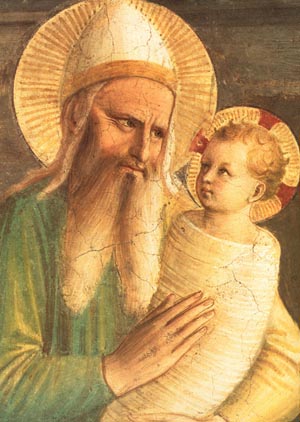
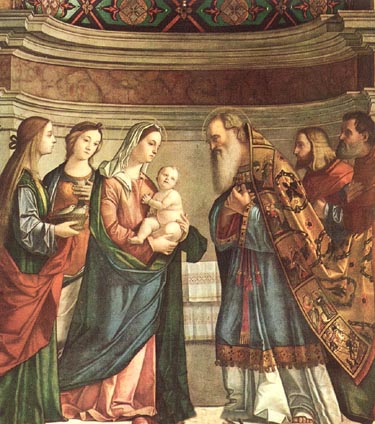
You remember the story from the Gospel, in Luke 2.  Mary and Joseph come to the temple in Jerusalem to fulfill the Law.  Firstborn males had to be dedicated to the Lord. The old woman Anna and the old man Simeon had the special grace from the Lord to have their dearest desires fulfilled before they died: to see the Messiah. It is in this moment that Simeon makes the prophecy about the sacrificial sufferings Mary will endure and he speaks his great Nunc dimittis, which Holy Church sings in the darkness at the end of the day for Compline.

In the traditional Roman liturgy today in larger churches there would be a special blessing of candles and a procession before Mass would begin.  The chants sung for the rite contain many references to light.  Also, a lighted candle is to be held during the reading of the Gospel and during the Roman Canon.  The candle brings to mind also our baptism.

In a way, the faithful really ought to have candles at all Masses.  But now, in High Masses, the “touchbearers” fulfill this role for the congregation.  Remember that the next time you see the candles come in: that’s you up there.

Remember: Holy Church gives us candles so that we will use them When I baptize, I suggest to people that they save the candle, with a label indicting what it is and who was there, the name of the priest, etc.  Perhaps then they could save that candle against the day when, perhaps, it might be used as one of the candles on the altar for their wedding, or with a home Communion set, for when they need Last Rites.  The candle you receive on other days of the year, the Vigil of Easter for example, or for Eucharist processions, could be burned in times of trial or danger, as when storms are coming or there is social upheaval.  These candles remind us that we too out to be filled with light for others, in their darkness and difficulties, to see and be guided by.

Candles are beautiful symbols of our sacrifices.  They are like living things.  They eat and drink the wax from the bees, made collectively in association with sweetness.  They breath air.  They move in their flames as they flicker.  They communicate to our eyes a beautiful light and give contrast to their surroundings by illumination.  They burn out at the end of their span.  So do we.  They are consumed for the Lord in the liturgy.  So should we be.  We do all these things.   And so, using candles in important times is a very wholesome and Catholic practice.  Leaving one of these little candles in a Church, as a symbolic sacrifice of your prayers and petitions is entirely natural.

For Holy Mass on Candlemas we hear some splendid prayers.  Let’s look at a couple.

Here is the third of several prayers recited by the priest for the blessing of the candles.  In older days, the priest would be wearing a purple cope and would switch to white for Mass.  By the time of the 1962 Missale Romanum all the rites are in white.

Domine Iesu Christe, lux vera, quae illuminas omnem hominem venientem in hunc mundum: effunde bene+dictionem tuam super hos cereos, et sancti+fica eos lumine gratiae tuae, et concede propitius; ut, sicut haec luminaria igne visibili accensa nocturnas depellunt tenebras; ita corda nostra invisibili igne, id est, Sancti Spiritus splendore illustrata, omnium vitiorum caecitate careant: ut, purgato mentis oculo, ea cernere possimus, quae tibi sunt placita, et nostrae saluti utilia; quatenus, post huius saeculi caliginosa discrimina, ad lucem indeficientem pervenire mereamur. Per te, Christe Iesu, Salvator mundi, qui in Trinitate perfecta vivis et regnas in saecula saeculorum.
R. Amen.

Daily Missal and Liturgical Manual (Baronius Press):

O Lord Jesus Christ, the true Light who enlightenest every man that cometh into this world: pour forth Thy blessing + upon these candles, and sanctify + them with the light of Thy grace, and mercifully grant, that as these lights enkindled with visible fire dispel the darkness of night, so our hearts illumined by invisible fire, that is, by the splendor of the Holy Spirit, may be free from the blindness of all vice, that the eye of our mind being cleansed, we may be able to discern what is pleasing to Thee and profitable to our salvation; so that after the perilous darkness of this life we may deserve to attain to neverfailing light: through Thee, O Christ Jesus, Savior of the world, who in the perfect Trinity, livest and reignest, God, world without end.

Presentation-of-the-LordThere is an adage that sin makes you stupid. Note the connection between vice and blindness and darkness.  The visible fire is not just a symbol of the indwelling of the Holy Spirit.  It also signifies life properly lived, a fact seen by others.

At the beginning of the procession an wonderful antiphon is sung.  Remember the Gospel.  Mary would have been brought within, carrying the Lord, the Light of the World, and led to a place of sacrifice, the offering of her Firstborn.  In the Churching of woman after child birth, they are met a the entrance to the church and then led forward.

Adorna thalamum tuum, Sion, et suscipe Regem Christum amplectere Mariam, quae est coelestis porta: ipsa enim portat Regem gloriae novi luminis: subsistit Virgo, ad ducens manibus Filium ante luciferum genitum: quem accipiens Simeon in ulnas suas, praedicavit populis, Dominum eum esse vitae et mortis, et Salvatorem mundi.

Adorn thy bridal-chamber, O Sion, and welcome Christ the King: with loving embrace greet Mary who is the very gate of heaven; for she bringeth to thee the glorious King of the new light: remaining ever a Virgin yet she bearest in her arms the Son begotten before the day-star: even the Child, whom Simeon taking into his arms, declared to the peoples to be the Lord of life and death, and the Savior of the world.

At Christmas we receive the Lord.  At Candlemas we offer Him.

In addition to the theme of light functioning throughout the rite there is also another echo of Christmas and Epiphany.  God meets man.  God comes to us, and we go to Him.  Today there is another meeting of God and man, expectant man, symbolized by Anna and Simeon.  The hymn sung in the procession frames our meeting, our Encounter as the liturgy of the Greek East calls this say, in nuptial terms.

In the Mass itself, we have the

COLLECT (1962MR):
Omnipotens sempiterne Deus,
maiestatem tuam suppliciter exoramus:
ut, sicut unigenitus Filius tuus hodierna die
cvm nostrae carnis substantia in templo est praesentatus;
ita nos facias purificatis tibi mentibus praesentari
.Presentation MantegnaThis is an ancient prayer, going back at least to the 9th c. and is found Liber sacramentorum Romanae ecclesiae ordine excarpsus.

You will see what is happening quickly, if you are a student of Latin, by taking careful note of the ut in the second part, which leads to a subjunctive down the line.  Also, there is a typical sicut…ita constuction, the ita part having the subjunctive result of the ut.  There is a nice turn of phrase at the end, using a trop hyperbaton, whereby that tibi separates the two elements of the ablative absolute purificatis … mentibus.  I also like that use of praesentatuspraesentari, a trope called, if memory serves, polyptoton.

The word maiestas is associated with gloria, a divine characteristic which transforms us who encounter it.  Thinks of the transformation of Moses’ face after he met with the Lord in the tent or on the mount: he had to wear a veil because his face was too bright to look at.  Also, Romans liked addressing people in indirect ways.  We still do this in some formal discourse and letters.  It is courtly, courteous.  Here maiestas can be heard as a form of address: Your Majesty.  So, maiestas has layers on layers of meaning.

Note the philosophical language of substantia.  Some times people will argue that the switch from Greek to Latin, the spoken language in ancient Rome, is justification for using the “vernacular” today.  The problem with that argument is that the Latin used in the Church for prayer, was not the language spoken by the people. It had technical vocabuary (e.g., maiestas, substantia) and turns of phrase nothing like everyday speech (e.g., hyberbaton, polyptoton).

See what happens?  It all seems straight forward.  Then you start to drill.

Candlemas is a beautiful feast full of meaning and symbols.

Holy Church puts candles in your hands today, to remind you of your gifts and your duties.

Posted in Liturgy Science Theatre 3000, Our Catholic Identity | Tagged , , , , , , ,
14 Comments

PRINCETON U: 3 Feb – Sung Mass in the university chapel

I received news that tomorrow, 3 February, there will be a Missa Cantata, Extraordinary Form, at the chapel of Princeton University at 9 pm. HERE

If you are nearby, it would be good to give support to this initiative.

I don’t know if they will be also imparting the traditional St. Blaise Day blessing of throats or not.  I hope so.  It would make sense to do so.  Thus, you would have an opportunity to get your throat blessed if you didn’t make it earlier in the day.

Brick by brick.

Posted in Brick by Brick, Events, The Campus Telephone Pole | Tagged
1 Comment

ASK FATHER: What sort of candles can be blessed at Candlemas?

Here is an oldie question from a reader…

QUAERITUR:

If I bring personal candles to the EF mass on Candlemass, must they be made of beeswax? Can they be entirely made of non-beeswax (paraffin)?
Not sure if the old regulations about things like this still apply to the EF.

We had a really good discussion about candles and what they can be made of HERE.

Given that discussion, and based even on the modern rules, my opinion is that it is far better for the candles to be wax candles, at least in part.  That is certainly the case for anything to be used in church.  I suppose it could be less strictly applied to candles not for use in church.

Still… let those candles be wax candles if at all possible.

Posted in "How To..." - Practical Notes, ASK FATHER Question Box, Linking Back, Liturgy Science Theatre 3000 | Tagged , ,
3 Comments

MADISON, WI – 2 Feb – CANDLEMAS – Pontifical Mass at the Throne

Presentation-of-the-LordOn 2 February – Candlemas – in Madison, WI, His Excellency Most Rev. Bishop Robert C. Morlino (the Extraordinary Ordinary) will celebrate a Pontifical Mass at the Throne.

The Mass will begin at 7 pm at the Bishop O’Connor Center.

Bishop Morlino will bless candles brought by parishes and people before Mass.  All are invited.

Candles are symbols of sacrifices.  They are like living things.  They eat and drink the wax from the bees, which reminds us that sacrifice can also be sweet, not just bitter. Candles breathe air.  They move in their flames as they flicker.  They communicate to our eyes a beautiful.  They die at the end of their span.  They are consumed for the Lord in all our liturgical rites.  So should we be.  Using candles during important times is a wholesome Catholic practice.

UPDATE 2 Feb evening:

Here is a shot from the Mass tonight.

15_02_02_Candlemas_01


15_02_02_Candlemas_02


Posted in Events, Just Too Cool, Liturgy Science Theatre 3000, The Campus Telephone Pole | Tagged , ,
4 Comments

Commercial banned from the Super Bowl?

It seems that the NFL didn’t want this commercial during the Super Bowl.

YouTube thumbnailYouTube icon

Posted in Semper Paratus | Tagged ,
36 Comments

CINOs

I point the attention of the readership to something at American Catholic.  This is dreadful, but I sense that much of our struggle for our Catholic identity will be circumscribed by situations like this.

The University of St. Thomas (St. Paul, MN) says, “Stick it in your ear!”

The folks over at The College Fix have done their homework, exposing how administrators at the University of St. Thomas (UST)—a “private Catholic liberal arts school” located in St. Paul, MN—are standing by their decision to let students to gain academic credit by serving as interns at a Minnesota-based National Organization for Women (NOW) chapter, even though the organization advocates for abortion on demand, LGBTQ rights, same-sex marriage, and its brand of so-called “racial justice.” UST’s Women’s Studies Department is sponsoring the internship opportunity.

This decision comes after the folks over at TFP Student Action also did their homework, organizing a successful petition drive garnering 10k+ signatures admonishing UST for offering internships at Planned Parenthood and Minnesota NARAL. Quickly after that email was forwarded to UST President Julie Sullivan, the listings were removed.

Now, that administrative fiat might satisfy some people.

However, what’s noteworthy about the NOW incident is not that diversity and inclusion means providing students opportunities to intern in organizations whose purpose contradicts official Church teaching. Nor is what’s noteworthy that academic administrators and professors sincerely believe that providing students those internships advances the institution’s mission as Catholic.

What’s noteworthy about this incident is that doing so provides additional evidence of a pattern of conduct on the part of academic administrators and professors at many of the nation’s Catholic universities and colleges. Namely, tacitly allowing opportunities like those internships at NOW to proceed. How? Perhaps through a “wink and a nod” or, even better yet, “Don’t inform me.” The idea is that if nobody finds out, all the better. And, if a crazy conservative Catholic does find out and complain, assert plausible deniability.

[…]

Read the rest there.

Posted in Lighter fare, Our Catholic Identity, Pò sì jiù, The Drill, The Olympian Middle | Tagged , ,
18 Comments

Septuagesima – Burying the Alleluia

We have come around again to Pre-Lent. It is time to get our heads into the game and start preparing for our upcoming Lenten discipline.



Already.

Sunday is Septuagesima. That means that on Saturday at 1st Vespers, in the traditional Roman Rite, we sing “Alleluia” for the last time until Easter.

Here are the Benedictines at Le Barroux singing the Alleluia for the last time.

Posted in "How To..." - Practical Notes, Liturgy Science Theatre 3000 | Tagged , ,
1 Comment

“Who says Catholic Social Teaching requires us to follow the policy prescriptions of the hard left?”

I found a really interesting opinion piece at Crisis by Austin Ruse, who runs C-FAM (an organization you should know and support).

I am going to drop you into this piece in medias res.  You should go back to read the first part on your own.  Plenty of fireworks there, too.

[…]

I first noticed this group of thunder-bolt tossing uber-Catholics at a blog called Vox Nova, [they seem to come unhinged pretty easily… HERE ] which for a good long while was exorcized over the question of water boarding. I engaged the debate and suggested this was a distraction from real issues and a way to convince faithful Catholics that they could not vote for the Republicans because of it. You would have thought I was the biggest heretic since Martin Luther.

People went to the board of directors of the group I run asking for my firing because a heretic like me certainly could not run a Catholic organization. [Pretty nasty, that.  But that’s how they work.] I was excoriated in columns and comment boxes. I was schooled on Elizabeth Anscombe’s essay about why numbers do not matter; that three water-boardings are as important as 50 million abortions, or something like that.

This started all up again when a few months ago the Democratic staff of the Senate Intelligence Committee released a 6,000-page report on “torture” wherein they did not interview anyone from the CIA, but spent most of their time with defense attorneys for terrorists jailed in Guantanamo Bay.

This group of writers hasn’t exactly downplayed the non-negotiables as to expand them into meaninglessness. Gun control is now a non-negotiable. So is the minimum wage. Universal government provided health care is a non-negotiable and now, with the impending papal encyclical on the environment, global warming is one, too.

I got into a debate a few weeks ago on the topic of water boarding. What I found is these juice-box theologians, that is, mostly young newly minted but largely unemployed PhDs, believe that water boarding is so important that one must cast their vote for president based on it and it alone.

Talk about single-issue voting.

This may be an important issue but not one that rises to the level of determining my vote nor should it. There are too many other important issues like—yes—abortion.

Has the GOP overturned Roe v. Wade just yet? No. Does the GOP desert this issue on a fairly regular basis? Sure. Are there anti-lifers all over the GOP elite? You bet. Even so, the GOP remains the only viable political vessel for stopping what Pope St. John Paul the Great called the most important human rights issue of our time. He did not say that about torture, or the minimum wage, or universal government-run health care.

[QUAERITUR…] As for Catholic Social Teaching, the cudgel this group likes to beat us with, who says Catholic Social Teaching requires us to follow the policy prescriptions of the hard left? The following fits right in with Catholic Social Teaching, if only Catholics were willing to put it this way:

Eliminate the corporate income tax. Eliminate the capital gains tax, and the death tax. Eliminate OSHA and the Department of Education. At the same time, run a national campaign out of the White House encouraging people to finish high school, get married, go to church, and have babies. Sit back and watch all boats rise.

While we’re at it, let’s get the Federal government out of the land business. The Feds own a third of all US land, up to half and more of many western states. Let’s have a modern day land-rush for all those Distributists out there who are just itching to fish, farm or make cheese—though one suspects they’ll stay exactly where they are, blogging and adjunct teaching. [heh heh]

Posted in Liberals, Our Catholic Identity, The Drill | Tagged
40 Comments

Brick by Brick: Another parish implements Summorum Pontificum. Wherein Fr. Z rants.

For your Brick by Brick file.

A reader sent me a link to a story in the St. Louis Review (a publication of the Archdiocese of St. Louis) about a parish which as started up a Traditional Latin Mass.

‘Mysterium tremendum’ | St. Barnabas begins offering the Traditional Latin Mass

With a single intoning of the bell, Mass had begun at St. Barnabas.

But this was no Ordinary Form of the Mass.

“In Nomine Patris, et Filii et Spiritus Sancti …”

For the first time in nearly 50 years, the Extraordinary Form of the Mass — better known as the Traditional or Tridentine Latin Mass — is being celebrated at the northern O’Fallon parish. In January, Father Raymond Hager began offering the Mass at 10 a.m. on Sundays, after a group of parishioners wrote a letter last January requesting it.  [See what happens when you ask?]

[…]

“At the first Mass, people had tears in their eyes,” said Father Hager. He said that all of this is “directed toward God and what’s called the ‘mysterium tremendum,’ or the tremendous mystery. [the sort of “tremendum” which makes one shudder with awe…] The sense of the sacred, and the mystery of God becoming present in His most sacred Body and Blood is proclaimed profoundly in and through the Extraordinary Form of the Mass.

[This part might sound familiar to longtime readers here…] “In the Eastern Churches they have the iconostasis … where you can’t see everything that’s going on, because what is happening is so holy it should be veiled. When the elements of the bread and wine become Our Lord’s Body and Blood, you’re not seeing that at that moment, but you do see Our Lord and God at the elevation of the consecration in the Extraordinary Form of the Mass. It really speaks to that sense of mystery.”

[…]

Ordained in 1997, Father Hager taught himself how to celebrate the Mass according to the 1962 Missal. Born in 1960, he has no memories of going to the Traditional Latin Mass as a child. As a seminarian, he would occasionally visit St. Agatha, where the Latin Mass was offered in St. Louis at the time. “I was blown away by the beauty and sacredness of the liturgy,” he said.

The process of learning the language and rubrics took several months. Father Hager approached Archbishop Robert J. Carlson, who connected him with Canon Michael Wiener, rector of St. Francis de Sales Oratory, one of two churches designated specifically for the Latin Mass in St. Louis. Canon Wiener, the episcopal delegate for the implementation of the Traditional Latin Mass in the archdiocese, offered his guidance.

Father Hager also watched videos, read books and sought help from several others, including Sister Michaleen Vomund, CPPS, PSR director at St. Barnabas, and Bill Guelker of the Latin Liturgy Association, a local organization that promotes the use of ecclesiastical Latin in the liturgy. Several changes had to be made in the sanctuary, including moving the nearly 1,500-pound altar back four feet and adding a communion rail.  [Well done!  And it was worth all the effort.]

[…]

Read the rest there.

We need as many celebrations of the older form of the Roman Rite as possible in as many places as possible as soon as possible.

These are trying times, and there is a lot of confusion right now.  Some people are showing signs of defeatism.

NO!

This is precisely the time to get to work.  Let’s keep our eyes focused on what is really going to make a difference.  I think that is located in exactly the vision that Pope Benedict XVI offered us.

So, I will repeat what I have been saying for some time now.

Make things happen.  Work with sweat and money to make them happen. If you thought you worked hard before, forget it.  Work harder.  Pope Francis wants some “lío”?  We’ve got some “lío” right here.  ¡Hagan lío!

Get involved with all the works of charity that your parishes or groups sponsor. If Pope Francis wants a Church “for the poor”, then we will respond, “OORAH!!” The “traditionalist” will be second-to-none in getting involved.  “Dear Father… you can count on the ‘Stable Group of TLM Petitioners-For-By-Now-Several-Months” to help with the collection of clothing for the poor!  Tell us what you need!”

Pray and fast and give alms. Have you been doing that?  Do more.

Form up and get organized.  Find like-minded people. Put in your request for the implementation of Summorum Pontificum.  Raise the money to help buy the stuff the parish will need. Make a plan. Find people. Execute!

Get your ego and your own little personal interpretations and preferences out of the way.  It is team-work time.  If we don’t sacrifice individually, we will stay divided and we won’t achieve our objectives.

The legislation is in place.  Young priests and seminarians are eager to get into this.

Give them something to do.

As I have written before, Pope Benedict gave us, boys and girls, a beautiful new bicycle!  He gave us a direction, encouragement, and a running push.  Now, take off the training wheels and RIDE THE DAMN BIKE!

Meanwhile, Fr. Z kudos to Fr. Raymond Hager and St. Barnbas parish!

Posted in ¡Hagan lío!, "How To..." - Practical Notes, ACTION ITEM!, Be The Maquis, Benedict XVI, Brick by Brick, Fr. Z KUDOS, Just Too Cool, Liturgy Science Theatre 3000, Our Catholic Identity, Si vis pacem para bellum!, SUMMORUM PONTIFICUM, The future and our choices, Wherein Fr. Z Rants |
20 Comments