And now a tune from Death and the Marginalia.
The video was made by HERE
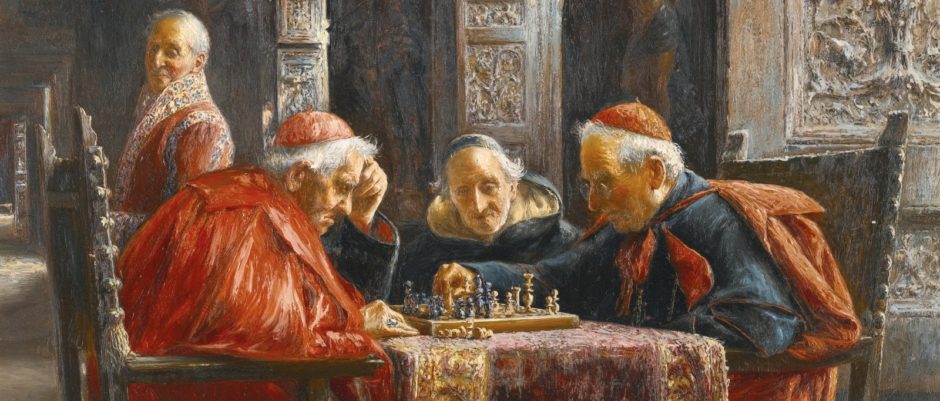
 From a reader…
QUAERITUR:
I got to wondering about the properties of holy water. Since so much water has been blessed before and recycled throughout time, does the church have comments about the length that water stays “holy”? Or is it a possibility that the tap water from the faucet could contain holy water if the water stays blessed to the end of time?
Speaking of wondering… I have sometimes wondered about the effective range of a blessing… 20 meters? I’m pretty good with a 9mm at that range, but not with an aspergilum. But I think I could manage a blessing at some distance.
But, duration of the blessing? That depends on what is being blessed. Let’s make a few distinctions.
Firstly, let’s think about things that go bad or get corrupted and those that don’t.
For example, we have food stuffs, obviously meant for relatively quick consumption. If on the Easter Vigil I bless all sorts of foods people bring to church, I know that they will be consumed quickly. If I bless, for example, wine, it could be years before it is consumed, but it will be consumed. If I bless salt… salt is really stable, so it will endure as long as it is not diluted by water, etc. But, blessed wine that is opened can corrupt, as can blessed sausages and cakes etc.. As in the case of the accidents of bread and wine remaining in the Eucharist, if the elements are corrupted and they cease to be what they were (wine turns to vinegar, etc.) they stop being blessed.
Water can go bad. If you let water stagnate (not move) it can develop algae and get nasty in a hurry. I am sure that no one wants to use that. This is probably one of the reasons why, in the traditional blessing of Holy Water, exorcised and blessed salt is added. Salt makes the water inhospitable to many critters. There is also a scriptural, symbolic basis for adding salt to water, and the blessing prayers reference it. The prophet Elijah poured salt into the waters at Jericho. Our Lord talks about salt. Holy Church has used blessed salt since her earliest years. For example, it is placed on the tongue of those to be baptized in the rite of baptism. In ancient times, salt was given to catechumens several times before they were baptized.
Next, things are blessed because God blesses them.
God blesses things on His own or through those who can bless, usually the priest in the case of the constitutive blessing. Contrary to the horrid Books of Blessings (which I will never use, because the texts don’t bless things), there are two kinds of blessings. The invocative blessing calls down a blessing by God on a person while the constitutive blessing establishes something as a blessed thing in a way that persists. A more solemn and deeper version of this is the consecration. For example, we bless medals and statues and water and so forth, but we consecrate altars and cemeteries. People can be consecrated, too, as in the case of religious and the ordained. If the bishop blesses you on the way out of church, you have received a blessing. If the bishop consecrates you at solemn profession or ordination, then you are thereafter a consecrated person.
By the way, abuse of a consecrated thing, place or person is the sin of sacrilege. If you vandalize a church, you commit two sins, destruction of property and sacrilege. Both must be confessed. If you visit the Diocese of Libville and, irritated after one of Bishop Fatty McButterpant’s sermons you bust him in the chops, you have to confess two sins: you hit a person and you hit a consecrated person, which is sacrilege. There are mitigating circumstances for your guilt, of course… but I digress.
Back to blessings.
God blesses things and people, usually through God’s agent.
Sure, God can bless a faucet such that whatever water might issue forth from thence would be blessed water. Perhaps that’s what God does with the spring that popped up at Lourdes. Apparently many miraculous healings have occurred in conjunction with contact with “Lourdes water”. God can do that. I don’t know how to do that. It is well beyond the pay grade of a human being, ordained or not, to bless a faucet or spring such that it will thereafter produce holy water in perpetuity.
So, turn on the faucet and I can bless what is in the sink or the container underneath, but that’s it. And as long as that water is water (it hasn’t dried up and it hasn’t turned into a mass of green algae clogged goo) it is blessed.
On another note, sometimes I get questions about adding more regular water to holy water to increase its quantity. Is it, for example, possible to add less than 50ml to 100ml and get 150ml? 25mm to 100ml? If at the offertory the priest can up to 20% of water to the wine in the chalice without making substance of the wine doubtful, can less than 20ml be added to 100ml of holy water to produce 120ml… and so on and so on?
This practice isn’t forbidden. Neither is it recommended. It seems to me that people do this because they want holy water and Father isn’t blessing enough or often enough. Hence, they creatively figured out a work around.
I would not do this.
Instead, work on Father to bless more water (hopefully with the older, traditional Rituale Romanum).
We are dealing with a sacramental.
“Sacramental” reality is not less real than what we perceive by our senses. Blessed water is perceptibly saltier than usual, but so is regular water that has salt added. We can’t taste test it and tell the difference.
Demons can tell the difference.
The Enemy really hates holy water. One of the explicit purposes of holy water is to put demons to flight wherever it is sprinkled. In exorcising and blessing the salt used for holy water, the priest says: “may [it] rid whatever it touches or sprinkles of all uncleanness and protect it from every assault of evil spirits.” In exorcising and blessing the water: “I exorcise you so that you may put to flight all the power of the Enemy, and be able to root out and supplant that Enemy with his apostate angels”. In blessing the combined water and salt: “Let whatever might menace the safety and peace of those who live here be put to flight by the sprinkling of this water”.
Heavy lifting, indeed!
St. Teresa of Avila in chapter 31 her autobiography explains how she was being tormented by demons. She used holy water against them and wrote:
“From long experience I have learned that there is nothing like holy water to put devils to flight and prevent them from coming back again. They also flee from the Cross, but return; so holy water must have great virtue.”
Demons can tell the difference, even if we can’t
So, why use anything iffy?
BTW… just for your additional instruction, here is a side by side comparison of the older, traditional rite of blessing holy water, and the newer, post-Conciliar rite. I won’t concern myself with matching them up because I have plenty to do today.
Read these and then ask yourself which you would rather use.
Try to find the specific words of blessing in each version.
| ORDER FOR THE BLESSING OF HOLY WATER OUTSIDE MASS
1391 The celebrant begins with these words: In the name of the Father, and of the Son, and of the Holy Spirit. All make the sign of the cross and reply: Amen. 1392 The celebrant greets those present in the following or other suitable words, taken mainly from Scripture. May God, who through water and the Holy Spirit has given us a new birth in Christ, be with you all. All make the following or some other suitable reply. And with your spirit. 1393 As circumstances suggest, the celebrant may prepare those present for the blessing in the following or similar words. The blessing of this water reminds us of Christ, the living water, and of the sacrament of baptism, in which we were born of water and the Holy Spirit. Whenever, therefore, we are sprinkled with this holy water or use it in blessing ourselves on entering the church or at home, we thank God for his priceless gift to us and we ask for his help to keep us faithful to the sacrament we have received in faith. READING of the WORD of GOD 1394 A reader, another person present, or the celebrant reads a short text of Sacred Scripture. [VARIOUS POSSIBLE SCRIPTURE READINGS] 1396 After the reading, the celebrant says: Let us pray. All pray briefly in silence, then with hands outstretched, the celebrant says the prayer of blessing. Blessed are you, Lord, all-powerful God, R. Amen. 1397 Or: Lord, holy Father, R. Amen. 1398 Or the celebrant says: O God, the creator of all things, R. Bless and purify your Church. O Christ the Lord, from your pierced side R. Bless and purify your Church. O Holy Spirit, giver of life, R. Bless and purify your Church. 1399 After the prayer of blessing, the celebrant sprinkles those present with holy water, as a suitable song is sung; as circumstances suggest, he may first say the following words. Let this water call to mind our baptism into Christ, R. Amen.
|
RITE FROM THE ROMAN RITUAL
(Priest vests in surplice and purple stole) P: Our help is in the name of the Lord.
Exorcism and Blessing of Salt (necessary for Exorcism of Water)
P: O salt, creature of God, I exorcise you by the living + God, by the true + God, by the holy + God, by the God who ordered you to be poured into the water by Elisha the prophet, so that its life-giving powers might be restored. I exorcise you so that you may become a means of salvation for believers, that you may bring health of soul and body to all who make use of you, and that you may put to flight and drive away from the places where you are sprinkled; every apparition, villainy, turn of devilish deceit, and every unclean spirit; adjured by him who will come to judge the living and the dead and the world by fire. R: Amen. P: Let us pray. Almighty and everlasting God, we humbly implore you, in your immeasurable kindness and love, to bless + this salt which you created and gave to the use of mankind, so that it may become a source of health for the minds and bodies of all who make use of it. May it rid whatever it touches or sprinkles of all uncleanness, and protect it from every assault of evil spirits. Through Christ our Lord. R: Amen. Exorcism and Blessing of Water P: O water, creature of God, I exorcise you in the name of God the Father + Almighty, and in the name of Jesus + Christ His Son, our Lord, and in the power of the Holy + Spirit. I exorcise you so that you may put to flight all the power of the enemy, and be able to root out and supplant that enemy with his apostate angels, through the power of our Lord Jesus Christ, who will come to judge the living and the dead and the world by fire. R: Amen. P: Let us pray. O God, for the salvation of mankind, you built your greatest mysteries on this substance, water. In your kindness, hear our prayers and pour down the power of your blessing + into this element, made ready for many kinds of purifications. May this, your creature, become an agent of divine grace in the service of your mysteries, to drive away evil spirits and dispel sickness, so that everything in the homes and other buildings of the faithful that is sprinkled with this water, may be rid of all uncleanness and freed from every harm. Let no breath of infection and no disease-bearing air remain in these places. May the wiles of the lurking enemy prove of no avail. Let whatever might menace the safety and peace of those who live here be put to flight by the sprinkling of this water, so that the health obtained by calling upon your holy name, may be made secure against all attack. Through Christ our Lord. R: Amen. (Priest pours exorcised salt into the water, in the form of a cross – three times) P: May a mixture of salt and water now be made, in the name of the Father, + and of the + Son, and of the Holy Spirit. + R: Amen. P: The Lord be with you. P: Let us pray. O God, Creator unconquerable, invincible King, Victor ever-glorious, you hold in check the forces bent on dominating us. You overcome the cruelty of the raging enemy, and in your power you beat down the wicked foe. Humbly and fearfully do we pray to you, O Lord, and we ask you to look with favor on this salt and water which you created. Shine on it with the light of your kindness. Sanctify it by the dew of your love, so that, through the invocation of your holy name, wherever this water and salt is sprinkled, it may turn aside every attack of the unclean spirit, and dispel the terrors of the poisonous serpent. And wherever we may be, make the Holy Spirit present to us, who now implore your mercy. Through Christ our Lord. R: Amen.
|
I, for one, will never use the newer form. Eh-vur.
From the Catholic Herald:
British Teilhard Association dissolves due to lack of members
The move comes just weeks after Pope Francis was asked to remove the decades-old official warning against Teilhard’s works
A British association dedicated to Jesuit thinker Teilhard de Chardin dissolved on New Year’s Eve due to falling membership.
The association announced the decision on Twitter on Monday, but added that its website would continue as a newly constituted ‘British Teilhard Network’.
The British Teilhard Association dissolved as of 31 December 2017. This was due to diminishing membership. But the previous BTA website continues as the newly formatted British Teilhard Network. #teilhard
— BTA (@teilhard_de_c) January 1, 2018
The move comes just weeks after the Pontifical Council for Culture asked Pope Francis to remove the decades-old official warning against Teilhard’s works.
Pierre Teilhard de Chardin wrote a series of best-selling theological works in the first half of the 20th Century in which he drew on his studies as a palaeontologist in an attempt to reconcile the faith with evolution.
He became famous for his theory of an “Omega Point”, mankind’s ultimate destination. He saw all of human development in terms of evolution, an upward movement towards a final goal, of which the Incarnation was a decisive moment.
Although many found his works helpful in reconciling their faith with new scientific discoveries, the Congregation of the Holy Office condemned them, writing that they “abound in such ambiguities and indeed even serious errors, as to offend Catholic doctrine”.
Pope Pius XII condemned Teilhard’s work as a “cesspool of error”, and the Vatican placed an official “monitum”, or warning, against it.
However, last year the Pontifical Council for Culture voted unanimously to ask Pope Francis to remove the warning, saying “albeit some of his writings might be open to constructive criticism, his prophetic vision has been and is inspiring theologians and scientists.”
 As the controversy erupted at the irruption of Amoris laetitia, I opined that, even though the document could be read in a properly orthodox way, those who were inclined not to support the Church’s teaching would say it meant something innovative but justifiable under the light of “mercy”, and those who were inclined to defend and teach with clarity what the Church teaches would stand their ground. Amoris laetitia caused a kind of “decomposition reaction” in the Church, if you recall your basic chemistry. It’s breaking down the unity of the Church.
This breaking of unity is in increasing evidence. Bishops conferences have developed different policies that contradict each other. For example, step over the border from Germany into Poland and the divorced and civilly remarried who don’t live continent lives and who don’t have a firm purpose of amendment cannot be admitted to Holy Communion. Step back across the border from Poland into Germany, and they can be. One small step for an adulterer, one giant disaster for doctrine. Other examples of decomposition can be found in statements from the Bishops of Malta and of Buenos Aires in Argentina.
There must, of course, be counter reactions to try to reestablish the integrity of the Church in her unity of doctrine.
The other day I received a text from the Bishops of Kazakhstan (including the great Bp. Schneider) which addresses certain truth about sacramental marriage.
It is very good.
As a preamble, you will want to scan quickly what canonist Ed Peters says about it. HERE He makes a couple of distinctions which head off what will be the backlash and denial on the part of libs, who will whipped up by the New Red Guards against this statement.
Peters makes three helpful observations. First, he reminds us that the Kazakhstani bishops are talking about sacramental marriage, even though much of what they say applies to other marriages. Second, when we write about “marriage” we can’t always put in every possible qualifier. Third, Peters points to the minuscule number of cases to which the Pauline and Petrine Privilege apply, or which are ratum sed non consummatum.
Now let’s look at the statement of the Bishops of Kazakhstan. Or rather, let’s hear it and look at it.
I rant at the end.
BONUS: At the end, I include several minutes of bells of a well-known church in Europe. Can anyone identify the church? I made the recording on the street near the church, so you might hear the occasional motorbike.
UPDATE:
I read on Twitter that
Two Italian Bishops, + Luigi Negri, archbishop emeritus of Ferrara-Comacchio and +Carlo Maria Viganò, former apostolic nuncio to the United States, have joined the bishops of Kazakhstan in putting their names to the Profession
UPDATE:
Interview with Bp. Negri HERE He said:
Faced with the grave confusion in the Church regarding the issue of marriage, I believe it is necessary to put forward again the clarity of the traditional position. It seemed right to me to sign because the content of the [document’s] position is what I have widely presented over the past years — not only in recent months – at every step of the efforts I dedicated to the theme of the family, life, procreation, and the responsibility to educate and form young people. These are issues of absolute importance which the Catholic world as a whole does not seem to be very aware of.
Card. Pujats of Riga has signed on. HERE
Podcast: Play in new window | Download
Subscribe: RSS
Profession of the immutable truths
about sacramental marriage
After the publication of the Apostolic Exhortation “Amoris laetitia” (2016) various bishops issued at local, regional, and national levels applicable norms regarding the sacramental discipline of those faithful, called “divorced and remarried,” who having still a living spouse to whom they are united with a valid sacramental matrimonial bond, have nevertheless begun a stable cohabitation more uxorio with a person who is not their legitimate spouse.
The aforementioned rules provide inter alia that in individual cases the persons, called “divorced and remarried,” may receive the sacrament of Penance and Holy Communion, while continuing to live habitually and intentionally more uxorio with a person who is not their legitimate spouse. These pastoral norms have received approval from various hierarchical authorities. Some of these norms have received approval even from the supreme authority of the Church.
The spread of these ecclesiastically approved pastoral norms has caused a considerable and ever increasing confusion among the faithful and the clergy, a confusion that touches the central manifestations of the life of the Church, such as sacramental marriage with the family, the domestic church, and the sacrament of the Most Holy Eucharist.
According to the doctrine of the Church, only the sacramental matrimonial bond constitutes a domestic church (see Second Vatican Council, Lumen Gentium, 11). The admission of so-called “divorced and remarried” faithful to Holy Communion, which is the highest expression of the unity of Christ the Spouse with His Church, means in practice a way of approving or legitimizing divorce, and in this meaning a kind of introduction of divorce in the life of the Church.
The mentioned pastoral norms are revealed in practice and in time as a means of spreading the “plague of divorce” (an expression used by the Second Vatican Council, see Gaudium et spes, 47). It is a matter of spreading the “plague of divorce” even in the life of the Church, when the Church, instead, because of her unconditional fidelity to the doctrine of Christ, should be a bulwark and an unmistakable sign of contradiction against the plague of divorce which is every day more rampant in civil society.
Unequivocally and without admitting any exception Our Lord and Redeemer Jesus Christ solemnly reaffirmed God’s will regarding the absolute prohibition of divorce. An approval or legitimation of the violation of the sacredness of the marriage bond, even indirectly through the mentioned new sacramental discipline, seriously contradicts God’s express will and His commandment. This practice therefore represents a substantial alteration of the two thousand-year-old sacramental discipline of the Church. Furthermore, a substantially altered discipline will eventually lead to an alteration in the corresponding doctrine.
The constant Magisterium of the Church, beginning with the teachings of the Apostles and of all the Supreme Pontiffs, has preserved and faithfully transmitted both in the doctrine (in theory) and in the sacramental discipline (in practice) in an unequivocal way, without any shadow of doubt and always in the same sense and in the same meaning (eodem sensu eademque sententia), the crystalline teaching of Christ concerning the indissolubility of marriage.
Because of its Divinely established nature, the discipline of the sacraments must never contradict the revealed word of God and the faith of the Church in the absolute indissolubility of a ratified and consummated marriage. “The sacraments not only presuppose faith, but by words and objects they also nourish, strengthen, and express it; that is why they are called “sacraments of faith.” (Second Vatican Council, Sacrosanctum Concilium, 59). “Even the supreme authority in the Church may not change the liturgy arbitrarily, but only in the obedience of faith and with religious respect for the mystery of the liturgy” (Catechism of the Catholic Church, 1125).
The Catholic faith by its nature excludes a formal contradiction between the faith professed on the one hand and the life and practice of the sacraments on the other. In this sense we can also understand the following affirmation of the Magisterium: “This split between the faith which many profess and their daily lives deserves to be counted among the more serious errors of our age.” (Second Vatican Council, Gaudium et Spes, 43) and “Accordingly, the concrete pedagogy of the Church must always remain linked with her doctrine and never be separated from it” (John Paul II, Apostolic Exhortation Familiaris Consortio, 33).
In view of the vital importance that the doctrine and discipline of marriage and the Eucharist constitute, the Church is obliged to speak with the same voice. The pastoral norms regarding the indissolubility of marriage must not, therefore, be contradicted between one diocese and another, between one country and another. Since the time of the Apostles, the Church has observed this principle as St. Irenaeus of Lyons testifies: “The Church, though spread throughout the world to the ends of the earth, having received the faith from the Apostles and their disciples, preserves this preaching and this faith with care and, as if she inhabits a single house, believes in the same identical way, as if she had only one soul and only one heart, and preaches the truth of the faith, teaches it and transmits it in a unanimous voice, as if she had only one mouth”(Adversus haereses, I, 10, 2). Saint Thomas Aquinas transmits to us the same perennial principle of the life of the Church: “There is one and the same faith of the ancients and the moderns, otherwise there would not be one and the same Church” (Questiones Disputatae de Veritate, q. 14, a. 12c).
The following warning from Pope John Paul II remains current and valid: “The confusion, created in the conscience of many faithful by the differences of opinions and teachings in theology, in preaching, in catechesis, in spiritual direction, about serious and delicate questions of Christian morals, ends up by diminishing the true sense of sin almost to the point of eliminating it” (Apostolic Exhortation Reconciliatio et Paenitenia, 18).
The meaning of the following statements of the Magisterium of the Church is fully applicable to the doctrine and sacramental discipline concerning the indissolubility of a ratified and consummated marriage:
Being bishops in the pastoral office those, who promote the Catholic and Apostolic faith (“cultores catholicae et apostolicae fidei”, see Missale Romanum, Canon Romanus), we are aware of this grave responsibility and our duty before the faithful who await from us a public and unequivocal profession of the truth and the immutable discipline of the Church regarding the indissolubility of marriage. For this reason we are not allowed to be silent.
We affirm therefore in the spirit of St. John the Baptist, of St. John Fisher, of St. Thomas More, of Blessed Laura Vicuña and of numerous known and unknown confessors and martyrs of the indissolubility of marriage:
It is not licit (non licet) to justify, approve, or legitimize either directly or indirectly divorce and a non-conjugal stable sexual relationship through the sacramental discipline of the admission of so-called “divorced and remarried” to Holy Communion, in this case a discipline alien to the entire Tradition of the Catholic and Apostolic faith.
By making this public profession before our conscience and before God who will judge us, we are sincerely convinced that we have provided a service of charity in truth to the Church of our day and to the Supreme Pontiff, Successor of Saint Peter and Vicar of Christ on earth .
31 December 2017, the Feast of the Holy Family, in the year of the centenary of the apparitions of Our Lady at Fatima.
+ Tomash Peta, Archbishop Metropolitan of the Archdiocese of Saint Mary in Astana
+ Jan Pawel Lenga, Archbishop-Bishop of Karaganda
+ Athanasius Schneider, Auxiliary Bishop of the Archdiocese of Saint Mary in Astana
 When I find an organization or cause that I like or that I use, I try to support it.
For example, I really like Our Lady of Hope Clinic, about which I have written. I like Team Rubicon.
I really like the TMSM! PLEASE DONATE!
I also like the work of the Latin Mass Society in England & Wales. Hence, I signed up for a membership today. (You would think they have a special membership for priests who celebrated Holy Mass in the traditional form.. but no.)
You might do the same and join. HERE They’ve been fighting to good fight for a long time and many good things are happening there these days.
This is not the time to rest on successes. This is the time to push forward.
The tank has only one gear.
Another good UK thing is the Catholic Herald. I’ve been writing a column for them for a long while now. It appears in the print and in the digital editions. You might subscribe. I think it is useful for Americans to read about what’s up in the UK. They are at a different stage in the culture war we are engaged in. With a subscription you get access to the whole archive. HERE
¡Hagan lío!
 Were the good points made in the sermon you heard during your Mass of Sunday obligation and at Mass for 1 January?
Let us know.
For my part, I spoke about the figure of the prophetess Anna, who was a widow for many decades. By praying and fasting at the Temple day and night she lived the aspirations of the Psalmist: “One thing I have asked of the Lord, this will I seek after; that I may dwell in the house of the Lord all the days of my life. That I may see the delight of the Lord, and may visit his temple.” And she did.
Anna must have wondered what was in store for her when she was widowed at such a young age. The lot of widows could be precarious in ancient times. She had a discipline of life and fulfilled the virtue of religion. God rewarded her with the sight of the Messiah. Thereupon, with joy, she shared what she had seen with others.
I added as an aside that Anna had come to the Temple “at that very hour” and saw the Lord. Hence, it is a good idea always to arrive in church on time for Mass… and see the Lord.
Of all the universes that God could have created, He created this one, into which He called us into being at a specific point in time and place. We have something to do here. It is often a mystery to us and hard to determine. But the virtue of religion and perseverance are keys.
2018 Predictions
1. Pres. Trump will acknowledge North Korea a nuclear state to diffuse the military option.
2. The building of The Wall will begin.
3. Justice Kennedy will resign from the Supreme Court, and Pres. Trump will get another pick.
4. Pope Francis – still Pope – will beatify Pierre Teilhard de Chardin with the intention to canonize him and declare him Doctor of the Church.
5. The Synod on Youth will discuss “viri probati”, which will be approved as a step to making clerical celibacy optional.
6. The Holy See and Palestine will establish full diplomatic relations, Nunciature in Bethlehem.
7. The number of places with Holy Mass ad orientem will grow quietly but significantly.
8. Card. Sarah will be transferred to Propaganda and Archbp. Roche will takeover at CDW.
9. Doctrinal evaluation of professors and theological writings will be devolved to local episcopal conferences.
10. Fr. Z will still not be a Monsignor.
How did I do last year? HERE
1. ObamaCare (aka “Affordable” Care Act) will be repealed. [+0 – Sort of… the mandate was.]
2. Construction will begin on The Wall. [+0 – Prototypes were made]
3. Pres. Trump’s first international trip will be to Jerusalem. [+1]
4. Pres. Trump will appoint two Justices to the Supreme Court. [-1 – Alas, he only got one]
5. Pope Francis will not respond to the Dubia and will, in fact, double down. [+1]
6. Card. Burke will emerge unscathed from the Knights of Malta controversy. [-1]
7. Curial reform will still not make significant progress. [+1]
8. The number of places in which Extraordinary Form (TLM) Masses are offered will continue to grow. [+1]
9. Applications to seminaries will continue to drop. [+1]
10. Fr. Z will still not be a Monsignor. [+1]
And you thought Adoptionsism was bad!
Via ijr.com:
Report: Church in Sweden Calls Jesus Gender Neutral: He ‘Is Not Very Masculine in Physique’
A church in Västerås reportedly bought an advertisement in a Swedish newspaper days before Christmas, inviting those in the area to celebrate the birth of Jesus with worship, Christmas music, and a Christmas crib. But it did it using a gender neutral pronoun. [Gender neutral Jesus!]
The word used was “hen,” which is the gender neutral alternative to “hon” (she) and “han” (he).
Swedish news-magazine Expressen originally reported the story in Swedish, according to Dangerous blog. IJR translated it into English. [According to Dangerous: “Sweden is at the forefront of the social justice movement, and not even Christianity is exempt from the progressive push for inclusivity of genders other than male and female and a full embrace of the ‘gender spectrum.’”]
Susann Senter, who’s the female dean of the church, explained:
“There are many who have heard from us via Facebook, but I have also received positive reactions. We did not want to sex the little child right away […] [They didn’t want to “sex” the God man!]
Theologically, we are talking about Jesus as true God and man. A human is not just ‘he.'” [Generic man. Not even a kouros.]
She also went on to say that how people are treated based on their gender [not “gender”, “sex”!] has been a frequently discussed topic at the church. She added that although Jesus Christ was a man, her interpretation of the Bible makes him “beyond man or woman.” [ummm…. Meta-Human!]
Senter continued:
“If I’m a little provocative, most 19th and [20th century depictions] of Jesus are quite feminine. He is gentle, has curly hair and is not very masculine in physique.” [So… a Jesuit?]
The dean concluded that “it is a strain that we always talk about God as ‘he’” and that “we can not change the texts in the Bible, but we can change our way of highlighting this.” [I think there are a lot of people who would disagree that can’t change texts in the Bible.]
Somethings are beyond parody.
What’s really funny is that today, 1 January, has traditionally been celebrated as the… wait for it…
Feast of the Circumcision.
UPDATE 31 Dec 2017:
The original questioner wrote:
Thank you so much for your guidance in response to my query. I had never even considered that my heartache could be used as an opportunity to grow in holiness! Rereading my words, the Lord also pricked my conscience regarding my own bitter prejudice against Arab Christians, which fairly sang out from the page. It would seem I have work enough to do removing the beam from my own eye. Please remember me in your prayers, Father, and rest assured of your place in mine.
Originally Published on: Dec 30, 2017
From a reader…
QUAERITUR:
First of all, thank you so much for your blog, I visit often and thoroughly enjoy your wit and unabashed orthodoxy. I am a convert with both Jewish and Protestant backgrounds, by the Grace of God, now a Catholic for five years. I am drawn powerfully to the Latin Mass and have serious difficulties with Vatican II. That said, whenever I visit traditionalist sites online, I am invariably slapped in the face with the gleeful antisemitism that seems to be a prerequisite to “belonging” in such cases. I’ve lived in Israel. I love the country and the Jewish people. I see no reason to be ashamed of this. I was sickened, literally became nauseous, by a ‘devout’ woman who took umbrage to the fact that I felt compelled to question a certain priest’s position that the Holocaust never happened. Fr. William something or other – not important. I have been told that I must purge myself of Zionist lies. That the “indigenous” Palestinians will one day be free of the Jews – these same Jews who stand with the West (those in the West willing to stand) against the scourge that is, and will be, the Islamic threat. And I am tired, so very tired, of hearing about the beleaguered Christian Arabs – whom I personally saw attacking Jews alongside with Muslims during the hudna of 2003, a part of the Second Intifada. These Christians will kill Jews, the only people keeping the Muslims from killing them. I ask you, Father, why is hating the Jews a membership due of the traditionalist Catholic. I will not abandon Christ over this, I will not go back to Judaism – I am in the bark of St. Peter, and with God’s help, will remain there until my dying breath. I cannot abandon the One who would not abandon me – but I need to know why Jews and Israel are such a problem. In truth, I need to hear someone say that this is wrong. If you cannot be that one, so be it – but explain your position to me, nonetheless. The Jews and the Muslims need conversion, as every human being does – I do not ascribe to the Nostra Aetate, we cannot go against Christ’s own commandment and call ourselves faithful, but how to leave the wound of antisemitism behind without leaving the Word? Please tell me that is possible.
First of all, congratulations on your determination to come into the Church. By doing so, you brought to bloom both your Jewish and Protestant roots.
I am sorry you have had negative experiences. Provided that there were no misunderstandings or miscommunication, Catholics ought to abhor the things that have been said to you by traditionalists.
Keep in mind that these folks are individuals, and that they only speak for themselves, or perhaps for smallish blogs and/or organizations, as the case may be. They do not speak for me or the vast majority of traditional Catholics, or the Church.
The Church recognizes that antisemitism is a sin. That said, there are tiny pockets of antisemitism in the Catholic Church, just as there are tiny pockets of racism and other forms of ignorance and hatred.
Mind you, the Church is not a Church of the spotless and the pure. The Church which Christ founded is precisely of and for sinners. Else, who is there for Christ to save? If any man says he is not a sinner he is a liar (cf. 1 John 1:8).
Sometimes the Church is described as a “field hospital”. If we are going to take that analogy seriously – and not just blurt it in a shallow, sentimental way – then let’s keep firmly before our faces the fact that, in “field hospitals” many ugly things happen. There is a lot of blood, screaming, pain and, quite often, death. Even with the great improvements in combat medicine and field hospitals, despite the heroic work of the personnel many who go in don’t come out alive, and many who do live are scarred.
The Church remains the spotless Bride of Christ, but we her members are not spotless.
Some who are in the Church will not go to heaven, despite the efforts of their pastors and loved ones, because of their black hearts and sins or even from sheer neglect and indifference. Some will not go to heaven because of the damage they are doing within the Church herself.
Not all will be saved. God will sort them out and he cannot be fooled.
As far as the State of Israel is concerned, both I and the people I know are its strong supporters. We detest terrorism directed against Israelis. Although the Holy See is not without its tremendous blind spots when it comes to the State of Israel, each Pope since St. John Paul II has recognized Israel as a sovereign state. No other Christian church or denomination can do that.
I hope that, as you continue to settle into the Church and to find its bright and beautiful chambers along with its dark corners and cellars, you will calmly distinguish between what we might be able to call traditionalist and, on the other hand traditional Catholics, the latter being the group to which you and your friends belong.
I doubt my words here can take all of the sting from what you experienced, but perhaps they can help you sort out what is going on if you encounter it again.
Remember that it is a spiritual work of mercy to bear wrongs patiently.
I may take some comments by email only.
 Sometimes people want to make donations, but they are not sure about how. Is the organization doing something good? The end of the year is upon us. This is it for 2017 donations.
Here’s a pitch for the Tridentine Mass Society of the Diocese of Madison. I am president of the TMSM. It is a 501(c)(3) organization, so your donations are tax deductible.
We are doing our best, with the support of the bishop (the Extraordinary Ordinary) to elevate all liturgical boats by promoting the generous implementation of Summorum Pontificum. We help priests and sponsor Masses in the Extraordinary Form. We have Pontifical Masses here with the bishop.
In the last few years, we have made sets of vestments for the worthy celebration of Mass, including a fantastic set for the diocese, with the coat of arms of the diocese and of the bishop.
Please help us.
The next three projects:
I’ve asked for an estimate for
Again, we need your help to make this happen.
There are three ways to give:
Make out big checks and send them right away!
UPDATE:
BTW… I’ve been searching – in vain – for a black fabric that I really like. However, I am considering this option, which Gammarelli has in stock.

In the background you can see the cut up fabric for our first big project, the gold pontifical set, a glimpse of which is in the photo at the top.
UPDATE:
I’ve been doing some research and calculations.
Regarding that photo of the black chasuble above, given the expense of the fabric, a Pontifical set would probably cost some $17K. That’s why I continue to research fabrics. Also, I saw something at Watts in London that I really like. I think they are also quite expensive.


Coat of Arms by D Burkart
 Senor Quixana on Distressing words of Leo about the SSPX consecrations: “Moving on seems the most sensible course. We should commit resources to ongoing negotiation to what end? Is there any…”
 on Distressing words of Leo about the SSPX consecrations: “As one podcaster noted, there is no place for Tradition in the ‘synodal church’, that ‘ape of the church’.” on Detroit’s Archbishop attends mosque opening, says: “There is no place where I feel more respect, fraternity, and kindness”: “The archbishop was most likely feeling the preternatural. Remember that the gods of the pagans are demons. (so are aliens)”
 on Distressing words of Leo about the SSPX consecrations: “Pope Leo is wisely returning to the approach of Ss. John Paul II and Paul VI towards the SSPX away…”
 on Detroit’s Archbishop attends mosque opening, says: “There is no place where I feel more respect, fraternity, and kindness”: “Two Points: 1. If that is the archbishop’s view that that mosque is better than the respect, fraternity, and kindness…”
 on Distressing words of Leo about the SSPX consecrations: “Pope Leo will not talk with SSPX, but he is willing to talk with Islamic leaders. Jesus told his disciples…”
 on Distressing words of Leo about the SSPX consecrations: “SSPX needs to do what they need to do if only to point out the absurdity, blasphemy, and sacrilege rampant…”
A Daily Prayer for Priests










They find you a pro-life agent in your area who commits to giving a portion of the fee to a pro-life group!

PLEASE subscribe via PayPal if it is useful. Zelle and Wise are better, but PayPal is convenient.
A monthly subscription donation means I have steady income I can plan on. I put you my list of benefactors for whom I pray and for whom I often say Holy Mass.
In view of the rapidly changing challenges I now face, I would like to add more $10/month subscribers. Will you please help?
For a one time donation...



Help Monks in Wyoming (coffee – UPDATED LINK) and Norcia (beer) and the wonderful "Soap Sisters" of Summit, NJ!


Please follow me on Twitter!










Visits tracked by Statcounter
since Sat., 25 Nov. 2006:


