My View For Awhile: “Romani ite domum!” Edition

Time to take my pack and hat and head home.

I haven’t yet offered samplings from this trip.

First, which drink is mine?

And one of these was mine, too.

Ivan Ramen.

Russ & Daughters.

Christmas market.

At the Morgan Library… nice book covers.

Also an exhibit about Charles Dickens’ Christmas writings.

There is a hot dog cart in front of the Met with great dogs.  Check out the cart dedicated to a Marine.

There is at the Met an amazing exhibit of Michelangelo’s sketches and drawings etc that took over 20 years to organize.

It could have been so very different.

The tree at the Met.  It is a great tradition.

Nice.

Which is mine?

Octopus.

Chicken… differently.

Shifting gears.

Chinese in Queens.  Scallion pancake.

Spicy potato.

\

Crispy beef.

Xiao long BAAAAOOO!

And so, one heads home.

And I got the text that my plane was put on board my flight!

So far so good.

UPDATE:

On the way home a great view of Manhattan with a sliver moon and strong Earth-shine.

The page I had open when I shot the photo…

Well… I think I could manage.

Posted in On the road, What Fr. Z is up to |
9 Comments

ASK FATHER: Egg nog – A holiday treat for all, or only for deaconettes?

From a reader…

QUAERITUR:

What are your thoughts on egg nog? A delicious holiday treat, or a custom befitting female deacons? Is non-alcoholic egg nog truly egg nog (or the other way around)?

These are the important questions, Father.

I am sure you are not being “flip” in asking about nog.

Get it?  Flip?

Nog, you say.   Which it’s too fun a word not to look at.

There are meanings of nog which have to do with pegs, and so forth.  However, we are mostly interested in the beverage… mostly.  That leads us to an alternate meaning of nog, which is a strong ale.  Taking the word play up a peg or two, nog is good for what ales you.  As a verb, to nog also means to fill in the spaces between bricks and so forth.  Perhaps that also refers to filling in the spaces between the heavy things we might eat at this time of year.

Nogs and flips (both of them are beverages made with beaten eggs) were standards of yesteryear, usually but not always with the addition of alcohol.  After all… why not?  It can be argued that that if anything less than wholesome arrives in the drink by way of the eggs, then the alcohol is all the more necessary.  Why risk it?  Right?  Besides, our forebears knew more than their prayers.

In the mighty Aubrey/Maturin series, our heroes enjoy various flips… hence, nogs.  We’re talking about the lads of the 18th and 19th c. Royal Navy, in the days of the great sailing ships.  (Think tots and rum rations.) So… no, this is no mere “deaconette” drink.

Have some flip.

Flip
1 egg
1 pint dry sherry
1/2 tsp nutmeg
2 tsp sugar
1 tsp butter

Beat the egg and a little sherry in a bowl
Heat the remaining sherry with the nutmeg, sugar and butter.
Gradually add the hot mixture to the egg mixture (don’t let it curdle).
Then “flip” the results back and forth between two jugs until it is frothy and creamy.

Nog has more eggs, especially yolks.

We can get into shrubs and dog’s nose another time.

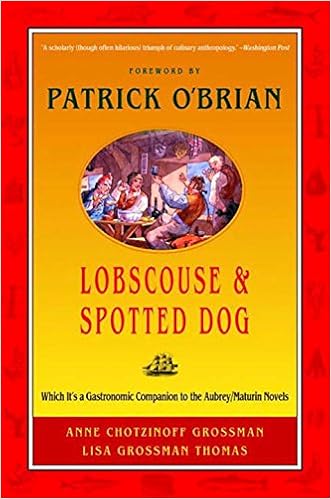
Meanwhile, learn about these things in  Lobscouse and Spotted Dog: Which It’s a Gastronomic Companion to the Aubrey/Maturin Novels.  US HERE – UK HERE

Alcohol.  Yessir.

And be sure to drink it from a noggin (a cup for drinking nog) obtained from my Swag Store!   Since some of you classify as “Zed Heads”, you might go for that particular line… Zed Noggins, as it were.   Get it?  Huh?


Posted in Fr. Z's Kitchen, Lighter fare, O'Brian Tags, Preserved Killick | Tagged , , ,
12 Comments

The “Golden Mass” tradition for Ember Wednesday of Advent

St. Lucy

Do you remember the little mnemonic poem:  “Lenty, Penty, Crucy, Lucy”? Or else

Fasting days and Emberings be
Lent, Whitsun, Holyrood, and Lucie.

The Wednesday, Friday and Saturday after the Feast of St. Lucy are the Advent Ember Days.

In the old, Julian calendar (before it was reformed and adjusted by Gregory XIII) 13 December was the shortest, darkest day of the year.  The feast of St. Lucy, whose name from the Latin lux, for “light”, was very important in yesteryear.  It reminded our forebearts, and us in unity with them in the still darkening northern hemisphere, that our days – which are numbered – will soon be getting longer again.

Lucy will usually be depicted in art with a lantern, or with a crown of candles, or – most commonly – with her own eyes on a platter.

Some accounts have Lucy slain by having her throat thrust through with sword.  Other accounts say that to protect her virginity she disfigured herself by cutting her own eyes out and sending them to her suitor, a plot likely to discourage him.  St. Lucy is therefore the patroness of sight.

St. Lucy shows up fairly often in Dante’s great Divine Comedy.  She is first in the Inferno.  It is Lucy who asked Beatrice to help Dante.  In Purgatory the eagle that bears Dante upward in a dream is actually Lucy who is bearing him to the gate of Purgatory.  Eagles, of course, are “eagle-eyed” and see very well.  In the Paradiso she is placed directly across from Adam in the Heaven of the Rose.  Lucy can gaze directly at God.

It seems that St. Lucy was something of a patroness for Dante and that he was devoted to her because, as we glean from various works, he may have had a problem not just with his eyes but also struggling with sins of the eyes.

This week we have the Ember Days, which in Advent come after the Feast of St. Lucy.

Today is Ember Wednesday in Advent.  Hence, today is the day of the so-called Missa aurea, or “Golden Mass”.

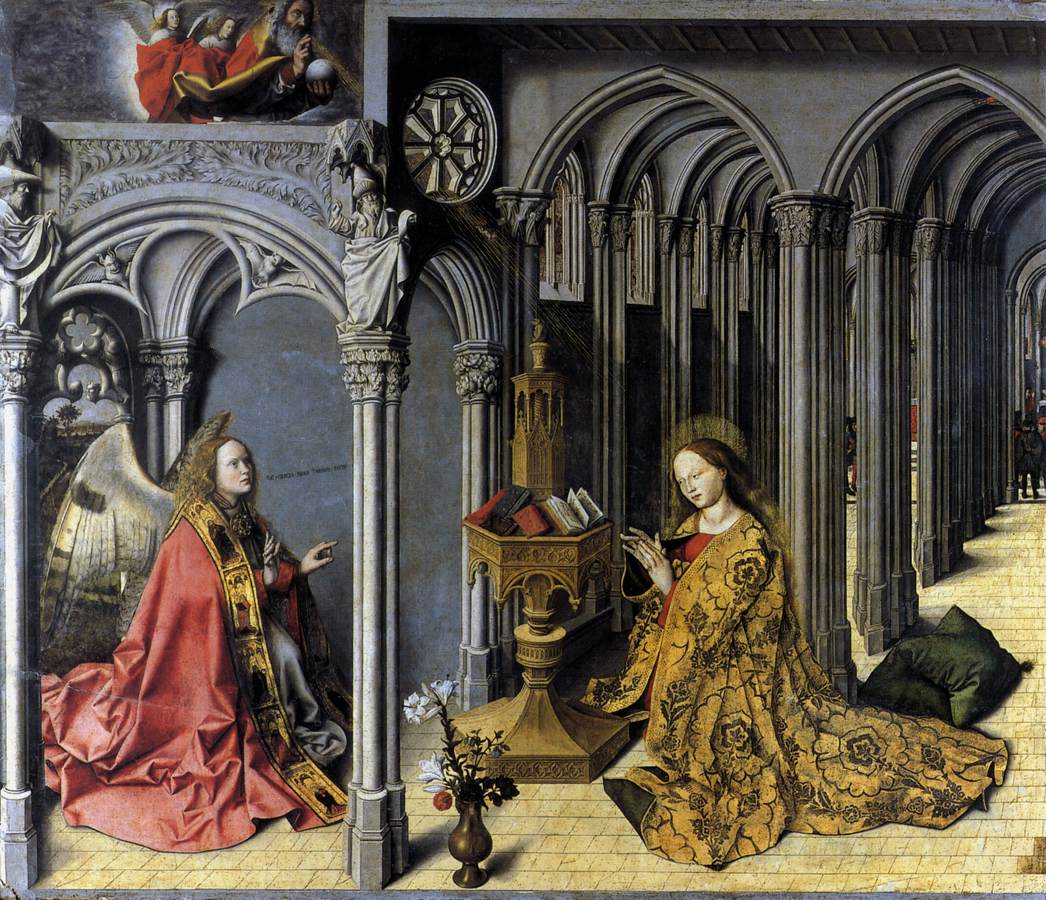
There is a strong Marian overtone to today’s Mass formulary.  The Roman Station for today is St. Mary Major. The Gospel is the Annunciation.

The illuminated missals and sacramentaries of centuries past presented the Gospel or at least its initial capital letters in gold, whence our nickname Missa aurea.

And the Gospel pericope begins Missus est angelus Gabriel….  It was once celebrated with a solemnity nearly approaching a feast day.

Missa aurea also refers to little dramas in medieval times in which the Annunciation was acted out.  It is thus not just “golden Mass” but “the golden sending“, which of course refers to the moment in which Our Lord becomes incarnate in the womb of the Virgin and His work for our salvation begins a new phase.

Missa aurea comes to be used in the terminology of art history also for paintings of the Annunciation, which often contain dramatic elements associated with the tableaux struck in the dramatic presentations of the mystery.  Doves would be lowered and an old man would be placed in a loft wearing an alb and cope.  Angels would come vested in dalmatics.

Here’s a photo of the 13th c. Scrovegni Chapel. Giotto’s frescoes echo this tradition as do many paintings of the Annunciation.

And, since today is an Ember Day, we who recite the Office according to the Roman Breviary must during Lauds also say the Weekday Intercessions, which don’t come up on all weekdays.

Weekday Intercessions
Lord, have mercy upon us. Christ, have mercy upon us. Lord, have mercy upon us.
Our Father, who art in heaven, Hallowed be thy name. Thy kingdom come. Thy will be done on earth as it is in heaven. Give us this day our daily bread. And forgive us our trespasses, as we forgive those who trespass against us.
. And lead us not into temptation:
. But deliver us from evil.
. I said: Lord, be merciful unto me:
. Heal my soul, for I have sinned against thee.
. Turn thee again, O Lord; how long will it be?
. And be gracious unto thy servants.
. Let thy mercy, O Lord, be upon us.
. As we have hoped in thee.
. Let thy priests be clothed with justice:
. And may thy saints rejoice.
. Let us pray for our most blessed Pope N.
. The Lord preserve him and give him life, and make him blessed upon the earth: and deliver him not up to the will of his enemies.
. Let us pray for our bishop N.
. May he stand firm and care for us in the strength of the Lord, in the might of thy name.
In Rome, the preceding Versicle and its Response are omitted. Elsewhere, the name of the local Ordinary is inserted at the letter N. If the Holy See or the See of the local Bishop is vacant, the appropriate . and ., either or both as the case may be, is omitted.
. O Lord, save our leaders.
. And mercifully hear us when we call upon thee.
. O Lord, save thy people, and bless thine inheritance:
. Govern them and lift them up for ever
. Remember thy congregation,
. Which thou hast possessed from the beginning.
. Let peace be in thy strength.
. And abundance in thy towers.
. Let us pray for our benefactors.
. O Lord, for thy name’s sake, deign to reward with eternal life all who do us good. Amen.
. Let us pray for the faithful departed.
. Eternal rest grant unto them, O Lord, and let perpetual light shine upon them.
. May they rest in peace.
. Amen.
. Let us pray for our absent brothers.
. Save thy servants, O God, who put their trust in thee.
. Let us pray for the afflicted and imprisoned.
. Deliver them, God of Israel, from all their tribulations.
. O Lord, send them help from thy sanctuary.
. And defend them out of Sion.
. Turn us again, O Lord, God of Hosts.
. Show us thy face, and we shall be whole.
. Arise, O Christ, and help us.
. And redeem us for thy name’s sake.
. O Lord, hear my prayer.
. And let my cry come unto thee.
Prayer {from the Proper of the season}
skip second ‘O Lord, hear my prayer’
Let us pray.
Grant, we beseech thee, Almighty God, that the solemn Feast of our redemption, which is now at hand, may both help us in the life which now is, and further us toward the attaining of thine eternal joy in that which is to come.
Through Jesus Christ, thy Son our Lord, Who liveth and reigneth with thee, in the unity of the Holy Ghost, ever one God, world without end.
. Amen.

Where is all this in the Novus Ordo?

(Trick question.)

Posted in Liturgy Science Theatre 3000 | Tagged , , ,
2 Comments

ASK FATHER: Father doesn’t put particle of Host into the chalice

From a reader…

QUAERITUR:

I attend daily Mass in my local parish and one local priests (who is not newly ordained) always omits commingling a particle of the Host into the precious blood after consecration. He fractures the Host into four pieces for distribution and does so only after he’s begun the Angus Dei… but never drops a particle. Am I being too picky? Am I over participating? If not how to proceed? I am afraid that he won’t take kindly to my questioning his rubric. But if I have firm grounds

If the priest is NOT properly doing the co-mingling, various called the “Immissio” or “Commixtio”, then, no, you are not being overly picky.

That part of the rite is not to be omitted.

It is of monumental symbolic meaning.   Among the things that the fraction of the Host represents are the three forms of the Church, Triumphant, Suffering and, for the piece put into the chalice, Militant (us).

If the priest is not the pastor, address yourself to him.  If this is the pastor, you might ask him to explain that part of the rite.  If that doesn’t produce positive results, try to develop a chain of correspondence and bring it to the bishop.

This is a touchy situation, it seems.  However, you have the right to make your concerns known.  Redemptionis Sacramentum 183 ff.

Posted in "How To..." - Practical Notes, ASK FATHER Question Box, Liturgy Science Theatre 3000 | Tagged , ,
10 Comments

Card. Burke pontificates in Fr. Z’s native place

For various reasons I had to demur, but at one point I was to be deacon for this.

This is how they do it in Minneapolis, friends.

Not too bad, all in all.  A worthy observance of Gaudete Sunday.

I hate to send anyone to Facebook – blech – but there are more photos there.


Posted in "How To..." - Practical Notes, Fr. Z KUDOS, Liturgy Science Theatre 3000 | Tagged
6 Comments

Latin. @RobertSRoyal opines while Fr. Z rants.

You all know that I tend to bang on about Latin in our sacred liturgical worship.
Most of us belong to the Roman Catholic, Latin Church.  The Latin Church.

Never using or hearing our language of prayer and teaching affects (defects) our identity as Catholics.

“But Father! But Father!”, some of you libs are snorkeling, “You’re just trying to perpetuate the oppression of the marginalized through your outmoded patriarchal tools of… of… oppression!  It’s because of people like YOU that we have to put our guitars and tambourines down and sing the … the… that’s it … the Kyrie in Latin!  Why?  Because YOU HATE VATICAN II!”

You mean the Vatican II that required that our worship remain in Latin? That priests had to say their Office in Latin?  That pastors had to teach people how to respond speaking and singing in Latin?  THAT Vatican II?

Today at the increasingly valuable The Catholic ThingRobert Royal has a piece which concerns the recent fluctus in simpulo about the translation of the Lord’s Prayer.   In this insight piece he writes:

[…]

My far greater concern these days, however, is how much the English translations of prayers are sliding into what might be called a kind of emotional blur. [This is the age of sentimentality.] It happens at Mass. But I see it especially in Morning and Evening Prayer. You might not notice if you recite the Liturgy of the Hours in English. (I may be wrong about this, but I’m told there’s still no definitive translation.)  [I believe it’s in production.  Who knows when it will see the light of day.  But… do I care?  No, I do not.  Guess why.]

Most days, I read those two Hours in Latin (again, just for personal reasons). But I’ll use the English when I’m pressed for time. The Universalis app is a convenient way to consult them both.

Going back and forth often brings you up short, because the Latin tends to speak concretely about sin, redemption, and mercy in a strikingly vertical way, much needed, in my view, at a time when much of our lives – even our religious worship – is markedly horizontal.

That’s very evident, especially in Advent. If any time of year reminds us that God “comes down,” metaphorically speaking, to become one of us while remaining the eternal second person of the Trinity, it’s now.

[…]

This blog began as my place to archive the articles on the translations of prayers for Holy Mass.  Looking at the Latin and then seeing the poor excuse for the English that was foisted on the Church for so long, drove me to write the column “What Does The Prayer Really Say?” for many years at The Wanderer (bless them – give a gift subscription for Christmas).   As the weeks and months and years of the column piled on, we saw the systematic removal of concepts not just from the horrific English ICEL versions of the Novus Ordo prayers, but from the Latin even before the loons got their paws on the originals.

Change the way we pray and, over time, what we believe will change.   Lex orandi – Lex credendi.   It is inevitable.

After decades of dreck, no wonder we are in the diminished, enervated state we’re in.

And.. NO… hearing an Agnus Dei sung at Mass every other month doesn’t cut it.  Or, even better, having the Kyrie “in Latin” doesn’t do it either.  That one never gets old.

Thank be to God we now also have Summorum Pontificum in force to act as both a rudder and a sea anchor in these stormy identity waters into which our barque has been purposely led by the steersmen.

Posted in "But Father! But Father!", "How To..." - Practical Notes, Liturgy Science Theatre 3000, WDTPRS, Wherein Fr. Z Rants | Tagged , ,
43 Comments

Nativity scenes and tinkeritis

There’s tinkeritis with liturgy and tinkeritis with creches.  They seem to be symptoms of the same mental, spiritual malady.   Is it hubris?

What is it with the desire to tinker with Nativity scenes?

I fully understand the desire and attempts of true artists to portray the mysteries of the Lord’s life in paint and sculpture.  Our museums are full of these, some good, some great, some magnificent.  And then there’s the gimicky and the unworthy.

From Church Militant and St Louis Post Dispatch:

Really?

Church Militant says:

An Illinois Catholic diocese is displaying a “Hipster Nativity” scene showing a skimpily clad Mary, with Joseph taking a selfie with the Baby Jesus.

The Nativity is one of about 60 on view in the “Nativities From Around the World” display in the Catholic Cathedral of St. Peter. The créches come to the Cathedral from the University of Dayton’s Marian Library, a Catholic college, which has collected more than 3,500 nativities from over 100 countries since 1998. The Hipster Nativity was built in 2016 and, in addition, showing the Holy Family as millennial caricatures, it also depicts the Three Wise Men on Segways holding Amazon Prime boxes and a “100 percent organic” cow eating gluten-free feed.

Church Militant spoke with Msgr. John Myler, rector of the Cathedral, about the modern créche, who justified it by insisting that “most nativities will have the flavor and or the costume or the culture of the people.”

Bob Baker, a parishioner, spoke to Church Militant, mentioning his “conversations with the Chancery office and the statements from Msgr. Myler,” who explained that the purpose of the Nativity “was to make it relevant to the school children.”

What makes that “relevant”?

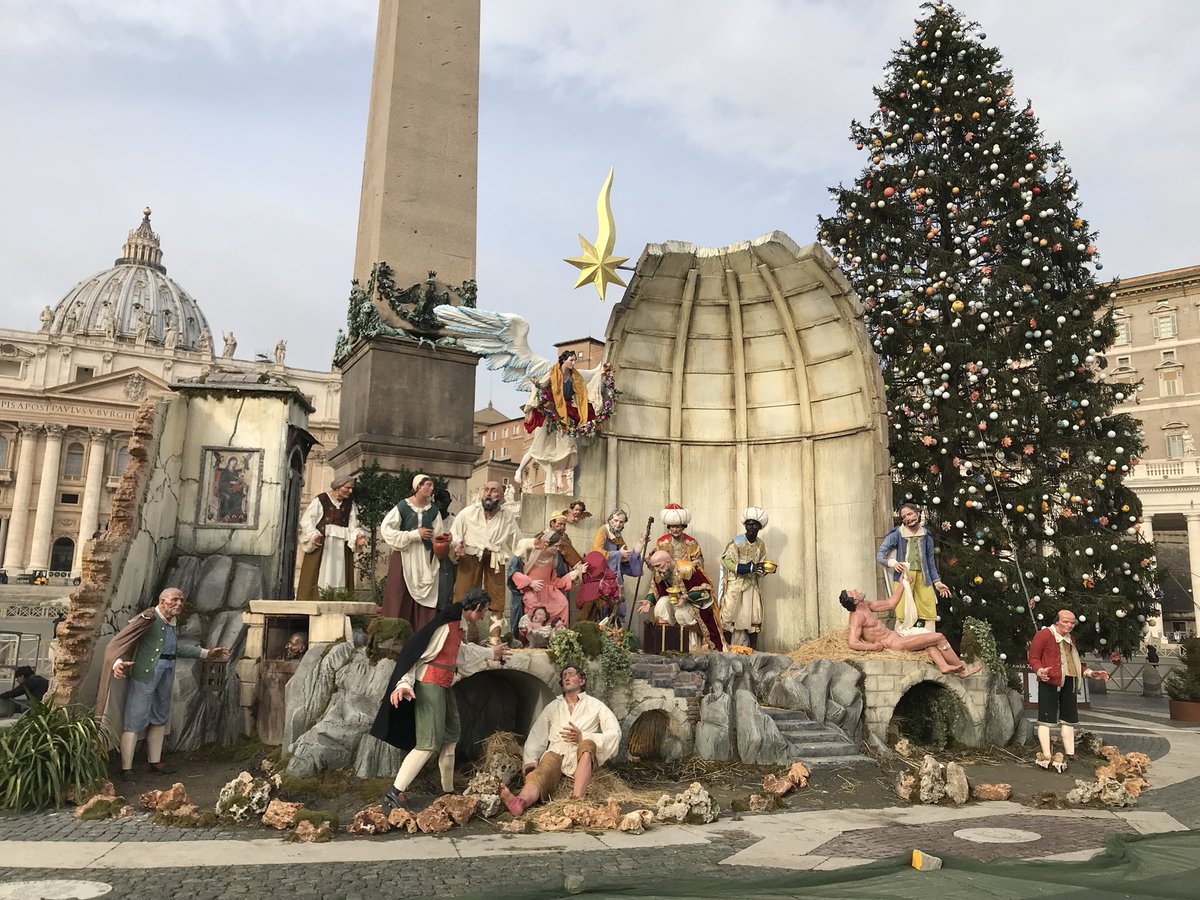
And there’s the really strange nativity scene this year in St. Peter’s Square.

Apart from the controversy about the naked guy at the right side, who thought that this composition was in any way coherent?   First… find the Holy Family.   Okay… got them yet?  The other figures are suppose to portray corporal works of mercy.  Got it?  Merrrrrrrcy.    The addition of “bury the dead” was especially appropriate for the Nativity scene.

Clever, right?  It’s soooo profound.

And relevant!

However, I don’t believe that the spiritual works of mercy were included.

You remember, those, right?

  • admonish the sinner
  • instruct the ignorant
  • counsel the doubtful
  • comfort the sorrowful
  • to bear wrongs patiently
  • to forgive all injuries
  • pray for the living and the dead

I am not sure that all of these are in vogue any more.

Posted in Pò sì jiù, You must be joking! | Tagged ,
24 Comments

ASK FATHER: Christmas gifts for priests

Quite a few people have asked for suggestions about things to get for their priests for Christmas.

This topic comes up once in a while, as in ordination season and for the brethren’s birthdays and anniversaries.

I can approach this in a couple ways, and I am entirely aware of the self-interest involved.  Having wishlists makes this an easier question in my regard.  I will, nevertheless, advance.

Here are a few things which might be helpful.

First, since this is the age of the “gift card”, how about gift cards to some place or outlet that Father might appreciate?  Does Father go fishing?  A card for some fishing gear place. Does Father build AR-15s?  A card for some parts outlet and ammo cans of 5.56 would help.  Does Father use Amazon?  Amazon cards!   I know that when I get an Amazon gift card, my life is a little easier that day: I order, inter alia, household essentials.  Does Father occasionally eat?   How about some card or gift certificate for a local restaurant (which he likes), perhaps large enough so he an a priest friend can go together.

Some airlines have gift cards.

Also, I was just made aware that some airlines have gift cards, too.  It might be good to give a priest some travel/airfare cards, so that he might be able to visit parents or grandparents if he is in a place where he didn’t grow up, or maybe to attend a classmate’s jubilees or other event, or even just have a vacation somewhere.

There’s a gift card for just about everything now.

Another option is to work with him to get vestments or liturgical books or training that he might looking for (especially if that involves the Extraordinary Form).  I know that a lot of younger priests are interested in this.  Going back to the gift card idea, perhaps they could order something from Leaflet Missal (who handle the Biretta Project – talk to John in Church Goods).

There is, of course, the ultimate.  The portable altar.    Since I already have one, I could use a Bugatti Chiron to haul it around.

I think that most priests would be honored to have a charitable donations made in their name either to a particular project of your church or to an organization he supports.  For example, I have my favorite projects, such as the tax-deductible Tridentine Mass Society of the Diocese of Madison and Our Lady of Hope Clinic (which has a matching grant to the end of the year).

In the Christmas cards I receive, many people say that they have enrolled me in novenas of Masses or they send spiritual bouquets.  That’s really nice and much appreciated.

Remember, too, that some priests are quite alone, and times like Christmas can be hard for them.  Check up on them without being pushy.  Ask if there is anything that they need or that you can do for them.   Also, keep in mind that priests can’t and shouldn’t accept every possible invitation.  Don’t be bent out of shape if Father doesn’t accept.

Some priests really like the 8th dozen of Christmas cookies.  Some, might not need the 2nd dozen… or the first.  I am among the later group.   I share them out if I can.

I think that priests don’t, in general, expect very much.  They know that something is going to come their way, of course.  They are happy when something comes along, but that’s not way they got into the fray.   Each man will have different interests.  However, being cheerful and helpful in the parish and supportive in projects can go a long way to making spirits bright, as it were.

Posted in "How To..." - Practical Notes | Tagged
1 Comment

ASK FATHER: Does a priest need a dispensation to say Mass “ad orientem”?

From a reader…

QUAERITUR:

Hello Father. I recently asked my Pastor if he would ever celebrate the Ordinary Form of the Mass ad orientem. He replied that a dispensation is required from our Bishop. I’ve never heard such a thing. Could this be true? Thanks very much.

No, that is not true.

A “dispensation” implies that there is a law.   A diocesan bishop cannot establish a law in contradiction to the Church’s universal laws.  Holy Mass can be celebrated ad orientem at the choice of the priest.  No permissions are need according to the law.  As a matter of fact, the rubrics in the Missal, read properly, assume that the priest is celebrating ad orientem: the indicate when he turns to face the people.

Indeed, the Congregation for Divine Worship ruled on this question in 2000.  HERE

Some bishops have – wrongly – made reference to GIRM 299 in their attempts to snuff out or prevent ad orientem worship.  Rather, surely some underlings of the bishops have done that, since no bishop would be so foolish as to ignore the CDWs ruling.  Nor would they be unaware of the mistranslation of the Latin of GIRM 299 which distorts the meaning of the paragraph.

Sometimes you will see letters of bishops – no doubt penned by underlings – which seem to forbid ad orientem worship for all manner of reasons such as a chimeric “unity” (supremely ironic given the variety of practices and unchecked abuses going on all around them).  They may even openly say, “Don’t say Mass ad orientem without my permission”, which doesn’t have any juridical basis at all.  However, a careful reading of such letters reveals that they do not establish any policy or legislate anything.  They convey the bishop’s wish.  Sometimes that wish is couched in fancy language, but that’s what it winds up being: “I don’t like it.  I don’t want it.  But I can’t make a law against it.  So, here’s an ominous legal-sounding letter with subtle threats.”

So, priests are free to celebrate ad orientem.

However, given the fact that a bishop can crucify a priest in a thousand unpleasant ways, many priests aren’t going to opt for ad orientem even though they would be open to it or want to do it.   Their rights mean little to nothing in the face of power turned against them.

This is the sad reality.

Hence, in your dealings with this priest, be a little compassionate.  Depending on your diocese, it could be that he, personally, would like to accommodate you, but in the background he has concerns with “downtown”, as it were.

Posted in "How To..." - Practical Notes, ASK FATHER Question Box, Liturgy Science Theatre 3000, Turn Towards The Lord | Tagged
5 Comments

My View For Awhile: Manhattan Edition

I’m off for a quick trip to Manhattan.

The primary mission on this trip is to attend an annual “O Antiphon” Dinner which has – in part – a motive of appreciation for priests who have helped at Holy Innocents, indeed, helped to keep it open when there was a strong possibility that it might be closed. Quite a few were involved in that effort and some close bonds were formed.

I will also have the pleasure of meeting up with good friends during this short jaunt.

A “Manhattan” may be involved at some point.

UPDATE

Upgrade. A good way to start.

UPDATE

Bumpy ride followed by soft landing.

Posted in On the road, What Fr. Z is up to | Tagged
1 Comment