ASK FATHER: Confession of serious sins in both kind and number.

From a reader…

QUAERITUR:

According to canon law, we are obliged to confess our mortal sins in “both kind and number.” Would my sins be absolved if I failed to mention the venial sins in number?

YES!  Number, too… for serious sins.

You are not obliged to confess venial sins, though doing so is good and helpful, especially as one proceeds in the spiritual life and overcomes major faults.

If you choose to confess venial sins, sure, go ahead and confess them in kind and number if you wish, although you are not obliged to.

In regard to serious, mortal sins, you are obliged.  Why?

If you confess that you “lied”, that might mean that you lied once or that you lied 50 times.  The former could be a one-off.  The latter means that you have a serious problem as an inveterate liar.  There’s a difference.

So, it is smart to confess sins in number, because we learn who we are for the sake of our journey towards our heavenly fatherland.

It is smart, but it is also the law.  It is the law, precisely because it is smart and good for us.

In the 1983 Code of Canon Law we read:

Canon 988 – §1. A member of the Christian faithful is obliged to confess in kind and number all serious sins committed after baptism and not yet directly remitted through the keys of the Church nor acknowledged in individual confession, for which one is conscious after diligent examination of conscience.
§2. It is to be recommended to the Christian faithful that venial sins also be confessed.


Remember that each sacrament has both matter and form. The matter of the sacrament of penance is the telling of sins.

While we are not obliged to include all sorts of circumstantial information surrounding the sins, we do need to indicate number and/or frequency, by number can change the severity of the sin and indicate to the confessor (and to yourself) where your principle problems are.

Sometimes it will happen that your memory is not clear about the number of times you committed a sin. In that case, just do your best.  If you truly cannot recall clearly, that’s okay.  Ultra posse nemo tenetur.

Even when your memory is faulty, if you do your best the sins you don’t remember or confess (through no fault of your own) are also indirectly remitted.

However, if you are aware that you should confess sins in both kind and number (or at least give an idea of frequency) and you deliberately avoid indicating number… that’s not good.

A regular, daily examination of conscience will help you in developing the good habits involved in making a good confession.

So, everything, really pry into yourself and then…

GO TO CONFESSION!

And, Fathers!  TEACH people about how to make a good confession.  And go to confession yourselves!  Souls, in including your own, depend on it.

Posted in "How To..." - Practical Notes, ASK FATHER Question Box, GO TO CONFESSION | Tagged , , ,
12 Comments

ASK FATHER: “Transgender” nun?

From a reader…

QUAERITUR:

What is going to happen when someone who identifies as a male , but is in a sane biological based world female, wants to become a priest of some male who competed on the girls soccer team in high school because he feels like a female wants to join the Carmelite nuns?

GUEST PRIEST RESPONSE: Fr. Tim Ferguson

What a odd world we now live in. When someone “identifies as a male.”

I know that’s the modern parlance, but think about it – how we “identify” is supposed to alter reality.

I blame Decartes. He set us on the track where our perception is more important than objective reality. Perhaps the blame lies further back in history, with William of Ockham.

Whatever the root, we are now living in a world where Humpty Dumpty, who said in Alice in Wonderland, “When I use a word, it means just what I choose it to mean – neither more nor less.” could be touted as the the wisest man, errr, egg, around.

In any case, the Church refuses to play these contemporary word games.

If someone who is female but “identifies” as male somehow manages to get through the application process, years of formation, and all the necessary vetting and, horrifically goes through an ordination ceremony, she enters the church building not as a priest, but as an excommunicated woman in virtue of canon 1378.2.1.

If a man attempted to enter a religious community of women, and somehow managed to bluff his way through the formation process, there would not be an automatic excommunication, but he would not in any way shape or form become a nun. He would be a man masquerading as a nun – which might be funny in a movie or play, but in the light of eternity and divine judgment, which we all will face, is a serious and blasphemous action.

Anyone who assisted, or colluded, or covered for the folks who lie to the Church in order to pretend to get ordained or pretend to take vows will also be subject to penalties in this life, and judgment in the life to come.

Fr. Z adds:

Check out a post about this back in 2012 concerning a future meeting of the LCWR in 2020. HERE

Posted in "How To..." - Practical Notes, ASK FATHER Question Box, B as in B. S as in S., Pò sì jiù, Sin That Cries To Heaven, Women Religious, You must be joking! | Tagged
8 Comments

ASK FATHER: 1st Communion at another parish because grandparents can’t travel

From a reader…

I am hoping for your wisdom and guidance here. My daughter is preparing for 1st communion (May 2018) at our home parish. However, my parents, living in another state, are not in good enough health to attend the event. Last year they missed the baptism of our son for this reason. Provided she has met all the sacramental preparation requirements is there a means by which she could receieve the sacrament at my parent’s parish? I am tried asking the religious education director but they did not have an answer.

Also, must a 1st communion take place in a specially set mass? Could the sacrament not be received during any mass after which all “mandated” preparation is complete?

GUEST PRIEST RESPONSE: Fr. Tim Ferguson

There should be no problem with this – especially if both pastors are reasonable people.

There is no need for First Communion to take place at a special Mass.

The pastor of your parish could write to the pastor of your parents’ parish, explain the circumstances, and ask if arrangements could be made.

Posted in "How To..." - Practical Notes, ASK FATHER Question Box | Tagged
6 Comments

ASK FATHER: Baptized but never lived as a Catholic, soon to marry

From a reader…

QUAERITUR:

A cousin of mine was baptised in the Catholic Church as an infant to fulfill the wishes of persistent grandparents. But was in no way raised in the Church and never recieved any other sacraments – is she Catholic? And bound by the laws and precepts of the Church? She is marrying a man (whose religious background I know nothing of) outside of Church (obviously, shes never practiced or known the faith), is this, in the eyes of God, a valid marriage? Or would it be valid only if she married in the Church? I have been asked to be in the wedding party and wish to know the waters I am navigating.

Thank you for your priesthood and guidance.

Baptism has effects and consequences.  When one is baptized into the Catholic Church, one is – forever and always – a member of the Catholic Church.

One might never darken the door of a Catholic Church after the baptism, but one is still always a Catholic. As a Catholic, one is bound by the laws of the Church.

This is one reason why the Church insists that, for a child to be baptized, the parents consent to it, and the priest (or deacon, or bishop, or authorized lay person) have a reasonable hope that the child will be raised in the faith.

This is one reason why just baptizing any child that is brought around may not be the best idea: there are consequences 2o years down the line, such as an invalid marriage.

Insistent grandparents notwithstanding, baptizing a child when there is no reasonable hope that the child will ever be taught the faith, go to Holy Mass, receive the sacraments, or otherwise practice the faith, is not a good thing. If the grandparents are going to insist on the baptism of their grandchildren, then they are obliged to follow through with the catechesis and formation of their now-Catholic grandchildren.

Every baptized Catholic is bound by law to observe the Catholic form of marriage, for validity.

Since this is the Church’s law, the Church is able to dispense from it.

The marriage of a baptized Catholic outside of the Church, and without obtaining a dispensation, is invalid.

However, it’s hard to imagine that someone who has never practiced the faith would even be aware of the need for a dispensation, let alone have the understanding of how or why to obtain it.

Posted in "How To..." - Practical Notes, 1983 CIC can. 915, ASK FATHER Question Box, One Man & One Woman | Tagged , , ,
13 Comments

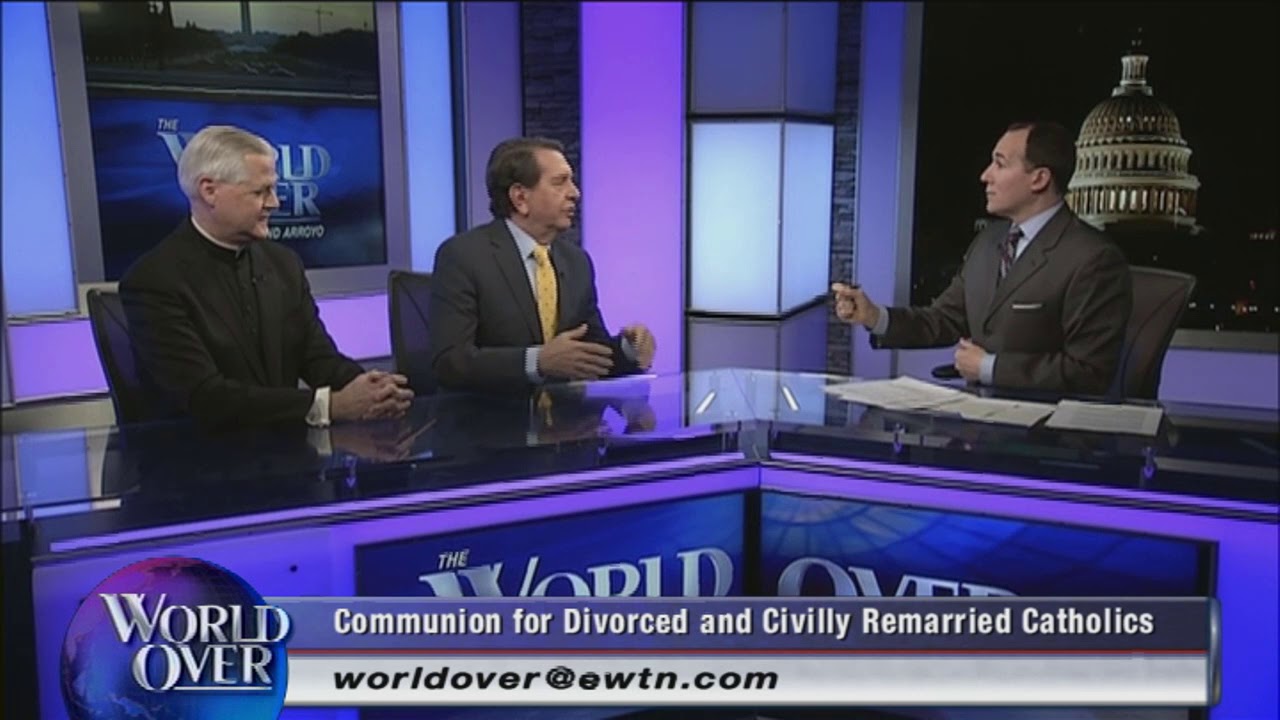
Must view video.   Fr. Gerald Murray and Prof. Robert Royal comment

Must view video.   Fr. Gerald Murray and Prof. Robert Royal comment on what’s going on.

In the wake of the Letter to Argentinian Bishop being placed in the AAS and of Il Papa Dittatore… just watch.

YouTube thumbnailYouTube icon

Posted in Francis, The Drill | Tagged ,
5 Comments

ASK FATHER: Can divorcees with “annulments” be prevented from marrying if there are young children?

From a reader…

QUAERITUR:

Something that I have been wondering about is whether or not the Church could deny marrying a couple where one intended spouse was previously married, had children then the Church granted an annulment [declaration of nullity] saying the marriage was invalid. Could it be argued that, for the sake of the children from the first marriage, a new marriage would not be possible until those children were adult age and the damage minimized from a parent’s new marriage and family? I’m not sure I explained my question well but I see so many damaged children struggling with assorted wounds and disorders from marriage and remarriage and new children and new step parents and all that instability. If Amoris Laetitia guides Pastors to consider what’s better for children in new unions, shouldn’t the Church also be mindful of protecting children from [of?] previous unions, even if those first unions were granted annulments?

GUEST CANONIST RESPONSE:

A monitum (warning) or vetitum (prohibition) is usually only applied to one party or both if one or both of the parties simulated their matrimonial consent (i.e., said “yes,” but meant “no”), and therefore either should not or must not attempt marriage in the future until it is certain that nothing stands in the way of a valid and licit celebration of marriage, in accordance with canon 1066 of the Code of Canon Law; or if there is still present in one party or the other (or both) a serious anomaly or grave affliction of the psyche which rendered the marriage null due to incapacity to contract marriage (e.g., this can be anything from alcoholism or drug addiction to schizophrenia) as under such circumstances it is also necessary to verify ahead of time that any possible future attempt at marriage will not result in an invalid marriage (emphasizing once again the immense importance of canon 1066, the admonitions of which are gravely incumbent upon those who prepare people for marriage).  [Fr. Z adds: Can. 1066: Before a marriage is celebrated, it MUST be EVIDENT that NOTHING stands in the way of its valid and licit celebration. – EMPHASES added!]

I have never heard of anyone who had a marriage declared null — having been declared free to marry and not having monitum or vetitum attached — having their right to marry (ius connubii) impacted or restricted due to the age of any offspring involved.

A Tribunal’s competence is to make a determination about the marriage presented at the request of one or both parties and, if necessary, to make provisions regarding any possibility of a future invalid attempt at marriage.

Ultimately, there is only so much any Tribunal can do. Painful family situations can often be addressed at the parish level or through counseling. Most family dysfunction is beyond the scope of any Tribunal’s competence to address or resolve.

That long-term, delicate, and time-intensive work must be left to others, in other sectors of the Church outside of the judicial branch.

Canon law can only do so much.

Fr. Z JUMPS IN

In addition to the monitum and vetitum, when a party is bound by a natural bond to a children from a previous union, can. 1071 §1, 3° requires the permission of the local ordinary before it may proceed.

It would be good for that to be spelled out in decrees.

Posted in 1983 CIC can. 915, One Man & One Woman | Tagged , , , ,
5 Comments

ASK FATHER: Confessor gave a penance I could not do. Was the absolution invalid?

From a reader…

QUAERITUR:

A few weeks ago I went to confession, and after some words of consolation and admonition, Father gave me my penance. He said I had to pray to the Holy Spirit during Lauds and Vespers for a week (I’m a layperson, but I pray parts of the Breviary as my daily routine).

Problem is: I wasn’t able to fulfill this obligation because one day I simply didn’t have the time to pray Lauds/Vespers.

Does this make my confession invalid?

I’ve answered this question many times in these electronic pages.  But, since it keeps coming up, let’s go at it again!  Repetita iuvant.

FIRST: The absolution was valid.

Your doing the penance afterward or not doing the penance does not in any way alter the validity of the absolution.

Remember, every penance is arbitrary and cannot possibly be commensurate with offending God!  Big and hard penances, small and easy penances… none of them are proportionate to offending our infinite God.  We just do our best.

However, priests must give penances to penitents and penitents are obliged to fulfill penances themselves (can. 981).  However, the penance should be clear, reasonable and doable in a reasonable period of time.

It should be clear: “Think a nice though about someone,” isn’t clear.  How do you know when you have done it?

It should be reasonable: “Rebuild with your own hands old St. Ugthred’s Church, which has been abandoned since 1923.”  Most people can’t do that.

Update your coffee ordering link!

It should be doable in a reasonable time frame: “Say the rosary for 100 days… Travel to the Shrine of Our Lady at La Vang, Vietnam… Next Easter Sunday (months away) do… Obtain and watch this movie ….”

This last point – reasonable time frame – was your situation.  You are not obliged to say the Office.  You sometimes don’t have time to do it in your state in life.  So, don’t worry about it.

That said, doing penance for sins is an obligation we have out of justice.  Penance is a necessary part of the sacrament of penance.

The next time you make your confession, tell the confessor that you are not sure you adequately performed the penance you were given last time, but add that the penance was complicated and drawn out over many days.

Ask for a clear penance you can perform right away.  If you don’t think you can do something that the priest suggests, ask for something else.


Posted in "How To..." - Practical Notes, ASK FATHER Question Box, GO TO CONFESSION | Tagged , , ,
6 Comments

Anonymous “Dictator Pope” author hunted by the Vatican

A few days ago wrote about the hard-hitting recently released on Kindle in Italian and in English.  The author wrote under a pen name.

Controversial Book about Pope Francis: “The Dictator Pope”

In Italian – US HERE – UK HERE
In English – US HERE – UK HERE

Need a Kindle (trick question – YES! You do.)
US HERE – UK HERE

The book is making waves.

I read now at the UK’s best Catholic weekly, the Catholic Herald, an article about the book and the author.

‘They will unmask me eventually,’ says author of ‘The Dictator Pope’

The pseudonymous ‘Marcantonio Colonna’ claims Pope Francis has seen a shortlist of six possible authors

Marcantonio Colonna, the pseudonymous author of The Dictator Pope, has said the Vatican is trying to discover his identity. The book was published as a Kindle edition last week and has caused consternation with its claims about Pope Francis’s reign.

Speaking to the Catholic Herald over email, Colonna claimed that the Pope had been given a list of possible names.

A person in England was misidentified as the author at one point and immediately received threatening telephone calls from Rome,” Colonna said. “I now hear that Vatican officials have laid before the Pope a shortlist of six people who they think may be the possible author. I suspect that it’s not for the purpose of awarding a literary prize.”

Asked whether he thought his anonymity would last, Colonna said: “Under the present Pope, the Vatican machine has taken espionage to a new level, and I have little doubt that they will unmask me eventually, perhaps after a few more false casts. But they will need to ask themselves whether it is at the cost of giving me more publicity.”

[…]

Read the rest there.

Posted in Francis | Tagged
20 Comments

POLL: Starting your confession: “Bless me, Father…” or “Forgive me, Father…”

In another post, I responded to a question from a reader about blessings at the beginning of sacramental confession, following the words, “Bless me, Father, I have sinned…”.

Of course, some people begin their confession differently.

It occurred to me to find out what you readers say?

Let’s have a POLL (now that my poll plugin is working!  THANKS JL – and pppfffft to BY!)

Anyone can vote.  You must be registered and approved to post a comment.

Pick your best answer.

When I begin my confession, I usually say:

View Results

And remember to examine your consciences and…

GO TO CONFESSION!

Posted in "How To..." - Practical Notes, GO TO CONFESSION, Lighter fare, Liturgy Science Theatre 3000, POLLS | Tagged , ,
14 Comments

Millennials and chapel veils

The first time I learned of the word “Fashionista” was back in the days of the Catholic Online Forum, when staffers Dawn and Gayle (who made the best, the most beautiful rosaries I’ve ever seen – RIP and prayers for her) went at it.

Let’s just say that Fashionista.com isn’t one I’ve bookmarked.  However, someone sent me a link to a story about Catholic “millennials”:

WHY MILLENNIAL CATHOLICS ARE RE-ADOPTING THE TRADITIONAL CHAPEL VEIL

A growing group of young Catholic women are choosing to cover their heads in church.

When former “America’s Next Top Model” contestant Leah Darrow first encountered young women in her Catholic community putting lace veils on their heads when entering church, she was a little weirded out. Having returned to the faith after a mystical experience on a magazine photo shoot [all those flashes?] convinced her to leave modeling behind, Darrow was serious about Catholicism — but wary of a practice she considered outdated at best.

“I was like, ‘Is somebody making you do this? What’s it about?'” Darrow says over the phone.

Since the practice of women covering their heads in Catholic worship spaces used to be the norm, but was largely abandoned by the ’60s, Darrow was uncertain as to what women covering their heads might signify in the 2010s. But the fact that the veil-wearing peers in question were “normal girls you could have a glass of wine with, but also very faithful” gave Darrow pause.

“There was something attractive to me about the life that they lived and how they prayed,” Darrow says. After researching more about the history and significance of veiling in the Catholic tradition, Darrow decided to try it herself. “I’m definitely a girly girl, so wearing a pretty veil sounded kind of fun,” she laughs.

Though Darrow didn’t start wearing a veil to mass every week, she did come to a new appreciation for the practice and now regularly brings a head covering on her visits to Rome, where she leads pilgrimages at least once a year. Her travels as a Catholic speaker and book author have convinced Darrow that veils are experiencing a renaissance amongst Catholic women — especially young American ones.  [Wait ’til she discovers the TLM.]

“There’s a new uprising in the Church of millennials who are actually wanting a more traditional take on their faith,” she says. This poses a striking contrast to Protestant mega-churches that are leveraging streetwear and celebrity connections to stay relevant.

Samantha Skinner, a high school science teacher in North Dakota, is one Catholic millennial interested in a return to tradition. Raised loosely Protestant but not a regular church attendee until she converted to Catholicism in college, Skinner began wearing a veil to mass every week before she’d even completed the classes necessary to formalize her conversion. A conversation with a friend who worked in a “holy bookstore” convinced Skinner to try the practice for herself.

“It just kind of resonated with me,” she says on the phone. For Skinner, the appeal of veiling was initially an emotional one: It made her feel humbled and reverent, like removing a hat during the national anthem or at a funeral might, [which men do, but not women] and made her more able to focus on prayer.

[…]

¡Hagan lío!

Posted in ¡Hagan lío!, Just Too Cool, Our Catholic Identity, The future and our choices | Tagged , ,
17 Comments