As Advent continues, was there a good point made in the sermon you heard during the Holy Mass in fulfillment your of Sunday Obligation?
Let us know.

As Advent continues, was there a good point made in the sermon you heard during the Holy Mass in fulfillment your of Sunday Obligation?
Let us know.
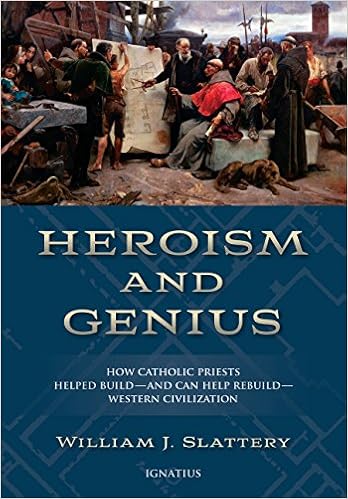 I recently received a book by Fr. William J. Slattery which has been truly intrigued.
Heroism and Genius: How Catholic Priests Helped Build—and Can Help Rebuild—Western Civilization
What’s this about? Our author says:
With stubborn facts historians have given their verdict: from the cultures of the Jews, Greeks, Romans, Arabs, and Germanic peoples, the Catholic Church built a new and original civilization, embodying within its structures the Christian vision of God and man, time and eternity.
The construction and maintenance of Western civilization, amid attrition and cultural earthquakes, is a saga spread over sixteen hundred years. During this period, Catholic priests, because they numbered so many men of heroism and genius in their ranks, and also due to their leadership positions, became the pioneers and irreplaceable builders of Christian culture and sociopolitical order.
Heroism and Genius presents some of these formidable men: fathers of chivalry and free-enterprise economics; statesmen and defiers of tyrants; composers, educators, and architects of some of the world’s loveliest buildings; and, paradoxically, revolutionary defenders of romantic love.
Okay? Yes, every priest, seminarian and prospective seminarian needs this book. Lay people need this book.
Think about how much our Catholic identity depends on the influence of priests. So, formation of priests as priests seems to be pretty important. Priests are formed not only by priests. They are formed by parents and parishes and present trends. However, they are also, I hope, formed by priests of the past, great figures and saints.
Another note.
I’ve started to read. This guy can really write. His prose is wonderful. Listen to this… from the beginning of the Preface…
To set the tone in the introduction, Slattery opens with Aragorn’s instruction of Boromir about the role of the Dúnedain, the difference between Gondor and the North, the hidden labors of the misunderstood men of the North. Tolkien‘s words, mind you, not the dreadful gruel from Philippa Boyens in the movies. It’s a strong opening image (especially if you are a traditional priest these days:
‘But my home, such as I have, is in the North. For here the heirs of Valandil have ever dwelt in long line unbroken from father unto son for many generations. Our days have darkened, and we have dwindled; but ever the Sword has passed to a new keeper. And this I will say to you, Boromir, ere I end. Lonely men are we, Rangers of the wild, hunters — but hunters ever of the servants of the Enemy; for they are found in many places, not in Mordor only.
‘If Gondor, Boromir, has been a stalwart tower, we have played another part. Many evil things there are that your strong walls and bright swords do not stay. You know little of the lands beyond your bounds. Peace and freedom, do you say? The North would have known them little but for us. Fear would have destroyed them. But when dark things come from the houseless hills, or creep from sunless woods, they fly from us. What roads would any dare to tread, what safety would there be in quiet lands, or in the homes of simple men at night, if the Dúnedain were asleep, or were all gone into the grave?
‘And yet less thanks have we than you. Travellers scowl at us, and countrymen give us scornful names. “Strider” I am to one fat man who lives within a day’s march of foes that would freeze his heart or lay his little town in ruin, if he were not guarded ceaselessly. Yet we would not have it otherwise. If simple folk are free from care and fear, simple they will be, and we must be secret to keep them so. That has been the task of my kindred, while the years have lengthened and the grass has grown.
‘But now the world is changing once again. A new hour comes. Isildur’s Bane is found. Battle is at hand. The Sword shall be reforged.
Sets the tone.
And there is the book’s alluring structure… I dare you to use my link, above, and then click on the book image for a preview of the Table of Contents. I suspect you’ll be hooked.
Also… while this is an engaging read, it’ll keep you read for quite a while. Interspersed with illustrations, there’s a lot of text.
For scale.


This is a winner.
 At the National Catholic Register there is a good article about several US bishops who have been persecuted by the catholic Left.
Little-Known Facts About 7 North American Bishops
Facts about Bishop James Conley, Archbishop Joseph Kurtz, Archbishop Michael Miller, Bishop Robert Morlino, Bishop Thomas Paprocki, Archbishop Alexander Sample and Archbishop Joseph Naumann.
Here are some interesting facts seven North American diocesan bishops shared with me about themselves of which you may not be aware.
Bishop of Lincoln, Nebraska James Conley, 62, has not only prayed for the end of abortion in front of abortion clinics, but was arrested and taken to jail for his participation in Operation Rescue, a protest movement in the 1980s that involved pro-lifers peacefully blocking the entrances to abortion clinics.
[… see the rest there!…]
Growing up, the closest sibling companion of Archbishop of Louisville, Kentucky Joseph Kurtz, 71, was his brother, George, who had Down syndrome. Archbishop Kurtz is the son of a Pennsylvania coal miner, and one of five children, but his three older sisters had married and moved out of the house while he was still young. Hence, “Georgie” was his friend and companion while growing up. Years later, when their mother died, Georgie came to live with his brother while he was both priest and bishop until Georgie’s death in 2002.
[…]
Archbishop of Vancouver, British Columbia, Canada Michael Miller, 71, has done an extensive study of the papacy, and wrote the 1995 book The Shepherd and the Rock: Origins, Development, and Mission of the Papacy. Speaking of how the papacy has changed in modern times, he said, “In the past 50 years, popes have emerged as central symbolic symbols. When you read the secular papers, they mention the pope two or three times a week. This wasn’t true in the 30s or 40s. The pope seemed to be more of a remote individual, not as visibly present in the lives of Catholics. The popes became a more present reality, I believe, beginning with the pontificate of Pope John Paul II.” [I got to know Archbp. Miller in Rome where we shared the same residence. He is a prayerful gentleman and a scholar.]
[…]
In 2008, the dissident group Call to Action placed a full-page open letter in the Wisconsin State Journal criticizing the leadership of Bishop of Madison, Wisconsin Robert Morlino, 70. He said, “I pray for people in Call to Action. I feel badly that they’re committed to what they’re doing as a good. It causes tremendous division within the Church. And, to try to organize the people against the bishop who is doing nothing but what the Church is teaching is a harmful thing. It grieves me.” [The Extraordinary Ordinary.]
Bishop of Springfield, Illinois Thomas Paprocki, 65, is an athlete who has run 22 marathons and plays hockey. [He performed an exorcism over the state of Illinois after a same-sex marriage law was passed. OORAH. And he celebrates the TLM.]
[…]
Archbishop of Portland Alexander Sample, 56, lives with and is a part-time caretaker to his 88-year-old widowed mother, Joyce Sample. Over the years he has cooked for her, done her laundry, bought her items at the store and taken her to the doctor. He said, “I can relate very much to families that care for elderly parents. I cook dinner for my mother and myself every night. It is my great honor and joy.” [I’ve known Archbp. Sample since the mid-80’s. A more prayerful priest you will not find.]
The father of Archbishop Joseph Naumann, head of the Archdiocese of Kansas City in Kansas and the newly elected chairman of the USCCB’s pro-life committee, was murdered in December 1948, when the archbishop was just a few months along in his mother’s womb. For decades, the archbishop has been active in pro-life activities, supporting a variety of pro-life organizations and even participating in Rosaries prayed in front of abortion clinics.
[…]
In my Z-Swag store… car magnets and bumper stickers in many variations HERE

CLICK
And individual items, of course, not just packs. But… get them by the pack. Also, long exposure in direct sun will make them fade. (Just buy more!)

CLICK
 First, if liturgical translations frustrate you, just use Latin. It is, after all, the official language of worship of the Roman Catholic Church.
I have had a couple dozen panicked or confused emails, and a few more that are simply curious, about the Pope remarks about (… you knew that was coming…) the translation of the Our Father.
Context: Recently the French changed their wording. It was pretty bad, frankly. That probably got the Pope thinking in translation terms about the Lord’s Prayer.
So the Pope opines that the Our Father says something that sounds in Italian like God the Father leads us into temptation, which doesn’t right. In English we have something that sounds a little like that: “lead us not into temptation”.
The Pope says something. People go bananas. Huzzah! Another chance for us to find out what the prayer really says! right?
Matthew 6:9–6:13 and Luke 11:2–11:4 are our GREEK biblical texts which are the foundation of the Our Father as we say it in Latin and in English. The Greek of the line in question, from Matthew, is “καὶ μὴ εἰσενέγκῃς ἡμᾶς εἰς πειρασμόν”. Frankly, the Greek is tricky. Read in a straight forward way, it says what we say when we say the Lord’s Prayer. So, what does it really say?
One of the last sections of the Catechism of the Catholic Church explains this petition.
VI. “And Lead Us not into Temptation”
2846 This petition goes to the root of the preceding one, for our sins result from our consenting to temptation; we therefore ask our Father not to “lead” us into temptation. It is difficult to translate the Greek verb used by a single English word: the Greek means both “do not allow us to enter into temptation” and “do not let us yield to temptation.” “God cannot be tempted by evil and he himself tempts no one”; on the contrary, he wants to set us free from evil. We ask him not to allow us to take the way that leads to sin. We are engaged in the battle “between flesh and spirit”; this petition implores the Spirit of discernment and strength.
2847 The Holy Spirit makes us discern between trials, which are necessary for the growth of the inner man, and temptation, which leads to sin and death. We must also discern between being tempted and consenting to temptation. Finally, discernment unmasks the lie of temptation, whose object appears to be good, a “delight to the eyes” and desirable, when in reality its fruit is death. God does not want to impose the good, but wants free beings…. There is a certain usefulness to temptation. No one but God knows what our soul has received from him, not even we ourselves. But temptation reveals it in order to teach us to know ourselves, and in this way we discover our evil inclinations and are obliged to give thanks for the goods that temptation has revealed to us.
2848 “Lead us not into temptation” implies a decision of the heart: “For where your treasure is, there will your heart be also…. No one can serve two masters.” “If we live by the Spirit, let us also walk by the Spirit.” In this assent to the Holy Spirit the Father gives us strength. “No testing has overtaken you that is not common to man. God is faithful, and he will not let you be tempted beyond your strength, but with the temptation will also provide the way of escape, so that you may be able to endure it.” [Hence, we need graces. God will not allow us to be tempted beyond our ability to say “No!”… provided that we choose to suffer in the short term, of course.]
2849 Such a battle and such a victory become possible only through prayer. It is by his prayer that Jesus vanquishes the tempter, both at the outset of his public mission and in the ultimate struggle of his agony. In this petition to our heavenly Father, Christ unites us to his battle and his agony. He urges us to vigilance of the heart in communion with his own. Vigilance is “custody of the heart,” and Jesus prayed for us to the Father: “Keep them in your name.” The Holy Spirit constantly seeks to awaken us to keep watch. Finally, this petition takes on all its dramatic meaning in relation to the last temptation of our earthly battle; it asks for final perseverance. “Lo, I am coming like a thief! Blessed is he who is awake.”
Could the English version which is traditional in deeply rooted in our identity a “bad” translation? No. It isn’t. However, it is incumbent on the Church’s pastors to teach people what it means, so that when they pray it, they get it.

So, there’s nothing wrong with the Pope bringing up the point. It gives us an opportunity to go beyond the shallow and our into the deep to fish up abundant meaning fishes.
Also, there is a fascinating little volume with the commentaries of three great ancient writers, Tertullian, Cyprian, and Origen on the Lord’s Prayer. Amazing stuff. US HERE – UK HERE
Also, St. Augustine eloquently explains the Lord’s Prayer. Among other things, he says:
Thou dost not see the devil, but the object that engages you you see. Get the mastery then over that of which you are sensible within. Fight valiantly, for He who has regenerated you is your Judge; He has arranged the lists, He is making ready the crown. But because you will without doubt be conquered, if you have not Him to aid you, if He abandon you: therefore do you say in the prayer, Lead us not into temptation. The Judge’s wrath has given over some to their own lusts; and the Apostle says, God gave them over to the lusts of their hearts. How did He give them up? Not by forcing, but by forsaking them.
If we do not pray and engage with God as suitors and dependents, we fall out of contact with Him and we grow cooler and cooler until our hearts freeze and harden. God will not force us. He will respect the “foresaken” nature of our relationship. So, it is a good idea – it is CHRIST’s idea, and so it’s good – to pray using that petition about temptations. No what you are praying.
Finally, the teachings of the Lord, while at times on the surface are pretty straight forward, are nevertheless offerings from the divine, eternal Logos. They contain unfathomable depths and mysteries.
UPDATE:
Catholic World Report has a good article about this issue with the Pope – HERE
 As a follow up to the nearby post about Latin, and to what Fr. Hunwicke wrote about the oath that bishops have to take – in Latin – when they receive a mandate from the Holy See, here is that Oath in Latin, with my translation.
When you translate something, you crack open its bones and scoop its marrow.
This oath could provide a lot of material for ongoing meditation and prayer by bishops, of course, but also by priests and lay people for their bishops.
Consider what is entrusted to a bishop. Consider how he, like everyone else, struggles with the world, the flesh and the Devil. Consider that, though fortified with the graces of the sacrament of orders, and defended by the holy angels God sends to them, a bishop hated and pursued by the forces of Hell with a persevering malice that we humans can only imagine with vague analogy. Consider his judgment before the Just Judge when it is his time. Consider his final reward, forever and ever as a bishop in whatever state will be his. Consider the weight of the burden that a diligent, faithful bishop feels, which the ever-harried Augustine of Hippo described as a sárcina, the massive backpack of the Roman solider. Consider too the vineyard into which the bishop is sent to tend, with its obstinate vines, vagaries of “weather” and pressing foes.
For your edification and contemplation.
|
FORMULA |
FORMULA |
| Ego, ___, ad sedem ___ promotus, catholicae Ecclesiae atque romano Pontifici, eius supremo pastori, Christi vicario beati Petri apostoli in primatu successori et collegii Episcoporum capiti, semper fidelis ero. | I, ___, promoted to the See of ___, will always be faithful to the Catholic Church and to the Roman Pontiff, her Supreme Pastor, Vicar of Christ, Successor in primacy of the blessed Apostle Peter and the Head of the College of Bishops. |
| Libero exercitio primatialis summi Pontificis potestatis in universa Ecclesia obsequar, Ipsiusque iura et auctoritatem mihi curae erit provehere ac defendere. Praerogativas quoque atque munera romani Pontificis Legatorum, quippe qui personam gerant supremi pastoris, agnoscam atque observabo. | I will submit to the free exercise of the primatial power of the Supreme Pontiff in the Universal Church, and I will take pains to advance and defend his rights and authority. I will also acknowledge and respect the prerogatives and duties of the legates of the Roman Pontiff, for they act in the person of the Supreme Pastor. |
| Apostolica munera Episcopis commissa, nempe populum Dei docendi, sanctificandi et regendi, in hierarchica communione cum collegii episcopalis capite atque membris, summa diligentia exsequenda curabo. | I will take with the greatest diligence that the apostolic duties committed to Bishops, namely of teaching, governing and sanctifying the people of God in hierarchical communion with the Head and the members of the College of Bishops, be carried out. |
| Universae Ecclesiae unitatem tuebor, ideoque studiose incumbam, ut depositum fidei inde ab Apostolis traditum purum et integrum servetur ac veritates tenendae et moribus applicandae, prouti ab Ecclesiae magisterio proponuntur, omnibus tradantur et illustrentur. Errantibus vero in fide paternum animum pandam atque omni ope adnitar, ut ad plenitudinem catholicae veritatis perveniant. | I will protect the unity of the universal Church, and, therefore, I will zealously see to it that the deposit of faith handed down through time by the Apostles will be preserved pure and undiminished and that the truths to be held and the moral teachings to be applied will be handed on and explained just as they are proposed by the teaching authority of the Church. I assuredly will extend a fatherly spirit to those who are straying in the faith and I will strive with every effort that they arrive at to the fullness of catholic truth. |
| Ad imaginem Christi, summi et aeterni sacerdotis, respiciens, pie sancteque agam ac ministerium mihi commissum ita adimplebo, ut, forma factus gregis ex animo, fideles in christiana perfectione adipiscenda confirmare valeam. | Carefully looking to the image of Christ, the High and Eternal Priest, I will behave dutifully and religiously and will fulfill the ministry entrusted to me in such a way that, having from my soul been made an example for the flock, I may be able to strengthen the faithful in the pursuit of Christian perfection. |
| Disciplinam cunctae Ecclesiae communem fovebo et observantiam omnium legum ecclesiasticarum, earum imprimis quae in Codice Iuris Canonici continentur, sollerter insistam, semper advigilans, ne mali usus irrepant praecipue circa ministerium verbi et sacramentorum celebrationem. | I will foster the common discipline of the whole Church and I will insist skillfully upon the observance of all ecclesiastical laws, first and foremost of those that are contained in the Code of Canon Law, always being vigilant lest any evil practices slither in, especially concerning the ministry of the Word and the celebration of sacraments. |
| Diligentem curam in temporalibus Ecclesiae bonis administrandis ponam, iis potissimum quae ad divini cultus exercitium, ad cleri aliorumque ministrorum honestam sustentationem, necnon ad sacri apostolatus et caritatis opera collata sunt. | I will put diligent care into the administration of the temporal goods of the Church, most especially those goods that are designated for the exercise of sacred worship, for the worthy support of the clergy and of other ministers, and for works of the sacred apostolate and of charity. |
| In explendo mandato mihi commisso omnes Presbyteros et Diaconos, ordinis episcopalis providos cooperatores, necnon Religiosos et Religiosas unius eiusdemque operis participes, peculiari dilectione prosequar. Itemque de sacris vocationibus provehendis maximam curam habebo, ut spiritualibus necessitatibus in tota Ecclesia convenienter consulatur. | To fulfill the mandate entrusted to me, I will with special affection attend to all of the Priests and Deacons, provided as coworkers of the episcopal order, as well as male and female religious, participants in one and the same work. Likewise, I will take the greatest care to promote sacred vocations, so that spiritual needs in the whole Church will be properly looked after. |
| Laicorum dignitatem propriamque ipsorum in Ecclesiae missione partem agnoscam et proveham. Opera vero missionalia ad gentium evangelizationem fovendam peculiari sollicitudine curabo. | I will acknowledge and promote the dignity of lay people and their own mission in the Church. I will, by all means, take care with particular solicitude to foster missionary works for the evangelization of the nations. |
| Ad Concilia ceterasque legitimas actiones collegiales vocatus, nisi impediar, ipse adero vel opportune respondebo. | Once called to Councils and other lawful collegial activities, I will personally attend or opportunely respond unless I am impeded. |
| Statutis temporibus vel occasione data Apostolicae Sedi rationem de pastorali meo officio reddam, eiusdemque mandata atque consilia simul obsequenter accipiam ac maximo studio perficiam. | At the appointed times or at a fitting moment, I will give an account of my pastoral office to the Apostolic See, and I will compliantly give careful attention to its mandates and measures, and, with great effort, will carry them out with the greatest application. |
| Sic me Deus adiuvet et haec santa Dei evangelia, quae manibus meis tango. | So help me God and these Holy Gospels of God, which I am touching with my hands. |
| (SUBSCRIPTIO ANTISTITIS) | (SIGNATURE OF THE BISHOP) |
| Ego infrascriptus testor praefatum Anstistitem iusiurandum ut supra in manibus meis dedisse hac die | I, the undersigned, testify that the aforementioned bishop above gave the oath (as written) above into my hands on this day |
|
____ |
____ |
So, there’s the text.
It might be an interesting exercise to take each of these paragraphs and, over time, bring them to Holy Mass and prayer before the Blessed Sacrament precisely for the sake of your bishop.
Perhaps another exercise could be to contemplate that oath in juxtaposition to the vesting prayers a bishop puts on, his pontificalia, with all their symbolic meanings. For example, when putting on the miter, the bishop prays: “Place upon my head, O Lord, the miter and helmet of salvation; that I may go forth unhindered against the snares of the ancient foe, and of all my enemies.” (cf Eph 6:17)
Priests might look at the oath and their vesting prayers in the same way. Perhaps we can look at some other texts in the future.
 How many times in these electronic pages have I lamented the blatant disobedience in regard to can. 249?
I remind the readership, especially those readers who are diocesan bishops, that the Code of Canon Law, can. 249, requires – it doesn’t suggest or recommend or propose, but requires – that seminarians be “very well skilled” in the Latin language:
Can. 249 — Institutionis sacerdotalis Ratione provideatur ut alumni non tantum accurate linguam patriam edoceantur, sed etiam linguam latinam bene calleant necnon congruam habeant cognitionem alienarum linguarum, quarum scientia ad eorum formationem aut ad ministerium pastorale exercendum necessaria vel utilis videatur.
How is this translated on the Vatican website?
Can. 249 The program of priestly formation is to provide that students not only are carefully taught their native language but also understand Latin well [FAIL!] and have a suitable understanding of those foreign languages which seem necessary or useful for their formation or for the exercise of pastoral ministry.
Calleo is “to be practiced, to be wise by experience, to be skillful, versed in” or “to know by experience or practice, to know, have the knowledge of, understand”. Sure, “understand” can translate calleant, but in this context that is the weakest of our choices. We get the word “callused” from calleo. We develop calluses when we do something repeatedly.
So, calleo is already “well versed/skilled”. Then bene calleant is “let them be very well versed/skilled”.
Review also Sacrosanctum Concilium 36 and Optatam totius 13, just to point to documents of Vatican II. … unless you “HATE VATICAN II!”, as the libs throw about.
Latin is necessary. Its benefits are so numerous that they shouldn’t have to be enumerated.
And yet we are faced today with a clergy of the LATIN Church who are nearly totally ignorant of Latin!
I ask you, Reverend and Most Reverend gentlemen, what does it mean for our Catholic identity if our clergy don’t know the language – and therefore what goes with the language – of their Rite and Church?
Do you think that that’s a problem?
“But Father! But Father!”, some of these priests and bishops will respond, “We have so many more pressing problems to address!”
Is that so?
Our Catholic identity is THE pressing problem.
Our identity has been severely enervated over the last half dozen decades. Let’s do something about this, starting with elementary and high schools! Let’s do something about this starting in homeschooling!
We have to recover these lost tools or we will, very soon, begin to pay even more massively than we do now for the wounds to our identity. Consider how the demographics of the Church are being reported. There are now more people who identity as former-Catholics than as Catholics, and the majority of the later barely go to church. What will that mean for, inter alia, vocations?
Oh… and by the way… when rectors or others stand up during ordinations to attest before God that the men to be ordained for the Latin Church have been properly trained…. is that true if they have no Latin?
So what are they stating before God and the Church?
Speaking of oaths, Fr. Hunwicke has something at his place today that I found interesting – HERE:
Appeal for information
A kind friend has sent me an interesting text: the oath fidelitatis that (?) newly consecrated or translated bishops have to swear in the Latin Church (how about the sui iuris Oriental Churches?).
My first impetuous reaction was to feel that no man with any sense of his dignity would sign such a grovelling formula (vide praesertim verba atque consilia prope finem) . Then I recollected that, over the last thirty years, hundreds, perhaps thousands, of bishops may have signed this piece of paper with no intention (exempli gratia) of doing anything to implement Canon 249 (seminarians being taught to be fluent in Latin). Or of doing anything to repress liturgical abuses. So I expect this ‘oath’ is just an empty formality that one performs and then has a good laugh about. As when we Anglican clergy used to swear an oath to use only the Book of Common Prayer. Ha Ha Ha. Indeed. Ha Ha Ha.
I would be interested, nevertheless, to know the history of this formula, and to what extent its wording is recent. Quite a bit of it seems to me to be redolent of the catch-phrases of Vatican II.
Interesting.
Can. 249, ladies and gents.
From a reader…
QUAERITUR:
As one currently discerning a religious vocation, I was wondering: if someone takes vows in a religious order before it is officially approved by the Holy See (such as an “ad experimentum” order), what happens to them if the order is never approved and closes? Are they moved to another convent/monastery? Or does something else happen?
Thank you very much, Father. I pray for you and all priests daily.
GUEST PRIEST RESPONSE: Fr. Tim Ferguson
An interesting question, indeed.
Once a religious institute has been established – even if it has only been established at the diocesan level – only the Holy See can suppress the institute (c. 584). When an institute is suppressed, in the act of suppression, provisions are made for the remaining members of the institute. Generally, this is done with the consent of the individuals.
It may be that there exists a similar institute, and the vows of a member can be transferred to that other institute. For example, if the Dominican Sisters of St. Reginald in Blackduck are suppressed, [Fr. Z adds: It is more like that that would happen over in Libville where Most Rev. Fatty McButterpants does what he can to repress new vocations] the remaining sisters may transfer to the Dominican Sisters of St. Mannes in Far Madding.
It may be that a member wishes to transfer to an entirely different institute. If the receiving institute is willing, a transfer may be made, but there may well be a period of formation required in the transfer, so that the new member be apprised of the history, charism, and life of the receiving institute.
If the institute involves clerics, some may wish to incardinate into a diocese. Again, the receiving diocese must be willing to accept them.
Some may wish to be released from their vows, and, generally speaking, this can be done. In some cases, there may be an insistence on the part of the Holy See that some – or even all – be dismissed from their vows. If there are significant problems in the institute, which provide the reason for suppression, the members might be dismissed without their consent – following the normal process of dismissal.
In the case of an community that is just beginning, and has not yet been formally erected by the bishop as a diocesan institute, if that community decides to close, or if the bishop decides, after a period of discernment, not to go ahead with erecting it as a diocesan institute, generally speaking, the members are simply released from any promises they have made. It may be that they choose to enter another community or institute. If there are clerics in such a community, the clerics are already incardinated into the diocese, or perhaps another diocese or religious institute (if it’s not a formal institute, it does not have the ability to incardinate clerics) and their incardination remains the same.
These questions are worthwhile asking if one is considering entering a religious community that has just started as an experiment. Without attempting to stifle the Holy Spirit, one must make reasonable provisions for the future, and enter into something with open eyes. The assistance of a good spiritual director can help one make the decision, with the full knowledge that, with any vocation, there is always an element of risk.
[Fr. Z adds: If I am not mistaken, some orders or institutes could be be revived even decades after the decease of their last members.]

Our Collect (once called the “Opening Prayer”) for the 2nd Sunday of Advent was not in the pre-Conciliar Missale Romanum but it was in the so-called Rotulus (“scroll”) of Ravenna, dated perhaps as early as the 5th century.
Omnipotens et misericors Deus,
in tui occursum Filii festinantes
nulla opera terreni actus impediant,
sed sapientiae caelestis eruditio
nos faciat eius esse consortes.
Impedio (built from the word pes, pedis, “foot”), at the core of this prayer, is “to snare or tangle the feet”. A consors is someone with (con-) whom you share your lot (sors). The phrase “faciat eius esse consortes” recalls both the Collect for Christmas Day and the priest’s preparation of the chalice during the offertory. Deus, “God”, is declined irregularly. In solemn discourse the nominative is used as the vocative form (e.g. cf. Livy 1, 24, 7). Sapientia (“wisdom”) and eruditio (“learning”) are packed, technical terms from ancient rhetoric and philosophy.
BRUTAL LITERAL RENDERING:
Almighty and merciful God,
let no works of worldly impulse impede
those hurrying to the meeting of Your Son,
but rather let the learning of heavenly wisdom
make us to be His co-heirs.
OBSOLETE ICEL (1973):
God of power and mercy,
open our hearts in welcome.
Remove the things that hinder us
from receiving Christ with joy,
so that we may share his wisdom
and become one with him
when he comes in glory,…
CURRENT ICEL (2011):
Almighty and merciful God,
may no earthly undertaking hinder those
who set out in haste to meet your Son,
but may our learning of heavenly wisdom
gain us admittance to his company.
Last week in our Collect we rushed to meet the Coming Lord while striving for our reward through works made meritorious by Him alone. During Advent, as the Baptist warns us, we are to make ready the path for the coming of the Lord.
This week we are still rushing but perhaps we are wiser after the first rush of excitement.
This week we are wary of obstacles which could impede us, snare our feet. These impediments are merely worldly ways and works, not meritorious for salvation since they are not performed in Christ. Worldly ways entangle us. St. Paul contrasts the wisdom of this world with the Wisdom of God (cf. 1 Cor 1:20; 3:19; 2 Cor 3:19). In Romans 12:2 Paul admonishes, “Do not be conformed to this world but be transformed by the renewal of your mind, that you may prove what is the will of God, what is good and acceptable and perfect.”
This is not just a Pauline concept. Compare today’s Collect with 2 Peter 1:3-4: “His divine power has granted to us all things that pertain to life and godliness, through the knowledge (cognitio: cf. eruditio) of him who called us to his own glory and excellence, by which he has granted to us his precious and very great promises, that through these you may escape from the corruption that is in the world because of passion, and become partakers of the divine nature (efficiamini divinae consortes).”
St. Augustine of Hippo (+430) dismantled Donatist arguments that all clerics ordained by a sinful bishop would automatically be stained by the same guilt. He used imagery reminiscent of today’s prayer: “The mire (lutum) their feet are stuck in is so thick and dense that, trying in vain to tear themselves out of it, they get their hands and head stuck in it too, and lingering in that muck they get more tightly enveloped” (c. Don. 25). The Donatist argument was based on worldly, not heavenly, wisdom. Sticky lutum is a metaphor for a worldly, sinful life. Augustine contrasts being lutum with being children of God. “Noli esse lutum …Don’t be muck, but become (efficere) a child of God through His mercy!” (diu. qu. 68.3).
 If we neglect God, we weak sinners can eventually convince ourselves of anything: down becomes up, back becomes front, black is white, wrong is right, and muddy is clean. We excuse away our sins. Once self-justification becomes a habit, it is a vice in more than one sense of that word. Our consciences may occasionally struggle against the vice of self-deception, but the proverbial “Struggle” supplies permission: “I really ‘struggled’ with this, … before I did it.”
If we go off the true path into the sticky mire of error, we escape neither the Enemy lion seeking whom he might devour (1 Peter 5:8), nor the glorious Lion of Judah who will open the seals and read the Book of Life (Rev 5:5).
During Advent, let us make straight Christ’s path and watch our step.
Nevertheless, no matter how sticky may be the mess we have gotten ourselves into, Christ’s loving mercy washes its stain away in a good, complete confession before Christmas.
 When it was found that the Pope’s Letter to Bishops of Buenos Aires was included in the AAS with a note from Card. Parolin, libs lined up for their customary conga line. They blew up the importance of that moment way beyond reality. However… how to get their false narrative back into the ACME crate it came in?
Canonist Ed Peters help us out. He has a piece today about the use (misuse) of canon law by theologians. It is longish, and you can read the whole thing there. But here are some highlights:
I agree, most Catholic theologians need more training in canon law (at least before they propound on it)
I applaud Massimo [“Beans”] Faggioli’s recognition that “canon law is clearly an important part of the Catholic tradition” and join him in urging that “the curricula of Catholic theologians should include more” canon law. His own Commonweal essay on what he thinks are the canonical implications of the appearance of Pope Francis’ letter to the Argentine bishops in the Acta Apostolicae Sedisillustrates several of the ways that non-canonists can stumble over canonical issues while setting those faulty views before the public. Let me just comment on some of Faggioli’s assertions.
1. Faggioli: “Changes in canon law don’t come quickly, as the ongoing reception of Amoris Laetitia since its promulgation in April 2016 is currently reminding us.” Well, sure, especially when papal documents do not change, or even mention, the canonical norms at issue. It is not easy to change a canon by not talking about it. [I’m tempted to make some popcorn.]
2. Faggioli: “The news this week that Pope Francis has officially recognized the interpretation of Chapter VIII of the exhortation put forth by Argentine bishops indicates that change does nevertheless occur.” But this is old news; Francis “recognized” the Argentine document when he signed his name to a letter endorsing their document last year. The appearance of Francis’ letter in the Acta Apostolicae Sedisadds nothing to his act of last year. [But they’ve already formed up in their conga line, Ed.]
[…]
4. Notwithstanding Faggioli’s exaggerated read of its significance, Francis’ placing the label “magisterial” on his letter to the Argentines (rather as he dubbed his recent remarks on the liturgical renewal movement as “magisterial”) is indeed unusual. I can think of several unquestionably magisterial statements being made by, say, Benedict XVI or St. John Paul II, but off hand, I do not recall either of them ever labeling their statements as “magisterial”. Papal statements, assessed in the light of criteria that Church law and tradition apply in such cases, either qualify as magisterial (a term whose import, by the way, is routinely exaggerated in common parlance) or they don’t so qualify. [NB]Labels attached do not, in my opinion, modify the nature of the assertion, but they do contribute to the mistaken view that papal “magisterium” is something that can be lightly turned on and off. [Of course libs use “magisterial” only when they want to liberal view to trump reality, such as when they want you to admit that 2+2=5. “It’s MAGISTERIAL!”, say shout as they reach for the little door to the rat cage.]
5. Of course, much of Faggioli’s (and others’) excited thinking about Amoris, the Argentine’s document, and the pope’s endorsement of it, assumes that Francis et al. have repudiated—to make a long story short—Canon 915 and the unbroken, divinely rooted, tradition behind it. To be sure, one could read Amoris and its progeny as doing exactly that, for the words in Amoris support that interpretation. But they also support exactly the opposite interpretation, namely, they can be read so that divorced-and-remarried Catholics are, as they have unquestionably always been, included among those regarded by Canon 915 as obstinately persevering in manifest grave sin (as each of those terms has been understood over the centuries, understandings that might not coincide exactly with how non-canonists might understand them) and thus are (outside of one well-defined situation) ineligible to present themselves for holy Communion thereby occasioning in ministers of that most august Sacrament the duty to withhold the Eucharist if such persons do present themselves. The plausibility of diametrically opposed interpretations of the text of Amoris is precisely why, in my view, theDubia posed by four cardinals warrant a direct, clear, and authoritative response. [Do I hear an “Amen!”?]
6. Faggioli’s invocation of the famous 1875 letter of Bl Pius IX to the German bishops endorsing their view of papal primacy against extra-ecclesial attacks, as if it were remotely comparable to Francis’ endorsement of the Argentine document, beggars belief. [I so admire Dr. Peters’ restraint.]
I invite interested persons to examine an English translation of the German bishops’ statement, Pius’ response letter, and his later consistorial remarks on it, as found in Donald Logan, “The 1875 statement of the German bishops on episcopal powers”, The Jurist 21 (1961) 285-295, and ask themselves whether the detail, clarity, and precision used by the German bishops in describing the matters before them are in any way comparable to the “endlessly malleable considerations phrased in verbiage redolent of the 1970s” employed, as I have said, by the Argentines in addressing their topic. I note that Pius’ endorsement of the German document, undoubtedly sufficient to make their language his, was not, to my knowledge, ever labeled “magisterial” by that pope. It didn’t need to be so labeled, for magisterial statements speak magisterially according to their own nature.
[… Hereafter I’m omitting really good stuff… ]
And so end as I began, by recommending with Faggioli that theologians receive more education in canon law, at least before venturing too many opinions on it.
How ’bout them apples?
A couple notes.
First, if your German is not up to speed, Barmherzigkeit is “mercy”.
Second, … later on.
From Ignatius His Conclave:
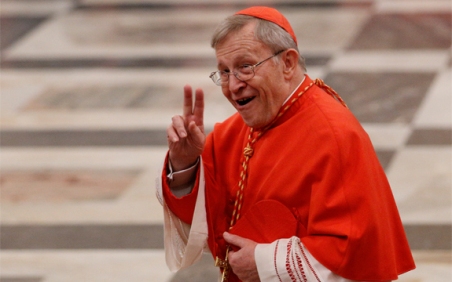
Said the Cardinal, “Don’t be afraid
Barmherzigheit is my trade,
In amorous dealings
Give way to your feelings;
Morality’s simply man-made.”
Fr. Z kudos.
“Ignatius”, as in the title of that blog, is not an example of modern “verbing”. It’s a kind of genitive: the conclave of Ignatius. “Ignatius His Conclave” is a work by John Donne (+1631) in which he ridicules the Jesuits of his day. In the work John Donne reveals how Ignatius was banished from Hell and sent to the moon where he (Jesuits) would do less harm. No lover of Jesuits, he.
What, I wonder, would Donne have written about the likes of James Martin, 2+2=5, and Thomas Reese?
BUT WAIT! There’s more!
This limerick seems to have been a response a request by Fr. Hunwicke:

There once was a German called Kasper
Whose theology was a disaster.
To divorcees twice wed
He reportedly said
‘I’m the world’s most merciful pastor’.

Coat of Arms by D Burkart
 happymom on ASK FATHER: For Benediction why the humeral veil?: “This gorgeous post deserves a gold star!”
 on Wherein Fr. Z rants. Benediction using the humeral veil BUT… blessings at Communion time? Fathers! THINK!: “@Fr. Reader: I’m from South America. Many things that are now customs were imported via people consuming US media (so…”
 on A few things I found today that I think are interesting: “I used to be rather horrified by Sagrada Familia. And then, when I was in Barcelona, I went in. That…”
 on Brooklyn 26/6 – Day 2: CHINESE: “As one who loves Chinese more than the rest of my family (for the most part), I love finding good…”
 on A few things I found today that I think are interesting: “Agree with Archaic and Kenneth re: the (modern art)istry of the basilica/altar cards.”
 on Wherein Fr. Z rants. Benediction using the humeral veil BUT… blessings at Communion time? Fathers! THINK!: “My mother used to express her disgust at being in line for Communion and seeing the Priest’s hand that would…”
 on A few things I found today that I think are interesting: ““Trust has broken down.” Noooooo. Really? What isn’t captured in this statement though is that the break in trust is…”
 on Wherein Fr. Z rants. Benediction using the humeral veil BUT… blessings at Communion time? Fathers! THINK!: “As long as the ushers dismiss people pew by pew and architects keep spacing the pews so close together that…”
A Daily Prayer for Priests










They find you a pro-life agent in your area who commits to giving a portion of the fee to a pro-life group!

PLEASE subscribe via PayPal if it is useful. Zelle and Wise are better, but PayPal is convenient.
A monthly subscription donation means I have steady income I can plan on. I put you my list of benefactors for whom I pray and for whom I often say Holy Mass.
In view of the rapidly changing challenges I now face, I would like to add more $10/month subscribers. Will you please help?
For a one time donation...



Help Monks in Wyoming (coffee – UPDATED LINK) and Norcia (beer) and the wonderful "Soap Sisters" of Summit, NJ!


Please follow me on Twitter!










Visits tracked by Statcounter
since Sat., 25 Nov. 2006:

