Here is a great opportunity, not only to experience a great Catholic boys choir, but also to SUPPORT a great Catholic boys choir!
There are both Masses and concerts. Take note.
The Schola Cantorum of The London Oratory School
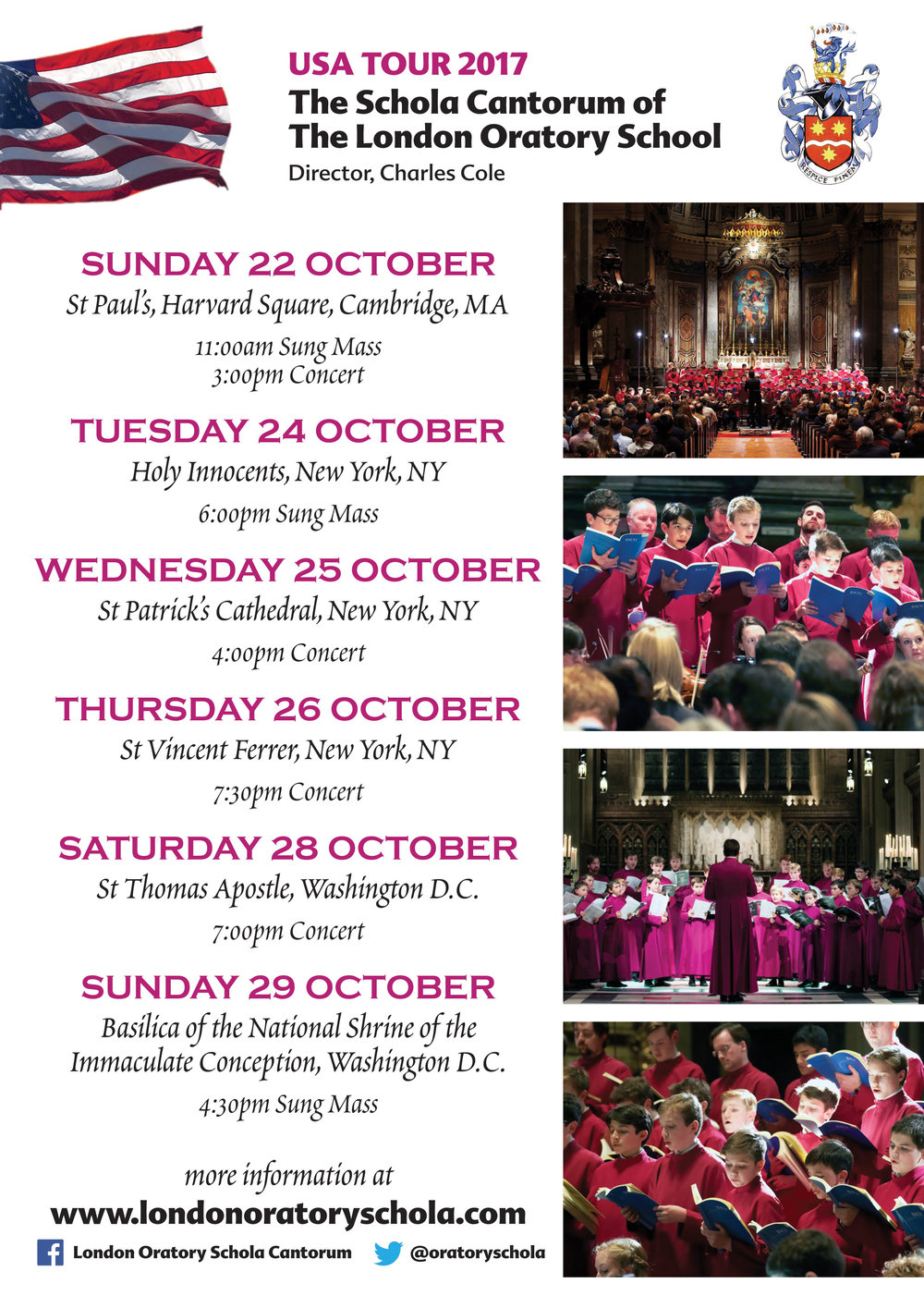

Here is a great opportunity, not only to experience a great Catholic boys choir, but also to SUPPORT a great Catholic boys choir!
There are both Masses and concerts. Take note.
The Schola Cantorum of The London Oratory School
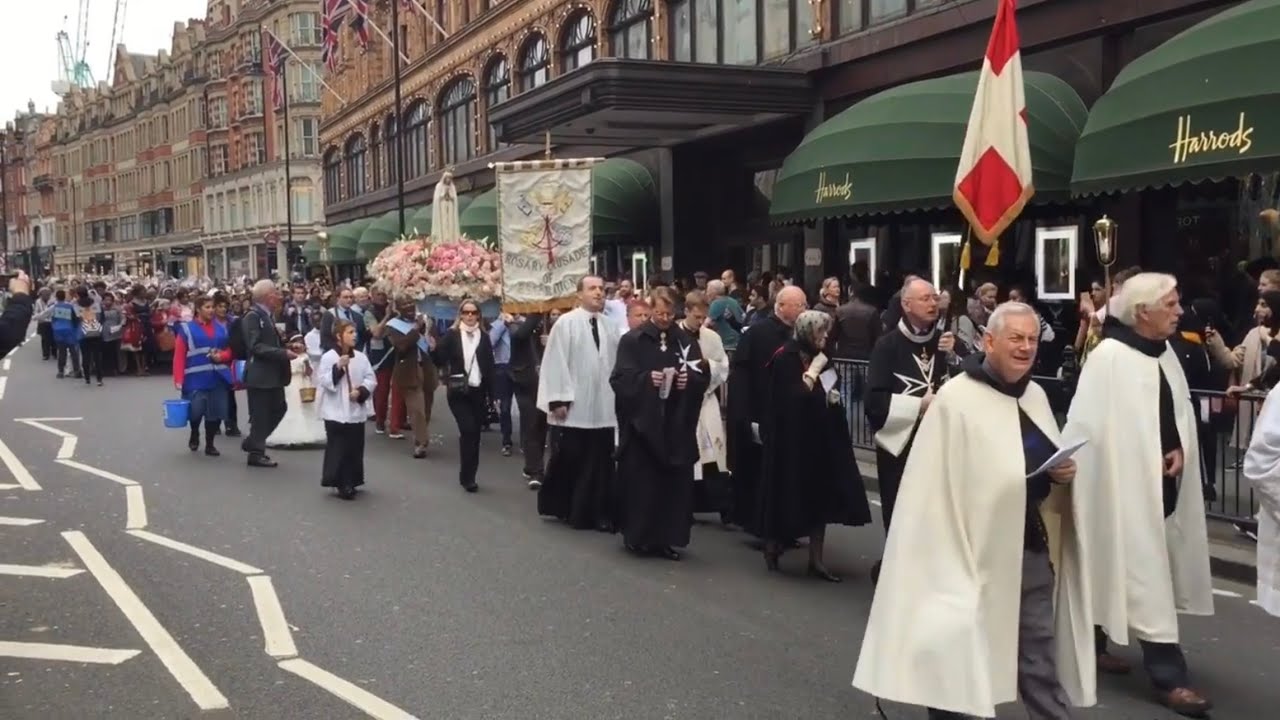
This is a marvelous video sent by a friend in London, who wrote:
Here’s how Fr Tim Finigan described it a couple of years ago.
This occasion must rank as one of the most splendid manifestations of Catholic faith in our country in recent years. The numbers have been swelled by the immigrant Catholics who have come to form part of the Catholic Church in London. At the same time, the clipped tones of the English middle and upper classes demonstrated that the Church is truly Catholic. There was no snobbery here – and no inverted snobbery. All were as one, witnessing to the faith they love, taking Our Lady onto the streets of London, and filling a Church that represents the high-point of English Catholic restoration – and not only in the 19th century.
I would encourage anyone who is dismayed by the falling numbers of clergy, or mass goers, or marriages, to come next year. This event neither seeks nor receives any official encouragement or support. If any ecclesial activity could be said to be of the people of God, it is this. You want to see the Church alive and kicking? Here is where the action is.

On Friday 13 October, we had a Pontifical Mass at the Throne with the Extraordinary Ordinary of Madison, His Excellency Most Reverend Robert C. Morlino at the little church of St. Mary in Pine Bluff where Fr. Richard Heilman is pastor.
Here are some images from the Mass. NB: Some of you readers helped to buy the vestments! HERE

Out Lady of Fatima has been in the church during the anniversary months.


The size of the sanctuary required us to find a Roman solution for the sacred ministers. We seated them on the steps of the altar, which worked well. We’ve done this before.

We are getting good enough at these Masses that we were able to proceed with about 20 minutes of practice of a few rough spots. The priests, who rotate through roles when we have these Masses, are pretty familiar now with the sacred action.


There were people standing along the sides and in the back, and we put more chairs in the narthex.

Turning the housling cloths. At this parish, even for the Novus Ordo Masses, everyone uses the rail and I don’t believe anyone receives in the hand anymore.


Fr. Heilman was one of the Deacons at the Throne.

 Today’s Secret for the 19th Sunday after Pentecost was in ancient versions of the Gelasian Sacramentary, such as the 8th c. Gellonensis. I don’t think it survived the scissors of the Consilium, wielded by Fr. Bugnini’s liturgical experts.
SECRET (1962MR):
Haec munera quaesumus, Domine, quæ oculis tuae maiestatis offerimus, salutaria nobis esse concede.
In prayers which stress propitiation we will often have looking words or imagery. For example, we get orations with the gentle imperative respice, from respicio (“look upon, have regard”). We also put things and ourselves in God’s sight, “in conspectus tuo” and, as today, we offer things to the “eyes of your majesty”. I think this is both a “courtly” form of address, but it also resonates of the Biblical, as in Ps 32 (33):18: “Behold the eyes of the Lord are on them that fear him: and on them that hope in his mercy.” We know from many other WDTPRS articles that maiestas can be a form of address for God, as in “Your Majesty”, but it also refers to a divine characteristic, His glory, in this case tied to His mercy.
SUPER LITERAL TRANSLATION:
We beseech You, O Lord, grant that these gifts which we are offering in the sight of Your majesty, are for us saving things.
SMOOTHER:
Grant, we beseech You, O Lord, that these gifts which we offer, under Your merciful gaze, may be for our salvation.
St. Andrew Bible Missal (1962):
O Lord, we ask that these gifts which we offer in the presence of your majesty may be availing unto our salvation.
In the Introit, we begin with Salus, (“salvation, health”). In the Collect we beg to be freed not only in mind, but also in body. The Epistle, from Ephesians, we hear the Apostle pray for the renewal of the mind and the new man. The Church sings in the Offertory “salvum me faciet… Thy right hand will save me.”
The Secret also has salutaria, “saving/healthful things” and in the Postcommunion the priest intones, “medicinalis operatio… the working of healing grace”.
Another common theme in the Mass formulary is that of observance of the commandments.
In the Introit the Psalmist sings “Attend, O my people, to my law.” In the Collect we pray to seek what is of God (“quae tuae sunt”). The Communion explicitly speaks about God’s mandata, His commandments “to be kept most diligently”. The Postcommunion links the medicinalis operatio with keeping God’s laws (“inhaerere mandatis”).
The “medicinal” imagery today may stem from the ancient Roman church where this Sunday’s Mass was celebrated: The Basilica of Sts. Cosmas and Damian, whose feast day since the earliest day has been celebrated in the autumn – in ancient times as today on the fifth day before the Kalends of October (27 Sept). Remember, this Sunday can “slide around” in the calendar depending on when Easter fell. St. Cosmas and Damian, you will recall, were brothers and physicians who were martyred during the reign of the Emperor Diocletian in 283. They were venerated in Rome, having not only a Basilica at the Roman Forum dedicated to their memory, but their names are in the Roman Canon.
I’m pretty excited about this book and I haven’t even gotten into it yet!
I’ve read a lot about Galileo over the years. This looks good. I like that “in context” part. The book doesn’t just deal with issues, but about the personalities and competing interests of the day.
Galileo Revisited: The Galileo Affair in Context by Paschal Scotti
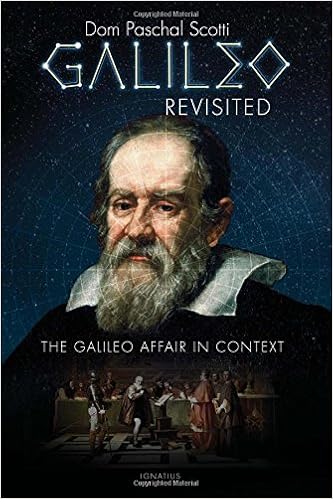
Inevitably people who attack the Church will bring up Galileo. When the issue of Faith and Science comes up, Galileo’s name is soon to follow. However, they usually have no idea what really happened with him.
May I ask a prayer from the readership? I am ailing and I must MC a Pontifical Mass this evening. First, something is wrong with my neck on the right side. When I move, it hurts like crazy. Second, I’ve come down with a cold, which makes the neck thing really fun. I have no energy and a lot of pain.
Please ask, on this most portentous anniversary, the Mother of God and Queen of Priests to intervene for me and lift both of these problems.
Thanks in advance.
 On 13 October, special Masses will be celebrated on the occasion of the 100th anniversary of the Miracle of the Sun during the final apparition of Our Lady at Fatima.
Use the combox to post about YOUR Masses!
In Madison, His Excellency Most Rev. Robert C. Morlino, the Extraordinary Ordinary, will celebrate a Pontifical Mass at the Throne at 6 PM at St. Mary’s, Pine Bluff.
Fr. Richard Heilman is pastor of St. Mary’s and the Mass is celebrated there at his request with the assistance of the Tridentine Mass Society of the Diocese of Madison.
We hope to be able also to LIVE STREAM this Mass over the interwebs! The equipment is in and working.
The Mass will be a 2nd Class Votive Mass of the Immaculate Heart of Mary in accord with Rubricae Generales of the 1962 Missale Romanum 342 & 370-372.
I am sure that in many places special Masses are being organized.

 People ran around with their hair on fire a while back when Pope Francis changed the process by which translations of the liturgical texts are prepared. He gave a greater role to bishops conferences.
I read today at the National Catholic Register that Robert Card. Sarah, Prefect of the Congregation for Divine Worship and Discipline of the Sacraments, confirms that the Holy See retains the last word on the translations.
Of course. It can’t be any other way.
Ed Pentin, the best English-language Vaticanista now, reports:
Cardinal Robert Sarah has weighed in on Magnum Principium, Pope Francis’ motu proprio on liturgical translations, reassuring the faithful that the Vatican will continue to safeguard any changes or new liturgical translations to ensure they remain faithful to the original Latin.
In an article in the French Catholic journal L’Homme Nouveau, the prefect of the Congregation for Divine Worship and the Discipline of the Sacraments (CDW) confirmed that the motu proprio’s change to Canon 838 — which shifts some responsibility for translating liturgical texts away from the Vatican to local bishops — will still require the Vatican to give approval to any such changes or translations.
The article, officially dated Oct. 1 — the day on which Magnum Principium (The Great Principle) came into effect — bolsters the guidance issued with the motu proprio by Archbishop Arthur Roche, secretary of the CDW. Archbishop Roche stressed that the Vatican’s role in confirming texts remains an “authoritative act” presupposing “fidelity” to the original Latin.
Cardinal Sarah’s statements on the matter contradict those who see the motu proprio as a gateway to more liberal vernacular interpretations of liturgical texts, inconsistent with their Latin original.
The Holy Father, who signed Magnum Principium Sept. 3, authorized changes to Canon 838 that decentralized the translation process, giving local bishops responsibility for translating liturgical texts, while retaining the Vatican’s authority to approve or reject a proposed translation.
The CDW will no longer instruct bishops to make proposed amendments, but retains authority to confirm or veto the results at the end of the process. [I effect, however, I’ll bet that there will be unofficial instruction to make changes.]
Among other consequences, this means that the Vatican commission Vox Clara, which was established by Pope John Paul II in 2002 to help the CDW vet English translations, will no longer be needed. [I don’t see why it couldn’t still be useful as a liaison, especially now.]
[…]Liturgiam Authenticam
In his article, Cardinal Sarah begins by reasserting that the “authoritative text” concerning liturgical translations remains Liturgiam Authenticam, the 2001 instruction issued by the CDW, that aimed to ensure “insofar as possible” that texts must be translated from the original Latin “integrally and in the most exact manner.”
For this reason, he continues, the faithful translations carried out and approved by bishops’ conferences “must conform in every way to the norms of this instruction.”
[…]
Read the rest there.
 This is really important.
I’ve been waiting for a Dominican well-versed in Thomas to examine the claim that Amoris laetitia is a “Thomistic” document and/or that it makes good use of the Angelic Doctor’s words.
At LifeSite find an examination by Father Thomas Crean, O.P., who has serious credentials.
I think what he wrote settles the issue.
I suggest that you print it out.
Today is the 25th anniversary of the release of the Catechism of the Catholic Church. St. John Paul II approved the provisional text in June 1992 and it was promulgated on 11 October 1992, which is also the anniversary of the opening of the Second Vatican Council. Hence, today is also the feast of Pope St. John XXIII who opened that Council with a speech known today as Gaudet Mater Ecclesia.
In that speech, the most important thing Pope John said was:
The manner in which sacred doctrine is spread, this having been established, it becomes clear how much is expected from the Council in regard to doctrine. That is, the Twenty-first Ecumenical Council, which will draw upon the effective and important wealth of juridical, liturgical, apostolic, and administrative experiences, wishes to transmit the doctrine, pure and integral, without any attenuation or distortion, which throughout twenty centuries, notwithstanding difficulties and contrasts, has become the common patrimony of men. It is a patrimony not well received by all, but always a rich treasure available to men of good will.
Our duty is not only to guard this precious treasure, as if we were concerned only with antiquity, but to dedicate ourselves with an earnest will and without fear to that work which our era demands of us, pursuing thus the path which the Church has followed for twenty centuries. […]
… But from the renewed, serene, and tranquil adherence to all the teaching of the Church in its entirety and preciseness, as it still shines forth in the Acts of the Council of Trent and First Vatican Council, the Christian, Catholic, and apostolic spirit of the whole world expects a step forward toward a doctrinal penetration and a formation of consciousness in faithful and perfect conformity to the authentic doctrine, which, however, should be studied and expounded through the methods of research and through the literary forms of modern thought. The substance of the ancient doctrine of the deposit of faith [NB] or the truths which are contained in our time-honored teaching is one thing, the manner in which these truths are set forth – in the same meaning and understanding – is another. [NB… that last bit is often left out of translations!] And it is the latter that must be taken into great consideration with patience if necessary, everything being measured in the forms and proportions of a magisterium which is predominantly pastoral in character.
Does that sound like what is going on today?
“adherence to all the teaching of the Church in its entirety and preciseness”
“a formation of consciousness in faithful and perfect conformity to the authentic doctrine”
I have a PODCAzT about John XXIII’s speech. HERE
This anniversary prompts me, once again, to urge that you dear readers begin to form small study groups. Let’s call them “base communities”.
In self-enrichment and in self-defense, begin to study the Catechism of the Catholic Church together.
Read, review, study the Catechism of the Catholic Church.
US HERE – UK HERE (There are many editions. Look around.)
I am a huge fan of Kindles (US HERE – UK HERE), but you should also have the BOOK, the material volume which you can hold in your hand and write in. Get the book, which you can flip around in and hold spots in with a couple fingers as you cross check.
Read it. Pick it up. Read portions every day.
St. John Paul II called the CCC, “a sure reference point”.
Finally, I have a personal anecdote about the CCC.
First, some strong Latin students were asked to contribute to the first Latin version of the CCC. I was one of them (Matrimony). It was a strange process. The provisional text of the Catechism was composed mainly in French. The Italian text was prepared from the French, but Italian became the bases of the Latin version. Imagine the difficulties that could arise when translating quotations, etc. Keep in mind that the 1992 text was provisional. It was eventually revised. There were quite a few errors of citations, etc. The text was given to my school, the Patristic Institute Augustinianum, for double-checking and verification and correction. When that process was completed, the president of the Institute, who knew I worked in the Palazzo Sant’Uffizio across the road from the Augustininianum, asked me to deliver the finished text to the Cardinal Prefect. And so, I carried the final version of the corrected, official LATIN text wrapped up in brown paper, up to Card. Ratzinger’s office and put it into his hands. St. Pope John Paul II would promulgate that official Latin text in 1997 on the Feast of the Assumption.

Coat of Arms by D Burkart
 nex001 on “…the young are more to be pitied, since they know not of what they have been deprived.”: ““Let the little children come to me.””
 on Wherein Fr. Z rants. Benediction using the humeral veil BUT… blessings at Communion time? Fathers! THINK!: “Robert: Commune the children too! – Eastern Rite :-)”
 on A few things I found today that I think are interesting: “Those altar cards look just like the ghastly basilica — that is, someone started to design something nice, but then…”
 on A few things I found today that I think are interesting: “Might the Archlaic be permitted a wee, brief rant? 1.) “In some dioceses trust has broken down between traditionalist communities…”
 on Wherein Fr. Z rants. Benediction using the humeral veil BUT… blessings at Communion time? Fathers! THINK!: “A brick for higher up in the wall rebuilding process though, perhaps? At present I fear in most parishes the…”
 on Wherein Fr. Z rants. Benediction using the humeral veil BUT… blessings at Communion time? Fathers! THINK!: “Are these “ushers” some sort of American innovation ?? Never come across anyone of the sort over here in the…”
 on A few things I found today that I think are interesting: “Altar cards (in general) always have me a bit puzzled, in the sense that after offering daily Mass in the…”
 on A few things I found today that I think are interesting: “Words have meaning. I can say without hesitation that “I fully accept the authority of the teaching of the Second…”
A Daily Prayer for Priests










They find you a pro-life agent in your area who commits to giving a portion of the fee to a pro-life group!

PLEASE subscribe via PayPal if it is useful. Zelle and Wise are better, but PayPal is convenient.
A monthly subscription donation means I have steady income I can plan on. I put you my list of benefactors for whom I pray and for whom I often say Holy Mass.
In view of the rapidly changing challenges I now face, I would like to add more $10/month subscribers. Will you please help?
For a one time donation...



Help Monks in Wyoming (coffee – UPDATED LINK) and Norcia (beer) and the wonderful "Soap Sisters" of Summit, NJ!


Please follow me on Twitter!










Visits tracked by Statcounter
since Sat., 25 Nov. 2006:

