Fr. Z’s prayers for before and after hearing confessions

confession-731x1024As I was rooting around for something I posted in the past, I found this which, by coincidence, I posted 3 years ago to the day.

Here are the prayers I usually say before and after hearing confessions.

They are taken from a small, old prayer book for priests from 1935.

We need new editions of these old prayer books for priests!

I have used these prayers during my whole priesthood now, over a quarter century.  They say it all. You could do a lot worse, Fathers, than to adopt them as your own. They provide a realistic view of the gravity of the office and work of the confessor.  They hold up ideals… ideals – which back in the day – we were expected to attain without namby-pamby excuses.  They are a mirror in which we can scrutinize ourselves as confessors. They are at the same time sobering and consoling.

In the following, I added accents to help your pronunciation. Over time, they become old friends.  The Latin, frankly, is richer in content then the translations, below. I provide a recording of the prayers in Latin, at the end.

ORATIO SACERDOTIS ANTEQUAM CONFESSIONES EXCIPIAT

Da mihi, Dómine, sédium tuárum assistrícem sapiéntiam, ut sciam iudicáre pópulum tuum in iustítia, et páuperes tuos in iudício. Fac me ita tractáre claves regni caelórum, ut nulli apériam, cui claudéndum sit, nulli claudam, cui aperiéndum. Sit inténtio mea pura, zelus meus sincérus, cáritas mea pátiens, labor meus fructuósus. Sit in me lénitas non remíssa, aspéritas non sevéra; páuperem ne despíciam, díviti ne adúler. Fac me ad alliciéndos peccatóres suávem, ad interrogándos prudéntem, ad instruéndos perítum. Tríbue, quaeso, ad retrahéndos a malo sollértiam, ad confirmándos in bono sedulitátem, ad promovéndos ad melióra indústriam: in respónsis maturitátem, in consíliis rectitúdinem, in obscúris lumen, in impléxis sagacitátem, in árduis victóriam: inutílibus collóquiis ne detínear, pravis ne contáminer; álios salvem, me ipsum non perdam. Amen.

PRIEST’S PRAYER BEFORE HEARING CONFESSIONS [Touched up – 29 March]

Grant to me, O Lord, that wisdom seated beside Thy throne, that I may know how to judge Thy people with justice, and Thy poor ones with discernment. Make me so to use the keys of the Kingdom of Heaven, that I may open the gates to no one upon whom they should be closed, nor close them upon any for whom they should be opened. May my intention be pure, my zeal sincere, my charity patient, my labor fruitful. Let there be in me a gentleness which is not negligent, a severity which is not harsh; let me not look down upon the poor, nor let me fawn upon rich. Make me pleasant for attracting sinners, prudent in questioning them, resourceful in directing them. Grant, I beseech Thee, ingenuity for drawing them back from sin, earnestness in confirming them in good, diligence in urging them to better things. Grant me mature judgment in responses, rectitude in advice, light in obscure matters, wisdom in complications, victory in adversities. Let me not be delayed in useless conversations, neither let me be stained by perversities. Let me save others, and let me not lose myself. Amen.

ORATIONES SACERDOTIS POSTQUAM CONFESSIONES EXCEPERIT

Dómine Iesu Christe, dulcis amátor et sanctificátor animárum, purífica, óbsecro, per infusiónem Sancti Spíritus cor meum ab omni affectióne et cogitatióne vitiósa, et quidquid a me in meo múnere sive per neglegéntiam, sive per ignorántiam peccátum est, tua infiníta pietáte et misericórdia supplére dignéris. Comméndo in tuis amabilíssimis vulnéribus omnes ánimas, quas ad paeniténtiam traxísti, et tuo pretiosíssimo Sánguine sanctificásti, ut eas a peccátis ómnibus custódias et in tuo timóre et amóre consérves, in virtútibus in dies magis promóveas, atque ad vitam perdúcas aetérnam: Qui cum Patre et Spíritu Sancto vivis et regnas in saecula saeculórum. Amen.

Dómine Iesu Christe, Fili Dei vivi, súscipe hoc obséquii mei ministérium in amóre illo superdigníssimo, quo beátam Maríam Magdalénam omnésque ad te confugiéntes peccatóres absolvísti, et quidquid in sacraménti huius administratione neglegénter minúsque digne perféci, tu per te supplére et satisfácere dignéris. Omnes et síngulos, qui mihi modo conféssi sunt, comméndo dulcíssimo Cordi tuo rogans, ut eósdem custódias et a recidíva praesérves atque post huius vitae misériam mecum ad gáudia perdúcas aetérna. Amen.

PRIEST’S PRAYERS AFTER HEARING CONFESSIONS [Touched up – 29 March]

Lord Jesus Christ, sweet lover and sanctifier of souls, I pray Thee, through the infusion of the Holy Spirit, purify my heart from every corrupt feeling or thought and, through Thy infinite compassion and mercy, deign to make good any transgression whatsoever made by me in my service due to my negligence or my ignorance. I commend to Thy most lovable wounds all the souls whom Thou hast drawn to repentance, and whom Thou hast sanctified by Thy Precious Blood, so that Thou mayest preserve them from every sin, keep them in Thy love and in Thy fear, promote more virtues in them each day, and lead them to eternal life. Who livest and reignest with the Father and the Holy Spirit, world without end. Amen.

O Lord Jesus Christ, Son of the living God, accept this ministry of my obedience with that surpassing love with which Thou didst absolve Saint Mary Magdalene and all sinners flying to Thee for refuge, and deign Thyself to supply and satisfy whatsoever in the administration of this Sacrament I performed negligently and less than worthily. I commend to Thy most sweet Heart each and every person who has just now confessed to me, begging that Thou mayest guard them and keep them from backsliding and, after the misery of this life, that thou mayest lead them with me to joys everlasting. Amen.

I used good ol’ “Thou” and retained something of the flowery style of yesteryear because, after all, there’s really nothing wrong with that at all.

I have turned on the combox moderation. I will accept comments from priests or bishops, which I receive in the combox or in email, and I will even anonymize them on request. I will more than likely not – not – post any comment made by a lay person or a permanent deacon. I am not really talking to you. Go ahead and call it clericalism: you are merely being permitted to listen in because, given that this is a blog, I can’t stop you. Read HERE if you want my defense. I might… might… post something of a transitional deacon or a seminarian (still laity)… might. Make it really good. Impress me.

Finally, lay people, please pray for your priests. Pray that they will soften and hear confessions if they don’t or won’t. Pray that they will be good and faithful confessors who will use good judgment, will not not use false charity or false compassion, will not fake in order to be liked, and will always do his best with the help of God’s grace.

Posted in "How To..." - Practical Notes, GO TO CONFESSION, Hard-Identity Catholicism, Liturgy Science Theatre 3000, Mail from priests, Priests and Priesthood | Tagged , ,
2 Comments

BAD REASON #873 for not going to confession

From the 24 March 2017 print edition of The Catholic Herald, the UK’s best Catholic weekly… for which I, by the way, write a a rather unheralded short weekly column.  The title: Omnium Gatherum

17_03_27_CH_Piers_Morgan

BAD REASON #873 for not going to confession when you know you ought to.

Friends… please…

GO TO CONFESSION!

If it has been a long time, GO ANYWAY.  Make an appointment outside of regular confession time if you think you might need a while.

You can subscribe to The Catholic Herald and read many things which they don’t put online… including my unheralded but usually engaging column.

Posted in GO TO CONFESSION, Liturgy Science Theatre 3000 | Tagged , , ,
26 Comments

ASK FATHER: Priest doesn’t purify vessels, leaves them overnight

Mass_1st ablutionFrom a reader…

I am a university student who attends daily mass at the college parish. Every day, the priest does not purify the vessels, leaving them with the Sacred Species out for sometimes hours or all night after mass. The pastor insists that the sacristan is permitted to purify vessels, though it’s clear that one must be at least an acolyte to do so. I’ve petitioned the bishop to institute me so that I can purify them licitly, since the sacristan does a sloppy job in doing so, all to no avail. Should I purify them to avoid sacrilege?

There’s a scene in the movie The Mission in which the priest takes the Blessed Sacrament in procession, followed by women and children, while they are under assault by the Spanish military, sent to suppress the Reducciones.  The soldier hesitate at first, but then, goaded by their officers, they shoot priest who falls to the ground. A young woman picks up the monstrance with the Blessed Sacrament and continues the procession as the gunfire continues.

Of course, some readers out there might at this point suggest that a layperson should never carry the Blessed Sacrament in procession. Yet, (and recognizing that this film is, while quasi-historical, a work of fiction) one cannot fault the young fictional woman for showing respect and honor to Our Lord in the Sacrament of the Altar, attempting to avoid sacrilege, and giving witness to her faith.

History abounds with stories of circumstances which excuse what would be in normal circumstances violations of liturgical discipline.

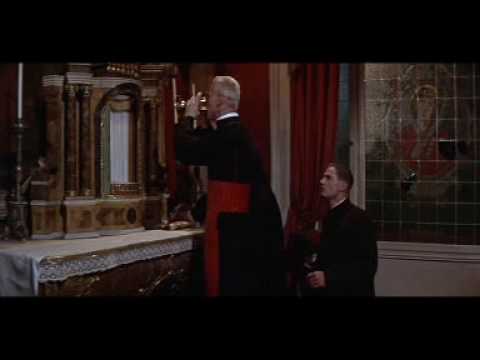
Sticking to movies for a moment, in that classic The Cardinal – which has great liturgical moments – we vicariously relive the horrific riot in October 1938 when a Nazi mob of 5000 stormed the palace of the Cardinal Archbishop of Vienna.  In a rush, the clerics seek to protect the Blessed Sacrament from desecration.  In an entirely un-liturgical way they consume the Hosts, not without reverence.  They were clerics, of course.  But you get the point.

YouTube thumbnailYouTube icon

They purified the vessel, too! How apt.

Firstly, we should all stop and say a prayer for this priest. The disrespect he shows to the Blessed Sacrament and the neglect he demonstrates for his priestly duties may indicate deeper problems. Priests are, every day, under assault from Satan. God’s grace sustains and strengthens us, but temptations are real. Priests are weak human beings. Whether this priest struggles with doubts of faith, laziness, pride – or he was appallingly poorly trained – does not matter: pray for him.

Next, it sounds you have done what should be done.  You asked the priest and found out that he, wrongly, believes the sacristan can purify the sacred vessels. You asked the bishop to institute your as an acolyte, so that you can licitly purify the vessels, and the bishop has not acquiesced. It seems to me that – given the extraordinary circumstances – you can in good conscience care for the sacred vessels and the Blessed Sacrament quietly, unobtrusively, and without fanfare.  Don’t to go about telling everyone that “Father’s not doing his job so I have to step in and do it for him”.  That would be bad for many reasons.

Meanwhile, were you to write a brief, respectful, factual, wholly objective letter to the bishop to explain the situation with a copy of the letter to the Congregation for Divine Worship and Discipline of the Sacraments, it is possible that there could be down the line some movement in this regard.  Be sure of the facts before you write.

And don’t forget to pray for the priest.

Posted in "How To..." - Practical Notes, ASK FATHER Question Box, Liturgy Science Theatre 3000 | Tagged ,
20 Comments

Fulton Sheen on “False Compassion”

A cup of really strong Mystic Monk Coffee can help you to wake up.   This video could have the same effect on liberals (to whom I also recommend Mystic Monk Coffee – eventually – when they convert and are worthy).

He reallay starts revving up at about 7:50.

Posted in "How To..." - Practical Notes, The Drill | Tagged ,
1 Comment

NYC – 28 March – Requiem for a Priest

I received notice that a 1 year anniversary Requiem Mass will be celebrated on Tuesday, 28 March in New York City at the Shrine of Our Lady of Mount Carmel for the late Fr. John E. Halborg.

I met Fr. Halborg only a few times.  He sometimes said Mass at Holy Innocents.  However, I was moved to post about his death last year not just because he, like me, was a convert, but also because of the pretty awful way the living handled his funeral.   They pretty much completely disrespected his clearly written wishes.

So, if you are in the area, please consider attending the Requiem.

In any event, please stop and say a prayer for this priest.  Priests need prayers after their earthly lives, too.

17_03_27_Halborg_Requiem

Posted in ACTION ITEM!, Four Last Things, Mail from priests, PRAYER REQUEST | Tagged ,
1 Comment

ASK FATHER: Hosts brought to altar at Communion, not before consecration

12_08_17_angels_monstranceFrom a reader…

Today at mass, after the priest had completed the Eucharistic Prayer, and we had moved past the Agnus Dei, one of the EMHCs noticed that the Chalices and Ciboriums with unconsecrated hosts (those meant for distribution to those at Mass) had not been placed on the altar.
Instead they had been on a table to the back left of the priest who presumably had no idea they were there (he looked quite shocked when the EMHC went to move them to the altar). They then proceeded to distribute communion as normal with those hosts and chalices that had not been on the altar during the consecration.
My question is: were those hosts consecrated, being behind the priest, and not on the altar? Would it matter whether he knew they were there?
I abstained from receiving lest I receive what was passed off as, but not really, the Blessed Sacrament, but I wondered what I should do.
Also, now that the leftover unconsumed hosts have been placed in the Tabernacle, what do I do if I return to Mass at the same Church. With my knowledge, must I be wary of receiving those possibly unconsecrated hosts, being passed off as the Eucharist? Thank you for your response!

Priests are trained, or ought to be trained, to have the intention, at least the moral intention, to consecrate the elements that are placed on the corporal upon the altar.  Priests have it drilled into them, and they drill it into themselves, that if it is on the corporal, it gets consecrated.  They don’t have to have a specific immediately conscious intention about each and every single host.  A general, or moral intention is adequate.

The practice of priests making a act of intention before they go out to celebrate Mass should be revived.  I warmly urge every priest (and bishop) who reads this to learn the Formula of Intention and even to print it, frame it, and locate it near where you put on your vestments.  There are other good prayers for the priest’s preparation to say Mass, but I think this is the most important and basic.  The Formula can be found in every copy of the traditional Missale Romanum.  I also found it in the Latin 2002 Missale Romanum.  I don’t happen to have to hand an English volume, but I’ll bet a translation is in the appendix.  Here is the text:

Ego volo celebrare Missam, et conficere Corpus et Sanguinem Domini nostri Iesu Christi, iuxta ritum sanctae Romanae Ecclesiae, ad laudem omnipotentis Dei totiusque Curiae triumphantis, ad utilitatem meam totiusque Curiae militantis, pro omnibus, qui se commendaverunt orationibus meis in genere et in specie, et pro felici statu sanctae Romanae Ecclesiae. My purpose is to celebrate Mass and to confect the Body and Blood of our Lord Jesus Christ according to the rite of the holy Roman Church to the praise of almighty God and all the Triumphant Church (in Heaven), for my good and the good of all the Church Militant (on Earth), and for all who have commended themselves to my prayers in general and in particular, and for the favorable state of the holy Roman Church.
Gaudium cum pace, emendationem vitae, spatium verae paenitentiae, gratiam et consolationem Sancti Spiritus, perseverantiam in bonis operibus, tribuat nobis omnipotens et misericors Dominus. Amen May the almighty and merciful Lord grant us joy with peace, amendment of life, room for true repentance, the grace and consolation of the Holy Spirit and perseverance in good works. Amen.

Back to the specific question.

In my opinion, the priest did not validly consecrate the hosts in the ciboria that were left on the credence table.

It might have mattered should he have know about them, remaining on the credence table, but then he ought to have had them brought to the altar.  In your description, you say that he was “quite shocked” when the ciboria were brought up, which indicates that he didn’t know of them and, therefore, didn’t intend to consecrated them.  Hence, they were not consecrated.

It is possible that the priest then spoke the words of consecration over those hosts.  However, even in the context of Mass that’s not good.  A priest mustn’t consecrate one species apart from the other.  What he should have done, in my opinion, is simply explain to the people that the ciboria were left on the table, they were not consecrated and there would not be enough consecrated Hosts for everyone.  He should explain that, yes, they were at Mass because he had consecrated and consumed his Host and Blood from the chalice and that they had fulfilled their obligation and he his obligation to say Mass for the intention offered.  Done.   That could have been a learning experience for many.

However, there is such a mania today that everyone must always go to Communion at every Mass, that Father was psychologically driven to do something else.

If the priest did not consecrate those hosts, and they were distributed, he would have committed a grave sin.  Please, Lord, I hope he didn’t do that.  Furthermore, if he put unconsecrated hosts into the tabernacle then he would cause people – albeit unwittingly – to commit acts of idolatry were they to venerate them.  Please, Lord, I hope he didn’t do that.  And he would sin again, sacrilegiously, by leaving them there and – quod Deus avertat – distributing them at another Mass!  If Father knows for sure which ciboria are in question, he should take steps to correct the situation.

In any event, it is better simply to explain what happened and learn from it than too do something imprudent and, potentially, scandalous.

For your part, I would refrain from receiving Communion for a few days, at least if you see that hosts from the tabernacle are being distributed.  Also, you would not be out of line to contact the priest and ask him about what you saw.  Be calm, respectful, factual, and listen carefully to his explanation.

Posted in "How To..." - Practical Notes, ASK FATHER Question Box, Liturgy Science Theatre 3000, Mail from priests, Priests and Priesthood, Seminarians and Seminaries | Tagged , , ,
14 Comments

1 Year Ago: Mother Angelica, RIP

Today is the 1st anniversary of the death of Rita Antoinette Rizzo, better known as Mother Angelica, the foundress of EWTN and many other initiatives.

May those who carry on with her work not disgrace her memory.

Here is one of the defining moments of her ministry.

It was World Youth Day in Denver.  There was a “stations of the cross” that was , quite frankly, blasphemous.  Mother reacted strongly.

Please, all of you, pray for her. She would love that Masses are offered for her. She would love rosaries.

Posted in Four Last Things | Tagged
10 Comments

Your Sunday Sermon Notes and a ‘Laetare’ Sunday ROSE POLL

17_03_26_Laetare_SMPB_01Was there a good point in the sermon you heard at the Mass to fulfill your Sunday obligation?  Let us know.

For my part, for the TLM this morning, I spoke of the flow of Lent, from Pre-Lent to the Vigil and about how the Church liturgically dies.    For the Novus Ordo, I reviewed necessary elements for making a good confession, including confession of all mortal sins in number and kind and therefore the need to make a daily examination of conscience.  I spoke also about a firm purpose of amendment.  Thereupon, a gave some suggestions for how to establish good habits (making an examination of conscience) and breaking bad habits (willingness to suffer and having a plan for doing something else).

And now, since this is Laetare Sunday, what vestments did you who belong to the Roman Rite see for Mass?  Let’s have a POLL.  Anyone can vote but you have to be registered and approved to use the combox.  For more on the liturgical color rosacea, HERE

For 'Laetare' Sunday 2017, at my Roman Rite Mass I saw...

View Results

17_03_26_Laetare_SMPB_02

Posted in Liturgy Science Theatre 3000, POLLS | Tagged , ,
37 Comments

WDTPRS – Lady Day: The very Feast of the Incarnation

Tanner AnnunciationThis is the very Feast of the Incarnation.

Today we celebrate that moment when our Lord elevated our humanity by taking our human nature into an indestructible bond with His Divinity.

In the Incarnation God opened for us the path to our “divinization”: His sharing of something of His own divine glory with us in the eternal happiness of heaven.

In the sin of our First Parents the whole human race sinned.  In justice, therefore, a human being had to correct the offense.  However, such a correction was entirely impossible for a mere mortal human.  Such a correction required the intervention of one who was both man and God.

In the Incarnation, the Word made flesh – made man – Jesus the Lord and Savior not only begins to save us from our sins in His earthly ministry, but begins also the mysterious revelation of man more fully to himself (cf. GS 22).

Part of the Lord’s mission was also to teach man more fully who He is in the beauty of His own Person.  However, He did not begin to do this only from the beginning of His public ministry.  He began this from the very moment of the Incarnation.

Remember: From the instant of His conception, the Word made flesh begins to teach man more fully who man is.

Light from Light sheds light on the dignity of man, God’s image, from the instant of conception, from man’s humblest beginning.

Here are the Collects for this beautiful Feast of the Annunciation, Lady Day.  Here are the “Opening Prayers” from both the older, traditional, Extraordinary Form of the Roman Rite and the newer, post-Conciliar, Ordinary Form.

You might discuss their differences, their respective strengths.

COLLECT (1962MR):

Deus, qui de beatae Mariae Virginis utero Verbum tuum, Angelo nuntiante, carnem suscipere voluisti: praesta supplicibus tuis; ut, qui vere eam Genetricem Dei credimus, eius apud te intercessionibus adiuvemur.

LITERAL VERSION:

O God, who desired Your Word to take flesh from the womb of the blessed Virgin Mary the angel announcing it: grant to your supplicants; that we who believe truly in the Mother of God, may be helped in Your sight by her intercessions.

COLLECT (2002MR):

Deus, qui Verbum tuum in utero Virginis Mariae
veritatem carnis humanae suscipere voluisti,
concede, quaesumus,
ut, qui Redemptorem nostrum
Deum et hominem confitemur,
ipsius etiam divinae naturae mereamur esse consortes
.

LITERAL VERSION:

O God, who wanted Your Word to take up
the truth of human flesh in the womb of the Virgin Mary,
grant, we beseech,
that we, who confess our Redeemer to be God and man,
may also merit to be the sharers of His divine nature
.

This is of new composition, though there is a reference here to Letter 123 Ad Eudociam Augustam – “De monachis Palaestinis” of St. Pope Leo I, “the Great” (+461).

“Fides enim catholica sicut damnat Nestorum, qui in uno domino nostro Iesu Christo duas ausus est praedicare personas, ita damnat etiam Eutychen cum Dioscoro, qui ab unigenito Deo Verbo negant in utero Virginis matris veritatem carnis humanae susceptam.”

NEW CORRECTED ICEL VERSION:

O God, who willed that your Word
should take on the reality of human flesh
in the womb of the Virgin Mary,
grant, we pray,
that we, who confess our Redeemer to be God and man,
may merit to become partakers even in his divine nature
.

Posted in Liturgy Science Theatre 3000, Our Solitary Boast, WDTPRS | Tagged ,
2 Comments

VIDEO: Card. Burke about the future of the Five Dubia about ‘Amoris laetitia’

At St. Raymond of Penafort Church in Virginia (which if I am not mistaken was built by my my friend Fr. James Gould), another Raymond, Card. Burke, answered a question about the Five Dubia submitted by the Four Cardinals about the infamous objectively murky bits of Amoris laetitia.

The Dubia That Won’t Die.

So far, Pope Francis has not given any clear answer to the Five Dubia, though surrogates (e.g., Card. Schoenborn, Card. Coccopalmerio, et al.) have thrown up smoke screens and misdirections which we were supposed to accept as adequate explanations of the objectively murky bits.  Others have flat out denied that there are any obscurities or ambiguities, which is, of course, absurd.

Yesterday, Card. Burke responded to a question about what might happen if the Holy Father does not provide responses to the Dubia.  There is a video.

The question was, what would the Four Cardinals do if the Pope does not respond to the dubia.

The Cardinal answers that they would have to correct the situation in a manner that draws from the constant teaching of the Church on the issues raised by the dubia, and that this teaching would be made known for the good of souls.

In other words, the Cardinals would issue a public restatement of the constant teaching of the Church in regard to the issues covered by the Five Dubia.  Does this mean all four of the Four Cardinals? Cardinal Burke did not say, at least in the video clip, above.

Play
Posted in One Man & One Woman, Our Catholic Identity | Tagged , , , , , ,
6 Comments