ASK FATHER: Does 4th Commandment apply to in-laws?

From a reader…

I simply cannot find the answer to this anywhere. My understanding is that my father in law and mother in law are my parents under the Catholic Church and therefore the 4th commandment applies to my duties and obligations towards them just as it does towards my natural father and mother. There is a lot of information about a relationship between a brother in law and sister in law being incest, but I can’t find anything where Catholic teaching or Catholic saints write specifically about positive teachings in regards to a Catholic’s obligation towards his in-laws. Or am I wrong in assuming the equivalence between a parent and parent-in-law? If you could kindly point me towards a book or website that may have information about this that I could look up myself, that would be more than enough, but I would be grateful for any information about this topic.

ANSWER FROM Fr. Tim Ferguson (a frequent commentator here): 

The Catechism of the Catholic Church treats of this matter, somewhat, in paragraph 2199. This paragraph says,

“The fourth commandment is addressed expressly to children in their relationship to their father and mother, because this relationship is the most universal. It likewise concerns the ties of kinship between members of the extended family. It requires honor, affection, and gratitude toward elders and ancestors. Finally, it extends to the duties of pupils to teachers, employees to employers, subordinates to leaders, citizens to their country, and to those who administer or govern it. This commandment includes and presupposes the duties of parents, instructors, teachers, leaders, magistrates, those who govern, all who exercise authority over others or over a community of persons.”

While it doesn’t specifically mention in-laws, I think one’s obligation of respect toward them is spelled out in this paragraph.

Further, the Church places before us in Sacred Scripture the Book of Ruth, which tells the story of Ruth, who, after the death of her husband, follows her mother-in-law in the spirit of filial piety and for her fidelity is rewarded with a new husband, with whom she bears the grandfather of King David. The Church Fathers (particularly St. Ambrose, St. Jerome, and Origen) write about Ruth as a model of the Church and as a prefigurement, in the Old Testament, of salvation being offered to the Gentiles.

Lastly, Christ’s own obedience and respect toward his foster father, Joseph, while not in the same category as a father-in-law, gives us an example to follow of showing the respect that is due to all those who are in a position of authority as well as respect to our elders, be they our parents, parents-in-law, foster parents, or other older relations.

The moderation queue is ON.

Posted in "How To..." - Practical Notes, ASK FATHER Question Box, HONORED GUESTS, Mail from priests | Tagged , , ,
9 Comments

Bad news on the “deaconette” front!

fishwrapThis day it seems that the news goes from bad to worse.  You can see what results from the ambiguities of Amoris laetitia.

You have heard, I’m sure, about the quixotic attempts to pry open Holy Orders for women (an impossibility… or is it?) through their admission to ordination to the diaconate.

Unfortunately, I picked this up from that purveyor of bad news, the National Schismatic Reporter (aka Fishwrap), which soon will be scheduling conga line dances in dissident parishes near and far.

Keep in mind, friends, before you slit your wrists, that this is based on rumor.  I want to see the Pope’s decree in black on white.  Meanwhile, because I am trying… trying… to be fair and obedient… I am going to work with this.  My emphases and comments.

Francis decrees: Women to be ordained deacons in the “internal forum”

VATICAN CITY — It has been reported that the special Commission established by Pope Francis to study the question of the ordination of female deacons met last month. A well-placed source disclosed that the Commission, which meets under the aegis of the Congregation for the Doctrine of the Faith, made sufficient progress in March to be able to submit a recommendation to the Holy Father. [It boggles the imagination that they could get any work done this quickly, but… hey!  Stranger things have happened.  Maybe someone came up with a key insight or piece of information.]

According to a report in the Münchener Beobachter, a member of the special papal study group, Petra Henkys-Asmussen, professor of historicity and theology at the University of Immenstedt, revealed [Of course the Commission’s members aren’t supposed to be talking to the press… but I digress…] that the Commission had recommended that women could indeed be ordained deaconesses. [Please, O Lord, return NOW!]

This positive response from the Commission was then studied by the theological experts of the Congregation who, in turn, made their recommendation to the Holy Father for his final judgment.

Pope Francis, it is reported, accepted the Commission’s recommendation, apparently in contradiction to the Congregation’s determination. [I can believe that.  Card. Müller must be going crazy.]

However, the Holy Father determined that, while the ordination of women to the diaconate could, in fact, go forward, it would at first be conferred in the “internal forum”.  [Behold, the fruits of Amoris laetitia!  But… why not?  If penitents who are not really penitents can, according to their own consciences, be admitted to the sacraments of Penance and to the Eucharist, then why not ordination?  More and more people claim that conscience is supreme.]

The Pope sidesteps the question of the ordination of a woman by suggesting that, [NB] if the woman herself, in prayer with Jesus, concluded that she could be ordained, then she can be ordained. This is because conscience is supreme, [SEE?!?] and the Magisterium has not infallibly closed the issue of ordination of women to the diaconate. Bishops, however, [This is where it gets worse… oh yes, they can always hurt us more…] would not be free in the matter.

It is probable, Henkys-Asmussen related, that if women are convinced that they are called to the diaconate, then bishops and priests must abide by their decision or be suspended a divinis, that is, from exercising their ministry.  [Okay, that’s it.  I’m not waiting anymore.  I now declare  that, in my conscience, I am officially an ‘internal forum’ Monsignor.  I’m getting my new gear the next time I am at Gammarelli.]

It is expected that a decree to this effect will be forthcoming once the Congregations for Clergy, Divine Worship and the Doctrine of the Faith have completed the necessary liturgical texts. [Imagine that nightmare.]

Prof. Henkys-Asmussen affirmed that, while this was certainly going to go forward, she expected that the inter-dicasterial preparations between the Congregations might proceed very slowly. [We can only hope.]

“There are many people, mainly men,” she said, “clerics of the Roman Curia of course, who are set firmly against this determination of the Pope to bring the church forward into the light of equality of all genders.” She continued, “It is good news, but they will try to block it.”

When asked about the very unique method of “internal forum” ordination, Henkys-Asmussen declared, “But naturally, this is a compromise path to avoid what some will see as a shock and even ‘scandal’, as they would put it.  But it is a logical bridge from the Pope’s revolutionary post-synodal apostolic exhortation Amoris Laetitia.

Fr Tullio Tomassini, SJ, an instructor of biblical exegesis at the Pontifical Gregorian University and an expert of the Pontifical Theological Commission, which did work on the topic of deacons in 2002, reacted to the news.

“The phrase in the New Testament, ‘Many are called, but few are chosen’, must be reinterpreted in light of history and through the signs of the times.  We, having greater insight now, sense the Christ’s meaning to really have been – if you’ll excuse levity in such a serious matter – ‘many are called, few are chosen, but some push their way in!'”  [Card. Kasper would be proud.]

Tomassini, continued, “When we inter-text that Matthean passage with ‘Go out into the highways and byways and force them to come in’ of Luke 14 we must conclude that the Holy Father discerned the right choice.”

When pressed on the possibility of opening up the ordination of  women to the priesthood as the next step, Tomassini was dismissive.

“In truth”, he said, “the next logical step must be the ordination of the trans-gendered. Now that the Church has made this definitive determination about deaconesses, [HA!] we look more closely at the figure of Phoebe in Romans 16:1. Given the needs of our age, we must ask if the Phoebe of the Bible was really a woman? Or was Phoebe, in fact, a man? What was Phoebe? This is not clear. This biblical ambiguity reminds us that gender itself is not a fixed reality.”  [What did you expect.  He’s a Jesuit biblical scholar, right?]

A well-placed Vatican source, who requested anonymity, reacted to the news saying, “This is obviously what these days in the media is being called ‘fake news'”. He continued, “[A decision] can’t possibly have happened this quickly. But, on the other hand, these days, who can say? What’s the phrase? ‘Who am I to judge’?[The phrase that keeps on giving.]

Cardinal Ludwig Gerhard Müller, Prefect of the Doctrine Congregation, and Greg Burke, the papal spokesman, were unavailable for comment.

The moderation queue is definitely ON.

Due to the highly flammable and dire nature of this story, at first I will let lots of comments stack up in the queue.  In that way I can trim the extreme stuff and keep people from hacking each other to bits.

I’m sure more details about this dreadful turn of events will hit the interwebs soon in force.  In the meantime, pray, keep your head in Lent and…

GO TO CONFESSION!

UPDATE:

For the sake of clarity, one of you readers asked via email:

Fr. Zuhlsdorf,

Could you explain in your post what NB means?

Yes, this is an abbreviation for the Latin phrase “Nota bene“, often also written “N.B.”, which means, “note, heed well”, or else, “pay close attention to what follows”.  It’s pretty standard now in writing in English.  However, this is not one of those medieval abbreviations that everyone who studies paleography has to learn.  It’s more like i.e. for id est, “that is to say”, or e.g. for exempli gratia, “for the sake of an example”), PS or P.S. for “post scriptum”, “after having written… added after having written what is above”, …. etc.

That leads me to digress on et cetera… but it’s a welcome digression, a good distraction from the nasty news above.  Et cetera is, was, sometimes rendered &c.  That & is called an “ampersand”.  It is, in fact, one of those medieval abbreviations, or ligatures (more than one letter or symbol bound together from Latin ligare). As a matter of fact, the symbol goes all the way back to ancient Rome.  The & is a combination, or ligature, of the letters of Latin et, e-t.  It was once, in English anyway, memorized with the entire alphabet, following z.  When the alphabet was recited, upon reaching the “and” symbol, you would say instead, “and, per se, and”.   Per se … i.e…. “by itself”.  And with that, I’ll leave the cetera for another time.

Posted in Deaconettes, Liberals, Lighter fare | Tagged ,
175 Comments

PODCAzT 153: Card. Sarah’s 2017 ‘Summorum Pontificum’ Address – URGENT

17_03_31_CWR_SarahHis Eminence Robert Card. Sarah, Prefect of the CDW, gave an fantastic talk in Germany on the occasion of a colloquium held for the 10th Anniversary of Summorum Pontificum, Benedict’s XVI’s “emancipation proclamation” for the older, traditional form of the Roman Rite.

You can find the exclusive English translation at Catholic World Report.   I warmly urge you to check it out.

This talk by Card. Sarah will be precious tool for renewal of our Catholic identity.

I recommend that you give a copy to every priest you know and that you send one to your bishop and the director of liturgy for your dioceses, with and cheerful note of encouragement, of course.

I was going to post excerpts, but I found myself wanting to post the whole thing.  That wouldn’t do.  Therefore, I contacted CWR and they gave me leave to record it for a podcast.

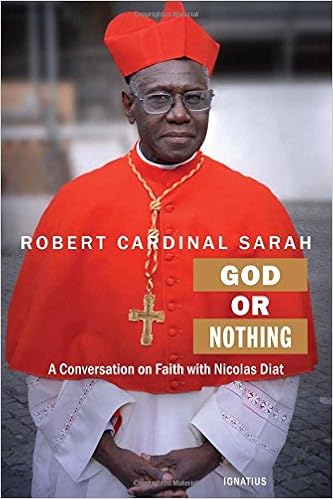
Check out Card. Sarah’s book, now in English,  The Power of Silence: Against the Dictatorship of Noise.

US HERE – UK HERE

And don’t forget also…

US HERE – UK HERE

Posted in ¡Hagan lío!, Hard-Identity Catholicism, Liturgy Science Theatre 3000, Our Catholic Identity, PODCAzT, SUMMORUM PONTIFICUM | Tagged , ,
17 Comments

ASK FATHER: Dispensation or commutation of Mass obligation, penance

ask_father_q_box_title_smFrom a reader…

QUAERITUR:

Can a bishop give the priests under his authority the faculty to dispense or commute a Mass obligation in the confessional? If I was unable to contact my pastor or out of town would I be able to ask for a dispensation or commutation during my confession?

Canon 1245 gives to pastors the right to dispense or commute the obligation of observing Sunday, a Holy Day of obligation, or a day of penance.

Canon 136 clarifies that the exercise of executive power (that’s  what a dispensation is) is valid over one’s subjects. even when they are outside of one’s territory, as well as over travelers who are present in one’s territory.

Many bishops grant this dispensing power to all priests, not just to pastors of parishes.

Hence, if you are looking for a dispensation or commutation, you generally need not look too far.

If you are outside of your parish, or not able to contact your parish priest for whatever reason, you might inquire of another priest.  Ask if he has the faculty to dispense or commute.  Otherwise, you can call the local chancery office and speak to the vicar general (who would have power to dispense), the chancellor (who would either have it or would know who does), or someone in the tribunal (who would usually know who has dispensing power).

This dispensation need not be done in the confessional.  As a matter of fact, dispensations aren’t strictly a matter for the confessional, which is the tribunal of mercy for sin, not for transacting other business like getting dispensations, seeking advice on local restaurants, obtaining sports updates, or engaging in social media commentary such as your thoughts about this blog.

Everyone: When you are in the confessional, stick to making a confession of your own sins. Be brief.

I hope this helps.

Posted in "How To..." - Practical Notes, ASK FATHER Question Box, Canon Law | Tagged , ,
12 Comments

Concerning Jesuit brains

UPDATE 1 April:

I’ve been thinking about this story in light of some current trends in the MSM (mainstream media).

What if….

What if zombies were to eat Jesuit brains?  Would they, too, have significant positive changes?  I can’t imagine that.  Can anything positive come from eating Jesuit brains?  However, once some Jesuits had had their brains eaten, they too would become zombies!  But, and here’s the rub, they wouldn’t have their positive Ignatian retreat brains anymore!   Right?  So, I suppose if they were merely bitten by zombies, and they retained their brains, then they might be happier zombies and wouldn’t need to lurch around looking for intracranial repasts.  They would probably just continue to teach in their schools, write in their publications and, in effect, carry on as before.

____ Originally Published on: Mar 31, 2017

My first reaction after my first glance would be, “That explains a lot.”

Some wag might rewrite this, taking a cue from just the headline.

17_03_31_CH_screenshot_03

I’ll tell you what changes my brain: Mystic Monk Coffee in my Clement XIV Papa Ganganelli mug!

Clement_XVI_Mug_01 Clement_XVI_Mug_02

For all the selections click

>HERE<<

Mystic Monk Coffee!  It’s swell!

Did I mention that Pope Clement suppressed the Jesuits?

Oh, yes… the story is in this week’s print edition of The Catholic Herald, the UK’s best Catholic weekly.

Meanwhile, don’t miss Sandro Magister’s piece today about the theological memorandum sent to the Holy Father about the antics of the present General of the aforementioned Jesuits. HERE  The General, Arturo Sosa Abascal, SJ, uttered some incredible comments a while back which, if taken on face value, gut Christianity of an essential characteristic: Christ.


Posted in ¡Hagan lío!, Lighter fare | Tagged ,
17 Comments

BRICK BY BRICK in CINCY! ORATORY!

I received wonderful Brick By Brick news from Cincinnati.

An Oratory of St. Philip Neri has been officially established at Old St. Mary’s Church.  HERE  and HERE

Screen Shot 2017-03-29 at 20.08.46

Not bad, huh?

Here’s their Mass and Confession schedule.

Screen Shot 2017-03-29 at 20.14.20

Here’s the press release.

This is, of course, delightful news.

Fr. Z kudos to them.   I look forward to my first visit there for a, say, Solemn Mass.

I have a great interest in the Oratory and in their founder, St. Philip Neri, on whose feast I was ordained.  Oratories are springing up as a clear need in the Church.

Posted in Brick by Brick, Just Too Cool, The future and our choices | Tagged ,
24 Comments

Before the ravages of liturgical chaos, before the degradation of our Catholic identity, there was…

cunard_shipI recently had a wonderful meal with two Good Friends close to the cusp of Midtown and Murray Hill.  We enjoyed superb Chinese and had a very Catholic reading during meal.  Rather than post a photo of the food, which I have been known to do on occasion, I’ll share the reading.  After all, for verbivores books are banquets as well.
Good Friend One shared something from an old book he found and had read: Open My Heart:  Travel Sketches By A Pilgrim Priest by Fr. Michael Andrew Chapman.  (Bruce, 1930).

Though Good Friend One read us just a couple of paragraphs, I felt a powerful bond with this priest writer, also a pilgrim in many respects.

Fr. Chapman was the author of the delightful duo – and long longed-after by me, by the way – Peregrinus Gasolinus: Wandering Notes on the Liturgy (1921) and Peregrinus Goes Abroad (1931).  The next time I am in Indianapolis, where Chapman served, I must visit Father’s grave.  He died in 1960, and so, happy, he did not witness the liturgical chaos that so ravaged the Church and the identity of millions, to the great detriment of our entire society and to the enduring degradation of our culture.

The passage that Good Friend One read follows hereafter.  I snapped photos of the pages with my phone’s camera so that I could share the passage with you.   At this point in the tale Father is on an ocean liner, which is how one crossed the Atlantic in those days.   He is about to say Mass for passengers:

I felt quite like a bishop as I vested at the little altar – a breach of ceremonial law which had only necessity to justify it. The Italian style vestments felt a bit strange, and the book and chalice looked very small. And there were no steps to go up and down. But I moved off the rug before the altar, blessed myself and began – Introibo ad altare Dei. Imagine my surprise when practically the entire congregation answered! Ad Deum qui laetificat juventutem meam. Of course, they were Italians, and Latin is a very like their own beautiful language. Besides, practically every Italian lad learns to serve Mass, and in Italy you are more likely to have some old man from the congregation come hobbling up to answer the prayers than to find a boy in cassock and surplice to serve for you.

So the Mass went on, the people sitting or standing, kneeling at the proper time, though even the slight motion of the ship made that difficult and many quite properly excused themselves from kneeling except during the consecration. Surely it was not a distraction when I thought, during a pause in the prayers, how wonderful a creature of God is this Catholic Church of ours, spreading all over the earth, covering even the sea, bringing men and women of every land and tongue to kneel before one common altar. Here was I, an American priest, with the merest smattering of any foreign language, starting on a journey which would take me to several countries, yet quite at home at this altar in mid-ocean, as I would be at every altar in every country I would visit. The same arrangements, the same book, the same prayers, the same ceremonies everywhere, with only such minor and unessential differences as would make the study of the ecclesiastical customs of various places interesting without being distracting. Surely, I thought, no other religion can show such a proof of divinity as this.

Marvelous, no?

Some notes:

  • Priests were/are generally not to vest at an altar.  That is generally reserved for bishops.  However, in circumstances such as those described (and on my private altar, I might add), this is done without harming the cosmic order.
  • He used a Roman vestment rather than the fuller “gothic” style and he was not so familiar with it.  That’s interesting because in the 1920s the Congregation for Rites issued a decree that the fuller style wasn’t to be used except with permission.  I don’t know if, perhaps, permission had been given for these USA.  Maybe one of you readers knows this.  However, if not, then there was a widespread liturgical abuse in the 20s and 30s!  His dictis, that’s one I could live with, just as I will live with the blue vestments for Pontifical Mass we will make.  But I digress.
  • Steps: Catholic altars should have an odd number of steps.
  • He, an American, was surprised by the congregation, presumably mainly Italians responding to the prayers.  In 1930 that was not done very much.
  • Note the lack of concern about people not kneeling or standing because of the ship’s motion.  We have always been practical.
  • And, of course, the main point: universality of practice and identity.  He revels in the bond with those people on the ship.  WE, however, can revel in the same bond with THEM, our forebears.  The Mass I say, is the same as the Mass he said.  That priest and those passengers would be just as “at home” in the parish church where I said Mass on Sunday.  That isn’t the case with the Novus Ordo… anywhere.  Would that more priests would, wake up to this point and claim their patrimony for themselves and for their flocks!

Two more notes.

I think it would be a great experience to cross on a ship someday.

Sometimes, when I have to transcribe longer passages, I use a program called Dragon Naturally Speaking.  US HERE – UK HERE  It is of enormous help when I am dealing with long passages or I am translating on the fly.  I’ve learned to regulate my speech so that it picks up and recognizes what I say with very few errors.  That works, of course, until I have to read something in another language embedded in the English text.  When I came to the moment the priest in the story spoke the Latin of the prayers at the foot of the altar, the program heard me say:

Intro evil on alt.a day odd dayroom belatedly cut you’ve into 10 Mayon.

I wonder if that’s how ICEL did some of their work?  In conjunction with Google Translate, perhaps?

Posted in Hard-Identity Catholicism, Just Too Cool, Liturgy Science Theatre 3000, Our Catholic Identity, Priests and Priesthood | Tagged ,
13 Comments

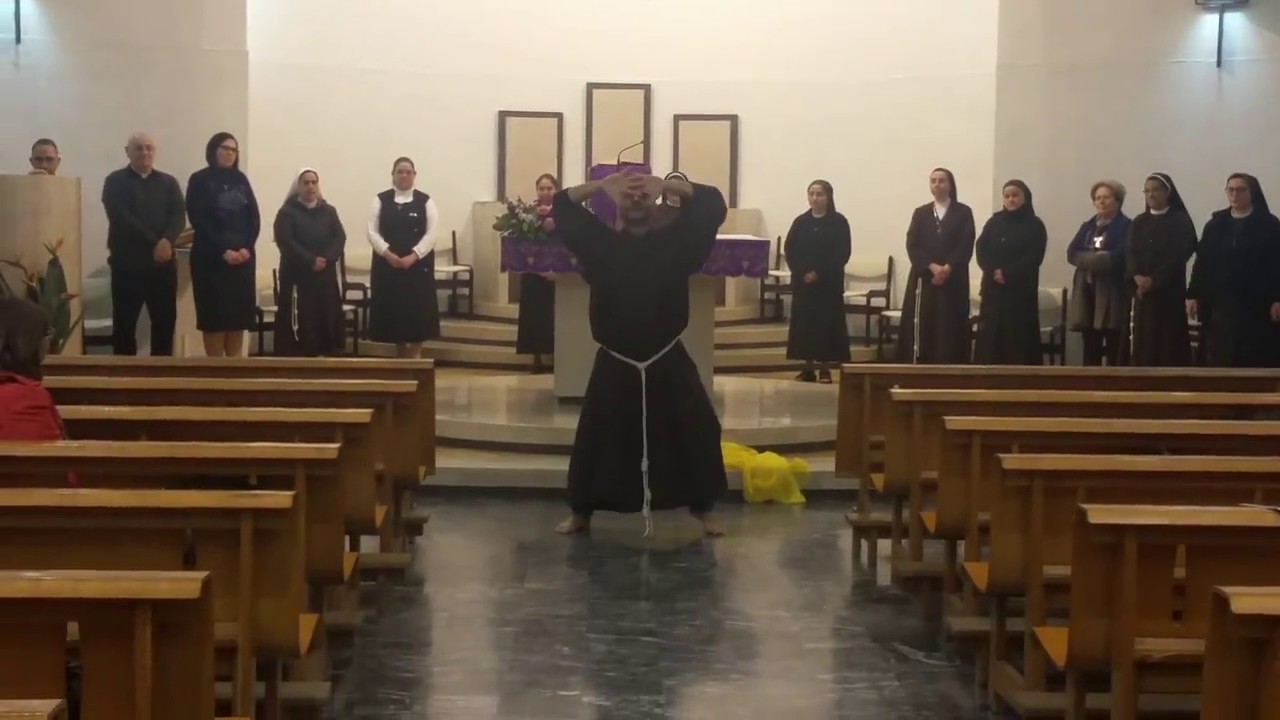
Franciscan. “Dancing”. Fail.

This …. fellow… jumped around in a church like a testosterone impoverished squirrel to the words “credo negli essere umani… I believe in human beings”.

Fail.

I’d also like to point out that this is a Franciscan and not a rather-more-expected Jesuit. Surely not all Franciscans have this… proclivity! Please, tell us it isn’t so!

To you good, sensible Franciscans out there, can’t you do something about guys like this? Among yourselves?

Dear readers, if your priest does this sort of thing, or anything like it, subdue him with a net, medicate him, place him in restraints, and have him assessed by a trustworthy professional.

YouTube thumbnailYouTube icon

UPDATE:

On further reflection, do you suppose that this was an audition video for the LA Religious Ed Conference (aka Three Days of Darkness)?  It has many of the qualities the organizers and choreographers must crave.

Posted in Lighter fare, You must be joking! | Tagged
66 Comments

UPDATE: White Pontifical Vestments Project


UPDATE 29 March: Progress

I received photos from Gammarelli.  They are cutting the fabric.

Fr. Zuhlsdorf 1 17_03_29_white_cutting_0 17_03_29_white_cutting_02 17_03_29_white_cutting_03 17_03_29_white_cutting_04 17_03_29_white_cutting_05

And so the process has started!

UPDATE 14 Feb: The next phrase

I just finished, with the help of the Vocations Director and his assistant, the unfurling, cutting, and folding of the last bolt of fabric that remained here in The Cupboard Under The Stairs.  As you may remember, I sent a huge amount to Rome through the kind intermediary of a seminarian.  This batch is going with the VD on his way to visit our guys at the NAC.

This means that Gammarelli will now have plenty of fabric to work with, even to make all the extra chasubles and dalmatics for ordinations, etc: an additional 23m!

Many thanks to all of you who contributed money to this Vestment Project!

Don’t worry… I’ll be back for more!

We still have to make sets in black and rose… and the famous blue.  The vestments in those sets won’t be as numerous, however.

You can still make tax deductible donations at any time!  Mail your large, generous checks to us (or to me!):

Tridentine Mass Society of Madison
733 Struck St.
PO BOX 44603
Madison, WI 53744-4603

UPDATE 24 Jan:  We are making progress.

I’ve exchanged email with Gammarelli.  I told them to GO AHEAD and to begin making the vestments!

I hope to receive even more donations so that we can have matching copes made for the servers who bear the instruments for the bishop (miter, bugia, etc.).  We could then use these copes for Solemn Vespers, etc.

ALSO: I am thinking about having two over-sized dalmatics made. XL.  That can give us more flexibility about whom we can vest.  So… kick in some cash!

A priest friend is going to Rome in February and he will deliver another large quantity of the same white fabric.  Hopefully we will be able to make additional chasubles and dalmatics for ordinations.  We saved a lot of money by providing our own fabric.

Click HERE to make a (generous) tax deductible donation to this project.

The Tridentine Mass Society of the Diocese of Madison is a 501(c)(3) charitable organization.

We will have the coat of arms of the Diocese embroidered on the dalmatics and cope.  Bp. Morlino’s (aka The Extraordinary Ordinary) coat of arms will be on the chasuble.  And, yes, I will have a chasuble made for myself with my arms.

Because the diocesan arms will go on the dalmatics, I may have them made all as dalmatics including stoles for each one so that they could be used for ordinations to the diaconate.  Maybe… maybe…  Otherwise, I would have 3 dalmatics made and 2 tunics, but with one diaconal stole only.  And, of course, the maniples.

Once again, we will get everything, down to the last bit: gremial, antependium, extra trim so we can make tabernacle veils (for Solemn Masses), buskins, gloves, the works.

I have a big Pelican case for transporting an entire set for when we need to take it on the road, as it were.  It’s heavy, but super tough and water proof.  Here it is filled with the red set.

What sorts of things are we doing?

Here are a few shots.

In the future I want to have made a full set in ROSE.  I suspect there aren’t make of those around.  Also, we have a black set, but it is less than optimal.  I very much want to replace it.  This last year we used it twice, once for All Souls and once for the Requiem of a wonderful priest.  There will be more opportunities in the future to donate.  But NOW is a really good time!

How do we fight against confusion and eroding Catholic identity here?  Beauty.  Fidelity to the Church’s teaching.  Worthy sacred liturgical worship.

Posted in ¡Hagan lío!, "How To..." - Practical Notes, ACTION ITEM!, Hard-Identity Catholicism | Tagged , ,
7 Comments

UPDATE: Card. Sarah’s book – The Power of Silence: Against the Dictatorship of Noise

There’s goes my reading schedule!

My copy in English of Robert Card. Sarah’s book, The Power of Silence: Against the Dictatorship of Noise, arrived today.

US HERE – UK HERE

This is the translation of  Le Force du Silence, hitherto only in French, is as I write available to PRE-ORDER in ENGLISH. It will be released on 15 April (Holy Saturday).  A great Eastertide reading gift to yourselves or friends.


The original French, if you prefer…

US HERE – UK HERE

And if you haven’t read it yet…

US HERE – UK HERE

May I suggest that you give Card. Sarah’s books to your priests?

Posted in REVIEWS | Tagged ,
7 Comments