ASK FATHER: Varia concerning today’s problems in the Church

Since I am on the road and busy with many times, but since these are pressing issues, allow me to respond, but collectively.

From readers…

QUAERITUR:

Given the rate things are going for this current pontificate, would it be sinful to pray that, if it be God’s will, that the pope either abdicates or dies and a new pope of a more conservative leaning is elected?

I get this often.

No.  It is not necessarily sinful to pray for the end of a pontificate, one way or another.

However, it depends on why and on your attitude.  I urge people not to have hate in their hearts for the person of the Holy Father.  He deserves our prayers.  That doesn’t mean that we have to like him or what he does.  We do NOT worship the Pope.  Popes come and go.  In our prayers, we can, without sinning, discuss with God about His time table.

QUAERITUR:

What are we to do if they reverse the English translation and go back to the other one?  That was so bad.  I can’t go back.  I just can’t.

In the news lately we have gotten signals that a “study” will be undertaken of translations and of the norms of Liturgiam authenticam.   Keep in mind that no translation is perfect.  We are using human language to convey pretty deep things.

I don’t think that any of the powers that be would attempt simply to reverse the implementation of the current ICEL translation.  I suspect that their first (and vicious) attack will be on the rendering of pro multis back to “for all”.  That’s because they a) don’t give that damn that that’s not what pro multis means and b) they don’t believe that there are those who are not saved.

What I think might happen is that they will make various translations “options” which priests can choose from.  That is, after all, what the Novus Ordo is: a rite filled with lots of options.

In any event, if they go down this road, and right now I don’t see anything preventing it, I think it might get pretty ugly.

And they won’t stop there.  Once these dogs are off the leash, they’ll bay and chase down anything that has even the faintest scent of tradition.  Mark my words.   They will be vicious.  They are liberals, after all.  Agere sequitur esse.

QUAERITUR:

The more news I learn about what is happening in Rome and what our Holy Father is doing, the more I teeter on the brink of despair for the future of the Church. I want to believe that Hell cannot prevail against the Church, as Our Lord promised, but it is getting very hard to do so. Some days, I simply want to give up.

Has there ever been a time like this one? What might I do to avoid giving in wholly to despair?

Buck up.  We have magnificent spiritual tools and weapons. And… you are not alone.

You might spend some time reading about the lives of martyrs in different periods of the Church’s long and sometimes bloody history.  Many of them went to their death with joy.  The martyrs are given to us as examples.  They are witnesses.

Also, if what you are reading causes serious anxiety and spiritual suffering, you might consider spending less time reading about current Church news.  If what the Holy Father is doing is causing you great anger or anxiety… ignore him.  Stick to your regular routine of daily prayers.  Perform concrete works of mercy.  Go to Mass.  GO TO CONFESSION!   Ignore the Pope and bishops, except for to pray for them… from afar.

Everyone, close ranks, clean your own houses, sacrifice.

Remember that this is an “ASK FATHER” entry.

The moderation queue is ON.
Posted in "How To..." - Practical Notes, ASK FATHER Question Box |
29 Comments

ASK FATHER: Can the Novus Ordo be “ad orientem”, in Latin, with Deacons?

From a reader…

QUAERITUR:

Can a Novus Ordo be ad orientem with Latin, chant, a subdeacon and deacon in traditional vestments?

Not only can the Novus Ordo be celebrated ad orientem, it ought to be.  The rubrics indicate that this is the standard, the norm.  The Roman Church’s tradition calls for it.  Permission is not necessary.  It can’t be forbidden.

Not only can the Novus Ordo be celebrated in Latin, it ought to be.  Latin is the language of the Latin Church.  The official books are in Latin.  The Second Vatican Council called for Latin to be preserved.  The Church’s sacred music is in Latin. Canon Law puts Latin in the first place for the language of Holy Mass.  Permission is not necessary.  It can’t be forbidden.

Not only can the Novus Ordo be celebrated with deacons, it ought to be.  Deacons have a proper liturgical role.  I’ll leave aside for now the issue of a subdeacon, which is complicated as far as the Novus Ordo is concerned.

My home parish in St Paul, St. Agnes, always had Mass ad orientem, in Latin, with deacons, one taking the role of reading the Gospel, and the other being at the altar near the priest.  So, they swapped roles of deacon and subdeacon, but they were both deacons, properly vested in dalmatics.  Yes, this can be done.

Keep in mind that the paradigm for Mass is not the quiet “Low Mass”.  Rather, it is the Pontifical and the Solemn Mass that are the paradigm. So, deacons aren’t “add ons”.  They are desired in the Roman Rite.

Where there are deacons, permanent or transitional, they should be warmly prompted to serve in their proper roles, in their proper vestments.  That means that parishes with deacons shouldn’t vest just one, but two!  They should have matching vestments with the priest!   C’mon!

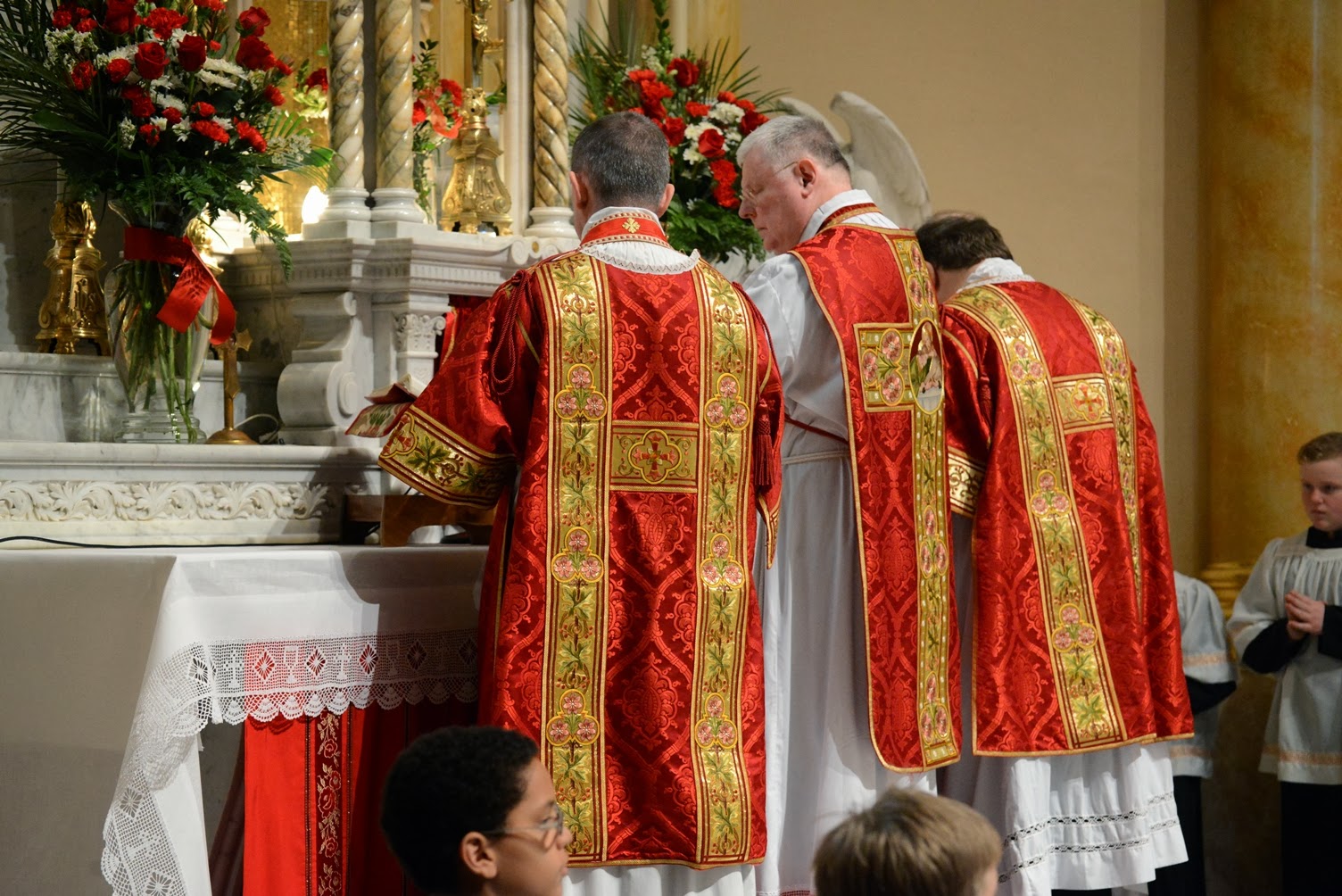
Here is a shot of Fr. Philips of the Canons of St. John Cantius saying Mass at St. Agnes as a visiting celebrant.  NB: Deacons.

Posted in "How To..." - Practical Notes, ASK FATHER Question Box, Liturgy Science Theatre 3000 | Tagged , , ,
11 Comments

The liturgical attack begins

We saw this coming, didn’t we?  There was the appointment of new consultors to the CDW.

From Amerika:

Pope Francis has ordered a review of the new Mass translation

Pope Francis has ordered a review of “Liturgiam Authenticam,” the controversial decree behind the most recent translations of liturgical texts from Latin into English and other languages. The commission, established by the pope just before Christmas, is also tasked with examining what level of decentralization is desirable in the church on matters such as this.

[…]

What’s next?

I think we know.

Posted in SESSIUNCULA |
128 Comments

Washington DC 27 Jan – Annual Mass in honor of Nellie Gray

I was sent this information. Those of you who are in Washington DC for the March for Life will not want to miss this.  It was sent only on a PDF which means it is a mess to transfer here, but here goes…

FIFTH ANNUAL MASS
FOR REMEMBRANCE AND REPOSE OF THE SOUL
OF NELLIE JANE GRAY

Saint Mary Mother of God Catholic Church Washington, DC
5th & H St. NW
Washington, DC
3:00 PM
January 27, 2017
44th Annual March for Life

Celebrant – Rev. Paul D. Scalia, S.T.D., M.A.

Vox in Rama Choir, Church of the Holy Innocents, New York City Kirsten d’Aquino, Organist and Director; Guest Conductor, Art Bryan Manabat; Joined by St. Mary’s Schola, Richard Rice, Dir.

Prelude – Lully Lulla Lullay, Philip W J Stopford (1977- )
Processional – Antiphon II – Laeva ejus sub capite meo, The Song of Solomon 2:6, from Vêpres du Commun des Fêtes de la Sainte Vierge, opus 18, aka Fifteen pieces, Marcel Dupré (1886-1971)
Propers – Gregorian Chant – Mass: Ex ore infantum, Mass of the Holy Innocents, Martyrs, 2nd Class Votive Mass
Ordinary – Messe breve aux Chapelles no.7, Charles Gounod (1818-1893)
Offertory Motet – Flos de Radice Jesse, Michael Praetorius (1571- 1621)
Communion Motet – T antum Ergo, Cesar Franck, Art Bryan Manabat, Baritone Soloist
Ave Maria, Franz Biebl (1906-2001)
Recessional – Fugue sur le thème du Carillon des heures de la Cathédrale de Soissons, Maurice Duruflé (1902-1986)

Posted in SESSIUNCULA |
4 Comments

Can 7th c. Pope Honorius I teach us about “Amoris laetitia” controversy?

7th c. mosaic of Pope Honorius I (625-638), in Basilica Sant’Agnese fuori le mura, Rome

7th c. mosaic of Pope Honorius I (625-638), in Basilica Sant’Agnese fuori le mura, Rome

These days it seems like we are “all Amoris laetitia all the time”. That’s because the document has stirred great confusion. The confusion has resulted even in contrary interpretation on the part of conferences of bishops, no less, about whether people who are committing objectively grave mortal sins can, without firm purposes of amendment, be admitted to Holy Communion. It is no wonder that confusion rises, since it concerns something taught by Our Lord Himself and which is confirmed in the Deposit of Faith through the centuries to our own day.

As controversy grows, so do pleas for clear explanations.

We have a long history in this our Church. We have been around the block. The experiences of our forebears ought to instruct us, who are coping with confusing circumstances.

Was it Edmund Burke who said that those who don’t know history are doomed to repeat it? It might have been George Satayana. Could be that we are repeating now, something that we have been through before?

Look at the increasingly valuable Crisis, where Fr. Regis Scanlon, OFM Cap, has a useful study of a time of confusion resulting both from a Pope’s teaching and – this is key – that same Pope’s refusal to clarify what he meant when he was urgently asked to do so.

Here are some samples so you can get the drift of it.  My emphases and comments:

What History May Tell Us About Amoris Laetitia

[…]

[A] similar situation of great confusion happened 1,500 years ago during the papal reign of Honorius I (625-638).

[…]

Honorius was pressured to react to a popular heresy Monothelitism, which held that Jesus Christ possessed only one will naturally. But the Church teaches that Jesus Christ has two inseparable but distinct wills or two distinct operations naturally. However, the Church also teaches there is only one will and one operation in Christ morally. In other words, there is no opposition between the two wills and two operations in Christ.

Although Honorius believed the Church’s true teaching, he wanted to avoid trouble in the Church and offending the Monothelitites, one of whom was the Emperor Heraclius. Similar to today, bishops wanted clarification, but Honorius counseled silence. He advised bishop Sergius saying:

That our Lord Jesus Christ, the Son and Word of God, by whom all things were made, is Himself one, operating divine and human things, the sacred writings plainly show. Whether, however, on account of the works of the Humanity and Divinity, one or two operations ought to be proclaimed and understood, these things do not belong to us; let us leave them to the grammarians, who are accustomed to display to the young their choice derivations of words…. [Sounds rather familiar in style, no?] We exhort your Fraternity to preach with us, as we do with one mind with you, in orthodox faith and Catholic unity,—avoiding the use of the introduced terms, one or two operations—that there is one Lord Jesus Christ, the Son of the Living God, most true God in two Natures, operating divinely and humanly.

Note that the Pope said, “…these things do not belong to us; let us leave them to the grammarians…” The Pope thought that the truth was plain enough and the Church didn’t need to clarify it further with terms, like two operations and two wills.

About 40 years after Honorius died, however, the Sixth General Church Council condemned the fact that Honorius had remained silent. Pope Leo II, [St. Leo II] the successor to Pope Agatho, accepted this condemnation with some qualification. In his confirmatory epistle sent to Constantine Pogonatus, Leo II stated:

We also anathematize the inventors of the new error, that is, Theodore, bishop of Pharan, Cyrus of Alexandria, Sergius, Pyrrhus, Paul, and Peter, ensnarers, rather than guides, of the church of Constantinople; and also Honorius, who did not illumine this Apostolic Church with the doctrine of the Apostolic tradition, but allowed it, while immaculate, to be stained by profane betrayal.

And, in his epistle to the bishops of Spain, Pope Leo II also stated:

Those, however, who contended against the purity of Apostolic doctrine, departing, have indeed been visited with eternal condemnation; that is, Theodore of Pharan, Cyrus of Alexandria, Sergius, Pyrrhus, Paul, and Peter, Constantinopolitans; with Honorius who did not extinguish the incipient flame of heretical dogma, as befitted Apostolic authority, but, by neglect, nourished it.

Therefore, Honorius’s decision was condemned—not because he actively preached falsehood or heresy—but because he “neglected” teaching the truth. As Pope Leo II pointed out, even during the silence of Honorius, the apostolic tradition and teaching remained untouched and “immaculate.”

This ancient case helps us to relate to Amoris Laetitia. After all, Pope Francis has remained silent, apparently allowing his bishops to judge the meaning of the document for themselves without his help in the face of calls for clarity amidst confusion and anguish. Actually, while Honorius’s silence affected the doctrine of the faith (theory), Pope Francis’ actions are even more serious since his silence pertains to moral acts (practice) which more directly and rapidly affect the people.

[…]

So, why does Pope Francis remain silent?

As of today, we do not know, and this is why we must be careful. While we can advise, plead, and complain to the pope (like St. Catherine Siena) about his actions and lack of action, we cannot officially judge him. Only a pope can judge a pope, which is not the same thing as fellow archbishops and cardinals exercising their authority to correct false statements. Pope Francis and his Amoris Laetitia will certainly be judged by a later pope. Will he receive a better judgment than Honorius? Only God knows. But we do not know everything. There may be reasons unknown to us why Pope Francis is refusing to settle the dispute. And, when all is said and done, he may receive a better and more favorable judgment from future popes than Honorius received.

[…]

Scanlon also gives a good explanation of how seriously wrong the Bishops of Malta are in their document about how to implement Amoris laetitia Chapter 8.

We all suffer from the effects of Original Sin.  Our intellects and wills are weakened.  However, we have the help of both authority (the teaching of the Church, the lessons of the past, etc) and of grace, procured through humble prayers.

Pray.  Study and pray.

Comment moderation is ON.

Posted in Francis, One Man & One Woman, The Drill | Tagged , , , ,
25 Comments

SCV v. SMOM – Just one front, but a telling one.

17_01_01_SCV_SMOMYet more SCV – SMOM reactions (for those of you in Columbia Heights, Stato Città Vaticano v Sovereign Military Order of the Knights of Malta).

Damian Thompson wrote at The Spectator about SCV v SMOM HERE.  He strongly underscored the obvious point that this is virtually an annexation of one country by another.  Both SCV and SMOM are sovereign states… the size of the states doesn’t change that fact.

Against Damian, at The Spectator there is now a riposte by one Jeremy Norman. HERE  Norman argues, as the title indicates, that “The Knights of Malta must understand that they are a religious order – not a country”. Well… quite simply, No. They don’t have to be understood that way.

Yesterday I wrote:

Moreover, as I have been instructed, article 6 of the constitution of the SMOM says that the Sovereign Council alone accepts or rejects the resignation of the Grand Master.

In fact, the Pope is informed only by the Council, for validity of the acceptance or rejection of the resignation. The Pope does not accept the resignation.

In addition, the SMOM’s Constitution does not foresee a “pontifical delegate”. There is no such critter in the life of the SMOM. There is a pontifical delegate in canon law for religious institutes. But, though there are aspect of the religious life to the SMOM, the SMOM is not a religious institute. SMOM is a sovereign nation.

Norman writes:

The Pope should go further and demonstrate his liberal credentials by taking firm action to reform this archaic backwater of the church; it represents the church of old and not the modernity he espouses. A light should be shone into the secret finances and workings of this archaic institution.The Order and its Grand Master must understand that they are a charitable religious order not a country. If they fail to grasp this, they have no meaning in 21st C. They are as Festing now admits, like all Roman Catholics, subject to the ultimate authority of the Holy See.

The Order, having bent its knee, must now drop its claim to nationhood and come clean about its sources of finance. History moves on and so should the Knights of Malta.

My friend Gregory DiPippo quipped: “the author wallows in ignorance like a pig in a sty.”

So you see how this is shaking out?

Consider something else I wrote a while back, about the plural of anecdote being “data”.  HERE  There is an uptick in priests being persecuted by bishops for being conservative, in seminarians being pressed because of the same, of traditional liturgy being repressed, etc.   Soon attacks will come on the language of vernacular rites.  In finem citius.  Motus in fine velocior.

Pò sì jiù!

Posted in Liberals, Pò sì jiù |
26 Comments

CONFLICT! ESCALATION! FORCES MASSING! Will there NEVER be PEACE?

The two smallest nations on earth have squared off: the Vatican City State and the Sovereign Military Order of the Knights of Malta.   I understand that San Marino may be readying for its own move.
The often amusing Eye of the Tiber offers this:

Tensions have escalated between conservative and liberal Catholics today as Knights of Columbus members amassed on Malta’s border, which was recently annexed by the Vatican. [Oh the humanity!  To have these mighty forces in such close contact… this is going to get out of hand!]
Maltese U.N. Ambassador Marcallino Galea told EOTT this morning that the Knights of Columbus had amassed more than 40,000 knights on the border of Malta.
“These numbers may reflect some very bad intentions and this is the last thing we would like to happen,” Galea said. “Our hope is that the Vatican will come to its senses and that they will come to understand that they cannot continue order us around and to tell us where we can or cannot park in our own parishes.”
Pope Francis has pledged to take counter-measures against Malta, which he accused of sending saboteurs into the Vatican to carry out liturgical-terrorist acts in which priests say the Latin Mass in Rome. [Typical lib fear-mongering.]
Pro-Vatican separatists have been fighting near Malta’s border for months now, with hundreds of Maltese civilian casualties from shelling, mines, and tickling people to death with fluffy ostrich plumes from their stupid hats.
“Casualties are horrific, yes, but what is worse than death is that they are infiltrating our churches and nagging parishioners about becoming members of the Knights of Columbus. They are torturing innocent bystanders by continually reiterating how good their life insurance policy is. Please send help.”

Posted in Lighter fare | Tagged , , ,
6 Comments

PETITION: Gathering signatures to thank Pres. Trump for DEFUNDING Planned Parenthood

Pres. Trump has made YHUGE moves against Big Business Abortion, especially Planned Parenthood.  It’s gonna be beautiful.  Believe me.

There is a “petition” you can sign to say “Thank you!” for cutting off tax payers’ dollar for Big Business Abortion, Planned Parenthood.

HERE

Posted in Emanations from Penumbras, Just Too Cool, The Campus Telephone Pole | Tagged , ,
24 Comments

BOOK: Nothing Superfluous: An Explanation of the Symbolism of the Rite of St. Gregory the Great

It is sometimes observed that elements of the Roman Rite, both traditional and revised, accrued as if my accident.  Liberals contemptuously squint at gestures (especially the reverent ones) as if they were barnacles on the hull of a ship that should be scraped off.   These medieval accretions don’t really offer anything important.

They misunderstand … well… a lot.

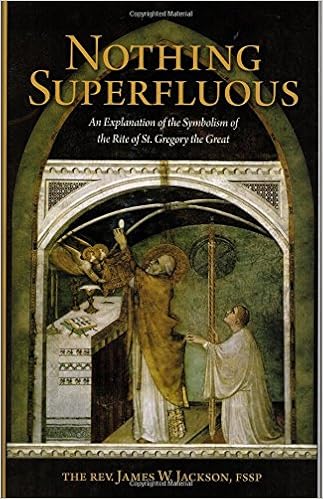
I bring to the attention of the readership an intriguing book by Fr. James W. Jackson, a priest of the FSSP Nothing Superfluous: An Explanation of the Symbolism of the Rite of St. Gregory the Great US HERE UK HERE

These days there are several ways in use to refer to the traditional form of the Roman Rite.  Variously, we hear Extraordinary Form, Usus Antiquior, Gregorian Rite, Pian Rite, etc.

Fr. Jackson addresses the fact that, yes, many elements crept into our rites over time and, yes, on the surface it seems that they got in there by accident or habit.  However, they are not superfluous.  They mean something.  They have their own beauty and impact.  Considered together, they communicate something important.

Jackson goes through the Mass and comments on the particulars.  I found quite interesting his brief presentation of St. Charles Borromeo’s ideas about church architecture, what a church should have and look like and, hence, what a Church means.

Seminarians would benefit from this book, as would priests.

Fathers, learn the traditional Roman Rite.  You will accrue to yourselves a deeper understanding of who you are as a priest at the altar.   The very fact that antinomian liberals, squishy on doctrine, hate the older form of Holy Mass is reason enough to embrace it and make it your own.  It stands like a bastion against their hateful iconclasm and murky notions of priesthood and Church.

Posted in SESSIUNCULA | Tagged , , ,
5 Comments

WDTPRS – Conversion of St. Paul: Comparison 1962MR & 2002MR Collects

In honor of the Apostle to the Gentiles let us make a rapid comparison of the Collects for today’s feast of the Conversion of St. Paul.


We’ll look first at the 1962 Missale Romanum and then the 2002 edition.

The Collect is nearly the same in both.

COLLECT (1962MR):

Deus, qui universum mundum beati Pauli Apostoli praedicatione docuisti: da nobis, quaesumus; ut, qui eius hodie Conversionem colimus, per eius exempla gradiamur.

This prayer is ancient.  It is found already in the 8th century Liber sacramentorum Engolismensis (Angoulême) and the 9th century Augustodunensis (Autun) as well as the Liber sacramentorum Romanae ecclesiae ordine excarpsus, but with the variation in the Engolismensis multitidinem gentium” in place of “universum mundum”.

Our precious Lewis & Short Latin Dictionary (UK HERE) informs us that the deponent verb gradior is “to take steps, to step, walk, go;” and in ecclesiastical Latin “of the conduct of life, to walk, live, conduct one’s self”.  The French source for liturgical Latin I call Blaise/Dumas (UK HERE) indicates that gradior is “to behave oneself”.

An exemplum is, “a sample for imitation, instruction, proof, a pattern, model, original, example….”

For the Fathers, so steeped in Greek and Roman rhetoric and philosophy, exemplum could mean many things.  First, an exemplum brings auctoritas to your argument, “authority”, inter alia the moral, persuasive force of an argument.  When we hear this prayer with ancient, Patristic ears, exemplum is not merely an “example” to imitate. It brings deeper moral force.  The historic event of Paul’s conversion is a reason for hope. It is an incitement to lead the kind of life which will lead ultimately to being raised up after the Risen Christ, the perfect exemplum.  The core of this exemplum is St. Paul’s response to the call of the Lord to turn his life around, his conversio or in Greek metánoia.

I especially like the word gradior in this prayer.  It invokes the image of St. Paul trudging the byways (without a horse off of which to fall).

LITERAL VERSION:

O God, who instructed the whole world by the preaching of the Blessed Apostle Paul: grant us, we beseech You, that, we who are today honoring his Conversion, may walk according to his examples.

Many (many many) of the prayers of the pre-Conciliar form of the Missale Romanum, were cut up and changed for the Novus Ordo, if they made the cut at all. Today’s prayer is a case in point.

COLLECT (2002MR):

Deus, qui universum mundum
beati Pauli Apostoli praedicatione docuisti,
da nobis, quaesumus,
ut, cuius conversionem hodie celebramus,
per eius ad te exempla gradientes,
tuae simus mundo testes veritatis.

LITERAL VERSION:

O God, who instructed the whole world
by the preaching of the Blessed Apostle Paul:
grant us, we beseech You,
that we, walking in life toward You according to the examples of him
whose conversion we are celebrating today,
may be witnesses of Your truth in the world.

Some may argue that the newer Latin version makes the point of “witness” more clearly.

I am not convinced the ancient prayer needed these “improvements”.  Are you?  Were these improvements?  Did the prayer really changing?  Did the good the Catholic faithful really call for that?

Posted in Liturgy Science Theatre 3000, WDTPRS | Tagged , ,
12 Comments






















