All Hallows Eve: Doing it right!

A few years back a reader sent:

Given that Halloween is a contraction of All Hallows Eve, and given that “hallows” are “saints”, and given that All Hallows Eve means, therefore, the Eve of the Feast of All Saints, it seems right that children (and others) might dress as saints for their Halloween rather than, you know, awful things.  That doesn’t mean that only saints are allowed, but… it’s All Saints Eve, for crying out loud.

This image stirred spirited comments the last time.

Posted in Be The Maquis, Our Catholic Identity, Saints: Stories & Symbols | Tagged ,
20 Comments

The Lord’s burial place opened for restoration and study

This is for your Just Too Cool file and for your November viewing calendar.

In the Church of the Holy Sepulcher in Jerusalem, the Aedicule, or structure around the niche carved into the rock that served as Christ’s resting place in the tomb is being overhauled.  Part of the process was to remove marble slabs that for centuries have covered the actual rock shelf.  National Geographic was there to document the work.  There will be a show on it in November.

More from National Geographic, including a video HERE.

Posted in Just Too Cool | Tagged ,
9 Comments

ACTION ITEM: Benedictine Monks of Norcia – affected again, badly, by new earthquakes

action-item-buttonUPDATE:

A reader sent email:

Wednesday Oct 26, according to my Theosis devotional (from Eastern Christian Publications in Virginia) is the Commemoration of the Great and Fearful Earthquake, Constantinople, 740.
For what it’s worth.

___

Last night, 26 Oct, I felt in Rome, the new series of earthquake.

From the Monks of Norcia.

Take care to read down to the part about Archbishop Sample of Portland saying Holy Mass there in Norcia when the quakes hit.

Dear friends,

I am hesitant to implore you all again for prayers and support. In the midst of so much suffering, one cannot help but feel a kind of embarrassment to invite your attention to our situation so soon after the first series of earthquakes in August. Since then, we monks have been trying to determine God’s will for our lives and community. Perhaps, at least for us, this second quake is God yelling even louder His will for our lives. We pray for understanding.

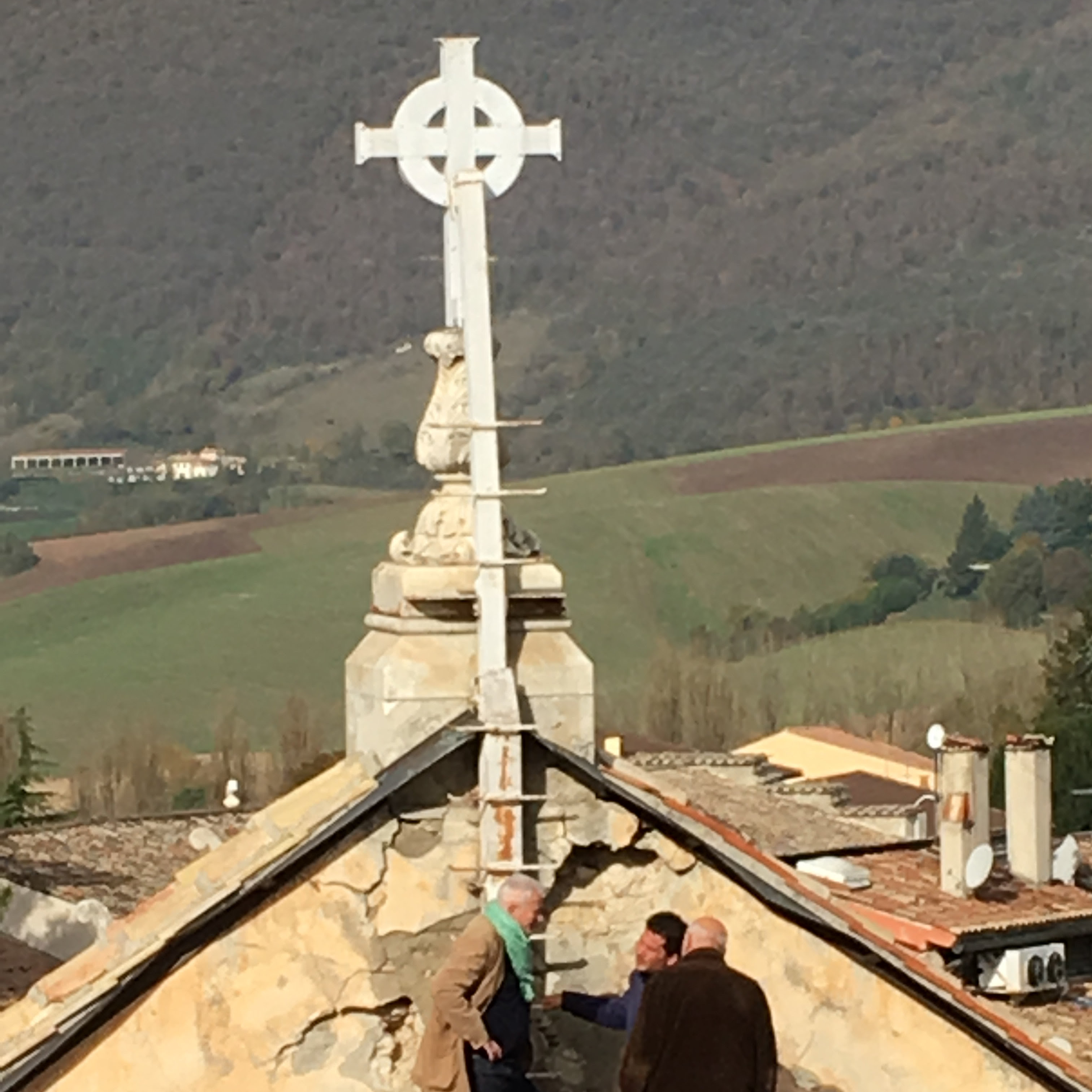
Over the past 24 hours, a powerful series of earthquakes passed through Norcia, once again graciously sparing the lives of the monks and inhabitants to Norcia. Unfortunately, however, it has brought many of the townspeople to the brink of despair and more damage than any of us can yet assess. As before, we are busy at work trying to respond to the crisis on multiple levels. Therefore, my time is short to update all of you, even though you each have found so much time to support us through your prayers and donations.??The Basilica fared the worst. Entire walls of decorative plaster crashed to the floor and the dome has begun to cave in. The roof collapsed in two places, leaving the ancient Basilica exposed to all the elements. Most dramatically, perhaps, the Celtic Cross which adorned the 13th century facade came crashing down.

“Most dramatically, perhaps, the Celtic Cross which adorned the 13th century facade came crashing down.”

Earlier this week, engineers were examining the falling Celtic Cross, which finally collapsed after the Oct. 26 earthquakes.
The 50% of the monastery which had been considered “habitable” after the August quakes has now been damaged far beyond what one might call safe livable conditions. At 10:30 PM last night, 5 of the town monks escaped to San Benedetto in Monte to join the 8 of us already here, where, after a common sip of Birra Nursia Extra, we camped out for a night of turbulence. After a few scant moments of sleep, we rose at 3:30 AM for Matins and started to accept once more that our life is not our own and God had altered our path once again, solidifying it here on the mountain top. Sadly, for the foreseeable future, this means it will no longer be possible for us to offer Mass in the crypt of the Basilica for the public. But, if God wills it, we will soon offer Mass here on the mountain.

“God will bring good to you out of this suffering and this earthquake will become the cornerstone on which generations of monks will build their monastic life.”
— Archbishop Alexander K. Sample

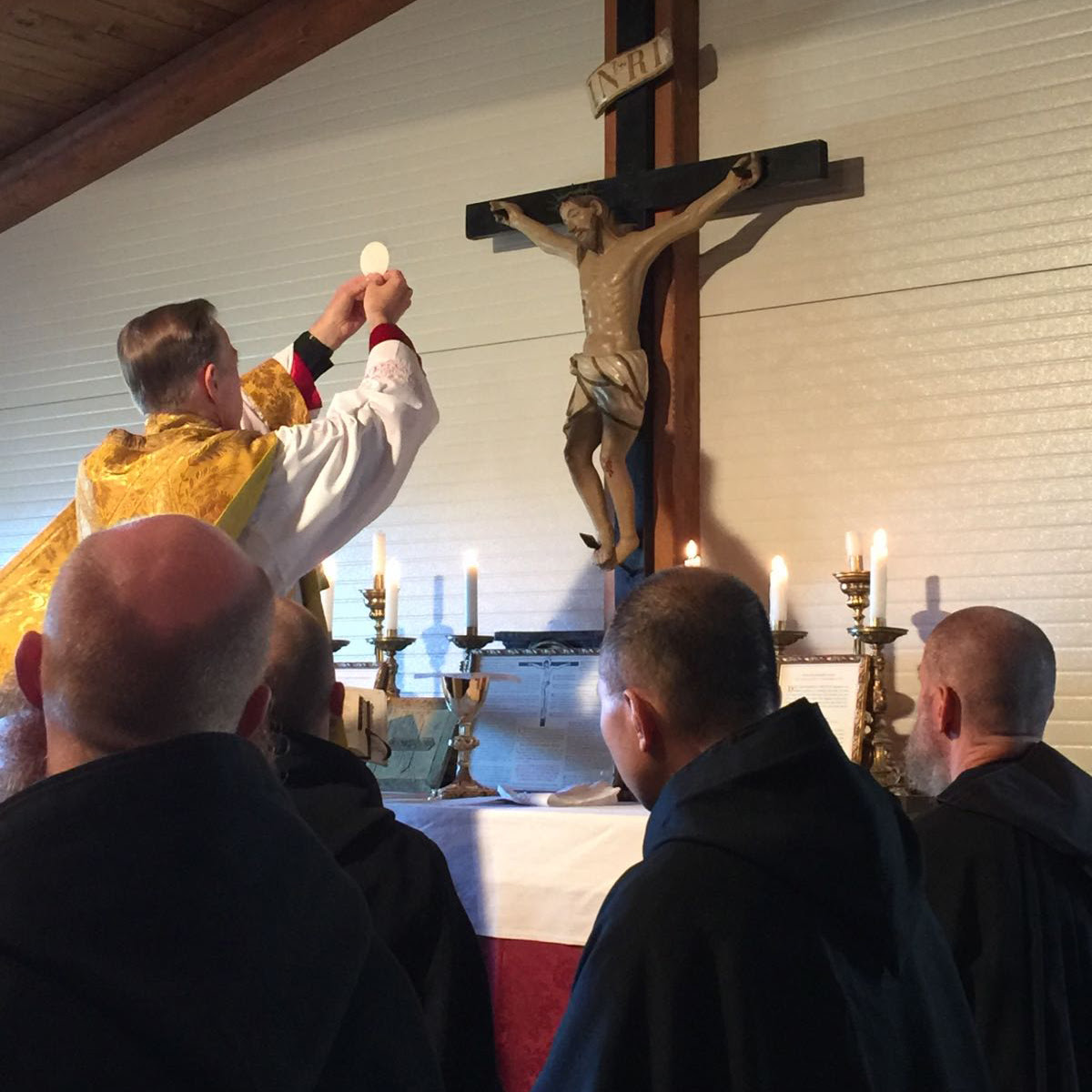
In closing, and on a note of hope, I want to tell you about a special visitor we had this morning. In an act of both ecclesiastical solidarity and paternal support, and as the ground beneath us continued to tremble, Archbishop Alexander K. Sample of Portland, Oregon, became the first Bishop to offer Mass in the private chapel of our modest dwellings. The Bishop was in Norcia to participate in the fifth annual Populus Summorum Pontificum pilgrimage. Following the earthquake, the pilgrimage’s Norcia events were cancelled, and so the Bishop spent time with our community. He was able to join us for coffee and offered soothing words of support, which we in turn repeat and offer to all of those in the region affected by natural disaster:

“God will bring good to you out of this suffering and this earthquake will become the cornerstone on which generations of monks will build their monastic life.”

Photo: Populus Summorum Pontificum

Relying, as ever, on your prayers and support,
Fr. Benedict
Subprior

Note: If you want to help the rebuilding process, you can give to the monks by clicking here.
Posted in ACTION ITEM!, SESSIUNCULA | Tagged ,
6 Comments

Camille Paglia on Hillary: “The woman is a disaster!”

As some of you long-time readers will recall, I have a grudging respect for Camille Paglia. She’s wrong about a lot of things, but she’s the rarest of the rare: an honest feminist.  She’s a realist. And, like her hate her, she’s a gas to read.

I saw this interview with Paglia at The Spectator:

‘The woman is a disaster!’: Camille Paglia on Hillary Clinton
A wide-ranging interview with the iconoclastic professor

[…]

Talking to Camille Paglia is like approaching a machine gun: madness to stick your head up and ask a question, unless you want your brain blown apart by the answer, but a visceral delight to watch as she obliterates every subject in sight. Most of the time she does this for kicks. It’s only on turning to Hillary Clinton that she perpetrates an actual murder: of Clinton II’s most cherished claim, that her becoming 45th president of the United States would represent a feminist triumph.

‘In order to run for president of the United States, you have to spend two or three years of your life out on the road constantly asking for money and most women find that life too harsh, too draining,’ Paglia argues. ‘That is why we haven’t had a woman president in the United States — not because we haven’t been ready for one, for heaven’s sakes, for a very long time…’

Hillary hasn’t suffered — Paglia continues — because she is a woman. She has shamelessly exploited the fact: ‘It’s an outrage how she’s played the gender card. She is a woman without accomplishment. “I sponsored or co-sponsored 400 bills.” Oh really? These were bills to rename bridges and so forth. And the things she has accomplished have been like the destabilisation of North Africa, causing refugees to flood into Italy… The woman is a disaster!

[…]

Which brings us back to Hillary and the so-called victory her re-entering the White House would represent: ‘If Hillary wins, nothing will change. She knows the bureaucracy, all the offices of government and that’s what she likes to do, sit behind the scenes and manipulate the levers of power.’

Paglia says she has absolutely no idea how the election will go: ‘But people want change and they’re sick of the establishment — so you get this great popular surge, like you  had one as well… [Brexit] This idea that Trump represents such a threat to western civilisation — it’s often predicted about presidents and nothing ever happens — yet if Trump wins it will be an amazing moment of change because it would destroy the power structure of the Republican party, the power structure of the Democratic party and destroy the power of the media. It would be an incredible release of energy… at a moment of international tension and crisis.’

All of a sudden, the professor seems excited. Perhaps, like all radicals in pursuit of the truth, Paglia is still hoping the revolution will come.

Paglia for Trump?  She doesn’t say so.  But…

If I would vote for the corpse of Millard Fillmore to block Hillary’s disaster, she might opt for the very living Trump.

Posted in The future and our choices | Tagged
35 Comments

ACTION ITEM! Birettas for Seminarians Project! UPDATES

UPDATE:

From my email…

I just received a biretta from John! [Hastreiter of Leaflet Missal] I am very happy with the biretta, and even more grateful for the work you and Mr. Hastreiter have put into this project.

If you happen to know any of the donors, please assure them that I will pray for them — especially when using the biretta.

Thank you!

(and of course, please keep my name and diocese anonymous in any public posting.)

Always!

I’m glad you were able to benefit from the Biretta Project!
UPDATE:

First off… I am informed that, through this project, YOU, dear readers, have supplied about 100 birettas to seminarians.  Kudos.

Next, I have had a few thank you notes from seminarians, who are receiving their new covers.  Here is one:

I want to thank you for your “Birettas for Seminarians Project.” Today I received my biretta, and I am very grateful!

I have a question though, what is the proper etiquette (birettaquette) for a seminarian? When sitting in choir is it the same as a priest? Also, when can one, seminarian or priest, wear a biretta? Is it only for liturgical use?

Carry it when walking in and out.  Cover after having sat down.  Uncover before standing up.  When holding it, hold it with both hands in front of your chest.  Use ONE hand to put it on.  Do NOT sit on it after the tabernacle is closed, if you put it on your chair during Communion time.

That said, I note that you are in a … place ((arch)diocese) where the local ordinary could be quite antagonistic about seminarians and birettas.  Thus, I urge you to be discreet.

And, yes, the biretta is mostly liturgical, although some priests wore it out and about.

UPDATE:

I received a note from the Incredible John at Leaflet Missal in St. Paul, aka the Biretta Broker for our Project.  To wit:

Hello Father,

Your eyes can stop welling with tears as you write! (At least, temporarily)

Thanks so much for your recent efforts, and thank you to all who contributed over the past year.

We now have enough donors to literally “cover” all of the remaining seminarians on the list…and then some.

As you know, Italy is pretty much shut down in August. But come September…many, many, birettas will be shipped in!

I think the manufacturers are wondering what’s going on in the Americas!

Brick by Brick!


UPDATE 16 Aug:

I received the following via email from a seminarian:

I want you to know that I received a Biretta from your action item posts. Thank you and the benefactor who came forward to purchase this for me. Every time I use it I pray for the benefactor who purchased it for me.

Not bad!

UPDATE 7 July 2016:

In honor of the anniversary of Summorum Pontificum I’m moving this to the top of the stack.

____

In the past we have had here a project to get birettas for seminarians.  It was a success (for example HERE) but, alas, it has fallen off the radar.  Let’s get back at it.

I am still getting notes from seminarians hither and yon who need birettas.

That is where YOU come in.

John Hastrieter at Leaflet Missal in St. Paul wrote that he has about 2o seminarians on a “biretta wanted list” but… and my eyes well with tears as I write this… no donors.

Help!

Contact John in church goods at Leaflet Missal in St. Paul – 651-209-1951 Ext-331. 

DON’T WRITE TO ME TO ASK FOR A BIRETTA… CONTACT TO JOHN AT LEAFLET!

If he is away, leave a voicemail with your phone number and he will call you back ASAP.

John is keeping track of the names of the seminarians and their hat sizes. My involvement would only get in the way of the process. Don’t write to me.

Let’s encourage these men.

Call John and buy a biretta for a seminarian.  It’s as easy as that.

Posted in ACTION ITEM!, Seminarians and Seminaries | Tagged ,
12 Comments

ASK FATHER: Bless or exorcize new home?

From a reader…

QUAERITUR:

I’m a long time reader of your blog and thank you for your ministry.

My wife and I are in the final stages of purchasing our first house. When we went to see the house the first time we noticed that the current residents were Indian and of the Hindu religion. We know this because not only of the smell of curry throughout the house but also because of the small shrines and altars throughout the house. While I can appreciate ones conviction towards one’s faith, my wife said we should make sure the house is blessed before we move in. My question is, should we just simply bless the house or should more drastic means of blessing and/or exorcism take place since the house was inhabited by those of another faith? If so, what would be the proper thing to do? Thank you for taking the time to answer this question.

First, it is never wrong to have your house blessed!  Let’s put that another way.  It is always right to have your house blessed.  In Italy, for example, parish priests go about in the Easter season to bless dwellings, even putting up posters in neighborhoods saying when he will “strike” on that block, etc.

I doubt that you would need an exorcism of a place for your house.   You should start with the blessing.  Should you have any other concerns after that, then talk to the priest about the exorcism of a place.

Dear readers, talk to your priests about blessings, blessings of objects, places and yourselves.   There are different sorts of blessings (in spite of what the Praenotanda of the dreadful “Book of ‘Blessings'” says).  There are constitutive and invocative blessings.   Some blessings call God’s favor down and others constitute something or some place (and sometimes a person) as sacred or consecrated.

We need to use all the tools in our wonderful Catholic toolbox, including sacramentals, so established by constitutive blessings, and the right use of the Sacraments.

And don’t forget to examine your consciences and…

GO TO CONFESSION!

Congratulations on your new home.  May you thrive in it.


Posted in "How To..." - Practical Notes, ASK FATHER Question Box, GO TO CONFESSION, Hard-Identity Catholicism | Tagged ,
8 Comments

Rome 2- Day 2 & 3: Cooking up vestments and victuals

Today I stopped in at Gammarelli to talk about the upcoming pontifical set of vestments in white and I saw a relatively inexpensive rose pianera.

They will make a matching cope and have it to us by Gaudete Sunday. Hopefully in the next year pontifical sets will follow in rose and in a far better black than we presently have.  I’ll start fundraising for that, don’t worry!

And here is a shot of a new fabric they made, based on some that a priest found.

And another.  I wish they’d have had this green before.  It’s great.  It reminds me of fabrics I saw in Venice.  It has griffons in it.

They are doing some good things and they are expanding. They remain very helpful and available.

Meanwhile, the fabric I chose for the white pontifical set and the trim to go with it.

On the other hand, this was in a window of a nearby shop.  No.  Just… no.

At least they have a scruple spoon.  I like the spoons from Leaflet better.

I dropped into Santa Maria sopra Minerva on the way back to the apartment.

The tomb of Leo X who decreed some good excommunications.

Tomorrow i’ll pick up this reliquary designed for a relic of the True Cross.  it will be wonderful for public veneration of the relic.

I’m so grateful to a donor who made this possible.

Later, past my old seminary and a view of my window from over a quarter of a century ago.

I did some shopping around the Campo at shops I know.  Here was something interesting!

My green grocer lady is still going strong!


In my short let apartment I have for cooking only a pot for water and a frying pan and a micro stove with those horrid heating elements under glass.  It’s so small that you can’t have both the pot and pan on at the same time.  But my various odd living circumstances over the years prepared me for these challenges.

Here is a pan of my own amatriciana.


Tonight I made a blazing arrabiatia followed by a roulade of chicken, prosciutto, rosemary and taleggio.  It’s nice not to have the option to prepare a meal at will without going out.

As I ate I suddenly felt dizzy.  I lasted for some time.  A bit late got texts from a friend here that there was an earthquake sort of between Assisi and Loreto.  That’s what I felt.

May God protect those people affected in that region.

Screen Shot 2016-10-26 at 23.50.15

UPDATE:

A priest wrote:

There is this one I saw in a local supply shop in Vancouver. Yikes!

image1

Posted in On the road, SESSIUNCULA, What Fr. Z is up to | Tagged ,
17 Comments

Flash back with Stravinsky’s Mass

Over at the increasingly-valuable Crisis there is a great piece about the composer Igor Stravinsky and his sacred music.  Yes, Stravinsky wrote truly sacred music, and I find it quite compelling.  Stravinsky was a deeply religious soul and at times he considered conversion to the Catholic Church.  He wrote a Mass, by the way.  From the piece:

Around the same time as Babel, Stravinsky had begun work on his one and only Mass. Completed in 1948, the Mass for choir and wind instruments was written “from spiritual necessity” (as Stravinsky’s assistant Robert Craft claimed) rather than from a commission. Stravinsky intended the Mass for actual liturgical performance—the score contains intonations for “the priest”—but the premiere performance was at an opera house and it has, regrettably, seldom been performed as part of an actual Mass. [AH HAH!] In this work, Stravinsky created a haunting amalgam of the ancient and the modern. At times the vocal incantations suggest Orthodox chant or medieval polyphony. The wind instruments form a glowing background to the choir, like the gold of a Byzantine icon. Stravinsky explained that the Credo is the longest movement because “there is much to believe.”

I am happy to report that I have been celebrant for Holy Mass in the Traditional Roman Rite with the very Mass mentioned above.  It was almost exactly 6 years ago, this time of year. I was in Detroit at the wonderful Assumption Grotto parish, where the esteemed church-musician Fr. Ed Perrone is pastor.  I had mentioned to him once that I would like to be able to have the Stravinsky Mass and he put it together.  They had it in their repertoire.   It isn’t the favorite, I think, of some of the choir members, but it is a moving experience.  The contrast of the music with the ancient lines and movements, the chants (and some Bach!) and language of the Roman Mass, East meets West, is striking and evocative.  My post on that Mass HERE.

Here is a sample of Stravinsky’s Mass.

YouTube thumbnailYouTube icon

Posted in Both Lungs, Linking Back, Liturgy Science Theatre 3000 | Tagged ,
5 Comments

Peter Kwasniewski: Why tradition is important and reverence alone isn’t enough

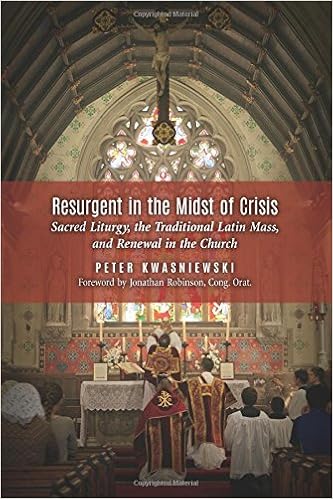
Over a Rorate there is something so good that it compels me to overcome even their animosity toward me, extend an olive branch again, and direct you there to read patiently and completely.  Peter Kwasniewski of Wyoming Catholic College (where students can’t have cellphones but they can have guns) did a presentation for the new translation into Czech of his fine book Resurgent in the Midst of Crisis: Sacred Liturgy, the Traditional Latin Mass, and Renewal in the Church.  US HERE UK HERE

Peter makes an argument, reflected in the talk’s title: “Reverence Is Not Enough: On the Importance of Tradition”

Here are a couple samples with my emphases and comments:

[…]

But after this extended metaphor, an objection might be raised. “Why is tradition so important? Isn’t it enough just to have a reverent liturgy?  As long as we are sincere in our intentions and serious about our prayer, all these other things—the language of our worship, the type of music, the direction of the priest at the altar, the way people receive communion, whether or not we keep the same readings and prayers that Catholics used for centuries, and so forth—are just incidental or accidental features. They are ‘externals,’ and Jesus taught us that externals aren’t the main thing in religion.” [All of us who have promoted the traditional Roman Rite have heard this countless times.  Right?  “The Novus Ordo where I go is reverent!  Don’t tell me that that isn’t enough!”  I say, it might be enough, but why not have more.  To use one of my old analogies, a grown man can survive on jarred baby food, but he won’t thrive.  He needs a steak and cabernet.  At the same time, many people today have to be brought carefully, prudently, to the steak and cabernet so that they, unready, are not overwhelmed.]

There is, of course, some truth to this objection. Our intentions are indeed fundamental. If a non-believer pretended to get baptized as part of a play on stage, he would not really become a Christian. No externals by themselves will ever guarantee that we are worshiping the Father in spirit and in truth (cf. Jn 4:23–24), and an attitude of reverence and seriousness is the most crucial requirement of the ars celebrandi. Nevertheless, I believe that the objection as stated is erroneous, and dangerously so, because it presumes (and thereby fosters) a radical transformation of the very nature of the Catholic religion under the influence of Enlightenment philosophy.

Prior to all arguments about which practice is better or worse is the overarching principle of the primacy of tradition, meaning the inherent claim that our religious inheritance, handed down from our forefathers, makes on us. We do not “own” this gift, much less “produce” it. Tradition comes to us from above, from God who providentially designed us as social animals who inherit our language, our culture, and our religion; it comes to us from our ancestors, who are called antecessores in Latin—literally, the ones who have gone before.[3] They are ahead of us, not behind us; they have finished running the race, and we stand to benefit from their collective wisdom. [That’s a good insight.  Our forebears are ahead of us!] St. Paul states the principle in 1 Thessalonians 4:1: “We pray and beseech you in the Lord Jesus, that as you have received from us how you ought to walk and to please God, so also you would walk, that you may abound the more.”

[NB] The rejection of tradition and the cult of change embodies a peculiarly modern attitude of “mastery over tradition,” which is the social equivalent of Baconian and Cartesian “mastery over nature.” The combination of capitalism and technology has allowed us to abuse the natural world, treating it as raw material for exploitation, in pursuit of the satisfaction of our selfish desires. In a similar way, the influence of rationalism and individualism has tempted us to treat Catholic tradition as if it were a collection of isolated facts from which we, who are autonomous and superior, can make whatever selection pleases us. In adopting this arrogant stance, we fail to recognize, with creaturely humility, that our rationality is socially constituted and tradition-dependent. By failing to honor our antecessores, we fail to live according to our political nature and our Christian dignity as recipients of a concrete historical revelation that endures and develops organically over time and space. [Superb.]

[…]

Kwasniewski later in his talk does something quite useful: He shows the contrast between Joseph Ratzinger’s view of liturgy and Walter Kasper’s! There’s quite a bit to it, but here are a couple tastes…

[…]

[On the topic of how the Novus Ordo is often implemented…] Every celebration is, in a sense, a new project, a new compilation, a new construct of the human agents involved. Even if the same “traditional” options were to be chosen as a rule, the very fact that they are chosen and could be otherwise makes the liturgy not so much an opus Dei as an opus hominis.[10] [A “work of human hands”?]

This voluntaristic malleability of the liturgy, joined with an emphasis on local adaptation and continual evolution, is precisely the liturgical equivalent of the decades-long dispute between Walter Kasper and Joseph Ratzinger in the sphere of ecclesiology. For Ratzinger, the universal Church and its sole Lord and Savior take precedence[11]—and therefore the liturgy, which is the act par excellence of Christ and His Mystical Body, should embody, express, and inculcate exactly this universality, the faith of the “one, holy, catholic, and apostolic Church.”

[…]

In contrast, we see Cardinal Kasper’s group-based “ecclesiology from below” reflected in the localist Novus Ordo Missae—not in its abuses, but in its essence as a matrix of possibilities destined to receive its “inculturated” form from priests and people at each celebration. It is a liturgy in a constant state of fermentation, re-visioning, re-invention, which is antithetical to orthodoxy in its original meaning of “right-worship-and-right-doctrine.” It is worth pointing out that proponents of Kasperian ecclesiology and liturgy also tend to repudiate Constantinian Christianity and its universalizing aspiration to “re-establish all things in Christ” (Eph 1:10). This is because they hold, with Karl Rahner, [yep… there he is… lurking…] than every man is already Christian at some level, and that the world as such, the secular world, is already holy. [Well done.  Rahner thought – and this really bad idea has had serious and deep consequences for those upon whom it was thrust in seminaries and universities and therefore congregations after them, that sacraments mark pre-exiting realities.  Think about how that starting point would affect every single liturgical choice, right down to architecture!] Thus there is no clear distinction between ad intra and ad extra, between sanctuary and nave, between minister and congregation, between tradition and innovation, or even between sacred and profane. All things collapse into immanence, into the choice of the moment, the quest for instant inculturation, the transient emotional connection, the self-proclamation of the group. It is a liturgy of the Enlightenment, ahistorical, sociable, accessible, efficient, unthreatening. It is supposed to be pleasant, convenient, thoroughly free of magic, myth, or menace. There must not be any of that primitive or medieval mysterium tremendens et fascinans, [A phrase from Rudolf Otto which I use all the time when talking about the ends of sacred liturgical worship.] none of that groveling of slaves to their masters: we are grown-ups who can treat with God as equals.  [Sound familiar?] As a matter of fact, we will edit out “difficult” passages from Sacred Scripture and rewrite “difficult” prayers so that offenses or challenges to our modern way of life will be, if not eliminated, then at least kept to a polite minimum. [And there is the connection to reinterpretation of Scripture, such as Christ’s teaching about indissolubility of marriage.  Add to that the Church’s teaching about scandal and about reception of Communion in the state of grace.  Everything is up for grabs!]

[…]

This is excellent stuff. Peter also underscored Kasper’s approach to interpretation of Scripture. Scripture is constantly to be reinterpreted according to the times. What it once meant doesn’t confine us now. We interpret Scripture differently than our ancestors did. Thus, Christ’s strong and clear injunction about matrimony does mean what it meant. You get this also in his latest offering in Stimmen der Zeit about Communion for the divorced and remarried in Amoris laetitia.  Robert Stark, in CWR, some time ago described Kasper has replacing philosophy with politics: majority rule can change interpretation of Scripture, doctrine, whatever.

In any event, you might head over there and read the whole thing. It is worth the time and trouble.

Posted in Liturgy Science Theatre 3000, Olive Branches | Tagged , , , , ,
23 Comments

TORONTO: Upcoming Solemn Mass and Conference

Anyone who is in the neighborhood of Toronto, please take note.


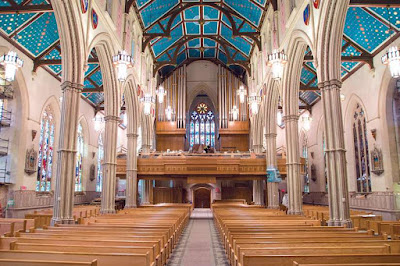
First, there will be a Solemn Mass celebrated for the Feast of Christ the King (the last Sunday of October), 30 October.  His Eminence Thomas Card. Collins will preach.  It is significant that this will take place at the St. Michael’s Cathedral of Toronto.  More on that HERE or HERE.

Also, Serviam Ministries is sponsoring a day conference in Toronto on Saturday, 5 November called “Revival: Restoring the Sacred in Our Lives and Church.  More on that HERE.  Tickets are still available.

Good things in Toronto!


Posted in Events, The Campus Telephone Pole | Tagged
2 Comments