Ultrapapalism is the other side of the coin of Sedevacantism

I extend my compliments to Fr. Hunwicke today for an excellent observation at his excellent blog Mutual Enrichment.

Here is an excerpt from the post I have in mind. You can read the whole thing there:

Two very brief pointers.

(1) Sedevacantism is the other side of the coin of Ultrapapalism (Hyperbergoglioism?) expressed by a number of the undesirables who surround the Holy Father. In each case, there is the same erroneous major premise.

The Pope is a demigod;
Bergoglio is clearly not a demigod;
Therefore Bergoglio is not pope.

The Pope is a demigod;
Bergoglio is pope;
Therefore Bergoglio is a demigod.

BOTH ARE HERESIES contrary to the teaching of Vatican I about the papal office.

(2) Whichever of the many forms of sedevacantism you are tempted by, subject it to the Pope Honorius Test. He was condemned by an Ecumenical Council and anathematised by a successor. But can anyone produce any evidence that the Council, or any subsequent popes who condemned him, or any reputable ecclesistical writer, has ever argued that Honorius had ceased to be Pope at the moment when he acted heretically?

Whether or not you like Bergoglio, he is, beyond any shadow of doubt, the Pope.

Well done.

I will add, Ultrapapalism is the other side of the coin of Sedevacantism .

Furthermore, former-Father Greg Reynolds is still excommunicated.

Posted in Francis | Tagged , , , ,
18 Comments

Belgian priest injured in knife attack

From the Catholic Herald:

Fr Jos Vanderlee, 65, was rushed to hospital following the attack, but his condition is not thought to be critical

A priest in Belgium was stabbed, after letting an asylum seeker into his home to use his shower, according to reports.

Fr Jos Vanderlee, 65, who has been named locally as the victim of the attack, was rushed to hospital following the attack, which happened at around 2.40pm local time. His condition is not thought to be critical.

Prosecutors have said the attack, which occurred in Lanaken, is not related to terrorism and police are looking for witnesses.

Fr Vanderlee celebrated his 40th anniversary as a priest in July and is responsible for eight local parishes.

The assailant went to the priest’s house and asked if he could use his shower, stating that he planned to apply for asylum in the country, according to a report in Belgian newspaper Nieuwsblad.

After being allowed on the premises, the suspect demanded money from Fr Vanderlee, lunging at him and injuring the priest’s hands. He then fled the scene.

The Mayor of Lanaken, Marino Keulen, said: “Despite the fact that we are shocked, we must stress that this incident can not be linked to terrorist acts at this stage of the investigation.”

It doesn’t always have to be about terrorism.  Sometimes it’s just about asylum seeker committing crimes.

I haven’t found any account of this attack that names the attacker.  He is uniformly called an “asylum seeker”.  Maybe they don’t know it.

Posted in The Coming Storm, The future and our choices |
9 Comments

“People can do just about whatever they want.”

The events of the last few days prompt me to go back to something I read at LifeSite waaaaay back on 8 July (which in blog years is about a decade).

Bp. Thomas Tobin of Providence nailed it when he said, concerning the ambiguity in Amoris laetitia:

The good news is, that because of this ambiguity, people can do just about whatever they want. The bad news is, that because of this ambiguity, people can do just about whatever they want.

We don’t have to single out Amoris laetitia.  There are any number of indicators that contribute to the fact that, these days, many Catholics are doing pretty much whatever the hell they want…. and they think that’s okay.

In the past, when people sinned or disagreed with the Church on some point (usually moral), they knew that they were sinning and they knew that disagreeing with the Church wasn’t acceptable.  They knew they were off base, but they didn’t claim that they were actually on.  This doesn’t seem to be the case anymore.  Sinners deny that sins are sins and dissenters think they are perfectly fine as they are.  And the many of Holy Mother Church’s official teachers do either little or nothing to correct them.  Heck, some even prompt them with a toothy smile and a now obligatory hug.

Look, friends, sinful behavior is one thing but faith is another.  We are all sinners, but we repent and confess our sins.  Sometimes we are bad Catholics, but we’re Catholics.  But if we don’t believe what the Church teaches….  are we still Catholic?

We now have a bunch of different religions going on side by side in what we call the Church.

May I suggest, dear readers, that, if you don’t know it already, you memorize this and recite it frequently.

Act of Faith

O my God, I firmly believe that Thou art one God in Three Divine Persons, Father, Son and Holy Ghost. I believe that Thy Divine Son became Man, and died for our sins, and that He will come to judge the living and the dead. I believe these and all the truths which the Holy Catholic Church teaches, because Thou hast revealed them, Who canst neither deceive nor be deceived.

We have sure references for our Catholic Faith.  We have her Catechisms and we have her Cult, that is, the texts of her sacred liturgical worship.

If you don’t have one… get one before it gets revised.

USA HERE – UK HERE

And there’s this…

US HERE – UK HERE

And also…

US HERE – UK HERE

I like Kindle versions of certain books, but there are some that we need also in concrete, pageable, form.  When the lights go off, we’ll still be able to read them by candlelight.

Moderation queue is ON.

Posted in Cri de Coeur, Hard-Identity Catholicism, The Coming Storm, The future and our choices | Tagged ,
13 Comments

At WYD a bishop rewrites the biblical story of Sodom

Pope Francis has shown particular favor toward Bp. Nunzio Galantino, of Cassano all’Jonio making him even General Secretary to the Italian Bishops Conference. I’ve mentioned him before HERE and HERE.

At World Youth Day in Poland, Bp. Galantino made some odd remarks to Italian young people in attendance.  HERE  He spoke about the “bargaining” dialogue that Abraham had with God over the destruction of Sodom and Gomorrah in Genesis 18.

You remember the scene:  God knows that Abraham is going to Sodom. Because God knows that He is going to destroy Sodom, and because He has future plans for Abraham, God tells Abraham of Sodom’s sin, which means destruction. So, Abraham starts this “bargaining” with God over the fate of Sodom and Gomorrah for the sake of a few innocent people who might be destroyed with the wicked. God agrees and it seems that the cities are “safe”. Of course God knew better than Abraham what was about to happen. Thus endeth Genesis 18.

Then there followeth Genesis 19.

Lot has guests in his house and he is responsible for their protection. The people of Sodom want Lot to turn them over so they can rape them.  Abraham had implored God not to destroy Sodom if there are even a few innocent people in the city.  As it turns out, there weren’t. God destroys both Sodom and Gomorrah.  It is salutary to read the description to see what happens when God means business and we defy Him:

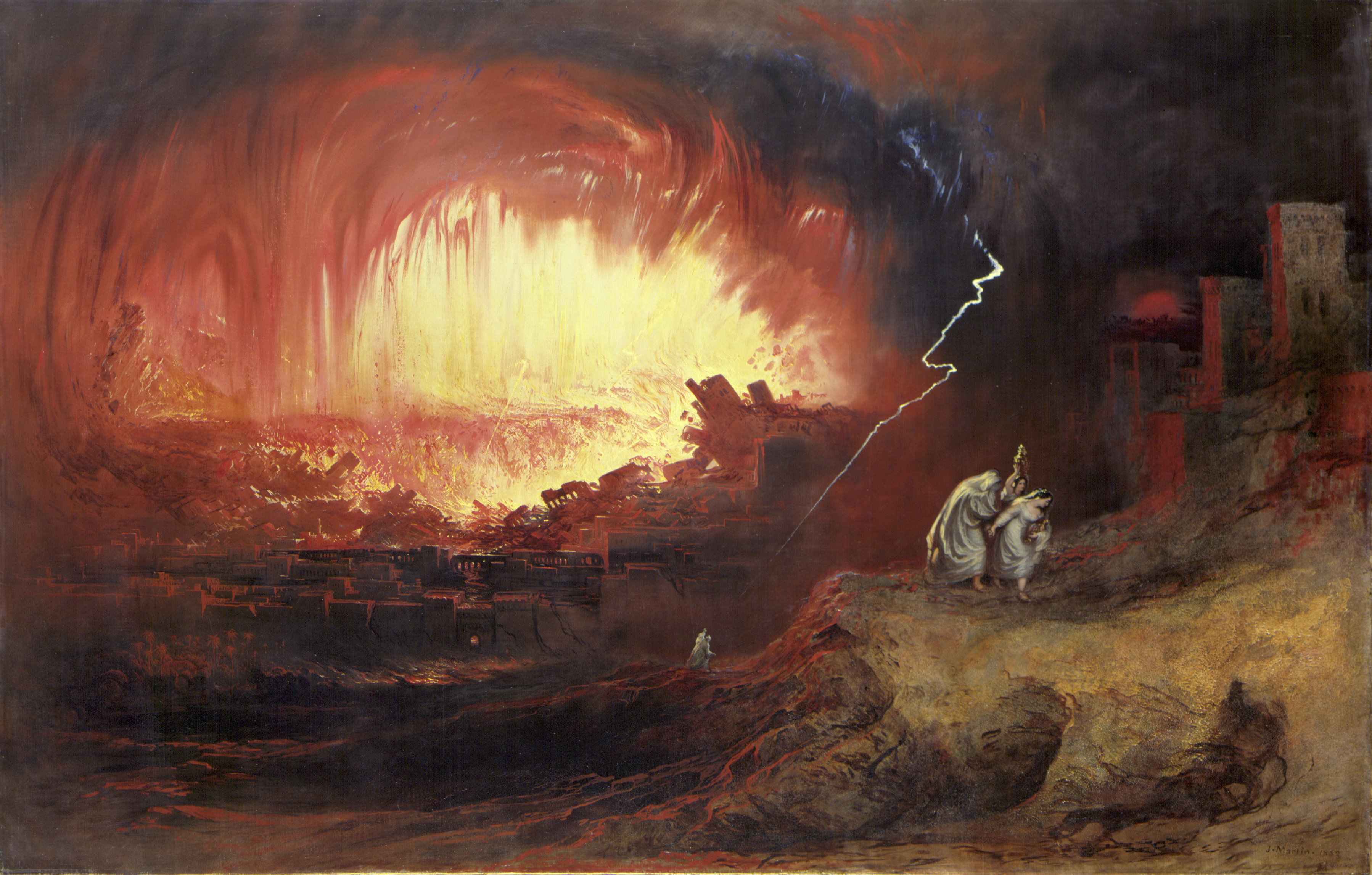
And the Lord rained upon Sodom and Gomorrha brimstone and fire from the Lord out of heaven.  And he destroyed these cities, and all the country about, all the inhabitants of the cities, and all things that spring from the earth. … And Abraham got up early in the morning and in the place where he had stood before with the Lord,  He looked towards Sodom and Gomorrha, and the whole land of that country: and he saw the ashes rise up from the earth as the smoke of a furnace.

So much for God’s opinion about unnatural sex.

You will recall that a certain despicable mortal sin, as well as a whole range of unnatural sex, is named after Sodom.

Here entereth, stage left, Bp. Galantino.  He tells the young people, because of Abraham, Sodom was “safe… saved”.  That’s fine if you end the story at the end of Genesis 18.  But there follows Genesis 19 and the rest of the story which everyone now knows!  What God knew, and what Abraham didn’t, is that there weren’t even 10 good men there.  God, being faithful to what He told Abraham, wiped out the cities.  But that’s not the impression that Bp. Galantino gives.

Read it and decide for yourselves. (Not my translation – HERE – but with my emphases and comments.)

“The intense dialogue between God and Abraham in the first reading tell us about prayer. And it’s about prayer that Jesus is asked in the Gospel. A prayer which is not an escape from troubles and responsibility, but a live experience made of listening and answering, through which God creates an authentic relationship and pushes us to be daring. As daring as Abraham’s intercession prayer in favor of Sodom. A city upon which nobody would have bet a dime. His intercession prayer and his will to dare save Sodom. The city is saved because some righteous ones are there, even though a few of them. [La città è salva perché ci sono i giusti, anche se pochi…] But the city is saved [ma la città è salva] above all because Abraham, a man of prayer, is not a relentless accuser, he doesn’t speak against but in favor. Abraham, man of prayer, doesn’t point to the misdeeds, but he announces the possibility for something new. Abraham, man of prayer, announces and invites to look at the positive possibilities. Abraham, man of prayer, is a tireless searcher for sign of hopes to present to the Lord for Him to give them value.”

Ummm… “la città è salva”?!?  And yet, turning to the very next page in the Old Testament’s account, Sodom and Gomorrah wind up heaps of smoking ashes, utterly destroyed.  No?

God would have left Sodom be, if there had been even a few righteous men.  The city was potentially saved, or safe, in the sense that IF there had been a few good people in it, THEN Abraham’s plea would have worked. But there weren’t and the sins they committed were so bad that God burnt them and their folk and their fields to a flaming crackly crisp.  God knew what Abraham did not.

So, what’s with that sermon by Galantino?

Forget about catechism and knowledge of the Bible for a second.  EVERYONE who has a minimal cultural literacy at all knows that Sodom and Gomorrah were obliterated and – wait for it – that the term sodomy comes from Sodom.

So, what’s his game here?  Is it to put into the empty heads of these young people that God did NOT destroy Sodom and Gomorrah (i.e., rewrite the Bible) because He does not abominate the “sin of Sodom”?

Sure, Bp. Galantino underscores Abraham’s intervention.  Fine.  It’s great to underscore what Abraham tried to do, but NOT at the expense of the truth about what happened to Sodom and Gomorrah!  As good and as positive as Abraham was, it didn’t work, except for poor Lot.  Moreover, when Abraham asked God to spare the cities because there might be good people in them, he is in no way condoning what the evil people did!  Abraham seems to be fine with destruction of the wicked.  He doesn’t want the innocent to be destroyed because of and together with the wicked.

The fact that such a thing might take place at a World Youth Day is dreadful.  Also, I think it is a stinging condemnation of the catechetical and biblical preparation of young people today, that anyone would think that he could get away with this.

Finally, I’ll add the old adage that if God doesn’t strike our society soon, then He’ll owe Sodom and Gomorrah and apology.  If I – Abraham-like – could bargain with God, I’d take a different tack and offer up for divine retribution, first, the present White House administration, and if God didn’t go for that, then the DCCC.  If that wasn’t enough, perhaps the whole Democrat Party with its appalling platform.  After that I have a little list… written on Fishwrap  But I digress.

Seriously, friends, we had better wake up.  God cannot be deceived.

Pray for our nations.  Pray that God will avert His wrath.  Pray and do penance for sins of sacrilege and blasphemy and those committed against nature.

The moderation queue is ON.
Posted in Liberals, Sin That Cries To Heaven, The Drill | Tagged , , , ,
53 Comments

Your Sunday Sermon Notes

Was there a good point made in the sermon during the Mass you heard for your Sunday obligation?  Let us know.

For my part, I spoke about the Portiuncula Plenary Indulgence on 2 August, about indulgences in general and about how lavishly generous God is to us. The Lord went about healing people during His earthly life. But no matter how dramatic and physics-defying His earthly healings were (and are today through miracles), they are of less consequence than spiritual healings and the spiritual gifts He offers us. We little humans tend to make lavish gifts rarely. In a reversal of our human ways, God offers the greater, spiritual gifts in far greater abundance than the rare dramatic, physical healings He works. One of the ways Christ showers us with gifts is through the authority He gave Holy Church to bind and loose, both sins and also the temporal punishment due to sin.

So, everyone…

GO TO CONFESSION!

And…

GET THOSE INDULGENCES!

Posted in SESSIUNCULA | Tagged ,
19 Comments

A new priest opines on “Extraordinary Ministers” and people with only minor sins after several years.

From a priest, on two points:

For our vigil Mass, we had our extraordinary ministers failed to show up.  I also did not have a deacon.  I preached about a 12 minute homily, used the Roman Canon, and distributed Holy Communion on my own to a congregation of about 200.

It still took only about an hour.  I don’t see how communion would be unduly delayed.  Therefore, I see no need for extraordinary ministers.

I’m still a new priest, but I really wonder about what they’ve been teaching the people here.  If someone hasn’t been to confession in several years and their only sins are minor, either they’ve not examined their consciences or they don’t know how to examine their consciences.  My bet is on the latter.

I really wonder about what they’ve been teaching the people here…”.

You are not alone, Father.

I’m glad you have your head screwed on in the right direction.

Now, learn to say the Extraordinary Form.  Also, get into that box and…

HEAR SOME CONFESSIONS.

Posted in Liturgy Science Theatre 3000, Mail from priests, Our Catholic Identity | Tagged ,
63 Comments

A joyous young woman enters Carmel

This is pretty cool. A friend alerted me to this video of a young woman entering a Carmel.


More HERE.

You young women out there, think about it.

I don’t think that God is calling fewer women per capita to religious life than He did before. Fewer can hear it for the din of modern life and the horrid expectations and images placed in women’s minds and hearts in this twisted world.

In each age since Christ’s Ascension, people have felt they were in the End Times. They were right. In any moment, when the conditions are right, the Lord could return.

Considering what is happening in the world now, I am pushed to think about the way Mass is being celebrated, even the number of Masses being celebrated. Many more people went to confession.

Once there were many communities of contemplatives, spending time before the Blessed Sacrament or in contemplation, in collective and in private prayer.

Who can know how they lifted burdens from the world and turned large and small tides by their prayers to God for mercy and in reparation for sin?

Play
Posted in Just Too Cool, Women Religious | Tagged , ,
37 Comments

PODCAzT 150: Leo XIII on Right Christian Conduct and the “bent of our age”

For this 15oth PODCAzT I offer Pope Leo XIII’s 1888 Encyclical Exuente iam anno, On Right Christian Conduct.

Despite the claims of many, the Church began neither with the Second Vatican Council nor the Pontificate of Francis.   There are inestimable treasures available to us in the magisterial documents of Popes stretching back through the centuries.

Today let us hear, in its entirety, this wonderful encyclical which could be addressed – and is – to us in this troubling age.

I’ll give you some pointers about Leo XIII, talk about the 1880’s and specifically 1888 and then give you the whole text.  If you can imagine such a thing, encyclicals were used to be brief and clear. They didn’t make you scratch your head as you turned to the Roman Catechism or the documents of the Council of Trent to make sure that what you just read was really what you just read.  But I digress.

US HERE – UK HERE

Leo paints a bleak picture, but he also offers consolations and counsel for how can can get out of this mess we are in with God’s help.  He makes a powerful plea to clergy, to priests, for learning and for virtue and for detachment.

Leo makes a strong case for the only thing that is going to help turn society around and avert the disaster that awaited every state and empire in history when it turned away from virtue. And Leo points to the fact that the pursuit of true virtues can only be rooted in faith in Christ.

Listen for the what he calls the “bent of our age”, meaning the overriding direction. Tune your ears for this paragraph:

“Nor is there any power mighty enough to bridle the passions, for it follows that the power of law is broken, and that all authority is loosened, if the belief in an ever-living God, Who commands what is right and forbids what is wrong is rejected. Hence the bonds of civil society will be utterly shattered when every man is driven by an unappeasable covetousness to a perpetual struggle, some striving to keep their possessions, others to obtain what they desire. This is well nigh the bent of our age.”

Posted in Hard-Identity Catholicism, New Evangelization, PODCAzT, Priests and Priesthood | Tagged , ,
6 Comments

Will SSPX get Personal Prelature? Could be, but obstacles remain.

From Christ und Welt, which is in German, via an English translation at Sunesis Press.

The Secretary of the Pontifical Commission “Ecclesia Dei” said that (with some added emphases and comments).

Note the references to doctrinal questions.

[…]

C & W: Recently there was an acceleration of relationships, why?

Pozzo:I would not speak of an acceleration, but by a patient process of rapprochement.  The Vatican is not demanding, insisting on ultimatums, instead we jointly planned some steps to reach full reconciliation. Since the stages were agreed upon, the way is easier to tread. [NB] We are still interested in clarifying some doctrinal and canonical questions. It is very important to promote a climate of mutual knowledge and understanding. In this respect, much progress has been made.  [Doctrinal questions remain.]

C & W: What has changed in the attitude of the Vatican since the beginning of the pontificate?

Pozzo: Several new perspectives were integrated. 2009 to 2012 was primarily a theological debate in the foreground.  There were doctrinal difficulties which hindered the canonical recognition of the Fraternity. We know, however, that life is more than doctrine. For through the theological discussion in the past three years we have come to know the desire and understand the reality of the Fraternity. [Interesting.]

[…]C & W: Bergoglio knew the Fraternity from Argentina.How crucial is this personal contact for the Pope?

Pozzo: This is certainly an important element. When he was still Archbishop of Buenos Aires, Pope Francis had contacts with the Fraternity. He saw how much effort they put in evangelization and in charitable work. The Fraternity does not, as is often claimed, only value the traditional liturgy, but also has substantive work.

C & W: Francis always stressed the pastoral aspect. Is this also the key to an understanding with the SSPX?

Pozzo: Pastoral and dogmatic theology are inseparable. The style and concrete willingness of Pope Francis to help the unity between the people not only to think but also to learn. Of course, some gestures are important. He has allowed the Priests of the SSPX to hear confessions of  the faithful, he has received the Superior General of the Fraternity, Monsignor Bernard Fellay in private audience. The rapprochement and resumption of talks was all made possible by the [lifting of the] excommunication by Benedict XVI.

C & W: Why is a Personal Prelature appropriate for the SSPX?

Pozzo: That seems to be the appropriate canonical form. [NB] Monsignor Fellay has accepted the proposal, even if in the coming months details remain to be clarified. Only Opus Dei currently enjoys this canonical structure, which is a big vote of confidence for the SSPX. [HOWEVER…] It is clear that the solution of the canonical form requires the solution of the doctrinal questions.

So, it seems that IF the doctrinal questions can be worked out, THEN the SSPX could get a Personal Prelature.

Posted in SSPX | Tagged , ,
36 Comments

VIDEO: Ordinary Form Mass very much in the Roman style

I was sent a link to a video of the Holy Mass in the Ordinary Form celebrated at the Proto-Cathedral of the Archdiocese of Seattle in Vancouver, WA for their Patronal Feast of St. James the Greater.

At this parish you can tell that they are trying to celebrate the Novus Ordo in continuity with the Roman liturgical style, in keeping with the Roman genius inhering in the Vetus Ordo or Extraordinary Form. Absent are the oddities that have slowly become virtually de rigueur in the Ordinary Form. The servers were well trained and reverent. The celebrant and single concelebrant were reserved and capable.

I must say, this parish music program is excellent. For the Mass they used Widor’s Mass for two organs and choirs, Op. 36 and they did it splendidly. They also executed some fine motets and Gregorian chant (though I am not a fan of mixed voice Gregorian chant).

Here is the video.

The Patronal Feast of St. James the Greater at the Proto-Cathedral of St. James the Greater from Proto-Cathedral of St. James on Vimeo.

For my part, I think that Father should have taken his seat at the sedilia as the music went on. Also, you will note that they, quite properly, separated the Sanctus and Benedictus. However I noticed that the celebrant waited for the two parts to end before continuing with the text. It seems to me that, in keeping with what Joseph Ratzinger had recommended, this would have been good moment simply to continue the Canon inaudibly (as we done for so many centuries – yes, yes I know what the stupid rubric says in the OF). I also noted that they used the Gradual rather than the responsorial psalm. Well done.

I compliment them for their reverence. Also, it is good that Latin is being used in the Novus Ordo. I hope that, in the future, the celebrant will also sing the Canon, also in Latin.

In my native place, at St. Agnes in St. Paul, the principle for the Novus Ordo “High Mass” in Latin, for both the orchestral and a cappella Masses, is that Latin is sung and the vernacular was spoken. So, the readings, petitions, etc. were spoken while everything else was sung.  Each place where sacred worship is taken seriously will develop their own house style.

It is possible to raise questions about the advantages of one rite or the other.  Some might say that, “If the Ordinary Form succeeds to the extent that it is like the Extraordinary Form, then why not just use the Extraordinary Form?”  That’s a legitimate point in an idea world.  Some places might need a way a) to make a transition to the Extraordinary Form or b) to keep at bay the howling wolves who would rend them limb from limb for being so traditional.

Another thing that impressed me about the parish is the fine examination of conscience available on their website. HERE They get it.

Fr. Z kudos.

Posted in "How To..." - Practical Notes, Liturgy Science Theatre 3000, Mail from priests | Tagged , , ,
30 Comments