Card. Dolan: “Where’s the Catholic Sandy Koufax?”

Because it is Spring (or close enough) and because in Spring all right-thinking souls turn their thoughts and hopes once again to that summa of sports, baseball, and because the Old English origin of the word “Lent”, lencten, means “Spring”, and because we are in Passiontide and rapidly approaching the end of Lent, a weekly column of His Eminence Timothy Card. Dolan caught my eye.  My emphases.

Have We Lost It?

One of my favorite memories of baseball is about the pitching legend Sandy Koufax. This cherished recollection about one of the game’s greatest pitchers did not occur on the mound, however, it came in 1965, when Sandy informed the manager of the Dodgers that he would not be able to pitch on the Jewish high holyday, Yom Kippur. For Sandy, his faith was more important than even baseball.

Last week I was taking a walk in Central Park and stopped at a cart for a bottle of water. But, the attendant was not to be seen. I walked around the cart hoping to find him, and there he was, a faithful Moslem, on his knees for his duty of prayer.

If you haven’t seen it…

How about the movie Chariots of Fire, the true story about the committed Christian Olympic runner, Eric Liddell, who would not compete on Sunday, the Sabbath? Remember?And now I understand the Jewish members of the senior class at Baruch University have asked that their late Friday afternoon graduation ceremony be rescheduled earlier so as not to interfere with Sabbath. God bless them!

What about us Catholics?

From what I can detect, instead of fidelity to communal acts of penance, we write in for “dispensations” for the measly eight days of fasting left – – Ash Wednesday and the Fridays of Lent.

We continue to schedule celebrations, parties, and fundraisers during what should be forty somber days of penance.

As for observing the Sabbath, only 25% of us attend Mass, instead of loyalty to Sunday, when we seem to prefer Starbucks and sporting events – – even sponsored by the CYO!

Our Catholic colleges will compete in “March Madness” even on Good Friday, and coaches in our parishes will complain that CYO games cannot be scheduled on Holy Thursday and Good Friday.

The Bible tells us we need fasting, penance, holy days and the Sabbath.

Sociologists tell us that a religion needs what they call “markers” to flourish, external signs (like Sabbath observances and fasting) to flow from internal conviction. [Like reverent sacred worship.]

Am I exaggerating when I ask if we Catholics have lost it?

Where’s the Catholic Sandy Koufax?

The Cardinal asks a good question.

Have we lost it?  It, I think, being our Catholic identity?  An identity strong enough to help us take the narrow and hard path rather than comform?

To start the discussion, I remind the readers of my long-running POLLS, which are implicit requests to the US Bishops…

Should the US Bishops have us return to obligatory "meatless Fridays" during the whole year and not just during Lent?

View Results

And what about …

Under normal circumstances, should the Latin Church Eucharistic fast (for people who are obliged) before Communion be lengthened?

View Results

I agree entirely with Card. Dolan in what he asks.  I respond, “Yes, we have lost it.  Our identity has been shattered through reckless liturgy and the dumbing-down or our markers.”

Please, may we have them back?

We might see a change, slowly, in the attitude of Catholics to Mass attendance, Lent, Good Friday, etc., etc., etc. We might also find that we are more respected in the public square.

The moderation queue is ON.  Think before posting.

UPDATE:

That admonishment to “think before posting” isn’t being followed by some of you, who think that this is simply an opportunity to vent or to trash the Cardinal.  Look, I didn’t like what he did at the St. Patrick’s Day Parade last year either.

However, if you want to give him a piece of your mind, don’t give it to me.  Go over to his blog, which has a combox of its own, and blast away to his face.  Don’t sneak around.

If he doesn’t personally handle his own blog, but lets handlers do it for him, that’s his choice.  As they say: “Not my circus, not my monkeys.”

Posted in Cri de Coeur, Our Catholic Identity, POLLS | Tagged , , , ,
56 Comments

ASK FATHER: A Host was dropped, the minister did nothing, and neither did I!

12_08_08_San_Leocadio_Christ_with_the_HostFrom a reader…

I recently started reading your inspiring blog and would like to pose a question regarding what is the appropriate response to a liturgical abuse during Holy Communion. I have been plagued with guilt since the incident.

Last December, I attended a 0700 Sunday Mass at my parish. Communion was being distributed by two female Eucharistic ministers. I was in the left line about 8-9 people back from the minister when I saw the Euchariatic minister in the right line drop a sacred Host to the ground. She did not immediately stop and pick up the Host to consume it. She saw it drop to the ground and repositioned herself over the Sacred Body. One by one people processed forward walking over The Lord. I was appalled and wanted to break through my line and pick up the Host. But I did not — mostly out of fear it would disrupt the flow of Communion and bring confusion to the people and anger to the Eucharistic ministers.

While I stood in judgment of the Eucharistic ministers, who clearly violated their roles, or who were outright ignorant of what to do in a situation like this, my question is: do I need to go to Confession for timidity? Did I sin by not honoring The Lord in breaking through my line to consume the Host and ensure all broken pieces were removed from the ground and consumed? Did I perpetuate the sacrilege committed that Sunday morning?

Please advise. My heart is very much consumed with guilt even four months after the incident.

Ah… these ministers…. So many of them are, in addition to being unnecessary, unprepared and clueless though not through their own fault.  Sadly, too few pastors spend adequate time with their legions of Extraordinary Ministers of Holy Communion to explain to them how to handle situations like this (perhaps because few pastors were ever themselves taught in seminary what to do).

We all must be vigilant about abuses and sacrileges against the Blessed Sacrament. It is… or rather He is Our Lord and Savior, worthy of all praise and worship. One can hardly think of a situation wherein one could show too much deference or too much respect towards the Blessed Sacrament. Paul Comtois, the Lieutenant Governor of Quebec, died in 1966, when a fire engulfed his residence. He had been privileged by the Archbishop of Quebec to have the Blessed Sacrament reserved in his residence. After being reassured that his family and all guests had been evacuated, Comtois re-entered the inferno to rescue the Blessed Sacrament from the chapel. As he was descending the stairs, they collapsed under him and he was burned alive. HERE  He wouldn’t be a martyr, in this case, by the way.  This is where the Orthodox category of Passion-Bearer would come in handy.

Polish President HostAnd do you remember the story, and video, of President of Poland, Andrej Duda who pounced protectively on a Host that had fallen and was being blown by the wind, lest it be lost or desecrated?  HERE (video)

Should he have waited for a priest to catch the Host?

In the traditional, pre-Conciliar Roman Missal there is a section dedicated to problems, things which goes awry during Mass: De defectibus.  It is useful today for the Novus Ordo, even though the Novus Ordo editions of the Missal lack such a clear section.  O tempora! O mores!   In De defectibus  – though addressed particularly to clerics, of course – we learn how to handle the situation of a dropped host. It happens, and not always because of irreverence or laziness.  Accidents can happen.

On an amusing side note, in better seminaries with good classes for the men to be ordained, there was usually discussion of how to handle situations of spiders winding up in chalices (Consume it or fish it out with your maniple pin? – Another reason to wear a maniple!), mice grabbing Hosts (What to do if you can catch the mouse? Burn it and put the ashes in the sacrarium?), Hosts accidentally dropped into an ample décolletage (Go in after It, to the amusement of all – perhaps except her husband? Let her, a layperson, fish It out, thereby touching it with unconsecrated hands? Quod Deus avertat!  Ladies, for pity’s sake, cover up.)

16_03_14_red_01

CLICK ME!

To your situation.  The logistics of what you described are a bit unclear. The EMHC positioned herself OVER the Host? Then how did others approaching step on, walk over the Host?

Hard to say without having been there.

To the more pressing problem.

You’ve stewed about this situation for four months?

Folks, the sacrament of penance is, even in this day and age, pretty widely available in the civilized world.

I don’t know you so I can’t say if you sinned or not.  You need to discuss this with a confessor.  However, remember that for a sin to be mortal it must concern grave matter (this did, because it concerned the Blessed Sacrament), it must be done with full knowledge (you don’t seem to have known what to do), and it must be done with full free will (you seem to have been afraid for various reasons).  I suspect you did not commit a mortal sin.  Furthermore, while we all have responsibilities to the Lord in the Eucharist you didn’t have a specific role in that moment as the priest or the EMHC did.  But … go talk to a confessor about this where you might give more details.  (That’s not a request for more from me, by the way.)

Folks, do not let your hearts be troubled by situations, or worries, or concerns for long periods of time.  GO TO CONFESSION!  Go this weekend! Let a good confessor help you untangle these situations and your particular roles in them.  Without going into long rambling detail, say what happened and express your concern.  If you think it’ll take a while, make an appointment.  Take the confessor’s advice, do the penance he assigns, pray for him, and move on.

Posted in "How To..." - Practical Notes, ASK FATHER Question Box, GO TO CONFESSION, Liturgy Science Theatre 3000 | Tagged , , ,
18 Comments

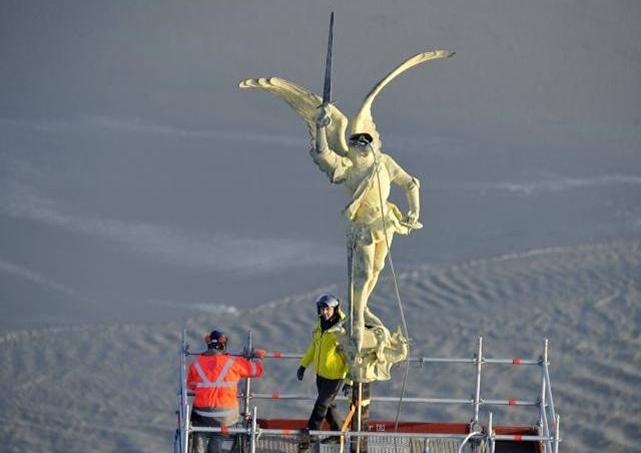
VERY COOL: St. Michael the Archangel flies again!

St. Michael leaves Mont-Saint-Michel… for now.

For years the famous Mont-Saint-Michel off the coast of France has been undergoing a lot of work.  Le Figaro has a story about the dismounting of the gilded statue of St. Michael from the pinnacle of the island town, from it’s monastic church’s steeple.  It will be restored.

There is some very cool video – alas preceded by annoying obligatory ads – followed by some other items.

From the article (you can translate it yourselves):

C’est la première fois, depuis sa dernière restauration en 1987, que l’archange de 520 kg qui culmine à 156 m au-dessus de la mer, est décroché. La restauration, prévue elle pendant deux mois, doit coûter 450.000 euros. «L’or a disparu, a expliqué François Jeanneau, architecte en chef des Monuments historiques. Sur l’archange, on voit l’usure due au vent chargé de sable. Le cuivre devient apparent. Il faut donc rénover l’œuvre pour la conserver», a-t-il ajouté.

L’archange en cuivre doré, arrivé en 1897 au sommet de l’abbaye, n’a été restauré que deux fois dans son histoire. Outre l’opération de 1987, la statue a aussi fait l’objet de réparations en 1935, mais sans décrochage. Seuls quelques éléments avaient été démontés pour être réparés, précise le Centre des monuments nationaux (CMN) qui gère l’abbaye.


Posted in Just Too Cool | Tagged ,
2 Comments

New interview with Benedict XVI in Avvenire

I just noticed the news at LifeSite that Pope (Emeritus) Benedict XVI gave an interview to Avvenire, which is the daily of the Italian Bishops Conference. Yes, they have their own newspaper.

The interview is refreshing.

At this point I haven’t seen a full English translation. Here is the Lifesite piece about it. My emphases and comments.

Pope Emeritus Benedict says Church is now facing a two-sided deep crisis

March 16, 2016 (LifeSiteNews.com) — On March 16, speaking publicly on a rare occasion, Pope Benedict XVI gave an interview to Avvenire, the daily newspaper of the Italian Bishops’ Conference, in which he spoke of a “two-sided deep crisis” the Church is facing in the wake of the Second Vatican Council. [Indeed.] The report has already hit Germany courtesy of Vaticanist Guiseppe Nardi, of the German Catholic news website Katholisches.info.

Pope Benedict reminds us of the formerly indispensable Catholic conviction of the possibility of the loss of eternal salvation, or that people go to hell:

The missionaries of the 16th century were convinced that the unbaptized person is lost forever. After the [Second Vatican] Council, this conviction was definitely abandoned. The result was a two-sided, deep crisis. Without this attentiveness to the salvation, the Faith loses its foundation.

He also speaks of a “profound evolution of Dogma” with respect to the Dogma that there is no salvation outside the Church. This purported change of dogma has led, in the pope’s eyes, to a loss of the missionary zeal in the Church – “any motivation for a future missionary commitment was removed.” Pope Benedict asks the piercing question that arose after this palpable change of attitude of the Church: “Why you should try to convince the people to accept the Christian faith when they can be saved even without it?[Indifferentism is pernicious and corrosive!  I will add that our identity is undermined through liturgical worship which is not sufficiently focused on the transcendent, not aimed at an encounter with Mystery, not helpful in our dealing with our fear of death.] As to the other consequences of this new attitude in the Church, the Catholics themselves, in Benedict’s eyes, were less attached to their Faith: If there are those who can save their souls with other means, “why should the the Christian be bound to the necessity of the Christian Faith and its morality?” asked the pope. And he concludes: “But if Faith and Salvation are not any more interdependent, even Faith becomes less motivating.”

Pope Benedict also refutes both the idea of the “anonymous Christian” as developed by Karl Rahner, [BOOO!] as well as the indifferentist idea that all religions are equally valuable and helpful to attain eternal life. He says: “Even less acceptable is the solution proposed by the pluralistic theories of religion, for which all religions, each in its own way, would be ways of salvation and, in this sense, must be considered equivalent in their effects.” In this context, he also touches upon the exploratory ideas of the now-deceased Jesuit Cardinal, Henri de Lubac, about Christ’s putatively “vicarious substitutions” which have to be now again “further reflected upon.” That is to say, Christ’s own acts in the place of others in order to save them eternally.

With regard to man’s relation to technology and to love, Pope Benedict reminds us of the importance of human affection, saying that man still yearns in his heart “that the Good Samaritan come to his aid.” He continues: “In the harshness of the world of technology – in which feelings to not count anymore – the hope for a saving love grows, a love which would be given freely and generously.” Benedict also reminds his audience that: “The Church is not self-made, it was created by God and is continuously formed by Him. This finds expression in the Sacraments, above all in that of Baptism: I enter into the Church not by a bureaucratic act, [Amen!  By a liturgical act!] but with the help of this Sacrament.” Benedict also insists that, always, “we need Grace and forgiveness.”

It is so refreshing again to hear Benedict think, to follow his line of thought.

Here is a portion I found intriguing (my on-the-fly translation):

“Above all I have to underscore once again what I wrote in Communio 2000 about the problem of justification.  For today’s man, in respect to the time of Luther and to the classical perspective of Christian faith, things are in a certain sense upside-down, or indeed there is no longer man who believes that he needs justification in the sight of God, but rather he is of the opinion that God has to justify himself because of all the horrible things present in the world and in the face of the misery of the human being, all things which in the final analysis would depend on him.

In this matter, I find significant the fact that a Catholic theologian assumes this overturning in a way that is indeed direct and formal: Christ wouldn’t have suffered for men’s sins, but rather would have, so to speak, cancelled the faults of God.  Even for now the majority of Christians do not share such a drastic reversal of our faith, we can say that all of this reveals an underlying trend of our time.”

I direct the readership back to my perpetual remarks about our identity and our liturgical worship.  They are inseparable.

We are our rites.

If we emphasize the horizontal and immanent, turning inward on ourselves (through, for example versus populum celebration of Mass, Communion in the hand, etc.) and do not leave time for the apophatic experience of Mystery in worship, what Benedict describes is inevitable.  Over time we are, as a Church, beginning to reap these fruits of “reversal – revolution – overturning – capsizing” of “capovolgimento” of the relationship of God and man.


Posted in Benedict XVI, Hard-Identity Catholicism, Our Catholic Identity | Tagged , ,
26 Comments

ASK FATHER: Priest asks for name during confession

12_10_04_confessionalFrom a reader…

What should I say when a priest, while in the confessional, wants to know my name? Or a priest that holds the belief that by knowing me personally he, by hearing my confession, will help me be more holy?

My first thought is to say, “Mind your own business, Father.”  Then again, since I’m a priest, and getting a little older, I might say, “Mind your own business, sonny.”, since most older, experienced priests would not do this… unless they are really slow learners.

Fathers, if you are young and you do this… STOP IT.

Penitents need to have the opportunity for anonymity if they choose it.  Anonymity is really important.

This is one reason why I abominate face-to-face confession rooms.  The one’s without windows I call “Law Suit Rooms”.  The tradition of the Church, and the law, from about the time of St. Charles Borromeo onward, was that all confessionals were to have a fixed grate, which would serve the functions a) of protecting the reputation of the priest and b) of at least partially obscuring the penitent from view and recognition.

I don’t hear confessions if there isn’t a fixed grate anymore.  And, according to the law, no priest can be compelled to hear confessions when there is not a fixed barrier. It is up to the individual priest, and not the bishop or the pastor, etc.

Many confessionals in Europe have, in addition to the side confessional spots, which have obscuring grates, a divided door in the center, to the box where the priest sits.  The lower part can be closed, leaving the upper part open for those who wish to talk to the priest face-to-face.

According to Canon Law, can. 964 §2. “The conference of bishops is to establish norms regarding the confessional; it is to take care, however, that there are always confessionals with a fixed grate between the penitent and the confessor in an open place so that the faithful who wish to can use them freely.”

Again, this is to protect the priest, but it is also to preserve the anonymity of the penitents.

What to say, then, about those parishes which have stingy confession schedules and list on the bulletin or website “By appointment”?  It seems to me that that risks the violation of anonymity, particularly if you have to give your name or if Father comes late to church and sees you before getting into the confessional.

So… in the case of the the nosy Fr. Ryan Ficcanaso, who is oozing concern and trying to connect in a priestly fervent bid for an especially compassionate warm and fuzzy experience of mercy, you might either stay silent until he gets the point or you can say, “I believe it is my right to be anonymous.”  You might also try, “…

… no, don’t say that.

In any event, if you don’t want to give your name, don’t.  And the priest presses you, tell him that you will let the bishop know what he is doing.

Finally…

GO TO CONFESSION!

Posted in "How To..." - Practical Notes, ASK FATHER Question Box, GO TO CONFESSION, Liturgy Science Theatre 3000 | Tagged , , ,
34 Comments

Jersey City, NJ – Tenebrae… No, the liturgical Tenebrae!

I received a good note from a reader…

HOLY WEEK TENEBRAE SERVICE AT ST. ANTHONY OF PADUA CHURCH

JERSEY CITY – The Office of Tenebrae of Holy Thursday will be anticipated on Wednesday, March 23 at 7:30PM as part of this year’s schedule of Holy Week services at the historic downtown church of St. Anthony of Padua, located at Monmouth St. between 6th and 7th.

This ancient service generally referred to as the Holy Week Office of Shadows or Darkness consists of the Office of Matins and Lauds for Holy Thursday, Good Friday and Holy Saturday. The name derives from the Latin meaning of Tenebrae which means “shadows.” It is also referred to as “Christ’s Funeral.”

As the name suggests, the service is conducted in a darkened church while the choir chants Psalms, Lamentations, Responsories and Lessons. After the completion of each Psalm one candle is extinguished from the “hearse” holding fifteen candles gradually reducing the lighting throughout the service. The six altar candles are put out during the Benedictus, and then any remaining lights in the church. The last candle is hidden, and the service ends with the strepitus (Latin for “great noise”) symbolizing the earthquake that followed Christ’s death. This beautiful and moving service is very rarely experienced in parish churches.

The resident choir, Cantantes in Cordibus will lead the Gregorian chant and other musical settings by Allegri. Its director, Maestro Simone Ferraresi, studied at the Conservatory of Music in Ferrara, Italy where he earned his degree with highest honors; at the Academy of Music and Performing Arts in Vienna he studied with world renowned pianist and musicologist Paul Badura-Skoda. Maestro Ferraresi specialized in interpretation of classical composers; at the Royal Academy of Music in London, where he was awarded the Diploma of the Royal Academy of Music – the highest examinable award given by the Royal Academy. He was also awarded three special prizes for best performance in the final recital. He is the founder and artistic director of the Ferrara International Piano Festival.

St. Anthony’s Church is listed on the State and National Registers of Historic Sites. The church built in the Victorian Gothic Style is a pristine example of a church untouched by modern elements and remains a true example of Roman Catholic aesthetic rarely seen today. The church parking lot is located on 6th St. between Coles and Monmouth Street and is easily accessible from the Grove Street PATH, the Newport PATH and Light Rail stop.

Through the generous support of Very Rev. Canon Joseph Urban, Pastor of St. Anthony’s, this is the first time Tenebrae will be available at St. Anthony’s. We invite everyone to attend this moving service during the most important and significant week of the Liturgical Year. Please visit the parish website at stanthonyjc.com for more information about the other traditional services during Holy Week.

Posted in Liturgy Science Theatre 3000, The Campus Telephone Pole | Tagged
8 Comments

ASK FATHER: Confession on a train when going through another diocese

steam trainFrom a reader…

A priest from Diocese X and a lay person travel by train to some place.  During the trip the latter feels the need to confess sacramentally. The train at that moment is in Diocese Y, where the priest has no faculties to hear confessions. What is the way round? Call to the ordinary bishop?

No, the priest can hear the confession and validly absolve unless there are rare circumstances in play.

If Father has faculties to hear confessions in his own diocese or order, he can hear them everywhere except when specifically told that he can’t.  If it is a matter of hearing confessions regularly in another diocese, then he needs to work that out with the local diocesan curia. But, the occasional confession here and there, on a legitimate (read: reasonable) request, when traveling – such as in an airport – good to go!

Ordination gives a priest the power to absolve, but not the permission to use the power.

To use the power validly – validly, mind you, not just licitly – he must have juridiction/permission/authority from the Church. This is his “faculty”. Faculties are granted by proper authority (such as the diocesan bishop or religious superior) or by the law in particular situations itself (such as danger of death).

16_03_14_red_01Now, if this priest is a bishop (only a sacerdos can absolve, and sacerdos here includes priests and bishops), his faculties are a little different, but to the same end in the train situation.

Can. 967 §1 says that the law itself grants that cardinals can hear confessions everywhere. So can a bishop unless he has been forbidden to do so by the local bishop. So, if the priest on the train is Bishop Jude Noble of Black Duck, and the Bishop of Libville, Most Rev. Fatty McButterpants, hates the Bishop of Black Duck because he believes in God and the Church’s Holy Dogmas, and Fatty has told the noble Bishop of Black Duck in writing that he mayn’t hear confessions, you are out of luck. BUT, if the new Pope Pius XIII, before disappearing into the Apostolic Palace, made the Bishop of Black Duck a cardinal, then ol’ Fatty can go pound sand and the layman on the train can be validly absolved.

Can. 967 §2 says that those who possess the faculty of hearing confessions habitually (whether by virtue of office – he’s a parish pastor – or by virtue of the grant of an ordinary of the place of incardination or of the place in which they have a domicile) can exercise that faculty everywhere unless the local ordinary has denied it in a particular case (except in danger of death, of course). So, if Father Joe Włotrzewiszczykowycki of the Diocese of Libville, having fled the persecution of Bp. McButterpants for his belief in God and the Church’s Holy Dogmas, now has domicile and the faculties of Black Duck from Bp. Noble, he can absolve inside Black Duck, outside Black Duck, and still also in Libville.

During the Year of Mercy, even SSPX priests can validly absolve in such a situation. Please note that, if this is an Agatha Christie situation on a train, and the layperson is dying because of murder, in danger of death all priests have the faculty to absolve validly, even if the priest had been “laicized” for whatever reason (can. 966 §2). In such a case, the day after the Year of Mercy ends even an SSPX priest, call him Fr. Fidel Jose Maria del la Cruz, can validly absolve in danger of death. But if there is no danger of death, then Fr. Fidel – outside the Year of Mercy – won’t have the faculty validly to absolve.

Posted in "How To..." - Practical Notes, ASK FATHER Question Box, Liturgy Science Theatre 3000 | Tagged , , , , , , , ,
23 Comments

ASK FATHER: Proper posture and use of biretta in choir.

12_11_12_birettaFrom a priest…

Our parish has recently begun celebrating the EF. Have assisted in choir before but concerned I may not be doing so correctly. My parochial vicar will be celebrating a sung Mass on the Solemnity of St. Joseph this weekend. Can you recommend any online source that spells out the proper posture and biretta usage for priests in choir?

First, it’s great to hear that you have a Missa Cantata for wonderful St. Joseph! And it is also great that you, the pastor, are participating. Thanks for that! Soon it will be your turn, I hope.

I’ve written a few times here about “birettaquette”. Here is a distillation of the main points. Once you get the basic principles, it’s easy.

  • Carry the biretta in procession (unless you are outside and you aren’t carrying a relic or monstrance, etc.).
  • Only the sacred ministers wear it indoors when walking.  Carry it during entrance procession and recessional.
  • Wear it when seated.  If it has 3 horns, the middle one is to the right, the hand you use to uncover and cover.  More on that later.
  • Remove it BEFORE standing. Re-cover only when seated again. IMPORTANT
  • Never wear it kneeling.
  • Uncover at the Holy Name by removing the biretta and lowering it to your right knee.  It is good for clerics to agree beforehand, or find out the local custom, about what to do when preachers are promiscuous with the Holy Name.  Commonly they uncover fully to the knee a couple times, tip on the third mention, and then do nothing after that.
  • Tip it in return if ministers bow to your direction as they pass before you or if they are heading to point X across the sanctuary and make the usual honorific bows.
  • Put it on correctly!  If it is a three-horned biretta, what Italians call a “tricorno”, the middle “horn” goes to the right side of your head so you remove and cover using your right hand.  DON’T use both hands.  It’s not a football helmet.
  • Servers should always offer the biretta so that the priest can grasp that middle “horn” and easily don the gear.
  • When standing, hold the biretta with hands before your chest, using both hands, holding the bottom edge so that the biretta is above your hands.
  • If in procession you are carrying a book (such as your Breviary), hold the book upright with the pages open to the left, binding to right, and hook the top of the biretta in your lower fingers below the book.
  • Hold the biretta before your chest as described above when standing, when orations are sung, the Gospel is sung, you are being incensed, the blessing at the end, etc.
  • Do not…not… sit on it!  IMPORTANT

There are some fast tips for your birettiquette!

If you are looking for berettaquette, that’s a different pot of beans.

For posture, a general rule of thumb is stand when the celebrant stands.

  • During the Confiteor – kneel
  • When the Celebrant ascends the altar – stand
  • When the Celebrant sits – sit
  • When the Celebrant rises – stand
  • Epistle – sit
  • Gospel – stand
  • Sermon – sit
  • When the Celebrant goes to altar or chair after sermon – stand
  • At Offertory Oremus – sit
  • When minister comes to incense you – stand
  • Sanctus – kneel
  • After elevation of the chalice (varies with the country – USA remain kneeling – if other clergy stand, then stand as you please)
  • After Communion – sit (kneel when Blessed Sacrament passes by on the way back to the altar)
  • Closing of tabernacle – sit
  • Dominus vobiscum – stand
  • Blessing – kneel
  • Last Gospel – Stand

I hope this helps a little.

Relax.  Again, once the theory is grasped, it’s easy.  And, repeat iuvant!  Have many more of these Masses and invite all the brethren to be in choro and feed them afterward with very clerical meals.

Posted in "How To..." - Practical Notes, ASK FATHER Question Box, Classic Posts, Linking Back, Liturgy Science Theatre 3000, Mail from priests | Tagged , , ,
6 Comments

Modernists don’t believe what they believe

I saw something good at the site of The Remnant today. The Remnant is responding to another cleric out there, but this is the part I liked:

I was thinking about mathematics this morning, and found it very, very interesting that mathematicians, physicists and engineers that believe:

-in the commutative properties of addition and multiplication
-in the associative properties of addition and multiplication
-in the distributive properties of addition over multiplication
-that the reciprocal of a non-zero number x is 1/x
-that the additive inverse of x is (-x)
-that the additive identity is 0
-that the multiplicative identity is 1

are never called “fundamentalists.

No one ever accuses an engineer of excessive rigidity or of a “fortress mentality” for his unswerving and intransigent belief in the fundamental properties of algebra. No one deems an engineer deeply flawed as a human being if he refuses to entertain the notion that the additive inverse of x might NOT be (-x), much less tolerate a plan for a building put before him in which the plans operate on the premise that the reciprocal of 2 is ¼.  [Try building a building using non-Euclidian principles.]

The heresy of Modernism has been well defined as “to not believe what one believes”. Only in the irrational, self-contradicting philosophical matrix of Modernism does believing in the fundamentals of one’s professed belief system make a person either crazy or evil.

Sadly, in today’s Church, thoroughly infiltrated by Modernism, it is simply incomprehensible that a Catholic not only should, but MUST believe the fundamentals of the Catholic faith with more certainty and less doubt than the fundamental properties of algebra. The supreme truth in the universe is Catholicism, not mathematics. After all, five loaves and two fishes went into baskets, and hundreds, if not thousands of loaves and fishes came out. The multiplicative identity did not hold.

Anyone who actually believes anything is, with regards to that belief, a fundamentalist. To be a fundamentalist is nothing less than to believe what you believe. It is a truly, truly deranged and depraved mind that can hold as not just tenable, but admirable and virtuous that he does not actually believe what he believes.

What the hurling the word “fundamentalist” as a pejorative at Catholics but not mathematicians, physicists and engineers proves is that the hurler fully and completely assents to and believes in mathematics and does not harbor any doubt. The facts of Divine Revelation to which the Church bears witness? Not so much.

Therefore, I am a Catholic fundamentlist, and I cannot be gaslighted by anyone for being so.

Read the whole thing over there.

Posted in Our Catholic Identity | Tagged ,
19 Comments

NOTRE SHAME strikes again! Honors a pro-abortion ‘c’atholic.

Notre Shame, not content with giving an honor to the pro-abortion Pres. Obama, is now giving one to pro-abortion catholic VPres. Biden.

Along with Nancy Pelosi, VPres. Biden is a certain candidate for can. 915.

From CNS:

Bishop Rhoades Slams Notre Dame Honor of Pro-Abortion Biden: ‘Can Provoke Scandal’

Fort Wayne – South Bend, Ind., Bishop Kevin Rhoades severely criticized the University of Notre Dame’s decision to award pro-abortion Vice President Joe Biden with the 2016 Laetare Medal, saying the controversial choice could “provoke scandal” by giving the impression “that one can be ‘a good Catholic’ while also supporting or advocating for positions that contradict our fundamental moral and social principles and teachings”
“While I understand Notre Dame’s intentions in conferring the Laetare Medal upon Vice President Biden and Speaker Boehner, I disagree with the decision,” Bishops Rhoades said in his official statement released today to The Cardinal Newman Society. “I believe it is wrong for Notre Dame to honor any ‘pro-choice’ public official with the Laetare Medal, even if he has other positive accomplishments in public service, since direct abortion is gravely contrary to the natural law and violates a very fundamental principle of Catholic moral and social teaching: the inalienable right to life of every innocent human being from the moment of conception.”
16_03_14_red_01“I also question the propriety of honoring a public official who was a major spokesman for the redefinition of marriage,” he added. “The Church has continually urged public officials, especially Catholics, of the grave and clear obligation to oppose any law that supports or facilitates abortion or that undermines the authentic meaning of marriage. I disagree with awarding someone for ‘outstanding service to the Church and society’ who has not been faithful to this obligation.”
Last week, Notre Dame announced that it would bestow its 2016 Laetare Medal, the “oldest and most prestigious honor accorded to American Catholics,” on Biden. According to the honor’s description, the pro-abortion Catholic politician is being honored as one “whose genius has ennobled the arts and sciences, illustrated the ideals of the Church and enriched the heritage of humanity.” Despite Bishop Rhoades’ personal warning several months ago not to award the medal to Biden, the University has proceeded with the planned honor.
The University also sought to justify its choice by pairing Biden’s award with former Republican Speaker of the House John Boehner, claiming to celebrate “respectful dialogue,” “compromise” and “working for the common good” in opposition to the “toxic political environment” of our time.

[…]

Read the rest of the shame over there.

Who can forget?

I say…

CLICK

Posted in 1983 CIC can. 915, Dogs and Fleas, Liberals | Tagged , , , , , ,
19 Comments