Card. Burke on Islam and our choices for the future

Just days after a 17-year-old Afghan refugee who aligned himself with Islamic State wounded four people with an axe and knives on a train near Würzberg, as I assemble this post I’m watching an active shooter situation at a shopping mall in Munich.  The Munich transit system is shut down.  Munich police are sending on Twitter, that people should avoid public areas.  We don’t yet know who the perp is… er… perps are.  I’ll bet it isn’t a Catholic named Max Mustermann.  [UPDATE: There is still incomplete information about the perp.  One Muslim witness said she heard the murderer shout “Allahu akbar”.  Other reporting suggests that the killer was shouting epithets against foreigners, meaning, Turks, etc., who haven’t integrated well into German society. But I just read that he has Iranian dual citizenship.]

Meanwhile, the lame-duck Pres. Obama and his horde of head-in-the-sand libs think that Donald Trump’s speech at the closing of the RNC last night was “doom and gloom”.  HERE and HERE

No, no, folks.  Nothing’s wrong.  No problems here.  Nope.

Meanwhile, the reliably liberal David Gibson of the skewed RNS wrote about Card. Burke.

U.S. cardinal says ‘Christian nations’ in West must counter Islamic influx

Amid heightened tensions over Islamic State-fueled terror attacks and anti-Muslim rhetoric, a prominent American cardinal says Islam “wants to govern the world” and Americans must decide if they are going to reassert “the Christian origin of our own nation” in order to avoid that fate.
Cardinal Raymond Burke, a Rome-based prelate known as an outspoken conservative and critic of Pope Francis’ reformist approach, said that Islam is “fundamentally a form of government.”
While Catholic teaching recognizes that all Abrahamic faiths worship the same God, Burke criticized Catholic leaders who, in an effort to be tolerant, have a tendency “to simply think that Islam is a religion like the Catholic faith or the Jewish faith.”
“That simply is not objectively the case,” he said.

[…]

Speaking to RNS, Burke said that individual Muslims “are lovely people” and can speak “in a very peaceful manner about questions of religion.”
“But my point is this: [NB] When they become a majority in any country then they have the religious obligation to govern that country. If that’s what the citizens of a nation want, well, then, they should just allow this to go on. But if that’s not what they want, then they have to find a way to deal with it.” [Before you ask, that is not what I want.]
He said that in some cities in France and Belgium with large Muslim populations “there are little Muslim states” that are effectively “no-go zones” for government authorities — an assertion that is widely disputed.
But Burke claimed “these things aren’t anomalies for Islam. This is the way things are to go … And if you do understand that and you are not at peace with the idea of being forcibly under an Islamic government, then you have reason to be afraid.”

[…]

When asked how the West should respond, the cardinal did not cite or endorse specific proposals, like those championed by the Republican presidential nominee Donald Trump and other conservatives, to ban or limit Muslims coming into the United States.
“I think the appropriate response,” he said, “is to be firm about the Christian origin of our own nation, and certainly in Europe, and the Christian foundations of the government, and to fortify those.”

[…]

Read the rest there.

As Sebastian Gorka wrote in Defeating Jihad: The Winnable War: (UK HERE):

The rectitude or devoutness of a Muslim believer is measured by how fully he submits himself to the will of Allah. And how does one know the will of God? Well, naturally from the words of his best and final revelation to mankind, communicated to Mohammed and eventually collected in the Koran. In the nature of the relationship between the revealed and the believer and what reality that establishes here on earth, Islam is very different from the Christian faith. The followers of Christ are also measured by their ability to follow the requirements laid down in Holy Scripture, with Jesus Christ and the New Testament being the fulfillment of the earlier laws and commandments of the Old Testament, yet the origins of Christianity and Islam and the political legacies of the two faiths are completely different. The Christian Church was born after Jesus’s followers, having seen him executed by crucifixion and resurrected, saw him ascend into heaven. Islam, on the other hand, was forged in battle, its founder defeating his enemies in war and becoming the head of a new theocratic state, reigning over his followers here on earth. [NB] Islam cannot be fully understood unless one recognizes that its founder was at the same time a political leader, a military commander, and a self-proclaimed prophet. Islam, then, is by its nature and its origins a theocracy. [NB] There can be no “separation of mosque and state” if one stays true to the religion practiced by Mohammed and his first followers.  There was no distinction between the political and religious in the original caliphate. In fact, there was no distinction between the religious, political, legal, or economic. Islam and the word of Allah regulated all of these spheres in a unitary whole. The political head of the community was also its religious leader. By contrast, theocracy was never a fundamental element of the Christian faith. Jesus Christ himself articulated the “separation of church and state” when, asked if the Jews should pay taxes to the occupying Romans, he responded, “Render unto Caesar the things that are Caesar’s and unto God the things that are God’s.” These words, with St. Paul’s elaboration in the thirteenth chapter of his epistle to the Romans, have shaped the relationship between the spiritual and temporal authorities in the Christian world. This seminal Christian idea finds no counterpart in foundational Islam. The Koran is deemed the source of all law, and sovereignty, rather than being a function of the people’s will, is a quality of God to be realized in submission to his will. This idea of Allah’s sovereignty expressed here on earth is the key to understanding why the control of territory has shaped not only the evolution of modern Islamic thought in general but the ideology of jihadists like Al Qaeda and ISIS in particular.

For Islam, the Koran is the “constitution”.

Many thanks to the reader who sent me the Kindle version from my wishlist.   Get a Kindle!  US HERE – UK HERE

Moderation queue is ON,

Posted in Semper Paratus, Si vis pacem para bellum!, The Coming Storm, The future and our choices, The Olympian Middle | Tagged , , ,
26 Comments

22 July: Happy FEAST of St. Mary Magdalene

22 July: Happy FEAST of St. Mary MagdaleneToday in the Ordinary Form calendar is the (recently elevated) Feast of St Mary Magdalene.  I wrote the following for my column in the print version UK’s best Catholic weekly, the Catholic Herald – which is availble in its entirety in digital form.
___

The Holy See recently announced that, in the Ordinary Form calendar of the Roman Rite, St Mary Magdalene’s annual liturgical observance on 22 July would be elevated to a Feast.  Her new Feast was even given a new proper Preface.  There is no way to arrive definitively at the identity of this fascinating figure.  Nevertheless, it is good to see her day restored to greater dignity.

Speaking of Mary Magdalene’s identity, we know from Scripture that she came to Jesus’ tomb in the garden to anoint His Body. Mary, the first witness of the empty tomb, then went to tell Apostles. Hence, she is called “the apostle to the apostles”.  Initially, Mary mistook the Risen Lord for the gardener.  St Augustine (d 430) says that “this gardener was sowing in her heart, as in His own garden, the grain of mustard seed.” When He said her name, she recognized and tried to cling to Him. Christ mysteriously forbade her to touch Him (“Noli me tangere” – John 20:17) saying, “I have not yet ascended to My Father; but go to My brethren and say to them, ‘I am ascending to My Father and your Father, and to My God and your God.'” Augustine proposes that Christ wanted to be touched spiritually, believed in, before being touched in any other way.  Reflect on that before receiving Communion.

The 3rd century writer Hippolytus identified Mary Magdalene with both Mary of Bethany, the sister of Martha and Lazarus, and also the woman who anointed Jesus’s feet. Mary Magdalene and/or Mary of Bethany are often identified as sinners. Pope Gregory I “the Great” (d 604) called her a peccatrix, “sinner”. Eventually she came to be called also meretrix, “prostitute”.  Another tradition supposes that Mary Magdalene was the woman the Lord saved from stoning. This is the tradition referenced in Mel Gibson’s movie The Passion of the Christ. Scholars today believe that Mary Magdalene, Mary of Bethany, the woman Jesus rescued, and the woman who anointed His feet are all different women.

Rightly or wrongly, Mary Magdelene has long been associated in art and literature with ongoing penitence for past sins.  Hallow her feast with an examination of conscience, which can be bitter.  You could then celebrate her Feast with the little scallop-shaped cookies called “madeleines”.  They aren’t really named after our saint, but, who cares?  They might sweeten your remembrance of things past.

___

I wrote more extensively on the feast of Mary Magdalene’s day to a feast HERE.  That post includes my translation of the new Latin Preface.  Please note that there is an ERROR in the LATIN text!    Today I received an email that included “the English working translation of the new preface for the Feast of St. Mary Magdalene”.  I will do an update of my original post.  Link above.

Posted in Liturgy Science Theatre 3000, Saints: Stories & Symbols | Tagged
5 Comments

Why aging liberals are so nasty and so frightened

Why aging liberals are so nasty and so frightenedAt the UK’s best Catholic weekly, the Catholic Herald, there is an analysis piece by a writer for First Things, Matthew Schmitz. He writes about the angst libs are experiencing, as they cope with the ticking clock: Pope Francis isn’t moving fast enough to realize the iconoclastic agenda and their time is running out. The younger generation doesn’t want their progressive fairyland of discontinuity.

Here’s a sample:

Liberal Catholicism’s unexpected crisis

[…]

[L[iberal Catholics whose initial enthusiasm is now curdling into concern, even alarm. Three years after his election, The Tablet has decided that Pope Francis’s reform programme is “rapidly becoming overdue”. Robert Mickens, the veteran Vatican correspondent, writes in the National Catholic Reporter that “many reform-minded Catholics have again become quite worried about the future direction of their Church”. [Micken’s had a spittle-flecked nutty about Card. Sarah the other day at the National Sodomotic Reporter.  Of course what set him off were the Cardinal’s comments about the evil of the demonic gender distortion agenda and homosexuality that is so ripe these days.]

Vito Mancuso, a former priest and protégé of the liberal Italian lion Cardinal Carlo Maria Martini, shares their fears. “Two diametrically opposed forces are intensifying within the Catholic Church,” he warns us in a recent interview in La Repubblica. Opposed to the innovators like himself are those who “want to return to the ‘sound tradition,’ something especially prevalent among young priests”. [They know that everything they worked for for so long is about to be dismantled.  And the nastier they get, in their sclerotic positions of power, they more joyously young priests will demolish their Babel towers.]

Mancuso believes that if Francis does not act more decisively, and soon, he risks being no more than “a shooting star”. After his death or retirement, the College of Cardinals could elect a pope who would end the flexible pastoral approach and begin making straightforward affirmations and condemnations. They particularly fear the election of Cardinal Robert Sarah, a man who does not seem much interested in flattering the sensibilities of educated Westerners. He appears in their nightmares with the name Pius XIII.

[…]

The first problem is demographic. There are not enough highly committed young liberal Catholics to replace the older generation. Last September, the posh Town and Country Club in St Paul, Minnesota, hosted to a conference with the title “Can Francis change the Church’s approach to sexuality?” Barbara Frey, a human rights lawyer, and Massimo Faggioli, an advocate for the theological education of newspaper columnists, addressed a crowd of 125 attendees. Notwithstanding the spicy topic, the National Catholic Reporter noted that crowd members were “mostly in their 60s, 70s and 80s”.

Though many self-identified Catholics count as liberals, broad trends away from religious attachment and observance have left fewer than ever willing to spend time and energy trying to change the Church. Phyllis Zagano, a professor at Hofstra University and advocate for women deacons, worries that “older Church professionals who adjusted to vernacular liturgies and who incorporate mercy into their understandings of justice are retiring daily” only to be replaced by young conservatives.

[…]

Read the whole thing there.

Meanwhile, Fr. Hunwicke, at Mutual Enrichment, comments on why bishops are so frenzied about The Sarah Appeal™.

So those bishops around the world who resent liturgical renewal are getting ever nastier, and turning the screws on their unfortunate clergy … especially the younger ones (you’d think they might be glad to have one or two younger clergy as they shut down their priestless churches by the dozen).

Why? I think they had their minds formed in an age when liturgical texts and habits preceding the 1970s were viewed by some with a deeply and viscerally personal detestation. There are some around who are still motivated by the same obsessive aversions.

[…]

Sad, really, that some bishops had (have?) so little confidence in the good sense of their clergy.

[…]

Why such silly tantrums? A wise priest trained in psychiatry has diagnosed the problem thus: They associate the Extraordinary Form with what they think of as a repressive and sin-obsessed form of Catholicism from which they were glad to be set free.

In other words, their liturgical passions are still tangled up in their adolescent struggles with their now aged hormones.

[…]

To which I should add some points.  I’ve made some of these points before.

First, do not forget that liberals are so smug and humorless because they perceive themselves as morally superior to us mere mortals.  This feeds into their small-minded nastiness.

Next, it is sometimes hard to remember when reading liberal crowing about their latest Pyrrhic victory, that younger committed Catholics, certainly seminarians, younger priests and goodly number of bishops, don’t give a tinker’s dam about anything the Fishwrap (aka National Sodomitic Reporter) says.  They don’t share the narrow vision of a still widespread – but rapidly weakening – discontinuity and rupture. Young people have nothing invested in that agenda.  The few that do are exceptions to the rule.  The seminarians I know, if they see the Fishwrap at all, just shake their heads.  Perhaps they smile a little.  The indifference this new generation of priests has concerning the liberal catholic agenda will inevitably have a huge knock-on effect in the parishes they will lead and the classrooms they will teach in.  That terrifies the aging catholic Left.

Moreover, just Fr. Hunwicke has his perspective on liberals in Ol’ Blighty, there is a perspective to be had about liberals in these USA.  On this side of the Pond, self-absorbed Promethean Neopelagian aging-hippie liberals still interpret everything within the Church through the lens they formed during the anti-authoritarian civil-rights and anti-war protest movements. When we (The Forces of Light) try to uphold hierarchy and authority or rubrics or the older form of Mass or obedience to the Magisterium or decorum in liturgy and sacred music (or in the clerical life) an involuntary subconscious switch clicks in their heads. They take your faithful Catholic position of continuity to be an attack themselves and on Vatican II, on … niceness… on bunnies … on the poor… on the Democrat Party…. Vatican II cannot, in their minds, be separated from the protest movements they have idolized until they are actually paradigmatic, iconic, even mythic.

The myth is now itself dying, and they don’t like it one little bit.

The moderation queue is ON.

Posted in Francis, Liberals, Liturgy Science Theatre 3000, Magisterium of Nuns, Our Catholic Identity, Priests and Priesthood, Seminarians and Seminaries, The Coming Storm, The Drill, The future and our choices | Tagged , , , , , , , , , , , ,
34 Comments

#gopconvention reminds me of two wonderful things

I’ve been watching the Republican National Convention speeches.

Tonight, I’ve been reminded of two wonderful things, one in the past and one in the future.

First, in the past, today is the anniversary of the amazing moment when man first walked on the moon. 20 July 1969. I watched the live TV coverage. I hope for the day that such a thing occurs again.

Armstrong Moon

Second, in the future, six months from today will be a joyous moment, the last day of the Obama Administration. 20 January 2017. I will watch the live TV coverage. I hope that such a thing will never occur again.

20 January 2017!

[Get your 12 Pius Clock HERE]

Posted in Liberals, Lighter fare, Look! Up in the sky!, The future and our choices | Tagged , , ,
41 Comments

Advice to new priests in first assignments who suffer under liberal pastors. Wherein Fr. Z rants.

Advice to new priests in first assignments who suffer under liberal pastors. Wherein Fr. Z rants.In June and into July, many newly ordained priests have reported to their first assignment as associate or assistant (as my old pastor used to say, “The first three letters are the same”).   These days we hear often the fancy term “parochial vicar”.
After the excitement of ordination, the grace-filled bliss of Masses of Thanksgiving, hearing confessions for the first time, visiting classmates for their ordinations, things settle down to the quotidian life of being a priest.

For some the transition is easy. For many there are difficulties.

I’ve been getting a number of emails and messages this week from men who were ordained this year, complaining, and/or asking questions about how to handle their pastor.

  • One pastor refuses to let the newly ordained priest make use of the “fiddleback” vestments his family gave him as an ordination gift.
  • Another new priest must do a “commissioning” ceremony for EMHCs that seems odd to him (and to me).
  • Another one must figure out what to do with the Children’s Liturgy of the Word.
  • Yet another pastor is telling the new priest that he’s no longer “allowed” to hang out with seminarians, and that he should only befriend priests and certain select laypeople that the pastor has picked out!

I’ve also been in contact with a couple older priests who are concerned that, in this time when liberals (read “fascists”) have the Big Mo, the younger guys who grew up in the time of John Paul II and who tried their vocations during the pontificate of Benedict XVI, are worried about the younger men, who’ve had a relatively easy time of it.   As a matter of fact, with one of my priest friends I have spoken about this often.

In the bad old days, when seminaries were rife with heretical teaching, banal preaching, and bizarre liturgical experimentation, newly ordained priests developed a pretty thick hide for craziness. For many, their first assignment seemed like a breath of fresh air, since they were no longer under the close scrutiny of a staff rabidly seeking out any semblance of orthodoxy or tradition. Even if the pastor was liberal and the parish music program was stuck in a jingle jangle morning of adulterated folk music, the freedom of being out of the seminary made the zaniness tolerable by comparison.

In the past two decades, however, in most places monumental work has been done to clean up seminaries.  Let’s be honest, seminaries aren’t perfect and some are better than others.  But the vast majority of seminaries are head-and-shoulders above where they were 20 years ago! Heretical professors retired, solid young priests were assigned to the formation faculty, sacred music and liturgy programs were brought closer in line with… well… the Catholic Church. All well and good.

But now, there are a couple new problems.

First, newly ordained priests have not had to spend the past six to eight years struggling in a miasma of fascistic liberal dissent and liturgical silliness.  Also, most parishes have not improved their liturgical and doctrinal landscape at the same pace that seminaries were cleaned up.

Many of the liberal priests who made seminaries so unbearable ten or twenty years ago, once removed from their positions of tyranny over seminarians, became pastors of the larger parishes which have enough numbers to merit the assignment of new priests as parochial vicars.  Some of these heterodox depots sit on personnel boards which advise the bishop on priestly assignments (and, let’s face it, many of these boards actually do the assignments, with the bishop merely giving a rubber stamp). As an example of the worst sort of clericalism, many of the priests who failed in their role on seminary faculties – priests who are latent or open homosexuals, priests who tolerated or practiced liturgical disobedience, priests who discouraged faithful orthodox seminarians from pursuing vocations while promoting guys who would eventually bring shame and embarrassment to the Church – instead of being retired to quiet lives of prayer and penance for their misdeeds, ineptitude, and villainy are given plum parishes.

Enter the newly ordained.

Our newly ordained priests are often unprepared to deal with the liturgical abuse, bizarre behavior (in some cases moral depravity), heterodox preaching, and strong pressure from their pastors to shun the traditional things they came to appreciate during their years in the seminary. Stories abound of pastors forbidding seminarians from wearing certain vestments because they’re “too traditional,” or requiring the young associate to preside over made up rituals that are in fact rites cobbled-up years before by Sr. Randi and GRE that became parish “traditions.” Even a young priest’s social interactions are scrutinized in an incredibly invasive way.

Hardened veterans of a 1980’s seminary might be prepared for this abuse. Thanks be to God seminaries aren’t the hell holes they once were, but today’s new priests haven’t the scaly armor and battle scars.

What is Pater Infans to do?

Fathers,…

Pray, of course. Don’t let the habits of prayer you developed in the seminary slack off now that the bell doesn’t ring at 6:00 AM (I was literally the bell-ringer one year in my seminary in Rome) and now that no faculty member checks to see that you are in for evening prayer. Keep close to Our Lord and Our Lady.  Actually, ramp up your prayer: you now are a priest of Jesus Christ. Obligations come with that. Find a good confessor and GO TO CONFESSION (perhaps at least every two weeks).

Maintain regular contact with your classmates and other young priests (and some older ones, too – they’re not all bad). If there are a good number of guys you in your area, arrange occasional get-togethers to pray, eat good food, drink a little, smoke cigars, complain about your pastors (but not too much – don’t be a whiner, be a man!), and talk about your plans for when you become pastor of a parish (or wind up in the chancery for your sins).

Keep a decent journal/calendar, especially if the pastor makes unreasonable requests of you, or you think something darker might be afoot. A written record can be invaluable if (God forefend) it’s ever needed. Scripta manent.  It will also serve as a good reminder in future years of what not to do when you are pastor with a young assistant.

Pick your battles wisely. Unless the pastor asks you to attempt the consecration of pumpkin bread, or use the 47th Eucharistic Prayer that he and Sr. Kitty wrote while on retreat together in Cancun, the wisest course of action is usually to comply. He doesn’t like your new “fiddleback” chasuble (as he wrongly calls it)? Keep it on reserve for your future pastorate.  He wants you to spend time with his country club friends instead of the homeschooling family of 12 that keeps asking for an Extraordinary Form Mass? Put in a little hard time at club, nod and smile when batty old Mrs. Onagaz starts harping on women’s ordination, and then sneak out to spend time with your delightfully orthodox friends.

In parish liturgical life, don’t let the perfect be the enemy of the good… or, more honestly, the mediocre be the enemy of the horrid. The music will probably be awful. You might have altar girls. There may be a “children’s liturgy of the word”, when the kids are kicked out of church for ten minutes for no other reason than they need to cut a dinosaur out of construction paper and sing, “This Little Light of Mine.” If you fight the pastor on liturgical matters, you will doubtlessly condemn yourself to years of unpleasantness, close supervision, and suggestions from the personnel board for psychological counseling or in-patient treatment.

Although as an assistant you just barely have the right to Christian burial, and while suffering can be redemptive, the Lord didn’t call you to the priesthood in order to make your life a living purgatory.

Your term as parochial vicar will, in most dioceses, be short; a few years at most. Keep your head down. Do your job.  Ask your liberal pastor for advice and pretend to take it seriously.  Thank him for his “wisdom”.  Do these things, sonny, and your pastor’s buddy on the personnel board will recommend you for a pastorate in relatively short order.

Due to the “Biological Solution” (to which we are all subject) liberals will lose their grip on chanceries, personnel boards, and larger parishes in due time. There simply are not enough liberals in the under-50 gaggle to replace them. You, by enduring a couple years of difficulty with patience, grace, humility, and humor, will become part of the solution.

Everyone, pray for priests, especially for priests in difficult assignments.

A very stringent moderation queue is ON.

Posted in "How To..." - Practical Notes, ASK FATHER Question Box, Liberals, Mail from priests, Priests and Priesthood, Semper Paratus | Tagged , ,
35 Comments

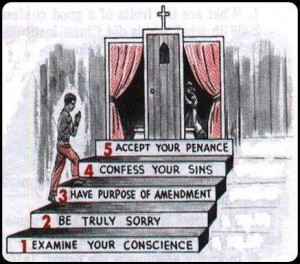
ASK FATHER: Is it a sin to laugh or joke when in need of confession?

penance_confession_stepsFrom a reader…

QUAERITUR:

Is it grave matter to laugh or joke when in need of Confession? (That is, when one has committed mortal sin and intends to go to Confession at the next opportunity.)

Aristotle points out that man is the only animal that laughs.  Critters might look like they are “laughing”, but they aren’t.  So, it’s human to laugh.

Mark Twain points out that man is the only animal that blushes… or needs to.  Hence, because we are sinners, it’s human to blush.

It doesn’t help us to mope around all long-face before confession, though we should indeed pray that we feel remorse and shame and guilt for sins, true compunction, so that we might even blush, at least when alone or when making amends to others.

Latin compunctio is a compound of cum + punctum from pungo, “to pierce, prick”. It means “the sting of remorse”.

Non-stop levity isn’t perhaps your best option in the state of sin.  Neither is relentless melancholy.

So, before making your good confession be penitentially joyful, or joyfully penitent. Be, at the same time, cheerfully remorseful, or remorsefully cheerful.

If, while in the state of that separation from God which we call mortal sin, we truly meditate on our state, we will get to confession as quickly as possible. Right away we should make the very best act of contrition which we can summon. Then we should hie ourselves hence.

Simultaneously, we can be of good cheer because we know that God loves us, that He is already giving us graces to make our good confession, and that, shortly, we shall be shriven.

There is nothing happy about sins, but confession and reconciliation are everything to be happy about.


From the Mass for begging for compunction of heart in the 1962 Missale Romanum:

Omnipotens et mitissime Deus, qui sitienti populo fontem viventis aquae de petra produxisti: educ de cordis nostri duritia lacrimas compunctionis; ut peccata nostra plangere valeamus, remissionemque eorum, te miserante, mereamur accipere. Per Dominum.

Almighty and most gentle God, who, when Thy people were parched, from out the rock drew forth living water, draw now forth tears of remorse from out the stone-hardness of our hearts, so that we may bewail our sins and, as you show mercy, merit to receive their forgiveness. Through our Lord Jesus Christ, your Son, who lives and reigns with Thee in the unity of the Holy Spirit, ever one God, world without end. Amen.

Finally…

GO TO CONFESSION!

Posted in "How To..." - Practical Notes, ASK FATHER Question Box, GO TO CONFESSION, Liturgy Science Theatre 3000 | Tagged , , , ,
5 Comments

Why are certain people afraid of “ad orientem” worship?

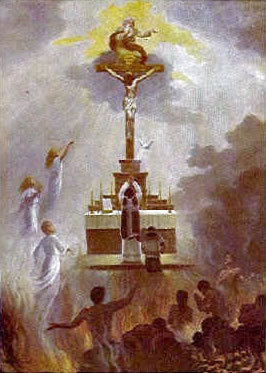
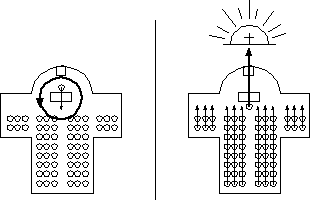
holy-sacrifice-of-the-mass-freeing-souls-from-purgatoryAd orientem worship in the Latin Rite is important just just because, practically, it helps to keep priests and bishops under control (i.e., Mass isn’t about them), it helps to create the necessary conditions for the apophatic experiences which facilitate an encounter with Mystery.  This encounter prepares us for the Four Last Things, death, judgment, heaven and hell.  We all face towards the symbolic liturgical East, because Christians perennially believed that Christ will return from the East, like the glory of the rising sun.   The “eastward” arrangement, priest and people together, for the Eucharistic, sacrificial portion of Holy Mass, has eschatological force.  Rather than being locked into a closed circle among ourselves, we are more manifestly opened to the Lord who is to come.  Not only are we oriented toward the Lord who will come, but ad orientem worship also orients us back through the ranks and ranks of our forebears who worshiped in the same way for the same reasons.  As we hope to connect with the Lord is His splendor, we hope to rejoin our predecessors in their joy.

First Things has made another contribution to the discussion of ad orientem worship, set in motion by the personal appeal made to priests by His Eminence Robert Card. Sarah – The Sarah Appeal™.

Let’s jump in toward the end…

WHO’S AFRAID OF AD ORIENTEM?

[…]

The real issue, I believe, is not restorationism (which, ironically, was one of the mistaken reasons for the introduction of versus populum in the mid-twentieth century) or clericalism (this layman finds his Christian dignity and equality affirmed by ad orientem worship, which makes visible the solidarity of clergy and congregation, as well as the self-effacement of ordained ministers before the Lord). The real issue is much deeper: the Church’s identity in time and eternity. That identity touches on history, Vatican II and its reception, ecclesiology, and eschatology.

[…]

Finally, ad orientem worship raises the issue of the Church’s relationship to its past, present, and future, to its identity across time. Despite Vatican II’s conviction that believers’ commitments as citizens of both the heavenly and earthly cities ought to be mutually reinforcing (e.g., Gaudium et spes, No. 43), we have witnessed a diminishment of the Church’s eschatological awareness. A minor, but telling, example is the title of Chapter VII of Lumen gentium. The Flannery translation, the most commonly used, renders that title as “The Pilgrim Church.” The Vatican website’s translation renders it, more faithfully, as “The Eschatological Nature of the Pilgrim Church and Its Union with the Church in Heaven.” The rejection or marginalization of ad orientem worship feeds this “presentism” and the concomitant eschatological deficit. I am convinced that a significant reason for opposition to ad orientem worship is the sense that it pulls believers away from each other and the “real world,” that it is “churchy” and self-referential. There are, however, few more visible means than ad orientem worship for connecting the Church to its past and future, bodily orienting it in solidarity to its Lord, and thereby contributing to a renewal of the Church’s mission in the world.

Turn towards the Lord.

16_07_19_magnet_01_sm

Posted in Liturgy Science Theatre 3000 | Tagged , ,
25 Comments

Implementing ‘ad orientem’ worship with charity, prudence and courage

ad orientem direction drawingMy friend Msgr. Charles Pope has a piece at the National Catholic Register about celebrating Holy Mass ad orientem. Msgr. Pope is determined to teach his flock about ad orientem worship.  He thinks that Card. Sarah should, in his role as Prefect, issue some guidelines which will help to avoid potential conflicts between priests amenable to the Sarah Appeal™ and bishops who are not.

Let’s see his peroration, with my emphases and comments:

Why We Should All “Face East” During the Eucharistic Prayer

[…]

But let me reiterate the concerns that Cardinal Sarah needs to address to the world’s bishops on this matter. Otherwise the wishes and attempts of priests may prove dead on arrival. While it is true that a priest can use this option on his own, Bishops who are displeased with such a notion can apply a good deal of pressure on priests who seek to fulfill the request. It is not merely that some bishops might be “nasty” about it. Rather, most priests do not seek to do things (and optional things at that) that are displeasing to their bishop or might create dissentions among the faithful. Consensus among priests and bishops to respect the option of eastward orientation and the wish of Cardinal Sarah is going to be important for success in bring forth a wider use of it. Even if a particular priest or bishop does not prefer such an option, an official communiqué from the Cardinal (not just a talk at a liturgical conference) can go a long way to defuse conflicts. A letter “on Vatican stationery” can assist mutual respect in this matter.

Priest too who support the option to face east might also assist the faithful by implementing the option at certain Masses, but not all. We who support the Eastward stance of the Eucharistic prayer have insisted all along that this is an option. And thus we might demonstrate a pastoral solicitude for those who prefer the Eucharistic prayer facing the people even after our teaching. If this thing becomes a liturgy war it will be a countersign and is doomed to failure and overreaction. [It will be a war, I’m afraid, but there are things that we can do to make it short and to avoid lots of damage.  We must move carefully and prudently.  We must avoid what was inflicted on people decades ago in the name of the Council: sudden changes with little or no explanation.  Pope Benedict’s suggested arrangement of versus populum altars would be helpful as a transition.]

To reiterate, an official communiqué from Cardinal Sarah to the world’s bishops is important to preserve charity among bishops and priests. Pastoral prudence is also very important for those of us who would like to more widely use the Eastward option. This will be a hard change for some. And while I feel very strongly that the eastward orientation of the Eucharistic prayer is best, I do not seek to do to others what was done to us all in the late 1960s as changes railroaded through our churches at the hands of enthusiastic clergy but bewildered parishioners. [As I said.]

In a different post at Chant Cafe, Fr. Christopher Smith offers a few practical suggestions on how to introduce ad orientem worship in a parish.

How to Introduce Ad Orientem to Your Parish

[…]

Then, the months leading up to Advent can be a powerful time for catechesis.  Father Jay Scott Newman of St Mary’s, Greenville, has an excellent set of bulletin columns by which he introduced the idea, along with a series of sermons, to his parish.  Excerpting and integrating these into bulletin columns and pastoral letters to the faithful can introduce the idea to the faithful.  [I wrote about Fr. Newman’s initiative, for example, HERE.]

In my own parish, we put into the pews a resource, which explains to visitors and parishioners why what they may see, hear and experience at our parish may be markedly different than their experience in other American parishes.  That resource is given to all new families when they register and is excerpted in the bulletin on a regular basis.  We also invite people at Christmas and Easter to take home the booklets to learn more.

It is a great time to do a book study on Michael Lang’s seminal work  Turning Towards The Lord [UK HERE]. Send a personal invitation to your highest donors, heads of ministries, school faculty and staff, parish employees and members of the finance and pastoral councils.

These months of catechesis leading up to Advent may be geared towards the implementation of ad orientem worship, but can also be used to address some of the lack of catechesis and liturgical confusion all around.  In my own parish we did a book study on Ronald Knox’s Mass in Slow Motion [UK HERE] as well as a sermonseries to which I go back from time to time.

[…]

It is clear that catechesis is the key.

It should be clear, sustained, calm and with a date in mind.

Fathers, bene ambula et redambula.

Posted in "How To..." - Practical Notes, Liturgy Science Theatre 3000, Mail from priests, Our Catholic Identity | Tagged , , ,
39 Comments

PODCAzT 149: Interview with Fr. Richard Heilman – Part 2

In this PODCAzT we hear the the second, shorter, of two parts of an interview I did with Fr. Richard Heilman, pastor of St. Mary’s Church in Pine Bluff, WI a few minutes to the west of Madison.  I’ve written about Fr. Heilman may times.  I help out at that parish on weekends.  I’ve seen some great things going on there.  It occurred to me that what Fr. Heilman is doing there could provide some encouragement, especially in the wake of Card. Sarah’s appeal to priests to start saying Mass ad orientem.

In the first part, Father spoke about an unusual situation he faced at the beginning of his pastorate, about moving his parish to ad orientem worship for all Masses and the influence learning the Traditional Latin Mass has had on him.  He also talks about working with groups of men.

In this part Father talks about confessions and confessionals (face to face or behind the screen), his Combat Rosaries and the Swiss Guard (I wrote on that HERE), and about his Scapular Crucifix.

Fr. Heilman’s blog is HERE.

In this PODCAzT we switch musical gears.  You might hear along the way something in honor of Pope Francis, whose favorite music is tango.

PODCAzT 149: Interview with Fr. Richard Heilman – Part 2

UK HERE

148 16-07-09 Interview with Fr. Richard Heilman – Part 1

Posted in Mail from priests, PODCAzT, Priests and Priesthood | Tagged , , ,
4 Comments

Aspirants to Religious Life, Priesthood, DEBT, and You – ACTION ITEM!

action-item-buttonI occasionally get email from people who want to enter convents, monasteries, seminaries, but they are held up on account of debt, mostly from education loans.  They usually have some crowd-funding page by which they are trying to raise money to pay off their debt and get on with the testing of their vocation.


Please use this entry to post about this aspirants to the priesthood or religious life.

Then… HELP THEM OUT!

Even small amounts given by a large number of people can add up quickly.

The sort of person who would write to me asking for help for himself or herself, or on behalf of another, are more than likely the sort of people we really need entering convents and seminaries.

And also please consider subscribing to making a monthly donation to give me a hand and to keep this blog going.  If you are regularly checking this blog and you have benefited from it, please pitch in.

Posted in ACTION ITEM! | Tagged
26 Comments