ASK FATHER: Send electronic donations to parish by texting during Mass?

From a reader…

QUAERITUR:

I’m not a registered user of your blog but I do “lurk” on a daily basis. I would appreciate it if you could comment on the following which was written up in our Sunday (Nov. 8th) Bulletin.

“Next Weekend is “Text to Give” Weekend- Don’t leave your cell phone at home or in the car. Bring it with you to Mass. Next Sunday is “Text to Give” Weekend throughout the Diocese. Parishioners who haven’t made a pledge or a gift, or who wish to increase their gift, will be able to do so by texting on their cell phones to support the ministries made possible by the Annual Appeal. Open your heart. Share your gifts. Text “GIVE” to the Annual Appeal.”

I went to the Diocesan website to see whether this was just a local parish thing or for the whole diocese. Apparently there are follow-up bulletin inserts for next Sunday (Nov. 15) for all parishes in which they say “TEXT the word “Give” to 64600″ I was taken aback when I read the insert and can’t believe that they actually want people to “Bring it with you to Mass.” I don’t know if we are going to be asked to do this during Mass or not (I already sent my contribution by snailmail several weeks ago) but, I’m just struck by the fact that nothing is sacred anymore. I can only pray. Please comment.

I’m on the fence.  I guess so.

How the Church adapts to modern technology has been controversial. There were probably protests over the first uses of electric lights in churches.  “If candles and whale oil lamps were good enough for our parents, they’re good enough for us!” “Codex?  No! The scroll forever!”

Some uses of modern technology don’t fit with Mass.  I have in  mind the dreadful use of a projector to project the words of the hymns on blank walls… although how different that is from the medieval Exsultet roll, I’m not sure.  Congregations were not expected to sing the Exsultet, for one thing.

People are not used to seeing new-fangled things in church.  Someone following the texts or chants of Mass are thought by others (of a certain age) to be “playing with their phones”.

Fewer and fewer people carry cash these days.  They pay for their coffee in the morning, their lunch, their theater tickets, their hotel rooms, with smart phones.  Once upon a time, instead of bringing bottles of olive oil and live chickens for the offertory, they started giving small round pieces of metal stamped with images.  Pretty edgy.

Why not make it possible for people to make donations using smart phones?   As a matter of fact, you can give me donations using your smart phone.  And you should!  And, if you meet me in person, using my phone I can take credit cards.  We have to move with the times.  The technology is neutral.

On the other hand, the immediately more human is the preference in our sacred worship.  For example, the unamplified human voice is preferable to the electronically amplified.  Music produced by people, rather than recorded music, must be used.   Wax candles, not electric.  Pipe organ rather than electronic.  Et cetera.

It would be at least cheesy were there to be a “ceremony” involved with taking electronic donations… “When the deacon raiseth on high the bronze serpent, press ye then the “send” upon the iPhones.”  A collection basket icon appears on your screen, you put in the amount you want to give and… swoosh!

I don’t see anything sacrilegious about it.  Just keep it short and clean.

While we are at it…


ASK FATHER: Send electronic donations to parish by texting during Mass?

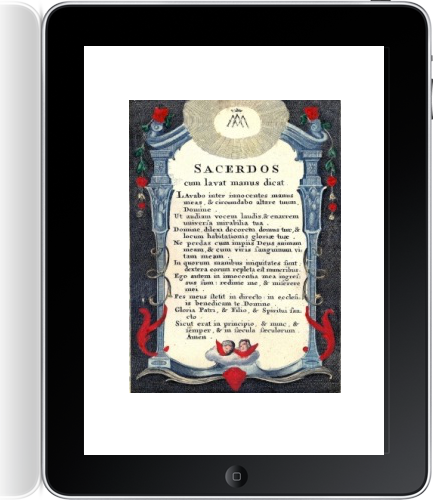
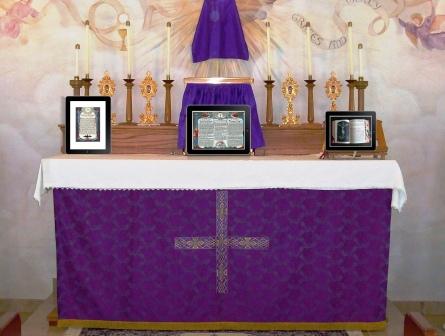
And remember… it takes 4 iPads for the Traditional Latin Mass.  Think beyond the Missal to the altar cards:

ASK FATHER: Send electronic donations to parish by texting during Mass?

Here’s a Passiontide set up.

ASK FATHER: Send electronic donations to parish by texting during Mass?


Posted in "How To..." - Practical Notes, ASK FATHER Question Box | Tagged , , ,
16 Comments

The historical view – the “long view” – Wherein Fr. Z rants.

Pope Francis is confusing.  Reasonable people won’t deny that.  He is confusing to both the Left and the Right, as well as the tepid, but for different reasons.

Some people are really upset by him.  I spend quite a bit of energy in email and conversations talking people down off the ledge.  That’s the part of the blog that you don’t see. Posts like these are my PSAs, public service announcements, as it were.

In several posts, one recently (HERE), I have advocated a “long view” of the pontificate of Pope Francis.  For example…

I’ve advised elsewhere that if this pontificate, or perhaps “parenthesis”, is getting you down, then stop paying so much attention to the news.  That said, some of you who are tough and well-balanced – not likely to fly off the nearest window ledge at the mention of turmoil in the Church – should know what is being said.  On the one side there is the rah rah rah from the catholic libs who think that Pope Francis is the 7th Apparition of Vishnu (whom I believe they may prefer to worship rather than the true King of Fearful Majesty) and those who are boo boo boo Pope Francis is bringing on the eruption of Mount Doom.

I am trying to take the longer view.  I remind myself that each pontificate is a parenthesis in the long history of the Church and of our Salvation.  This parenthesis will close one day and another will open.

[…]

I advocate the long-term view.  

Pontificates are parentheses.  Some are short, some are long.  Some are important, some are not.  God opens them and closes them according to a plan we cannot see.

At The Catholic Thing Fr. C. John McCloskey has much the same view about what’s up in the Church these days:

I am a Church historian, and received a doctorate in this discipline from a pontifical university. I bring this up because of the great controversies in the media around the world surrounding the recent meeting of the bishops in Rome for the Synod on the Family, which happily has now ended without any change in traditional Catholic teachings.

This did not surprise me at all, and should not surprise any Catholic, for the simple reason that the teachings of the Church that are considered dogma cannot be changed by anyone, including the Holy Father. Let us not forget that the Church always has the help of the Holy Spirit, as Christ promised, and will continue to have it until the end of time. We should remain certain of that, because it is the truth. And, resting in that truth, we should not be surprised at any time to witness the unfaithful misinterpretations of those who consider themselves Catholics, but whose interest is in trying to confuse the faithful, as if the Church were man-made rather than God-made.

The reality is that the Church will always be under attack and has been from the beginning, whether those attacks take the form of controversies or of physical attacks on Christians who then become “martyrs” (meaning witnesses) of the truth.

[…]

It’s especially at times like these that we should not let passing troubles disturb us, but find confidence in the record of how the Holy Spirit has preserved the Faith in ages like ours – and even worse.

Read the rest there.

While I emphasized the long view forward with regard to Church’s histories of turmoils and challenges from within and without, that the present chaos will eventually resolve, Fr. McCloskey emphasized the long view backward to give us perspective about how the Holy Spirit has maintained the Church through thick and thin.

Both approaches remind us that we are not just isolated in the “now”.  The Church is not just of the present moment.  There is a long past that teaches us who we are and points towards where we are moving, the eschatological dimension, our ultimate goal.

It is easy to get worked up about things that are going on in our day, because current events distract us from the larger picture, past and future. Not every pontificate (parenthesis) or event, such as a synod or council, are equally important in the large scheme that God has for the Church.

The historical view - the "long view" - Wherein Fr. Z rants.I am reminded of Joseph Ratzinger’s observations about councils.

“Not every valid council in the history of the Church has been a fruitful one; in the last analysis, may of them have been a waste of time.  Despite all the good to be found in the texts it produced, the last word about the historical value of Vatican Council II has yet to be spoken.” In Principles of Catholic Theology: building Stones for a Fundamental Theology. San Francisco: Ignatius Press, 1987, p. 378.

There are councils and synods and pontificates (parentheses) which, frankly, didn’t help us much one way or another and others which were, frankly, pretty awful.

But we went forward.

And today, who thinks of Lateran V?   Who thinks of Urban VII (+1590), whose reign was 13 days.  He seems to have been a beautiful soul!  Check his story in the Catholic Encyclopedia.  Not to take away anything from his holiness or preparation, malaria made him into a mere placeholder, a blip, before the pontificate of Gregory XIV (about whom I’ll bet you know nothing about … he was consecrated by St. Charles Borromeo and was a friend of St. Philip Neri).  He was Pope for less than a year and managed to get a few things done.

Frankly, in the long run, Vatican II will not be held as being all that important in the Church’s history.  It caused a ruckus – for us – but… what did it define?  To my mind, Vatican II is relatively insignificant compared to certain other Councils, such as Nicea I, Constantinople I, Ephesus, Chalcedon and Trent, to name just a few.

Vatican II?  Blip.

Without a historical perspective, it’s easy to get drunk on the ephemera of current events, the stuff that seems so very important because it’s close to us.

The historical view - the "long view" - Wherein Fr. Z rants.

Click

Fr. McCloskey, at the end of his piece, recommends a couple of accessible books to help people put things in perspective.  He recommends… Don’t Know Much About Catholic History: From the Catacombs to the Reformation by Diane Moczar and The Church Under Attack?, by the same. I have not read those, but I trust his choice.

The historical view - the "long view" - Wherein Fr. Z rants.And as far as Vatican II is concerned, don’t be bamboozled by the Bologna school of thought.  At least try for another interpretation and perspective, keeping in mind Benedict XVI’s amazing address to the Roman Curia before Christmas 2005 (one of the most important moments of his parenthesis/pontificate).  Try, for example, Wiltgern’s The Rhine Flows Into The Tiber and Marchetto’s The Second Vatican Ecumenical Council: A Counterpoint for the History of the Council.

Some of you might have your own suggestions.

Posted in The Drill, Wherein Fr. Z Rants | Tagged ,
29 Comments

Wherein Fr. Z, who died a painful death, is … STILL ALIVE?

Wherein Fr. Z, who died a painful death, is ... STILL ALIVE?

Do you not have a Kindle yet? What’s wrong with you? Click HERE! End your suffering now!

Long time readers might remember that I was killed a while ago.

I have been a character in some sci-fi books.

HERE

Chris Kennedy has been turning out some highly entertaining sci-fi books in which he includes “red shirts”.  After I read the first series, I contacted Kennedy and became a “black shirt” in a couple of the books.

As I wrote before, Kennedy’s books are not exactly Tolstoy… or even Azimov.

They are sort of … Galaxy Quest meets The Magnificent Seven meets Stargate meets Indiana Jones.

Kennedy’s first book, is here: Red Tide: The Chinese Invasion of Seattle (Occupied Seattle Book 1)

Wherein Fr. Z, who died a painful death, is ... STILL ALIVE?

Click!

Eventually, I was killed.

Or was I?

The second book of a trilogy that Kennedy is working on now is out and it seems that …

I’M NOT DEAD AFTER ALL!

As a matter of fact, when I (alive) am discovered, I have a pretty funny line, which people paying attention to the Church will understand.

Here’s the moment I (alive) am found:

“Let’s go,” Nightsong added, motioning Calvin through the doorway into the new chamber. As he entered the room, Calvin saw a familiar figure off to the side.

“Father Zuhlsdorf!” he cried, running to where the priest was zip-tied to a chair. The priest had seen better days and, judging by the wounds and bandages, had been subjected to an enormous amount of torture. Father Zuhlsdorf’s head was on his chest, but when he heard his name, he lifted it and tried to focus bleary eyes on Calvin. “But… you’re dead,” Calvin said. “Nothing so exciting… as a return from… the Existential Peripheries,” the priest replied.

So… it seems that I survive!

Or … DO I?

You’ll need to find out on your own.

Anyway… the new book is called…

Beyond the Shroud of the Universe (Codex Regius Book 2)

Wherein Fr. Z, who died a painful death, is ... STILL ALIVE?

UPDATE:

Great battle descriptions.  Just sayin’  It’s hard to write that stuff.

Posted in Just Too Cool, Lighter fare, Linking Back | Tagged ,
13 Comments

Your Sunday Sermon Notes

Was there a good point in the sermon you heard for your Sunday Mass?

Let us know.

Meanwhile, here are two shots from this morning’s Mass at St. Mary’s in Pine Bluff.

With the new vestments I recently bought in Rome.  I blessed them before the Asperges.  

What beautiful blessing prayers!

Sample:

Almighty everlasting God, who decreed through Moses, your servant, that the vesture of high-priest, priest, and levite, used in fulfilling their ministry in your sight, should be worn to dignify and beautify the worship rendered to your holy name; mercifully heed our prayers, and be pleased, through our lowly ministry, to bless ~ these priestly vestments (this priestly vestment), bedewing them with your grace, so that they become hallowed and suitable for divine worship and the sacred mysteries. Let every bishop, priest, or deacon clothed in these sacred vestments be strengthened and defended from all assault or temptation of wicked spirits; let them perform and celebrate your mysteries reverently and well; and let them always carry out their ministry in a devout and pleasing manner; through Christ our Lord.

This looks like the moment before the Gospel.

15_11_08_Mass_01

15_11_08_Mass_02

Worthy of Norman Rockwell.

I spoke of how God’s omnipotence is manifested in mercy and addressed the perennial question of why God allows the wicked to keep at it.  God is patient.  He allows wickedness before he chastises.  Remembering the words of Augustine, perhaps one day the weeds will become the wheat!  We have role in people’s lives.

Some of you might recognize this as the church where the the Diocese of Madison’s Extraordinary Ordinary, Bp. Robert Morlino, had a Pontifical Mass at the Faldstool a while back (yes… at the faldstool, even though he is the bishop).  Your’s truly is MC standing slight behind and to the Epistle side of the sacred ministers.

I, vigilant, watch to make sure they are observing the rubrics.

Your Sunday Sermon Notes

In January we will have Pontifical NUPTIAL Mass at the same Church.

Posted in SESSIUNCULA |
17 Comments

ASK FATHER: Father told penitent to go to a different priest

12_08_16_confessionFrom a reader…

QUAERITUR:

Last year during Advent, my parents went to a Confession service at a parish different than theirs and my dad had an unusual situation. This particular parish has a large Hispanic population, so they had several bilingual priests available. My dad entered the confessional and he barely got through saying Bless Me Father, when the priest informed him if didn’t speak Spanish he should go into another confessional even though this priest spoke English just fine. My dad was rather upset about this. Should the priest have heard his confession, even if my dad had unknowingly entered the Spanish line?

Would that we all spoke Latin so that we could understand each other, worship in one language, and read Leo the Great, Augustine, and Lee Child in the original language. Sad, but it is not so.

There could be circumstances whereby a confessor might ask someone to go to another confessor, if there were a language barrier.

In this case, it seems that the confessor didn’t have difficulty communicating in English (though he might have). It might have been the case that there was only one priest at the Penance Service who was fluent in Spanish, and with a preponderance of Spanish speaking penitents it made sense to reserve his confessional for the merely Spanish speaking sinners.

Still, that seems a little blunt for a confessor. He caused the penitent some embarrassment (having to leave the confessional and then immediately get into another line).  Also, this sort kind of experience could provides people with an excuse to avoid the sacrament altogether and also bad mouth priests.

Fathers, welcome penitents into your confessional. Don’t shoo them away!

I hope your father got over whatever anger or embarrassment he may have felt and that he found another priest to shrive him.

Remember that priests, too, are people, and sometimes have bad days.

Don’t let Father’s bad day, or bad temperament, or silly comment imperil your eternal soul!

Review, please, my 20 TIPS.

Posted in SESSIUNCULA | Tagged , ,
5 Comments

ASK FATHER: The pastor anoints everyone at Mass, sick or old or not – everyone.

last rites extreme unction anointing viaticum 02From a priest …

QUAERITUR:

Every year at this time, my pastor has a communal anointing of the sick at mass. At the mass, everyone gets anointed, whether they need it or not. Is this correct? What should I, a lowly curate, do about this?

First, tread carefully.  The care of souls is the pastor’s and you assist him.  That said, it may be that the priest is not well educated about the sacrament, especially if he is of a certain age group.  Depending on your relationship with him, you might open up a discussion with him about the Sacrament of Anointing, telling him about some interesting things you read recently.  Hopefully the priest, once better informed, will not just cave in to the false expectations that people have by now and, thus, continue to abuse the sacrament rather than do the right thing (i.e., stop anointing everyone).

The Second Vatican Council said that “’Extreme Unction,” which may also and more properly be called ‘anointing of the sick,’ is not a sacrament for those only who are at at the point of death.  Hence, as soon as anyone of the faithful begins to be in danger of death from sickness or old age, the fitting time for that person to receive this sacrament has certainly already arrived.” [SC 73]

Let us remember that Anointing was and still is called Extreme Unction… the word “Extreme” does not mean that you are giving it on a skateboard or you are using huge amounts of oil. It means that a person is “in extremis“, that is, “in danger of dying”, as in, soon, in the final moments.

Another problem is that everyone is always in danger of death. However, we make distinctions.  We are always in danger of death from, say, a meteor, a drunk driver, a stray bullet from a drive by shooting, scaffolding falling from on high, earthquakes, etc.  These are all external to us.  There are other dangers that are internal to us, such as fourth stage pancreatic cancer, a known aneurysm, the massive gunshot wound that tore the femoral artery, being 93 years old, being 93 and getting pneumonia, etc.

So, the factors of old age and illness are internal  to our persons.

That said, the law – based on the Church’s teaching – is pretty clear.

Can. 1004 §1. The anointing of the sick can be administered to a member of the faithful who, having reached the use of reason, [thus, the ability also to commit mortal sins] begins to be in danger due to sickness or old age.

This doesn’t say “everyone”.

The Catechism of the Catholic Church says:

1514 “The anointing of the sick is not a sacrament for those only who are at the point of death. Hence, as soon as anyone of the faithful begins to be in danger of death from sickness or old age, the fitting time for him to receive this sacrament has certainly already arrived.”

Common points? Danger of death… sick and old age.  Not “everyone”.


Some of you might be saying “But Father! But Father! You really hate Vatican II! Vatican II did away with rules. This is the age of mercy! Pope Francis said so! All sacraments should be given to everyone all the time. You make me cry. That means that you must do what I want.  I need to be anointed now.”

Dear Cry Baby.  It is my job to keep you out of Hell.  Therefore, it is my job to say “No!” more often than it is to say “Yes!”.

Let’s not abuse what God has given us, especially something as solemn as a sacrament intended to help us die well.

One of the serious ways to abuse this sacrament is to administer it higgledy-piggledy.  Why?

There is an old distinction about sacraments of the dead (baptism and penance), and sacraments of the living (the other five).  Sacraments of the dead bring you out of spiritual death into life.  Sacrament of the living are to be received by the spiritually alive, in the state of grace. Otherwise, they don’t bring you all that you need from them, even if they are validly conferred.  For example, a man and woman validly marry in the state of mortal sin, but they don’t have the actual graces of the sacrament until they are in the state of grace.  A confirmand or ordinand in the state of mortal sin are ontologically changed by their sacraments, but they don’t enjoy all the benefits of being confirmed or ordained until they return to the state of grace.

Even when a person begins to be in danger of death from old age or illness, the Sacrament of Anointing should – if possible – be received in the state of grace.  If a person is incapacitated, the Sacrament of Anointing also forgives sins, but if a person is capable of confessing he should confess properly and receive absolution before being anointed.

Again, the Sacrament of Anointing, or “Extreme Unction”, unless there is urgent need or incapacitation,  should be preceded by sacramental confession of sins.

These “anointing” Masses could be a great moment for catechesis and spiritual renewal.

At such a Mass it would be good to explain what I explained above, adding what the effects of the sacrament are and aren’t (i.e, it is not just to make people feel good or feel like they belong – which is what Communion is turning into – it is not a moment to “get something”).  They should know that they should receive it in the state of grace.  Therefore, there should be confessors available to hear their sins in regular auricular confession before being anointed.  It could be a two step process.  Catechesis followed by confessions and then the Mass.

Anyway… good luck with the parish priest.


Posted in "How To..." - Practical Notes, ASK FATHER Question Box, Liturgy Science Theatre 3000, Mail from priests | Tagged , , ,
25 Comments

UPDATE: Our Saviour Church in Manhattan – “Hare Krishna!”

A reader alerted me to something at Fr. Rutler’s former parish in Manhattan, Our Saviour Church.

Screenshot:

15_11_07_OurSaviour_Krishna_01

At Dandavats we find the video:

Caption:

Devotees conduct kirtan in a Christian church, New York (1 min video)
In late September, a few friends and I were asked to organise and participate in an interfaith prayer session in New York City. Members from The Bhakti Center led kirtan for an hour.

Play video

Just thought you would like to know.

Posted in You must be joking! | Tagged , , ,
57 Comments

CQ CQ CQ #HamRadio Saturday: Calls, clubs and cables

ming flash gordon ham radio

The ultimate objective…

Now for another edition of Ham Radio Saturday.

I created a page for the List of YOUR callsigns.  HERE  Chime in or drop me a note if your call doesn’t appear in the list.

The first Ham Radio news of global importance is that …

… my call sign changed!

KC9ZJN is now…

15_11_06_W9FRZ_front_10 copy

The new card.  So, you reader hams, we need some contacts so I can send a few of these.

I haven’t made many contacts with the new call sign yet, since I wanted to wait until it also got into QRZ.com.

When I was notified by the FCC, I switched on the rig and made a DX contact saying “Whiskey Nine Foxtrot…” which cuts through better than “Kilo Charlies Nine…”.

So… that’s done.

The next item involves the possibility of setting up a station and shack here in the Diocese of Madison with a club.  At a local parish where I say Mass on Sundays there is an old school that has some storage space that can – and will – be reallocated.  My local Elmer and I met the pastor and scoped out the place.  We also looked at where antennas could go and of what sort.  It’l take some elbow grease, but it can be done.  Furthermore, I have found at least four hams from the parish who are interested in forming the core of the club, so that we can get a call sign.

Brick by brick.

Another bit: thanks to WB0YLE who gave me a gift of credit at Ham Radio Outlet.  They assign credit to your call sign and you can use it at any of their stores.  You have to call in your order, but that’s not a big deal.   I used some credit to buy a 100′ long high quality cable so that I can get my antenna down on the ground rather that on my re-rod reinforced balcony.

Look how thick this stuff is.  Whew.

CQ CQ CQ #HamRadio Saturday: Calls, clubs and cables

CQ CQ CQ #HamRadio Saturday: Calls, clubs and cablesAlso, I solved an intermittent SWR problem that I was having with my portable SuperAntenna.   There is a whip antenna on the top of the coil.  The whip is to be extended all the way.  However, there is a little hitch in one of the tubes of the antenna that made me think that it was extended all the way… when it wasn’t.  Once I discovered that, and I powered by the little sticky part, and got it correctly extended, the SWR dropped.

Anyway, my Saturday looks pretty flexible and it looks like it’ll be a sunny day.  I may give myself a field day and go to the parish cemetery again (HERE and HERE) and – after praying for the dead to gain an indulgence (hopefully plenary) – see what happens.

That’s the update for this week.

W9FRZ (olim KC9ZJN)
73


Posted in Ham Radio, What Fr. Z is up to | Tagged , , ,
62 Comments

Thompson on Bad Church Music (BCM). Wherein Fr. Z rants.

Sacred liturgical music is NOT an add-on in worship. It is – and must therefore be treated as – an integrating part (pars integrans) of liturgical worship, since it is prayer, liturgical music must be both sacred and also art.

The texts must be sacred texts and appropriate for the moment they are chosen.  Moreover, the idiom of the music must be a sacred idiom, or at least not opposed to the sacred.

And, as should be obvious but clearly isn’t in 90% places you will visit, the music must be good, that is, well-composed, of high artistic value, and it must be performed well.

Music for liturgical worship must be sacred and it must be art.

If the music does not fulfill those criteria, it does not belong in the Mass.

The music itself becomes prayer within the liturgical setting.  People pray also by listening to true sacred liturgical music.  It is prayer.

Some people object that “artistic” music distracts from “prayer” (or what they think is prayer).  Wrong.  You cannot be distracted from prayer by prayer.  The key is learning how to engage is authentic active participation, which is primarily willed, active, interior receptivity.

We cannot go wrong when we stick to the texts actually assigned by the Church for each Mass or office.  We cannot go wrong when we use Gregorian chant and polyphony and the pipe organ, as the Fathers of the Second Vatican Council established as having the first place among all genres of music for sacred worship.

The problem of bad music in our churches is huge.  It is central to much of the crisis of identity we are facing.  The dumbing-down of everything Catholic over the last few decades as been devastating.  Music is such a powerful influence on us. The massacre of music has been catastrophic.

In the UK’s best Catholic weekly, The Catholic Herald, there is a piece by Damian Thompson on bad church music (BCM).

He begins:

“Extraordinary how potent cheap music is,” says a character in a Noël Coward play. And it’s true. Even in church. A morbid Victorian hymn or a Christmas carol can reduce even the most cynical atheist to tears.

But even more potent, I’d argue, is church music that isn’t so much cheap as embarrassingly bad.

I can’t speak for other denominations, but I’m convinced that the distinctive awfulness of the music in many Catholic parishes helps explain why Mass attendance has fallen off a cliff since the 1970s.

[…]

And…

[…]

Bad Catholic Music (BCM for short) is uniquely inauthentic. It doesn’t sound like any other sort of music. Whether “inspired” by folk, jazz or chant, BCM has the knack of always sounding more or less the same.

There’s no precedent in the history of church music for such a clumsy cobbling together of musical ideas and styles.

[…]

He goes on to name names of some of the decomposers we have all suffered from (Joncas, Haugan, Inwood) and includes on the brilliant lines from Thomas Day’s nearly classic book Why Catholics Can’t Sing:

The “moaning and self-caressing quality of the music”, writes Day, “indicates that the real topic of the words is not the comforting Lord but ‘me’ and the comforts of my personal faith”.

Damian is not optimistic.

[…]

That was in 2007, when Benedict XVI was in his prime. Anti-BCM choirmasters were reintroducing chant and polyphony to Catholic parishes – but quietly, because there was always the risk of being shopped to the diocesan authorities.

Eight years on, how much progress have they made? In the south-east of England and certain university towns, quite a lot. Young, middle-class practising Catholics take a counter-cultural delight in traditional worship. They’ll travel a long way to avoid what Thomas Day calls the “studied whimsy” of BCM, whose elevator-music harmonies sound quaint to anyone born after 1990. Some of them will join choirs to sing Byrd and Victoria; there are a surprising number on Facebook.

But, in the end, I’m sceptical of conservative musicians’ claims that Catholic music will recover as soon as congregations discover the simple joys of of plainchant, whether in Latin or English.

[…]

We face a lot of problems in improving the qualities of music used in church (to make it truly sacred and artistic).

First, it costs money to hire good musicians. We have to be willing to stick the crowbar in and pry loose some cash.

Next, priests tend not to know much about music. I know a few priests who are exceptions, of course, but a) they are few and b) they are not young. Priests don’t get any real training in music in seminary. I’d say 90% of priests ordained in the last 10 years couldn’t name 5 serious composers of real Catholic sacred music. They’ve never heard it. They know – sort of – what Gregorian chant is, because it remains a point of contention and it was being revived in places during the pontificate (parenthesis) of Benedict XVI. But, for the most part, priests don’t know music.

Furthermore, the young guys don’t know Latin.  It’s not their fault, of course.  But – and this is a big hurdle – having been denied Latin (which law required be taught to them and the people who didn’t are, in my opinion criminally negligent) they don’t even know what they don’t know.   The loss of Latin means that the doors to the vast treasury of truly sacred and artistic Church music were slammed on them. They don’t even know the treasury is there much less how to unlock it.

Also, priests know that to change the music means having fights. The good ones already have fights to eliminate the gross abuses left from their aging-hippy predecessors and the entrenched aging-hippy liturgy team and now geriatric hippy pop-combo that likes to be watched up in front. It is hard to want to start something that they know will provoke another stream of bitchy letters from women with short gray hair to the bishop about how he is trying to “turn the clock back”, and how they want their “traditional” songs like “Gather Us In”. Of course there is nothing traditional or liturgical about “songs” at Mass and the ditties they think are traditional are laughably bad.

What is needed not just a priest who understands music, or understands that he doesn’t understand music but knows he has to find the right people, and not just willingness to spend money (and raise it, if needed), and not just willingness to fight the fights that will surely follow. No. What is also needed is a bishop who doesn’t suffer from the same ignorance and reticence to fight (or cowardice).   Bishops have to take this matter in hand. Instead, bishops are distracted into a hundred other drainpipes and rabbit holes which we are now convinced are “really important”.  I, however, contend that no fancy initiative we undertake in the Church will succeed unless and until we revitalize our sacred liturgical worship.  That means that that is where the time, talent and treasure have to go!  Revitalization of our sacred worship!

We have to be willing to have the fight.  We must be willing to have the civil war and the moaning, carping letters with their threats and tears and half-baked notions of the “spirit of the Council”.  No… now it’s of Francis!

We have to be willing to convert people to Catholicism and, therefore, risk having them walk away from us because our message is toooo haaaard.

Our architecture for our churches reflects who and what we believe the Church to be. Our vessels and vestments and other Church appointments both reveals and reinforces what we believe happens at Holy Mass.

So does our liturgical music.

A constant stream of shallow, crappy music that was bad even when it was new, will by now have eroded the faithful into something bloodless, weak and shapeless. Compound that will a church – rather, worship space – that looks like a municipal airport cum movie theatre, cheap vessels, lack of decorum, egalitarian notions of “ministry”, pointless abstract windows, constant yakking and distractions and… over, say, 40 years you will wind up with… what?

The Catholic Faith? The Catholic Faith that can help people get to heaven while withstanding the assault of the world, the flesh and the Devil?

A couple generations are gone now.  Are we going to ruin yet another?

You know what I think we have to do.

Is it too late to correct this?

Thus endeth the rant.
Posted in Hard-Identity Catholicism, Liturgy Science Theatre 3000, Wherein Fr. Z Rants | Tagged , ,
45 Comments

Reducing Christianity to a fading smile

I direct the readership’s attention to a provocative piece at The Catholic Thing about an effective weapon perennially deployed to destroy Christianity. It is one of which the Serpent has long made use.

The Cheshire Cat

The let’s-destroy-Christianity project has been underway for more than three centuries now, but it is only in the last half-century that the anti-Christians discovered their most effective weapon.

[…]

We are living in an era when Christianity, like the Cheshire Cat, is gradually fading away in the world’s most modernized countries. The Cheshire Cat left only a smile behind. Liberal Christianity, both Protestant and Catholic, is also leaving something like a smile behind, a smile that says, “I’m a great fan of Jesus, the guy whose deathless message is summed up in the magnificent words, ‘Judge not, that you may not be judged.’”

Posted in Our Catholic Identity, The Coming Storm, The future and our choices, The Olympian Middle | Tagged
8 Comments