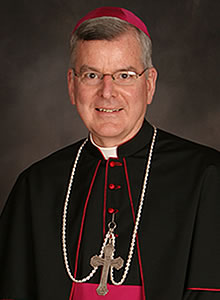
Archbp. Nienstedt: “A serious threat to religious freedom… radical secularism at its epitome” – ACTION ITEM!

There is an ACTION ITEM below.  I also call on bloggers who are reading this to pick it up.

From His Excellency Most Rev. John Nienstedt, Archbishop of St. Paul and Minneapolis in The Catholic Spirit.  My emphases and comments:

A serious threat to religious freedom

September 15, 2011 8:00 am
Archbishop John C. Nienstedt

[…] [T]here has arisen a very serious threat to the religious freedom of all religious institutions, especially our Catholic health care programs and Catholic social services, a threat posed by the U.S. Department of Health and Human Services.

Under HHS Secretary Kathleen Sebelius (a Catholic), [I am glad H.E. mentioned this.  She says she is CATHOLIC.] the department is imposing a “preventative services” mandate requiring all private health plans — including ones administered by the church and its agents — to provide coverage for surgical sterilizations, prescription contraceptives approved by the FDA, and “education and counseling” for “all women of reproductive capacity.

Seismic change in approach

Unfortunately, this is the logical result of a seismic change in this administration’s approach to religious groups involved in providing social services to, among others, the poor, the homeless, the sick, the immigrant.

It began when President Obama and Secretary of State Clinton started using the term “freedom of worship” as distinct from what we have always known as “freedom of religion.”  [Qui bene distinguit, bene docet.]

Under the concept of “freedom of worship,” church agencies are restricted to hiring employees only from their own denomination and providing services for clients only from their own denomination
.

Such a concept restricts Christian believers in their charitable outreach to society and, in effect, encloses them within their own sanctuaries[Sounds like the usual, liberal “rawlsian” approach: side-line as obstacles all positions which don’t fit in the desired consensus those in power are trying to bring about.]

This is radical secularism at its epitome. It is an affront to the centuries of Christian service offered by churches to clients of all backgrounds, color or creed. And, it is the slippery slope to a completely secularized state wherein people of religious conviction will be required to privatize their beliefs and in doing so, at least for Catholics, render their faith meaningless[Meaningless might be a little strong, but the Christ, the Perfect Communicator, gave the Church a command to communicate in Matthew 28:19: “Going therefore, teach ye all nations; baptizing them in the name of the Father, and of the Son, and of the Holy Ghost.” We have a faith we practice ad intra and a faith we must practice ad extra.  Furthermore, this ad intra/extra dynamic was an essential goal of the Second Vatican Council.  What is going on here is a secularist effort to marginalize the Church and drive a Catholic voice from the public square.  This will be easier to do the weaker our Catholic identity becomes.  This is why I am constantly ranting about a “Marshall Plan” for the Church.]

Action steps

I highly recommend two steps.  The first is to write Secretary Sebelius (U.S. Department of Health and Human Services, 200 Independence Avenue SW, Washington, D.C. 20201) or your congressional officers to oppose this mandate and to demand that it be rescinded. These letters need to be received before the end of September. [Get that?  END OF SEPTEMBER.]

Secondly, letters should also be sent to federal congressional representatives to support a bill, [NB] the “Respect for Rights of Conscience Act,” (H.R. 1179, S. 1467), that would protect conscience rights in the Patient Protection and Affordable Care Act (PPACA). This legislation is needed even more so in face of HHS’s mandate to require all private institutions to cover contraceptives and sterilizations.

As Cardinal DiNardo, chair of the USCCB Pro-Life Committee, wrote last week:

“Those who sponsor, purchase and issue health plans should not be forced to violate their deeply held moral and religious convictions in order to take part in the health care system or provide for the needs of their families, their employees or those most in need.  To force such an unacceptable choice would be as much a threat to universal access to health care as it is to freedom of conscience.”

(The cardinal’s letter can be found online HERE).

Lesson from history

The “preventive services” mandate is a significant threat to religious freedom that should put all Catholics on notice that there are many in government and in our culture who will sacrifice long-held and cherished liberties on the altar of so-called reproductive autonomy.

I ask you to join with me today in taking action to preserve our religious freedom and conscience protection.  History reminds us that “evil triumphs when good people do nothing.

This is a time for believers to act and let our representatives in government know that this is an unacceptable course of action!

God bless you!
WDTPRS KUDOS to Archbp. Nienstedt.

He did not flinch from using the word “evil”.

He urged people to WRITE.

Perhaps some readers here will have some language and strategy suggestions.

Posted in "How To..." - Practical Notes, Fr. Z KUDOS, New Evangelization, Our Catholic Identity, The Drill, The future and our choices, The Last Acceptable Prejudice | Tagged , , , , ,
27 Comments

NCFishwrap promotes… wait for it… Ember Days! Yes, you read that correctly.

Over at the National catholic Fishwrap today one Charles Morris has a rather positive piece about Ember Days, which traditionally fall this week.  Readers here know all about Ember Days.  It is nice to see that readers at NCF will have some exposure as well.

Mr. Fr. Morris [I was informed after posting this that the writer is a priest of the Archd. of Detroit… my apologies.] has some good comments and then treads into eco-friendly stuff.  I am not against eco-friendly stuff, so long as it is rational.  Moreover, Pope Benedict has offered some starting points for a theology of ecology.  But I digress.

Let’s have a look at Fr. Morris’ piece, in an irenic eco-friendly spirit, with my emphases and comments.  I edited.

Ember Days in the 21st century
by Charles Morris on Sep. 20, 2011

Once not so long ago, this coming Wednesday (Sept. 21) would be marked as a day of fasting and abstinence. So would Friday, Sept. 23, and Saturday, Sept. 24. The church marks these three days as the fall Ember Days.  [There is something of a confusion of tenses here. No?]

Although the fall Ember Days are marked as the first Wednesday following the Exaltation of the Cross (Sept. 14), they are inextricably tied to the fall equinox.

[…]

I have felt for some time that we as a church, by our recent neglect of Ember Days, have lost an opportunity to connect ritually with those sacred rhythms of creation[Do I hear an “Amen!”? We might have a different emphasis than Fr. Morris, but the idea is properly oriented.]

Given the psychic/spiritual cost of our contemporary era’s alienation from those rhythms, I believe we need a revival of the potential power of Ember Days for the 21st century. Unlike our ancestors, we really don’t ritualize the mysterious changing of the seasons and their relationship to the cycle of life. [Other than in the rest of the Church’s liturgical year?  Going to Mass on Sunday is one way to ritualize the changes.]

Given the psychic/spiritual cost of our contemporary era’s alienation from those rhythms, I believe we need a revival of the potential power of Ember Days for the 21st century. Unlike our ancestors, we really don’t ritualize the mysterious changing of the seasons and their relationship to the cycle of life.

About four years ago I gathered some of the folk from the Worship Commission and artists of our parish of St. Elizabeth to brainstorm some practices that we as a parish community could observe to rekindle a sense of the Sacred in terms of the great annual movement of the cosmos.

In addition to the traditional forms of fasting and abstinence, we challenged our community to some of the following methods of reconnection as part of the Ember Day observance. Following are some suggested practices we put out to our parishioners.

[…]

This may surprise you, but I have a few suggestions for them!

Firstly, use the Extraordinary Form of the Roman Rite.   By the traditional Roman calendar, and using the older Missale Romanum, Wednesday, Friday, and Saturday actually are the autumnal Ember Days.  There is no “would be” for those days when using the Extraordinary Form.  They are the Ember Days, with the full glory of their texts which “ritualize” quite well the points the writer underlines.  Holy Church has already done the heavy-lifting.

Second, and this is something he seems to be aware of, though doesn’t state explicitly, the Ember Days are still referred to on the calendar of the Ordinary Form.  They are still recommended for observance in the Novus Ordo.  However, as so many traditional things which were made mere options in the Ordinary Form, they have fallen into abeyance. Thus, I am happy Fr. Morris wrote about them for the readership wayyyyyy out there on NCR.

Third, if Fr. Morris wants to really get into this ritualizing the seasons, I suggest they get ready for the Minor Rogation Days in the spring.  They could organize a procession, the “beating of the bounds” with the litanies praying to God for a good season and harvest.  That’s pretty eco-conscious!  No?  And it is all laid out in the old books.  No need to make anything up!

Fourth, I hope they will also do everything they can to “rekindle a sense of the Sacred” not just in terms of the cosmos, but in terms of liturgical worship in church.  After all, “Save The Liturgy – Save The World“.

Lastly,

[CUE MUSIC]

I hope that for their brainstorming sessions, they use my link to order some Mystic Monk Coffee!

Only Mystic Monk Coffee is sure to help them to the very best brainstorming.   And consider the synergy of natural cosmic force vectors were they think about Ember Days while drinking Mystic Monk Coffee, perhaps Fair Trade Decaf, from one of my WDTPRS mugs.  Portentous.  They might even open a pathway for The Vortex.

But a positive, eco-friendly Vortex!

And the alternative-drink-conscious-types can always opt for … okay.. lemme find an eco-friendly sounding option… yes… there…

Monks Wellness Blend Tea!

Mystic Monk Wellness Blend TeaJust think of how they could plan to ritualize the sacred rhythms with this!

The minty fresh Monks Wellness Blend has a delicious scent and taste and is good for you as well! Spearmint, rosemary, lemon balm, linden, eucalyptus, wood betony, blackberry leaf, and eleuthero root combine to give you a pleasant herbal tea with many tremendous health benefits.

Mystic Monk Wellness!

It’s swell!

Posted in "How To..." - Practical Notes, Brick by Brick, Liturgy Science Theatre 3000 | Tagged , , , ,
23 Comments

How a German magazine welcomes the Pope to Germany

The German magazine Der Spiegel welcomes the Pope in this manner.

Incorrigible.
A Pope lets Germans fall away from the Faith.

Nice, huh?

Posted in Biased Media Coverage, The Last Acceptable Prejudice |
53 Comments

Peace bee with you.

Not since the Barbarini will there have been so many bees around the Pope.

This is from VIS:

BEES FOR THE PONTIFICAL FARMS AT CASTELGANDOLFO

VATICAN CITY, 20 SEP 2011 (VIS) – As part of its initiatives to mark the Day for the Protection of Creation, the Italian agricultural organisation “Coldiretti” has given Benedict XVI eight beehives containing more than 500,000 bees. The beehives will be kept at the pontifical farm of Castelgandolfo where they will be used in pollination and the production of honey (some 280 kilos a year). [Some of which will probably be sold in the Vatican PX.]

Coldiretti explained that bees play a vital role in the planet’s ecosystem and their disappearance would have disastrous consequences for health and the environment: a third of human food production depends on crops pollinated by insects, eighty percent of which are bees.

The “Campagna Amica” Association will provide technical assistance to the pontifical farms to oversee the protection of the bees and the production of honey. Castelgandolfo is considered to be a model farm because it unites traditional production methods with modern technology. It has 25 dairy cows, 300 hens and 60 cockerels as well as an ancient olive grove producing three thousand litres of oil a year, an orchard of apricot and peach trees and a greenhouse of ornamental flowers.

In years past I have visited the farm at the villa and seen the holy cows and papal bulls.  It will be interesting to track what happens with the pontifical bees, with the theological implications of having queens in charge of their hives.  I hope that heraldic Corbinian bear doesn’t get at them.

Honey is remarkable stuff, by the way.  It is bacteriostatic and lasts practically forever.

Bees were also thought in the ancient world to reproduce parthenogenically, and thus became symbols for virginity for the Fathers of the Church, such as St. Ambrose.  There was a pious, hagiographical account of Ambrose’s infancy in which it was said that, as little Amby slept, bees would fly in an out of his mouth.  Most mother’s would probably freak out a little about that, but when you are a mother in a hagiographical account of a future saint, you take it all in stride.  The obvious implication of the bees and little Ambrose was that he would be a great defender of virginity as a state of life and an eloquent preacher with honeyed words.  Filippo Lippi made a painting of this.  For a large version go here.

Ambrose and the bees

I am delighted to discover, by the way, that the St. Ambrose College teams are the “Fighting Bees”.  The women’s volleyball team are the Queen Bees.  I wonder if they know why they are called that.

Finally, this story brought firmly to mind the great episode in Post Captain when Dr. Maturin brought the glass hive filled with bees aboard HMS Lively.

‘Stephen,’ he said, ‘how are your bees?’
‘They are very well, I thank you; they show great activity, even enthusiasm. But,’ he added, with a slight hesitation, ‘I seem to detect a certain reluctance to return to their hive.’
‘Do you mean to say you let them out?’ cried Jack. ‘Do you mean that there are sixty thousand bees howling for blood in the cabin?’
‘No, no. Oh no. Not above half that number; perhaps even less. And if you do not provoke them, I am persuaded you may go to and fro without the least concern; they are not froward bees. They will have gone home by morning, sure; I shall creep in during the middle watch and close their little wicket. But perhaps it might be as well, were we to sit together in this room tonight, just to let them get used to their surroundings. A certain initial agitation is understandable after all, and should not be discountenanced.’

Killick didn’t take to well to the bees.

Posted in Just Too Cool, Lighter fare, O'Brian Tags, Patristiblogging, Preserved Killick | Tagged , , , , ,
22 Comments

The miracle of the blood of San Gennaro in Naples

I am glad that Sancte Pater picked up the ANSA story about the miracle of the blood of St. Januarius, in Italian San Gennaro, the bishop of Benevento near Naples who was martyred during the persecution by Diocletian around 305.

Blood of San Gennaro is preserved in a crystal phial.  It miraculously re-liquifies three times a year.  First, on the anniversary of the saint’s martyrdom, 19 September, next on 16 December the anniversary of an eruption of the volcano Mt. Vesuvius in 1631 which was halted by the intervention of the saint, and also on the Saturday before the first Sunday in May. The first historical reference to the miracle is from 1389.

This event is a HUGE deal in Naples.  When the martyr’s blood does not re-liquify, bad things happen.  On one occasion, 1527, plague killed tens of thousands of people.  In 1980 3,000 people were killed in an earthquake.

UPDATE 21 Sept 1427 GMT:

Be sure to read Fr. Alexander Lucie-Smith’s piece at The Catholic Herald.  He recounts his own experience of “il miracolo“.

Posted in Just Too Cool, Our Catholic Identity, Saints: Stories & Symbols | Tagged , ,
21 Comments

“Copernican Revolution”? Not!

Our friends at Rorate have published part of something from Messa in latino, speculation about the “Doctrinal Preamble” offered by the CDF to the SSPX during their meeting of 14 September, last.  I wrote about that here.

The speculation rises to a climax in an assertion that the “Doctrinal Preamble” might constitute a “Copernican Revolution” concerning the documents of the Second Vatican Council and subsequent Magisterial teaching.

Again, what Rorate posted from Messa in latino is a long piece of speculation about the hypothetical text of the “Doctrinal Preamble”.   From my reading of what they posted, if the speculation is correct, nothing new has been offered.

As much as I enjoy astronomical comparisons, the claim about a “Copernican Revolution” isn’t accurate.  It suggests something new and challenging has been offered.  Not quite.

First, the hypothetical “Doctrinal Preamble” is supposed to say that the SSPX must express concerns in a respectful manner.  That was already a point made in the conditions for further dialogue offered by the Holy See and accepted by the SSPX in 2008.  Nothing new there.

More importantly, the speculation on the hypothetical “Doctrinal Preamble” offered by Messa in latino and Rorate presents this (their translation and my emphases and comments):

In practice, it is asked of the Fraternity to sign the profession of faith which every Catholic must hold; it seems pretty feasible. But some could fear that this obligation of “religious assent of mind and intellect“, if applied to certain Conciliar teachings, could curtail, even if it would not nullify (under certain conditions, it is possible to dissent – but not loudly – from non-definitive teachings), the right of criticism to the Council. And here is the great innovation. [Ooops… no.]

As the official communiqué of the Holy See reports, the Preamble leaves “open to legitimate discussion the study and theological explanation of particular expressions and formulations present in the texts [Keep, now, your focus on the issue of “texts”.] of the Second Vatican Council and of the Magisterium that followed it.” Let it be noted that the object of this discussion, which is expressly recognized as “legitimate“, is not merely the interpretations of the documents, but the very texts of the latter: the “expressions or formulations” used in the conciliar documents. If the words used in the preamble, and thus in the official communiqué, have a sense, there is here a Copernican revolution in the approach to the Council: [No.] that is, the displacement from a mere exegetical level to a substantive one.

I suggest to that writer, and the readers here, a close review of the CDF’s 1990 Instruction Donum veritatis “On the ecclesial vocation of the theologian”.    Especially relevant are Donum veritatis 6, 21-22, 24, and 30-34.

One also needs an understanding of the levels of assent which Catholics must give to different levels of Magisterial teachings.  Catholics are, of course, bound to accept (and not dissent from) teachings which are definitive.  But there are other teachings which are not at that level.  Though they cannot simply be brushed aside, dissented from freely, they do not bind in the same way that defined or infallible teachings do.  There is some room.

For readers of English, I suggest the authoritative reading of Donum veritatis by the late Card. Dulles in his useful book Magisterium: Teaching and Guardian of the Faith. Every seminarian and parish priest should have this book.  Know a seminarian or priest?  Get him this book now.

I direct your attention to pp. 97-98:

If, in an exceptional case, one feels justified in dissenting, the next question is what to do about it.  One option is to remain silent, so as not to trouble other believers and cause division in the Church.  If can be assumed that if the Magisterium has erred, it will correct itself.  Many of the older textbooks recommend a silentium obsequiosum (reverent silence).  Donum veritatis speaks of situations in which the theologian will be called “to suffer for the truth, in silence and prayer, but with the certainty that if the truth is really at stake it will ultimately prevail.  [citing Dv 31; 123]  Today it is not uncommon to hold that dissenters who are qualified experts should make their disagreements known, with the aim of being corrected by colleagues or, alternatively, to “provoke a stimulus to the Magisterium to propose the teaching of the Church in greater depth and with a clearer presentation of the arguments.”  An expressed dissent can be private, if it is shared only with a relatively small group, or public, if shared with a wide audience.  According to Donum veritatis, theologians who have difficulty in accepting some doctrine would generally do well to enter privately into communication with a few colleagues, to see how they react, and perhaps also to make their difficulties discreetly known to hierarchical teachers, for the reasons mentioned above.  The development of doctrine has sometimes been assisted by expressions of dissatisfaction with previous deficient formulations.  This observation of the CDF is noteworthy, since it is relatively new for theologians to receive official encouragement to express their problems with current magisterial teaching.

Dulles goes on to address the situation of dissenters who take out ads, have press conferences, use the media to promote their own positions and, thereby, and usurp the authority of the divinely constituted Magisterium.

The point is that, if the speculation about the hypothetical “Doctrinal Preamble” is accurate, then there is nothing new in the proposition that theologians can offer differing views not only about the interpretation of documents of Vatican II and subsequent Magisterium, but also about the texts themselves.  That is not new.  It is already explained in Donum veritatis, which was issued by the CDF under then-Prefect, Card. Ratzinger.

Focus on the idea of dissent from texts and not just interpretation of texts and you will not go down the rabbit hole.

If the speculation about the hypothetical “Doctrinal Preamble” is accurate, the “Doctrinal Preamble” would not constitute a “Copernican Revolution”.

Furthermore, it is not helpful to suggest such a thing.

The suggestion that the “Doctrinal Preamble” might constitute a “Copernican Revolution” because the hypothetical “Doctrinal Preamble” might say that the SSPX can challenge texts, will simply incite liberals to claim that the Holy See has caved in to the Lefebvrists.   That would not be what is going on.

If the speculation about the “Doctrinal Preamble” is accurate, the Holy See has not caved in on the texts of the Second Vatican Council.  Donum veritatis laid out the possibility of and parameters of dissent in 1990.  The theologians of the SSPX can work with the divinely constituted Magisterium along the lines already laid down in 1990.

Certainly Card. Ratzinger had in mind primarily liberal dissenters when Donum veritatis was issued.  But he most certainly would have had some part of his attention focused on the SSPX, which had just broken with Rome two years before Donum veritatis was issued.

The CDF/SSPX “Doctrinal Preamble” is important.  But! … we still don’t have the text of the “Doctrinal Preamble”!  Speculation abounds.

We don’t want floating around, however, the claim that the Holy See or the Holy Father is making “Copernican” moves when it comes to dissent from documents, the texts, of a Council.

Donum veritatis of 1990 led the way.

Nihil novi sub sole.

Posted in "How To..." - Practical Notes, Brick by Brick, Our Catholic Identity, Pope of Christian Unity, The Drill, The future and our choices, Wherein Fr. Z Rants | Tagged , , , , , ,
14 Comments

“And a little child shall lead them”. A reaction to the new, corrected ICEL translation.

In England, Catholics are already using the new, corrected ICEL translation of the Order of Mass.  Fr. Finigan, mighty p.p. of Blackfen, has an interesting post about a reaction to the new, harder words in the Creed.

Excerpt:

The mother of a young family was talking to me today about the new translation of the Mass. She said that her children have really latched onto the word “consubstantial” and look forward to it in the Creed. They were disappointed last week because we did not say the Creed at the school Mass (it was a weekday.)

[…]

Read the rest over at Fr. Finigan’s place.

Isaiah 11:6.

Isaiah 11:6

Posted in Brick by Brick, Just Too Cool, Mail from priests, Our Catholic Identity | Tagged
9 Comments

Revising and updating the 1962 Missale Romanum

Sandro Magister at Chiesa has in interesting piece about the activity of the Holy See.

Here is a little bit of what he offered.

VATICAN CITY, September 19, 2011 – “The activity of the Holy See” is a hefty volume that gives a year-by-year account of the actions of the pope and the Roman curia. It is an “unofficial publication,” as specified on the frontispiece, but in spite of this it contains not a little information, sometimes rather unusual, that cannot be found in other Vatican sources.

To verify this it is enough to leaf through the latest edition, on the activities of 2010, which has just been printed by Libreria Editrice Vaticana (1343 pp., 80.00 euro).

In it we learn, for example:

[…]

– that a joint commission was set up, with experts of the commission “Ecclesia Dei” and of the congregation for divine worship, for the “updating” of the commemorations of the saints and the “possible insertion of new prefaces” into the preconciliar Roman missal of 1962, to which Benedict XVI gave full citizenship in 2007.

[…]

Posted in "How To..." - Practical Notes, Brick by Brick, Liturgy Science Theatre 3000, SUMMORUM PONTIFICUM, The future and our choices, Universae Ecclesiae | Tagged , ,
37 Comments

Card. Piacenza interviewed

On ZENIT there is part 1 of an interview with His Eminence Mauro Card. Piacenza, Prefect of the Congregation for Clergy.

I have heard Card. Piacenza speak several times and I was impressed.  He has issued some good things as Prefect of Clergy, including the guide for confessors entitled The Priest, Minister of Divine Mercy – An Aid for Confessors and Spiritual Directors.  I wrote about that here.

In the interview, Card. Piacenza tackles some good questions.  Here are the questions.

  • ZENIT: Your Eminence, over the past decades, with surprising regularity, the same set of ecclesial questions resurface in public debate like clockwork. How can we explain this?
  • ZENIT: Is women’s ordination to be understood as a doctrinal question?
  • ZENIT: So, is there no place for women in the Church?
  • ZENIT: But can someone really participate in the life of the Church without having effective power and responsibility?
  • ZENIT: Doesn’t Rome have too much power?
  • ZENIT: Doesn’t this role that Rome plays hinder unity and ecumenism?

Let’s look at one of these with my emphases.

ZENIT: So, is there no place for women in the Church?

Cardinal Piacenza: On the contrary, women have a most important place in the ecclesial Body and they could have one that is even more evident. The Church is founded by Christ and we human beings cannot decide on its form; therefore the hierarchical constitution is linked to the ministerial priesthood, which is reserved to men. [Note anything missing?] But there is absolutely nothing to prevent the valuing of the feminine genius is roles that are not linked with the exercise of Holy Orders. Who would stop, for example, a great woman economist from being head of the administration of the Holy See? Who would prevent a competent woman journalist from being the spokesman of the Vatican press office? The examples could be multiplied for all the offices that are not connected with Holy Orders. There are tasks in which the feminine genius could make a specific contribution! [How would being a head of administration of the Holy See or papal spokeswoman be a manifestation of the “feminine genius”?  One assumes that a woman would bring a different perspective.]

It is another thing to think of service as power and try, as the world does, to meet the quota for this power. I maintain, furthermore, that the devaluation of the great mystery of maternity, which has been the modus operandi of the dominant culture, has a related role in the general disorientation of women. The ideology of profit has stooped to the instrumentalization of women, not recognizing the greatest contribution that — incontrovertibly — they can make to society and to the world.

Also, the Church is not a political government in which it is right to demand adequate representation. The Church is something quite different; the Church is the Body of Christ and, in her, each one is a part according to what Christ established. Moreover, in the Church it is not a question of masculine and feminine roles but rather of roles that by divine will do or do not entail ordination. Whatever a layman can do, so can a laywoman. [Ummm… I know this is an interview and not a theological treatise.  But a laywoman cannot be ordained and a layman can be.] What is important is having the specific and proper formation, then being a man or a woman does not matter.

It seems to me that we need greater insights into the connection of God’s design for the image of God as male and female and what the Sacrament of Holy Orders is which requires the “masculine genius” and excludes the “feminine genius”.  Does it involve sacrifice and the shedding of a victim’s blood?  But diaconate is not directed to sacrifice.  Priesthood is.  But diaconate, being a “grade” of Holy Orders, is open only to males.

In any event, I suppose sometime today, Monday, the second part will be released… if it hasn’t been already.

Posted in Mail from priests, Our Catholic Identity, The Drill, The future and our choices | Tagged ,
28 Comments

Dr. Peter’s responds to Dr. Kreeft

I posted a piece by Peter Kreeft who opined that it would be good for one hundred anti-abortion-graphic-image-totin’ bishops to be thrown in jail as a witness against abortion.  Among other consequences, the press could not ignore the message.

I thought that was pretty edgy.  I posted about that here.  Peter Kreeft’s original piece is on Youth Defense.

Here is a reaction to Dr. Kreeft’s view by Dr. Peters, the Canonical Defender on his blog, In The Light Of The Law.  Alas, Dr. Peter’s doesn’t have an open combox.  Do add him to your RSS feed reader.

My emphases and comments.

I have learned far more from the great Dr. Peter Kreeft than he has ever learned (or had need to learn!) from me, but I think his recent remark that it would be good to see one hundred bishops thrown in jail for carrying graphic images of aborted babies need some nuance. His comment also lets me make a few points regarding the use of graphic imagery by pro-lifers.

1. Abortion is brutal, ugly, and downright disgusting. But, pro-lifers didn’t make abortion that way, it already is that way. The vast majority of the adult population in the US does not appreciate how violent abortion is; they have a sanitized impression of abortion, fostered by such words as “clinic” and “procedure” and “choice”. Pictures contextualize those words in an instant. If memory serves, the greatest progress against “partial-birth abortion” came when (wholly accurate) diagrams of scissors being jammed into the base of nearly-born babies’ skulls began to circulate.

2. I’ve always been more amenable to the use of graphic images of abortion than have some other, quite sound and amply dedicated, pro-lifers I know of, but at least some of my ‘tolerance’ can be ascribed to simple things like a sterner stomach. In any case, one’s degree of openness to the use of graphic abortion pictures should not be regarded as a measure of one’s dedication to saving lives or as a test of one’s pro-life machismo. [Good point.]

3. Good arguments against the use of such photos, especially in certain contexts, exist and should be heeded. No one I know of thinks, for example, that photos of aborted babies should be paraded through grade-schools in the hopes that, say, it will frighten 8-year-olds away from seeking abortions ten years later. But the use of such these images in public venues and easy-access websites threatens exactly this sort of premature and traumatizing exposure.

4. Pictures of abortion victims must never, ever, be used for any purpose except to directly and prudently educate adults about abortion. Using dead baby photos to, say, influence bystanders into pressuring Church officials to make personnel decisions about their clergy who are working in one of many worthy pro-life apostolates is, besides everything else that is wrong about that, to exploit the death of the very victims one claims to love.

Now to Kreeft’s comment, distinguens.  [Qui bene distinguit, bene docet.]

It is one thing to say that “It would be good if one-hundred bishops were thrown in jail for carrying pictures of aborted babies,” and another thing to say “Good could be drawn from having one-hundred bishops thrown in jail for carrying pictures of aborted babies.” The second claim is wholly defensible, I think, the first is less so.

It is never “good” for the coercive power of the State to be applied against individuals, let alone against bishops, striving to proclaim the Gospel and/or to witness to the demands for Christian living. Such coercion is wrong itself, of course, but it also, as history shows time and again, feeds the appetite of the State to inflict yet more suffering on the Body of Christ. [Thus…] Nothing, however casually offered, should be said to encourage such actions. Yes, I know, sanguis martyrum, semen christianorum. Amen to that, but Tertullian did not call good the infliction of suffering on the faithful, rather, he showed how God could bring great good from sufferings accepted for his name.

Put another way, I hope and pray that we have one hundred bishops (or philosophy profs, or canon lawyers) willing to be thrown in jail for undertaking any number of good and holy works, but I also hope that we never find out for sure.

I doubt Kreeft would disagree with any of my observations, but I didn’t see these points being made elsewhere, so. . .

Now a few more people will see them.

An interesting and well-reasoned response.

I am sure we will see more.

What do you think?

Posted in Emanations from Penumbras, Linking Back, The Drill, The future and our choices | Tagged , ,
36 Comments