Bp. Tobin of Providence reacts to passage of same-sex “marriage” legislation

Bp. Tobin of Providence reacts to passage of same-sex "marriage" legislationHis Excellency Most Rev. Thomas J. Tobin, Bishop of Providence has issued a pastoral letter to the people of the diocese entrusted to him.  He reacts to the passage of same-sex “marriage” legislation for Rhode Island… a state which once had a very high percentage of Catholics.

He, first, invites people to pray.   He speaks about our “post-Christian” era.  He says that we have challenges but also opportunities.  God will judge our actions.

Here is the letter from the site of the Diocese of Providence:

Letter to Catholics on the Approval of “Same-Sex Marriage” in RI

My dear Brothers and Sisters,

Since the legislative approval of “same-sex marriage” in Rhode Island, a number of people have requested that I offer some guidance on this development. It is for that purpose that I write at this time. In particular I wish to invite members of the Catholic Church in Rhode Island to a moment of prayer and reflection as we respond to this new challenge of the post-Christian era into which, clearly, we have now entered.

First, like many others, I am profoundly disappointed that Rhode Island has approved legislation that seeks to legitimize “same-sex marriage.” The Catholic Church has fought very hard to oppose this immoral and unnecessary proposition, and we are most grateful to all those who have courageously joined us in this effort. When all is said and done, however, we know that God will be the final judge of our actions. [And of those who passed the legislation.  In the meantime, can. 915 comes to mind.]

As I have emphasized consistently in the past, the Catholic Church has respect, love and pastoral concern for our brothers and sisters who have same-sex attraction. I sincerely pray for God’s blessings upon them, that they will enjoy much health, happiness and peace. We also offer our prayerful support to families, especially parents, who often struggle with this issue when it occurs in their own homes.

Our respect and pastoral care, however, does not mean that we are free to endorse or ignore immoral or destructive behavior, whenever or however it occurs. Indeed, as St. Paul urges us, we are required to “speak the truth in love.” (Eph 4:15)

At this moment of cultural change, it is important to affirm the teaching of the Church, based on God’s word, that “homosexual acts are intrinsically disordered,” (Catechism of the Catholic Church, #2357) and always sinful. And because “same-sex marriages” are clearly contrary to God’s plan for the human family, and therefore objectively sinful, Catholics should examine their consciences very carefully before deciding whether or not to endorse same-sex relationships or attend same-sex ceremonies, realizing that to do so might harm their relationship with God and cause significant scandal to others. [I am glad that he mentions scandal.  This is a concept to which people should be reintroduced.  It may be that the meaning of the word has be emptied under the onslaught of the MSM reporting “scandals” about starlets and pop-tarts and athletes.]

Despite this serious regression in the public morality of our state we need to recognize that there are other major issues that demand our attention. We must continue to engage our culture, remembering that Jesus called us to be “the salt of the earth and the light of the world.” (Mt 5:13-14) Be assured, therefore, that the Catholic Church in the Diocese of Providence will continue its mission of preaching the Gospel, advocating for what is right and just, and serving the needs of our community to the very best of our ability.

Without a doubt this is a time of challenge, even disappointment for many of us, but it is also an opportunity to be steadfast and courageous, and to renew our commitment to Christ and His Church. As our Lord Jesus Christ told us, “In the world you will have trouble, but take courage, I have conquered the world.” (Jn 16:33)

Dear brothers and sisters, through the intercession of our Blessed Mother, the Virgin Mary, may God be with you as you continue your journey of faith, and may He bless you and your families with His finest gifts, now and always.

Fr. Z kudos to Bp. Tobin.

Bp. Tobin of Providence reacts to passage of same-sex "marriage" legislationI just finished reading a book by Russell Shaw called American Church: The Remarkable Rise, Meteoric Fall, and Uncertain Future of Catholicism in America.  He traces how, over many decades, the drive to assimilate so completely into the worldly aspects of American life has gutted our Catholic identity, has eroded our “plausibility structures” and destroyed our Catholic subculture.  He offers a few ideas for rebuilding, but the climb will be steep.

We are seeing the effects of the loss of our Catholic identity.

To rebuild our Catholic identity, however, we have to build our Catholic liturgical worship.  This is the sine qua non for any other undertaking.

Posted in SESSIUNCULA | Tagged , , , , , , ,
38 Comments

Of Holy Cards, Magazines, and Your Donations

I received a note from folks who are putting out the “Magnificat” style magazine but for the Traditional Roman Rite, Laudamus Te. They have put their project on hold for a bit as they work through translations and so forth. You may want to visit their site and boost them with a subscription.

20130502-154358.jpg

They included a great Holy Card of Our Lady, Undoer of Knots!   What a great title!

20130502-154403.jpg

Speaking of Holy Cards, you may recall that in March when I was in Rome for conclave and subsequent election of Pope Francis, I had the very day of the election stopped at a couple souvenir type stores to buy packages of Holy Cards with some image of St. Peter on them.  I could find really good ones, but… hey!  In any event, I hauled them around in my back pack all day and then to the square in the evening for Pope Francis appearance for the first time… and his Urbi et Orbi blessing.  It is generally the intention of the Popes to bless objects people bring for that purpose.

In any event, when I got them home, I ordered ink stamps so that I could mark them with the necessary information about the who, where, what, etc.

20130502-154347.jpg

20130502-154352.jpg

Of Holy Cards, Magazines, and Your Donations

Again, they are what they are.

I am sending them out by snail mail to readers who send particularly generous donations (involving 3 digits).  It is my great pleasure to do so.  Since some people clicked the waving flag (I am raising money for a liturgy conference in Rome at the end of June), today I was happy to write up a few more envelopes for Mr Postman tomorrow!

Posted in "How To..." - Practical Notes, What Fr. Z is up to | Tagged , ,
Comments Off on Of Holy Cards, Magazines, and Your Donations

TLM: We need it everywhere!

A friend of mine, Fr. Charles Johnson, is a Navy chaplain serving in Afghanistan.

The TLM:

TLM: We need it everywhere!

You may remember that Fr. Johnson gave me a tour of USS Theodore Roosevelt a few years back.

Please support the Archdiocese for Military Services.  I have a link on my side bar.


Posted in Brick by Brick, Just Too Cool, Linking Back, Liturgy Science Theatre 3000, Mail from priests, Priests and Priesthood | Tagged , , ,
14 Comments

If you build confessionals, people will come … and use them

If you build confessionals, people will come ... and use themAt Religion News Service there is something about confession and confessionals.

Putting real confessionals in churches… that’s what I call promoting the New Evangelization.

Let’s have a look at this excellent brick by brick story.

DERBY, Conn. (RNS) The Rev. Janusz Kukulka can’t say for sure that his parishioners are sinning more, but they sure are lining up at the new confessional booth to tell him about it. [If priests hear confessions, people will come to make their confessions.  This is not rocket science.]

For years, Kukulka, was content with absolving sins in a private room [blech] marked by an exit sign to the right of the altar St. Mary the Immaculate Conception Catholic Church.

But something happened during Lent this year. [I commend this priest but, in all honesty, this is like rediscovering the wheel, isn’t it?] For the first time, Kukulka really noticed the two confessionals missing from the rear of his church. They’d been gone for four decades, ripped out during the 1970s to make room for air conditioning units during a renovation inspired by the Second Vatican Council.  [Renovations that result in confessionals being torn out are inspired by Hell, not by Vatican II.]

They must have been a thing of beauty, Kukulka thought. He imagined their dark oak paneled doors and arched moldings to match the Gothic architecture of the church designed by renowned 19th-century architect Patrick Keely.

Their absence was striking, especially when the Archdiocese of Hartford had asked parishes to extend their confession hours during Lent, part of a public relations campaign to get Catholics to return to the sacrament of reconciliation.

So, one Sunday Kukulka announced his desire to the congregation. “I told them I wanted a visible confessional,” he said.

He got one within a week.  [Not only the rediscovery of the wheel, but of fire too!  Does the speed of this surprise anyone?]

Parishioners Timothy Conlon and Patrick Knott moved quickly to fulfill their priest’s wish. They thought about building a confessional, but the cost was prohibitive for the cash-strapped parish. So, they turned to the Internet, where Conlon found an antique confessional for sale in Iowa on eBay.

Conlon flew out to Iowa and drove the confessional back to Derby. Knott’s wife, Elisa, donated the $1,100 cost of the confessional in honor of her parents, who were devoted church members. A plaque above the confessional bears their name.

“It’s a big hit,” Conlon said.

Patrick Knott, who had never confessed in the private room, [blech] said a long line formed in February when Kukulka held the first confession in the booth. He was the first to try it out.

“I got celebrity status,” he said. “It wasn’t bad.”

Kukulka said confessions have been up ever since at the church.  [BEHOLD!  I am the maker of fire!  Good for Father.  I am not running him down, people, believe me.  I think it is great what he did.  But now the villian enters from stage left….]

But Thomas Groome, professor of theology and religious education at Boston College, doubts [Imagine my shock.] that an old-school confessional will be enough to keep the momentum going.If you build confessionals, people will come ... and use them[This guy has been bad news for decades.  If you want to know about Thomas Groome, get this book by Eamon Keane, A Generation Betrayed.  Keane vivisects the ex-priest Groome, along with Rahner and Fiorenza.]

Confessions among American Catholics have been on the decline for decades, a trend many theologians attribute to changes introduced by the modernizing reforms of the Second Vatican Council (1962-1965).  [“modernizing reforms”… as if going to confession is old fashioned? Well…. it is old fashioned!  It is also the ordinary means Christ Himself intended for us to receive forgiveness for our post-baptismal mortal sins.]

In an attempt to make confession less about sin, [?!?] many churches during Vatican II shuttered their confessional booths and opened “reconciliation rooms” where the faithful could sit face-to-face with a priest and talk about their sins in the context of self-improvement. [I won’t use a room that has a door but doesn’t have a barrier.]

“The church was moving in a direction where priests were supposed to be counselors instead of judges,” Groome said. “The problem was that many priests didn’t have the counseling or spiritual skills, and people didn’t like the openness. They wanted the anonymity that comes behind the grill.”  [Broken clocks are correct a couple times a day.]

When Monsignor Stephen DiGiovanni arrived at St. John the Evangelist Roman Catholic Church in Stamford, Conn., in 1998, he found two confessionals nailed shut during Vatican II.  [Grrrrrrrr…..]

He closed off the church’s reconciliation room that featured “two beat-up old chairs and a crummy little screen” and opened up the confessionals. In 2009, he told a New York Times reporter that more than 400 people partake in the confessional rite every Sunday.  [BEHOLD!  My new invention which I call the Wheel!]

That number continues to grow, and the church has added more confession times.

“When I began as a priest in 1977, it was about ‘I’m OK , you’re OK, we don’t have to confess anything,’” he said. “We shouldn’t be guilt-ridden Catholics, that’s all true, but we should be contrite.”

Kukulka couldn’t be happier with the new confessional.

There’s just one small problem: Voices inside the confessional echo through the sanctuary. [Two suggestions: tell people to whisper and keep them out of the sanctuary!]

(Ann Marie Somma is the editor of Hartford Faith & Values.)

Warm Fr. Z kudos to Fr. Kulkulka, the donors, and the people of that parish.


Posted in "How To..." - Practical Notes, Brick by Brick, Just Too Cool, Liturgy Science Theatre 3000, Mail from priests, New Evangelization, Our Catholic Identity, Priests and Priesthood | Tagged , , ,
61 Comments

ACTION ITEM! Vote for the Sisters!

A while back I posted about the  Dominican Sisters of Mary, Mother of the Eucharist (decidedly not LCWR types!) participating in the TV show with the American Bible Challenge HERE.

I was sent an email, which says:

GSN recently launched the American Bible Challenge Fan Favorite contest. Fans of The American Bible Challenge can go to gsntv.com to vote for their favorite team, which can potentially win $10,000 for the team’s charity, until midnight PST on Sunday, May 19.

Please make sure to show you support for the Dominican Sisters of Mary and vote now, and EVERY DAY. You should vote and encourage others to vote once per day. If the Sisters win the fan-favorite competition, not only will it provide them with critical funds they need to provide for the retirement of their older Sisters, but it will also show how highly regarded the religious vocation is. This is an opportunity for EVANGELIZATION!

You can vote directly HERE[scroll to the bottom to find the sisters… and note that I had a hard time voting – the page was very slow – PERSEVERE!]

Watch the promo video for the contest HERE.

http://www.youtube.com/watch?feature=player_embedded&v=nO7KdxAVMSg

Posted in Just Too Cool, Lighter fare, Linking Back | Tagged ,
10 Comments

Sacred Liturgy Conference in Rome 25-28 June

Sacred Liturgy Conference in Rome 25-28 June

At site of the Cardinal Newman Society I saw a note about a presser with the French Bishop, Dominique Rey, one of the supporters of a great conference on liturgy which will take place in Rome this summer and to which I wish to go.  My old friend Archbp. Sample will get the pallium in that period as well.  I am raising funds for it. Help!  Click the waving flag.

You, dear readers, dear Fathers, dear Bishops, might think about attending if you are going to be in Rome for the pallium Mass.

Also, check on the Cardinal Newman Society‘s feed on the sidebar of this blog. Useful.

Bishop Dominique Rey Discusses ‘Sacra Liturgia 2013’ Conference
May 2, 2013, at 10:42 AM | By Tim Drake |

In an interview with the National Catholic Register’s Rome correspondent, Edward Pentin, Diocese of Fréjus-Toulon, France Bishop Dominique Rey talks about the upcoming Sacra Liturgia 2013 Conference (June 25-28) to be held in Rome. The Sacra Liturgia conference is being co-sponsored by The Cardinal Newman Society. Cardinals, bishops, and other experts on the liturgy will be in attendance.

Speaking of the aims of the conference, Bishop Rey says that its goal is to “show the link between the New Evangelization and the liturgy…because the central thing in the New Evangelization is to meet Jesus Christ, and the central place where we meet Jesus Christ is in the liturgy. The [Church’s] Tradition says that the liturgy is the source and purpose of the mission of the Church.”

Asked about the genesis of the conference, Bishop Rey responded:

We live in a secularized society, and we need the expression of the centrality of God. The expression of the centrality of God is given by the liturgy. We live in a superficial world, so, through the liturgy,we discover the presence of God in the Eucharist; it enters in our body and soul. A sense of intimacy, interiority, is given by the liturgy. And in the liturgy we celebrate the fact that the bread becomes the body of Christ; there is a transformation, and so, when I receive the Eucharist, it can transform me, too.

The transformation of the Word begins in the liturgy, in the celebration of the Eucharist, because it’s an expression of the beginning of the transformation of the Word. For all these reasons, we have to restore a real and perfect sense of the liturgy given by the traditional magisterium of the Church given by Vatican II.

I maintain that no project of evangelization, new or old, no project of reform of any aspect of the Church’s life will succeed without a revitalization – and a redirection – of our liturgical worship of God.

A conference like this is timely, especially now that Benedict XVI has retreated from the spotlight.  What he sparked in a new liturgical movement must be continued.

We must press forward.


Posted in Benedict XVI, Liturgy Science Theatre 3000, Our Catholic Identity, The Campus Telephone Pole | Tagged , ,
3 Comments

Benedict XVI returns to the Vatican

Benedict XVIreturned today to Vatican City after his sojourn at Castel Gandolfo.  He will live in a building in the gardens behind San Pietro which also houses some religious.

Here is a shot of the helicopter with Benedict.

Benedict XVI returns to the Vatican

Posted in Benedict XVI | Tagged ,
10 Comments

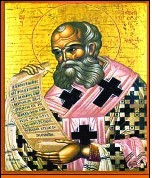
WDTPRS: St. Athanasius – propugnator, champion

St. AthanasiusIn both the traditional Roman calendar and the post-Conciliar calendar today is the feast of St. Athanasius, Doctor of the Church.


Let’s have a quick look at the Collect for the Mass for St. Athanasius in the Ordinary Form..

2002MR:
Omnipotens sempiterne Deus,
qui beatum Athanasium episcopum
divinitatis Filii tui propugnatorem eximium suscitasti,
concede propitius,
ut, eius doctrina et protectione gaudentes,
in tui cognitione et amore sine intermissione crescamus
.

A propugnator is one who fights “in the place of” another, as indicated in that proposition pro in this compound.  “Champion” is a good way to convey that subtlety.

OBSOLETE ICEL (1973):
Father,
you raised up St. Athanasius
to be an outstanding defender
of the truth of Christ’s divinity.
By his teaching and protection
may we grow in your knowledge and love
.

CURRENT ICEL (2011):
Almighty ever-living God,
who raised up the Bishop Saint Athanasius
as an outstanding champion of your Son’s divinity,
mercifully grant,
that, rejoicing in his teaching and his protection,
we may never cease to grow in knowledge and love of you
.

You decide.

Posted in WDTPRS | Tagged
2 Comments

MSM double standards

They who control the topics control what people think.

The mainstream media controls what people think because they control the topics being discussed.

How to combat this?

A long-time reader sent this by email:

MSM double standards

I don’t follow the NBA very closely, but I have never heard of this guy.  Have you?  I looked him up to see what his career stats are.  If I read them right, he is a center who has a career average of 3.6 points per game.

Please explain of what possible interest it is to have splattered all over the MSM what kind of sex this guy likes to have and who he likes it with?  Why is this news?

It is news, because the MSM controls topics and topics shape the way large swaths of the population think.  The MSM wants people to accept sodomy as the new normal.


Posted in SESSIUNCULA | Tagged
39 Comments

Collegiality’s dark underbelly

Collegiality's dark underbellyThere is a trend you need to be aware of.  Indeed, this is a virus you need to help inoculate others against.

Here are a couple examples of the virus that is spreading.

First, turn your attention a piece on the site of a news agency in Asia, UCANEWS.  A Maryknoller (almost never a good starting point these days) and UCANews publisher Fr William Grimm MM, makes a proposal for decentralization of the Curia.  What he is actually proposing is the reduction of the role of the Pope to something like the Archbishop of Canterbury.  Let’s look at just a couple things he proposes.

Inspired by Pope Francis appointment of a group of 8 Cardinals with whom he can consult, Grimm writes:

A half-millennium of attempts to reform the central administration of the Catholic Church has not succeeded. Hopes that the Operations Octet will perform better against entrenched special interests than others have in the past are probably excessively optimistic. The most radical, and therefore probably the most effective and necessary reform of the Curia would be its abolition.

500 years?  Grimm doesn’t know his history.  I can think of a successful reform of the Curia which was undertaken by Pope Pius X in 1909 (cf Sapienti consilio) when the Pope was no longer monarch of the Papal States.

Think about what would happen with the abolition of the Curia.

The Curia is the extension of the Roman Pontiff.  The offices of the Curia do, in various spheres of the Church’s life, what the Pope can’t do by himself.  Were the Curia to be decentralized, the Pope would be reduced to a Roman tourist attraction who kisses babies and blesses things once in a while.  Furthermore, nothing will be accomplished.  Get a load of Grimm’s next idea.  Because Grimm doesn’t like Italian language (sheesh, this is petty and anti-intellectual), he says:

The solution is not to start teaching three-year-olds to speak Latin so that we can restore the past. The solution is to make one or more of the world’s international languages that function as Latin once did the administrative language of the Church. Then the Church could once again draw upon a world of talent, knowledge, information and experience without being limited to clerical natives of one country or careerists.

The writer doesn’t have a clue.  Italian serves that purpose in the Curia now.  But… more languages?   Think of how well the EU functions with their 23 official languages, which have equal status.  Again, nothing would get done.

But the whopper is his idea of having different offices in different parts of the world.

A Church that claims to be global must globalize. That means that, like the United Nations, it must have major parts of its operations outside the headquarters, in places where communications, international transportation and a global ethos make for efficiency and a broader vision. New York, Brussels, Nairobi, Hong Kong, Jakarta, Rio de Janeiro, Moscow, London and many more places come to mind as places where Church offices could function and have better contact than they can have in Rome with the realities that Catholics and others throughout the world face.

Because the UN gets so much done. Right.

I can picture it: the UN-ization of the Roman Curia.  The Congregation for the Doctrine of the Faith – were it to be necessary anymore – could be in, say, Jakarta.  The Council for Interpretation of Legislative Texts could be in Nairobi, Divine Worship in Moscow, Oriental Churches in Rio, and Clergy in Hong Kong.   That would make things so much better.

And there is:

Most, if not all, of what it claims as its scope of authority could and should be handled by regional, national and local bishops’ conferences and synods of leaders and laity.

The bottom line is that Grimm wants to be an Anglican.   This is an ecclesiology that Rowan Williams would recognize.

There is a lot more, but let’s move on.

On the site of Vatican Insider we find that the retired Archbishop of San Francisco, Most Rev. John Quinn, has issued his magnum opus, a 57-page book which he says he started working on in 2005.

Quinn makes proposals along the lines that Grimm desires. Quinn…

concludes by proposing that, in line with the Second Vatican Council’s teaching on collegiality, new patriarchal structures be created in other parts of the world, and that the synod of bishops be given decision-making power. He believes these proposals, if implemented, would remedy the excessive centralization and strengthen communion in the Catholic Church today.

Let’s drill in.

QUESTION: Your new book takes the whole discussion a step further by proposing the creation of new patriarchal structures in parts of the world where they do not yet exist, and by advocating that deliberative or decision-making power be granted to the synod of bishops to enable it to function more effectively. Could you explain this?

QUINN: To begin with, patriarchal structures are not a novelty in the Church. They began almost 1500 years before the modem democracies arose. The Council of Nicaea in 325 called the patriarchal structure ancient. In the Western Latin Church, the Roman synods held in the later part of the first millennium and during the first half of the second millennium were deliberative, decision-making synods. Consequently, these structures are not new, nor are they mechanisms to weaken papal authority since the Popes themselves used them, and the patriarchal structures, ….

When one of these old liberal warriors says that “this is not about weakening the Pope”, then weakening the Pope is exactly what it is all about.

More:

Patriarchal structures would involve some administrative decentralization.  […]  So my book does propose the creation of new patriarchal structures in the Latin Church and these would mean some decentralization. […]   Two major responsibilities which would fall within the competence of new patriarchal structures would be the appointment of bishops and the creation of dioceses. There would be other things as well such as the determination of liturgical texts.  […]  A deliberative or decision-making synod would have several advantages.  […]  Clearly such far reaching responsibilities could not be assumed by regional structures without some preparation. I would think it very useful if this were to be done, that the planning might begin with taking a look at how the Religious Orders went about renewal after the Council. It would be wise to adopt some such process if these new structures were to be used in the Latin Church.

Here is the problem.

It was the LOCAL CHURCHES and LOCAL RELIGIOUS SUPERIORS who messed up the clerical sexual abuse crisis. That is the latest, and possibly the greatest proof that what Grimm and Quinn propose has a dark underbelly to it. When regional and national bishops are left to conspire among themselves, they sometimes engage in collective cover-ups. In the Ratzinger Report, Collegiality's dark underbellythe then Cardinal Ratzinger reminded us that in Germany during the Hitlerzeit, the most courageous anti-Nazi statements were made by individual bishops, whereas the collective statements of bishops were wan and weak.

What Grimm and Quinn are putting forward is the reduction of the Catholic Church to something like Anglicanism, with is various national synods and countless groups of laity pitted against clergy pitted against… pitted against… pitted against…. What will prevent bishops in one part of the world from taking doctrinal or moral stances that are flatly contradicted by bishops in other regions of the Church? This is what constantly happens in Anglicanism.

These are two examples, but there are more.  And there will be even more to come.

The virus is spreading quickly enough that there was an interview in L’Osservatore Romano with Archbishop Angelo Becciu, the “Sostituto” of the Secretariat of State which explains the group of 8 cardinals and makes distinctions about what its role really is.

Liberals are sensing an opportunity and they are tumbling over each other to offer their “solutions”.

The irony is that in making these suggestions, they demonstrate their contempt for the documents of the Second Vatican Council.

Review Lumen gentium 18-25.

Posted in Francis, Liberals, Our Catholic Identity, The Drill, Throwing a Nutty | Tagged , , , , , ,
42 Comments