Prayers requested for Fr. Phillips of St. John Cantius in Chicago – UPDATED

UPDATE 1858 CST:

I received a note from St. John Cantius in Chicago about Fr. Phillips:

With the help of God’s grace and many prayers, Fr. Phillips has had a tremendous improvement today. He is continuing his recovery under the doctor’s supervision, and he is resting well.  He deeply appreciates the many thoughts and sentiments of those who have expressed concern for his health. Please continue to pray for him.

______

Published on: Feb 2, 2013 @ 16:28

I am getting a flood of email in which people are saying that Fr. Frank Phillips, founder of the Canons of St. John Cantius in Chicago is in a “coma” after surgery.

I called St. John’s to find out the straight story.  NO.

As of this writing, Fr. Phillips is not in a coma so don’t spread false stories.

That said, he sure could use your prayers!

Fr. Phillips is in the hospital. He is not doing well after knee-replacement surgery. As of 4:30 CST, he is in critical but stable condition.  There are some complications.

Definitely not good, but not a “coma”.

Do NOT call the parish for news.  They have plenty on their plate.  They will let me and others know what is going on.  Don’t play “telephone” and blow the story up into something that isn’t true. Okay?

In your charity, pray for Fr. Phillips and for that good community.

Posted in PRAYER REQUEST | Tagged ,
12 Comments

Your Sunday Sermon Notes

Was there a good, memorable point in the sermon you heard for your Sunday Mass?

Let us know what it is.

Posted in SESSIUNCULA |
33 Comments

WDTPRS POLL: 3 February St. Blaise Day Blessing of Throats

Our liturgical calendar is packed with wonderful opportunties for spiritual benefits.

Today there is a special blessing for candles (not just yesterday!) in honor of St. Blaise and then a blessing of throats.

I once stood for hours in the church in Rome dedicated to St. Blaise and blessed people with a relic of the saint.

Please chose your best response and leave a comment in the combox!

St. Blaise Blessing of Throats

View Results

Specially blessed candles held in the form of an X or a relic of St. Blaise is placed at the throat and the blessing is spoken by a priest or deacon:

Per intercessionem Sancti Blasii, episcopi et martyris,
liberet te Deus a malo gutturis, et a quolibet alio malo.
In nomine Patris, et Filii +, et Spiritus Sancti.  Amen.

Through the intercession of St. Blaise, bishop and martyr,
may God free you from illness of the throat and from any other sort of ill.
In the name of the Father, and of the Son + and of the Holy Ghost.  Amen.

The blessing for the candles in the older Rituale Romanum is wonderful:

O God most powerful and most kind, Who didst create all the different things in the world by the Word alone, and Whose will it was that this Word by Which all things were made should become incarnate for the remaking of mankind; Thou Who art great and limitless, worthy of reverence and praise, the worker of wonders; for Whose sake the glorious Martyr and Bishop, St. Blaise, joyfully gained the palm of martyrdom, never shrinking from any kind of torture in confessing his faith in Thee; Thou Who didst give to him, amongst other gifts, the prerogative of curing by Thy power every ailment of men’s throats; humbly we beg Thee in Thy majesty not to look upon our guilt, but, pleased by his merits and prayers, in Thine awe-inspiring kindness, to bless+this wax created by Thee and to sanc+tify it, pouring into it Thy grace; so that all who in good faith shall have their throats touched by this wax may be freed from every ailment of their throats through the merit of his suffering, and, in good health and spirits, may give thanks to Thee in Thy holy Church and praise Thy glorious name, which is blessed for ever and ever.  Through our Lord, Jesus Christ, Thy Son, Who with Thee lives and reigns, in the unity of the Holy Spirit, God, world without end.  R. Amen.

Grand, ain’t it?

Posted in "How To..." - Practical Notes, Liturgy Science Theatre 3000, Our Catholic Identity, POLLS |
53 Comments

Archbp. Müller, Prefect of the CDF, anti-Catholicism in USA, time running out for SSPX

From Vatican Insider comes this.

The Prefect of the Congregation for the Doctrine of the Faith, Mgr. Gerhard Ludwig Müller, has launched a biting attack of [on?] the mood toward the Catholic Church in the U.S. and Europe, comparing it to an anti-Jewish “pogrom” [!] in German weekly Die Welt. “The campaigns which are specifically targeted at discrediting the Catholic Church in the U.S. and Europe have led to clerics in some sectors being publicly insulted in a vulgar way,” the former bishop of Regensburg said. “An artificially instigated anger is building, occasionally echoing the sentiment of the pogroms against Jews in Europe,” he added. Attacks against the Church are launched on many blogs and on television. The instruments adopted in these attacks “recall the struggles of totalitarian ideologies against Christianity.”  [I think he is right.  And I think the Obama Administration is okay with all this.]

[… herein he talks about Germany and same sex-marriage …]

The real stagnation in reforms within the Church, Müller said, regards “essential issues that are not being dealt with, such as participation in the sacraments and knowledge of the Catholic faith.” The word “reform” should be used to hinder real renewal through Christ.   [No renewal will take place in any sector of the Church’s life until we recover the right sense of liturgical worship!]

[… more on Germany… ]

Finally, the Prefect of the Congregation for the Doctrine of the Faith sent a clear message to the Lefebvrians: we presented them with a proposed doctrinal preamble but “we have received no response so far and we will not wait forever.

Get that?

Posted in New Evangelization, Our Catholic Identity, Pope of Christian Unity, Religious Liberty, SSPX, The future and our choices, The Last Acceptable Prejudice, Year of Faith | Tagged , , , ,
83 Comments

Archbp. Sample interviewed. Well done.

His Excellency Most Reverend Alexander Sample, the next Archbishop of Portland, was interviewed by The Oregonian.  They didn’t lob him softballs.

After an introductory paragraph or two in which they tee the reader up with the news that he is a rising star and that he likes the pre-Conciliar liturgy.

Here is the business end of the piece.  I think you’ll find that he acquits himself very well.

In a telephone interview Friday, Sample talked about his experience handling clergy sex abuse claims, his “obvious fondness for traditional liturgy” and how open he is to the diversity of Western Oregon’s Catholic community. His answers have been edited for length and clarity.

Q: What did you know about the Archdiocese of Portland when you received the call about becoming the next archbishop?
 

A: I knew about the bankruptcy. The archdiocese was the first to go through with that. It was huge news. But other than knowing about some of the past archbishops, I didn’t know a whole lot. As soon as I got off the phone, I pulled the National Catholic Directory off the shelf. 

Q: A priest of the Archdiocese of Portland is facing criminal charges related to sexual abuse. What does an archdiocese owe to a priest in that position? For example, is it appropriate for an archdiocese to give or lend an accused priest money to cover his defense?

A: I don’t think it would be appropriate for me to comment on that situation. I’m not the archbishop there yet and don’t know all the details. But I can answer from my own experience.

A lot of people in the church don’t understand the implications of what we call incardination, the attachment of a priest to a diocese. The church has certain obligations. If a priest is completely dismissed from the clerical state, the responsibility of the archdiocese ceases. But if he is removed from ministry, but not dismissed from the clerical state, canon law requires that the church provide some sustenance, some decent support of living to that person. Not that we have to support them in luxury, by any means, but health insurance and a minimal stipend to live on is required. Many of these men are elderly and not able to find other employment.

This causes great concern from people used to a more secular mode, where a person is fired and you’re done with him, you have no other responsibility.

Q: The Survivors Network of those Abused by Priests, or SNAP, says you’ve “done nothing to distinguish” yourself from “the overwhelming majority of Catholic officials who continue to minimize and hide clergy sex crimes.” How could you be more transparent in regard to this issue?

A: It’s a very tricky minefield I have to navigate. There are competing interests at stake. First and foremost are the interests of those who have been victimized. But there are also the interests of the accused. We live in a system, in a church, where the accused has a right to defense. And, in civil cases, we have to be concerned for the patrimony of the diocese and the interests of the folks in the pews.

Sometimes the bishop is in the middle. People are angry because he hasn’t done enough for the victims or hasn’t been just to the priest. Parishioners are mad because we’ve removed their beloved pastor and the charges couldn’t possibly be true and why are they bringing it up 25 years later. And the issues of confidentiality and the right to privacy apply to victims as well.

I mean to be as open as we can, saying as much as we can, keeping people as informed as we can without getting into confidential details. If a priest is removed for some kind of misconduct, we used to say he had health issues. We wouldn’t give the reasons. That’s what we have to get over. If father is removed because of an accusation, we need to tell the people straight out. They are adults, they have a right to know this information. We can’t afford to forget about the victims, they need to be informed and brought along through the process.

Q: Catholics in Western Oregon are divided between those who long to return to traditional liturgies and strict adherence to official church teaching and those who are critical of church teaching, often presenting their cases with careful historical and theological reasoning. What do you have to say to these two groups?

A: I am called to be the shepherd of all of those people. I probably Google-up as a more traditional, strong defender of church teaching kind of person. That shouldn’t communicate that I’m not willing to engage in dialogue. I want to understand people’s perspectives.

Q: Are you bringing a more conservative point of view to the archdiocese?

A: I don’t come in with any sense of stridency. It will take me some time to get to know the church, the people there, the culture of Portland and other areas. My first task is to learn, to listen, to observe, not be like a bull in a china shop.

Q: Why are you a fan of the old rite, or Latin Mass?

A: I am completely a product of the second Vatican Council. That period of renewal and reform in the church is part of who I am. I was in college before I really knew what that older Mass was like. I took a music appreciation class and heard Gregorian chant for the first time. Then five years ago, the holy father asked his bishops to be generous with the traditional liturgy for people who were attached to it. I was a bishop, I needed to know both forms. I got my videotapes and learned to do it privately. I’ve had three opportunities to celebrate it as a bishop. From my experience, the old Mass enriches my understanding of the ordinary, or English, Mass. People don’t need to be worried that I’ll suddenly introduce the traditional liturgy in every parish of the archdiocese. But I will be generous with the folks there who request that form.

Q: Women are active in the archdiocese, as teachers at every level of education, as parish administrators and volunteers. Catholic sisters have played and continue to play a major role. Some of these women have organized to challenge the church to use their gifts more effectively. How do you see the role of women in the church?

A: Aside from the issue of women’s ordination, I’m comfortable, supportive and encouraging. I’ve worked with a lot of women in leadership and we’d be lost without them. The feminine genius needs to be part of the conversation.

Q: Some people wonder if you’ll be here in Western Oregon very long. They’ve read that you are a rising star and might move on quickly to another church post. Cardinal Francis George was here for about a year.

A: Listen, that is the farthest thing from my mind. I wasn’t looking for a move. I have every intention to be there for a long time. I’m even thinking of relocating my 84-year-old mother there.

Posted in Brick by Brick, Just Too Cool, Priests and Priesthood, The Drill | Tagged , ,
19 Comments

Swiss Bishop forbids the use of churches and chapels to the SSPX

I am saddened by the following story, which I found on Vatican Insider in Italian from Andrea Tornielli:

“Lefevbrites are suspended a divinis, they cannot celebrate in Catholic churches”

His is a striking and suggestive position: the Bishop of Diocese of Lausanne, Geneva and Fribourg, Charles Morerod, Dominican theologian, onetime Rector of the Angelicum and Secretary of the International Theological Commission and member of the delegation from the Congregation for the Doctrine of the Faith in dialogues with the Society of St. Pius X – has published a decree forbidding Lefebvrite priests from celebrating Mass in churches and chapels of his diocese. He reaffirmed that priests of the Society are suspended “a divinis”.

The document, signed 20 January, deals with “the admission of other religions, confessions or religious groups, such as indeed the Society of St. Pius X, and of independent theologians in Roman Catholic churches and chapels”.

[…]

He cites the 1993 Decree on Ecumenism.

I am sure the whole thing will be translated soon, but that is the core of it.

I have said often in these electronic pages that, one of these days, the SSPXers are going to wake up and find that they are not considered Catholic by the Catholic Church.  I hope and pray that it will not come to that.  This is an open and suppurating wound in the unity of the Church.  We need what the SSPX can offer.  But they must bend to proper authority.

Benedict XVI is the Pope of Christian Unity.

Posted in Benedict XVI, Pope of Christian Unity, SSPX, Year of Faith | Tagged , , ,
51 Comments

WDTPRS: Candlemas

Today is the final “peak” arising from the liturgical cycle of Advent/Christmas/Epiphany.  Today, called in the traditional way and according to the older Roman calendar the Feast of the Purification of the Blessed Virgin Mary, Holy Church would cease to sing the Marian antiphon associated with Christmas,

It is forty days since Christmas.

In the physical world, we in the Northern hemisphere are beginning to notice more and more the growing of the light of day.  The seemingly endless darkness of the short days has finally in a noticeable way been attenuated.  I have noticed in the last couple days that the birds have broken their silence and are beginning to sing in a different way, even though winter here as far from over.  Today’s feast is also about light, in the broader symbolic sense.

This feast has its name from the Blessed Virgin, because the Law in Leviticus required her to go to the temple for purification after giving birth.  The Lord did not need to be baptized by John in the river, for He had nothing to repent.  Mary did not need purification, for she was spotless.  But they desired to fulfill the Law.  This feast also reminds us of the beautiful tradition of the “Churching” of women after childbirth, a special blessing given by the Church, which has alas fallen into desuetude.  “Churching” was done in honor also of this moment in the life Christ’s Mother.

This is, however, really a feast in honor of the Lord: He is being offered to the Father in a foreshadowing of His greater Sacrifice for our salvation.  The theme of offering, of sacrifice draws our eyes away from looking back at Christmas and Epiphany forward to the Passion and Easter.

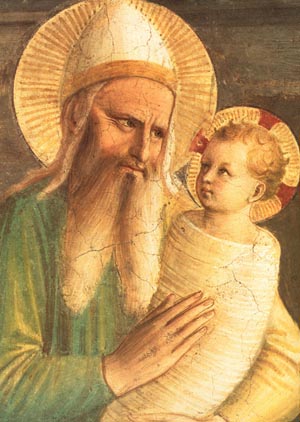
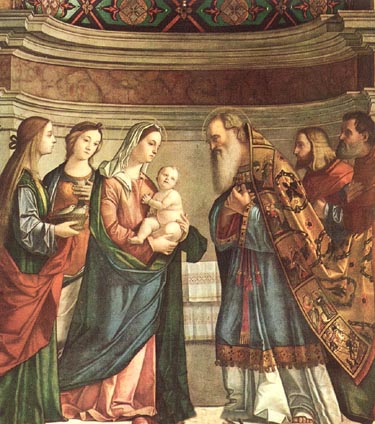
You remember the story from the Gospel, in Luke 2.  Mary and Joseph come to the temple in Jerusalem to fulfill the Law.  Firstborn males had to be dedicated to the Lord. The old woman Anna and the old man Simeon had the special grace from the Lord to have their dearest desires fulfilled before they died: to see the Messiah. It is in this moment that Simeon makes the prophecy about the sacrificial sufferings Mary will endure and he speaks his great Nunc dimittis, which Holy Church sings in the darkness at the end of the day for Compline.

In the traditional Roman liturgy today in larger churches there would be a special blessing of candles and a procession before Mass would begin.  The chants sung for the rite contain many references to light.  Also, a lighted candle is to be held during the reading of the Gospel and during the Roman Canon.  The candle brings to mind also our baptism.

In a way, the faithful really ought to have candles at all Masses.  But now, in High Masses, the “touchbearers” fulfill this role for the congregation.  Remember that the next time you see the candles come in: that’s you up there.

Remember: Holy Church gives us candles so that we will use them When I baptize, I suggest to people that they save the candle, with a label indiciting what it is and who was there, the name of the priest, etc.  Perhaps then they could save that candle against the day when, perhaps, it might be used as one of the candles on the altar for their wedding, or with a home Communion set, for when they need Last Rites.  The candle you receive on other days of the year, the Vigil of Easter for example, or for Eucharist processions, could be burned in times of trial or danger, as when storms are coming or there is social upheaval.  These candles remind us that we too out to be filled with light for others, in their darkness and difficulties, to see and be guided by.

Candles are beautiful symbols of our sacrifices.  They are like living things.  They eat and drink the wax from the bees, made collectively in association with sweetness.  They breath air.  They move in their flames as they flicker.  They communicate to our eyes a beautiful light and give contrast to their surroundings by illumination.  They burn out at the end of their span.  So do we.  They are consumed for the Lord in the liturgy.  So should we be.  We do all these things.   And so, using candles in important times is a very wholesome and Catholic practice.  Leaving one of these little candles in a Church, as a symbolic sacrifice of your prayers and petitions is entirely natural.

For Holy Mass on Candlemas we hear some splendid prayers.  Let’s look at a couple.

Here is the third of several prayers recited by the priest for the blessing of the candles.  In older days, the priest would be wearing a purple cope and would switch to white for Mass.  By the time of the 1962 Missale Romanum all the rites are in white.

Domine Iesu Christe, lux vera, quae illuminas omnem hominem venientem in hunc mundum: effunde bene+dictionem tuam super hos cereos, et sancti+fica eos lumine gratiae tuae, et concede propitius; ut, sicut haec luminaria igne visibili accensa nocturnas depellunt tenebras; ita corda nostra invisibili igne, id est, Sancti Spiritus splendore illustrata, omnium vitiorum caecitate careant: ut, purgato mentis oculo, ea cernere possimus, quae tibi sunt placita, et nostrae saluti utilia; quatenus, post huius saeculi caliginosa discrimina, ad lucem indeficientem pervenire mereamur. Per te, Christe Iesu, Salvator mundi, qui in Trinitate perfecta vivis et regnas in saecula saeculorum.
R. Amen.

Daily Missal and Liturgical Manual (Baronius Press):

O Lord Jesus Christ, the true Light who enlightenest every man that cometh into this world: pour forth Thy blessing + upon these candles, and sanctify + them with the light of Thy grace, and mercifully grant, that as these lights enkindled with visible fire dispel the darkness of night, so our hearts illumined by invisible fire, that is, by the splendor of the Holy Spirit, may be free from the blindness of all vice, that the eye of our mind being cleansed, we may be able to discern what is pleasing to Thee and profitable to our salvation; so that after the perilous darkness of this life we may deserve to attain to neverfailing light: through Thee, O Christ Jesus, Savior of the world, who in the perfect Trinity, livest and reignest, God, world without end.

There is an adage that sin makes you stupid. Note the connection between vice and blindness and darkness.  The visible fire is not just a symbol of the indwelling of the Holy Spirit.  It also signifies life properly lived, a fact seen by others.

At the beginning of the procession an wonderful antiphon is sung.  Remember the Gospel.  Mary would have been brought within, carrying the Lord, the Light of the World, and led to a place of sacrifice, the offering of her Firstborn.  In the Churching of woman after child birth, they are met a the entrance to the church and then led forward.

Adorna thalamum tuum, Sion, et suscipe Regem Christum amplectere Mariam, quae est coelestis porta: ipsa enim portat Regem gloriae novi luminis: subsistit Virgo, ad ducens manibus Filium ante luciferum genitum: quem accipiens Simeon in ulnas suas, praedicavit populis, Dominum eum esse vitae et mortis, et Salvatorem mundi.

Adorn thy bridal-chamber, O Sion, and welcome Christ the King: with loving embrace greet Mary who is the very gate of heaven; for she bringeth to thee the glorious King of the new light: remaining ever a Virgin yet she bearest in her arms the Son begotten before the day-star: even the Child, whom Simeon taking into his arms, declared to the peoples to be the Lord of life and death, and the Savior of the world.

At Christmas we receive the Lord.  At Candlemas we offer Him.

In addition to the theme of light functioning throughout the rite there is also another echo of Christmas and Epiphany.  God meets man.  God comes to us, and we go to Him.  Today there is another meeting of God and man, expectant man, symbolized by Anna and Simeon.  The hymn sung in the procession frames our meeting, our Encounter as the liturgy of the Greek East calls this say, in nuptial terms.

In the Mass itself, we have the

COLLECT (1962MR):
Omnipotens sempiterne Deus,
maiestatem tuam suppliciter exoramus:
ut, sicut unigenitus Filius tuus hodierna die
cvm nostrae carnis substantia in templo est praesentatus;
ita nos facias purificatis tibi mentibus praesentari
.

This is an ancient prayer, going back at least to the 9th c. and is found Liber sacramentorum Romanae ecclesiae ordine excarpsus.

You will see what is happening quickly, if you are a student of Latin, by taking careful note of the ut in the second part, which leads to a subjunctive down the line.  Also, there is a typical sicut…ita constuction, the ita part having the subjunctive result of the ut.  There is a nice turn of phrase at the end, using a trop hyperbaton, whereby that tibi separates the two elements of the ablative absolute purificatis … mentibus.  I also like that use of praesentatuspraesentari, a trope called, if memory serves, polyptoton.

The word maiestas is associated with gloria, a divine characteristic which transforms us who encounter it.  Thinks of the transformation of Moses’ face after he met with the Lord in the tent or on the mount: he had to wear a veil because his face was too bright to look at.  Also, Romans liked addressing people in indirect ways.  We still do this in some formal discourse and letters.  It is courtly, courteous.  Here maiestas can be heard as a form of address: Your Majesty.  So, maiestas has layers on layers of meaning.

Note the philosophical language of substantia.  Some times people will argue that the switch from Greek to Latin, the spoken language in ancient Rome, is justification for using the “vernacular” today.  The problem with that argument is that the Latin used in the Church for prayer, was not the language spoken by the people. It had technical vocabuary (e.g., maiestas, substantia) and turns of phrase nothing like everyday speech (e.g., hyberbaton, polyptoton).

See what happens?  It all seems straight forward.  Then you start to drill.

Candlemas is a beautiful feast full of meaning and symbols.

Holy Church puts candles in your hands today, to remind you of your gifts and your duties.

Posted in Liturgy Science Theatre 3000, Patristiblogging, WDTPRS | Tagged , ,
18 Comments

Knights of Divine Mercy

I am in Pine Bluff, WI, in the Diocese of Madison, to help on the First Friday, with an outstanding men’s group started by the parish priest, Fr Heilman.

For the Knights of Divine Mercy tonight we began with Holy Mass in the Extraordinary Form, Exposition, and then a period for confessions. The chaplet of Divine Mercy was recited, the Blessed Sacrament temporarily veiled, and now the local bishop, Most Rev. Robert Morlino, is speaking.

20130201-192904.jpg

His Excellency had touched on how the Church has become feminized, and how important it is for men to be men. He has touched on the damage rejection of Humanae vitae did, along with no-fault divorce, to marriage. “We have to stay focused on accountability for our commitments, even before the state.” “There are demands built into human nature.”

Once the way is opened by totally contraceptive, sterile, marriage, then the way is opened to calling anything you want marriage.

He is moving on to orientation and “gender identity”.

He is hitting one after another out of the park!

Posted in Brick by Brick, New Evangelization, Our Catholic Identity, What Fr. Z is up to, Year of Faith |
15 Comments

Card. Mahony’s next move? Deflect responsibility to Archbp. Gomez.

Read what I wrote HERE about Los Angeles’s Archbishop Gomez bumping Card. Mahony off the diocesean schedule because of Mahony’s cover-up of abuse of children.

Now Card. Mahony writes on his blog… and it sincerely grieves me to point this out… writes on his blog a statement to Archbp. Gomez:

When you [Archbp. Gomez] were formally received as our Archbishop on May 26, 2010, you began to become aware of all that had been done here over the years for the protection of children and youth. You became our official Archbishop on March 1, 2011 and you were personally involved with the Compliance Audit of 2012—again, in which we were deemed to be in full compliance.

Not once over these past years did you ever raise any questions about our policies, practices, or procedures in dealing with the problem of clergy sexual misconduct involving minors.

I have stated time and time again that I made mistakes, especially in the mid-1980s. I apologized for those mistakes, and committed myself to make certain that the Archdiocese was safe for everyone.

[…]

HUH?!?

So… he is deflecting his responsibility to Archbp. Gomez.

I hope Archbp. Gomez does not respond.  Let the papal nuncio and the Holy Father deal with this one.

In the meantime, will the National Schismatic Reporter call on Card. Mahony to do a Card. Billot? Resign from the College of Cardinals?  The NSR’s (aka Fishwrap) editors and writers have danced a circle around Bp. Finn with torches and inflated pig’s bladders hooting for him to resign as bishop of Kansas City – St. Joseph.  What will the paper of record for heretics and schismatics do now?

Posted in Clerical Sexual Abuse, Linking Back | Tagged , , ,
113 Comments

More about Obamatax – Will families be ready to pay $20k per year?

More about

From CNSNews:

(CNSNews.com) – In a final regulation issued Wednesday, the Internal Revenue Service (IRS) assumed that under Obamacare the cheapest health insurance plan available in 2016 for a family will cost $20,000 for the year.

Under Obamacare, Americans will be required to buy health insurance or pay a penalty to the IRS.

The IRS’s assumption that the cheapest plan for a family will cost $20,000 per year is found in examples the IRS gives to help people understand how to calculate the penalty they will need to pay the government if they do not buy a mandated health plan.

The examples point to families of four and families of five, both of which the IRS expects in its assumptions to pay a minimum of $20,000 per year for a bronze plan.

“The annual national average bronze plan premium for a family of 5 (2 adults, 3 children) is $20,000,” the regulation says.

Bronze will be the lowest tier health-insurance plan available under Obamacare–after Silver, Gold, and Platinum. Under the law, the penalty for not buying health insurance is supposed to be capped at either the annual average Bronze premium, 2.5 percent of taxable income, or $2,085.00 per family in 2016.

In the new final rules published Wednesday, IRS set in law the rules for implementing the penalty Americans must pay if they fail to obey Obamacare’s mandate to buy insurance.

[…]

Posted in Dogs and Fleas, Emanations from Penumbras, Liberals, Religious Liberty, The Drill | Tagged , , ,
30 Comments