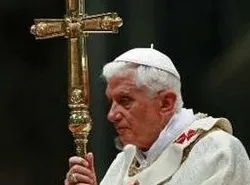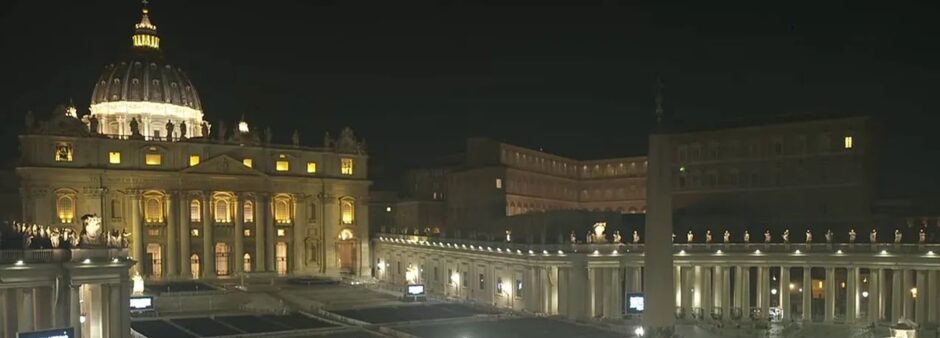
Benedict XVI’s Sermon for the Easter Vigil: of creation, light, communication, community, and bees

Here is the Pope’s sermon for the Easter Vigil.

Dear Brothers and Sisters,

Easter is the feast of the new creation. Jesus is risen and dies no more. He has opened the door to a new life, one that no longer knows illness and death. He has taken mankind up into God himself. [Already!  In the Incarnation!  But this really seals the deal, doesn’t it.] “Flesh and blood cannot inherit the kingdom of God”, as Saint Paul says in the First Letter to the Corinthians (15:50). On the subject of Christ’s resurrection and our resurrection, the Church writer Tertullian in the third century was bold enough to write: “Rest assured, flesh and blood, through Christ you have gained your place in heaven and in the Kingdom of God” (CCL II, 994). [Do I hear an “Amen!”?] A new dimension has opened up for mankind. Creation has become greater and broader. Easter Day ushers in a new creation, but that is precisely why the Church starts the liturgy on this day with the old creation, so that we can learn to understand the new one aright. At the beginning of the Liturgy of the Word on Easter night, then, comes the account of the creation of the world. Two things are particularly important here in connection with this liturgy. On the one hand, creation is presented as a whole that includes the phenomenon of time. The seven days are an image of completeness, unfolding in time. They are ordered towards the seventh day, the day of the freedom of all creatures for God and for one another. Creation is therefore directed towards the coming together of God and his creatures; it exists so as to open up a space for the response to God’s great glory, an encounter between love and freedom. [Beyond which is the eighth day, the day outside the regular march of time, beyond even the day of rest, our Sabbath or Sunday rest which reflects God’s rest after creation.  It is eschatological day, in which we long to be with God forever.] On the other hand, what the Church hears on Easter night is above all the first element of the creation account: “God said, ‘let there be light!’” (Gen 1:3). The creation account begins symbolically with the creation of light. The sun and the moon are created only on the fourth day. The creation account calls them lights, set by God in the firmament of heaven. In this way he deliberately takes away the divine character that the great religions had assigned to them. No, they are not gods. They are shining bodies created by the one God. But they are preceded by the light through which God’s glory is reflected in the essence of the created being.

What is the creation account saying here? Light makes life possible. It makes encounter possible. It makes communication possible. [There’s “communication” again.  He worked with this on Holy Thursday.] It makes knowledge, access to reality and to truth, possible. And insofar as it makes knowledge possible, it makes freedom and progress possible. [There is material to work with here.  More on that later.  Maybe.  If I have energy.] Evil hides. Light, then, is also an expression of the good that both is and creates brightness. It is daylight, which makes it possible for us to act. To say that God created light means that God created the world as a space for knowledge and truth, as a space for encounter and freedom, as a space for good and for love. Matter is fundamentally good, being itself is good. And evil does not come from God-made being, rather, it comes into existence through denial. It is a “no“.  [Some people characterize “freedom”, a false “freedom” as the uncovering of things or the bringing into light and communication of that which should not be communicated.  They think it is a “yes” but actually it is a profound “no”.]

At Easter, on the morning of the first day of the week, God said once again: “Let there be light“. The night on the Mount of Olives, the solar eclipse of Jesus’ passion [Since ancient times the Son of God is depicted as “sun of justice” (cf. Augustine of Hippo.)] and death, the night of the grave had all passed. Now it is the first day once again – creation is beginning anew. “Let there be light”, says God, “and there was light”: Jesus rises from the grave. Life is stronger than death. Good is stronger than evil. Love is stronger than hate. Truth is stronger than lies. [I want to link that back to his “communication” theme.] The darkness of the previous days is driven away the moment Jesus rises from the grave and himself becomes God’s pure light. But this applies not only to him, not only to the darkness of those days. With the resurrection of Jesus, light itself is created anew. [lumen de lumine from the beginning… now lumen novum] He draws all of us after him into the new light of the resurrection and he conquers all darkness. He is God’s new day, new for all of us.

[QUAERITUR:] But how is this to come about? How does all this affect us so that instead of remaining word it becomes a reality that draws us in? Through the sacrament of baptism and the profession of faith, the Lord has built a bridge across to us, through which the new day reaches us. [A bridge, like a door, moves you from one place to another where there is a barrier.] The Lord says to the newly-baptized: Fiat lux – let there be light. God’s new day – the day of indestructible life, comes also to us. Christ takes you by the hand. From now on you are held by him and walk with him into the light, into real life. For this reason the early Church called baptism photismos – illumination.

Why was this? The darkness that poses a real threat to mankind, after all, is the fact that he can see and investigate tangible material things, but cannot see where the world is going or whence it comes, where our own life is going, what is good and what is evil. The darkness enshrouding God and obscuring values is the real threat to our existence and to the world in general. If God and moral values, the difference between good and evil, remain in darkness, then all other “lights”, that put such incredible technical feats within our reach, are not only progress but also dangers that put us and the world at risk. [“world at risk”, “threat to our existence”, “real threat to mankind”… get it yet?] Today we can illuminate our cities so brightly that the stars of the sky are no longer visible. Is this not an image of the problems caused by our version of enlightenment? With regard to material things, our knowledge and our technical accomplishments are legion, but what reaches beyond, the things of God and the question of good, we can no longer identify. Faith, then, which reveals God’s light to us, is the true enlightenment, enabling God’s light to break into our world, opening our eyes to the true light.

Dear friends, as I conclude, I would like to add one more thought about light and illumination. On Easter night, the night of the new creation, the Church presents the mystery of light using a unique and very humble symbol: the Paschal candle. This is a light that lives from sacrifice. The candle shines inasmuch as it is burnt up. [Love it.  I have often explained candles which we light for people, as stand-ins for our prayers, as being like living things.  They breath air, they eat and drink wax, they move, they cast light (and shadows), and they burn out.] It gives light, inasmuch as it gives itself. Thus the Church presents most beautifully the paschal mystery of Christ, who gives himself and so bestows the great light. Secondly, we should remember that the light of the candle is a fire. Fire is the power that shapes the world, the force of transformation. [cf. Prometheus… but of course that means bad things, too.] And fire gives warmth. Here too the mystery of Christ is made newly visible. Christ, the light, is fire, flame, burning up evil and so reshaping both the world and ourselves. “Whoever is close to me is close to the fire,” as Jesus is reported by Origen to have said. And this fire is both heat and light: not a cold light, but one through which God’s warmth and goodness reach down to us.

The great hymn of the Exsultet, which the deacon sings at the beginning of the Easter liturgy, points us quite gently towards a further aspect. It reminds us that this object, the candle, has its origin in the work of bees. [The bees are back in English!] So the whole of creation plays its part. In the candle, creation becomes a bearer of light. But in the mind of the Fathers, the candle also in some sense contains a silent reference to the Church. The cooperation of the living community of believers in the Church in some way resembles the activity of bees. It builds up the community of light. So the candle serves as a summons to us to become involved in the community of the Church, whose raison d’être is to let the light of Christ shine upon the world.

Let us pray to the Lord at this time that he may grant us to experience the joy of his light; let us pray that we ourselves may become bearers of his light, and that through the Church, Christ’s radiant face may enter our world (cf. LG 1). Amen.  [Lumen ad revelationem gentium…]

Posted in Just Too Cool, Liturgy Science Theatre 3000, Pope of Christian Unity | Tagged , , , , , , , ,
16 Comments

A side-by-side look at Exsultet texts

My apologies from the onset if there are some typos or formatting problems here. I cut and pasted texts into a table and then copied the table to the blog, which isn’t always successful. But this could be a helpful quick glance at the differences of the new and old translation of the Exsultet. I am sort of busy today and couldn’t clean it up. But, its flaws considered, I thought to share it anyway.  If someone can do a better job, feel free to do so and send it to me and I will check it out.

Latin 2002MR CURRENT ICEL (2011) OBSOLETE ICEL
Exsúltet iam angélica turba cælórum:
exsúltent divína mystéria: et pro tanti Regis victória tuba ínsonet salutáris.
Gáudeat et tellus, tantis irradiáta fulgóribus: et ætérni Regis splendóre illustráta, tótius orbis se séntiat amisísse calíginem.  Lætétur et mater Ecclésia, tanti lúminis adornáta fulgóribus: et magnis populórum vócibus hæc aula resúltet.
Exult, let them exult, the hosts of heaven,exult, let Angel ministers of God exult,let the trumpet of salvation sound aloud our mighty King’s triumph! Be glad, let earth be glad, as glory floods her,ablaze with light from her eternal King,let all corners of the earth be glad,knowing an end to gloom and darkness.Rejoice, let Mother Church also rejoice,arrayed with the lightning of his glory,let this holy building shake with joy,filled with the mighty voices of the peoples. Rejoice, heavenly powers! Sing, choirs of angels! Exult, all creation around God’s throne! Jesus Christ, our King, is risen!
Sound the trumpet of salvation!  Rejoice, O earth, in shining splendor, radiant in the brightness of your King! Christ has conquered! Glory fills you! Darkness vanishes for ever!  Rejoice, O Mother Church! Exult in glory! The risen Savior shines upon you! Let this place resound with joy,
echoing the mighty song of all God’s people!
[Quaprópter astántes vos, fratres caríssimi,
ad tam miram huius sancti lúminis claritátem,
una mecum, quæso,
Dei omnipoténtis misericórdiam invocáte.
Ut, qui me non meis méritis
intra Levitárum númerum dignátus est aggregáre,
lúminis sui claritátem infúndens,
cérei huius laudem implére perfíciat.]
[V/ Dóminus vobíscum.
R/ Et cum spíritu tuo.]
V/ Sursum corda.
R/ Habémus ad Dóminum.
V/ Grátias agámus Dómino Deo nostro.
R/ Dignum et iustum est.
(Therefore, dearest friends, standing in the awesome glory of this holy light, invoke with me, I ask you, the mercy of God almighty, that he, who has been pleased to number me, though unworthy, among the Levites, may pour into me his light unshadowed, that I may sing this candle’s perfect praises).(V. The Lord be with you.R. And with your spirit.)V. Lift up your hearts.R. We lift them up to the Lord.V. Let us give thanks to the Lord our God.R. It is right and just. My dearest friends,
standing with me in this holy light, join me in asking God for mercy, that he may give his unworthy minister
grace to sing his Easter praises.Deacon: The Lord be with you.
People: And also with you.
Deacon: Lift up your hearts.
People: We lift them up to the Lord.
Deacon: Let us give thanks to the Lord our God.
People: It is right to give him thanks and praise.
re dignum et iustum est, invisíbilem Deum Patrem omnipoténtem
Filiúmque eius unigénitum,
Dóminum nostrum Iesum Christum,
toto cordis ac mentis afféctu et vocis ministério personáre.Qui pro nobis ætérno Patri Adæ débitum solvit, et véteris piáculi cautiónem pio cruóre detérsit.Hæc sunt enim festa paschália,
in quibus verus ille Agnus occíditur,
cuius sánguine postes fidélium consecrántur.Hæc nox est, in qua primum patres nostros, fílios Israel edúctos de Ægypto, Mare Rubrum sicco vestígio transíre fecísti.Hæc ígitur nox est,
quæ peccatórum ténebras colúmnæ illuminatióne purgávit.Hæc nox est, quæ hódie per univérsum mundum in Christo credéntes, a vítiis sæculi et calígine peccatórum segregátos,
reddit grátiæ, sóciat sanctitáti.
It is truly right and just, with ardent love of mind and heartand with devoted service of our voice,to acclaim our God invisible, the almighty Father, and Jesus Christ, our Lord, his Son, his Only Begotten.Who for our sake paid Adam’s debt to the eternal Father, and, pouring out his own dear Blood, wiped clean the record of our ancient sinfulness.These, then, are the feasts of Passover, in which is slain the Lamb, the one true Lamb, whose Blood anoints the doorposts of believers.This is the night, when once you led our forebears, Israel’s children, from slavery in Egypt and made them pass dry-shod through the Red Sea.This is the night that with a pillar of fire banished the darkness of sin.

This is the night that even now, throughout the world, sets Christian believers apart from worldly vices and from the gloom of sin, leading them to grace and joining them to his holy ones.

It is truly right
that with full hearts and minds and voices we should praise the unseen God, the all-powerful Father,
and his only Son, our Lord Jesus Christ.
It is truly right
that with full hearts and minds and voices we should praise the unseen God, the all-powerful Father,
and his only Son, our Lord Jesus Christ.For Christ has ransomed us with his blood, and paid for us the price of Adam’s sin to our eternal Father!This is our passover feast, when Christ, the true Lamb, is slain,
whose blood consecrates the homes of all believers.This is the night when first you saved our fathers: you freed the people of Israel from their slavery and led them dry-shod through the sea.This is the night
when the pillar of fire destroyed the darkness of sin!This is the night when Christians everywhere, washed clean of sin and freed from all defilement, are restored to grace and grow together in holiness.
Hæc nox est,
in qua, destrúctis vínculis mortis,
Christus ab ínferis victor ascéndit.Nihil enim nobis nasci prófuit, nisi rédimi profuísset.
O mira circa nos tuæ pietátis dignátio!
O inæstimábilis diléctio caritátis:
ut servum redímeres, Fílium tradidísti!O certe necessárium Adæ peccátum,
quod Christi morte delétum est!
O felix culpa,
quæ talem ac tantum méruit habére Redemptórem!O vere beáta nox,
quæ sola méruit scire tempus et horam,
in qua Christus ab ínferis resurréxit!Hæc nox est, de qua scriptum est:
Et nox sicut dies illuminábitur:
et nox illuminátio mea in delíciis meis.
This is the night, when Christ broke the prison-bars of death and rose victorious from the underworld.Our birth would have been no gain, had we not been redeemed.O wonder of your humble care for us!O love, O charity beyond all telling, to ransom a slave you gave away your Son!O truly necessary sin of Adam, destroyed completely by the Death of Christ!O happy fault that earned so great, so glorious a Redeemer!O truly blessed night, worthy alone to know the time and hour when Christ rose from the underworld!

This is the night of which it is written: The night shall be as bright as day, dazzling is the night for me, and full of gladness.

This is the night
when Jesus Christ broke the chains of death
and rose triumphant from the grave.What good would life have been to us,
had Christ not come as our Redeemer?
Father, how wonderful your care for us! How boundless your merciful love! To ransom a slave you gave away your Son.O happy fault, O necessary sin of Adam, which gained for us so great a Redeemer!Most blessed of all nights, chosen by God to see Christ rising from the dead!Of this night scripture says: “The night will be as clear as day: it will become my light, my joy.”
Huius ígitur sanctificátio noctis fugat scélera, culpas lavat:
et reddit innocéntiam lapsis
et mæstis lætítiam.
Fugat ódia, concórdiam parat
et curvat impéria.O vere beáta nox,
in qua terrénis cæléstia, humánis divína iungúntur!In huius ígitur noctis grátia, súscipe, sancte Pater, laudis huius sacrifícium vespertínum, quod tibi in hac cérei oblatióne solémni,
per ministrórum manus de opéribus apum, sacrosáncta reddit Ecclésia.Sed iam colúmnæ huius præcónia nóvimus, quam in honórem Dei rútilans ignis accéndit. Qui, lícet sit divísus in partes, mutuáti tamen lúminis detrimenta non novit.Alitur enim liquántibus ceris, quas in substántiam pretiósæ huius lámpadis
apis mater edúxit.
The sanctifying power of this night dispels wickedness, washes faults away, restores innocence to the fallen, and joy to mourners, drives out hatred, fosters concord, and brings down the mighty.On this, your night of grace, O holy Father, accept this candle, a solemn offering, the work of bees and of your servants’ hands, an evening sacrifice of praise, this gift from your most holy Church.But now we know the praises of this pillar, which glowing fire ignites for God’s honor, a fire into many flames divided, yet never dimmed by sharing of its light, for it is fed by melting wax, drawn out by mother bees to build a torch so precious.O truly blessed night, when things of heaven are wed to those of earth, and divine to the human. The power of this holy night dispels all evil, washes guilt away, restores lost innocence, brings mourners joy; it casts out hatred, brings us peace, and humbles earthly pride.[…]Night truly blessed when heaven is wedded to earth and man is reconciled with God!
Orámus ergo te, Dómine,
ut céreus iste in honórem tui nóminis consecrátus,
ad noctis huius calíginem destruéndam,
indefíciens persevéret.
Et in odórem suavitátis accéptus,
supérnis lumináribus misceátur.Flammas eius lúcifer matutínus invéniat:
ille, inquam, Lúcifer, qui nescit occásum.
Christus Fílius tuus,
qui, regréssus ab ínferis, humáno géneri serénus illúxit,
et vivit et regnat in sæcula sæculórum.R/ Amen.
Therefore, O Lord,we pray you that this candle, hallowed to the honor of your name, may persevere undimmed, to overcome the darkness of this night.Receive it as a pleasing fragrance, and let it mingle with the lights of heaven.May this flame be found still burning by the Morning Star: the one Morning Star who never sets, Christ your Son, who, coming back from death’s domain, has shed his peaceful light on humanity, and lives and reigns for ever and ever.R. Amen. Therefore, heavenly Father, in the joy of this night, receive our evening sacrifice of praise, your Church’s solemn offering.Accept this Easter candle, a flame divided but undimmed, a pillar of fire that glows to the honor of God.Let it mingle with the lights of heaven
and continue bravely burning to dispel the darkness of this night!May the Morning Star which never sets
find this flame still burning: Christ, that Morning Star, who came back from the dead,
and shed his peaceful light on all mankind,
your Son, who lives and reigns for ever and ever.
Amen.

Some years ago I sang the Exsultet and it was recorded.


Posted in Liturgy Science Theatre 3000 | Tagged
25 Comments

A Good Friday Liturgy intercession in the light of our current concerns

In light of the current circumstances we face as Catholics, as people of all faiths, and as American citizens, this is excerpted from the Good Friday intercession prayers in the Ordinary Form:

IX. For those in public office

Let us pray also for those in public office,
that our God and Lord
may direct their minds and hearts according to his will
for the true peace and freedom of all.

Prayer in silence. Then the Priest says:

Almighty ever-living God,
in whose hand lies every human heart
and the rights of peoples,
look with favor, we pray,
on those who govern with authority over us,
that throughout the whole world,
the prosperity of peoples,
the assurance of peace,
and freedom of religion
may through your gift be made secure.
Through Christ our Lord.
R. Amen.

Posted in Our Catholic Identity, Religious Liberty | Tagged , , , , , , , , , , ,
9 Comments

Victorious couple pleases God and the holy angels and saints by returning to confession!

From a reader:

Dear Father,

Through your influence both my husband and I went to confession today. First time in 19 years for me, 24 years for him. It was AMAZING. We had to do some searching to find somewhere with a traditional booth (we both prefer that) but we feel so fortunate to have had your guidance.

Thank you!

One of the nicest things I could have read this Good Friday.

Thank YOU!

Posted in GO TO CONFESSION, Liturgy Science Theatre 3000, Non Nobis and Te Deum, Our Catholic Identity | Tagged , ,
10 Comments

A reader returns to confession after 15 years

From a reader:

Your discussions of Confession helped me go to Confession for the
first time in 15 years. It was a wonderful experience. I did memorize
the Act of Contrition but I stumbled over it. Father helped me through
it – what a gift.

I stopped going to Confession after my second face-to-face. Both times
as I was saying my sins, the priests laughed (literally) at me and
told me that what I was confessing was minor. What they didn’t know
was I was working my way up to major ones. I was so hurt by them I
just could never work myself up again but the weight of my sin was
holding me down. I know you will keep promoting Confession, now I will
too.

Have you been away from confession for a long time because of some bad experience?

Take heart and just go. Explain what happened and you’ll be fine.

Posted in GO TO CONFESSION, Liturgy Science Theatre 3000, Non Nobis and Te Deum, Our Catholic Identity | Tagged , ,
32 Comments

The Pope’s egg heads

I had to read the headline twice.

From CNS:

Pope’s chocolate egg heads to prison

By Bridget Kelly

Catholic News Service

Pope Benedict XVI admires his 551-pound chocolate Easter egg before donating it to a youth detention center in Rome. (CNS photo/L’Osservatore Romano via Reuters).

VATICAN CITY — During the pope’s Wednesday general audience in St. Peter’s Square, a chocolate company in Northern Italy gave him a 551-pound chocolate egg. The massive, beautiful egg is hand-decorated and reaches more than seven feet high. The detailed egg not only includes various designs and small pink flowers, but also features the papal coat of arms.

The pope decided to donate the egg to the children living at a Rome detention center, Casal del Marmo Prison for Minors. The pope visited the prison back in 2007, meeting the detainees and giving them his blessing. The youths, including many immigrants and non-Catholics, said they were moved by the fact that a pope would take time to visit them. Before leaving, the pope also told the young people he wished he could stay longer, and promised to keep them in his prayers.

In 1996 the same chocolate company, Tosca, gave Pope John Paul II a 551-pound hand-decorated chocolate egg as well. This year’s egg was designed to initiate cheer, sharing, and to celebrate the Easter season, the company said.

During the Easter season in Italy, many people give chocolate eggs because the egg represents birth, renewal and is a sign of life. Many pastry shops produce grand, hand-decorated chocolate eggs but none are comparable to the company’s nearly three-ton eggs that are 16 1/2 feet tall!

Posted in Lighter fare | Tagged
11 Comments

QUAERITUR: What to do about liturgical abuses?

I am under siege in email from frustrated people pouring our their tales of liturgical abuses, perpetrated or scheduled, for Holy Thursday. They ask “what am I supposed to do”?

Most of the time, there is nothing we can do in the face of some priest who in his arrogance or, sometimes, ignorance but sincerity, imposes his whims on God’s people. Liturgical abuse is abuse of people, by the way.

What can you do?

This depends on circumstances.  Sometimes, in the face if ingrained arrogance or ignorance, or that unbeatable combination of both, you can do nothing except pray for patience and pray for the people involved.  Offer your sufferings to God for the sake of some good purpose.

If you are going to act, however, take a few moments to read the end of Redemptionis Sacramentum:

6. Complaints Regarding Abuses in Liturgical Matters

[183.] In an altogether particular manner, let everyone do all that is in their power to ensure that the Most Holy Sacrament of the Eucharist will be protected from any and every irreverence or distortion and that all abuses be thoroughly corrected. This is a most serious duty incumbent upon each and every one, and all are bound to carry it out without any favouritism.

[184.] Any Catholic, whether Priest or Deacon or lay member of Christ’s faithful, has the right to lodge a complaint regarding a liturgical abuse to the diocesan Bishop or the competent Ordinary equivalent to him in law, or to the Apostolic See on account of the primacy of the Roman Pontiff.  It is fitting, however, insofar as possible, that the report or complaint be submitted first to the diocesan Bishop. This is naturally to be done in truth and charity.

Read all of Redemptionis Sacramentum and other liturgical legislation.  It may be that what you think is an abuse, is really a legitimate option.  Be sure.

You can also review my tips for writing to ecclesiastical authorities.

Also, I would engage is a deep examination of your own conscience before setting pen to paper. Examine carefully your motives and your own practices. You need to be clean.

Posted in "How To..." - Practical Notes, Liturgy Science Theatre 3000, Our Catholic Identity, The Drill | Tagged ,
40 Comments

Benedict XVI’s sermon for Holy Thursday evening Lord’s Supper Mass – a theology of kneeling

The Pope’s sermon for Holy Mass evening “Supper” Mass.

Within this sermon there is a tremendous reflection on the posture of kneeling.

My emphases and comments:

Dear Brothers and Sisters!

Holy Thursday is not only the day of the institution of the Most Holy Eucharist, whose splendour bathes all else and in some ways draws it to itself. [Water image.  File that away.  Ratzinger is careful when he crafts his sermons.  He plants points at the beginning and comes back to them.  Let us see if he picks up on water again, down the line.] To Holy Thursday also belongs the dark night of the Mount of Olives, to which Jesus goes with his disciples; the solitude and abandonment of Jesus, who in prayer goes forth to encounter the darkness of death; the betrayal of Judas, Jesus’ arrest and his denial by Peter; his indictment before the Sanhedrin and his being handed over to the Gentiles, to Pilate. Let us try at this hour to understand more deeply something of these events, for in them the mystery of our redemption takes place.

Jesus goes forth into the night. Night signifies lack of communication, a situation where people do not see one another. It is a symbol of incomprehension, of the obscuring of truth. [He is picking up the theme of Truth from his Chrism Mass sermon in the morning.] It is the place where evil, which has to hide before the light, can grow. Jesus himself is light and truth, communication, purity and goodness. He enters into the night. Night is ultimately a symbol of death, the definitive loss of fellowship and life. Jesus enters into the night in order to overcome it and to inaugurate the new Day of God in the history of humanity.

On the way, he sang with his disciples Israel’s psalms of liberation and redemption, which evoked the first Passover in Egypt, the night of liberation. Now he goes, as was his custom, to pray in solitude and, as Son, to speak with the Father. But, unusually, he wants to have close to him three disciples: Peter, James and John. These are the three who had experienced his Transfiguration – when the light of God’s glory shone through his human figure – and had seen him standing between the Law and the Prophets, between Moses and Elijah. They had heard him speaking to both of them about his “exodus” to Jerusalem. Jesus’ exodus to Jerusalemhow mysterious are these words! Israel’s exodus from Egypt had been the event of escape and liberation for God’s People. What would be the form taken by the exodus of Jesus, in whom the meaning of that historic drama was to be definitively fulfilled? The disciples were now witnessing the first stage of that exodus – the utter abasement which was nonetheless the essential step of the going forth to the freedom and new life which was the goal of the exodus. The disciples, whom Jesus wanted to have close to him as an element of human support in that hour of extreme distress, quickly fell asleep. Yet they heard some fragments of the words of Jesus’ prayer and they witnessed his way of acting. Both were deeply impressed on their hearts and they transmitted them to Christians for all time. Jesus called God “Abba“. The word means – as they add – “Father”. Yet it is not the usual form of the word “father”, but rather a children’s word [But NOT “daddy”.  “Abba” is not “daddy”. I’ve written about that here at other times.  But let us not get bogged down.] – an affectionate name which one would not have dared to use in speaking to God. It is the language of the one who is truly a “child”, the Son of the Father, the one who is conscious of being in communion with God, in deepest union with him.

If we ask ourselves what is most characteristic of the figure of Jesus in the Gospels, we have to say that it is his relationship with God. He is constantly in communion with God. Being with the Father is the core of his personality. Through Christ we know God truly. “No one has ever seen God”, says Saint John. The one “who is close to the Father’s heart … has made him known” (1:18).  [As St. Hillary taught, the Son, the Word, was the perfect invisible image of the invisible Father.  Christ is the perfect visible image of the invisible Father.  In the Chrism Mass sermon, Benedict speaks about “translations” of the Word in our world.] Now we know God as he truly is. He is Father, and this in an absolute goodness to which we can entrust ourselves. The evangelist Mark, who has preserved the memories of Saint Peter, relates that Jesus, after calling God “Abba”, went on to say: “Everything is possible for you. You can do all things” (cf. 14:36). The one who is Goodness is at the same time Power; he is all-powerful. Power is goodness and goodness is power. We can learn this trust from Jesus’ prayer on the Mount of Olives.  [Counter-intuitive, no?  In human terms, power corrupts.  In divine terms, absolute power is absolute goodness.]

[Let liturgists pay attention to this next paragraph!] Before reflecting on the content of Jesus’ petition, we must still consider what the evangelists tell us about Jesus’ posture during his prayer. Matthew and Mark tell us that he “threw himself on the ground” (Mt 26:39; cf. Mk 14:35), thus assuming a posture of complete submission, as is preserved in the Roman liturgy of Good Friday. Luke, on the other hand, tells us that Jesus prayed on his knees. In the Acts of the Apostles, he speaks of the saints praying on their knees: Stephen during his stoning, Peter at the raising of someone who had died, Paul on his way to martyrdom. In this way Luke has sketched a brief history of prayer on one’s knees in the early Church. Christians, in kneeling, enter into Jesus’ prayer on the Mount of Olives. [Are you ready to say it aloud now?  “Let us KNEEL for Holy Communion!”] When menaced by the power of evil, as they kneel, they are upright before the world, while as sons and daughters, they kneel before the Father. Before God’s glory we Christians kneel and acknowledge his divinity; by that posture we also express our confidence that he will prevail.  [Clear enough?]

Jesus struggles with the Father. He struggles with himself. And he struggles for us. He experiences anguish before the power of death. First and foremost this is simply the dread natural to every living creature in the face of death. [Fear of death is described by Augustine as “our daily winter”. I have often used this as a starting point for my own liturgical reflections here and elsewhere.] In Jesus, however, something more is at work. His gaze peers deeper, into the nights of evil. He sees the filthy flood of all the lies and all the disgrace which he will encounter in that chalice from which he must drink. [Benedict doesn’t often invoke the image of “filth”, but when he does, he is profound.  Think of his 2005 Stations of the Cross, Jesus Falls the Third Time.] His is the dread of one who is completely pure and holy as he sees the entire flood of this world’s evil bursting upon him. [There’s the water image again.  And in his Stations reflection, he used the image of water swamping the boat of the Church even when talking about the “filth” of abuse, etc.] He also sees me, and he prays for me. This moment of Jesus’ mortal anguish is thus an essential part of the process of redemption. Consequently, the Letter to the Hebrews describes the struggle of Jesus on the Mount of Olives as a priestly event. In this prayer of Jesus, pervaded by mortal anguish, the Lord performs the office of a priest: he takes upon himself the sins of humanity, of us all, and he brings us before the Father.  [This is about the meaning of priesthood.  The Chrism Mass sermon in the morning, he dealt with priests who are disobedient.  They have forgotten that priesthood is inseparable from sacrifice.  Priests of Christ the High Priest are ordained for sacrifice, as all priests are, but they are also, like Christ, priest and victim.]

Lastly, we must also pay attention to the content of Jesus’ prayer on the Mount of Olives. Jesus says: “Father, for you all things are possible; remove this cup from me; yet not what I want, but what you want” (Mk 14:36). The natural will of the man Jesus recoils in fear before the enormity of the matter. He asks to be spared. Yet as the Son, he places this human will into the Father’s will: not I, but you. In this way he transformed the stance of Adam, the primordial human sin, and thus heals humanity. The stance of Adam was: not what you, O God, have desired; rather, I myself want to be a god. This pride is the real essence of sin. We think we are free and truly ourselves only if we follow our own will. God appears as the opposite of our freedom. We need to be free of him – so we think – and only then will we be free. This is the fundamental rebellion present throughout history and the fundamental lie which perverts life. [Again, I cannot help but think of his Chrism Mass sermon.] When human beings set themselves against God, they set themselves against the truth of their own being and consequently do not become free, but alienated from themselves. We are free only if we stand in the truth of our being, if we are united to God. Then we become truly “like God” – not by resisting God, eliminating him, or denying him. [This is a theme for his whole pontificate which he signaled at the close of his sermon at his inaugural Mass at the beginning of his pontificate in 2005.  I have quoted it time and again on this blog.] In his anguished prayer on the Mount of Olives, Jesus resolved the false opposition between obedience and freedom, and opened the path to freedom. Let us ask the Lord to draw us into this “yes” to God’s will, and in this way to make us truly free. Amen.

Posted in "How To..." - Practical Notes, Brick by Brick, Liturgy Science Theatre 3000, New Evangelization, Our Catholic Identity, Pope of Christian Unity | Tagged , , , , , , , , ,
13 Comments

Benedict XVI’s Sermon for Chrism Mass: hits hard about priesthood, disobedience, zeal for souls

The Holy Father’s sermon for Holy Thursday Chrism Mass (in the morning, not the even “Last Supper” Mass).

UPDATE: This sermon is starting to get some sizzle.  The New York Times is out and the head line is “Pope Assails ‘Disobedient’ Among Priests.”, and the writer’s, Donadio’s, first line refers to Benedict again as “God’s Rottweiler”.  Hell’s Bible is not trying to be complimentary, but this is exactly what we need!   I would by far, leaps and bounds, want to have them talk about the Pope as a “Rottweiler” right now.  He isn’t like that, and we know that, but, right now, I want hard-ball, not soft-ball.  We do better with “Rottweiler” than “grandpa”.  Let the Pope be Pope. Let Benedict be Benedict.

With my emphases and comments.

Dear Brothers and Sisters,

At this Holy Mass our thoughts go back to that moment when, through prayer and the laying on of hands, the bishop made us sharers in the priesthood of Jesus Christ, so that we might be “consecrated in truth” (Jn 17:19), as Jesus besought the Father for us in his high-priestly prayer. He himself is the truth. He has consecrated us, that is to say, handed us over to God for ever, so that we can offer men and women a service that comes from God and leads to him. [QUAERITUR:] But does our consecration extend to the daily reality of our lives – do we operate as men of God in fellowship with Jesus Christ? This question places the Lord before us and us before him. “Are you resolved to be more united with the Lord Jesus and more closely conformed to him, denying yourselves and confirming those promises about sacred duties towards Christ’s Church which, prompted by love of him, you willingly and joyfully pledged on the day of your priestly ordination?” After this homily, I shall be addressing that question to each of you here and to myself as well. Two things, above all, are asked of us: there is a need for an interior bond, a configuration to Christ, and at the same time there has to be a transcending of ourselves, a renunciation of what is simply our own, of the much-vaunted self-fulfilment. We need, I need, not to claim my life as my own, but to place it at the disposal of another – of Christ. I should be asking not what I stand to gain, but what I can give for him and so for others. Or to put it more specifically, this configuration to Christ, who came not to be served but to serve, who does not take, but rather gives – what form does it take in the often dramatic situation of the Church today? [NB:] Recently a group of priests from a European country issued a summons to disobedience, and at the same time gave concrete examples of the forms this disobedience might take, even to the point of disregarding definitive decisions of the Church’s Magisterium, such as the question of women’s ordination, for which Blessed Pope John Paul II stated irrevocably that the Church has received no authority from the Lord. Is disobedience a path of renewal for the Church? [Remarkable.  Benedict used this moment to answer that dissident group.  If any of those men have the slightest Catholic sense left in them, I imagine they would have to feel deep shame that Peter would on Holy Thursday itself use them as an example of the OPPOSITE of what priests should be.] We would like to believe that the authors of this summons are motivated by concern for the Church, that they are convinced that the slow pace of institutions has to be overcome by drastic measures, in order to open up new paths and to bring the Church up to date. But is disobedience really a way to do this? Do we sense here anything of that configuration to Christ which is the precondition for true renewal, or do we merely sense a desperate push to do something to change the Church in accordance with one’s own preferences and ideas?

But let us not oversimplify matters. [QUAERITUR:] Surely Christ himself corrected human traditions which threatened to stifle the word and the will of God? Indeed he did, so as to rekindle obedience to the true will of God, to his ever enduring word. His concern was for true obedience, as opposed to human caprice. Nor must we forget: he was the Son, [and we are not] possessed of singular authority and responsibility to reveal the authentic will of God, so as to open up the path for God’s word to the world of the nations. And finally: he lived out his task with obedience and humility all the way to the Cross, and so gave credibility to his mission. Not my will, but thine be done: these words reveal to us the Son, in his humility and his divinity, and they show us the true path.

[QUAERITUR:] Let us ask again: do not such reflections serve simply to defend inertia, the fossilization of traditions? No. Anyone who considers the history of the post-conciliar era can recognize the process of true renewal, which often took unexpected forms in living movements and made almost tangible the inexhaustible vitality of holy Church, the presence and effectiveness of the Holy Spirit. And if we look at the people from whom these fresh currents of life burst forth and continue to burst forth, then we see that this new fruitfulness requires being filled with the joy of faith, the radicalism of obedience, the dynamic of hope and the power of love. [I am not entirely surely I understand what he is talking about in that paragraph.]

Dear friends, it is clear that configuration to Christ is the precondition and the basis for all renewal. But perhaps at times the figure of Jesus Christ seems too lofty and too great for us to dare to measure ourselves by him.  [St. Augustine makes this point, suggesting that the lives of saints are better models which we can actually imitate.] The Lord knows this. So he has provided “translations” on a scale that is more accessible and closer to us. [Saints.  Note what the Pope is doing here.  Christ is the Word made flesh.  Saints are the Word’s “translations”.] For this same reason, Saint Paul did not hesitate to say to his communities: Be imitators of me, as I am of Christ. For his disciples, he was a “translation” of Christ’s manner of life that they could see and identify with. Ever since Paul’s time, history has furnished a constant flow of other such “translations” of Jesus’ way into historical figures. We priests can call to mind a great throng of holy priests who have gone before us and shown us the way: from Polycarp of Smyrna and Ignatius of Antioch, from the great pastors Ambrose, Augustine and Gregory the Great, through to Ignatius of Loyola, Charles Borromeo, John Mary Vianney and the priest-martyrs of the 20th century, and finally Pope John Paul II, who gave us an example, through his activity and his suffering, of configuration to Christ as “gift and mystery”. The saints show us how renewal works and how we can place ourselves at its service. And they help us realize that God is not concerned so much with great numbers and with outward successes, but achieves his victories under the humble sign of the mustard seed.  [Holy Church has always given two great gifts to all of humanity, not just to her own members: art and saints.  Both art and saints reflect the beauty of God’s truth.]

Dear friends, I would like briefly to touch on two more key phrases from the renewal of ordination promises, which should cause us to reflect at this time in the Church’s life and in our own lives. [Whew!  Getting heavy…] Firstly, the reminder that – as Saint Paul put it – we are “stewards of the mysteries of God” (1 Cor 4:1) and we are charged with the ministry of teaching (munus docendi), which forms a part of this stewardship of God’s mysteries, through which he shows us his face and his heart, in order to give us himself. At the meeting of Cardinals on the occasion of the recent Consistory, several of the pastors of the Church spoke, from experience, of the growing religious illiteracy found in the midst of our sophisticated society. [Could this same “religious illiteracy” be a factor in the disobedience of certain priests?] The foundations of faith, which at one time every child knew, are now known less and less. [This is so true, but it has been true for YEARS.  It has been said again and again.] But if we are to live and love our faith, if we are to love God and to hear him aright, we need to know what God has said to us – our minds and hearts must be touched by his word. [Nemo dat quod non habet.] The Year of Faith, commemorating the opening of the Second Vatican Council fifty years ago, should provide us with an occasion to proclaim the message of faith with new enthusiasm and new joy. We find it of course first and foremost in sacred Scripture, which we can never read and ponder enough. Yet at the same time we all experience the need for help in accurately expounding it in the present day, if it is truly to touch our hearts. This help we find first of all in the words of the teaching Church: the texts of the Second Vatican Council [Some of the disobedient might try reading them for the first time.] and the Catechism of the Catholic Church are essential tools which serve as an authentic guide to what the Church believes on the basis of God’s word. And of course this also includes the whole wealth of documents given to us by Pope John Paul II, still far from being fully explored.

All our preaching must measure itself against the saying of Jesus Christ: “My teaching is not mine” (Jn 7:16). We preach not private theories and opinions, but the faith of the Church, whose servants we are. Naturally this should not be taken to mean that I am not completely supportive of this teaching, or solidly anchored in it. In this regard I am always reminded of the words of Saint Augustine: what is so much mine as myself? And what is so little mine as myself? [Typical Augustinian paring/aporia.] I do not own myself, and I become myself by the very fact that I transcend myself, and thereby become a part of Christ, a part of his body the Church. If we do not preach ourselves, and if we are inwardly so completely one with him who called us to be his ambassadors, that we are shaped by faith and live it, then our preaching will be credible. I do not seek to win people for myself, but I give myself. The Curé of Ars was no scholar, no intellectual, we know that. But his preaching touched people’s hearts because his own heart had been touched.

The last keyword that I should like to consider is “zeal for souls”: animarum zelus. It is an old-fashioned expression, not much used these days. In some circles, the word “soul” is virtually banned because – ostensibly – it expresses a body-soul dualism that wrongly compartmentalizes the human being. Of course the human person is a unity, destined for eternity as body and soul. And yet that cannot mean that we no longer have a soul, a constituent principle guaranteeing our unity in this life and beyond earthly death. And as priests, of course, we are concerned for the whole person, including his or her physical needs – we care for the hungry, the sick, the homeless. And yet we are concerned not only with the body, but also with the needs of the soul: with those who suffer from the violation of their rights or from destroyed love, with those unable to perceive the truth, those who suffer for lack of truth and love. We are concerned with the salvation of men and women in body and soul. [Zelus animarum leads to salus animarum.] And as priests of Jesus Christ we carry out our task with enthusiasm. [Zelus!] No one should ever have the impression that we work conscientiously when on duty, but before and after hours we belong only to ourselves. A priest never belongs to himself. People must sense our zeal, [there it is again] through which we bear credible witness to the Gospel of Jesus Christ. Let us ask the Lord to fill us with joy in his message, so that we may serve his truth and his love with joyful zeal. Amen. [I have on my shelf a signed copy of his book of some years ago on priesthood called “Servitori della vostra gioia“.]

UPDATE:

I have now seen AP’s article by Nicole Winfield, who is usually more careful with what she writes.

Pope denounces dissident priests on celibacy
By NICOLE WINFIELD

VATICAN CITY (AP) — Pope Benedict XVI denounced priests who have questioned church teaching on celibacy and ordaining women, saying Thursday they were disobeying his authority to try to impose their own ideas on the church. […]

No, Nicole. I don’t think that is a fair characterization. The Holy Father wasn’t talking about HIS own authority, was he. Read the sermon. Hepful hint: Other than the fact the Pope is talking about JESUS throughout, focus on the section where Benedict says “Blessed Pope John Paul II stated irrevocably that the Church has received no authority from the Lord.”. Whose authority are the priests defying? Not just Benedict’s.

Most of the article focuses on the position of the dissidents in Austria.  There is some truly slithery thought in the rest of the AP piece.  If any of you in the USA or other English-speaking countries think you have it bad with your priests and bishops, thank God you not in Austria, so beautiful, once so Catholic, now so confused.  Corruptio optimi pessima.


Posted in Mail from priests, New Evangelization, Non Nobis and Te Deum, Our Catholic Identity, Priests and Priesthood, The Drill | Tagged , , , , , , , ,
46 Comments

Good piece by Catholic League on links between Obamacare, HHS mandate, and ACLU

Be sure to review and file away for reference this piece from the Catholic League:

OBAMA ENLISTS ACLU TO WAR ON CATHOLICS

April 4, 2012

On April 3, Catholic News Service published a story on an internal memo from the bishops on ObamaCare. Catholic League president Bill Donohue comments on it today:

The more the bishops study this issue, the more resolved they are in opposing ObamaCare. At the heart of the bishops’ objections is the contrived and unjust way the Obama administration defines a religious organization; it grants an exemption only to what it deems is a religious entity. In point of fact, it is the ACLU that is really dictating to Catholics what passes as a religious institution.

In 2000, the California Contraceptive Equity Law was passed. In it there is a provision defining what qualifies as a religious employer, and it was written by the ACLU. Besides noting that the institution must be a non-profit, the exact qualifying language is as follows:
“The inculcation of religious values is the purpose of the entity”
“The entity primarily employs persons who share the religious tenets of the entity”
“The entity serves primarily persons who share the religious tenets of the entity”

The Health and Human Services edict forcing Catholic institutions to provide for abortion-inducing drugs in their insurance coverage also allows an exemption for groups it deems religious. Besides noting the non-profit status, the exact qualifying language is as follows:
“Has the inculcation of religious values as its purpose”
“Primarily employs persons who share its religious tenets”
“Primarily serves persons who share its religious tenets”
Having written a Ph.D. dissertation and two books on the ACLU, I can say unequivocally that the ACLU has long been an enemy of religious liberty. Indeed, when it was founded in 1920 by Roger Baldwin (whom I interviewed in 1978), it listed all the provisions of the First Amendment among its first ten goals. Not among them was religious liberty. And these are the same folks that Obama turns to in his war on Catholics.

Contact our director of communications about Donohue’s remarks:
Jeff Field
Phone: 212-371-3191
E-mail: cl@catholicleague.org

Posted in Dogs and Fleas, Emanations from Penumbras, Our Catholic Identity, Religious Liberty, The Drill | Tagged , , , , ,
9 Comments