COMMUNIQUE CONCERNING DOCTRINAL ASSESSMENT OF LCWR (i.e., the meeting they had)

From VIS:

COMMUNIQUE CONCERNING DOCTRINAL ASSESSMENT OF LCWR
Vatican City, 12 June 2012 (VIS) – Given below is the text of an English-language statement released by the director of the Holy See Press Office concerning a meeting held at the Congregation for the Doctrine of the Faith about the doctrinal Assessment of the LCWR.

“Today the superiors of the Congregation for the Doctrine of the Faith met with the president and executive director of the Leadership Conference of Women Religious (LCWR) in the United States of America. Archbishop Peter J. Sartain of Seattle, the Holy See’s delegate for the doctrinal assessment of the LCWR, also participated in the meeting.

“The meeting provided the opportunity for the Congregation and the LCWR officers to discuss the issues and concerns raised by the doctrinal assessment in an atmosphere of openness and cordiality.

“According to Canon Law, a conference of major superiors such as the LCWR is constituted by and remains under the supreme direction of the Holy See in order to promote common efforts among the individual member institutes and cooperation with the Holy See and the local conference of bishops (cf. Code of Canon Law, canons 708-709). The purpose of the doctrinal assessment is to assist the LCWR in this important mission by promoting a vision of ecclesial communion founded on faith in Jesus Christ and the teachings of the Church as faithfully taught through the ages under the guidance of the Magisterium.

Get that?

The Magisterium.

Not the Magisterium of Nuns or any other pretended teaching authority.

Posted in "How To..." - Practical Notes, Brick by Brick, Magisterium of Nuns, New Evangelization, Our Catholic Identity, The Drill | Tagged , ,
13 Comments

BLOOD! BLOOD! MORE BLOOD!

Please use the sharing buttons!  Thanks!

BLOOD! BLOOD! MORE BLOOD!QUAERUNTUR:

What’s your blood type?  Have you, because of some problem, ever needed blood?  Have you ever given blood?

I understand that Thursday is World Blood Donor Day.

I have a pretty rare blood-type. As an A- (about 3.5% of the population) I can receive blood only from A+, A-, AB+, and AB- while I can give only to A- and O-.

AB+ can receive from anyone but give only to AB+, while O- can give to anyone and receive only from O-.

It has been a while since I have given blood. When I was a college student I sold blood pretty regularly. For a few years then I regularly gave blood. When I moved overseas I got out of the practice. It’s time to start doing this again.

Sometimes I write about disaster preparedness. We have a social responsibility, it seems to me, to help in a broader effort. Bad things happen to people and a good blood supply could save lives.

Just for the heck of it, lets have a poll or two.

My blood type is...

View Results

Loading ...

Also, try this one. Choose your best answer and add comments below.

Giving blood

View Results

Loading ...
Posted in "How To..." - Practical Notes, Global Killer Asteroid Questions, POLLS, TEOTWAWKI | Tagged , , , ,
68 Comments

The CDF wanted to hurt Margaret Farley, not help her sales. Right?

Some Fishwrap types have chortled that the Congregation for the Doctrine of the Faith aided sales of Sr. Margaret Farley’s dread and perverse book.   Why, they burble, would the bad men at the CDF do something so stupid as to condemn Farley’s books?  If those bad men reeeeeeally want to hurrrrrrrt Farley, they would have ignored her book!  Leave aside that the CDF has no desire to hurt Farley.  They are trying to defend the Faith and help people, including Farley, avoid going to hell.

That is the way Fishwrap types view fidelity to the doctrine of our Catholic faith.

At the site of the Cardinal Newman Society, there is a good response to the idiots who weigh Farley’s spot on the amazon.com list against the CDF’s actual role.

Here is part:

[…]

So why would the CDF condemn Just Love: A Framework for Christian Sexual Ethics by Sr. Margaret Farley? Especially since the author herself wrote on Yale’s website “that the book was not intended to be an expression of current official Catholic teaching, nor was it aimed specifically against this teaching.  It is of a different genre altogether.”

Well, somebody forgot to tell that to many Catholic theologians, because they’ve used the book in classrooms in Catholic colleges all across the country and as support for their own writings, sometimes challenging the teachings of the Catholic Church.

While Just Love has been largely ignored by the public, it seems to be quite popular in the world of Catholic higher education. [Get that?]

Perhaps most offensively, Fordham University theology and religious education professor Kieran Scott lists Farley’s book as one basis for his argument to “reassess cohabitation as a viable moral option” outside of marriage in Human Sexuality in the Catholic Tradition (2007), which Scott co-edited with Fordham religious education professor Harold Horell.

Sister Farley’s Just Love was a required text in Fairfield University’s 2010 religious studies course, “Sexuality and Spirituality in American College Life.”  Really, doesn’t that say everything about the contemporary Jesuit university?

The prior year, Fairfield lauded Sister Farley’s “keen intellect and prophetic voice” in a statement praising Farley as well as her book, “in which the notion of justice serves as a key to understanding, and re-thinking, human sexuality and the Christian moral tradition.” Farley was there to deliver the University’s Anne Drummey O’Callaghan Lecture on Women in the Church.

At Loyola University Chicago, the spring 2012 seminar for first-year doctoral students in ethics and theology, taught by Sandra Sullivan-Dunbar, required students to read Just Love. The spring 2010 “Christian Ethics” course at Seattle University, taught by Susan Secker, also required Sister Farley’s book. And Loyola Marymount University in 2009 listed Just Love under “required texts” for its “Issues in Moral Theology Today” course taught by Jonathan Rothchild.

Secker seems particularly enamored of Sister Farley, as she noted in her course description:

Sister Farley is an eminently respected Catholic ethicist who has written this volume as a pastoral response to issues of sexual ethics shaped by her years of teaching and ministering at Yale University. Make sure you read her preface and introduction. Of particular importance is her attentiveness to gender, culture, race and religious pluralism in her construction of a framework for sexual ethics. [And don’t miss her descriptions of “self-pleasuring”.]

Just Love was a “suggested” text for the “Christian Sexuality” course at Seattle University in 2011, taught by Fran Ferder and John Heagle. Boston College offered a spring 2010 seminar class on “Contemporary Theories of Justice” by Fr. David Hollenbach S.J., who listed Farley’s book in a supplemental reading list for students. In 2005 Fr. James T. Bretzke, S.J., then of the University of San Francisco, included Farley’s book in his Sexual Ethics Bibliography under “Miscellaneous Sexual Ethics.” Father Bretzke is now a moral theologian at Boston College.

Sister Farley noted her own book in a speech she delivered at the Conference for Mercy Higher Education at Gwynedd-Mercy College, a Catholic college in Pennsylvania, in 2006.

This is far from an exhaustive list. There are likely many other instances of Farley’s book being used in classrooms of Catholic colleges or listed in footnotes of several theological articles or books. Far from being in “a different genre altogether,” as Farley has claimed, her book was being used in theology classrooms and was the basis for many articles being read by college students now and over the past decade.

And it is that serious concern, not how high the book ranks on Amazon, that should matter most to the Vatican – and undoubtedly it does.

[…]

There it is.

The book contains many things that are contrary to the Catholic faith and advance things that are spiritual dangerous.

THAT is why the CDF issued the Notification.


Posted in Biased Media Coverage, Magisterium of Nuns | Tagged ,
20 Comments

QUAERITUR: Tattoos

From a reader:

Dear Father – can you please advise if it is ok to have a tattoo. My
son who is 18 would like to have a tattoo in latin, via, veritas et
vita. I have searched the web, it does not look like the church
prohibits it.

Is it okay?  It is prohibited?

I don’t know and I don’t think so.

Holy Church doesn’t prohibit getting a tattoo.  But tattoos are subject to cultural taboos and customs.

However, if your son is living under your roof, you could lay down a house rule that people who get tattoos can’t live there.

I suspect no one here will have an opinion about tattoos.  Nope.  No chance.

Posted in "How To..." - Practical Notes, ASK FATHER Question Box, Our Catholic Identity | Tagged
122 Comments

Have any good news?

Share some of your good news with the readers.

Posted in SESSIUNCULA |
36 Comments

Obama’s judicial appointment who helped craft Roe v. Wade

From LifeNews:

The Senate will vote on Monday on Andrew Hurwitz, President Obama’s pro-abortion nominee to the U.S. Circuit Court of Appeals for the Ninth Circuit.

Obama added to his pro-abortion record by placing yet another abortion activist in nomination to a top federal appeals court — this time a lawyer credited with helping craft the Roe v. Wade decision. He appointed Hurwitz to the 9th Circuit Court, the most liberal appeals court in the country based in San Francisco and covering laws approved in western states.

The Senate Judiciary Committee voted 13-5 in March to approve Hurwitz as a candidate for a vacancy on the appeals court. Now his nomination heads to the full Senate, which will decide whether to invoke cloture on the nomination.

Hurwitz was instrumental to providing some of the legal framework for Roe, which resulted in 54 million abortions. In a law review paper published in 2002, Hurwitz takes partial credit for drafting opinions as a law clerk that the Supreme Court would later use to frame its landmark decision in Roe v. Wade.

[…]

Call your Senators office and tell him what you think about approving this appointment.

Posted in "How To..." - Practical Notes | Tagged , ,
8 Comments

QUAERITUR: Priest walking around the church during his sermon

From a reader:

May a priest give his sermon off the altar and peripatetically — wander into the aisle of the nave to deliver it?

QUAERITUR: Priest walking around the church during his sermon

I am not aware that there is any legislation which specifically forbids a bishop, priest or deacon to remain in the sanctuary to preach.  In fact, sometimes it is necessary to exit the sanctuary in order to reach the pulpit.  In the ancient basilicas the ambo was outside the sanctuary.  Before microphones and sound systems, pulpits and ambos were often situated in the nave in help people the better to hear.  I have preached in churches where I had to leave the sanctuary to get to the pulpit.

With those common sense points understood in he background, the GIRM says:

136. Sacerdos, stans ad sedem vel in ipso ambone, vel, pro opportunitate, in alio loco idoneo, profert homiliam; qua finita, spatium silentii servari potest. … The priest, standing at the chair or at the ambo, or, when appropriate, in another suitable place, gives the homily; when the homily is completed, a period of silence as the occasion allows may be observed.

Sacerdos, stans… The priest, standing.  Not Erraticus circumvagans… suas profert nugas.

That said, it is clearly not part of the Catholic experience from the earliest centuries that a preacher should walk around.

For centuries in the pre-Conciliar form of the Roman Rite the preacher is accompanied to the pulpit by the master of ceremonies who stands nearby.  The celebrant and preacher are not to be left alone. I am summoning to my imagination’s inward eye what a roving preacher and shadowing m.c. would look like.  Stupid, I’m thinking.

I am thinking the roving preacher in the Catholic Church comes from the imposition of the man’s own personal quirk on the people of God.  This may be in imitation of Protestants, who almost by the very nature of much Protestant preaching need to impose their own personality on the sermon.

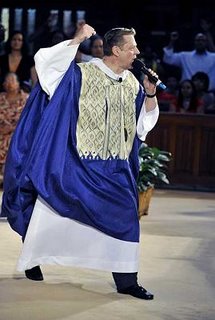
In  my opinion and experience, the Catholic preacher who does this is a narcissist.  He is drawing attention to himself.  He imposes himself, overlays himself, for his own needs, on the rite, the Word of God, and the people.

Are there exceptions?  Of course.  But not many.

Perhaps we can learn something about the idea of preaching outside the sanctuary, and strutting about like a peacock, from the Church’s rubrics for the sign of peace.  This is another occasion in which priests will jack-in-the-box out of the sanctuary where they belong and, sometimes, go to absurd lengths to see and be seen, to demonstrate how caring, warm and matey they are.


The General Instruction of the Roman Missal states that funerals are one of the rare occasions when the priest is permitted to leave the sanctuary for the sign of peace.

Sometimes there are exceptions, such as processions with the Eucharist.  There is also the beginning and end of the funeral.  If there is a person of note present, the celebrant can leave the sanctuary to give the sign of peace. These are exceptions to the general rule that the priest belongs in the sanctuary.

The sanctuary is the place of the priest, symbolically and liturgically the head of the Body the Church gathered in the sacred space of the church.  The head of the assembly has his place.  The Body, assembled in the nave, have their particular place.  The priest moves into the sanctuary, as into the holy of holies, the even more sacred space within the sacred space, as if into the bridal chamber.  He should stay there for the whole sacred action.

In the older form of Mass, the priest would remove his maniple before preaching.  This was a symbolic gesture to show that he was, as it were, stepping out of Mass for the sake of the sermon.  He began and ended with the sign of the Cross.  Returning to the altar, he replaced the maniple.   After the Council great effort has been made to connect preaching to the liturgical action itself.   The sermon is generally preached from the place the Gospel is proclaimed.  The sermon is supposed to be part of the liturgical action, connected to the proclamation of the Word of God.

Darting about with a microphone is at striking variance with the post-Conciliar vision of the homily.

So, there are some liturgical directives that suggest something about this.  There are some theological and liturgical points that suggest something about this.  There is common sense, which clinches the deal.

Posted in "How To..." - Practical Notes, ASK FATHER Question Box, Liturgy Science Theatre 3000 | Tagged , ,
48 Comments

QUAERITUR: Priest follows new translation but continues to say “for all” rather than “for many”

From a reader:

My pastor uses the new translation of the Mass with the exception of the words “for many” at the consecration. He continues to use the words “for all.” I find that this bothers me. I would appreciate your opinion on this matter.

I suspect that, at this point, Father isn’t just slipping back into a habit, words that he was used  to.  He is doing this pointedly and purposely.  He is doing this from defiance.

My suggestion is you ask your local bishop if Father obtained a special permission from him to continue to use a sacramental form (words of consecration) that differs from that approved by the Church.

Keep your letter extremely brief, without any angry words or accusations.  Don’t instruct the bishop about the new translation.  Just ask the question and request a response.

Send a copy of the letter to the Apostolic Nuncio.  Make sure you indicate on the letter to your bishops that you are cc:’ing the Nuncio.

His Excellency
Most Rev. Carlo Maria Viganò
Apostolic Nuncio of United States of America
3339 Massachusetts Avenue, NW
Washington, D.C. 20008-3687

Posted in "How To..." - Practical Notes, ASK FATHER Question Box, Liturgy Science Theatre 3000, Our Catholic Identity, Priests and Priesthood, The future and our choices |
29 Comments

Media coverage of the LCWR: ignorance, bias and laziness, sloppy and incomplete

This is a little dated, but it helps to explain some prominent errors about what is going on the the Holy See’s reforming efforts concerning key women religious.

This was by Ann Carey on NRO.

Nun Too Accurate Reporting
By Ann Carey
June 4, 2012

The mainstream media has had a field day with the June 1 press release of the Leadership Conference of Women Religious (LCWR) accusing the Vatican of causing “scandal” and “polarization” by identifying doctrinal problems within the LCWR that need to be corrected. What is really an internal Church matter about the proper role of an organization that has canonical standing in the Catholic Church has become a hot topic in a media that seems to delight in any controversy within the Church, especially one that involves challenges to its authority.

Headlines like “U.S. Nuns crack back at Vatican crackdown” (USA Today, June 1) and “American nuns come out swinging against Vatican” (CNN, June 1) might be funny if they weren’t so very ignorant. In fact, ignorance and bias have marked much of the media’s coverage of the doctrinal assessment of the LCWR by the Vatican Congregation for the Doctrine of the Faith (CDF). Or perhaps it’s laziness, for it is clear that many of the people writing about this issue know little about the Catholic Church and even less about the background for this story.

The June 1 New York Times editorial “When in Rome, Speak Up for Reality,” is a prime example of this ignorance/laziness/bias. For starters, the LCWR does not represent 80 percent of the sisters in the U.S., as the Times and many other media outlets claim. It represents only its 1,500 members, and sometimes even that is questionable, for it was only the LCWR 21-member national board that met and issued the June 1 press release well in advance of the August LCWR annual membership meeting.

Further, only members of leadership teams of religious orders belong to LCWR: The grassroots sisters in religious orders do not belong to LCWR, and have neither voice nor vote in the organization. Many of these sisters have told me they resent the LCWR claiming it represents them.

The Times editorial also claims that “many” see the Vatican action as “retaliation” for the LCWR endorsement of Obamacare, which the U.S. bishops opposed because of abortion funding and lack of conscience protection. If the editorial writers had read the CDF document, they would have seen that the decision to conduct the doctrinal assessment was made in 2008, when George W. Bush was still president and Obamacare was just a dream.

The Times and other media also persist in interpreting the Vatican action as insensitive to the good works sisters have done and continue to do. Again, if one actually read the CDF document, it would be clear that the good works of sisters are generously acknowledged and praised, and the CDF made clear that its action applies only to the 1,500-member LCWR.

However, good works do not justify doctrinal deviations, and again, the Times and most media have ignored sections in the Vatican document that discuss serious doctrinal problems such as a “rejection of faith.” And the issues cited in the document under the heading of “radical feminism” (a term called “a particularly dated canard” by the Times) include distortions of faith in Jesus and the structure of sacramental life, as well as undermining the doctrines of “the Holy Trinity, the divinity of Christ, and the inspiration of Sacred Scripture.”

These are all major doctrines of the Catholic Church, not just “basic, nonheretical questions about gender equality in the church,” as the Times editorial claims.

Such sloppy and incomplete reporting leads one to think that the Times and other secular media rather enjoy playing up any controversy related to the Catholic Church, even when they do not know the facts.

— Ann Carey is author of Sisters in Crisis: The Tragic Unraveling of Women’s Religious Communities.

Posted in "How To..." - Practical Notes, Biased Media Coverage, Magisterium of Nuns | Tagged , , , ,
10 Comments

RECENT POSTS OF INTEREST

Thank you for your prayers while I was ill.

Some posts as they scroll along:

Posted in SESSIUNCULA |
Comments Off on RECENT POSTS OF INTEREST