Card. Burke’s opinion on female servers in the Extraordinary Form

About the sad situation at Fisher House in Cambridge, where the chaplain had for some time, I am told, determined to have a female altar server for celebration of Holy Mass in the Extraordinary Form, something that truly goes against the entire ethos of the Roman Rite in the older form and certainly the sensibilities of the congregants….

Some time ago, His now-Eminence Raymond Card. Burke made observations about this very subject.  We saw this here at WDTPRS some time ago HERE.  Card. Burke had written a preface to a canonical study in German of Summorum Pontificum by Fr. Gero P. Weishaupt.

NLM posted a rough English translation of the German original of Archbp. [Card.] Burke’s preface.  The original text is available on the blog Summorum Pontificum.  My emphases.  Comments will follow.

I reproduce here what I offered back in August 2010 (my emphases and comments).

In the second chapter of his commentary, Weishaupt answers a number of practical issues that arise regarding the implementation of Summorum Pontificum and result from recent changes to the discipline of the celebration of the sacraments, such as e.g. those regarding female altar servers [that is the issue at hand] or lay people who perform the ministry of lecturers or extraordinary ministers of Holy Communion. To answer these questions , the commentary correctly applies two general canonical principles.

The first principle requires that liturgical norms, which were in force in 1962, are to be diligently observed for the celebration of the Extraordinary Form of the Roman Rite, for these norms protect the integrity of the Roman rite as contained in the Missal of Blessed John XXIII. [In due regard to the law today, do what was done as it was done in 1962.  I pray this shows up in the forthcoming, legendary, verging on chimeric “Instruction”.] The second principle states that the subsequent liturgical discipline is only to be introduced in the Extraordinary Form, if this discipline affects a right of the faithful, which follows directly from the sacrament of baptism and serves the eternal salvation of their souls. [Thus, in Cambridge the chaplain introduced a female server into the Extraordinary Form.  Cui bono?  Did that help anything?  Anyone?  Service at the altar isn’t something that is a right because you are baptized, and a lot of people were seriously irritated.  Furthermore, it sounds as if a female server was instrumentalized as a means to an end.]

The application of these two principles to the cases mentioned leads to the conclusion that neither the service at the altar by persons of the female sex [There it is.] nor the exercise of the lay ministries of lecturer or extraordinary ministers of Holy Communion belong to the basic rights of the baptized. Therefore, these recent developments, out of respect for the integrity of the liturgical discipline as contained in the Missale Romanum of 1962, are not to be introduced into the Extraordinary Form of the Roman rite. The commentary presents here in an impressive manner that the mutual enrichment of both forms of the Roman rite is only possible if discipline peculiar to each of the two forms is accordingly carefully observed.

A few comments of my own.

  • This is not an official document.  It is a preface by an official of the Holy See to a book which is a commentary by a writer who is not an official of the Holy See.  The preface has no legal force.
  • Archbp. [now Card.] Burke is a distinguished canonist who also knows inside and out the older, Extraordinary Form because he has been so open to it and has often been celebrant for liturgies in the traditional form.  He knows the logic of the rite from within and not as some onlooker.
  • Card. Burke was consulted about the text of Summorum Pontificum before its release.  He knows more than a little about its genesis and intention.
  • As a canonist, Card. Burke understands the rights of the baptized from the point of view of the Church’s law.

His dictis…

  1. It is not a right of the faithful for the sake of their salvation, that they be allowed to serve at Mass or to act as an EMCH.
  2. Since reception of Holy Communion – and the manner of Its reception – comes far closer to the issue of the salvation of the baptized, that might be a stickier issue.  Nevertheless, it seems to me that it is not a manner that touches on the salvation of the baptized to be permitted to receive on the hand when clearly it is contrary to the Church’s normative way of receiving.  Remember that permission to receive in the hand is actually an exception.
  3. I have held (pace Burke) that Summorum Pontificum did not in fact revive the laws that were in force in 1962, thus creating a parallel set of laws.  Was I wrong?  [We shall see.  But what is my opinion compared to Card. Burke’s?  Perhaps the “Instruction” will clarify.]
  4. Also, if there is to be such a strict separation of 1962 and 1970/2002, is mutual enrichment possible insofar as rites are concerned? [Perhaps during the next generation?]
  5. Or, and this is where I have put all my stress over the last few years, does it have more to do with ars celebrandi?

Some food for thought.

People may send comment by email for review and, if I desire, posting here on my schedule.

Posted in "How To..." - Practical Notes, ASK FATHER Question Box, Classic Posts, Linking Back, Liturgy Science Theatre 3000, SUMMORUM PONTIFICUM, The Drill | Tagged , , , , , ,
1 Comment

ENGLAND: TLM training for priests and servers concluded, new session announced for August

From the Latin Mass Society in England with a few edits:

THE LMS’s Seventh Training Conference for Priests and Servers Successfully Concluded

Over thirty clerics and laymen attended the Latin Mass Society’s seventh residential training conference for the training of priests in the Traditional or Extraordinary Form of the Roman Rite. This conference took place from Tuesday 3 May to Friday 6 May at Buckfast Abbey in Devon.

The programme, as in recent conferences, also provided for the training of altar servers.  Fifteen servers were trained. This included a number of young men, three of whom are discerning vocations to the priesthood.

The twelve priests came from across the UK: England, Scotland, Wales and Northern Ireland were all represented. Two of the priests were Polish and one was an Army chaplain who has recently seen active service in Afghanistan and Iraq.

The servers followed a similar progression, learning to assist at celebrations up to High Mass.

Each day sung Mass was celebrated in the abbey church and the quality of the polyphonic singing and Latin plain chant was outstanding.

As usual at LMS conferences, the food and accommodation were appreciated for their high quality throughout.

Pictures of the Buckfast conference are available from the LMS website here.

The next training programme, the eighth, will be a one-day event on Tuesday 23 August at Holy Cross Priory, Leicester. This will be for priests and servers wishing to study the rubrics of the Mass in its Solemn Form and who are already familiar with Low Mass. The day will start at 9.30 am and finishing around 5.00 pm. The fee for attending will be £5.00. For further details or to register, contact the LMS office on 020 7404 7284 or email info@lms.org.uk

I’ll bet none of the servers learning the older form were female… as they had at Fisher House in Cambridge, thanks to the chaplain there.

Posted in "How To..." - Practical Notes, Brick by Brick, The Campus Telephone Pole | Tagged , , , ,
Comments Off on ENGLAND: TLM training for priests and servers concluded, new session announced for August

“Pope Attacks Pathologies of Faith and Reason!” – ANALYSIS

On the site of the American Spectator my friend the great Samuel Gregg, of Acton Institute, has a piece about Pope Benedict which I bring to your attention with my emphases and comments.

Benedict XVI: In No One’s Shadow

By Samuel Gregg on 5.6.11 @ 6:08AM

It was inevitable. In the lead-up to John Paul II’s beatification, a number of publications decided it was time to opine about the direction of Benedict XVI’s pontificate. The Economist, for example, portrayed a pontificate adrift, “accident-prone,” and with a “less than stellar record” compared to Benedict’s dynamic predecessor (who, incidentally, didn’t meet with the Economist’s approval either).

It need hardly been said that, like most British publications, the Economist’s own record when it comes to informed commentary on Catholicism and religion more generally is itself less than stellar. And the problems remain the same as they have always been: [NB:] an unwillingness to do the hard work of trying to understand a religion on its own terms, and a stubborn insistence upon shoving theological positions into secular political categories. [Rem acu, Samuele, tetigisti.  He put this very well.  Though we often will borrow terms such as “right v. left” in our own churchy talk, we do so with a difference.  MSM does not.]

Have mistakes occurred under Benedict’s watch? Yes. Some sub-optimal appointments? [Finally someone else who uses sub-optimal!  I hope he got it from WDTPPS.] Of course. That would be true of any leader of such a massive organization.

But the real difficulty with so much commentary on this papacy is the sheer narrowness of the perspective brought to the subject. If observers were willing to broaden their horizons, they might notice just how big are the stakes being pursued by Benedict. This pope’s program, they may discover, goes beyond mere institutional politics. He’s pursuing a civilizational agenda.  [I have said that Benedict’s program revolves around the restoration of Catholic identity.  There are ad intra and ad extra dimensions.  Within, we have to shore up our understanding and acceptance of doctrine.  To do that the first step is liturgical worship.  When it comes to works of mercy, they must be done for true charity, etc.  As far as the world is concerned, if we don’t know who we are, then we have little to say in the public square and no one will bother to listen to us if we are unsure.  At stake is the lost of the identity of the West, especially in Europe, whose heart and soul must be Christian if Europe is to remain Europe and not, as the last Oriana Fallaci quipped, Eurabia, or something else.  My thoughts turn back constantly to the Pope 2006 Message for the World Day for Peace as an important signal about what he is doing… or trying to do.  Let’s see if Gregg and I are on the same track.  Perpend…]

And that program begins with the Catholic Church itself. [That’s the ad intra dimension I mentioned above.] Even its harshest critics find it difficult to deny Catholicism’s decisive influence on Western civilization’s development. It follows that a faltering in the Church’s confidence about its purpose has implications for the wider culture.  [So far so good!]

That’s one reason Benedict has been so proactive in rescuing Catholic liturgy [Say da magic woid, win a hunned dahlahs.] from the banality into which it collapsed throughout much of the world (especially the English-speaking world) after Vatican II. Benedict’s objective here is not a reactionary “return to the past.” Rather, it’s about underscoring the need for liturgy to accurately reflect what the Church has always believed — lex orandi, lex credendi — rather than the predilections of an aging progressivist generation that reduced prayer to endless self-affirmation.

This attention to liturgy is, I suspect, one reason why another aspect of Benedict’s pontificate — his outreach to the Orthodox Christian churches — has been remarkably successful. [Benedict XVI is the Pope of Christian Unity.] As anyone who’s attended Orthodox services knows, the Orthodox truly understand liturgy. Certainly Benedict’s path here was paved by Vatican II, Paul VI, and John Paul II. Yet few doubt that Catholic-Orthodox relations have taken off since 2005.

That doesn’t mean the relationship is uncomplicated by unhappy historical memories, secular political influences, and important theological differences. Yet it’s striking how positively Orthodox churches have responded to the German pope’s overtures. They’ve also become increasingly vocal in echoing Benedict’s concerns about Western culture’s present trajectory.  [Not only. The Orthodox also are pressed on many sides.  They have far few resources and reach in most of the world and, in their diaspora, they struggle to maintain their identity, which is tied in part to ethnic concerns in the context of highly-heated melting pots.  This sounds more negative than it is intended to sound, but the principle is the same: the enemy of my enemy is my friend.  To whom will the Orthodox turn in their own struggle against the incursion of Islams in Orthdox regions and the prevailing dictatorship of relativism in the West?]

But above all, Benedict has — from his pontificate’s very beginning — gone to the heart of the rot within the West, a disease which may be described as pathologies of faith and reason. [Well said.]

In this regard, Benedict’s famous 2006 Regensburg address may go down as one of the 21st century’s most important speeches, comparable to Alexander Solzhenitsyn’s 1978 Harvard Address in terms of its accuracy in identifying some of the West’s inner demons.

Most people think about the Regensburg lecture in terms of some Muslims’ reaction to Benedict’s citation of a 14th century Byzantine emperor. That, however, is to miss Regensburg’s essence. It was really about the West. [Excellent.]

Christianity, Benedict argued at Regensburg, integrated Biblical faith, Greek philosophy, and Roman law, thereby creating the “foundation of what can rightly be called Europe.” [Keep in mind that years before his election Ratzinger had a book called, in Italian at least, Una svolta per l’Europa… a Turning point for Europe.] This suggests that any weakening of this integration of faith and reason would mean the West would start losing its distinctive identity. In short, a West without a Christianity that integrates faith and reason is no longer the West. [Bingo.]

Today, Benedict added, we see what happens when faith and reason are torn asunder. Reason is reduced to scientism and ideologies of progress, thereby rending reasoned discussion of anything beyond the empirical impossible. Faith dissolves into sentimental humanitarianism, an equally inadequate basis for rational reflection. [Remember my comment about “true charity”?  Cf. Caritas in veritate.  This is also why the Holy See is starting to crack down on the organization Caritas.] Neither of these emaciated facsimiles of their originals can provide any coherent response to the great questions pondered by every human being: “Who am I?” “Where did I come from?” “Where am I going?”

So what’s the way back? To Benedict’s mind, it involves affirming that what he recently called creative reason lies at the origin of everything. [I think it starts with liturgical renewal.]

As Benedict explained one week before he beatified his predecessor: “We are faced with the ultimate alternative that is at stake in the dispute between faith and unbelief: are irrationality, lack of freedom and pure chance the origin of everything, or are reason, freedom and love at the origin of being? Does the primacy belong to unreason or to reason? This is what everything hinges upon in the final analysis.”  [This is why when I write about liturgical worship I hammer away at the concept of mystery.]

It’s almost impossible to count the positions Benedict is politely assailing here. On the one hand, he’s taking on philosophical materialists and emotivists (i.e., most contemporary scholars). But it’s also a critique of those who diminish God to either a Divine Watchmaker or a being of Pure Will. [Modernism?]

Of course none of this fits into sound-bites. “Pope Attacks Pathologies of Faith and Reason!” is unlikely to be a newspaper headline anytime soon. [But it has in the blogosphere.  Thanks, Mr. Gregg.] That, however, doesn’t nullify the accuracy of Benedict’s analysis. It just makes communicating it difficult in a world of diminished attention-spans and inclined to believe it has nothing to learn from history.  [Again, as part of my own liturgical reflection, I note that we are dominated by distraction,and at the root of that distraction is timor mortis, which Augustine calls our hiems cotidiana.  The focus on the Cross is what cracks that distraction and brings us into touch with the mystery which both terrifies and attracts.  If liturgical worship doesn’t accomplish this over time, it has failed.]

So while the Economist and others might gossip about the competence of various Vatican officials, [A distraction.] they are, to their own detriment, largely missing the main game. Quietly but firmly Benedict is making his own distinct contribution to the battle of ideas upon which the fate of civilizations hang. His critics’ inability to engage his thought doesn’t just illustrate their ignorance. It also betrays a profound lack of imagination.

Well done, Mr. Gregg.

Posted in Fr. Z KUDOS, Our Catholic Identity, Pope of Christian Unity, The Drill, The future and our choices | Tagged , , , , , , ,
8 Comments

To those who have donated: Mass Monday and Wednesday

Your PROTEST v. Fishwrap donations are still coming and I am very grateful.  I will add these names to the list for tomorrow morning’s (MONDAY 0900 EDT – 1400 UK) Mass.

DD, GB, MT, SW, AT, JMJ, JB,
MD, CL, RMM. Fr.RC, MG, AB,
AS, RR, NB. MH, JB, DB, KO,
PS, CDW, PF, EP,CP, JA, BA,
TR, MF, JH, RS, CB, MM, CG,
EG

I like to think that with every donation, a heretic was annoyed.

Now if we could only convert them. I think God has to do it. Please stop what you are doing and say a prayer to the Guardian Angels of the people who write for the Fishwrap. They are doing harm to the unity of the Church and the souls of the faithful.

Also, I have an open intention on Wednesday and will be able to say another for those who come in after the Monday Mass.

Many people attach notes asking me to pray that they might find work or to have some clarity for their vocation discernment.

On Wednesday (Sts. Philip and James in the older, traditional calendar) I will again say Mass for benefactors with any more names which are to be superadded.


To those who have donated: Mass Monday and Wednesday

SUPERADDED NAMES THIS MORNING:

FlM, JH, FL, MW, SJ, BE, DE,
DE, TB, AMHW, HM, CG, DW, MS,
JW, ER, AS, SW

Posted in SESSIUNCULA |
Comments Off on To those who have donated: Mass Monday and Wednesday

The Feeder Feed: ORANGE!

Today as I was driving, a flash of orange swooped in front of me.  Oriole, thought I.

I had put out orange slices in the hope of attracting the first returning Orioles.

Now the place is lousy with Orioles!

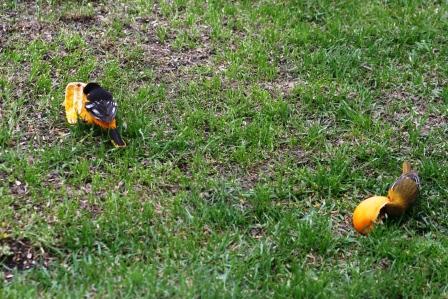
On my return home, they had knocked down the slices and were busily stripping them clean on the ground.

I put out more.  More came.

Mrs. Oriole.

The Feeder Feed: ORANGE!

Mr. and Mrs.

The Feeder Feed: ORANGE!

The Feeder Feed: ORANGE!

The Feeder Feed: ORANGE!

The House Finches wanted in on the action.

The Feeder Feed: ORANGE!

This fellow is of such an intense orange it is hard to imagine that he didn’t stop at some garage for detailing.

The Feeder Feed: ORANGE!

So!  I will be buying more oranges and also grape jelly.  They love grape jelly.

In the last week I have seen the return of Brown Thrasher, Rose-breasted Grosbeak, Baltimore Oriole, and a few less attractive species.

I am now waiting for the humming birds.  I will clean the feeders right away and hang them up tonight.

Posted in SESSIUNCULA | Tagged , , ,
8 Comments

Do As I Say, Not As I Do! – UPDATE

Do you recall that “Do As I Say, Not As I Do!” post?  Refresh your memory here.

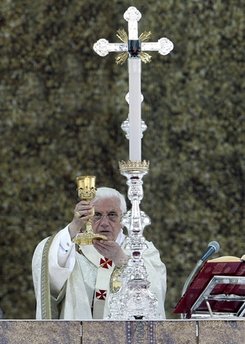
Precious or not, beautiful or not, Pope Benedict did not use glass vessels at the Mass as Mestre/Venice.

Do As I Say, Not As I Do! - UPDATE

Posted in SESSIUNCULA | Tagged , , ,
23 Comments

TLM with female servers… not just a theory? FACT.

A while ago Cardinal Burke, not a slouch when it comes to the Church’s law, made a statement about head coverings for women in church for Mass.  In a nutshell, he said that, while the present Code of Canon Law, does not impose an obligation, with we are talking about the Extraordinary Form, it is good to go by the practices in use at the time when the Extraordinary Form was the Only Form.  This should apply also to practices such as how to receive Holy Communion: at the TLM receive on the tongue while kneeling, even though the law in the place me permit Communion in the hand.

It just makes sense.  Frankly I think that Communion on the tongue while kneeling makes sense all the time, but I digress.

There are some things which, though not strictly against the law, are simply inimical to the law’s spirit.

I received more than one note about this.

I was told yesterday that in England a priest was planning to have Holy Mass in the Extraordinary Form with female servers.

It seems to me that this is a really bad idea and deeply offensive to the sensibilities of those who revere the older form of Holy Mass.  It is hard to imagine that this is true.

UPDATE 8 May 1305 GMT:

I had first received information which was at the level of a rumor and so I anonymized the top entry.  But… now… it isn’t rumor anymore:

I had two notes…

Dear Fr Zuhlsdorf,
I am sorry to confirm the rumour about the developments at Fisher House in Cambridge. As a result of te decisions to have female servers in the Extraordinary Form all servers who have been helping with the Masses in the Extraordinary Form in Fisher house have resigned; the congregation was much smaller than usual because some of the faithful (like me) decided not to come (and probably also because of lacking information on the Mass schedule, so it was not only out of protest), and some people left during the Mass. As someone who has been deeply involved in the liturgical life of Fisher House …  I am very sorry about this development, and I hope that Ecclesia Dei will reply speedily to resolve the matter (I have written to them twice last year, when then chaplain first mooted this idea, but still have not received any official reply). However, I would like to stress that the Fr Alban has been an exemplary chaplain to Cambridge University, ….

And this…

Dr Kevin Marshall, the LMS representative, says the Mass occurred, although he left after the kyrie.   There were two male servers and one female.  The congregation was about twelve (slightly less than half the normal size) and, for the most part, a completely different crowd.  At least two people walked out.

I am sure that some of the more traditional mind-set will have a nutty about this and lose all ability to self-edit.  I urge you not to have a nutty.

Observations:

Take a lesson: If priests want to get rid of something, they sometimes will make that something a very unpleasant experience.  If they want to get rid of the Extraordinary Form, they need only do stupid stunts like this.  Therefore, keep a cool head.

If you write letters to anyone, review my tips for writing.

Posted in "How To..." - Practical Notes, Liturgy Science Theatre 3000 | Tagged , , ,
92 Comments

WDTPRS: 3rd Sunday of Easter – COLLECT (2002MR): restored in the glory of spiritual adoption

COLLECT: (2002 Missale Romanum):
Semper exsultet populus tuus, Deus,
renovata animae iuventute,
ut, qui nunc laetatur in adoptionis se gloriam restitutum,
resurrectionis diem spe certae gratulationis exspectet.

The genitives, adoptionis…resurrectionis… gratulationis, give the end of this collect a very cohesive feeling.

LITERAL TRANSLATION:
O God, let your people always rejoice,
now that the youth of their spirit has been renewed,
so that, he who now rejoices that he has been restored in the glory of spiritual adoption
may await the day of the resurrection in the hope of sure thanksgiving.

We have an elegantly scrambled word order in the second part: qui nunc laetatur in adoptionis se gloriam restitutum, the infinitive esse being understood… laetatur se restitutum (esse) in gloriam adoptionis. The slightly odd wording puts a special emphasis on the word gloria.

This gives weight to a connection I will make to another famous Easter Latin prayer.

But first some vocabulary!

Adoptio of course is “adoption” in the sense of “to take as one’s child.” We find the phrase adoptionem filiorum Dei … “adoption of the sons of God” in the Latin Vulgate of Jerome (Romans 8,23; Gal 4,5; Eph 1,5). Gratulatio means “a manifestation of joy; a wishing joy, congratulation; a rejoicing, joy and also “a religious festival of joy and thanksgiving, a public thanksgiving.”

Now for the connection I mentioned above.

I wonder if there is not a conscious attempt on the part of the Church, now that Easter and its octave have passed, to remind us of the Easter Vigil.

Maybe we are being reminded that in the Easter season Easter itself is truly being extended. I guess at this because of the words exsultet and adoptio.

On the Vigil of Easter the great hymn of the diaconate was sung, the Praeconium Paschale or Exsultet. Composed perhaps as early as the fifth century and maybe in parts going back to St. Ambrose himself, this hymn (or lucernarium) came into the Roman tradition through a ninth century addition to the so-called Gregorian Sacramentary.

After the preparation of the Paschal candle and the procession to the sanctuary, dressed in his dalmatic the deacon asks a blessing from the priest/celebrant as if he were about to read the Gospel. He incenses the Paschal candle, or “Christ Candle” as it is often called. He begins the hymn much as if he were singing a Preface (Sursum corda! “Up with your hearts!”) He invites the vast array of heavenly angels to join him in praising Christ symbolized in the candle that is lit at the beginning of the Vigil liturgy.

This is a long text: sung at a normal pace the Exsultet is about ten minutes in duration. It has many beautiful and evocative images. In the medieval Church, the text was written out elegantly on long parchment rolls, with large beautiful pictures painted on it depicting the mysteries and imagery being sung. They were painted upside down, so that as the deacon sang and unrolled the scroll over the back of the ambo, the people could see the images right-side up.

The text is a long meditation on the candle as it symbolizes Christ, risen gloriously, and how He has saved humanity from sin. The famous phrase O felix culpa is found here, “O happy fault that merited so to have so great a redeemer.” Also, many times the hymn refers to the amazing nature of the night itself, during which Christ rose. There are constant contrasts of light and darkness.

One of the images of meditation in the Exsultet concerns the flame of the candle itself: the wax which nourishes the divided and yet undiminished flame of the candle is identified as the work of bees.

Above I explained that adoptio is a “spiritual adoption” in the sense of the effects of baptism making us members of the risen Christ and children of the loving Father. Adoptio is also used in a transferred sense, as The Lewis & Short Dictionary informs us, for the “admission of a bee into a new hive.” This is a classical Latin usage.

However, we must remember that these prayers, Christian though they may be, come forth from a deep culture formed and permeated in great part by two thousand years of Latin literature. The well-read will remember images and interesting usages of words from classical literature and weave them into what they compose in a conscious way. This connection with the roots of Western literature is all the more reason to provide the English speaking faithful with truly accurate and beautiful translations of the Latin prayers in the Missale Romanum.

LAME-DUCK ICEL:
God our Father,
may we look forward with hope to our resurrection,
for you have made us your sons and daughters,
and restored the joy of our youth.

This prayer touches themes found in the Latin. It eliminates what I consider a necessary reference to glory. Of course, in the Latin prayer, the word gloria is clearly present. But gloria, which I have explained in previous offerings of WDTPRS, is also that dynamic transforming power by which God will make us more and more “godlike” in the life to come. Easter is very much about gloria. Christ reigns now in glory because of the resurrection. We can share that glory because He is risen.

Another thing that might be worth mentioning is a possible connection between the theme of restored “youth” and the Psalm that the priest would say always at the beginning of Mass: Introibo ad altare Dei, ad Deum qui laetificat iuventutem meam…. “I will go unto the altar of God, of God who makes my youth joyful.” In baptism we are made members of Christ’s own mystical Person. While there is a clear qualitative distinction between the priesthood of the ordained priest and that of the baptized laity, this idea of youthful and renewed priesthood is part of our Easter joy. All of us, ordained and lay, each in our own way must in the manner of a priest offer our spiritual sacrifices to the Father, uniting them to those of Jesus our High Priest. In Him, we therefore already share that eternally youthful life that will never age. We will one day be risen and glorious, with glorified bodies that will not know age or deficiency and will reflect the beauty of the purified soul. Easter and indeed our own baptism anticipate this glory.

But the lame-duck ICEL eliminated “glory”.

NEW CORRECTED ICEL:
May your people exult for ever, O God,
in renewed youthfulness of spirit,
so that, rejoicing now in the restored glory of our adoption,
we may look forward in confident hope
to the rejoicing of the day of resurrection
.

Better? You decide.

Posted in WDTPRS | Tagged ,
4 Comments

QUAERITUR: When there is no Mass for Sunday

From a reader:

I was just reading my parish’s bulletin and noticed that next week
there is no Mass on Saturday or Sunday because the priest is away.
Instead the deacon is leading a Liturgy of the Word with a Communion Service in place of the Masses.

I live in a city that’s sufficiently large enough (around 20 Latin
Rite parishes, and a number of Eastern Rite Churches) that the vast
majority of parishoners could attend an actual Mass or Divine Liturgy on either day without any trouble.

This made me wonder if attending a Liturgy of the Word with a
Communion Service when one can easily attend a Mass at another parish a few kilometers away would count as fulfilling one’s Sunday
Obligation? Does it have to be an actual Mass?

People are not bound to something that they cannot fulfill. If there is no Mass within a reasonable distance, then you cannot fulfill your obligation and therefore, you are not at fault.

That said, should a person chose to make a bit of a sacrifice, it would be commendable to drive somewhere more distant.  Perhaps such a person could from goodness take someone with you.

In any event, Sunday remains the Lord’s Day, and divine positive law holds us always.

In your case, it is not hard to get to another Church for Mass.  I would go to Mass elsewhere on Sunday rather than go to some liturgy of the word and Communion service.  How dreadful.

Posted in "How To..." - Practical Notes, 1983 CIC can. 915 | Tagged ,
33 Comments

Thanks from Fr. Z for your PROTESTS

I spent a good deal of time today writing notes of thanks to people who sent in a PROTEST DONATION against the Fishwrap.

I have also added the following names to the list of those for whom I will be saying Mass.

VD, TMcN, TC, LR, FA, MP, DK, HE, MZ, NB, AB, IFA, CG, CDF,KK, T&TS, BK, ACW, RM, PC, MM, BB, Fr. RB, VR, LF, SA,  CR, JK, MPP, CM, AS, MSO – TS,  RT, BT, EE, ML, HM, RM, DB, JCR, AM, GE, MD, CB, RL, WC, NS, CK3, MP, PP

Since donations are still coming, I will also say Mass again for benefactors on Monday.

Some of the notes people added to the form when they sent the donations have been very touching. They ask me to pray for certain things, such as loved ones who are sick, to find jobs, for their own vocations.

In the meantime, Mrs. Grosbeak (left), the first I have seen this season, thinks you should still keep sending donation!

And White-Crowned Sparrow (right) looks on.

Thanks from Fr. Z for your PROTESTS

However, Mrs. Grosbeak took exception to something.  Perhaps a suggestion that Fishwrap really wasn’t all that bad.  It is.

Thanks from Fr. Z for your PROTESTS

Thanks from Fr. Z for your PROTESTS
UPDATE 8 May 0344 GMT:
I have had some very nice notes from people in the last few days, along with many requests for prayers.  Here was a nice piece of feedback:
Fr. Z, I read your blog daily; I have not only learned a whole lot, but the regular reading has strengthened my faith, hundred-fold. Your ministry has also allowed me to approach the pastor of my parish with confidence in topics associated with the liturgy. You will be glad to know that I not only have been doing more frequent (and better) confessions, but have been able to bring one person back into this good practice. For these – and many other benefits to my spiritual life – I am happy to make this donation! P.
Then my work here is done.
Posted in The Feeder Feed | Tagged
Comments Off on Thanks from Fr. Z for your PROTESTS