From a reader:
Prior to the consecration, the altar servers are negligent in removing everything extraneous from the altar. They have left the cruet of water on the altar, and more importantly, the carafe from which the wine was poured. The priest continues on with the Mass (and consecration), all the while with the carafe and its remnants of wine on the altar. My question is, has the wine in the carafe now been consecrated?
I have asked two priests about this. One says only that which the priest intends to be consecrated is consecrated, and even if the bread or wine were not on the altar but the priest intended them to be consecrated they would be. The other said all bread and wine on the altar is consecrated, period. I have searched online for definitive guidance from the Church, and while I am finding lots of non-specific stuff from folks who may or may not know, I have not found anything official.
Priests are to have the intention to consecrated the matter they know they want to consecrate. The usual way to help with this intention, to help make it explicit, is to place the matter to be consecrated on the corporal which is spread on the altar.
The corporal is a square linen cloth placed on the altar upon the altar linens. It is often treated with starch or other substances to make the surface smooth. It is intended to delineate the place where the sacred vessels are placed and also, importantly, to catch any particles of the sacred Host that might fall, lest they be lost. To that end, the corporal was always scraped with the paten at the time of the purification of vessels. Also, it is folded into a smaller square "envelope", to hold within its folds any particles that weren’t caught up by the celebrant, lest they be lost… ne pereant.
That said, a priest can also have the moral intention to consecrate. He knows beforehand what needs to be consecrated and then, even if it isn’t right in front of his face, when he consecrates, it is consecrated.
But the corporal is the best way to keep this clear. Priests should use corporals.
And corporals should not be left on altars between Masses, unless they are under a monstrance.
In Redemptionis Sacramentum 199 we also see the importance of using the corporal. If vessels are to be purified even at the credence table (i.e., not on the altar) a corporal is to be used.
That said, a priest can have the intention to consecrate something not on the altar or not on the corporal. We see this in these mega-Masses during, for example, Papal trips. I don’t know what the effective range of a consecration, but to my mind… well… it would be better not to …. well… let’s just leave that alone.
The priest who made the comment about the intention (above) put it best. The priest who said everything on the altar is consecrated, period, express the reality badly. It may be that he personally has the intention to consecrated everything on the altar. I don’t. Nor to 99.99% of priests in the world, I think. I consider it very imprudent to that that moral intention when saying Mass, precisely because containers which shouldn’t be consecrated may inadvertently be left on the altar. Before launching into the consecratory section of the Eucharistic Prayer, the priest really ought to make a rapid check of what vessels are where so that he knows what needs to be consecrated and, in that moment, intend to consecrate them and them alone.
The old De defectibus, section on defects, which was part and parcel of the Roman priest’s knowledge for centuries is helpful in this regard. There is a description of defects of intention. My emphases and comments.
VII – Defect of intention
23. The intention of consecrating is required. Therefore there is no consecration in the following cases: when a priest does not intend to consecrate but only to make a pretense; when some hosts remain on the altar forgotten by the priest, or when some part of the wine or some host is hidden, since the priest intends to consecrate only what is on the corporal; [See what I mean?] when a priest has eleven hosts before him and intends to consecrate only ten, without determining which ten he means to consecrate. On the other hand, if he thinks there are ten, but intends to consecrate all that he has before him, then all will be consecrated. For that reason every priest should always have such an intention, namely the intention of consecrating all the hosts that have been Placed on the corporal before him for consecration.
24. If the priest thinks that he is holding one host but discovers after the Consecration that there were two hosts stuck together, he is to consume both when the time comes. If after receiving the Body and Blood, or even after the ablution, he finds other consecrated pieces, large or small, he is to consume them, because they belong to the same sacrifice.
25. If, however, a whole consecrated host is left, he is to put it into the tabernacle with the others that are there; if this cannot be done, he is to consume it.
26. It may be that the intention is not actual at the time of the Consecration because the priest lets his mind wander, yet is still virtual, [this is what I meant but a moral intention, above. Here it is described as a "virtual" intention.] since he has come to the altar intending to do what the Church does. In this case the Sacrament is valid. A priest should be careful, however, to make his intention actual also. [That is what I meant about the priest, just before the consecration, making a quick review of what is to be consecrated.]
Since this is the most important this a priest does, and since it deals with the most important thing we have, perhaps deserves the most care and attention.
 From the gentlemanly
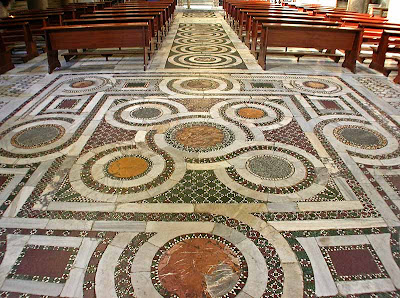
  ROME, September 13, 2010 – The image [right] is a partial panorama of the immense mosaic that covers the floor of the cathedral of Otranto, on the southeast coast of Italy.
 September 2010 marked the third anniversary of the promulgation of the Motu Proprio, Summorum Pontificum. In the letter to the bishops of the world accompanying the document Pope Benedict writes, "…I invite you, dear Brothers, to send to the Holy See an account of your experiences, three years after this Motu Proprio has taken effect."

 Peace doves fly over Cathedral of the Blessed Sacrament

 excalibur on YOUR URGENT PRAYER REQUESTS: “Personal intentions.”






























