Here is the Holy Father’s sermon for the Feast of the Sacred Heart, marking the closing of the Year for Priests.
I divided the paragraphs a bit more than the release did to make it easier to follow and added my emphases and comments:
Dear Brothers in the Priestly Ministry,
Dear Brothers and Sisters,
The Year for Priests which we have celebrated on the one hundred and fiftieth anniversary of the death of the holy Curè of Ars, the model of priestly ministry in our world, is now coming to an end. We have let the Curé of Ars guide us to a renewed appreciation of the grandeur and beauty of the priestly ministry.
The priest is not a mere office-holder, like those which every society needs in order to carry out certain functions. Instead, he does something which no human being can do of his own power: in Christ’s name he speaks the words which absolve us of our sins and in this way he changes, starting with God, our entire life. [He leads with absolution instead of transubstantiation.] Over the offerings of bread and wine he speaks Christ’s words of thanksgiving, [eucharist] which are words of transubstantiation – words which make Christ himself present, the Risen One, his Body and Blood – words which thus transform the elements of the world, which open the world to God and unite it to him.
The priesthood, then, is not simply "office" [not just a function, someone who fills a role] but sacrament: God makes use of us poor men in order to be, through us, present to all men and women, and to act on their behalf. This audacity of God who entrusts himself to human beings – who, conscious of our weaknesses, nonetheless considers men capable of acting and being present in his stead – this audacity of God is the true grandeur concealed in the word "priesthood". That God thinks that we are capable of this; that in this way he calls men to his service and thus from within binds himself to them: this is what we wanted to reflect upon and appreciate anew over the course of the past year.
We wanted to reawaken our joy at how close God is to us, and our gratitude for the fact that he entrusts himself to our infirmities; that he guides and sustains us daily. In this way we also wanted to demonstrate once again to young people that this vocation, this fellowship of service for God and with God, does exist – and that God is indeed waiting for us to say "yes". [Thus, the Year was also to promote vocations. As I read I have a twinge of irony at the mention of young people, given the timing of how the crisis of clerical sexual abuse exploded again precisely during this Year for Priests.] Together with the whole Church we wanted to make clear once again that we have to ask God for this vocation. We have to beg for workers for God’s harvest, and this petition to God is, at the same time, his own way of knocking on the hearts of young people who consider themselves able to do what God considers them able to do.
It was to be expected that this new radiance of the priesthood would not be pleasing to the "enemy"; [The MSM and some liberal Catholics may latch on to this with a sneer, but the Holy Father rightly introduces the work of the Enemy of the soul, the devil. It is good for Popes to speak of the Enemy, who is real. This may bring some negative spin. Some will suggest that by blaming the devil, the Pope is dodging responsibility, yadda yadda. But all of this involves the mysterium iniquitatis. I can’t help but think that what in worldly terms we might think of as a "disaster", might not in the long run also be helpful, in the sense that purification and healing can take place and we have a stronger sense of reliance on GOD, rather than on ourselves or any other human being.] he would have rather preferred to see it disappear, so that God would ultimately be driven out of the world. [NB:] And so it happened that, in this very year of joy for the sacrament of the priesthood, the sins of priests came to light – particularly the abuse of the little ones, in which the priesthood, whose task is to manifest God’s concern for our good, turns into its very opposite. We too insistently beg forgiveness from God and from the persons involved, while promising to do everything possible to ensure that such abuse will never occur again; and that in admitting men to priestly ministry and in their formation we will do everything we can to weigh the authenticity of their vocation and make every effort to accompany priests along their journey, so that the Lord will protect them and watch over them in troubled situations and amid life’s dangers. [Amen. But watch what he does next…] Had the Year for Priests been a glorification of our individual human performance, it would have been ruined by these events. [… As I said, above…] But for us what happened was precisely the opposite: we grew in gratitude for God’s gift, a gift concealed in "earthen vessels" which ever anew, even amid human weakness, makes his love concretely present in this world. So let us look upon all that happened as a summons to purification, as a task which we bring to the future and which makes us acknowledge and love all the more the great gift we have received from God. In this way, his gift becomes a commitment to respond to God’s courage and humility by our own courage and our own humility. The word of God, which we have sung in the Entrance Antiphon of today’s liturgy, can speak to us, at this hour, of what it means to become and to be a priest: "Take my yoke upon you, and learn from me; for I am gentle and humble of heart" (Mt 11:29).
We are celebrating the feast of the Sacred Heart of Jesus, and in the liturgy we peer, as it were, into the heart of Jesus opened in death by the spear of the Roman soldier. [In writing about liturgical matters I have not a few times used the image of Moses peering through the crack in the rock to see God as He passed by. I think it was Richard of St. Victor who wrote of peering through the visible wound to see the invisible wound of love.] Jesus’ heart was indeed opened for us and before us – and thus God’s own heart was opened. The liturgy interprets for us the language of Jesus’ heart, which tells us above all that God is the shepherd of mankind, and so it reveals to us Jesus’ priesthood, which is rooted deep within his heart; so too it shows us the perennial foundation and the effective criterion of all priestly ministry, which must always be anchored in the heart of Jesus and lived out from that starting-point.
Today I would like to meditate especially on those texts with which the Church in prayer responds to the word of God presented in the readings. In those chants, word (Wort) and response (Antwort) interpenetrate. On the one hand, the chants are themselves drawn from the word of God, yet on the other, they are already our human response to that word, a response in which the word itself is communicated and enters into our
lives. The most important of those texts in today’s liturgy is Psalm 23(22) – "The Lord is my shepherd" – in which Israel at prayer received God’s self-revelation as shepherd, and made this the guide of its own life. "The Lord is my shepherd, I shall not want": this first verse expresses joy and gratitude for the fact that God is present to and concerned for humanity. The reading from the Book of Ezechiel begins with the same theme: "I myself will look after and tend my sheep" (Ez 34:11). God personally looks after me, after us, after all mankind. I am not abandoned, adrift in the universe and in a society which leaves me ever more lost and bewildered. God looks after me. He is not a distant God, for whom my life is worthless. The world’s religions, as far as we can see, have always known that in the end there is only one God. But this God was distant. Evidently he had abandoned the world to other powers and forces, to other divinities. It was with these that one had to deal. The one God was good, yet aloof. He was not dangerous, nor was he very helpful. Consequently one didn’t need to worry about him. He did not lord it over us.
Oddly, this kind of thinking re-emerged during the Enlightenment. There was still a recognition that the world presupposes a Creator. Yet this God, after making the world, had evidently withdrawn from it. The world itself had a certain set of laws by which it ran, and God did not, could not, intervene in them. God was only a remote cause. Many perhaps did not even want God to look after them. They did not want God to get in the way. But wherever God’s loving concern is perceived as getting in the way, human beings go awry. It is fine and consoling to know that there is someone who loves me and looks after me. But it is far more important that there is a God who knows me, loves me and is concerned about me. "I know my own and my own know me" (Jn 10:14), the Church says before the Gospel with the Lord’s words. God knows me, he is concerned about me. This thought should make us truly joyful. Let us allow it to penetrate the depths of our being. Then let us also realize what it means: God wants us, as priests, in one tiny moment of history, to share his concern about people. As priests, we want to be persons who share his concern for men and women, who take care of them and provide them with a concrete experience of God’s concern. Whatever the field of activity entrusted to him, the priest, with the Lord, ought to be able to say: "I know my sheep and mine know me". "To know", in the idiom of sacred Scripture, never refers to merely exterior knowledge, like the knowledge of someone’s telephone number. "Knowing" means being inwardly close to another person. It means loving him or her. We should strive to "know" men and women as God does and for God’s sake; we should strive to walk with them along the path of friendship with God.
Let us return to our Psalm. There we read: "He leads me in right paths for his name’s sake. Even though I walk through the darkest valley, I fear no evil; for you are with me; your rod and your staff – they comfort me" (23[22]:3ff.). The shepherd points out the right path to those entrusted to him. He goes before them and leads them. Let us put it differently: the Lord shows us the right way to be human. He teaches us the art of being a person. [cf. GS 22] What must I do in order not to fall, not to squander my life in meaninglessness? This is precisely the question which every man and woman must ask and one which remains valid at every moment of one’s life. How much darkness surrounds this question in our own day! We are constantly reminded of the words of Jesus, who felt compassion for the crowds because they were like a flock without a shepherd. Lord, have mercy on us too! Show us the way! From the Gospel we know this much: he is himself the way. Living with Christ, following him – this means finding the right way, so that our lives can be meaningful and so that one day we might say: "Yes, it was good to have lived". The people of Israel continue to be grateful to God because in the Commandments he pointed out the way of life.
The great Psalm 119(118) is a unique expression of joy for this fact: we are not fumbling in the dark. God has shown us the way and how to walk aright. The message of the Commandments was synthesized in the life of Jesus and became a living model. Thus we understand that these rules from God are not chains, but the way which he is pointing out to us. We can be glad for them and rejoice that in Christ they stand before us as a lived reality. He himself has made us glad. By walking with Christ, we experience the joy of Revelation, and as priests we need to communicate to others our own joy at the fact that we have been shown the right way.
Then there is the phrase about the "darkest valley" through which the Lord leads us. Our path as individuals will one day lead us into the valley of the shadow of death, where no one can accompany us. Yet he will be there. Christ himself descended into the dark night of death. Even there he will not abandon us. Even there he will lead us. "If I sink to the nether world, you are present there", says Psalm 139(138). [The Holy Father is working with psalms, which his primary audience, priests – the Holy Father included – know well from their daily recitation of the office.] Truly you are there, even in the throes of death, and hence our Responsorial Psalm can say: even there, in the darkest valley, I fear no evil. When speaking of the darkest valley, we can also think of the dark valleys of temptation, discouragement and trial through which everyone has to pass. Even in these dark valleys of life he is there. Lord, in the darkness of temptation, at the hour of dusk when all light seems to have died away, show me that you are there. Help us priests, so that we can remain beside the persons entrusted to us in these dark nights. So that we can show them your own light. [And maybe find some ourselves as well.]
"Your rod and your staff – they comfort me": the shepherd needs the rod as protection against savage beasts ready to pounce on the flock; against robbers looking for prey. Along with the rod there is the staff which gives support and helps to make difficult crossings. Both of these are likewise part of the Church’s ministry, of the priest’s ministry. The Church too must use the shepherd’s rod, the rod with which he protects the faith against those who falsify it, against currents which lead the flock astray. The use of the rod can actually be a service of love. Today we can see that it has nothing to do with love when conduct unworthy of the priestly life is tolerated. Nor does it have to do with love if heresy [!] is allowed to spread and the faith twisted and chipped away, as if it were something that we ourselves had invented. [I suspect, once again, that some in the MSM will throw a little nutty over the Pope’s mention of heresy. I can hear them sputtering, "After all! Wasn’t he the Church’s doctrine enforcer? The Rottweiler?! Head of what was the Inquisition?!?] As if it were no longer God’s gift, the precious pearl which we cannot let be taken from us. Even so, the rod must always become once again the shepherd’s staff – a staff which helps men and women to tread difficult paths and to follow the Lord. [In other words, don’t be afraid to correct error when you encounter it. This is a necessary dimension of priestly ministry. Hopefully priests will hark back to this and be reminded of the Pope’s distinctions and underlying message when they run into this psalm in the Office and, as often happens, at funerals.]
At the end of the Psalm we read of the table which is set, the oil which anoints the head, the cup which overflows, and dwelling in the house of the Lord. In the Psalm this is an expression first and foremost of the prospect of the festal joy of being in God’s presence in the temple, of being his guest, whom he himself serves, of dwelling with him. For us, who pray this Psalm with Christ and his Body which is the Church, this prospect of hope takes on even greater breadth and depth. We see in these words a kind of prophetic foreshadowing of the mystery of the Eucharist, in which God himself makes us his guests and offers himself to us as food –as that bread and fine wine which alone can definitively sate man’s hunger and thirst. How can we not rejoice that one day we will be guests at the very table of God and live in his dwelling-place? How can we not rejoice at the fact that he has commanded us: "Do this in memory of me"? How can we not rejoice that he has enabled us to set God’s table for men and women, to give them his Body and his Blood, to offer them the precious gift of his very presence. Truly we can pray together, with all our heart, the words of the Psalm: "Goodness and mercy shall follow me all the days of my life" (Ps 23[22]:6). [I would add, How then would any priest not desire to be faithful to the Church’s rites in this regard?]
Finally, let us take a brief look at the two communion antiphons which the Church offers us in her liturgy today. First there are the words with which Saint John concludes the account of Jesus’ crucifixion: "One of the soldiers pierced his side with a spear, and at once blood and water came out" (Jn 19:34). The heart of Jesus is pierced by the spear. Once opened, it becomes a fountain: the water and the blood which stream forth recall the two fundamental sacraments by which the Church lives: Baptism and the Eucharist. From the Lord’s pierced side, from his open heart, there springs the living fountain which continues to well up over the centuries and which makes the Church. The open heart is the source of a new stream of life; here John was certainly also thinking of the prophecy of Ezechiel who saw flowing forth from the new temple a torrent bestowing fruitfulness and life (Ez 47): Jesus himself is the new temple, and his open heart is the source of a stream of new life which is communicated to us in Baptism and the Eucharist.
[That was the real antiphon, as it were. But since in the Novus Ordo there are so many options, …. ] The liturgy of the Solemnity of the Sacred Heart of Jesus also permits another phrase, similar to this, to be used as the communion antiphon. It is taken from the Gospel of John: Whoever is thirsty, let him come to me. And let the one who believes in me drink. As the Scripture has said: "Out of his heart shall flow rivers of living water" (cf. Jn 7:37ff.) In faith we drink, so to speak, of the living water of God’s Word. In this way the believer himself becomes a wellspring which gives living water to the parched earth of history. We see this in the saints. We see this in Mary, that great woman of faith and love who has become in every generation a wellspring of faith, love and life. Every Christian and every priest should become, starting from Christ, a wellspring which gives life to others. We ought to be offering life-giving water to a parched and thirst world. [All Christians, lay people in particular, have the vocation to shape the world around them according to their state in life and calling.]
Lord, we thank you because for our sake you opened your heart; because in your death and in your resurrection you became the source of life. Give us life, make us live from you as our source, and grant that we too may be sources, wellsprings capable of bestowing the water of life in our time. We thank you for the grace of the priestly ministry. Lord bless us, and bless all those who in our time are thirsty and continue to seek. Amen.
I have the sense that the Holy Father had quite a bit more on his mind, but that he simply had to wrap this up, force the sermon to a conclusion for the sake of length.

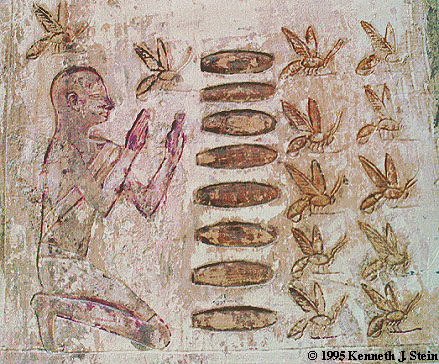 Bees are interesting critters. In the ancient world they were thought to reproduce parthenogenetically. Therefore, in the early Church, bees were a symbol of virginity and purity. Because of the honey they produce, they were sometimes associated with eloquence. Hagiographical accounts of the life of St. Ambrose of Milan (+397) had bees flying in and out of baby Amby’s mouth as he slept. Bees figure, of course, in the great Easter Vigil hymn the Exsultet. Honey is bacteriostatic. Though I understand that honey shouldn’t be given infants, children under 1 year of age, it is very good for you. In ancient Rome it was at times used as money. There are many biblical references to honey, including the description of the promised land, what John the Baptist ate, and what Samson found in the carcass of the lion. The patriarch Jacob sent his sons to Egypt with honey as a gift. Manna tasted like honey. The prophet Samuel said that in the forest there was so much honey that honeycombs were all over the ground. When the Risen Lord showed Himself to the Apostles and asked for something to eat – to demonstrate that He was not a ghost – they gave Him fish and μελίσσιος, honeycomb. In the Psalms we say that the Lord’s judgments are sweeter than honey and in the book of Revelation John takes the scroll from the angel and eats it and it was as sweet as honey.


 Fr. John Zuhlsdorf on Daily Rome Shot 1117 – A *POLL* about 2026-27: “Sorry… my bad. It is indeed SIX. 1. Rh8+! Kxh8 2. Qh2+ Kg8 3. Qh7+ Kf8 4. Qh8+ Ke7 5.…”




























