Furze

A timely and light-hearted offering from the Laudator:

Oliver Rackham, The History of the Countryside (1986; rpt. London: Phoenix Press, 2000), p. 295:

Furze is an important and widely-used fuel; it produces a quick hot blaze suitable for heating ovens, getting up a fire in the morning, or burning heretics.

Posted in SESSIUNCULA |
7 Comments

Religious cover for wavering Dems in place? Dissident women religious lobby House Reps in favor of the health care bill

I fear that this may give the Democrats wavering about the health care bill because of abortion the religious cover they need to vote in favor of the health care bill.

Here is an article in the WaPo.

Catholic nuns urge passage of Obama’s health bill

By RICARDO ALONSO-ZALDIVAR
The Associated Press
Wednesday, March 17, 2010; 10:14 AM

WASHINGTON — Catholic nuns are urging Congress to pass President Barack Obama’s health care plan, in an unusual public break with bishops who say it would subsidize abortion.

Some 60 leaders of religious orders representing 59,000 Catholic nuns Wednesday sent lawmakers a letter urging them to pass the Senate health care bill. It contains restrictions on abortion funding that the bishops say don’t go far enough.

The letter says that "despite false claims to the contrary, the Senate bill will not provide taxpayer funding for elective abortions." The letter says the legislation also will help support pregnant women and "this is the real pro-life stance."

The Catholic Bishops need to rise up as a man and do something about this act of defiance from the LCWR.

Here is the text of the letter the sisters sent to Representatives forwarded to me by a staffer for a member of the House:

Subject: Catholic Sisters for Healthcare Reform  

Dear Representative,    

We write to urge you to cast a life-affirming "yes" vote when the Senate health care bill (H.R. 3590) comes to the floor of the House for a vote as early as this week. We join the Catholic Health Association of the United States (CHA), which represents 1,200 Catholic sponsors, systems, facilities and related organizations, in saying: the time is now for health reform AND the Senate bill is a good way forward.  [So this is effectively liberal women who say they are Catholic who are effectively doing what they can to pave the way for funding for abortion even though they claim that that is not what they are doing.]  

As the heads of major Catholic women’s religious order in the United States, we represent 59,000 Catholic Sisters in the United States who respond to needs of people in many ways.  Among our other ministries we are responsible for running many of our nation’s hospital systems as well as free clinics throughout the country.    

We have witnessed firsthand the impact of our national health care crisis, particularly its impact on women, children and people who are poor.  We see the toll on families who have delayed seeking care due to a lack of health insurance coverage or lack of funds with which to pay high deductibles and co-pays. We have counseled and prayed with men, women and children who have been denied health care coverage by insurance companies. We have witnessed early and avoidable deaths because of delayed medical treatment.     

The health care bill that has been passed by the Senate and that will be voted on by the House will expand coverage to over 30 million uninsured Americans. While it is an imperfect measure, it is a crucial next step in realizing health care for all. It will invest in preventative care. It will bar insurers from denying coverage based on pre-existing conditions. It will make crucial investments in community health centers that largely serve poor women and children. [NB] And despite false claims to the contrary, the Senate bill will not provide taxpayer funding for elective abortions. [Prove it!] It will uphold longstanding conscience protections and it will make historic new investments – $250 million – in support of pregnant women. This is the REAL pro-life stance,  and we as Catholics are all for it. [No kind of Catholic I recognize.  Right in the eye of the Catholic bishops. No?]    

Congress must act. We are asking every member of our community to contact their congressional representatives this week. In this Lenten time, we have launched nationwide prayer vigils for health care reform. We are praying for those who currently lack health care.  We are praying for the nearly 45,000 who will lose their lives this year if Congress fails to act. [WHAT?] We are also praying for you and your fellow Members of Congress as you complete your work in the coming days. For us, this health care reform is a faith mandate [?] for life and dignity of all of our people.    

We urge you to vote "yes" for life by voting yes for health care reform in H.R. 3590.     

Sincerely,    

Marlene Weisenbeck, FSPA  LCWR President  Leadership Conference of Women Religious     Leadership Team  Sisters of Mercy of the Americas     Leadership Team  Sisters of Charity of the Blessed Virgin Mary     Joan Chittister, OSB  Co-Chair Global Peace Initiative of Women  Erie, PA     Sr. Mary Persico, IHM  President  Congregation of the Sisters, Servants of the Immaculate Heart of Mary,  Scranton, PA     Sr. Susan Hadzima, IHM  Councilor for Missioning and Community Life  Sisters, Servants of the Immaculate Heart of Mary,  Scranton, PA      Mary Pelligrino, Marguerite Coyne, Rosanne Oberleitner, Carolyn Bodenshatz  Leadership team  Sisters of St. Joseph  Baden, PA      Sr. Helen McDonald, SHCJ  Province Leader  Society of the Holy Child Jesus  Philadelphia, PA     Vivien Linkhauer, SC  Sisters of Charity of Seton Hill, United States Province  Greensburg, PA     Ruth Goodwin, OSF  Sisters of St. Francis of Philadelphia     Sister Barbara Hagedorn, SC  Sisters of Charity of Cincinnati  Mt. St. Joseph, Ohio     Marilyn Kerber, SNDdeN  Sisters of Notre Dame de Namur  Canonical Representative, Ohio Province     Sisters of St. Francis  Tiffin, Ohio      Leadership Team  Sisters of the Precious Blood  Dayton, OH     Nancy Conway CSJ  Congregation Leadership Team  The Congregation of St. Joseph     Joan Saalfeld, SNJM, Provincial  Sisters of the Holy Names of Jesus and Mary  U.S.-Ontario Province     Jo’Ann De Quattro, SNJM  Sisters of the Holy Names  U.S.-Ontario Province Leadership Team     Josephine Gaugier,  OP  Adrian Dominican Sisters  Holy Rosary Mission Chapter Prioress  Adrian, MI     Kathleen Nolan, OPAdrian Dominican SistersOffice of the General Council     Joan Mumaw, IHM – Vice President  On behalf of the Leadership Council  Sisters, Servants of the Immaculate Heart of Mary  Monroe, MI     Corinne Weiss,  Servants of Jesus Leadership Team  Saginaw   MI     Beatrice Haines, OLVM  President, Our Lady of Victory Missionary Sisters  Huntington, IN     Eileen C. Reid, RJM  Provincial Superior  Religious of Jesus and Mary  Washington DC     Sister Cecilia Dwyer, O.S.B.  Prioress  Benedictine Sisters of Virginia     Sr. Dorothy Maxwell, Councilor  Sisters of St. Dominic  Blauvelt, New York     Adrian Dover OPPrioress  Dominican Sisters of Houston, Texas     Francine Schwarzenberger OP  Dominican Sisters of Peace  Denver, Colorado      Rose Mary Dowling, FSM  President  Franciscan Sisters of Mary     Margaret Byrne CSJP – Congregation LeaderTeresa Donohue CSJP – Assistant Congregation Leader  Sisters of St. Joseph of Peace     Sr. Carmelita Latiolais, S.E.C.  Sisters of the Eucharistic Covenant     Sheral Marshall, OSF  Provincial Councilor  Sisters of St Francis       The Congregation of Sisters of St. Agnes  Sister Joann Sambs, CSA  General Superior     The Leadership Team of the Sisters of St. Joseph of the Third Order of St. Francis  Sister Jane Blabolil, SSJ-TOSF  Sister Michelle Wronkowski, SSJ-TOSF  Sister Dorothy Pagosa, SSJ-TOSF  Sister Linda Szocik, SSJ-TOSF        Sr. Mary Genino (RSHM), Provincial  Religious of the Sacred Heart of Mary  Western American Province.     Debra M. Sciano, SSND  Provincial Leader  Milwaukee Province, School Sisters of Notre Dame     Sister Liz Heese  School Sisters of St. Francis  US Province, Milwaukee, WI     Marlene Weisenbeck, FSPA, President  Franciscan Sisters of Perpetual Adoration  La Crosse, WI      Sharon Simon, OP  President  Racine Dominicans     Maryann A. McMahon, O.P.  Vice President  Dominican Sisters of Racine, WI     Agnes Johnson, OP  Vice President  Racine Dominicans     Pat Mulcahey, OP  Prioress of Sinsinawa Dominicans     Theresa Sandok, OSM  Servants of Mary (Servite Sisters)  Ladysmith, Wisconsin     Sister Maureen McCarthySchool Sisters of St. FrancisU.S. Provincial TeamMilwaukee, WI      Dolores Maguire  Sisters of the Holy Faith  Northern California LCWR Region XIV        Patricia Anne Cloherty, PBVM   Leadership Team, Sisters of the Presentation, San Francisco     Pam Chiesa, PBVM  President  Sisters of the Presentation, San Francisco     Gloria Inés Loya  Leadership Team  Sisters of the Presentation, San Francisco     Gloria Marie Jones, OP  Dominican Sisters of Mission San Jose  Congregational Prioress and Council     Mary Litell  Provincial Councilor  Sisters of St. Francis of Penance and Christian Charity St. Francis Province     Sr Claire Graham SSS  General Director  Sisters of Social Service  Encino CA     Sr. Gladys Guenther SHF  Sisters of the Holy Family  Congregational President  Fremont, CA     Sister Patricia Rayburn, OSF,  Provincial Minister, Sisters of St. Francis,  Redwood City, CA     Sisters of St. Louis, California Region     Marianites of Holy Cross      Sr. Suellen Tennyson, MSCCongregational Leader  New Orleans, LA     Sister Clare of Assisi Pierre, SSF  Sisters of the Holy Family  New Orleans, LA           Congregation of Our Lady of Mount Carmel  Sister Elizabeth Fitzpatrick, O.Carm.  Sister Andree Bindewald, O.Carm.  Lacombe, Louisiana     Sister Marla Monahan, SNDProvincialSisters of Notre Dame(St. Claire Regional Medical Center in Morehead, KY  and St. Charles Care Center in Covington, KY)     Sr. Mary Elizabeth Schweiger, OSB  Subprioress  Mount St. Scholastica  Atchison, KS     Janice Cebula, OSF  President  Sisters of St. Francis, Clinton, Iowa     Mary Rehmann, CHM  President  Congregation of the Humility of Mary  Davenport, IA

UPDATE 1557 GMT:

Check CMR‘s entry "Nun of the above"

"The sisters point to the many good things the bill may accomplish. But you can’t caveat evil. It’s still just evil."

There it is.

UPDATE 1619 GMT:

The Council of Major Superiors of Women Religious (the "matter" to the LCWR "anti-matter")  issued a statement of their own, very different from the dissenting pro-abortion stance of the LCWR.

UPDATE 1734 GMT:

 At least one bishop has a clear statement.  Read what Bp. Finn has to say.

UPDATE 2022 GMT:

Biretta tip   o{]:¬)    to the youthful papist and I like his title: "How did a few hundred nuns become 60,000?"

USCCB News Release

10-048
March 18, 2010
FOR IMMEDIATE RELEASE

Clarification

Washington—A recent letter from Network, a social justice lobby of sisters, grossly overstated whom they represent in a letter to Congress that was also released to media.

Network’s letter, about health care reform, was signed by a few dozen people, and despite what Network said, they do not come anywhere near representing 59,000 American sisters.

 The letter had 55 signatories, some individuals, some groups of three to five persons.  One endorser signed twice.

There are 793 religious communities in the United States.

The math is clear. Network is far off the mark.

Sister Mary Ann Walsh
Director of Media Relations
United States Conference of Catholic Bishops

Posted in SESSIUNCULA |
54 Comments

Benedict XVI on how to govern

Sandro Magister has this today, which you will want to take a moment to read in full.

Be sure to visit chiesa.

My emphases and comments.

How to Pilot the Church in the Storm. A Lesson

Benedict XVI has taught it to the faithful in a general audience, against those who call for a new beginning for Christianity, without hierarchy or dogmas. The secret of good governance, he said, is "above all to think and to pray"

by Sandro MagisterBenedict XVI on how to govern

ROME, March 18 – Few have noticed it, but in the thick of the storm that has battered the Catholic Church in the wake of the scandal presented to the "little ones" by some of its priests, Joseph Ratzinger has faced the challenge in a way uniquely his own. With a surprising lesson on the theology of history, not without references to his own experience as theologian and pope.

He gave the lesson to the pilgrims crowding the hall for the general audience on the morning of Wednesday, March 10.

The pope repeatedly looked up from the written text and improvised. [He does this far more than his predecessor.] The complete transcript is reproduced further below, and deserves to be read from beginning to end. But a few of its features should be pointed out immediately.

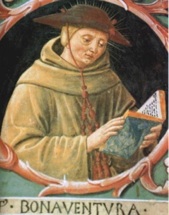
At the center of the lesson stands Bonaventure of Bagnoregio, doctor of the Church, one of the first successors of Saint Francis as head of the order he founded.

And this is the first of the autobiographical features. Because it was precisely on Saint Bonaventure’s theology of history that the young Joseph Ratzinger published, in 1959, his thesis for certification to teach theology, which has recently been republished.

The novelty of this early text was that it compared, for the first time, Saint Bonaventure’s theology of history with the highly influential version of Joachim of Fiore.

Joachim of Fiore has had a tremendous influence on both Christian and atheist thought, in his own century and in later ones, up until our own time. Thirty years ago, the theologian Henri De Lubac dedicated a two-volume study to this influence, entitled: "La posterité spirituelle de Joachim de Flore."

When today, in reaction to the scandal of some priests, appeals come again for an epochal, radical purification of the Church, a new Council to be a "new beginning and rupture," a spiritual Christianity made up of the bare Gospel without any more hierarchies or dogmas, what is being invoked if not the age of the Spirit proclaimed by Joachim of Fiore?

In his lesson last March 10, Benedict XVI described and made accessible with rare clarity the contrast between Joachim and Bonaventure. He showed how Joachim’s utopia found fertile ground in Vatican Council II to reproduce itself once again, [think "Spirit of Vatican II"] successfully opposed, however, by the "wise helmsmen of Peter’s barque," by the popes who were able to defend simultaneously the novelty of the Council and the continuity of the Church.

It’s a small step from spiritualism to anarchy, Benedict XVI warned. That’s the way it was in Saint Bonaventure’s century, and that’s the way it is today. In order to be governed, the Church needs hierarchical structures, but these must be given a clear theological foundation. This is what Saint Bonaventure did in governing the Franciscan order. For him, "to govern was not simply a task but was above all to think and to pray. At the base of his government we always find prayer and thought; all his decisions resulted from reflection, from thought illumined by prayer."

The same thing – the pope said – must happen today in the universal Church: "governing, that is, not only through commands and structures, but through guiding and enlightening souls, orienting them to Christ."

This is the second, decisive autobiographical trait from the lesson on March 10. In it, Benedict XVI said how he intends to govern the Church. He said it with the meek humility that is characteristic of him, putting himself in the shadow of a saint.

Just as for Saint Bonaventure the theological and mystical writings were "the soul of governance," so it is for the current pope. [NB:] The soul of his governance is the liturgical homilies, instruction for the faithful and the world, the book on Jesus, in short, "thought illuminated by prayer." It is there that the hierarchical structure of the Roman Church and its acts of governance find their foundation and nourishment. It is from there that the Church of Pope Benedict draws healing for its children’s sins and an answer to the attacks – far from innocent – that reach it from without and from within.

But let’s let him speak. Here is his catechesis from Wednesday, March 10, 2010:

__________

"There is not another higher Gospel, there is not another Church to await…"

by Benedict XVI

Dear brothers and sisters, […] among various merits, St. Bonaventure had that of interpreting authentically and faithfully the figure of St. Francis of Assisi, whom he venerated and studied with great love.

In a particular way, in the times of St. Bonaventure a current of Friars Minor called "spiritual" held that there was a totally new phase of history inaugurated with St. Francis; the "eternal Gospel" had appeared, of which Revelation speaks, which replaced the New Testament.

This group affirmed that the Church had now exhausted her historical role, and in her place came a charismatic community of free men guided interiorly by the Spirit, namely, the "spiritual Franciscans."

At the base of the ideas of this group were the writings of a Cistercian abbot, Joachim of Fiore, who died in 1202. In his works, he affirmed a Trinitarian rhythm of history. He considered the Old Testament as the age of the Father, followed by the time of the Son, the time of the Church. To be awaited yet was the third age, that of the Holy Spirit. [Sounds like charismatics as well as some liberals.]

The whole of history was thus interpreted as a history of progress: from the severity of the Old Testament to the relative liberty of the time of the Son, in the Church, up to the full liberty of the children of God, in the period of the Holy Spirit, which would have been also the period of peace among men, of the reconciliation of peoples and religions.

Joachim of Fiore aroused the hope that the beginning of the new time would come from a new monasticism. It is thus understandable that a group of Franciscans thought it recognized in St. Francis of Assisi the initiator of the new time and in his order the community of the new period –- the community of the time of the Holy Spirit, which left behind it the hierarchical Church, to begin a new Church of the Spirit, no longer connected to the old structures.
 
There was, hence, the risk of a very serious misunderstanding of the message of St. Francis, of his humble fidelity to the Gospel and to the Church, and such a mistake implied an erroneous vision of Christianity as a whole.
 
St. Bonaventure, who in 1257 became minister-general of the Franciscans, found himself before serious tension within his own order due, precisely, to those who espoused this current of "spiritual Franciscans," which aligned itself to Joachim of Fiore. Precisely to respond to this group and to give unity again to the order, St. Bonaventure carefully studied the authentic writings of Joachim of Fiore and those attributed to him and, taking into account the need to present correctly the figure and message of his beloved St. Francis, he wished to show a correct view of the theology of history.

St. Bonaventure addressed the problem in fact in his last work, a collection of conferences to monks of the Paris studio, which remained unfinished and which was completed with the transcriptions of the hearers. It was titled "Hexaemeron," that is, an allegorical explanation of the six days of creation.

The Fathers of the Church considered the six or seven days of the account of creation as a prophecy of the history of the world, of humanity. The seven days represented for them seven periods of history, later interpreted also as seven millennia. With Christ we would have entered the last, namely, the sixth period of history, which would then be followed by the great sabbath of God. St. Bonaventure accounts for this historical interpretation of the relation of the days of creation, but in a very free and innovative way.

For him, two phenomena of his time render necessary a new interpretation of the course of history.
 
The first: the figure of St. Francis, the man totally united to Christ up to communion of the stigmata, almost an "alter Christus," and with St. Francis the new community created by him, different from the monasticism known up to then. This phenomenon called for a new interpretation, as a novelty of God which appeared in that moment.
 
The second: the position of Joachim of Fiore, who announced a new monasticism and a totally new period of history, going beyond the revelation of the New Testament, called for an answer.
 
As minister-general of the Order of Franciscans, St. Bonaventure had seen immediately that with the spiritualistic conception, inspired by Joachim of Fiore, the order was not governable, but was going logically toward anarchy.

For him there were two consequences .
 
The first: the practical need of structures and of insertion in the reality of the hierarchical Church, of the real Church, needed a theological foundation, also because the others, those who followed the spiritualist conception, showed an apparent theological foundation.
 
The second: although taking into account the necessary realism, it was not necessary to lose the novelty of the figure of St. Francis.
 
How did St. Bonaventure respond to the practical and theoretical need? Of his answer I can only give here a very schematic and incomplete summary in some points:
 
St. Bonaventure rejected the idea of the Trinitarian rhythm of history. God is one for the whole of history and he is not divided into three divinities. As a consequence, history is one, even if it is a journey and – according to St. Bonaventure – a journey of progress.
 
Jesus Christ is the last word of God, in him God has said all, giving and expressing himself. More than himself, God cannot express, cannot give. The Holy Spirit is Spirit of the Father and of the Son. Christ himself says of the Holy Spirit: He "will bring to your remembrance all that I have said to you" (John 14:26), "he will take what is mine and declare it to you" (John 16:15).

 [NB] Hence, there is not another higher Gospel, there is not another Church to await. Because of this, the Order of St. Francis had also to insert itself in this Church, in her faith, in her hierarchical order.
 
This does not mean that the Church is immobile, fixed in the past and that novelties cannot be exercised in her. "Opera Christi non deficiunt, sed proficiunt," the works of Christ do not go backward, do not fail, but progress, says the saint in the letter "De tribus quaestionibus."

Thus St. Bonaventure formulates explicitly the idea of progress, and this is a novelty in comparison with the Fathers of the Church and a great part of his contemporaries. For St. Bonaventure, Christ is no longer, as he was for the Fathers of the Church, the end, but the center of history; history does not end with Christ, but a new period begins.

Another consequence is the following: prevailing up to that moment was the idea that the Fathers of the Church were at the absolute summit of theology, all the following generations could only be their disciples. Even St. Bonaventure recognizes the Fathers as teachers for ever, but the phenomenon of St. Francis gave him the certainty that the richness of the word of Christ is inexhaustible and that also new lights can appear in the new generations. The uniqueness of Christ also guarantees novelties and renewal in all the periods of history.
 
Certainly, the Franciscan Order – so he stresses – belongs to the Church of Jesus Christ, to the Apostolic Church, and cannot build itself on a utopian spiritualism. But, at the same time, the novelty of such an order is valid in comparison with classic monasticism, and St. Bonaventure […] defended this novelty against the attacks of the secular clergy of Paris. The Franciscans do not have a fixed monastery, they can be present everywhere to proclaim the Gospel. Precisely the break with stability, characteristic of monasticism, in favor of a new flexibility, restored to the Church her missionary dynamism.
 
At this point perhaps it is useful to say that also today there are views according to which the whole history of the Church in the second millennium is a permanent decline; some see the decline already immediately after the New Testament.  [This leads some with "archeologizing" tendencies to think that, for example in the sphere of liturgy, anything that followed that "pristine" early period was a merely an "encrustation" that is fit for removal.]

In reality, "opera Christi non deficiunt, sed proficiunt," the works of Christ do not go backward, but progress. What would the Church be without the new spirituality of the Cistercians, of the Franciscans and Dominicans, of the spirituality of St. Teresa of Avila and St. John of the Cross, and so on?

This affirmation is also valid today: "Opera Christi non deficiunt, sed proficiunt," they go forward. St. Bonaventure teaches us the whole of the necessary discernment, even severe, of the sober realism and of openness to new charisms given by Christ, in the Holy Spirit, to his Church.

And while this idea of decline is repeated, there is also the other idea, this "spiritualistic utopianism," which is repeated. [WATCH…] We know, in fact, how after the Second Vatican Council, some were convinced that everything should be new, that there should be another Church, that the pre-conciliar Church was finished and that we would have another, totally "other" Church. An anarchic utopianism! And thanks be to God, the wise helmsmen of Peter’s Barque, Pope Paul VI and Pope John Paul II, on one hand defended the novelty of the council and on the other, at the same time, defended the uniqueness and continuity of the Church, which is always a Church of sinners and always a place of grace.  [Here is an echo of the Holy Father’s polemic with the "hermeneutic of discontinuity and rupture".]
 
In this connection, St. Bonaventure, as minister-general of the Franciscans, took a line of government in which it was very clear that the new order could not, as a community, live at the same "eschatological height" of St. Francis, in which he saw the future world anticipated, but – guided, at the same time, by healthy realism and spiritual courage – had to come as close as possible to the maximum realization of the Sermon on the Mount, which for St. Francis was the rule, though taking into account the limits of man, marked by original sin.
 
 [NB] Thus we see that for St. Bonaventure, to govern was not simply a task but was above all to think and to pray. At the base of his government we always find prayer and thought; all his decisions resulted from reflection, from thought illumined by prayer. His profound contact with Christ always accompanied his work of minister-general and that is why he composed a series of theological-mystical writings, which express the spirit of his government and manifest the intention of guiding the order interiorly, of governing, that is, not only through commands and structures, but through guiding and enlightening souls, orienting them to Christ.
 
Of these his writings, which are the soul of his government and show the way to follow either as an individual or a community, I would like to mention only one, his masterwork, the "Itinerarium mentis in Deum," which is a "manual" of mystical contemplation.

This book was conceived in a place of profound spirituality: the hill of La Verna, where St. Francis had received the stigmata. In the introduction, the author illustrates the circumstances that gave origin to his writing: "While I meditated on the possibility of the soul ascending to God, presented to me, among others, was that wondrous event that occurred in that place to Blessed Francis, namely, the vision of the winged seraphim in the form of a crucifix. And meditating on this, immediately I realized that such a vision offered me the contemplative ecstasy of Father Francis himself and at the same time the way that leads to it" ("Journey of the Mind in God," Prologue, 2, in "Opere di San Bonaventura. Opuscoli Teologici," 1, Rome, 1993, p. 499).
 
The six wings of the seraphim thus became the symbol of six stages that lead man progressively to the knowledge of God through observation of the world and of creatures and through the exploration of the soul itself with its faculties, up to the satisfying union with the Trinity through Christ, in imitation of St. Francis of Assisi.

The last words of St. Bonaventure’s "Itinerarium," which respond to the question of how one can reach this mystical communion with God, would make one descend to the depth of the heart: "If you now yearn to know how that happens (mystical communion with God), ask grace, not doctrine; desire, not the intellect; the groaning of prayer, not the study of the letter; the spouse, not the teacher; God, not man; darkness not clarity; not light but the fire that inflames everything and transport to God with strong unctions and ardent affections… We enter therefore into darkness, we silence worries, the passions and illusions; we pass with Christ Crucified from this world to the Father, so that, after having seen him, we say with Philip: that is enough for me" (Ibid., VII, 6).
 
Dear friends, let us take up the invitation addressed to us by St. Bonaventure, the Seraphic Doctor, and let us enter the school of the divine Teacher: We listen to his Word of life and truth, which resounds in the depth of our soul. Let us purify our thoughts and actions, so that he can dwell in us, and we can hear his divine voice, which draws us toward true happiness.

(Translation by Zenit).

__________

The catechesis reproduced above is the second of a trilogy dedicated by Benedict XVI to Saint Bonaventure of Bagnoregio, at the general audiences of three consecutive Wednesdays.

Here are links to the first and third catecheses, respectively from March 3 and March 17, 2010:

> Saint Bonaventure 1

> Saint Bonaventure 3

At the end of this catechesis, Benedict XVI announced the imminent publication of a letter to the Church of Ireland, rocked by the scandal of pedophile priests:

"As you know, in recent months the Church in Ireland has been severely shaken as a result of the child abuse crisis. As a sign of my deep concern I have written a pastoral letter dealing with this painful situation. I will sign it on the solemnity of Saint Joseph, the guardian of the Holy Family and patron of the universal Church, and send it soon after. I ask all of you to read it for yourselves, with an open heart and in a spirit of faith. My hope is that it will help in the process of repentance, healing and renewal."

Posted in Pope of Christian Unity, SESSIUNCULA | Tagged , ,
11 Comments

AFP: Man screams abuse at Pope Benedict XVI

UPDATE 18 March 12:52 GMT:

A reader sent this:

I read that the AFP communique was disinformation and that the man was shouting against pro-choice groups.

HERE.
___________

Pray for the Pope.

He will be more and more under attack of every kind.

From the AFP:

AFP: Man screams abuse at Pope Benedict XVIMan screams abuse at Pope Benedict XVI

March 18, 2010

THE Pope was verbally abused as he gave his weekly address in St Peter’s Square yesterday.

A man, apparently in his early 50s, shouted "bulls***, bulls***" while stretching an accusatory arm towards Benedict XVI, after approaching the barrier in front of the Pope’s podium.

Vatican police forcibly removed the man, still shouting, from the square.

The Pope went on to announce that he would "soon" send a pastoral letter to Irish Catholics over the paedophile priest scandal that has rocked Ireland.

The address was the first of the year to be held in St Peter’s Square, which was bathed in early spring sunshine.

Security for the 82-year-old Pope was tightened after a woman knocked him to the ground at midnight mass on Christmas Eve.

However, Vatican authorities said it would be impossible to entirely protect the Pope without putting a wall between him and the masses who come to see him.


Pray for the Pope and help others to do so as well.

Posted in Pope of Christian Unity, The Last Acceptable Prejudice |
15 Comments

Twitter update: another feed – @FatherZuhlsdorf

I have started another Twitter feed:

@FatherZuhlsdorf

Follow this.

And @fatherz

I will use this new one to follow a great many more people.

Twitter update: another feed - @FatherZuhlsdorf

Also, sign up with the Google thingy on the left side bar.  I am closing on 400.  Let’s put it out of its misery.

Posted in SESSIUNCULA |
9 Comments

Mass on Wednesday of the 4th Week of Lent

Mass on Wednesday of the 4th Week of LentWhat a moving formulary for Holy Mass in the older form today.

I am not usually the emotional type when saying Mass.  I really wish that "priestcraft" wasn’t a negative word, because I think priests should firstly attend to their business during Mass, the craft of being a priest at the altar, especially in a parish setting.

But today, in the special format of today’s Mass, something grabbed and shook me.

There is, oddly enough, an extra reading and prayers in today’s formulary for Mass in the Extraordinary Form.  Why is today’s Mass different?  In history today was the day when catechumens had a special stage in their march toward baptism.. at St. Paul’s outside-the-walls.  The catechumens would be allowed in to the church today.  They heard the readings, all about baptism.  The priest put salt in their mouths, a symbol of wisdom.  And then they left, with this anticipation of their own baptism.

The Gospel is about the Lord curing the man born blind.

At the end of the Gospel we hear:

They [the pharisees] answered and said to him [the blind man, who told them what happened], Thou wast wholly born in sins, and dost thou teach us? And they cast him out. Jesus heard that they had cast him out; and when He had found him, He said to him, “Dost thou believe in the Son of God?” He answered and said, Who is He, Lord, that I may believe in Him? And Jesus said to him, “Thou hast both seen Him, and it is He that talketh with thee.” And he said, I believe, Lord: (Here all kneel down) and falling down he adored Him.

The Lord went and found him once He heard how he had been treated.

The man adored him.

"I will take the stony heart out of your flesh."

"I went, I washed, and now I see."

Simple phrases.

During Holy Mass you encounter mystery in this moment of the Gospel kneeling, sudden, out of place in Mass.  Unexpected.

I am not usually sentimental in my celebration of Mass, but today this choked me completely.

Posted in SESSIUNCULA |
17 Comments

A reminder

A reminderAs I was listening to the news tonight, I tuned into hear Fox News White House correspondent Major Barrett in front of the White House.
As he spoke there was a Cardinal singing unmistakably, brazenly, unselfconsciously, in the background.

Matthew 6:

25    "Therefore I tell you, do not be anxious about your life, [think about health care bills] what you shall eat or what you shall drink, nor about your body, what you shall put on. Is not life more than food, and the body more than clothing?
26    Look at the birds of the air: they neither sow nor reap nor gather into barns, and yet your heavenly Father feeds them. Are you not of more value than they?
27    And which of you by being anxious can add one cubit to his span of life?
[…]
33    But seek first his kingdom and his righteousness, and all these things shall be yours as well.
34    "Therefore do not be anxious about tomorrow, for tomorrow will be anxious for itself. Let the day’s own trouble be sufficient for the day.


Yes, the things of this world are important. We must, in charity, try to discern the right thing to do for our neighbor and ourselves.

But think also – mostly – of your eternal reward.

Posted in SESSIUNCULA |
12 Comments

WDTPRS POLL! Your progress through Lent: honest assessment

WDTPRS POLL! Your progress through Lent: honest assessmentPassiontide is around the corner.

How are you doing with your Lent?

Your voting is entirely anonymous and, to my knowledge, cannot be traced by me or followed back.

{democracy:47}

Feel free to describe your experience, share or add tips, and give each other some encouragement as we ready ourselves for the more profound Passiontide.

Posted in LENT, POLLS | Tagged ,
39 Comments

Embarassing treatment of Summorum Pontificum on vatican.va website

I received a note from a friend of many years in Rome.

I don’t know how many times have I called them to alert them to unbelievable errors in their transcripts and translations, to no avail, despite their reassurances after having been on the phone forever being passed from one extension to another. I have come to the conclusion that they are either unbelievably unprofessional or they do it on purpose. I could translate better than they do and put everything online within hours from the Holy Father’s actual speech/homily/whatever. It takes MONTHS now to have lousy versions of anything put online, IF anything at all!Embarassing treatment of Summorum Pontificum on vatican.va website

This is from Paolo Rodari today, on his blog Palazzo Apostolico.

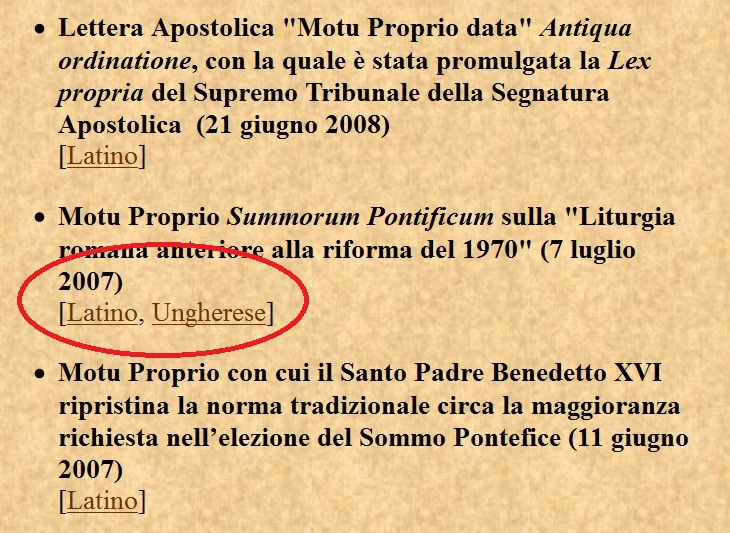
I thought the Vatican had at last taken care to put online on its very own site the version of the Motu Proprio Summorum Pontificum … in all languages.  Instead, nothing.  On vatican.va the Motuo Proprio is accessible only in Latin and (LISTEN, LISTEN) in Hungarian.  (Find here the page of vatican.va dedicated to the all the Motu Proprio documents of Benedict XVI.)  [Sort of like Spanky and Our Gang have a Website.]

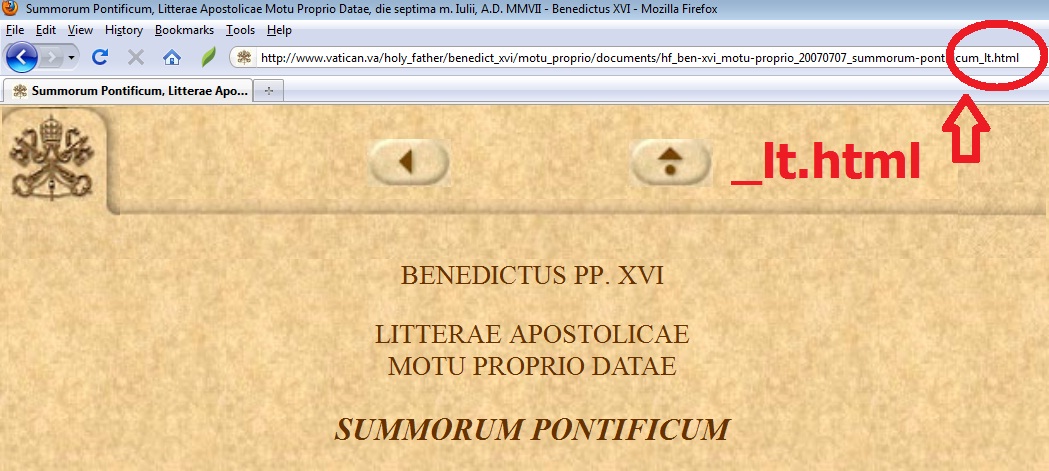
However, as the blog Una Fides notes, "once the Latin text is clicked it is enough to try a little game, that it to say, change to the "l" of the last part of the "_lt.html" to a "i" and, voilà, there magically appears the hidden Italian text. (read here: "games and magic tricks in the Vatican").  [I tried this and it didn’t work.  Someone at the switch in the Vatican office that runs the site probably changed this, no doubt from sheer embarrassment.]
Embarassing treatment of Summorum Pontificum on vatican.va website
I don’t know if the Italian version (as that in French, Portuguese and Spanish) of the Motu Proprio doesn’t appear on Vatican.va through negligence or in order purposefully to block the diffusion of the text.  I know, however, that to act with such superficiality does nothing other than provoke the suspicion of those who sustain that there is a part of the Church which is blocking the diffusion and application of the Motu Proprio, a disposition strongly desired by Benedict XVI.

UPDATE:

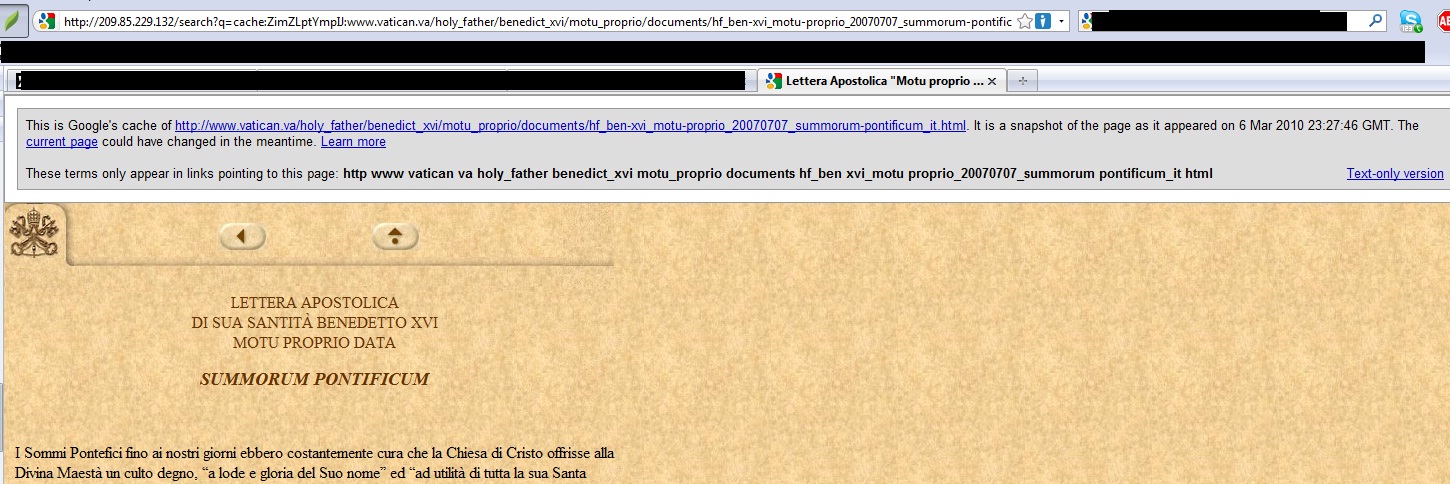
Someone sent me the cached page of the Italian:

Embarassing treatment of Summorum Pontificum on vatican.va website


Posted in SESSIUNCULA, SUMMORUM PONTIFICUM |
28 Comments

In preparation for the Feast of St. Joseph

The current Enchiridion Indulgentiarum #19 attaches an partial indulgence to the following prayer in honor of St. Joseph.

This will also be our Holy Father’s name day.  Pray for him.

Other prayers in honor of St. Joseph also gain a partial indulgence.  For example, The Litany of St. Joseph, and Office of St. Joseph.

Ad te Beate Ioseph
To thee, O blessed Joseph

TO thee, O blessed Joseph, do we come in our tribulation, and having implored the help of thy most holy Spouse, we confidently invoke thy patronage also. Through that charity which bound thee to the immaculate Virgin Mother of God and through the paternal love with which thou embraced the Child Jesus, we humbly beg thee to graciously regard the inheritance which Jesus Christ has purchased by his Blood, and with thy power and strength to aid us in our necessities.

O most watchful Guardian of the Holy Family, defend the chosen children of Jesus Christ; O most loving father, ward off from us every contagion of error and corrupting influence; O our most mighty protector, be propitious to us and from heaven assist us in our struggle with the power of darkness; and, as once thou rescued the Child Jesus from deadly peril, so now protect God’s Holy Church from the snares of the enemy and from all adversity; shield, too, each one of us by thy constant protection, so that, supported by thy example and thy aid, we may be able to live piously, to die holy, and to obtain eternal happiness in heaven. Amen.

AD te beate Ioseph, in tribulatione nostra confugimus, atque, implorato Sponsae tuae sanctissimae auxilio, patrocinium quoque tuum fidenter exposcimus. Per eam, quaesumus quae te cum immaculata Virgine Dei Genetrice coniunxit, caritatem, perque paternum, quo Puerum Iesum amplexus es, amorem, supplices deprecamur, ut ad hereditatem, quam Iesus Christus acquisivit Sanguine suo, benignus respicias, ac necessitatibus nostris tua virtute et ope succurras.

Tuere, o Custos providentissime divinae Familiae, Iesu Christi subolem electam; prohibe a nobis, amantissime Pater, omnem errorum ac corruptelarum luem; propitius nobis, sospitator noster fortissime, in hoc cum potestate tenebrarum certamine e caelo adesto; et sicut olim Puerum Iesum e summo eripuisti vitae discrimine, ita nunc Ecclesiam sanctam Dei ab hostilibus insidiis atque ab omni adversitate defende: nosque singulos perpetuo tege patrocinio, ut ad tui exemplar et ope tua suffulti, sancte vivere, pie emori, sempiternamque in caelis beatitudinem assequi possimus. Amen.

Posted in Saints: Stories & Symbols | Tagged
12 Comments