WDTPRS: Ash Wednesday – Prayer over the people – (1962MR & 2002MR)

I am delighted that in the 2002 Missale the tradition of the "Prayer over the people" was revived in Lent.  This is an important custom.

The origin of the Oratio super populum is quite complex and hard to pin down.  Turning to Fr. Joseph A. Jungmann’s monumental two volume The Mass of the Roman Rite: Its Origins and Development we find a history of this prayer at the beginning of the section concerning the close of the Mass (II, pp. 427ff).  Something Jungmann emphasizes that caught my attention is the fact that we are at a “frontier” moment, the threshold of the sacred precinct of the church and the world.  When properly formed we want the influence of our intimate contact with the divine to carry over into the outside world.  The use of this prayer is very ancient, found in both the Eastern liturgies of Syria and Egypt and in the West.  

Unlike the Postcommunio, the object of the prayer is not “us”.  Instead, the priest prayers for and over the people, not including himself as he does in the prayer after Communion. 

By the time of Pope Gregory the Great this was only in the Lenten season, probably because this is perceived to be a time of greater spiritual combat requiring more blessings.  Indeed it was extremely important for those who were not receiving Holy Communion, as was the case of those doing public penance before the Church, the ordo poenitentium.  

How important was this prayer to the Romans?  In 545, when Pope Vigilius (537-55) was conducting the station Mass at St. Cecilia in Trastevere, troops of the pro-Monophysite Byzantine Emperor Justinian arrived after Communion to take the Pope into custody and conduct him to Constantinople.  The people followed them to the ship and demanded “ut orationem ab eo acciperent… the they should receive the blessing prayer from him”.  The Pope recited it, the people said “Amen” and off went Vigilius who would return to Rome only after his death.

ORATIO SUPER POPULUM (2002MR):
Super inclinantes se tuae maiestati, Deus,
spiritum compunctionis propitius effunde,
ut praemia paenitentibus repromissa
misericorditer consequi mereantur.

This seems to be of new composition, though utilizing some snips from the older, corresponding prayer in the 1962MR.

We looked into this prayer HERE and some of you readers gave your versions:

SLAVISHLY LITERAL VERSION:
O God, graciously pour forth a spirit of compunction
upon those bowing themselves to Your majesty,
so that they may merit to obtain
the rewards promised to penitents
.

Let’s also have a look at the corresponding prayer in the older, traditional Missale Romanum:

ORATIO SUPER POPULUM
(1962MR):
Inclinantes se, Domine, maiestati tuae,
propitiatus intende:
ut, qui divino munere sunt refecti,
caelestibus semper nutriantur auxiliis.
misericorditer consequi mereantur.

I found this prayer in ancient books such as the Liber sacramentorum Augustodunensis as the Postcommunio of the Mass for the Station at San Gregorio (Thursday after Ash Wednesday).

SLAVISHLY LITERAL VERSION:
Having been propitiated, have regard
for those bowing themselves to You majesty, O Lord:
so that, those who have been refreshed by the divine gift,
may always be nourished by heavenly helps,
and may merit, mercifully, strive after them.

When creating the Novus Ordo on their desks the cutters and snippers of Fr. Bugnini’s Consilium obviously wanted to keep something of the prayer from the pre-Conciliar Missale in their new version.

Under the other entry, I suggested some of you might offer translations of the prayers.  Since I have done that here, how about offering your views on the differences of content between the older prayer and the newer.

Remember: We are very glad that the Oratio super populum is once again part of the post-Conciliar Missale Romanum.  But let’s have a look at what the prayer really says, since we will be seeing it in the new translation.
Posted in LENT, WDTPRS | Tagged , , ,
5 Comments

WDTPRS: Ash Wednesday (2002MR)

The Roman Station for Ash Wednesday is Santa Sabina on the Aventine Hill.

The Collect in the 2002 Missale Romanum, is an ancient prayer found in the Gelasian Sacramentary for the Vigil of Pentecost.

It is also among the prayers for the 4th day of the 4th month, which more than likely involved the traditional fast of the fourth month (there were fasts in the 4th, 7th and 10th months).  This prayer is in the so-called Veronese Sacramentary under the title In ieiunio quarti mensis. 

This prayer was in the 1962 Missale Romanum but at the end of the section for the blessing of and imposition of ashes, before the Introit of the Mass itself. 

Let’s see what the prayer really says.

COLLECT:
Concede nobis, Domine, praesidia militiae christianae
sanctis inchoare ieiuniis,
ut, contra spiritales nequitias pugnaturi,
continentiae muniamur auxiliis.

Praesidium has a powerfully military connotation.  It means fundamentally "defense, protection, help, aid, assistance" and thus it refers to "soldiers who are to serve as a guard".  Thus, by extension, it comes to mean "any place occupied by troops, as a hill, a camp, etc.; a post, station, entrenchment, fortification, camp".  Munio is equally military: "to build a wall around, to defend with a wall, to fortify, defend, protect, secure, put in a state of defense".  As you can imagine pugno, "to combat, give battle, engage, contend", is a military term.  Are you getting the picture?  Of course auxillium means "help, aid, assistance, support, succor", but when in the plural it is also "auxiliary troops, auxiliaries (mostly composed of allies and light-armed troops; hence opposed to the legions)".  Then there is militia, which is "military service, warfare, war" and also specifically in the genitive militiae "in military service, or on a campaign, in the field".  

LITERAL TRANSLATION:
Grant us, O Lord, to commence the defenses of the Christian field campaign by means of holy fasts,
so that, we who are about to do battle against spiritual negligences,
may be fortified by the support of continence.

WDTPRS: Ash Wednesday (2002MR)This is a mighty prayer.  

Several things come to mind. 

First, most of us when we were confirmed were reminded in some way that we are soldiers in this pilgrim Church.  We must be ready to suffer for the Faith. 

Militaristic imagery informs much of the history of Christian spirituality. 

Next, while we are soldiers we are on the march, pilgrim soldiers.  We are on campaign.  When the Roman legions were on the march, they would build a fortified camp when they halted.  They took no chances.  We are on the march in a vale of tears where anything and everything can happen to us and around us. 

Thirdly, when we make mistakes, the results can be deadly.  The word nequitia means "bad quality, badness" but that is because it is "bad moral quality, of all degrees, idleness, negligence, worthlessness, vileness".  It usually refers to a lack of attention that duty and prudence require, resulting in negative consequences.  Moreover, the virtue of continence is described with the same word used to describe the auxiliary troops that supported the legion’s regulars.  While it could simply refer to "abstinence", continence is the virtue which restrains the will from consenting to strong impulses of sexual desire.  So, this prayer could have a special focus. 

SUPER OBLATA:
Sacrificium quadragesimalis initii sollemniter immolamus,
te, Domine, deprecantes,
ut per paenitentiae caritatis labores
a noxiis voluptatibus temperemus,
et, a peccatis mundati,
ad celebrandam Filii tui passionem
mereamur esse devoti.

This prayer also has roots in the ancient Gelasian and the Gregorian Sacramentary.  Notice, however, how long, wordy it is.  Hardly in the style of the terse prayers of the Romans.

REALLY LITERAL VERSION:

Praying to You, O Lord,
we solemnly raise up the Sacrifice of the beginning of Lent,
so that through the exertions of the charity of penitence
we may abstain from harmful pleasures,
and, cleansed from sins,
we may be worthy to be dedicated
to celebrating the Passion of Your Son.

St. Leo the Great refers to the time of the Lenten fast as a sacramentum, preparing us for the mysterium of the dying and rising of the Lord.  

Here at the threshold of Lent, let us make our "Lenten start". In the sacrament of Penance, Christ will cleanse your slate and you may make a renewed beginning.

POST COMMUNION:
Percepta nobis, Domine,
praebeant sacramenta subsidium,
ut tibi grata sint nostra ieiunia,
et nobis proficiant ad medelam.

A VERSION:
May the sacramental mysteries which we have received, O Lord,
afford us help,
that our fasts may be pleasing to You,
and may be profitable for us unto a remedy.

I am delighted that in the 2002 Missale the tradition of the "Prayer over the people" was revived in Lent.  This is an important custom.

The origin of the Oratio super populum is quite complex and hard to pin down.  Turning to Fr. Joseph A. Jungmann’s monumental two volume The Mass of the Roman Rite: Its Origins and Development we find a history of this prayer at the beginning of the section concerning the close of the Mass (II, pp. 427ff).  Something Jungmann emphasizes that caught my attention is the fact that we are at a “frontier” moment, the threshold of the sacred precinct of the church and the world.  When properly formed we want the influence of our intimate contact with the divine to carry over into the outside world.  The use of this prayer is very ancient, found in both the Eastern liturgies of Syria and Egypt and in the West.  

Unlike the Postcommunio, the object of the prayer is not “us”.  Instead, the priest prayers for and over the people, not including himself as he does in the prayer after Communion. 

By the time of Pope Gregory the Great this was only in the Lenten season, probably because this is perceived to be a time of greater spiritual combat requiring more blessings.  Indeed it was extremely important for those who were not receiving Holy Communion, as was the case of those doing public penance before the Church, the ordo poenitentium.  

How important was this prayer to the Romans?  In 545, when Pope Vigilius (537-55) was conducting the station Mass at St. Cecilia in Trastevere, troops of the pro-Monophysite Byzantine Emperor Justinian arrived after Communion to take the Pope into custody and conduct him to Constantinople.  The people followed them to the ship and demanded “ut orationem ab eo acciperent… the they should receive the blessing prayer from him”.  The Pope recited it, the people said “Amen” and off went Vigilius who would return to Rome only after his death.

ORATIO SUPER POPULUM:
Super inclinantes se tuae maiestati, Deus,
spiritum compunctionis propitius effunde,
ut praemia paenitentibus repromissa
misericorditer consequi mereantur.

Who wants to take a crack at it?

As we begin our Lenten observance, like a soldier on the march, on a mission from your great Captain, be sure you have your objectives clearly defined. Get clear in your head whatever strategies and tactics will win for you your prize. 

Posted in WDTPRS | Tagged
8 Comments

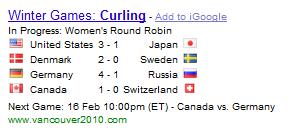
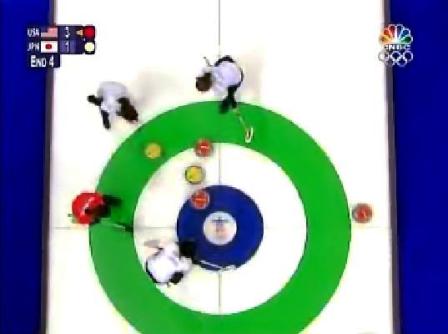
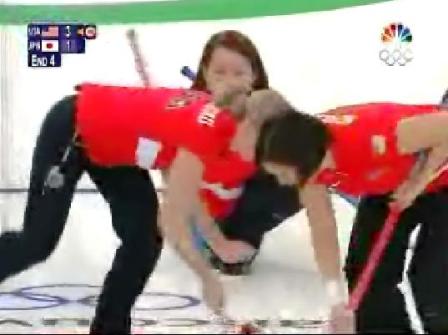
Finally… some curling!

I finally have a chance to see the most important sport of the Winter Olympics.

Finally... some curling!

Finally... some curling!

Finally... some curling!

CURLING!

Right now the USA women are beating the Japanese.

UPDATE:

I am conflicted.

The Westminster Dog Show is also on:

Finally... some curling!

Finally... some curling!

Posted in SESSIUNCULA |
30 Comments

Irish bishops should restore credibility through penance in Lent

From CNA:

Cardinal Brady: Irish bishops should restore credibility by repentance in Lent

Rome, Italy, Feb 16, 2010 / 03:30 pm (CNA).- Five members of the Irish Bishops’ Conference, led by their president and Primate of all Ireland Cardinal Sean Brady, addressed the media on Tuesday afternoon following two days of what they called "intense" discussions with Pope Benedict XVI and members of the Roman Curia. Cardinal Brady said in his remarks that the bishops should spend the penitential season of Lent doing penance to promote “a change of heart.”

[…]

There is a lot more in that article.

Posted in SESSIUNCULA | Tagged ,
44 Comments

Summorum allows substitution of Novus Ordo Masses with TLMs on priest’s own initiative

I have been having an internet nightmare for a few days, so I am pretty sure someone may have picked up on this already.

Summorum allows substitution of Novus Ordo Masses with TLMs on priest's own initiativeI have had many discussions with priest friends about the flexibility with the provisions of Summorum Pontificum so that priests are able to make the best pastoral applications within their own contexts.
For example, I have had good discussions with the great Fr. Tim Finigan about whether priests could, on their own initiative – that is, without requests from a group – add a TLM to the existing schedule or substitute a Novus Ordo Mass with a TLM.   We both agreed that, yes, Summorum Pontificum allows for such a thing, though that is not spelled out in the document itself.

Yah, I know.   But keep reading.

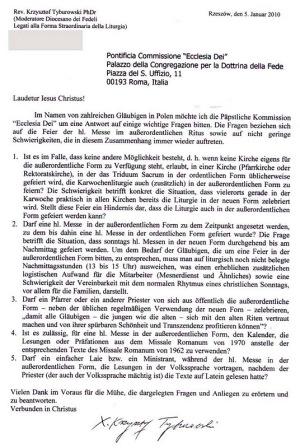
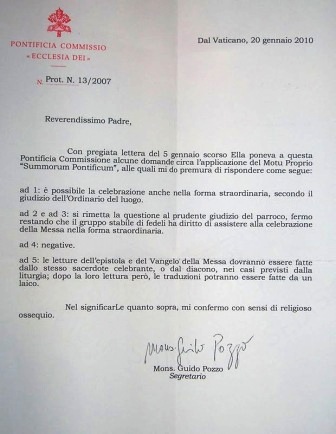
Now comes this from the Pontifical Commission Ecclesia Dei.   The Commission’s Secretary, Msgr. Pozzo, replied to a letter sent from a priest in Poland about similar questions.

A kid reader did some transcription for us from the Polish site Nowy Ruch Liturgiczny, and another sent some images of the letters in question.

Let’s have a look with my usual emphases and comments.

From GERMAN:

Rev. Krzysztof Tyburowski
(Moderatore Diocesano dei Fedeli
Lefati alla Forma Straordinaria della Liturgia)
[postal address left out]

To:
Pontificia Commissione "Ecclesia Dei"
[postal address left out]

Laudetur Iesus Christus!

On behalf of many faithful in Poland, I would ask the Pontifical
Commission "Ecclesia Dei" for an answer to some important questions.
The questions relate to the celebration of the Holy Mass in the
extraordinary rite, and with no small difficulties that arise in this
context again and again.

1. In the case whe there is no other option, i.e. when no church is
available specifically for the extraordinary form, is it allowed to
celebrate the Holy Week Liturgy also (additionally) in the
extraordinary form
, in a church (parish church or a rectorate), in
which the Triduum sacrum is usually celebrated in the ordinary form
?
The difficulty relates specifically to the situation that in many
places the Holy Week liturgy is celebrated practically in all churches
in the new form. Is such celebration an obstacle for celebrating the
liturgy in the extraordinary form?  [The problem is that normally you should only have the Triduum ceremonies once.  An exception could be, I believe, an additional Good Friday service for pastoral reasons.  If you can have the Triduum only once, then in theory you could not have both Ordinary and Extraordinary Form.]

2. Can the holy Mass in the extraordinary form be scheduled for the
hour when until now holy Mass was celebrated in the ordinary form? The
question concerns a situation when Sunday Masses in the new form are
celerated non-stop until the afternoon. To meet the needs of the
faithful who ask for the celebration in the extraordinary form, one
has to schedule it on liturgicaly unassigned hours of the afternoon (1
to 3 PM), which presents a significant additional logistical burden
for the staff (sacristan and the like), and is difficult to make
compatible with the normal rhythm of a Christian Sundays, especially
for families.  [In other words, can you change one of the regularly scheduled Novus Ordo Masses to a TLM.]

3. Can a pastor or another priest celebrate publicly of his own accord
the extraordinary form
– apart from the usual regular use of the new
form – "so that all faithful – both young and old – become familiar
with the older rite and can benefit from its appreciable beauty and
transcendence"?  [That is the key: "on his own accord"… without a group having asked.   This is very important.]

4. Is it permissible to use calendar, readings or prefaces from the
Roman Missal of 1970 for a holy Mass in the extraordinary form instead
of the corresponding texts of the Roman Missal of 1962?  [I believe this was raised at other times.   I have in the past given a hesitant yes.  We shall see.]

5. Can an ordinary lay person, during a holy Mass in the extraordinary
form, recite the readings in the vernacular, after the priest (who
also comands that language) has read the texts in Latin?

Thank you in advance for the effort of consideration and answering the
presented questions.
Connected in Christ

x. Krzysztof Tyburowski

Summorum allows substitution of Novus Ordo Masses with TLMs on priest's own initiative—————-
PCED answers: [My translation, without the usual florid curial embellishments.]
—————-

Dal Vaticano, 20 gennaio 2010
From the Vatican 20 January 2010
Pontificia Commissio
"Ecclesia Dei"

Prot. N. 13/2007

Most Reverend Father,

With your letter of 5 January, last, you posed some questions to this Pontifical Commission concerning the application of the Motu Proprio "Summorum Pontificum", to which I respond as follows:

ad 1: Celebration also in the Extraordinary Form is possible according to the judgment of the Ordinary of the place. [While this isn’t freedom to make the decision at the parish level, now no bishop or other authority can say that Summorum Pontificum forbids the Triduum with the 1962MR even where the Ordinary Form is also observed.  That is important.  It is possible to have both.]

ad 2 and ad 3: The question is remanded to the prudent judgment of the parish priest [pastor, parochus] it being understood that the stable group of faithful have the right to assist at the celebration of Mass in the Extraordinary Form.  [This is very significant.  YES, a parish priest can change one of the Novus Ordo Masses to a TLM.  He doesn’t have to add one.  Why?  Because people have the right to have also the Extraordinary Form.  Moreover, the priest can decide to have a TLM even if there are not requests from the faithful because he thinks it is in the best interest to have one available.  The flip side is that the parish priest must also be sure that there is a Novus Ordo Mass remaining on the schedule, because people also have a right to attend Mass that way.]

ad 4: negative.  [Okay!  This surprises me a bit.  It seems to walk back the famous guidelines we wrote when Card. Mayer was President of the PCED lo those many years ago.  So, you cannot mix calendars or use readings, prefaces, etc.  Interesting.]

ad 5: The readings of the Epistle and Gospel of the Mass must be read by the same priest celebrant, or by a deacon, in the cases foreseen by the liturgy; after their reading, however, the translations can be read by a layman.  [What this does not resolve is whether the priest or deacon can read or sing the readings in the vernacular without having first done this in Latin.  But that was not the question posed to the Commission.]

[etc.]

Mons. Pozzo
Secretary


To #4: I would want to raise the following question.

Since saints such as St. Maximilian Kolbe was canonized after the implementation of the Novus Ordo. 

On 14 August would you be able to say, using the 1962MR, a Mass for St. Maximillian Kolbe using just the Common for Martyrs?   Would you be able to use the Common for Martyrs with the Latin Collect approved by the Congregation?

This is something which needs clarification.

Posted in SESSIUNCULA, SUMMORUM PONTIFICUM | Tagged ,
45 Comments

Z update – mostly grrrrr

I had reported that things here at Mater Ecclesiae are rather chaotic right now.

The pastor, Fr. Pasley, had throat surgery – which I why I am here – and he cannot talk very much.

He came home on Sunday night to find that the snow had caved in part of the roof of the rectory.

I have a broken toe, and thus cannot genuflect, but at least I can talk.

Then we had a flat tire on the way to supper the night I got here.

All the furnaces for church and rectory went out at the same time.

Then the secretary today had a flat this morning.

But… the broadband connection started dying a few days ago, even before I got here. Over the last few days the connection has been either dreadful or nothing. This morning, just nothing – not even dreadful.

I got the problem narrowed down to the Comcast cable modem. So today we went to Comcast to swap the modem.

Back at home, I got it up and running with really good speed!

However, I can only get through with this one laptop. I can’t get the data through to the router for the net work. Therefore, I am sitting on the floor in the hallway with a short CAT5 hooked up to the cable modem.

I ask you please to say some prayers to lift whatever malocchio is focused on this place right now.

UPDATE 2248 GMT :

SUCCESSES!

We have restored fast internet and the network and wifi are working perfectly.

Fr. P got his new tire for less than he thought it would cost.

I have spaghetti al seminario on the stove in a large quantity.

The time for the blognic is getting arranged.

A priest friend whose parish includes D’Alessandro’s called.

Man’ mano.

Brick by brick.

UPDATE:

Z update - mostly grrrrr

Z update - mostly grrrrr

Posted in SESSIUNCULA |
22 Comments

25 March – Card. Egan – Pontifical Mass to mark 25th anniv of “Evangelium vitae”

I was sent this reliable information about an upcoming event in NYC.

CARDINAL TO CELEBRATE MASS MARKING 15TH ANNIVERSARY OF PRO-LIFE ENCYCLICAL

New York, Feb. 12, 2010 – New York’s Agnus Dei Council of the Knights of Columbus announced today that Edward Cardinal Egan, Archbishop Emeritus of New York, will celebrate a Pontifical Mass to mark the 15th anniversary of Evangelium Vitae (“The Gospel of Life”), the pro-life encyclical by Pope John Paul II.  Issued on March 25, the day nine months before Christmas when Catholics celebrate the Annunciation to Mary of the Incarnation of Jesus Christ in her womb, the 1995 encyclical condemns murder, abortion and euthanasia.

The Pontifical Mass for Life begins at 7:30 PM at the Church of the Holy Innocents, 128 W. 37th Street, in Manhattan.  Before Mass, there will be a Rosary for Life at 7:00 PM.  Organist and choirmaster, David J. Hughes, will lead the choir singing Tomas Luis Victoria’s Missa de Beata Mariae Virgine.  Edward Cardinal Egan will celebrate the Mass according to the Roman Missal of 1962, the form of the Catholic Church’s Mass before the Second Vatican Council.

According to Richard Janniello, past Grand Knight of the Agnus Dei Council, this is the second year the Knights have sponsored a special Mass for the Feast of the Annunciation.  “It was no coincidence that John Paul II issued his great pro-life encyclical on the Feast of the Annunciation and Incarnation.  It’s the preeminent pro-life Feast in our Catholic calendar,” he said, “because it reminds us every year that Our Lord’s human life was sacred from the very moment of His conception in the womb, already nine months before His birth.”

Evangelium Vitae explicitly recognizes this link in its opening words:  “Mary’s consent at the Annunciation and her motherhood stand at the very beginning of the mystery of life which Christ came to bestow on humanity. Through her acceptance and loving care for the life of the Incarnate Word, human life has been rescued from condemnation to final and eternal death.”

The Pontifical Mass for Life also marks an important milestone for the New York Archdiocese.  At the request of the Agnus Dei Knights, it will be the first time since the Second Vatican Council that an American Cardinal will celebrate a Pontifical Mass in New York City according to the form in use before the Council.  Anthony Ignacio, current Grand Knight of the Agnus Dei Knights, explained “the men of our Council share a special affection for this form of the Mass and His Eminence has shown extraordinary generosity in agreeing to celebrate it in this form.”

The Pontifical Mass for Life will be the third Pontifical Mass according to the earlier form celebrated in New York City in the last year.  “These Masses have become more common since Pope Benedict XVI’s Summorum Pontificum made the 1962 form available to every priest in the Church,” said Ignacio.  Before becoming Pope Benedict XVI, Joseph Cardinal Ratzinger often celebrated Mass according to the earlier form.

WHAT:  Pontifical Mass for Life
WHERE:  The Church of the Holy Innocents, 128 W. 37th Street, Manhattan
WHEN:  Rosary for Life, 7 PM; Pontifical Mass, 7:30 PM; Reception to follow in the Church Hall
For more information, call (212) 569-1252 or visit www.traditionalknight.com.

Posted in Brick by Brick | Tagged ,
15 Comments

QUAERITUR: Funeral problems with relatives

From a reader:

An unhappy and scandalous situation has just occurred in my family. My aunt passed away last week. I live in a different state, and am not sure at what level she was still engaged in her Catholic faith, but she certainly did practice when I was in closer proximity to her, and I know that a few years ago when her husband died she provided for him a normal funeral, with wake the night before and a funeral mass the next day. Unfortunately, it doesn’t seem that she will receive the same treatment.

Her surviving children, neither of whom practices their faith anymore, decided NOT to arrange for any funeral mass. They had my aunt cremated and are having a “remembrance” luncheon instead.

So, Father, my quandary: if a person’s own children do not arrange for a funeral mass such as in a situation as this, can another more distant family member arrange for a funeral mass at the deceased person’s parish, even though the remains are not present?

This is going to happen more and more frequently, I’m afraid.

So many of the generation following the Council, so many aging children of the now elderly devout, are either unchurched or, having seen so much of the unworthy in their churches during their youth, simply drifted off into the warm embrace of the world, the flesh and the devil.

We cannot impose our will on the deceased’s immediate family. We can, however, on our own initiative arrange for Masses to be said for the one who died.

It would be a fine spiritual work of mercy.

[From my iPhone… broadband not to be had right now]

Posted in ASK FATHER Question Box |
71 Comments

CURLING IS COMING!

I am looking forward to seeing some Curling during the coverage of the Winter Olympics.

I will have to follow the coverage ex longinquo in more than one way.  Here at Mater Ecclesiae in Berlin, NJ, as I reported elsewhere, the extreme abundance of snow caved in part of the roof of the rectory.  Thus, there is no TV available for the watching of the Curling.   And for some reason the Comcast broadband in the area is struggling.  

I am mostly using my iPhone’s 3G connection which, compared to Comcast, has blazing speed!

Therefore, I am going to have to get creative to follow the best sport of the Winter Olympics: Curling.


Posted in SESSIUNCULA | Tagged ,
27 Comments

Quinquagesima sermon: a program for Lent

Here is a sermon for Quinquagesima.

I propose something for your Lent.

Moreover, it was a dreadful mistake to excise the pre-Lenten Sundays from the Church’s post-Conciliar calendar.

Posted in Sermons |
13 Comments