Some Catholic stats and surprises… Fr. Z rants

I think we all know that some sectors of the Church’s life, in the USA at least, though better than in many places in the world have nevertheless been devastated in the last 40 years.

We know this is true from our observations.

You know the old adage that the plural of anecdote is data.

Well… it is and it isn’t.

But the Center for Applied Research in the Apostolate (CARA) is gathering data in a more – I hope – precise way.

With interesting results.

For example… Catholic population in the USA is going up and so is, – surprise – Mass attendance.

U.S. Data 1965 1975
1985
1995
2000
2005
2009
Total priests 58,632 58,909 57,317 49,054 45,699 42,839 40,666
Diocesan priests 35,925 36,005 35,052 32,349 30,607 28,702 27,594
Religious priests 22,707 22,904 22,265 16,705 15,092 14,137 13,072
Priestly ordinations 994 771 533 511 442 454 472
Graduate-level seminarians 8,325 5,279 4,063 3,172 3,474 3,308 3,357
Permanent deacons na  898 7,204 10,932 12,378 14,574 16,380
Religious brothers 12,271 8,625 7,544 6,535 5,662 5,451 4,863
Religious sisters 179,954 135,225 115,386 90,809 79,814 68,634 59,601
Parishes 17,637 18,515 19,244 19,331 19,236 18,891 18,280
Without a resident priest pastor
549 702 1,051 2,161 2,843 3,251 3,400
Where a bishop has entrusted the pastoral care of the parrish to a deacon, religious sister or brother, or other lay person (Canon 517.2)
na na 93 314 447 553 517
Catholic population 45.6m 48.7m 52.3m 57.4m 59.9m 64.8m 65.2m
Percent of U.S. population 24% 23% 23% 23% 22% 23% 22%
Catholic elementary schools
—
8,414
7,764
6,964
6,793
6,122
6,028*
Students in Catholic elementary schools —
2.557m
2.005m
1.815m
1.800m
1.559m
1.568m*
Catholic secondary schools —
1,624 1,425 1,280
1,297
1,325
1,220*
Students in Catholic secondary schools —
884,181
774,216
638,440
653,723
653,226
624,515*
Mass Attendance
CARA Catholic Poll (CCP): Yearly average percent of U.S.adult Catholics who say they attended Mass once a week or more (i.e., those attending every week) in CARA’s telephone polls.

Comparison: The Gallup Poll trend for the  yearly average percent of U.S.adult Catholics who say they attended Mass in the last seven days (i.e., those attending in any given week). 

— — — —
33%

35%
36%
*Most recent estimates of the National Catholic Educational Association (NCEA). School data for previous years is from the ASE.


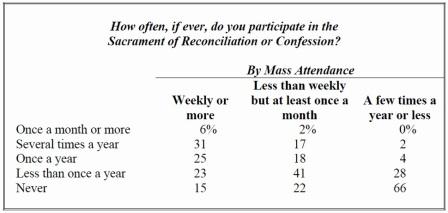
I would like to see the stats about how often people go to confession.

But wait!  We may have them too!

Fascinating and demoralizing reading.

Three-quarters of Catholics report that they never participate in the sacrament of Reconciliation or that they do so less than once a year.

About one in eight Catholics (12 percent), participate in Reconciliation once a year and an identical proportion do so several times a year. Two percent report that they participate in Reconciliation at least once a month. Results of a 2005 poll conducted by CARA with Knowledge Networks show similar patterns of participation in this sacrament.

The differences in frequency of Mass attendance and age really show a huge divergence.

Also, respondents were asked the extent to which they agree or disagree with each of five statements about forgiveness and the sacrament of Reconciliation.

• About six in ten respondents agree at least “somewhat” that they can be a good Catholic
without celebrating the sacrament of Reconciliation at least yearly. One-third agree
“strongly.”
• Just over half of Catholics agree that by going to Confession and making acts of
contrition and penance, they are reconciled with God and the Church. One-quarter agree
strongly.
• Slightly fewer, just under half of Catholics, agree that acts of penance such as prayer or
fasting are necessary for forgiveness of sins.
• Only one-quarter of Catholics agree that the Reconciliation is only necessary for
forgiveness of very serious sins, with fewer than one in ten agreeing “strongly.”

Furthermore:

More than six in ten weekly Mass attenders (62 percent) say they participate in Reconciliation at least once a year, compared to 37 percent of those attending Mass less than weekly but at least once a month and only 6 percent of those attending less often.
Some Catholic stats and surprises... Fr. Z rants

We have a lot of work to do.

Here is an overarching observation after looking at the results for a while.

There is a HUGE difference of "opinion" on the part of Catholics about what the meaning and effect of sacramental confession is according to frequency of Mass attendance.

We have got to

  • get people into Church,
  • give them liturgical worship which leaves them astounded and fascinated,
  • and start preaching the basics.

Fallen away Catholics…. what do we do to get them back into the fold?

There has to be help from marketing here.. no?  Am I wrong?

And then once they are back in the door…. what do they experience? 

We know that churches with strong community programs tend to draw lots of people in.

We all know people who are fallen away, but how many can respond to the objections they toss at you with anything like coherence or accuracy?

When is the last time you invited someone to go to Mass or to come along for regularly scheduled confession times?

Don’t get me started on priests who won’t hear confessions.  They are dying off… finally… but they are still around.

Okay… I’m ranting… I’ll stop now.
Posted in SESSIUNCULA |
115 Comments

Wherein Fr. Z muses about Latin and the vernacular and mirages

In the poll I posted about preference for language of Holy Mass in the Latin Rite, Latin is pasting the vernacular.

Anyone can vote in that poll… registered to comment here or not.

In the entries I have been posting with your feedback about your age and your preference for the Ordinary Form or TLM, the TLM has a great deal of support.

I am wondering if… among those who care… who have thought things through… there is a great deal more support out there for Latin, at least Latin if not the Extraordinary Form, than I previously expected.

I know there is a good percentage of readers here who are great proponents of the TLM, etc. 

I expected a great deal more support for the Novus Ordo and for vernacular than I am seeing.

Thus, I ask…. where is it?  Where are the thoughtful supporters of the vernacular?

Is this huge support of the vernacular simply a mirage?  Progressivist propaganda which over the years has become the unassailable default position?

Again, I am sure that if people are posting on a blog, they have probably thought about this a little.  There are swarms of people out there who have barely even heard of this issue, much less thought about it.

Still… again, I am forced to wonder, do the results I am getting suggest that Latin introduced into parish worship more widely would meet with a pretty good reception?  Yes, there will be a strong voice against it anywhere you go.  But… in the main….

I wonder.

We are, after all, talking about how truly to help people come to a fuller, more active, more conscious participation at Holy Mass.

Posted in I'm just askin'... |
Comments Off on Wherein Fr. Z muses about Latin and the vernacular and mirages

Old Mass/new Mass thoughts – part 8

Under another entry (“I am 59 years old and like the current liturgy.”) there has been some consideration of the age of Catholics who prefer the newer form of the Roman Rite, the Novus Ordo.  Old Mass/new Mass thoughts – part 8

Some suggest that people of a certain age may be more interested in the Novus Ordo, while younger people are more open also to the older form of Mass, the TLM.

So, would some of you younger folks take some time to write your thoughts about the new Mass/old Mass question?

HERE IS MY DESCRIPTION OF HOW TO DO THIS: click

  • Do your best to leave aside bashing of either form.  Since both are legitimate forms of Holy Mass, let’s accept that for this exercise and move on.
  • State your age, and if you are a cradle Catholic, revert, or convert and whether or not liturgy had anything to do with your once leaving the practice of your faith, your return to the Church or conversion.
  • Try to be brief.  Stick to a couple hundred words if you can.  Do a little editing.  [Some have gotten a little enthusiastic in their word count!   o{]:¬)  ]

We need to be able to explain ourselves to others when we discuss these matters, and provide the whys and wherefores for our liturgical choices.

I also invite seasoned Catholics to do the same.

Let’s see some responses…. posted in the combox.

UPDATE:

Allow me to add this somewhat related WDTPRS POLL:

{democracy:42}


Posted in SESSIUNCULA |
10 Comments

Caveat pipiator: The Vatican and Twitter

Who’s tweeting the tweeters? 

When I learned that the Vatican had launched a couple Twitter feeds, I thought was do these … folks, know what they are in for?  If this is being handled by the usual sort of techno-twit I have encountered there… they are in for some trouble.

Now I find this.

Fellow Minnesotan and long-time CNS Rome correspondent John Thavis has some of the skinny on the Vatican’s step into (pace Mr. Eliot) "this twittering world".


Who’s tweeting for the Vatican?
Posted on January 25, 2010 by John Thavis

VATICAN CITY — Over the weekend some media announced that the Vatican had opened a Twitter feed. Intrigued, I quickly went to "@vatican_va" on Twitter. At first glance, it looked like the Vatican [uh oh] — there was the Vatican coat of arms, the Vatican flag and a link to the Vatican Web site. And hundreds of tweets in many languages, linking to Vatican Radio stories.

Then I e-mailed Father Federico Lombardi, who heads both the Vatican press office and Vatican Radio. I got a response rather quickly, and a surprising one. He said the Twitter feed was news to him,[uh oh again]  and that neither the press office nor Vatican Radio was doing the tweeting. A call to the Pontifical Council for Social Communications elicited a similar response: it wasn’t them, and they didn’t know who it was.

Hmmm. This was beginning to look more and more like online impersonation.  Perhaps not the first, either: I knew there was already a "@vaticanen" Twitter feed that also identified itself as “Vatican” without, as far as I knew, any authorization.

A few more calls around the Vatican this morning elicited more surprise and some concern. [They better be concerned.] I have the impression that Vatican Radio may be seriously considering a Twitter feed, and doesn’t like being hijacked like this.

At this point, no one I’ve spoken with here has any idea who’s tweeting for the Vatican. More as it develops…


Caveat pipiator.

Posted in Lighter fare | Tagged , ,
4 Comments

QUAERITUR: Priest won’t preach on Sunday assigned to deacon

From a reader:

This Sunday my family and I attended a OF mass, [or "Ordinary Form" or Novus Ordo] at the homily, ironically the reading was Christ’s first homily; the priest informed us “This was the Deacons week to preach, do you see a Deacon? No? Therefore no homily” and then proceeded onto the Profession of Faith. I was under the impression that a homily was a must on Sundays and holydays of obligation. Is this correct?

No, this is not correct.  This is actually rather shabby.  Unless….

Unless the priest was suffering from laryngitis or some other malady which made it difficult for him to talk.

Not being prepared just isn’t a good enough reason. 

A priest ought to be able, must be able, to stand up in front of a congregation and at least say something.

Is that to much to ask?

Even if Father just picks a phrase from the Creed … makes a point about the importance of going to confession … gives a fervorino about loving God or some edifying experience he has had as a priest. 

Anything. 

He doesn’t have to be erudite or prolix or dynamic.

He just has to be faithful, direct and brief.

In a pinch a sermon doesn’t have to be polished or scholarly or pertain to the readings. 

Sooooo many problems for preaching … as well as some advantages … have come from the nearly iron-clad conviction impressed on clergy that they must must must stick to the day’s readings… but I digress….

In any event, unless there is a very good reason, a very good reason, priests are to preach at public Masses on Sundays or see to it that there is a sermon by someone authorized.

So, my reaction to that priest – if that happened as you described, with that rather brutal dismissal of his obligation to preach is…

"Father, shut up and preach."

Posted in ASK FATHER Question Box, SESSIUNCULA |
45 Comments

WDTPRS: Conversion of St. Paul – Collects compared (1962MR & 2002MR)

WDTPRS: Conversion of St. Paul - Collects compared (1962MR & 2002MR)In honor of the Apostle to the Gentiles let us make a rapid comparison of the Collects, or “Opening Prayers”, for today’s feast. 

We’ll look first at the 1962 Missale Romanum and then the 2002 edition. 

The Collect is nearly the same in both.

COLLECT (1962MR):
Deus, qui universum mundum
beati Pauli Apostoli praedicatione docuisti:
da nobis, quaesumus;
ut, qui eius hodie Conversionem colimus,
per eius exempla gradiamur.

This prayer is ancient.  It is found already in the 8th century Liber sacramentorum Engolismensis (Angoulême) and the 9th century Augustodunensis (Autun) as well as the Liber sacramentorum Romanae ecclesiae ordine excarpsus, but with the variation in the Engolismensis “multitidinem gentium” in place of “universum mundum”. 

Our precious copies of the increasingly costly Lewis & Short Latin Dictionary inform us that the deponent verb gradior is “to take steps, to step, walk, go;” and in ecclesiastical Latin “of the conduct of life, to walk, live, conduct one’s self”.  The French source for liturgical Latin I call Blaise/Dumas indicates that gradior is “to behave oneself”.   An exemplum is, “a sample for imitation, instruction, proof, a pattern, model, original, example….” For the Fathers, so steeped in Greek and Roman rhetoric and philosophy, exemplum could mean many things.  Mainly, an exemplum brings auctoritas to your argument, “authority”, which means among other things the moral persuasive force of an argument.  When we hear this prayer with ancient and Patristic ears, exemplum is not merely an “example” to imitate. It brings deeper moral force. The historic event of Paul’s conversion is a reason for hope. It is an incitement to lead the kind of life which will lead ultimately to being raised up after the perfect exemplum, the Risen Christ.  The core of this exemplum is St. Paul’s response to the call of the Lord to turn his life around, his conversio or in Greek metánoia.

I especially like the word gradior in this prayer.  It invokes the image of St. Paul trudging the byways.  Thus are we called, also.

LITERAL VERSION:
O God, who instructed the whole world
by the preaching of the Blessed Apostle Paul:
grant us, we beseech You,
that, we who are today honoring his Conversion,
may walk according to his examples.

Many (many many) of the prayers of the pre-Conciliar form of the Missale Romanum, were cut up and changed for the Novus Ordo, if they made the cut at all. Today’s prayer is a case in point.

COLLECT (2002MR):
Deus, qui universum mundum
beati Pauli Apostoli praedicatione docuisti,
da nobis, quaesumus,
ut, cuius conversionem hodie celebramus,
per eius ad te exempla gradientes,
tuae simus mundo testes veritatis.

LITERAL VERSION:
O God, who instructed the whole world
by the preaching of the Blessed Apostle Paul:
grant us, we beseech You,
that we, walking in life toward You according to the examples of him,
whose conversion we are celebrating today,
may be witnesses of Your truth in the world.

I am not convinced the ancient prayer needed these changes. 

Some may argue that the newer Latin version makes the point of "witness" more clear.  I guess so.

Posted in WDTPRS |
6 Comments

Pope Benedict and ecumenical dialogue with the Orthodox

Pope Benedict XVI is the Pope of Christian Unity.

He is the Pope of Christian Unity because he is the Pope of Continuity.

Liberals will always try to define the parameters of ecumenical dialogue and will inevitably introduce compromises in essential points of Catholic doctrine and identity for the sake of continuing dialogue. 

Benedict XVI doesn’t do that.  He has shown how we can move on issues that are not of essence while representing those that are in new terms without undermining them.

I read this on chiesa of Sandro Magister.  You should go over there and read the whole text.

My emphases and comments.

ROME, January 25, 2010 – This evening, with vespers in the basilica of Saint Paul’s Outside the Walls, Benedict XVI is closing the week of prayer for Christian unity.

There are some who say that ecumenism has entered a phase of retreat and chill. [And you know who they are.  These are the same folks who gripe about dialogue with the obviously Catholic (though without manifest unity) SSPX but who happily move in the ethos of the LCWR.  They carp about the Holy See’s offer to traditionally minded Anglicans, while seeming to smile on the very aberrations which are tearing the Anglican communion apart.]  But as soon as one that looks to the East, the facts say the opposite. Relations with the Orthodox Churches have never been so promising as they have since Joseph Ratzinger has been pope. [Benedict XVI is the Pope of Christian Unity.]

The dates speak for themselves. A period of chill in the theological dialogue between the Catholic Church and the Orthodox Churches of Byzantine tradition began in 1990, when the two sides clashed over so-called "uniatism," meaning the ways in which Catholic communities of the Eastern rites duplicate in everything the parallel Orthodox communities, differing only by their obedience to the Church of Rome.

In Balamond, in Lebanon, the dialogue came to a halt. It hit an even bigger obstacle on the Russian side, where the patriarchate of Moscow could not tolerate seeing itself "invaded" by Catholic missionaries sent there by Pope John Paul II, who were all the more suspect because they were of Polish nationality, historically a rival.

The dialogue remained frozen until, in 2005, the German Joseph Ratzinger ascended to the throne of Peter, a pope highly appreciated in the East for the same reason he prompts criticisms in the West: for his attachment to the great Tradition.   [He is the Pope of Christian Unity because he is the Pope of Continuity.]

First in Belgrade in 2006, and then in Ravenna in 2007, the international mixed commission for theological dialogue between the Catholic Church and the Orthodox Churches started meeting again.

And what rose to the top of the discussion was precisely the question that most divides East and West: the primacy of the successor of Peter in the universal Church.

From the session in Ravenna emerged the document that marked the shift, dedicated to "conciliarity and authority" in the ecclesial communion.

The document of Ravenna, approved unanimously by both sides, affirms that "primacy and conciliarity are mutually interdependent." And in paragraph 41, it highlights the points of agreement and disagreement:  [NB…]

"Both sides agree that . . . that Rome, as the Church that ‘presides in love’ according to the phrase of St Ignatius of Antioch, occupied the first place in the taxis, and that the bishop of Rome was therefore the protos among the patriarchs. They disagree, however, on the interpretation of the historical evidence from this era regarding the prerogatives of the bishop of Rome as protos, a matter that was already understood in different ways in the first millennium."

"Protos" is the Greek word that means "first." And "taxis" is the structure of the universal Church.

Since then, the discussion on controversial points has advanced at an accelerated pace. And it has started to examine, above all, how the Churches of East and West interpreted the role of the bishop of Rome during the first millennium, when they were still united.

The basis of the discussion is a text that was drafted on the island of Crete at the beginning of autumn in 2008.

The text has never been made public before now. It is in English, and can be read in its entirety on this page of www.chiesa:

> The Role of the Bishop of Rome in the Communion of the Church in the First Millennium


This should be interesting.

Posted in Pope of Christian Unity |
8 Comments

D. Phoenix raises the bar on time and extent of marriage preparation

People have a natural right to marry.  Despite that, I have from time to time heard smart people, including priests, opine that while perhaps it ought to be relatively easy to get a divorce, it should be really hard to get married.  That seems to set the issue on its head, but perhaps there is some useful point in framing it that way.

I read this on azcentral.com from Phoenix, AZ.

My emphases and comments.

Phoenix Diocese pushes to make stronger marriage bonds
Rules on training, prep time may lead to fewer weddings

by Michael Clancy – Jan. 25, 2010 12:00 AM
The Arizona Republic

With the definition of marriage being challenged nationwide, the Catholic Church in Phoenix has introduced significant changes in its program for couples who want a church wedding, lengthening the preparation time from six to nine months.

Partly in response to efforts promoting gay marriage and a growing trend of unwed couples living together, Bishop Thomas J. Olmsted of Phoenix has decided to intensify the church’s teaching for people planning a Catholic marriage. The new rules for pre-marriage preparation include more time and deeper education. [First thought: Some would think that in the face of challenges from the outside (perverted unions and casual to unblessed unions) the Church would try to make it easier to be married rather than more difficult.  Instead, D. Phoenix is raising the bar.  This is probably the right response.  Consider that divorce tears apart the bonds of society and weakens the concept of the marriage bond.  The prevalence of divorce, easy or hard, has also weakened the concept of marriage.  Better prep could lead to a stronger marriage.  Stronger marriages are less likely to end in divorce. Better prep could raise militate against that particular erosion of marriage.]

The goal is to strengthen marriages and a couple’s Catholic faith at a time when marriage is on the decline in the United States. Few dispute the value of marriage-preparation programs. Studies indicate that a solid course of marriage preparation, particularly one based on developing interpersonal skills, succeeds in reducing divorces.

But some in the church fear the changes detailed in the bishop’s July pastoral letter, "Covenant of Love," which became mandatory this month, may result in even fewer church weddings.  [Which leads us in a circle back to a fundamental point.  People have a right to marry.]

The letter points to four "concerns" that led to the updated policies, which will include post-wedding marriage classes [The prep had better be pretty darn interesting and well-executed if they think couples are going to come back after the wedding.] and ongoing education about marriage. They are:

• Fewer marriage role models and increased cohabitation.

• A high divorce rate.

• A growing number of single-parent families.

• "Increasing confusion" over the meaning of marriage in society because of efforts to legalize gay marriage.

The changes, Olmsted hopes, will help counteract those trends.

"Many young people know little about their call to be married in the church and to receive the grace of that sacrament," said Michael Phelan, a layman who leads the diocese’s Office of Marriage and Respect Life. [The reason for this is obvious: we have fumbled the ball on catechesis and preaching about fundamentals worse than the Vikings did against the Saints.]

"It could be compared to a dearth of culinary knowledge. If I know little about the difference between eating at a fast-food restaurant and a four-star feast, I won’t value the whole experience." 

Among the changes being instituted are:

• Nine months of pre-marriage preparation time instead of six. Several methods of preparation will remain available, including intensive weekend sessions or a series of weeknight meetings, but the time will be lengthened.

• A full course in Natural Family Planning, a type of family planning that does not use artificial forms of birth control. The church opposes use of contraceptives, from condoms to pills.

• More comprehensive courses on practical skills and the theology of marriage, including the reasons for the church’s position on gay marriage. The church believes marriage can only be a union between a man and a woman.  [The article sure seems to be focused on this state sanctioned sodomy thing, which I suspect overstresses the point.  As far as practical skills are concerned, I wonder if that won’t have something to do with, for example, family finances, time management, talking to couples who have raised children, etc.  And… and… it just occurred to me… if families weren’t so very shredded these days, the Church wouldn’t have to be the provider of this help.  The same seems to apply to "sex education" in Catholic schools.  Parents are the primary educators of children.  Should the Church be involved in any sort of sex ed?  Perhaps… when it is clear that most parents don’t give their children adequate formation.  Thorny questions.]

Andrew Junker, a reporter for the Catholic Sun diocese newspaper, recently went through the marriage-preparation courses and said he found them worthwhile, even though he was skeptical at first.

"For a lot of people, it seems like a lot of hoops to jump through," he said. "But once we started getting into it, the vast majority was really helpful just on the level of communication."

An increased emphasis on the theological underpinnings of marriage may be helpful to the numerous people seeking Catholic weddings but who are not really practicing the faith, Junker said.

"They presented the theology very positively, not as arcane rules devised to make your life miserable," he said. [Sort of like the Ten Commandments.]

Still, he said, most of his friends are not and would not consider a Catholic marriage if they are considering marriage at all. They are part of a nationwide trend of fewer people getting married. Since 1980, marriage rates in the United States have dropped from 11 per thousand people in 1980 to 7.1 per thousand in 2008, according to the U.S. Census Bureau.  [Good grief!]

[…]

Church weddings have been on the decline in the Phoenix Diocese, officials say. The diocese covers Maricopa, Yavapai, Coconino and Mohave counties in Arizona.

Out of an average of 27,000 marriage licenses issued a year in those counties – a number that has held steady for 15 years despite population growth – the number of weddings conducted in a Catholic church has dropped from 1,542 in 1993 to 1,389 last year, according to figures provided by the diocese. The numbers have rarely topped 1,800 in the 40-year history of the diocese.

Even though about 15 percent of diocese residents profess to be Catholic, only 5 percent of marriages take place in church.

The decline has occurred even as the diocese has grown at a rate exceeding the population generally, from an estimated 355,000 members in 1993 to 644,000 today.

Mark Gray of Georgetown University, who has researched Catholic marriage in the United States, says the trend is not restricted to Phoenix.

Overall, he said, the number of Catholic marriages has declined from 10 or more per 1,000 Catholics in the 1940s and ’50s to 3.5 today. The number in the Phoenix area for 2008 was 1.9 marriages per 1,000 Catholics.

The reasons, Gray said, may have to do with the rise in divorce and second marriages, which the church may not allow, the trend to getting married later in life, increased numbers of interfaith marriages and a preference for other marriage venues such as resorts or beaches. The latter trend is especially pronounced in Sun Belt states, he said.

[…]

Not everyone agrees with the new policy for Catholics.

[Get this… they had to go out and find a wacko to be the dissenting voice?] Roberta Meehan, an acknowledged foe of Olmsted’s conservative approach who is [pretending to be] ordained as part of the Roman Catholic Womenpriests movement, said the diocese should offer marriage preparation, but one size does not fit everyone.  [No doubt if the diocese said the sky was blue she would say it was lime green.]

"What works for two Ph.D. scientists is not the same for a couple of 19-year-olds just out of high school," she said. "Each couple should be counseled on an individual basis."  [And the sun still rises at dawn… film at 11.]

Posted in Our Catholic Identity, The Drill | Tagged , ,
154 Comments

Your good news

To start a new work week, how about some of your good news?

Posted in SESSIUNCULA |
43 Comments

A little cartoon irony

With a biretta tip to The Black Biretta, this was on the site Catholic Cartoons.

A little cartoon irony

Posted in SESSIUNCULA |
11 Comments