WDTPRS: 2nd Sunday of Ordinary Time – Collect (2002MR)

WDTPRS: 2nd Sunday of Ordinary Time - Collect (2002MR)We have into the Sundays “Ordinary Time” (once called the Season of Epiphany) during which we wear the green vestments that some say symbolize of hope.  Even though these Sundays are not part of a sacral cycle such as Advent/Christmas with a focus on specific mysteries of Our Lord’s life and saving work, each Sunday is always an echo of Easter. 

Pre-Conciliar liturgical books called the Sundays after Epiphany and the Sundays after Pentecost the tempus per annum… “the time through the year” and this terminology has remained in the Novus Ordo.  

We are entering the liturgical span stretching from the adoration of kings and shepherds at the feet of the infant King to the end of the year and the solemn feast of Christ the King, the King of fearful majesty who will come as judge and will separate the goats from the sheep and usher in the unending reign of peace.

COLLECT – LATIN TEXT (2002MR):
Omnipotens sempiterne Deus,
qui caelestia simul et terrena moderaris,
supplicationibus populi tui clementer exaudi,
et pacem tuam nostris concede temporibus.

This prayer was the Collect for the Second Sunday after Epiphany in the 1962MR.    It is an ancient prayer, found in manuscripts of the Gelasian Sacramentary.

We should look at some words before getting at what the prayer really says.  The unrivaled Lewis & Short Dictionary says that simul et connects two or more co-ordinate terms or facts and represents them as simultaneous and is the equivalent of simul etiam meaning “and at the same time, and also”.  The deponent verb moderor means “to manage, regulate, rule, guide, govern, direct”.  The word moderator is what we use in Latin for people like the state governor or the president of the United States: governing officials.  A gubernator was the steersman or pilot of a sailing ship.  

When we pray in Latin we often ask God to pay attention in some way, usually by “hearing” us.  Exaudio signifies “listen to” in the sense of “harken, perceive clearly.”  The imperative exaudi is more urgent than a simple audi (the imperative from audio, not the car).   I like “hark, hearken.”  Different words are used for this in Latin and though they mean subtly different things, they are all pretty much the same thing.  A good example is the beginning of one of the Litanies in Latin: Christe audi nos… Christe exaudi nos… which is often translated as “Christ hear us… Christ graciously hear us.”  

Clementer is an adverb from clemens, means among other things, “mild in respect to the faults and failures of others, i.e. forbearing, indulgent, compassionate, merciful.”  In the religious language of the ancient Romans a supplicatio was a public prayer or supplication, a solemn religious ceremony in consequence of certain public events, good or ill.  So, what we have here is a phrase something like, “in an indulgent manner graciously pay close attention to the humble petitions of your people, bent down in prayer.”  Tempus means many things but primarily, “time in general, or a season of time; the state of the times, position, state, condition; circumstances.”  It can also be “the appointed time, the right season, an opportunity (Greek kairos)”.   In the plural tempora gives us the word for the “temples” of the sides of your head.  The word “temporal” ultimately derives from tempus and it often indicates worldly or earthly things, material things, as opposed to sacred, eternal or spiritual.   

LITERAL TRANSLATION:
Almighty eternal God,
who at the same time govern things heavenly and earthly,
mercifully hearken to the supplications of Your people,
and
in our temporal affairs grant Your peace.

ICEL (1973 translation of the 1970MR):
Father of heaven and earth,
hear our prayers, and show us the way
to peace in the world.

We discovered in the course of this WDTPRS series that the lame-duck ICEL versions of the prayers for the festal seasons of Advent/Christmas and Lent/Easter were marginally better than those of Ordinary Time. 

The old ICEL version of the first Collect we see in Ordinary Time isn’t terribly successful when compared to the Latin, is it? 

Now that we are in Ordinary Time again you will see a change in the quality of the “translations”.  They must have had a different committee work on the prayers of Ordinary Time.  First take note that t

To my mind the ICEL prayer is sterile, not just terse.  We can all agree that God is the “Father of heaven and earth”, but the Latin addresses “Almighty eternal God.”  “Father of heaven and earth” makes God smaller than He is, it seems to me, and is not what the Latin prayer really says.  “Hear our prayers”, indicates little of our humble posture before God which the Latin clearly proposes with “mercifully give ear to the supplications of your people”. 

In the Latin, we are cast down, bent in prayer, asking the almighty God, indulgently to spare us a little attention. 

I am perfectly content to grovel with penitentially confident joy before God even if the translators of the lame-duck ICEL version were not.  

In our Collect we beg God as omnipotent disposer of all things for peace in our temporal affairs now, not just later in heaven.  And we want not just any peace man can cobble together, but rather the peace which comes from Him.  During Holy Mass (before the entirely optional “sign of peace”) the priest repeats Christ’s words in John 14:27: “Pacem relinquo vobis, pacem meam do vobis… Peace I leave with you; my peace I give to you; not as the world gives do I give to you. Let not your hearts be troubled, neither let them be afraid.”  Catholic Christians are confident.  Christ said He was going to give it to us.  

There is a great difference between the peace the world can offer and the peace that God offers.  This world of temporal goods (and ills) is passing and fragile, always susceptible to loss.  The goods of heaven are lasting, enduring, solid and dependable.   We must never fall into the sin of putting any created thing or person in the place which only eternal God may properly have.  No infinite and passing thing can provide lasting joy or eternal peace.  Any created thing can be lost through theft, wear and time.  The vicissitudes of this passing world roar over us like an inexorable wave and can sweep away any material thing to which we have clung, perhaps even in idolatry.  Our wealth, our family, our health, our appearance and our reputation can be taken in the blink of an eye. 

We, our loved ones, our possessions can be taken out at any time… perhaps by an earthquake.

God alone endures.  Whereas any created thing or person can be lost, God can never be lost.

God knew each one of us outside of time, before the creation of both the visible and invisible universe.  He called us into existence at a precise moment in His eternal plan.  We have something to do in God’s plan.  He gives us work to fulfill and the talents and graces to fulfill it.  We must cooperate with Him, making His plan for us our own so that He can then make us strong enough to carry it out. 

God knows our needs and in turn we confidently come to Him in prayer asking humbly in our trials during this earthly journey for peace only He can give, the peace which alone can make sense of what we experience in life.  Our sins lost this peace for us but it has been restored through the merits of Christ’s Sacrifice which we renewal and remember with each Holy Mass. 

We ask God to bless us in this new year of salvation.  We beseech Him to give aid to all who suffer.  With bended knee and foreheads to the ground, bodies and wills both bent in supplication, we beg His patient indulgence and His peace.
Posted in WDTPRS |
7 Comments

POLL ALERT! This is a nice one!

ACTION ITEM for WDTPRSer LAY PEOPLE!

It is nice to be able to give a good poll some visibility.

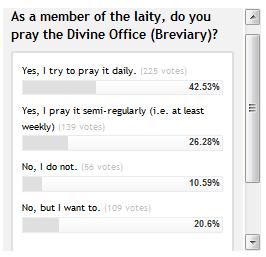
Over at NLM I saw a worthy poll offered to lay people about whether or not you pray the Liturgy of the Hours, Divine Office, Breviary… whatever… or aspire to.

This poll is in the context of an interesting entry.  I point it out so that you will see at and then…

I don’t have a dog in this fight, of course… and it’s not a fight… and I don’t have any sort of dog… so…

Lay people… go vote!

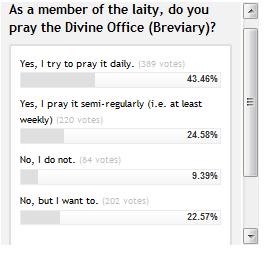
Right now here are the results.   I could get the total votes in, but it is 529.  Let’s see if, with the help of WDTPRS readers, we can get a solid turn out!

NB: "the poll is for the laity; for those for whom praying the Divine Office is a choice. The interest here is seeing who has taken up this excellent practice of praying the divine office."

POLL ALERT! This is a nice one!

UPDATE 17 Jan 1845:

Total votes: 895

POLL ALERT! This is a nice one!

UPDATE 18 Jan 0255 GMT:

As I mentioned earlier, that site took down its poll and "Testimonial" page, but … but… the testimonial section is still there.

Here is the link.

Take a look!

Posted in POLLS | Tagged , ,
33 Comments

Imaginary book titles

I was paging through a bird book and found some sections which struck me as being rather like the titles of books.

Imagine a Ludlum novel called…

THE EMPIDONAX COMPLEX

Or a LeCarre book called…

The Accidental Flycatchers
Or an Alan Furst volume called…

Nighthawks
 
Or maybe something by Tom Clancy called…
 
Buteos Overhead
How about a Ann Coulter commentary entitled…

Loons in Flight
 
Maybe the vastly overrated Dan Brown could continue his inexplicable streak of high-selling stupid books with…

Pigeons and Doves

Or a Nicholas Sparks goo fest called…

Flight Patterns of Dabbling Ducks
I have a sense that this too should be a book title, but I can’t quite match it….

South Texas Specialties
 
Hmmmm… Maybe Vince Flynn.
Posted in SESSIUNCULA |
10 Comments

Traditionalist priest in Verona, Italy acts up as Pope visits Roman synagogue

I read some alarming news in a spectacularly poorly written ANSA piece.

Most of the article is simply less-than-well-informed blather.  The bad bit comes at the end.

Meanwhile, followers of the Lefebvre community in Verona announced on Friday they would celebrate a "mass of atonement" on Sunday to coincide with the pope’s visit to Rome’s synagogue.
The rite will be celebrated by a controversial member of the dissident group, Floriano Abrahamowicz, who has been excommunicated by the Vatican for denying the Holocaust.

I think it would be a good idea for the SSPX to make a statement about this … at this important juncture.  Is the Abrahamowicz still a member of the SSPX?  There have been difficulties with him before.  I believe he was expelled from the SSPX this last year.

At the very least, if this Mass in Verona takes place, and for the reasons suggested in this ANSA piece, the SSPX will have to make a statement of some kind.

Posted in SESSIUNCULA |
65 Comments

The Feeder Feed: CHICKADEE REPORT

There are lots of hungry Chickadees at the feeders these days.  They are among my favorites, probably because they are nearly fearless.

Here is a little focus on Chickadees.

The Feeder Feed: CHICKADEE REPORT

Windy day.

The Feeder Feed: CHICKADEE REPORT

The Feeder Feed: CHICKADEE REPORT

The Feeder Feed: CHICKADEE REPORT

The Feeder Feed: CHICKADEE REPORTThe Feeder Feed: CHICKADEE REPORT

The Feeder Feed: CHICKADEE REPORT


Posted in The Feeder Feed |
10 Comments

Stitch by Stitch for the Benedictines of Mary

Some interesting new came from a reader about one of my favorite groups of sisters in the USA, the Benedictines of Mary, Queen of Apostles, near Kansas City, MO.

The sisters make vestments rather more traditional Gothic and Roman designs, as well as altar cloths, albs, etc.

Here is the report from the WDTPRSer:

I was browsing the website of the Benedictines of Mary, Queen of Apostles, and came upon what I believe is the "Irony of the Day."

"  Since establishing ourselves in the Diocese of Kansas City-St. Joseph, we have been greatly blessed in our pursuit of this craft by the heritage we recently received from the Sisters of the Most Precious Blood in O’Fallon, Missouri. They have been making priestly vestments for over one hundred and fifty years. In fact, their distinctive style and the quality of their workmanship became well-known both in the United States and overseas. However, under the present circumstances of their community, the demands of the work have become too burdensome and they have decided to make us their successors in the craft, generously offering to assist us with personal instruction, patterns, materials and equipment. We are very happy to learn from their knowledge and experience! It is difficult to enumerate all the ways they have assisted us, but we would particularly like to acknowledge our gratitude for the motifs which they provided, viewable on our vestment pages."

I then went to the Precious Blood Sisters’ website where I found the following:

"After 150 years the Ecclesiastical Art Department (EAD) is going to enter into a new phase. Instead of taking orders for custom-made vestments and stoles, we will make stoles and vestments which will be sold through our gift shop and through the EAD website. We will discontinue taking orders for vestments at the end of 2008 and orders for stoles at the end of May 2009. For the time being we will continue to make custom sized altar cloths and altar linens and we will still take on a limited number of special projects, for example, a funeral pall. Because we have a backlog of vestments to complete, we will not have ready-made chasubles and dalmatics for sale until 2010."

This irony is only enhanced by the differences in styles of vesture between the two communities, and yet, here is the Sisters of the Most Precious Blood, a LCWR-friendly order that is experiencing decline, passing on their work to a traditional order that is growing by leaps and bounds.  Amazing!

But not a surprise.

Market forces work here, too.  Younger clergy want traditional styles for their liturgical worship.


I looked around on the site of the Benedictines of Mary and found this statement about vestments:


As we stand in the place of Our Lady, we are anxious for the honor of the priesthood and for the great mystery of God’s love for man, which priests renew for us each day in the Holy Sacrifice of the Mass. Thus, our prayerful support of the priesthood has inspired us to make the hand-crafting of vestments, priestly apparel, sacred linens and altar clothes a special focus of our work. [I don’t think you would find that as part of the agenda of the LCWR.] We use the finest materials available, primarily pure silks and 100% Belgian Linen, because we believe that the beauty of the altar and the dignity of its sacred ministers signify in an important way the reality of the True Presence of Our Lord in the Eucharist. [Do I hear an "Amen!"?]  Carried out in the Benedictine spirit of contemplative silence, our stitches are interwoven with prayers as we strive to be worthy vessels in the hands of Our Lady, receiving the mercy and grace flowing from the heart of her Son and pouring it out upon His priests. In other words, each stitch is a prayer for the sanctification of the priest who will be using our vestments. [!]


I suspect the Benedictines of Mary will welcome with huge smiles the visitors appointed by the Holy See for the Apostolic Visitation of women religious.

Posted in Brick by Brick | Tagged ,
8 Comments

New Vesperale to come out soon?

I picked this up on the site of MusicaSacra Forum.

Gregorian Chant: General: Vesperale for Sundays and Feasts to be expected next week

A Vesperale is the book used for the singing of Vespers in Latin.

Furthermore, the Abbot of Solesmes (the abbey where these books are produced) recently had an audience with Pope Benedict.

So… it has only been decades in prep, right?

I am pretty sure that this project had been blocked in the Congregation for a long time because there was a bias against communal singing of the office in Latin.  Now that there is a different regime in place, the project could move forward.

It will be interesting to compare what comes out to a Vesperale prepared in Rome some years ago by a private group.

Posted in Brick by Brick | Tagged
9 Comments

The Pope of Christian Unity address the CDF

Remember to refer to Pope Benedict as "the Pope of Christian Unity"… for indeed he is.

Liberals will try to cling to what they perceive as their right to define what ecumenism means as well as with whom and how we may engage.

Benedict XVI has other, clearer ideas about ecumenism, in line with a hermeneutic of continuity rather than of rupture.

The other day the Holy Father addressed the plenary meeting of the most important of the Vatican dicasteries, the Congregation for the Doctrine of the Faith.

Here is part of the VIS report relevant to our interest in Benedict XVI as "the Pope of Christian Unity". 

My emphases and comments.

VATICAN CITY, 15 JAN 2010 (VIS) – Participants in the annual plenary assembly of the Congregation for the Doctrine of the Faith, the president of which is Cardinal William Joseph Levada, were received this morning by the Holy Father. In his address to them he highlighted the fact that their dicastery "participates in the ministry of unity" which is primarily entrusted to the Pope through his "commitment to doctrinal fidelity.  [In explaining his moves with both the SSPX and Anglicans Benedict XVI underscored his role, as Peter, as one of unity.  He will not compromise anything that is essential in the regula fidei… he cannot.  But he can be flexible with structures in the Church to facilitate the unity of those who would otherwise hold themselves apart from fullness of membership in the Church Christ founded.]

"Unity", he added, "is first and foremost unity of faith, upheld by the sacred tradition [Why continuity is so important…] of which Peter’s Successor is the primary custodian and defender. … This is an indispensable service upon which depends the effectiveness of the Church’s evangelising activity unto the end of time.

"The Bishop of Rome", the Pope explained, "must constantly proclaim that … Jesus is Lord". The Roman Pontiff’s "potestas docendi" requires "obedience to the faith, so that the Truth that is Christ may continue to shine forth in all its grandeur, … and that there may be a single flock gathered around a single Shepherd".

The goal of a shared witness of faith among all Christians "represents, then, a priority for the Church in all periods of history. [Ecumenism is not an option for us… but it must be ecumenism properly understood.  Pope Benedict gets to determine what that is and his first collaborators are in the CDF.  It is not by chance that the structures for the Anglicans were developed by the CDF and the Pont. Comm. Ecclesia Dei were placed directly under the CDF.] … In this spirit, I trust particularly in your dicastery’s commitment to overcoming the doctrinal problems that still persist in achieving the full communion of the Society of St. Pius X with the Church".

Benedict XVI then went on to thank the members of the congregation for their efforts towards "the full integration of groups and individuals of former Anglican faithful into the life of the Catholic Church, in accordance with the provisions of the Apostolic Constitution ‘Anglicanorum coetibus’. The faithful adherence of these groups to the truth received from Christ and presented in the Magisterium of the Church is in no way contrary to the ecumenical movement", [RIGHT!   This is the point.  Liberals want to determine what ecumenism involves.  That is over now.] he said, "rather, it reveals the ultimate aim thereof, which is the realisation of the full and visible communion of the disciples of the Lord".


On the Eve of the Week of Prayer for Christian Unity, the Pope of Christian Unity, Benedict XVI, vigorously defended his two initiatives spear-headed by the Congregation for the Doctrine of the Faith (of which he was Prefect) has been in the forefront: unity with members of the Society of St. Pius X and unity with traditionally-minded Anglicans who – sua sponte – petitioned Rome for a dignified place within the Roman Catholic Church.

He corrected critics inside and outside of the Catholic Church about ecumenism.

The Constitution [for Anglicans] "is in no way contrary to the ecumenical movement. Rather, it reveals the ultimate aim thereof, which is the realisation of the full and visible communion of the disciples of the Lord".

Posted in Pope of Christian Unity, SESSIUNCULA | Tagged , , ,
18 Comments

Old Mass/new Mass thoughts – part 3

Under another entry there has been some consideration of the age of Catholics who prefer the newer form of the Roman Rite, the Novus Ordo.  Old Mass/new Mass thoughts – part 3

Some suggest that people of a certain age may be more interested in the Novus Ordo, while younger people are more open also to the older form of Mass, the TLM.

So, would some of you younger folks take some time to write your thoughts about the new Mass/old Mass question?

I also invite seasoned Catholics to do the same.

Let’s set a few parameters.

  • Do your best to leave aside bashing of either form.  Since both are legitimate forms of Holy Mass, let’s accept that for this exercise and move on.
  • State your age, and if you are a cradle Catholic, revert, or convert and whether or not liturgy had anything to do with your once leaving the practice of your faith, your return to the Church or conversion.
  • Try to be brief.  Stick to a couple hundred words if you can.  Do a little editing.

We need to be able to explain ourselves to others when we discuss these matters, and provide the whys and wherefores for our liturgical choices.

Rather than make this a project for the combox, I suggest you send them to me by e-mail.  I will post them as I can. 

Posted in SESSIUNCULA |
20 Comments

Purgamentum init, exit purgamentum

Many years ago I had a philosophy prof, former Marine and great brilliant gentleman, who in his gruff way spoke to us about insanity.

He observed that insane minds produced bad results, not in conformity with reality.  But in the modern world we are more and more exposed to the artificial and the aberrant.  Garbage in… garbage out.  We are more and more becoming insane.

I picked this up from the indispensable Laudator: 

Wendell Berry, Andy Catlett: Early Travels (Emeryville: Shoemaker & Hoard, 2006), p. 93:

    Increasingly over the last maybe forty years, the thought has come to me that the old world in which our people lived by the work of their hands, close to weather and earth, plants and animals was the true world; and that the new world of cheap energy and ever cheaper money, honored greed, and dreams of liberation from every restraint, is mostly theater. This new world seems a jumble of scenery and props never quite believable, an economy of fantasies and moods, in which it is hard to remember either the timely world of nature or the eternal world of the prophets and poets.

Posted in SESSIUNCULA | Tagged
9 Comments
























