Our friend John Sonnen at Orbis Catholicus has posted a nice photo of one of the purple dalmatics made for the pontificate of Benedict XVI. These are the purple vestments used at Vespers at the beginning of Advent.
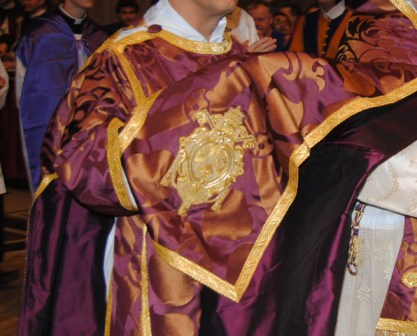
Here is a detail.
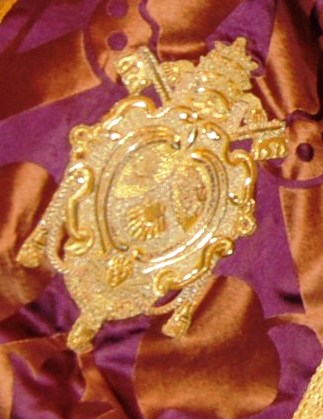

Our friend John Sonnen at Orbis Catholicus has posted a nice photo of one of the purple dalmatics made for the pontificate of Benedict XVI. These are the purple vestments used at Vespers at the beginning of Advent.
Here is a detail.
In no special order here are a few images and notes from Florida and a maternal visit. I made some spaghetti … nothing special. Just good ingredients combined and presented in simplicity.

Nice to have fresh basil off a plant in the ground at this time of year. There are no palm trees or orchids at the Sabine Farm.


Nor is there any papyrus… though there should be!

A friend of my mother and my mother herself are both diligent in the creative conversion of old stuff into new stuff. Here are a few interesting applications of shards of stained glass to old guitars and other stringed instruments. These are the pretty striking in person, and I can’t help contemplating a metaphor.
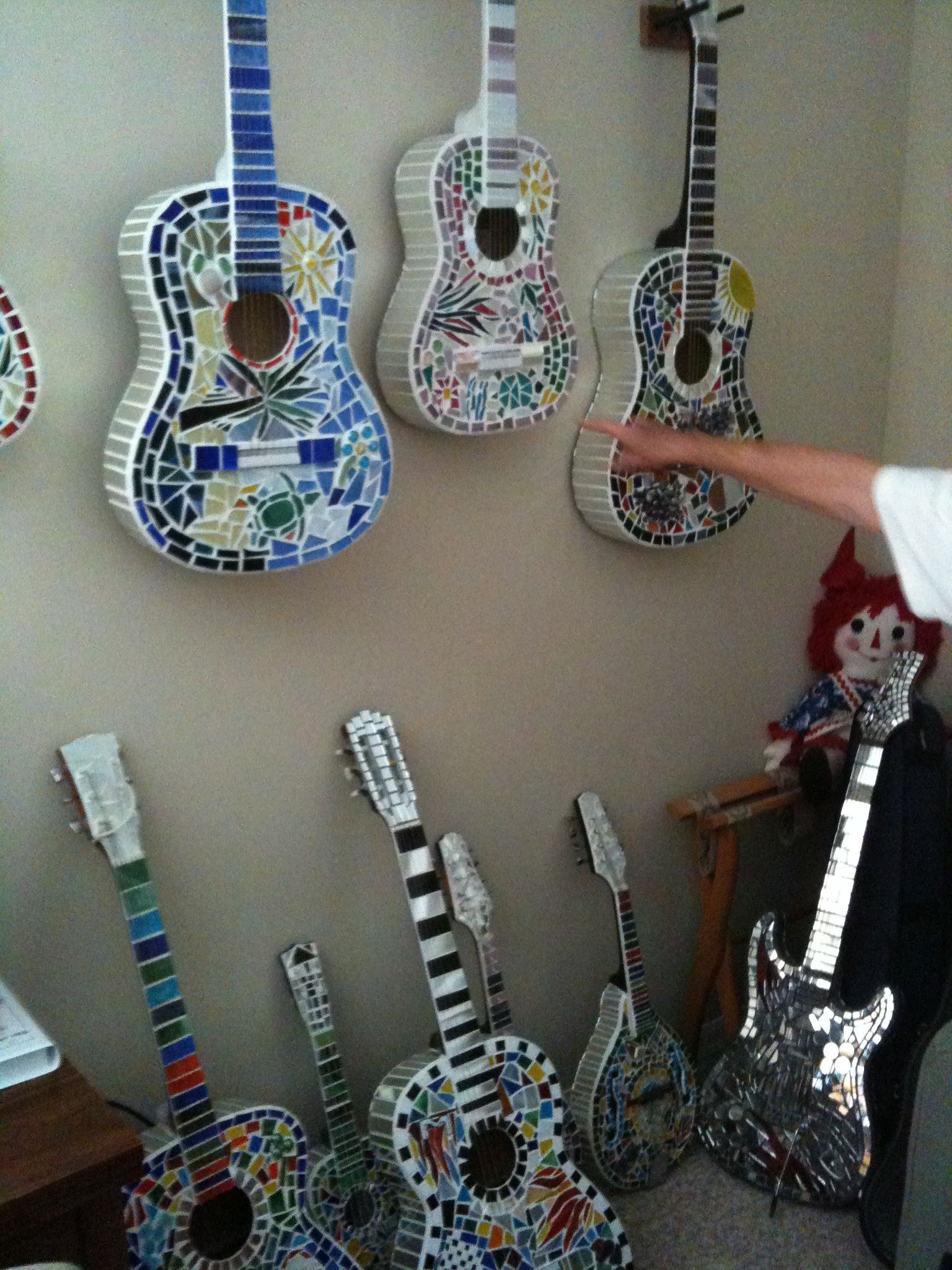

The whole family are fans of bluegrass and many if them play instruments. At gatherings they sometimes play together. In their kitchen you can what can be done with one of these guitars and some car detailing stuff.

Being in Florida there is strong dedication to NASCAR and the Gators.

I was also struck by an old violin with a pink breast cancer awareness ribbon worked into the design.

The local Catholic church is dedicated to St Helena. It is a sober neo-Romanesque structure.


It seems to be a reasonably serious and busy parish, lots of northern "snow birds", with a strong pro-life spirit. The are sundry birds I don’t know but they don’t wait for me and my iPhone to get near. I especially enjoy the Sand Hill Crane. Oh well. The waning day is nice.

You may know that when he was Archbishop of Munich, Pope Benedict gave series of sermons on the Sundays of Advent. He has spent significant time reflecting on this season.
But year and each change in our lives, changes our perspectives on things we may have known well for years. For example, the mysteries of our faith or what we observe in the liturgical years don’t change from year to year, but we do.
This is why we must never be complacent when it comes to our Faith, either they Faith by which we believe (the gift from God which is a grace that we pray will be deepened) or the Faith in which we believe (the content we can learn and study make a part of our worldview and lives).
So many people come to their 60th year with no long catechism than that which they have have heard at 6 and forgot by 16. And yet our Faith asks us to seek understanding.
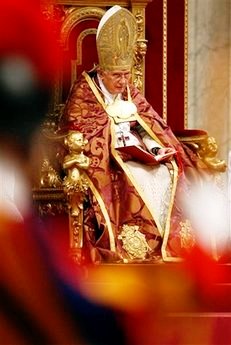 That is a little preamble to a few points from Pope Benedict’s sermon for 1st Vespers of Advent and a new liturgical year. I won’t translate the whole thing; only a few key sentences. I will mostly summarize. I haven’t seen an English version of the sermon anywhere and thought you might want more than a spoonful.
I was struck by something in this sermon. I was caught by the possibility that the Pope is suffering in a human way and in a spiritual way. I was struck by the notion that at this point in his life, with the burdens he bears and the life perhaps he thought he was going to have after the death of the late Holy Father, he is sorting many things out on a personal level even as he gazes at the Church in this modern world, this modern world around our Church.
Benedict XVI, in his sermon for 1st Vespers of Advent, reflected on the word "coming… adventus".
He observed that it can be translated variously as "presence, arrival, coming" and that in the ancient world it had to do with the coming of an important person, such as the visit of the emperor to a province. It could also mean the coming of a divinity. Christians adopted this word to describe their relationship with Christ.
They were saying: "God is here, he hasn’t left the world, he has not left us alone. Even if we cannot see and touch him as he comes in a sensible reality, He is here and he comes to visit us in many places."
"Adventus" also has to do with visitatio, "visit", especially a visit by a God: "He enters into my life and wants to address me."
"We all have the experience, in our daily life, of having little time for the Lord and little time even for ourselves. One winds up absorbed by ‘doing’. Isn’t it perhaps true that often it is exactly activity that possesses us, society with its multiple interests that monopolizes our attention? Isn’t it perhaps true that one dedicates lots of time to diversions and amusements of different kinds?" … "Advent invites us to stand in silence in order to understand a presence. … How often God causes us to perceive something of His love!"
He also elaborated another point. "Another fundamental element of Advent is waiting, a waiting which is at the same time hope."
Advent helps us to understand the meaning of time as kairos, as the favorable opportunity for our salvation. Jesus pointed out this mysterious reality through parables.
Through the different stages of his life man is constantly waiting. But he comes at last to find that he hoped for too little if all he hoped for was social standing or a profession. Christians, however, have the sense that God is along side us, "and will one day dry our tears".
There are many different forms of waiting. If time isn’t filled with meaning, waiting is unendurable. "Every breath that passes seems exaggeratedly long." If it is enriched with meaning, then "in every instant we perceive something specific and of value."
"Dear brothers and sisters, let us intense live the present, where the Lord’s gifts are reaching us, let us live it as if we were launched towards the future, a future charged with hope."
Christian Advent helps us to an understanding of waiting. The Messiah waited for centuries and was born into poverty. Coming among us, he offered the gift of His love and salvation. Present among us He speaks in many ways: in Scripture, in the liturgical year, in the saints, in the events of daily life, in all creation. "For our part, let us address Him, let us offer Him the sufferings that afflict us, the impatience, the questions that burst from our hearts. Let us be sure that He is always listening to us!" "If He is present, we can continue to hope even when others cannot any longer assure us of any support, even when the present becomes wearying."
At the end the Holy Father made a comment that gave me pause: "Advent is the time of the presence and waiting for eternity. For just this reason it is, in a special way, the time of joy, of interiorized joy, that no suffering can take away."
I don’t know how many times my own proposals, or those of others I have heard about, were rejected because of "young people". "No, no. We have to do [FILL IN BLANK] for young people".
Pretty much you know in your heart that [FILL IN THE BLANK] is going to flop because a) young people aren’t stupid and b) young people don’t have 1960’s-70’s baggage and c) what ever hip bad groovy sick cool thing you attempt in church is always done better elsewhere by people who are actually good at it.
Over at NLM I saw an interesting graph.
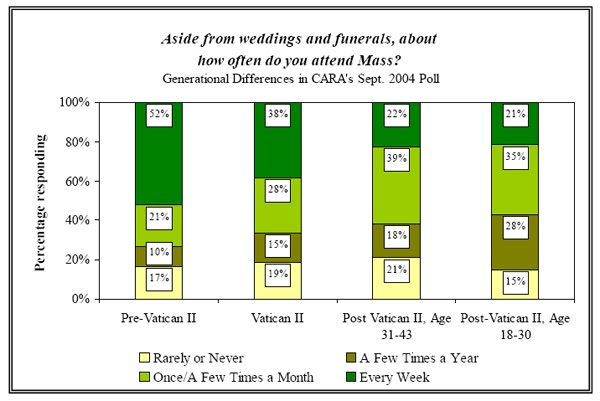
This graph concerns age groups against frequency of Mass attendance.
My friend Jeffrey Tucker puts it this way (with my emphases and comments):
The upheaval of the 1960s and 1970s were justified largely based on the desperate need of young people for a liturgical experience that meets their needs and speaks to a new generation. [Sounds about right. Ever heard that yourself?] Apparently the "new generation" didn’t much like what they heard, because they left in droves. Meanwhile, the strongest attachments to Catholic Church can be observed among those raised in a liturgical environment widely decried for its failure to connect to people and its propensity to foster alienation. These are the survivors who cling to the memorized portions of the Baltimore Catechism for sustenance in difficult times.
Knowing nothing other than these facts, one can easily conclude that the conventional wisdom is complete wrong and that the truth is the reverse of what we’ve been told. The hip and happening style at Mass backfired and emptied the Church. It is the "bad old days" that instilled deeper attachments. The proper direction for change, then, is to recover what we lost.
Do I hear an "Amen!"?
You can read the rest over there.
From the op-ed page of Hell’s Bible comes this from a name that some of you will recognize
NEW YORK TIMES
OPINION
By KENNETH J. WOLFE
Published: November 29, 2009Washington
WALKING into church 40 years ago on this first Sunday of Advent, many Roman Catholics might have wondered where they were. The priest not only spoke English rather than Latin, but he faced the congregation instead of the tabernacle; laymen took on duties previously reserved for priests; folk music filled the air. The great changes of Vatican II had hit home.
All this was a radical break [Some might say "rupture".] from the traditional Latin Mass, codified in the 16th century at the Council of Trent. For centuries, that Mass served as a structured sacrifice with directives, called "rubrics," that were not optional. This is how it is done, said the book. As recently as 1947, Pope Pius XII had issued an encyclical on liturgy that scoffed at modernization; he said that the idea of changes to the traditional Latin Mass "pained" him "grievously."
Paradoxically, however, it was Pius himself who was largely responsible for the momentous changes of 1969. It was he who appointed the chief architect of the new Mass, Annibale Bugnini, to the Vatican’s liturgical commission in 1948.
Bugnini was born in 1912 and ordained a Vincentian priest in 1936. Though Bugnini had barely a decade of parish work, Pius XII made him secretary to the Commission for Liturgical Reform. In the 1950s, Bugnini led a major revision of the liturgies of Holy Week. As a result, on Good Friday of 1955, congregations for the first time joined the priest in reciting the Pater Noster, and the priest faced the congregation for some of the liturgy.
The next pope, John XXIII, named Bugnini secretary to the Preparatory Commission for the Liturgy of Vatican II, in which position he worked with Catholic clergymen and, surprisingly, some Protestant ministers on liturgical reforms. In 1962 he wrote what would eventually become the Constitution on the Sacred Liturgy, the document that gave the form of the new Mass.
Many of Bugnini’s reforms were aimed at appeasing non-Catholics, and changes emulating Protestant services were made, including placing altars to face the people instead of a sacrifice toward the liturgical east. As he put it, "We must strip from our … Catholic liturgy everything which can be the shadow of a stumbling block for our separated brethren, that is, for the Protestants." (Paradoxically, the Anglicans who will join the Catholic Church as a result of the current pope’s outreach will use a liturgy that often features the priest facing in the same direction as the congregation.)
How was Bugnini able to make such sweeping changes? In part because none of the popes he served were liturgists. Bugnini changed so many things that John’s successor, Paul VI, sometimes did not know the latest directives. The pope once questioned the vestments set out for him by his staff, saying they were the wrong color, only to be told he had eliminated the week-long celebration of Pentecost and could not wear the corresponding red garments for Mass. The pope’s master of ceremonies then witnessed Paul VI break down in tears. [I am the one who brought that story to the internet. I heard this story from a priest, one of the papal MC’s, who was an eye-witness to the event. Second hand, granted, but also from someone who wasn’t a fan of Ecclesia Dei and a resurgence of the older form of Mass either.]
Bugnini fell from grace in the 1970s. Rumors spread in the Italian press that he was a Freemason, which if true would have merited excommunication. The Vatican never denied the claims, and in 1976 Bugnini, by then an archbishop, was exiled to a ceremonial post in Iran. He died, largely forgotten, in 1982.
But his legacy lived on. Pope John Paul II continued the liberalizations of Mass, allowing females to serve in place of altar boys and to permit unordained men and women to distribute communion in the hands of standing recipients. Even conservative organizations like Opus Dei adopted the liberal liturgical reforms.
But Bugnini may have finally met his match in Benedict XVI, a noted liturgist himself who is no fan of the past 40 years of change. Chanting Latin, wearing antique vestments and distributing communion only on the tongues (rather than into the hands) of kneeling Catholics, Benedict has slowly reversed the innovations of his predecessors. And the Latin Mass is back, at least on a limited basis, in places like Arlington, Va., where one in five parishes offer the old liturgy.
Benedict understands that his younger priests and seminarians – most born after Vatican II – are helping lead a counterrevolution. They value the beauty of the solemn high Mass and its accompanying chant, incense and ceremony. Priests in cassocks and sisters in habits are again common; traditionalist societies like the Institute of Christ the King are expanding.
At the beginning of this decade, Benedict (then Cardinal Joseph Ratzinger) wrote: "The turning of the priest toward the people has turned the community into a self-enclosed circle. In its outward form, it no longer opens out on what lies ahead and above, but is closed in on itself." He was right: 40 years of the new Mass have brought chaos and banality into the most visible and outward sign of the church. Benedict XVI wants a return to order and meaning. So, it seems, does the next generation of Catholics.
Kenneth J. Wolfe writes frequently for traditionalist Roman Catholic publications.
I am surprised that NYT published this.
I can easily imagine the vitriolic responses that people will send.
You may have seen that the Holy Father has a new ferula, in place of the older one from the time of Bl. Pius IX.
Pope Benedict began his pontificate using the staff of the late John Paul II. Then he changed to the more traditional ferula. Now he has his own ferula.
He is a shot from 1st Vespers of the 1st Sunday of Advent in the Vatican Basilica.
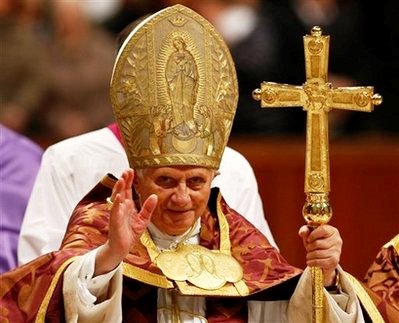
OH! And nice mitre there, too!
I received this by e-mail from a reader in the UK. I think he puts it well:
Dear Father Z
I feel moved to comment on the furore concerning Bishop Tobin and Senator Kennedy, <font color="#ff0000"><b>[Representative or Congressman Kennedy. The Senator Kennedy was this fellows father, pro-abortion Ted Kennedy who died recently.]</b></font> but before I go any further may I say that my opinions cannot be discounted simply because I live in England and am thus deemed to be not directly affected. I AM directly affected, as this is MY church, the One, Holy, Catholic and Apostolic Church which this affair is scandalising. I take my hat off to the good Bishop who is strong enough to give a lead on this matter.
The Liberal Catholic Movement is in dire need of a rude awakening. Support for abortion, however cloaked, is sinful and against the teachings of the Church. To say that the Senator is right to compartmentalise his life so that those things he needs to do do to reflect the opinions of his electors (in this case support abortion) and his faith are kept separate, is an absolute nonsense.
1) One’s faith should be the bedrock of one’s life upon which all our actions should be built
2) This is not a matter of politics it a matter of Faith. The feeble attempt to try and conflate the two issues, and thus discredit the Bishop, will simply not wash. .
3) The Catholic Church is not a democracy, we cannot pick and choose the bits we like, but instead we give our unconditional obedience to the teachings of the Magisterium (unless of course we believe that Holy Spirit can get things wrong on occasions!).
4) Such opinions as the Senator holds, <font color="#ff0000"><b>[Patrick Kennedy is not a Senator, but rather sits in the House of Representatives. But!… But!… mutatis mutandis, there are any number of "Catholic" pro-abortion Senators to whom your comment can be applied! So your comments still strike home and with force.]</b></font> do a grave disservice to the good doctors and nurses in the UK who fought for, and won, the right to a ‘conscience clause’ which exempted them from having anything to do with abortions when they were legalised here. Had this not been allowed, many would have left the profession. Perhaps some food for thought for the Senator there.
I give my whole hearted support to the good Bishop and pray for his success. He is an outstanding example to us all.
Apologies for sounding off and being so long-winded about it.
Hardly long-winded! Very concise and well-phrased.
An oldie PODCAzT about an Advent hymn.
As I wrote back then:
I decided during Advent to drill into the hymns in the Liturgia Horarum.
We begin today with the hymn for Vespers called Conditor alme siderum, with its variation Creator alme siderum as it was in Breviarium Romanum.
I dissect this hymn and we hear different translations and many musical version.
 I ramble a bit. No… I ramble a great deal. We get into an amusing comparison of two Latin verbs… always hilarious and interesting. You Latin students will be ROFL, because that’s what Latin students do with this stuff. No. Really.
 Then we veer sharply into Roman agriculture and cooking.
Then we get into a book that screwed up the world, by Jean Jacques Rousseau. And I talk about a book that talks about books that screwed up the world.
Sing the hymns! Buy a Liber Hymnarius!
You will hear various versions of the famous hymn along the way!


Coat of Arms by D Burkart
 fac on Daily Rome Shot 1118 – Paddywhack!: “Speaking of the disputatio back on October 31st between Archbishop Vesco and Bishop Barron (Vesco saying the Catholic Church was…”
 on Continue the Rome shot posts? I dunno.: “Please call continue the Rome photo posts if it not too much of a burden. Thank you, Father!”
 on Daily Rome Shot 1117 – A *POLL* about 2026-27: “Sorry… my bad. It is indeed SIX. 1. Rh8+! Kxh8 2. Qh2+ Kg8 3. Qh7+ Kf8 4. Qh8+ Ke7 5.…” on Encrypted Yeast? The Fathers on “What does the “leaven” really say?” (6th Sunday after Epiphany Resumed): “I especially like St. John Chrysostom’s insight, that when we are “hidden” in the normal places we live and work,…”
 on Daily Rome Shot 1117 – A *POLL* about 2026-27: “pestolover: For what it’s worth, your solution was the best I could do also.”
 on Daily Rome Shot 1117 – A *POLL* about 2026-27: “Fr Z thanks so much for 2 reminders. 1. Using your Amazon link! For heaven’s sake it costs us nothing…”
 on 10 November – St Andrew Avellino (Vetus Ordo). Wherein Fr. Z rants.: “So interesting that you bring this up, a couple weeks ago a priest at a neighboring parish died unexpectedly. They…”

A Daily Prayer for Priests








They find you a pro-life agent in your area who commits to giving a portion of the fee to a pro-life group!

PLEASE subscribe via PayPal if it is useful. Zelle and Wise are better, but PayPal is convenient.
A monthly subscription donation means I have steady income I can plan on. I put you my list of benefactors for whom I pray and for whom I often say Holy Mass.
In view of the rapidly changing challenges I now face, I would like to add more $10/month subscribers. Will you please help?
For a one time donation...



Help Monks in Wyoming (coffee – UPDATED LINK) and Norcia (beer) and the wonderful "Soap Sisters" of Summit, NJ!


Please follow me on Twitter!










Visits tracked by Statcounter
since Sat., 25 Nov. 2006: