Card. Kaspar about the Anglican ordinariates.
The gentlemanly Sandro Magister has this.

From Vincenzo, the official WDTPRS photoshopper, comes this homage to guerrilla warfare at the meeting of the USCCB.
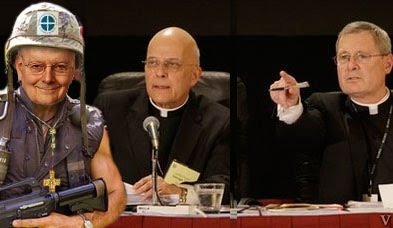
During the USCCB plenary meeting there was a riveting report from the John Jay College of Criminal Justice about sexual abuse of minors by priests.
Armed with statistics, she hammered seminary formation in the 60’s and 70’s. An increase in the number of homosexuals entering seminary in 70’s lead to an increase in abusers.
Furthermore, the studies confirmed that some 80% of the victims were male, boys.
However, there was also a comment made about whether homosexuality should be a factor in excluding men from the seminary. The response came "If that exclusion were based on the fact that that person would be more probable than any other candidate to abuse, we do not find that at this time."
I will at this point recall to your minds that the Holy See issued a strong document treating this very subject and that document is not optional.
But you can be sure that this response during the Q&A period will be trotted out by all who desire to set aside anything from the Holy See on this matter, or common sense for that matter.
One sally onto to this field comes from, big surprise here, the Jesuit weekly America. James Martin, SJ wrote:
Let’s hope that this study helps the bishops to continue their work in combating sexual abuse in the priesthood, and also begins to bring to a close the false conflation of homosexuality and pedophilia, and the vilification of celibate gay priests.
Leaving aside the question of how a homosexual functions as a priest, alter Christus, for a Church which is Christ’s Spouse, other points of concern remain.
First, look at the sex of the great majority of victims.
Second, reread the Holy See’s document on seminary formation.
At the same time, this is from Fr. Martin, SJ, saying "This is either the funniest thing I’ve ever seen or the scariest. Or a pretty good hoax. "
I don’t know about you, but I am a little tired of the suggestion (from churchmen who shall remain nameless, out of respect for those who are offended by gender-exclusive language) that people are too stooopid to understand the new translation which, God willing, we will be able to use before the Lord returns.
Let me put this to you this way:
Are you stooopid or something?
Okay, boys and girls, let’s have a test!
Let’s read the new and improved text of the Creed used at Mass.
Here we go! I will flag in RED the parts that might be tooo haaard. Skip them if you have to.
I believe in one God,
the Father almighty,
maker of heaven and earth,
of all things visible and invisible.
And in one Lord Jesus Christ,
the Only Begotten Son of God,
born of the Father before all ages.
God from God, Light from Light,
true God from true God,
begotten, not made,
consubstantial* with the Father;
through him all things were made.
For us men and for our salvation
he came down from heaven,
and by the Holy Spirit
was incarnate* of the Virgin Mary,
and became man.
For our sake
he was crucified under Pontius Pilate,
he suffered death and was buried,
and rose again on the third day
in accordance with the Scriptures.
He ascended into heaven and is seated
at the right hand of the Father.
He will come again in glory
to judge the living and the dead
and his kingdom will have no end.
[…] And in the Holy Spirit, the Lord,
the giver of life, who proceeds
from the Father and the Son,
who with the Father and the Son
is adored and glorified,
who has spoken through the prophets.
[…] And one, holy, catholic
and apostolic Church.
I confess one baptism
for the forgiveness of sins
and I look forward to the resurrection
of the dead
and the life of the world to come. Amen.
*WARNING: These are in fact haaard parts, generally considered by smart people… not necessary just liberal smart people (in other words, people smarter than you), to be mysteries. While they ought to be covered thoroughly in your First Holy Communion catechesis as well as from the pulpit at different times of the year, they do remain sort of haaard, even ineffable. This fact does NOT… NOT… put the following POLL in the category of "trick question".
Okay! I am sure that was haaard, but let’s see how you did!
n
I mentioned Zuhlsdorf’s Law in another post.
Apparently, and for no reason I can discern, the self-registration function here switched itself off.
I was wondering why I didn’t see new registrations coming in for my thumbs up (or down, as the case may be).
Thus, I believe self-registration is functioning again. I must approve registrations, which doesn’t always happen immediately… or ever if I don’t like what I see.
TIP: I like registrations that include something in the personal blurb category. None of that appears to the reading public, just to me. I tend to pay attention to and approve more quickly registrations with info in that category.
Remember: I have to approve these, and I don’t always get to them rapidly during the day, especially when I am traveling.
Anthony Stevens-Arroyo, a blogger with Newsweek/WaPo, has the amazing penchant for being wrong.
You might remember some of his other accomplishments along these lines, for example, his ululation when Bp. Martino of Scranton resigned. Or his agreement with Planned Parenthood.
This time he is wrong about the passing of the blocks of the new translation by the USCCB in their plenary session.
His hero? None other than His Excellency Most Rev. Donald W. "Ineffable" Trautman, Bishop of Erie and perennial jihadist against the new translation.
Let’s have fatiguing look at how Mr. Stevens-Arroyo get’s it wrong this time with my emphases and comments.
‘Latinese’ when plain English will do
Note: U.S. Catholic bishops gave final approval Tuesday to an English translation of the Roman Missal that has been in development for years. After the Vatican gives its final authorization, the new translation will be adopted by parishes nationwide, possibly next year.
Sometime soon, Catholic America will be asked to "unlearn" our cherished prayers at Mass. [Cherished? Let’s quiz people leaving Mass on a Sunday morning and ask them if they can recite, for example, the Gloria, on their own without a body of people around them. Also, note that he wants you to accept a premise: people really like the present translation. You must: Compared to what other translation?] As a result of a command to retranslate [perhaps better "translate for the first time"] the Roman Missal, we are on schedule to be reprogrammed [Oooooo!] when praying at Mass. I am usually in favor of change in order to further the work of the Church, but in this case I wonder why we are trading in English for Latinese. [What he leaves aside is that the present translation is inaccurate and banal.]
The word "Latinese" is my invention; but as a professor of many years, I know Latinese when I see it. It is a made-up language that is technically English, but which sounds like Latin. [Ummm… what did that mean? If it is English, it is English, right? How is it made up? But watch this next anti-intellectual cheap shot.] Some students think that big words make you into an intellectual so they avoid plain English. I am not the only professor to prefer plain English, however, and I wish that the Vatican bureaucrats pushing Latinese would agree. [Two things here. First, this is the sort of condescending sneer you get from an academic elitist. "I’m a professor! Look at those over-reaching students." Next, liberals paradoxically create a false dichotomy between intellectual and "pastoral". This is a very common technique. But it is paradoxical in that it is okay for them to be recognized as intellectuals, whereas no conservative can be. Liberals can be intellectuals, but they know how – through some gnosis of their own – how to mask their brilliance and be folksy, pastoral. In this case the writer is smearing the new translation and the norms behind it with, first, the primer of condescension, and then the drab coat of a false dichotomy. Furthermore, in churchy circles liberals will generally bludgeon anything they disapprove of as not being "pastoral" even if it isn’t profoundly intellectual. Tune your inner ear as you read for these subtle frequencies of condescension and gnosis.]
I am not against Latin-derived words; [Laus Deo!] they are irrevocable parts of the English language. I only oppose using Latinese when it gets in the way of clarity. For example, [watch this move] we have grown used to professing our faith saying that Jesus "was born of the Virgin Mary:" We will now speak in Latinese and say he was "made incarnate of the Virgin Mary." Get used to other Latinese words like "consubstantial," "’ignominy," "ineffable," "gibbet" [Latinate? Not sure.] and "unvanquished." [Did you get that? Our being used to something is what makes it clear to us. Brilliant reasoning. Aside from the obvious fact that we will have time to get used to the important changes even before the new translation goes into effect (through catechesis, etc.) people will probably have the change to get used to them after the new translation goes into force… just as they got used to the lame-duck version now in force. And the new translation with be more accurate. In the case cited by the gnostic writer, the Latin in the Creed is "et incarnatus est… ex Maria Virgine". Would a first year Latin student translate that as "born of the Virgin Mary"? To be born and to incarnate are different ideas, no?]
I took four years of Latin at St. Joe’s Prep in Philadelphia, and earned 90’s every semester. I got to the point of sight-reading the Aeneid and still have no difficulty with the original Latin of St. Thomas’ Summa, [And… what about the content?] but that’s not the experience of most people in the pews.
Try this:
Latin, having been used during the centuries when, from apostolic origins, continuing in the traditions of the Roman Church and the experiences of holy men and women of Christendom whenever the identification of theological preciseness being constantly required in the articulation of the faith, while being fostered and preserved through the use of gender and temporality designates, is preferred.
The sentence above is Latinese. At 59 words, it is shorter than one sentence in the new missal for the Preface of the Feast of Christ the King that has 88 words spread out over 13 lines. [Here is another brilliant bit of reasoning. His complaint is the length. You would think that his complaint might be that this is a periodic sentence, with various clauses which force the reader/listener to pay attention and think, to hold concepts in the air, so to speak, until the whole is resolved at the end. But no, the gnostic writer focuses on length.] And this Latinese is better than other places where sentences roll on without verbs! [Weren’t there verbs in that? Readers? Were there any verbs in that?] I suggest interested readers consult the comments of [wait for it…] Bishop Donald Trautman of Erie, Pennsylvania, who also said at the Catholic University in Washington:
"The Latin text is not inspired. It is a human text, reflecting a certain mindset, theology and worldview. … [Indeed. A Roman Catholic worldview consistent for many centuries.] Because of literal translation in the new missal, complicated Latin wording has become complicated English wording." [Can’t have complexity! After all, people are stooopid.]
The reasons given in favor of the retranslation are laudable: [AGH! Latinese! Why couldn’t he just say… good. Two fewer syllables and geared for his view of people in the pew! But no… he is not writing for people in the pew, is he. He is writing for his fellow gnostics so that they can feel good about themselves as they sneer at the conservative ideals behind the norms for the new translation. That is the reason for most of the entries on the WaPo/Newsweek religion blog: make liberals feel good about themselves as they look down on the simple people.] a single English text for all English speakers in the world, from Pakistan to Peoria and conformity with a central Latin version. I suppose a case can be made for such issues, but I am less receptive to the notion voiced by some Vatican bureaucrats that speaking to God in prayer in plain everyday language lacks "transcendence." It is a non sequitur (real Latin!) that unintelligibility makes you holy. [Dear Professor, did banal make us holy? Does inaccuracy sanctify?]
Moreover, when the new translation was "tested," the reactions were mostly negative. [I think this needs some support. Am I wrong?] In the end, most churchgoers will go along with the changes because we love the Church, [There’s a sneer at the Holy See and the bishops for ya!] even if we don’t always understand its administrative decision. [Remember: When reading the writing of liberals, always look for how they contrast X, whatever that may be, with "pastoral".] But what about the younger generations of Catholics who have never attended a Latin Mass in their lives? [I say "Bring ’em on!" Then in a few years let’s ask them to compare the old with the new and see what they say. But watch for this next cliche:] They will never have nostalgic feelings about the transcendence of Latin. And this new Latinese is at a distinct disadvantage against Facebook and MP3 downloads. [And here is on of Bp. Trautman’s talking points:] Aren’t we making worship more remote? [Remember, for Bp. Trautman, our sacred liturgy shouldn’t have sacred language. Rather, it should be everyday speech, adjusted to the immediate styles of the time and the audience (who are pretty stooopid after all.] I am against taking pastoral concern [TA DA!] for liturgical celebrations away from Catholic America and giving it to unseen Vatican bureaucrats. [BOOO!] The prayer of the Church belong to all of us! [Indeed? How egalitarian. Then it belongs to all of us, indeed. Except anyone with traditional inclinations.]
In the end, I wouldn’t be surprised to see bishops start giving special permission for Mass in the rite we have now. [That’s what he wants, of course. He wants people to request not to have to use the new translation. This is a Lefebvrism of the left, as Card. George once put it.] After all, the Church allows the original Latin Mass for [cliche alert!] old-timers [He perpetuates the canard that the emancipation of the older form of Mass is just for old people. But wait… that is also a sneer at old people, then, isn’t it?] and an Anglican ritual for Anglican converts: shouldn’t Catholic America get equal treatment? Happily, I have an escape until that happens because Bishop Trautman says the Spanish translation is better than the English one. Sí, Padrecito. [Actually, he might find even more solace in an liberal Episcopalian community that uses the updated alternative services rather than the older Book of Common Prayer. That might be a good match, actually. The bishops are weak. They never have to deal with Rome or Popery or Latin.]
An object lesson in how to be wrong all the time.
Instead of posting or writing, I am in a cage match with technology.
Zuhlsdorf’s Law* clicks in again!
My printer died and no workaround will fix it. I have tried it on three different computers.
*Zuhlsdorf’s Law: Whenever you want to show someone something with technology, at that very moment you need it, the technology will fail. The extent of the failure is in proportion to your urgency.
You have to admire Bp. Trautman. He kept his powder dry and his plan of attack hidden, saving his very last musket ball for the end.
He raised a motion that the bishops should see the Gray Book of the Antiphons, discuss it and vote on it.
Very dramatic, really.
Background: Card. George, as President, had asked in the name of the Conference that the Holy See handle translation of the the antiphons. The Holy See, of course, agreed. Eventually, the Holy See sent a Gray book, but it was not distributed.
Bp. Trautman, who said at one point he wasn’t aware of the Holy See’s Gray book, reacted to this departure from procedure saying that the Constitution on Sacred Liturgy requies that competent territorial authority has to approve translations. He calls this a doctrinal issue. I will return to that important point at the end.
Therefore Bp. Trautman put a motion on the floor for the bishops to insist that the all Latin bishops as a conference have the change to work on the Gray Book for antiphons.
This was probably his Waterloo.
The bishops as a body rejected his motion.
It remains to be seen how the bishops will eventually deal with this departure from regular procedure in the future.
Unlooked for players on the correct side of this battle were, wait for it…. Archbp. Pilarcyk and Card. Mahony. They both suggested that, after Bp. Trautman’s motion was addressed, the body of bishops could simply ratify what Card. George had done acting as president of the USCCB in his dealings with the Holy See over the Gray Book for antiphons.
As it was, Bp. Trautman’s last ditch move to delay the process was rejected by the other bishops. Then Archbp. Pilarczyk made the motion that the bishops let Rome handle the antiphons and the bishops approved the same overwhelmingly.
That seems to have been the last hurrah.
Of course, it is Zuhlsdorf’s Law that whenever you want to show someone something with technology, at that very moment you need it, the technology will fail. And the extent of the failure is in proportion to your urgency.
At the very moment when Card. George was to announce the results of the vote on Bp. Trautman’s motion, the TelecareTV coverage died… video froze and then went black as the audio died. SO,…. I picked up a tweet from the Twitter feed of @usccbmedia. Thanks to them we learned what happened.
We didn’t learn it from TelecareTV, tasked with the coverage. We got it from Twitter.
It was a dramatic moment for more than one reason!
It is not quite time for a Te Deum, but this was a great step forward.
All during the presentation of the various elements for voting, Bp. Seratelli, head of the liturgy committee, reminded the bishops that this meeting, this November, was – according to the Holy See! – the last chance to vote on things. After this, the Holy See would take charge and handle the issues that remained open. It seems that the bishops took this to heart… a heart that was no doubt weary and flagging after all these years.
Going back to Bp. Trautman’s motion.
As this was going on I was reminded of what I read in the book that came out under the name of the former papal master ceremonies, Archbp. Piero Marini. He described in detail the workings of the Consilium under the late Annibale Bugnini. Marini explained that the Consilium realized they were changing doctrine with the liturgical changes. An objective of Bugnini was to strip the Congregation for Rites of its power and redistribute it to territorial conferences. One of the knives he used was the question of who gets to approve liturgical translations, Rome or the local conferences?
This same dynamic and question returned at this meeting of the bishops, with Bp. Trautman playing the advocate of the old Bugnini/Marini objective.
But it is a sign of the times that the American bishops rejected that position and were content that the Holy See not only approve the translation of liturgical texts but, in the case of the antiphons, actually do the work.
You can see why Bp. Trautman was so intent on this and why he saw it as his last great chance.
But he is a sly one. Perhaps he will find a loaded pistol on the ground even as he abandons his discharged musket.
Discuss.


Coat of Arms by D Burkart
 fac on Daily Rome Shot 1118 – Paddywhack!: “Speaking of the disputatio back on October 31st between Archbishop Vesco and Bishop Barron (Vesco saying the Catholic Church was…”
 on Continue the Rome shot posts? I dunno.: “Please call continue the Rome photo posts if it not too much of a burden. Thank you, Father!”
 on Daily Rome Shot 1117 – A *POLL* about 2026-27: “Sorry… my bad. It is indeed SIX. 1. Rh8+! Kxh8 2. Qh2+ Kg8 3. Qh7+ Kf8 4. Qh8+ Ke7 5.…” on Encrypted Yeast? The Fathers on “What does the “leaven” really say?” (6th Sunday after Epiphany Resumed): “I especially like St. John Chrysostom’s insight, that when we are “hidden” in the normal places we live and work,…”
 on Daily Rome Shot 1117 – A *POLL* about 2026-27: “pestolover: For what it’s worth, your solution was the best I could do also.”
 on Daily Rome Shot 1117 – A *POLL* about 2026-27: “Fr Z thanks so much for 2 reminders. 1. Using your Amazon link! For heaven’s sake it costs us nothing…”
 on 10 November – St Andrew Avellino (Vetus Ordo). Wherein Fr. Z rants.: “So interesting that you bring this up, a couple weeks ago a priest at a neighboring parish died unexpectedly. They…”

A Daily Prayer for Priests








They find you a pro-life agent in your area who commits to giving a portion of the fee to a pro-life group!

PLEASE subscribe via PayPal if it is useful. Zelle and Wise are better, but PayPal is convenient.
A monthly subscription donation means I have steady income I can plan on. I put you my list of benefactors for whom I pray and for whom I often say Holy Mass.
In view of the rapidly changing challenges I now face, I would like to add more $10/month subscribers. Will you please help?
For a one time donation...



Help Monks in Wyoming (coffee – UPDATED LINK) and Norcia (beer) and the wonderful "Soap Sisters" of Summit, NJ!


Please follow me on Twitter!










Visits tracked by Statcounter
since Sat., 25 Nov. 2006:

