Reversing the liturgical field
by Richard McBrien on Sep. 21, 2009
Judging from the comments, some readers thought last week’s column on the "Year for Priests" unduly pessimistic about the present state of the Catholic Church. To the contrary, one of latest developments inside the Vatican only underscores the point of that column.
According to a report late last month by Andrea Tornielli in the Italian daily Il Giornale, the prefect of the Vatican’s Congregation for Divine Worship and the Discipline of the Sacraments, Cardinal Antonio Cañizares Llovera, met with Pope Benedict XVI on April 4 (the fact that we have a precise date is significant) to present a list of proposed changes to the liturgical norms for the celebration of the Eucharist.
The proposals were said to have been formally approved at a meeting of the congregation in March, and were designed to "restore a greater sense of the sacred" to the celebration of Mass. [Which is precisely what McBrien objects to. He would probably have Mass reduced to a horizontal and merely human experience.]
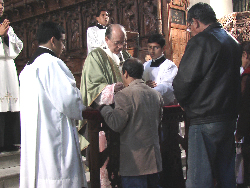
Among the proposals that had been approved by the congregation in March and presented to the pope early the next month were calls to end the practices of receiving Communion in the hand and having the priest celebrate Mass facing the congregation.
Once the story was leaked to the press, however, there were denials (of sorts) from the Vatican. Undoubtedly, Vatican officials were miffed by the leak and a statement was issued by the deputy director of the Vatican Press Office, Passionist Fr. Ciro Benedettini, that said only that "for the time being there are no institutional proposals for a modification of the liturgical books used at present."
Some Vatican observers predict that the delay may last as much as a year, or until the matter quiets down. [It would take that long anyway, since it is the practice of the Congregation to study and consult.]
But what is clear is that something is in the works and it is entirely consistent with what Roman sources have been hearing for some time about the pope’s desire to return gradually to Communion on the tongue as the normative practice. [Hang on… Communion on the tongue IS the normative practice. Communion in the hand is an aberration which is permitted according to decisions of conferences, of diocesan bishops and, in the case of risk of profanation, parish priests.] At the same time, the Pope knows full well that such a highly controversial reversal of current practice could never be accomplished in an instant. [And the Pope has already written about patience in liturgical reform.]
The practice of Communion in the hand was originally granted by the Vatican’s Congregation for Divine Worship on May 29, 1969 (before it was combined with the Congregation for the Discipline of the Sacraments by Pope Paul VI in 1975), in response to requests from various episcopal conferences, including that of the United States, and with the explicit approval of Paul VI. [But this is not the whole story. What McBrien is ignoring here is that the practice began and continued for years contra legem, against the Church’s law. But this would his his preferred way of making changes to his liking, no? Forget about the church’s law. Do whatever you find self-actualizing in this moment.]
Lest anyone question Benedict’s personal preference in this matter, it should be pointed out that, beginning on the feast of Corpus Christi last year, those receiving Communion from the pope must do so only on the tongue. He has also expressed support for restoring the practice of the priest’s celebrating Mass "facing the East," which means in plain English with his back to the people. [Only if by "plain language" you mean "inaccurate clichés".]
Given the possibility that such reversals (sometimes referred to as a "reform of the reform") [He would think of this as a reversal. But when something has gone wrong – and so much has gone wrong – your choices are either the ignore the problem and blunder along or retrace your steps and fix the problem.] will eventually be mandated, one can only imagine the confusion, frustration and anger that many priests and laypeople will experience. [What is the assumption here? McBrien’s assumption is that this would be imposed suddenly, without explanations or catechesis. Of course this is nothing but fear mongering, which is the perennial tool of those who themselves are fearful.]
Today, if individual Catholics choose to receive the sacrament on the tongue, they are free to do so. Eucharistic ministers — priests and laypeople alike [Correction: lay people are not "Eucharistic ministers". They can be "Ministers of Holy Communion".] — respect their wishes. The great majority, however, prefer to receive Communion in the hand and continue to do so.
But this proposal, if enacted, would actually prevent Catholics from making that choice for themselves. They would be denied the option, approved by Paul, that has been available to them for the past 40 years, namely, to receive Communion in the hand or on the tongue. [Yes, indeed. You would think that someone who has tried to write about Church history would understand that part of a reform means saying "no" to something that has been going on for a while. And didn’t Paul VI also issue Humanae vitae? What about that? We should adhere to what Paul VI issued, right?]
The so-called "John Paul II priests" [NCR’s nightmare..] would very likely be happy with such a reversal of practice and would ostentatiously deny giving Communion to those with outstretched hands. [Why "ostentatiously" here? Why the slur? Why not talk about some people who go to a TLM and "ostentatiously" refuse to receive on the tongue?] However, many other priests, whether old enough to have been shaped by Vatican II or not, would ignore the mandate and continue to distribute Communion in the hand to those who requested it. [And that is McBrien’s ignoble wish.]
[Now we see McBrien in the role of drama queen…] What would happen as a result of this tug of war at Communion time? Would some bishops threaten priests with suspension? If so, how many priests would expose themselves to such a penalty? If the numbers were large, how would the church be able to compensate for the additional decline in the number of available priests? [The fact is that younger priests will implement the law they are given to implement. The older priests will just retire or die.]
[CLICHE ALERT!] Mandating the celebration of Mass with the priest’s back to the congregation [I wonder if he know how foolish this sounds to people who know anything about this issue?] might pose an even greater problem, except in churches built before the Second Vatican Council and still with main altars facing the rear wall. But such churches are probably in the minority today. The architectural problems would be exceeded only by the pastoral dislocations.
May none of this come to pass.
Year by year these priests of discontinuity and rupture are retiring or dying. The biological solution is quickly taking care of them.
He can see in his mind’s eye that faithful "John Paul II priest" standing by, ready to open the door for him to make room for the walker. Another is holding McBrien’s hat with a smile. Yet another is telling the visiting nurse not to forget to get more Depends. Perhaps they are taking the old guy down to the park or out for a ride.
These young priests will in charity come to visit McBrien and sit with him and listen to his stories about the halcyon days of the "spirit of Vatican II" and listen to him rail about how his life’s work came to nothing.
And when this old dissenter comes to his final breaths, a "John Paul II priest" will come in his cassock, surplice and stole to give him last rites in Latin using the pre-Conciliar Rituale Romanum.
tick….









 URGENT petition to Notre Dame: Please drop the charges


 fac on Daily Rome Shot 1118 – Paddywhack!: “Speaking of the disputatio back on October 31st between Archbishop Vesco and Bishop Barron (Vesco saying the Catholic Church was…”




























