As I reassess all things WDTPRS…
Is anyone out there savvy enough to make a WordPress theme which looks like the present theme used for WDTPRS but … well… better? Lighter? Widget enabled? Etc?
Drop an e-mail.
As I reassess all things WDTPRS…
Is anyone out there savvy enough to make a WordPress theme which looks like the present theme used for WDTPRS but … well… better? Lighter? Widget enabled? Etc?
Drop an e-mail.
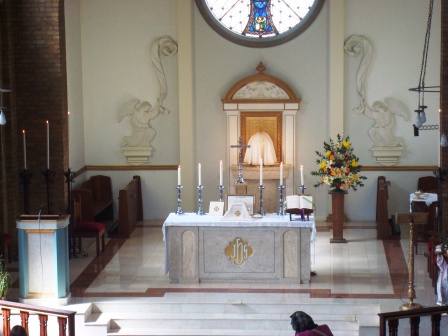
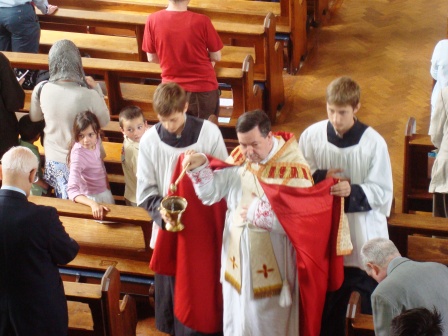
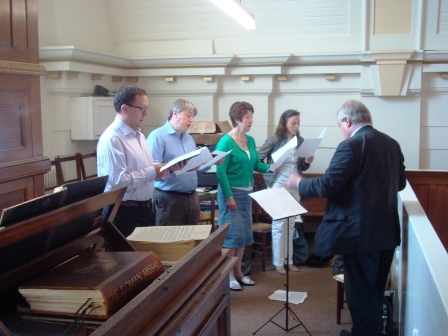
Sunday at St. Bede’s in Clapham Park, London included a Missa Cantata in the Extraordinary Form. The celebrant was Fr. Andrew Southwell and the choir, which sings monthly, provided Gregorian chant propers and the Ordinary by Victoria.
Some images and a short video clip.
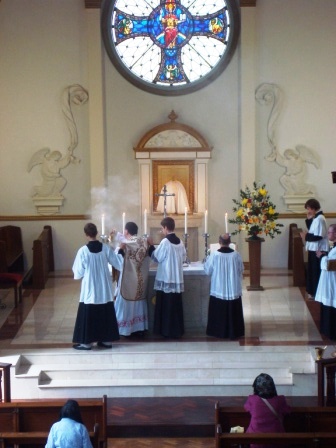
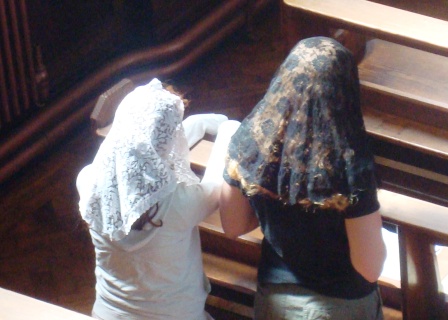
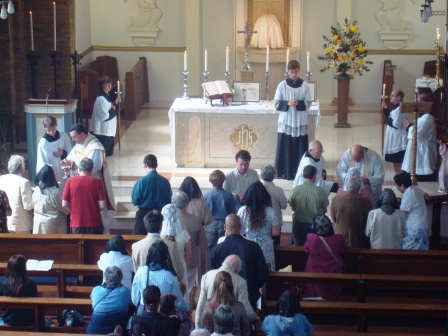
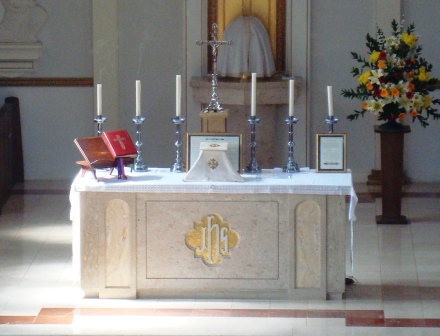
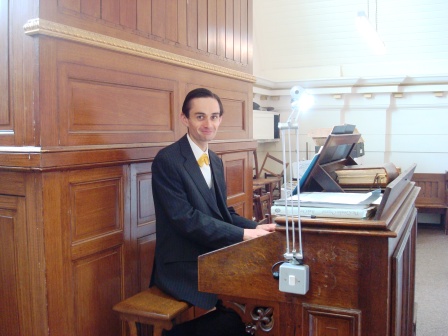
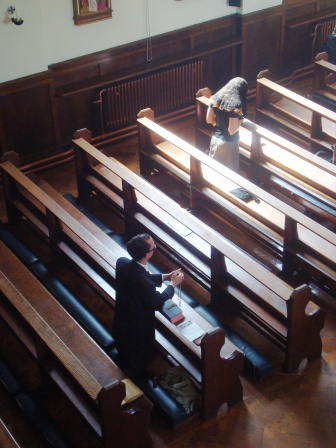
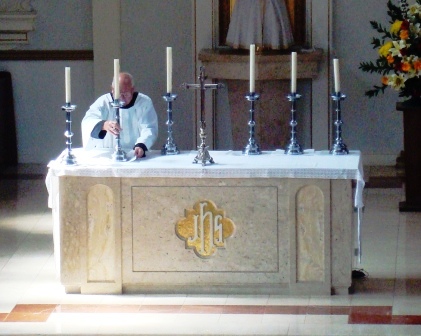
On 15 August His Excellency Most Rev. Robert Finn, Bishop of Kansas City, MO, will preside over the ground breaking for a new building for the wonderful community of sister, the Benedictines of Mary, Queen of Apostles.
I have written of this group before.
I have for a while turned off the "open" posting of comments. Right now you must be registered participant to post a comment.
There are a few deeply creepy "green ink" people out there who have an obsessive need to create problems. They are probably sick in the head and in need of prayers.
In the meantime, I will do some registrations manually, on my own schedule.
Send a note to my regular e-mail address and put this, nothing else, in the subject line: MANUAL REGISTRATION REQUEST
I will need:
Desired Username
First Name
Last Name
Working E-mail (required)
Just give the information I asked for as I asked for it. I can simply cut and paste and work quickly.
I will send a password by e-mail. Everyone will get the same password, which you can change at your leisure.
I don’t believe the blog software accepts special characters, such as #, etc. I might have to give you a different username if you have characters that the software doesn’t allow.
If you are already registered… don’t ask! No… wait… I mean it. If you send your registration note and I find you are already registered, I will simply skip you and move down the line.
It may be that you picked as a desired username something that is already taken. In that case… well… I don’t know what to do at this moment, since I am not going to spend a lot of my time in London sorting this out. If you don’t hear back in a while, maybe something went wrong.
However, please note that I am having a little trouble sending out e-mails from my present location. I think they are going out. If you haven’t heard anything back from me, and you sent a request, you might drop another note.
I think you have all seen it happen.
As the time for Holy Communion approaches, a small throng of EMHCs troop up into the sanctuary.
On the blog Uncommon Sense there is a proposal, worth reading and passing around. I include the whole thing here so as to make it a bit more visible. Be sure to visit that blog, however.
His emphases in the original but with my emphases and comments.
Whereas the General Instruction for the Roman Missal 162 states: “The priest may be assisted in the distribution of Communion by other priests who happen to be present. If such priests are not present and there is a very large number of communicants, the priest may [not must] call upon extraordinary ministers to assist him, e.g., duly instituted acolytes or even other faithful who have been deputed for this purpose. In case of necessity, the priest may depute suitable faithful for this single occasion.
And whereas the Instruction “Redemptionis Sacramentum” in paragraph 88 states “Only when there is a necessity may extraordinary ministers assist the Priest celebrant in accordance with the norm of law.”
And whereas the same instruction in paragraph 151 states: “Only out of true necessity ["necessity"… sensing a theme yet?] is there to be recourse to the assistance of extraordinary ministers in the celebration of the Liturgy. [NB…] Such recourse is not intended for the sake of a fuller participation of the laity but rather, by its very nature, is supplementary and provisional. [I don’t know how many times I have heard priests and laypeople talking about giving laypeople something to do during Mass.] Furthermore, when recourse is had out of necessity to the functions of extraordinary ministers, special urgent prayers of intercession should be multiplied that the Lord may soon send a Priest for the service of the community and raise up an abundance of vocations to sacred Orders.”
And whereas the same document states in paragraph 158: “Indeed, the extraordinary minister of Holy Communion may administer Communion only when the Priest and Deacon are lacking, when the Priest is prevented by weakness or advanced age or some other genuine reason, or when the number of faithful coming to Communion is so great that the very celebration of Mass would be unduly prolonged. [The problem is that "necessity" and "unduly" can be loosely interpreted and there isn’t really any way to tighten up the meaning.] This, however, is to be understood in such a way that a brief prolongation, considering the circumstances and culture of the place, is not at all a sufficient reason.
And whereas the Vatican instruction “On Certain Questions Regarding the Collaboration of the Non-Ordained Faithful in the Sacred Ministry of Priest” states in Article 8 § 2: “Extraordinary ministers may distribute Holy Communion at Eucharistic celebrations only when there are no ordained ministers present or when those ordained ministers present at a liturgical celebration are truly unable to distribute Holy Communion. They may also exercise this function at Eucharistic celebrations where there are particularly large numbers of the faithful and which would be excessively prolonged because of an insufficient number of ordained ministers to distribute Holy Communion.
And whereas the same document at the end of Article 8 states: ”To avoid creating confusion, certain practices are to be avoided and eliminated where such have emerged in particular Churches: the habitual use of extraordinary ministers of Holy Communion at Mass thus arbitrarily extending the concept of “a great number of the faithful.” [Again, this practice, as it is usually observed today tends to blur the distinct roles of priest and laypeople in Holy Mass.]
And whereas the conclusion of the same document states: ”All particular laws, customs and faculties conceded by the Holy See ad experimentum or other ecclesiastical authorities which are contrary to the foregoing norms [On Certain…] are hereby revoked.” [In other words, they cannot be continued out of an excuse that it is local custom.]
And whereas in “Norms for the Distribution and Reception of Holy Communion Under Both Kinds in the Dioceses of the United States of America” paragraph 24 states: ”In practice, the need to avoid obscuring the role of the priest and the deacon as the ordinary ministers of Holy Communion by an excessive use of extraordinary ministers might in some circumstances constitute a reason either for limiting the distribution of Holy Communion under both species or for using intinction instead of distributing the Precious Blood from the chalice.” [Intinction also gets rid of Communion in the hand…]
And whereas the same norms in paragraph 28 states: ”When the size of the congregation or the incapacity of the bishop, priest, or deacon requires it, the celebrant may be assisted by other bishops, priests, or deacons. If such ordinary ministers of Holy Communion are not present, “the priest may [not "must"] call upon extraordinary ministers to assist him, i.e., formally instituted acolytes or even some of the faithful who have been commissioned according to the prescribed rite. In case of necessity, the priest may also commission suitable members of the faithful for the occasion.” … When recourse is had to Extraordinary Minister of Holy Communion, especially in the distribution of Holy Communion under both kinds, their number should not be increased beyond what is required for the orderly and reverent distribution of the Body and Blood of the Lord. In all matters such Extraordinary Ministers of Holy Communion should follow the guidance of the diocesan bishop [Mindful of the fact that this paragraph draws its authority from GIRM 151 which speaks only of instances where a great number of the faithful are gathered, and it is the competence of the Holy Father alone, and of no bishop or priest, to legislate anything in the liturgy against the norms which the Holy Father has duly set forth].
[All that having been laid out…] We put forth the following observations:
Observation 1: The habitual use of extraordinary ministers at Masses in the United States is in fact a violation of the norms set forth in “On certain questions.” In most parishes across this country are even scheduled weeks ahead of time.
Observation 2: The majority of these Masses are not attended by “a great number of the faithful” and thus this term is being arbitrarily extended in violation of the norms of the Holy Father set forth in “On Certain Questions…”.
Observation 3: In point of fact, aside from being viewed as supplementary and provisional, extraordinary ministers are being utilized in such a way that they believe that their ministry involves a fuller participation in the Eucharistic celebration, in violation of the norms set forth by the Holy Father in “Redemptionis Sacramentum.”
Observation 4: The continued unnecessary recourse to the use of extraordinary ministers continues to blur the distinction between the ordained and lay members of the Catholic Church.
[Therefore] And in light of the above observations we submit the following petition:
Petition: Considering the constant violations of the norms set forth above, we humbly ask you [bishops and priests] to implement the provisions set forth in the Norms for the United states, namely that Holy Communion normally be distributed only by the ordinary minister, under one species [the Host], or by intinction in those parishes and communities where the faithful wish to receive under both species.
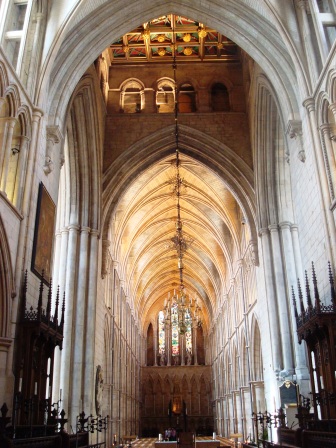
I rather like Southwark… little streets and interesting corners.
I popped into the once-Catholic Cathedral for a visit.
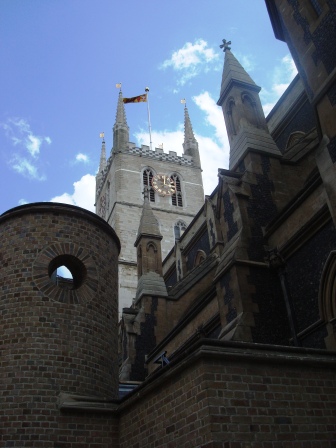
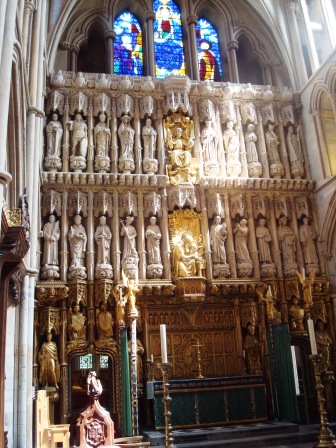
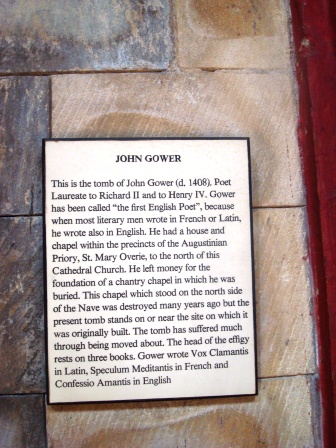
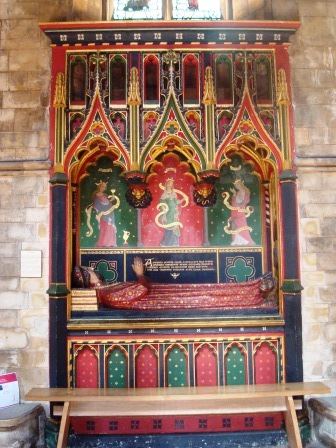
An alert reader sent me the following notice about a comment in a parish bulletin in the Diocese of Raleigh, NC, St. Mary’s in Willmington where Fr. Robert Kus.
Fourth, beginning the last Sunday of August, the diocese will host a “forma extraordinaria” Mass at 7 p.m. at St. Mary’s upon my invitation. It will occur the last Sunday of each month at 7 p.m. This Mass was common in modern times of our Church history but declined greatly when the Second Vatican Council asked us to go back to the ancient Mass, i.e., the Mass conducted in the language of the people. The forma extraordinaria Mass is a diocesan event, not a ministry of St. Mary parish. Our parish will continue to only offer the ancient form of the Mass in English and Spanish. For more information on the forma extraordinaria Mass, contact the parish in Dunn, NC.
??!?!
Let’s get this straight…
Father needs a refresher course.
On the other hand, I am glad that he has been willing to host an event for the diocese.
I had lunch today with a Dominican from a traditional community in France.
We spoke about the corona, and the communities of religious who still maintain it.
A different sort of corona…
APOD show the total eclipse last week, compliments of God and a view from Asia.

From a reader (edited):
I am at the [organized thing for seminarians] for the summer and each Friday Holy Mass is celebrated in Spanish. In my estimation, about 20-40 out of 173 seminarians here this summer spoke spanish as their mother tongue, but everyone here is fluent in English. My question is, can Mass be licitly offered in Spanish here at [organized thing for seminarians], whose working language is English? Is my interpretation of vernacular (the everyday language of the local people or institution) too strict? If I do have the correct definition of vernacular, it would seem that the only licit options here would be to celebrate Mass in Latin or English, as Spanish is not the vernacular of [organized thing for seminarians] or [this city].
Yes, I believe it would be licit to celebrate Spanish at that organized thing for seminarians in that city. It is licit also to use English. Those languages are permitted exceptions to the official language of Holy Church’s liturgy in the Latin Rite. It would also be licit to have Holy Mass in Tagalog, Hmong, or Swahili. It would be silly to have Mass in those languages for that crew, but it would be licit.
It seems to me that a more inclusive approach at this summer thing for seminarians would be to have Holy Mass in Latin. The seminarians could use whatever language resources they would need to follow and they would get some exposure to the language of their Rite. Furthermore, no favoritism would be shown to any group. Finally, I am guessing that, as seminarians, they may be a little familiar with the structure of Holy Mass. I don’t think it was be overly challenging for them to figure our what is going on.
C’mon, people. More Latin in the Latin Church, okay?
A couple related stories via CNA:
First, a few lines of this… Proposed abortion reduction bill a Planned Parenthood ‘stimulus package,’ bishops’ pro-life official says
.- An official with the U.S. bishops’ Secretariat of Pro-life Activities has attacked a federal bill promising to prevent unintended pregnancies and reduce abortions, characterizing it as a "Planned Parenthood Economic Stimulus Package." She said increased abstinence among youth, not contraceptive access, should be encouraged.
The bill, co-sponsored by Reps. Tim Ryan (D-OH) and Rosa DeLauro (D-CT), is titled "Preventing Unintended Pregnancies, Reducing the Need for Abortion and Supporting Parents Act." Its sponsors have described it as a "common ground" initiative that would appeal to people on all sides of the abortion debate.
Susan Wills, Assistant Director for Education and Outreach in the U.S. Conference of Catholic Bishops’ Secretariat of Pro-Life Activities, said the bill is "dressed up" with some funding for after-school programs and "very poorly crafted" efforts to support pregnant students.
However, she quoted Rep. Ryan’s May 19 remarks on MSNBC’s "Hardball," in which the congressman said the bill is "about access to birth control."
"We have to have birth control and contraception offered to these poor women who don’t have access to contraception, period, dot," he continued, saying there is no other way America can reduce abortions.
To this, Wills responded:
"About what you’d expect in a bill whose co-sponsors enjoy a 100% pro-choice rating from NARAL."
Read the rest at CNA. There are some good numbers and remarks.
Also, U.S. House votes down Pence Amendment intended to defund Planned Parenthood
Washington D.C., Jul 24, 2009 / 02:55 pm (CNA).- The U.S. House of Representatives has voted 247-183 against an amendment that would stop federal taxpayer funding for Planned Parenthood through the Title X Family Planning programs.
The amendment was sponsored by Indiana Republican Rep. Mike Pence. [So, Rep. Pence tried to shut down the tax money gravy train to Planned Parenthood (an industry founded by a racist to kill black children).]
"The largest abortion provider [industry] in America should not also be the largest recipient of federal funds under Title X," Rep. Pence said while introducing the amendment. His proposal would have modified H.R. 3293, the appropriations bill for the Departments of Labor, Health and Human Services, and Education.
The amendment was supported by a majority of Republicans and opposed by a majority of Democrats. [What a surprise. I wonder how the Catholic Dems voted?] According to the web site of the Clerk of the House, 20 of the 258 Democrats who voted on the Pence Amendment voted in its favor, while nine of the 172 voting Republicans opposed it.
Other pro-life amendments had been proposed but the House Rules Committee did not allow them to be considered in a full vote, LifeNews.com reports.
Prior to the vote, Rep. Chris Smith (R-NJ) spoke in favor of the amendment.
"No child is safe in a Planned Parenthood clinic. That goes equally for the preborn child yearning to be born or the 15 year old pregnant girl being told she’s entitled to a secret abortion – an abortion procured with neither her parents’ knowledge nor consent."
Rep. Smith charged that Planned Parenthood has caused "a staggering loss of children’s lives." He said the organization "aggressively lobbies and litigates against every modest restriction" proven to "significantly reduce" abortions and has even opposed bans on partial-birth abortions. [An excellent point. This is precisely what we must keep in mind when we read the rhetoric about "reduce" that comes from the White House. We must question whether or not they really mean what they say.]
"Planned Parenthood lobbies and litigates against prohibitions on taxpayer funding of abortion even though Planned Parenthood’s own research shows that funding bans reduce abortion by 20 to 35 percent," Rep. Smith said. "It’s time to understand the irreversible harm Planned Parenthood is doing to the children of America – born and unborn."
According to LifeNews.com, Planned Parenthood received more than $350 million in taxpayer money from federal, state, and local governments in fiscal year 2007-2008.
$350 million…. tax money
For more, look at this on Lifesite. Moreover, Lifesite has a PDF of the roll call on the vote about this amendment. You can see how your reps voted. Perhaps someone could tease out the Catholics.
In the meantime, back to the issue of whether the words and the actions of the Obama Administration actually match up.
From CNA:
Obama misled Pope on his abortion agenda, congressman charges
Washington D.C., Jul 20, 2009 / 01:40 pm (CNA).- In remarks on the House floor last week, Congressman Chris Smith (R-NJ) argued that President Obama purposely misled Pope Benedict XVI when he said that he “wants to reduce abortion” at their July 10 meeting. [No Chris! Say it ain’t so!]
Smith recalled the president’s statement to the Pope and pointed out that Obama has repeated it several times to different audiences. And yet, Smith charged, Obama’s actions have not aligned with his words. “He says one thing and does precisely the opposite.” [For example, at the site of C-Fam read about how Pres. Obama is throwing his administration’s weight around through UN agencies to expand abortion rights.]
Now, the New Jersey Congressman said, Obama is offering a plan for health care reform that is a thinly veiled attempt to increase access to abortion on demand. The plan would increase funding for abortions and allow abortion services to be considered part of “basic health care” required by all insurance plans, including private plans. [Does that sound like a reduction strategy to you?]
Smith pointed to information from the Guttmacher Institute, which has stated that “when taxpayer funding is not available, between 20 and 35 percent of Medicaid abortions that would have been procured simply don’t occur.”
These children go on to be born, he explained, referencing the millions of children throughout the country who are able to live their own lives and pursue their own hopes and dreams “because taxpayer subsidies didn’t effectuate their demise.”
“The ugly truth is that if his so-called health care reform care bill, if enacted, will lead to millions of additional deaths to children and millions of mothers will be wounded,” Smith said.
Rep. Smith concluded his remarks by encouraging his fellow congressmen to vote against the health care bill and insisting that “[t]here will be children who will die if this legislation becomes law simply because the subsidies are there to effectuate their deaths.”


Coat of Arms by D Burkart
 fac on Daily Rome Shot 1118 – Paddywhack!: “Speaking of the disputatio back on October 31st between Archbishop Vesco and Bishop Barron (Vesco saying the Catholic Church was…”
 on Continue the Rome shot posts? I dunno.: “Please call continue the Rome photo posts if it not too much of a burden. Thank you, Father!”
 on Daily Rome Shot 1117 – A *POLL* about 2026-27: “Sorry… my bad. It is indeed SIX. 1. Rh8+! Kxh8 2. Qh2+ Kg8 3. Qh7+ Kf8 4. Qh8+ Ke7 5.…” on Encrypted Yeast? The Fathers on “What does the “leaven” really say?” (6th Sunday after Epiphany Resumed): “I especially like St. John Chrysostom’s insight, that when we are “hidden” in the normal places we live and work,…”
 on Daily Rome Shot 1117 – A *POLL* about 2026-27: “pestolover: For what it’s worth, your solution was the best I could do also.”
 on Daily Rome Shot 1117 – A *POLL* about 2026-27: “Fr Z thanks so much for 2 reminders. 1. Using your Amazon link! For heaven’s sake it costs us nothing…”
 on 10 November – St Andrew Avellino (Vetus Ordo). Wherein Fr. Z rants.: “So interesting that you bring this up, a couple weeks ago a priest at a neighboring parish died unexpectedly. They…”

A Daily Prayer for Priests








They find you a pro-life agent in your area who commits to giving a portion of the fee to a pro-life group!

PLEASE subscribe via PayPal if it is useful. Zelle and Wise are better, but PayPal is convenient.
A monthly subscription donation means I have steady income I can plan on. I put you my list of benefactors for whom I pray and for whom I often say Holy Mass.
In view of the rapidly changing challenges I now face, I would like to add more $10/month subscribers. Will you please help?
For a one time donation...



Help Monks in Wyoming (coffee – UPDATED LINK) and Norcia (beer) and the wonderful "Soap Sisters" of Summit, NJ!


Please follow me on Twitter!










Visits tracked by Statcounter
since Sat., 25 Nov. 2006:
 Washington D.C., Jul 24, 2009 / 02:55 pm (CNA).- The U.S. House of Representatives has voted 247-183 against an amendment that would stop federal taxpayer funding for Planned Parenthood through the Title X Family Planning programs.

