QUAERITUR: choosing not to go to Sunday Mass if it is not a TLM

From a reader:

Recently, after reading this post on traditional Catholicism, I posted the link on Facebook and got into a debate with a few friends of mine.  Basically, it boiled down to the following three questions:  [there were three questions, but the second was the important one…]

2. Whether some people are dispensed from fulfilling their Sunday obligation at a Novus Ordo mass by the idea of "spiritual danger" attached to going to that rite.

A couple of my friends say yes, a couple say no.  What do you think?

I think that God cannot be fooled.

If people who are obliged are truly impeded from attending Holy Mass on a day of obligation, then they don’t sin by not attending.

There can be physical impediments (e.g., the bridge was washed out in a flood), or impediments of health (e.g., too ill to go out) or "psychic" impediments (e.g., an old person is afraid to fall on ice in the winter) or circumstantial impediments (e.g., you are traveling on a close schedule and have no idea where to go), etc.

But there are other kinds of moral impediments.  For example, say you are part of a small parish and something really bad happened with the priest or parishioners and the thought of going there is just too much, but the next parish a great distance.

Say, for example, the liturgical abuses at your parish are so bad that you simply cannot stand going and there is no place else to go within a reasonable distance.

Now… this is where things get thorny.  Some people have come to the conclusion that the Novus Ordo itself is a liturgical abuse which they cannot bear.  If they are truly convinced, based on adequate information and sound reasoning, that is one thing, but… if they are making intellectual excuses or were lazy in their choices – because they just don’t like some things that happen, that is another. 

I think some people start out disgusted at liturgical abuses they have experienced and then, slowly but surely, come to convince themselves that the problem is the Novus Ordo itself.  They harden in their position over time.  Sadly, many people who do that often don’t have the legitimate basis in fact to make such a decision in the first place, but they gradually harden their minds and hearts in it.

I say that people in this dilemma should examine their consciences and discern whether they have been just to the issues.  Deliberately choosing not to fulfill one’s obligation by refusing to attend Holy Mass, properly celebrated in an approved Rite of the Church, is a pretty serious step.

I think that God cannot be fooled.

This response is sure to bring out all sorts of knuckle-headed stuff, so I will close the combox.  People can e-mail me if they have something well-considered, measured, and respectful to contribute.
Posted in ASK FATHER Question Box |
Comments Off on QUAERITUR: choosing not to go to Sunday Mass if it is not a TLM

Davenport, IA – 13 June – Extraordinary Form workshop for laity

From a reader:

Una Voce Quad Cities is happy to announce a Workshop for the Laity in the Extraordinary Form of the Roman Rite (the “Latin Mass”), Saturday, June 13, 2009 (the feast of St. Anthony of Padua) at St. Anthony’s Church, 417 N. Main St., Davenport, Iowa 52801.

Fr. Scott Haynes, SJC, a priest of the Canons Regular of St. John Cantius in Chicago, will speak on the history and ceremony of the Roman Rite, the Divine Office, and Gregorian chant. Mass will be included in the schedule, and we will conclude the day by singing the short mid-afternoon service of None in Latin according to the traditional Gregorian Chant melodies.

To register for this event, visit the following link, call 1-800-838-3006 (When you call request the “Workshop for the Laity”).

Posted in SESSIUNCULA |
4 Comments

The accelerating exclusion of God from the public square

Are you a citizen of the United States of America?

Are you irritated by the erroneous claims made about the separation of Church and state used to justify the total exclusion of references to God (at least in a Judeo-Christian manner) from the public square?

Take a look at this…

Do you know the Preamble for your state? . .

  • Alabama 1901, Preamble We the people of the State of Alabama , invoking the favor and guidance of Almighty God, do ordain and establish the following Constitution..
  • Alaska 1956, Preamble We, the people of Alaska , grateful to God and to those who founded our nation and pioneered this great land.
  • Arizona 1911, Preamble We, the people of the State of Arizona , grateful to Almighty God for our liberties, do ordain this Constitution…
  • Arkansas 1874, Preamble We, the people of the State of Arkansas , grateful to Almighty God for the privilege of choosing our own form of government…
  • California 1879, Preamble We, the People of the State of California , grateful to Almighty God for our freedom…
  • Colorado 1876, Preamble We, the people of Colorado , with profound reverence for the Supreme Ruler of Universe…
  • Connecticut 1818, Preamble. The People of Connecticut, acknowledging with gratitude the good Providence of God in  permitting them to enjoy.
  • Delaware 1897, Preamble Through Divine Goodness all men have, by nature, the rights of worshipping and serving their Creator according to the dictates of their consciences.
  • Florida 1885, Preamble We, the people of the State of Florida , grateful to Almighty God for our constitutional liberty, establish this Constitution…
  • Georgia 1777, Preamble We, the people of Georgia , relying upon protection and guidance of Almighty God, do ordain and establish this Constitution…
  • Hawaii 1959, Preamble We , the people of Hawaii , Grateful for Divine Guidance … Establish this Constitution.
  • Idaho 1889, Preamble We, the people of the State of Idaho , grateful to Almighty God for our freedom, to secure its blessings.
  • Illinois 1870, Preamble We, the people of the State of Illinois, grateful to Almighty God for the civil , political and religious liberty which He hath so long permitted us to enjoy and looking to Him for a blessing on our endeavors.
  • Indiana 1851, Preamble We, the People of the State of Indiana , grateful to Almighty God for the free exercise of the right to choose our form of government.
  • Iowa 1857, Preamble We, the People of the State of Iowa , grateful to the Supreme Being for the blessings hitherto enjoyed, and feeling our dependence on Him for a continuation of these blessings, establish this Constitution.
  • Kansas 1859, Preamble We, the people of Kansas , grateful to Almighty God for our civil and religious privileges establish this Constitution.
  • Kentucky 1891, Preamble.. We, the people of the Commonwealth are grateful to Almighty God for the civil, political and religious liberties..
  • Louisiana 1921, Preamble We, the people of the State of Louisiana , grateful to Almighty God for the civil, political and religious liberties we enjoy.
  • Maine 1820, Preamble We the People of Maine acknowledging with grateful hearts the goodness of the Sovereign Ruler of the Universe in affording us an opportunity .. And imploring His aid and direction.
  • Maryland 1776, Preamble We, the people of the state of Maryland , grateful to Almighty God for our civil and religious liberty…
  • Massachusetts 1780, Preamble We…the people of Massachusetts, acknowledging with grateful hearts, the goodness of the Great Legislator of the Universe In the course of His Providence, an opportunity and devoutly imploring His direction 
  • Michigan 1908, Preamble.   We, the people of the State of Michigan , grateful to Almighty God for the blessings of freedom, establish this Constitution.
  • Minnesota, 1857, Preamble We, the people of the State of Minnesota, grateful to God for our civil and religious liberty, and desiring to perpetuate its blessings:
  • Mississippi 1890, Preamble We, the people of Mississippi in convention assembled, grateful to Almighty God, and invoking His blessing on our work.
  • Missouri 1845, Preamble We, the people of Missouri , with profound reverence for the Supreme Ruler of the Universe, and grateful for His goodness . Establish this Constitution…
  • Montana 1889, Preamble. We, the people of Montana , grateful to Almighty God for the blessings of liberty establish this Constitution .
  • Nebraska 1875, Preamble We, the people, grateful to Almighty God for our freedom . Establish this Constitution.
  • Nevada 1864, Preamble We the people of the State of Nevada , grateful to Almighty God for our freedom, establish this Constitution…
  • New Hampshire 1792, Part I. Art. I. Sec. V Every individual has a natural and unalienable right to worship God according to the dictates of his own conscience.
  • New Jersey 1844, Preamble We, the people of the State of New Jersey, grateful to Almighty God for civil and religious liberty which He hath so long permitted us to enjoy, and looking to Him for a blessing on our endeavors.
  • New Mexico 1911, Preamble We, the People of New Mexico, grateful to Almighty God for the blessings of liberty..
  • New York 1846, Preamble We, the people of the State of New York , grateful to Almighty God for our freedom, in order to secure its blessings.
  •   North Carolina 1868, Preamble We the people of the State of North Carolina, grateful to Almighty God, the Sovereign Ruler of Nations, for our civil, political, and religious liberties, and acknowledging our dependence upon Him for the continuance of those…
  • North Dakota 1889, Preamble We , the people of North Dakota , grateful to Almighty God for the blessings of civil and religious liberty, do ordain…
  • Ohio 1852, Preamble We the people of the state of Ohio , grateful to Almighty God for our freedom, to secure its blessings and to promote our common.
  • Oklahoma 1907, Preamble Invoking the guidance of Almighty God, in order to secure and perpetuate the blessings of liberty, establish this
  • Oregon 1857, Bill of Rights, Article I Section 2. All men shall be secure in the Natural right, to worship Almighty God according to the dictates of their consciences
  • Pennsylvania 1776, Preamble We, the people of Pennsylvania, grateful to Almighty God for the blessings of civil and religious liberty, and humbly invoking His guidance….
  • Rhode Island 1842, Preamble. We the People of the State of Rhode Island grateful to Almighty God for the civil and religious liberty which He hath so long permitted us to enjoy, and looking to Him for a blessing…
  • South Carolina, 1778 Preamble We, the people of the State of South Carolina grateful to God for our liberties, do ordain and establish this Constitution.
  • South Dakota 1889, Preamble We, the people of South Dakota , grateful to Almighty God for our civil and religious liberties ..
  • Tennessee 1796, Art. XI..III. That all men have a natural and indefeasible right to worship Almighty God according to the dictates of their conscience…
  • Texas 1845, Preamble We the People of the Republic of Texas , acknowledging, with gratitude, the grace and beneficence of God.
  • Utah 1896, Preamble Grateful to Almighty God for life and liberty, we establish this Constitution.
  • Vermont 1777, Preamble Whereas all government ought to enable the individuals who compose it to enjoy their natural rights, and other blessings which the Author of Existence has bestowed on man ..
  • Virginia 1776, Bill of Rights, XVI Religion, or the Duty which we owe our Creator can be directed only by Reason and that it is the mutual duty of all to practice Christian Forbearance, Love and Charity towards each other
  • Washington 1889, Preamble We the People of the State of Washington, grateful to the Supreme Ruler of the Universe for our liberties, do ordain this Constitution
  • West Virginia 1872, Preamble Since through Divine Providence we enjoy the blessings of civil, political and religious liberty, we, the people of West Virginia reaffirm our faith in and constant reliance upon God …
  • Wisconsin 1848, Preamble We, the people of Wisconsin, grateful to Almighty God for our freedom, domestic tranquility…
  • Wyoming 1890, Preamble We, the people of the State of Wyoming , grateful to God for our civil, political, and religious liberties, establish this Constitution…

Posted in SESSIUNCULA |
41 Comments

QUAERITUR: moving up the age of (Latin Rite) confirmation

QUAERITUR: moving up the age of (Latin Rite) confirmationFrom a reader:

A bit related to your post about seeking Confirmation from another diocese, I was wondering what you thought of seeking out the sacrament of Confirmation for my children before they receive Holy Communion for the first time. 

As I understand it, Holy Communion traditionally stood as the culmination of the process of entering the Church.  Baptism – Confirmation – Holy Communion.  Indeed, that’s the order of reception at the Easter Vigil and, I think, is the way those three sacraments are presented in the Catechism of the Catholic Church.  With the movement of the reception of Holy Communion for the first time to an earlier age (by Pius X, I believe), was there any intention to also move Confirmation to a correspondingly earlier age?  If not, would it be recommended/proper/pious to seek out Confirmation before First Holy Communion?


In the ancient Church and still in the Eastern Churches, those entering the Church would receive all three sacraments of "initiation".  Thus, even the very young, even infants were confirmed.

When the numbers of people to be "initiated" became too great for the lone bishop to handle everyone, practical solutions were adopted and the sacraments were separated.

In the Latin Church we have been separating Baptism, Confirmation and Communion for quite some time now.  The age of Communion has been moved to the "age of reason", to be be determined primarily by parents in consultation with their pastor.

The age of Confirmation has been pushed later and later.  The 1983 Code of Canon Law c. 891 sets the age for Confirmation "at about the age of discretion unless the conference of bishops has determined another age … ".   In the USA the Latin Rite bishops set the age for Confirmation at between the age of discretion (considered to be about age seven) and "about sixteen years of age."

Many people argue that late teens is too late for the sacrament.  They think it should be earlier.   The idea is that the sacrament of Confirmation, the strengthening it gives, is really needed before the turbulent years of adolescence. Canon Law supports this possibility, but the local bishops conference might have set other guidelines.

I don’t see why there could not be an exception, but it seems to me that this should be worked out carefully with your pastor and, perhaps, with the bishop who would confirm.

So, unless you really have a compelling reason to do otherwise, how about following the directives of the bishops according to the program your pastor determines? 

In the meantime, form your children well!  Giving them the gift of Faith, the Faith in which we believe, will make their deepening of the Faith by which we believe that much richer and effective in their lives.  This is your honor and duty.

Posted in ASK FATHER Question Box |
40 Comments

Garabandal visionary Mari Loli, RIP

The Garabandal visionary Mari Loli Lafleur has died in Boston after a long illness.

Garabandal still does not have approval of the Holy See.

Requiescat.
 

Posted in SESSIUNCULA |
13 Comments

Consecration of Mexico to the Holy Spirit

Read this with three points in mind.

1) Pope Benedict has a project for his pontificate to reinvigorate our Catholic identity so that we both can be better Catholics on the road to salvation and also contribute effectively to the public square.

2) Years ago at a conference of the Catholic Press Association, I heard a keynote speech by Card. George.  He explained that the real work of a Catholic journalist is not so much to report on what priests, bishops and Pope’s do, as to report on the workings of grace amongst God’s people. Card. George explained that to recognize the workings of grace, you must be in the state of grace.

3) Our Lady of Fatima asked that Russia be consecrated by the Pope and all the bishops to her Immaculate Heart.   I suggest that this is a

I read this in CNA.

Bishops consecrate Mexico to the Holy Spirit

Mexico City, Mexico, Apr 22, 2009 / 09:44 am (CNA).- In the Mass opening its 87th Plenary Assembly, the Bishops’ Conference of Mexico consecrated the nation to the Holy Spirit and prayed that the Spirit would help the country to “rebuild and strengthen the social fabric.”
 
Leading the more than 120 bishops gathered for the meeting, conference president Archbishop Carlos Aguiar Retes said, “The presence of evil in the history of humanity has always been repetitive and cyclical, enveloped in tragedy and drama, in struggle and ambition, over and over again the law of the survival of the fittest is imposed and the dignity of the human person is easily trampled underfoot.”
 
The archbishop called the meeting of the bishops “historic” and an effort to survive the violence which has overtaken the country.  “The Bishops are convinced that [watch this] the Catholic Church in Mexico must intensify her positive presence in society in order rebuild and strengthen the social fabric (…). We are aware that such a task is only possible through the gift of the Holy Spirit,” he said.  [And there is something else very important that must be done.]
 
The Archdiocese of Mexico City reported that Archbishop Aguiar has set Pentecost Sunday, May 31, as the day on which each diocese in the country will consecrate its own particular Church to the Holy Spirit, as was done in 1925 amidst the difficulties and persecution of the Cristeros War.


This is an excellent initiative.

I would add that the next step should be a comprehensive renewal of the Church’s sacred liturgy, especially along the lines the Holy Father has indicated both in his own liturgical theological writings and in his actions as Successor of Peter.

Posted in SESSIUNCULA |
14 Comments

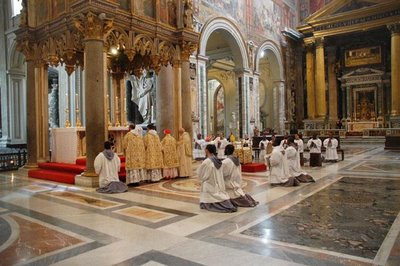
Lateran – Cañizares – TLM – Brick By Brick

Once upon when a Cardinal celebrated Holy Mass in one of the Roman Major Basilicas at the Papal Altar it was a special event.  Only the Pope could celebrate at those altars.  A special bull from the Pope had to be posted above the altar to show that he had permission.

These days it is not so special anymore to see a Cardinal celebrating at those altars. 

But it is special when that Cardinal is pontificating in the fullness of the traditional Roman Rite.

This morning, Antonio Card. Cañizares Llovera, Prefect of the Sacred Congregation for Divine Worship, celebrated Pontifical High Mass in the older, traditional use at the Archbasilica of St. John Lateran.  The ceremonies were handled by the the Franciscan Friars of the Immaculate.

That makes two times in one week the older Mass has been celebrated in the Lateran Basilica. 

The eye-candy specialists will have more images, but this one struck me.

Lateran - Cañizares - TLM - Brick By Brick

It had to start slowly, folks. 

Posted in Brick by Brick |
23 Comments

St. Anselm – 900 years

Today is the 900th anniversary of the death of St. Anselm.

His feast day coincides in both the traditional and post-Conciliar calendar.

Posted in SESSIUNCULA |
9 Comments

NatRev: Fr. Sirico on Pres. Obama at Georgetown

From National Review comes this piece by Fr. Robert Sirico of the Acton Institute.

My emphases and comments.

The Catholic Identity Crisis
What the Georgetown and Notre Dame controversies reveal.

By Rev. Robert A. Sirico

In his speech this week at Georgetown University, President Obama made an interesting comment about economics. “We cannot rebuild this economy on the same pile of sand,” he said. “We must build our house upon a rock.”

I doubt that anyone would accuse him of plagiarism, [Unlike V.P. Biden, who receives an award at Georgetown tomorrow…. but I digress…] but what he was quoting came from Jesus’s parable. The man who built his house on sand paid a price when the winds took it down, while the man who built his house on stone saw it withstand the storm.

It is quite appropriate that a parable was quoted at a Catholic university founded by Jesuits. The entire campus is filled with religious symbolism. Crucifixes, statues of Mary, and other religious items are everywhere, revealing the rich tradition here.

Oddly, however, although the president didn’t mind quoting Jesus without credit, [People will generally recognize a parable of Jesus.] his advance team insisted that all religious symbols be covered in the place in which he was speaking. Incredibly, Georgetown officials complied. [That is what I found so disturbing, not that the Obama administration would ask, but that Jesuists would comply!] At the request of the White House, officials at the university placed cover over the letters IHS — the Greek abbreviation for the name of Jesus.

This incident followed the uproar over Obama’s planned speech at Notre Dame, at which he will be given an honorary doctorate. The Notre Dame development department reports widespread anger at the decision to invite him.

Now, if I were a conspiratorial sort of thinker, which I am not, [A common rhetorical tool…] I might suspect that Obama is deliberately trying to divide Catholics. But this is not a conspiracy. Obama is merely capitalizing on a cultural shift that has been in process for a long time. Over the last half century or so, Catholics have undergone a kind of psychological development, moving from the embattled and impoverished immigrant class, unsure of their own status in a hostile culture, to founding their own institutions, serving their country, and becoming as successful as any WASP capitalist in getting their share of the American Dream.

So complete has been this assimilation that on almost any matter of public-policy or lifestyle choices, Catholics are indistinguishable from other Americans.  [Now… here it comes!] Until, that is, one looks at those who regularly practice their faith as compared with those who have a nominal commitment that amounts to showing up to say hello or goodbye at baptisms and funerals, as Jacqueline Kennedy once put it.

If this thesis is correct, then it is not far-fetched to assert that nominal Catholics are in the midst of an identity crisis.  [Not far-fetched at all!  I have been talking about Pope Benedict’s "Marshall Plan" till I am blue in the … fingers…] They are embarrassed by the distinctiveness of their more faithful brethren  [Good point!] who observe fast days, don’t approve of abortion, think marriage is what their grandparents thought it was, and hold conservative views on the other hot-button issues that Catholics in public life frequently get asked about by reporters.

Of course, nominal Catholics would deny such an identity crisis. [They too are like people who build their houses on sand.] We simply believe in a pluralistic and tolerant society, they would insist.  [Watch this…] But if the Georgetown episode doesn’t reflect an identity crisis — the religious family that was once the Church’s leading defender blots out their name (Jesuit) and their historic inspiration (Jesus) — then what does?  [Indeed.]

Think of it: A Catholic university was willing to cover up the name of Jesus, hide it from the cameras, because the president of the United States was coming and asked them to do so. The fact alone gives me chills.

At the root of tolerance is the notion that one is permissive, not about one’s own beliefs, but about the beliefs of those with whom one disagrees. If you do not know who you are and what you hold to be true, you cannot be tolerant.  [Very good.]

We have come to the point that the most significant contribution Georgetown or Notre Dame could make to society’s diversity [which is a cherished goal of those who embrace relativism, right?] would be to become, once again, Catholic — and not be embarrassed about it. The Church in general and the Jesuits in particular have in their own history heroic examples of martyrs refusing to submit to secular authority and dying for the faith (such as Edmund Campion, S.J., at the hands of Elizabeth I). The least these campus authorities can do is not take active measures to undermine their own identity.

— Father Robert A. Sirico is president and co-founder of the Acton Institute.


Bingo.

If the Georgetown episode doesn’t reflect an identity crisis, then what does?

Posted in SESSIUNCULA |
33 Comments

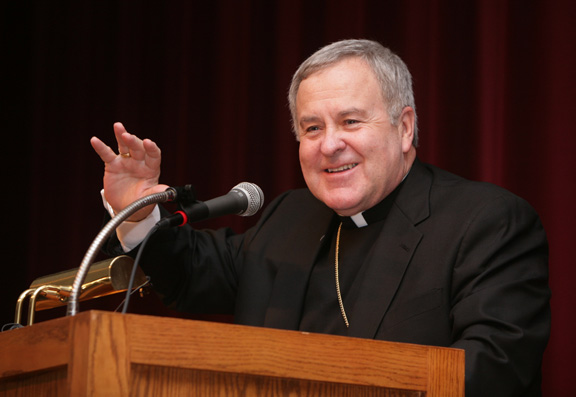
Archbp. Carlson in St. Louis

Some photos of Archbishop Carlson are available.

Archbp. Carlson in St. Louis

Posted in SESSIUNCULA |
32 Comments