QUAERITUR: How early can the Easter Vigil begin?

From a reader:

There is a parish in our diocese that is advertising (in the bulletin and even in the diocesan paper) a 4:00 p.m. Easter Vigil.  Are there ANY circumstances which allow for such an exception to the rule that the Easter Vigil may not begin until after sundown?  

I seem to remember a clarification from Rome which stipulated that beginning an Easter Vigil at the same time as anticipated Masses is "reprehensible."

I cannot think of any exceptions.  Given the time of year and daylight savings time) 4:00 pm is simply too early.  It is still too light out.

Since this night is the most important of the year, you want to get it right.  Right?

That includes the time when the rite is to begin.  

The symbolism of the light in darkness is important to the meaning of the rite.  And the purpose of our liturgical rites is to have an encounter with mystery.  The signs and symbols are important.

This Vigil (which is by definition a nighttime action) is not to normal "vigil" celebrated in anticipation of a Sunday or Holy Day.  It has a unique character in the whole liturgical year.

The rubrics for this rite, as found in the 2002MR says this is "nox", night.

3. Tota celebratio Vigliae paschalis peragi debet noctu, ita ut vel non incipiatur ante initium noctis, vel finiatur ante diluculum diei dominicae.   The whole celebration of the Paschal Vigil ought to be completed at night, both so that it does not begin before the beginning of night, or and that it finishes before dawn of Sunday.

As your Lewis & Short Dictionary will indicate perago is "to complete", in other words, "to get through it".  Vel…vel… is the equivalent of et… et..

To repeat: the Vigil is to

a) gotten through entirely during nighttime
b) begun after nightfall
c) complete before dawn

Also,

4. Missa Vigiliae, etsi ante mediam noctem celebratur, est Missa pachalis dominicae Resurrectionis.   The Mass of the Vigil, even celebrated before midnight, is the Easter Mass of the Lord’s Resurrection.

In most cases you don’t have to say that a vigil Mass is for the following Sunday.  But the unique character of the Rite, different from the Sunday morning Mass, needs to be clarified.  Also, the time midnight is explicitly mentioned.  This is the traditional time to begin the Vigil Mass rites.

Also, 1988 Circular of the CDWDS called Paschale solemnitatis dealt with the time of the beginning of the Vigil,

78. This rule is to be taken according to its strictest sense. Reprehensible are those abuses and practices which have crept in many places in violation of this ruling, whereby the Easter Vigil is celebrated at the time of day that it is customary to celebrate anticipated Masses.

I suppose we can drill into initium noctis.

This is the time with daylight is no longer visible. It is after nightfall.  The Jews made all sorts of distinctions about sundown and twilight and night.  So do we when considering liturgical times.

The earliest time we can start the Vigil is initium noctis.   What does this mean?

QUAERITUR: How early can the Easter Vigil begin?I think it is when sunlight is no longer part of the illumination of the sky: nightfall. 

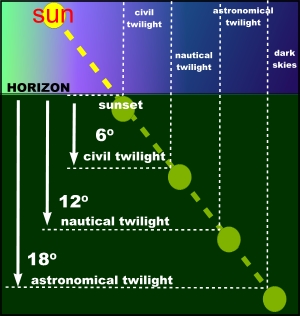
Sunset is when the upper edge of the sun finally sinks the horizon.  This is what the Jews called sunset.  There there is "civil" twighlight, that is, when the sun’s center is 6 degress below the horizon.  Of course there is still a lot of light from the sun in the sky at that time.  For Jews the evening twilight lasted until a few stars appeared.  Then it was night.  They had to figure these things out so that they knew, for example, how far they could walk to get to places, etc., before the sabbath fell.

We can go by that, but perhaps more helpful in this day of astronomical precision and electric lights is to go by astronomical twilight.  This is, techincally, when sunlight is not longer illuminated the sky.  That is a fancy way of saying: it’s night.


QUAERITUR: How early can the Easter Vigil begin?Astronomical twilight is helpful because we can use the calculations of, for example, the Naval Observatory to figure out with astronomical twilight takes place. 

Your nightfall (astronomical twilight) will be a little different depending on your location (latitude and longitude, etc). 
QUAERITUR: How early can the Easter Vigil begin?
Let’s say you are in the umbilicus mundi, where I was born, Minneapolis, MN.   You summon a chart for Minneapolis and find the beginning of astronomical twilight for 11 April.  2040h + 0100h for daylight savings.

In Vatican City (41° 54′ 10.8″ N, 12° 27′ 7.2″ E) it would be 2026h. + 0100h for daylight savings.

Okay, clearly it is the Church’s intention that the rites begin when it is dark.  There can be a little flexibility.  There might still be traces of twilight but it would be black in church with the lights out, etc. 

The point is: let there be darkness!

So… if by 4:00 pm where you are night has fallen, fine!  Start the Vigil Mass.  If not, then 4:00 pm is too early.  And, given how important the Vigil is, it is a grave liturgical abuse to begin Mass at 4:00 pm.

Perhaps the local bishop should be invited to attend, given that the rite will be over before the real time to begin comes around!  Surely, His Excellency will have time!

Posted in "How To..." - Practical Notes, ASK FATHER Question Box, SESSIUNCULA |
53 Comments

N. Gingrich talks about his conversion

Watch Fox News Sunday with Chris Wallace for this Sunday when you can.

At the end of the second block, toward the bottom of the hour, Chris Wallace asked Mr. Gingrich why he converted to Catholicism last Sunday.

Gingrich responded well and clearly. 

Two interesting points were the role of Pope Benedict’s visit to the USA.

Also, Wallace asked Gingrich if, since he had been married and divorced, he can receive Holy Communion.  Gingrich responded that over the last 10 years they had done everything according to Church law that was necessary to be done and that, yes, he could receive Communion.

WDTPRS congratulates Mr. Gingrich.

Also, during the interview itself Gingrich brought up the 1977 commencement speech Pres. Carter gave at… Notre Dame.

That was block worth watching.

Posted in SESSIUNCULA |
Comments Off on N. Gingrich talks about his conversion

QUAERITUR: Latin examination of conscience

From a reader:

I am looking for "examen conscientiae" in Latin, but I cannot find anything suitable for la layperson. The only one I found so far is in the book "Manuale sacerdotum" by  Joseph Schneider (availabe in Google Books), but it is tailored toward priests. Do you know of any detailed examination of conscience in Latin, suitable for laypeople?


Sincerely, I cannot see why an examination of conscience in Latin would be that useful unless your Latin is so good that there is nothing of the "intellectual exercise" in it.

What is the point of an examination of conscience?  Truly?  Why do such a strange thing?

Because when you get into the tribunal which is the confessional, you are your own prosecutor.   You expose all your mortal sins in number and kind.

There isn’t really time to screw around with gimmicks at that point. 

That said, maybe someone has a Latin examen. 

I know that there are a couple in the Latin edition of the Ordo Paenitentiae published by the Vatican.

Posted in ASK FATHER Question Box |
22 Comments

Clevelend, OH: Miracle for John Paul II’s Beatification?

From CNA:

‘Miraculous’ recovery from ‘non-survivable’ gunshot wound could beatify Pope John Paul II

Cleveland, Ohio, Apr 4, 2009 / 01:55 pm (CNA).- A man who suffered a "non-survivable" execution-style gunshot to the head during a mugging in Cleveland has had a "miraculous" recovery possibly due to the intercession of Pope John Paul II. If the late pontiff is credited for the miracle, it would lead to his beatification.  [This from the beginning reminds me of some of the amazing stories I read when I was doing the Studium at the Cong. for Causes of Saints.  Amazing and inexplicable things.  Amazing.]

Jory Aebly, 26, suffered the gunshot would five weeks ago. Doctors at the Metro Health Medical Center declared it to be a "non-survivable" injury, ABC’s Good Morning America reports.

Hospital chaplain Fr. Art Nedeker administered Aebly with the Sacrament of the Sick, asking Pope John Paul II to pray for Jory and to protect him.  [This is an important element: There has to be a specific intention to pray for the intercession through that specific person.  This usually requires the suggestion and prompting of someone who knows about the cause and then how to report it.]

Fr. Nedeker explained that the Pope had promised him [!] he would always pray for the patients at the hospital and blessed a dozen rosaries with special patients at the hospital.

The priest gave Aebly the last of the rosaries [This is sounding to me more and more to a serious cause for a miracle.] that had been blessed by the Pope, after which Aebly consistently improved.

He was released on Tuesday, two days before the fourth anniversary of Pope John Paul II’s death.

Dr. Robert Geertman, a neurosurgeon involved in Aebly’s treatment, told Good Morning America his patient’s survival was "one in a million."

"My jaw was on the floor after a day or two of seeing he is hanging on. …I’d say it’s pretty miraculous," he said at a press conference days after the shooting.

At the press conference announcing Aebly’s release, Fr. Snedeker said:

"I stand before you today and can say, to my mind, Jory is a miracle."  [At the level of the Congregation all the medical records would be reviewed.]

Aebly himself credited his recovery to "the many prayers from family, friends and co-workers" and others.

His mother Deb Wolfram told the press conference she believes in "the power of prayer" and said she believed people’s prayers helped her son through his ordeal, Good Morning America says.

A Vatican official reported that the investigation into the alleged miracle could take time.  [Of course!]

"We cannot predict a precise schedule," Monsignor Angelo Amato, prefect of the Congregation for the Caucus [Iowa, here we come!] of Saints told ANSA. "All stages, including the examination of the miracle, have to be conducted in a particularly thorough way."

Approval of the miracle could lead to Pope John Paul II’s beatification, leaving one more miracle before he can be canonized.


Here is what happens.

When people think there was a verifiable miracle, they start a cause, like a court case.

All the "proofs" must be gathered… documents and testimony gathered according to a procedure.

Once everything is gathered in the place where the alleged miracle occured, it is sent to Rome.

The Congregation verifies that the procedures were followed correctly.  Then they look at the theological aspects of the claim: can it be demonstrated that the people prayed to X or asked for a miracle through X, etc.  It has to be explicit and not just mixed in with "Jesus, Mary, Joseph and X, Y, Z all the saints and angels!"  Often there is an image or relic or project to pray to X. 

In the case of a cure (there are other kinds of miracles too!) the healing or change in condition must be sudden, complete and lasting.  That must be demonstrated by proofs.  The medical records are studied by a panel of doctors and other necessary experts.  They look into the diagnosis and prognosis and then what happened in stark scientific terms.  They determine if what happened can be explained by the science they know.

With a miracle, the Congregation has to look at the evidence and then determine that what happened. within moral certitude, through the intercession of X, the condition was grave/dire/serious and there was a sudden complete and lasting change that cannot be explained.

What I like about this case is that there was a priest who knew what was going on and there was an object associate with John Paul II and his own remark.  The person’s prognoss was very bad and the healing was sudden and complete and seems to be lasting and they can’t explain it.

Posted in Just Too Cool, SESSIUNCULA |
57 Comments

QUAERITUR: Music just not right for Mass. What to do?

From a reader:

The director of music (and Liturgy, sigh)  at our parish, a woman with an incredible voice, learned a contemporary song several years ago which she and a male member of the choir sing together whenever possible.  If there is any mention in the gospel about the poor, or the outcast, I brace myself, because I know this song will be performed.  Yes, performed.  The choir sings oooh ooooh parts throughout.

There’s a hungry one, living on the street.
There’s a lonely one, with no food to eat

All of these are My people (whoo whoo hoo) All of these are My beloved All of these, are Me.

Evicted, illegal, unwanted, diseased, dif-fer-ent….

The hungry
The Lonely
The forgotten
The neglected
The abandoned
The invisible
The battered
The Frightened
The hopeless
The dying…

All of these are Me.

Sorry I can’t remember it exactly, but you get the picture.

It’s a beautiful song in its own way, but it totally rubs me the wrong way at Mass.  Am I being unreasonable about this song?  It seems very protestant, almost secular, more like a hymn of social work for a Habitat for Humanity work crew.

What do you suggest to get her to stop singing this song?

In the days of Vaudeville, they used to use a looooong hook.

Seriously, the first point one must consider is how the song, any song, is appropriate for the liturgy.

The Church says that music is an "integrating part… pars integrans" in the liturgy.  It is not an add on.  It is liturgy.

Thus, are the texts sacred and liturgically appropriate?  To the day… to the occasion? To the season?

The Church gives us the texts for those times when there is liturgical music to be sung: Introit, Gradule/Alleluia/Tract Offertory Communion.   They are sacred texts chosen by the Church for that moment on that day. 

They must be urged to think about the importance of the liturgical season and the day, consider the actual texts and whether their music choices have ANYTHING to do with the Church’s liturgy.

Beyond that, you can talk to the pastor and be willing to get involved with the music at church.

You can’t just lob comments.  You must be willing to get involved somehow.

Perhaps others will have had experience in their own parishes and will have tips about how to change music around… diplomatically.

Posted in ASK FATHER Question Box |
27 Comments

Archd. of Manila’s “Clarification” about Summorum Pontificum

You will recall that His Eminence the Archbishop of Manila, Card. Rosales, had originally imposed severe restrictions on the provisions enacted by the Supreme Pontiff in Summorum Pontificum.

Those restrictions were so clearly out of step with the Church’s law and the intent of the Motu Proprio that Card. Castrillon, President of the Pontifical Commission "Ecclesia Dei", intervened to explain the situation to Card. Rosales.

Now the Archdiocese of Manilia as a new page on its website with a "Clarification" about Summorum Pontificum.

Let’s look at it with my emphases and comments.

 Episcopal Commission on Liturgy
Catholic Bishops’ Conference of the Philippines

 Clarifications on Summorum Pontificum

Pope Benedict XVI published the Apostolic Letter Summorum Pontificum on July 7, 2007 with effectivity on September 14, 2007. The Episcopal Commission on Liturgy received several requests to clarify certain issues [that’s one way to put it] regarding its contents and implementation.

    * What is the aim of the Apostolic Letter?

The Apostolic Letter was published to seek “interior reconciliation in the heart of the Church”, that is, with those who still adhere to the Missal of Pius V. It is also a reaction to what is perceived as “abuses” in the celebration of the Mass after Vatican II.  [Several things.  First, this is an attempt to place the people who "still" adhere, benighted as they are, in a time frame so far in the past ("Pius V") that they cannot be considered normal.  Second, it think this Clarification suggested that the Pope is a "reactionary".  Third, there are more than "perceived ‘abuses’" going on.  Fourth, the MP is not simply about abuses.  It is about restoring to a place a dignity sacred rites of Holy Church where were never abrogated.  The Pope is working through these provisions not to throw a sop to the abnormal, or to reconcile groups, but to reconcile a vast rupture in the identity of the mainstream Church.]

    * Are there now two rites of the Roman Missal?

Summorum Pontificum distinguishes two forms of celebrating the one and the same Roman Rite, namely, “forma ordinaria” and “forma extraordinaria”. The ordinary form is the 1970 Missal of Pope Paul VI revised by authority of Vatican II. The extraordinary form is the Tridentine Missal [Well.. not really "Tridentine", but let that pass.  However, the fact that it is called "Tridentine" here suggests to me that the person who drafted this has not been keeping up on his reading about these issues.] published in 1962 by Pope John XXIII.

    * What would be an implication of the “forma extraordinaria” of the Roman Missal?  [What sort of question is this?]

The hermeneutics of continuity means that the 1970 Missal is a Vatican II revision of the Tridentine, [?] while the hermeneutics of legitimate progress could justify the inclusion of inculturated liturgies as other extraordinary forms of the same Roman Rite.   [HUH?  What the…!  The writer has taken this opportunity to interpolate something that is his own pet project.  He creates a term "hermeneutics of legitimate progress" and places it together with something the Pope proposed.  He is trying to instrumentalize the MP for his own purposes.  First, the "hermeneutics of continuity" is not a phrase that appears in Summorum Pontificum.  It is extrapolated as a conclusion from remarks made by Pope Benedict in Dec. 2005 to the Roman Curia.  But what Pope Benedict was talking about with his explication of a "hermeneutic of discontinuity and rupture" as opposed to a "hermeneutic of reform" (e.g., "hermeneutic of continuity") has far greater implications than a singular application to the Missale Romanum.  The writer introduces a third idea and tries to blend it into the Popes proposition. This is what the writer did: Since the Missal of Pius V is culturally circumscribed, and since we have two forms of the Roman Rite, we can therefore justify any number of forms of the Roman Rite, each inculturated according to its own cultural circumscriptions.  This is claimed to be an "implication" of Summorum Pontificum.   This is absurd.  I could go on, but you get the point.]

    * What are some of the important conditions for celebrating according to the 1962 Missal?

Those who wish to celebrate it should possess “a certain degree of liturgical formation and some knowledge of the Latin language”. Furthermore, the Missal to be used should be the 1962 edition.  [This insistence on 1962 supports what I said earlier about the reference to "Pius V".] It is important to remember that the 1962 Missal requires the use of the Latin language (except for the readings and the homily), particular liturgical furnishings, vestments, books, and liturgical calendar. [So… you can use vernacular readings and the new calendar.] Lastly, in order to be in full communion with the Church, priests who celebrate according to the 1962 Missal must, as a matter of principle, accept the validity of the 1970 Missal.

    * What other liturgical rites are included in the permission?

Besides the 1962 Roman Missal, permission is granted to use the other Tridentine Rituals of baptism, confirmation, marriage, penance, anointing of the sick, funerals, and the Roman Breviary. The Apostolic Letter excludes the Easter Triduum [Umm…. it doesn’t exclude the Triduum.  The MP mentions the Triduum in Art. 2, which begins, "Art. 2  In Masses celebrated without the people….". 
Clearly in those places where the EF is celebrated with people it is possible to have the Sacred Triduum with the older Missal.  This is in fact being done around the world.  Furthermore, the Holy Father would not have bothered to alter a prayer for Good Friday if the texts for the Triduum were not to be used.]
and is silent about holy orders.  [It is silent about Holy Orders.  But Bishops can use the Pontificale Romanum for consecration of churches and for confirmations, etc.  A bishop could chose to use it for Holy Order too, right?]

    * How about the seminaries?

Summorum Pontificum does not directly address the question of celebrating the Tridentine Missal in seminaries.  [It is silent.  However, if there are two forms of the Roman Rite, then priests of the Roman Rite should know those forms.  You can bet seminarians will be pressed to know the "inculturated" forms.  If that is the case, by the writer’s argument above, they must be trained in the two formal forms of the Rite.  Futhermore, the PCED has expressed that seminaries must train seminarians.  I also remind everyone that the 1983 CIC requires that all seminarians be very well trained in Latin.]

    * What is the responsibility of parish priests?

In parishes, where a stable group of the faithful adheres to the 1962 Missal, [I thought it was the missal of "Pius V"…] the parish priest should willingly accept their request. Such Mass maybe [sic] celebrated on weekdays, and once on Sundays and feast days. [Actually, it can be celebrated more than once, provided that adequate celebrations of the Novus Ordo are available for those who prefer to attend them.] The Ordinary shall determine what a “stable group” consists of.   [Oh?  Says who? This little phrase effectively reduces the provisions of the Supreme Pontiff to what the local ordinary wants to do.  He is therefore ready to implement the 1988 MP Ecclesia Dei adflicta but not Summorum Pontificum.]

    * What is the responsibility of bishops?  [It is not the responsibility of the local ordinary to determine what a stable group is….]

If a parish priest fails to satisfy the request for Tridentine Mass, the faithful that request it should inform the Ordinary. If he himself cannot satisfy the request, he should [must] refer the matter to the Pontifical Commission Ecclesia Dei. Furthermore the Ordinary may [Interesting how this shifts from "responsibility" to "may".] establish a personal parish where the Tridentine rituals may be used, or he may appoint a chaplain for such group of faithful.

    * What happens to active participation?  [Again… what sort of question is this?  What is the real aim?]

While the liturgical reform of the Vatican II aims principally to promote active participation, the Tridentine Missal encourages prayerful meditation during the Eucharistic celebration.  [On the surface, that sounds positive, right?  But what the real point here is to say that the older form of Mass does not promote active participation.  Anyone who wants "active participation" should not go to this form of Mass.  The problem here is that the writer is working from a false sense of active participation if he thinks (and clearly he does) that there is a "rupture" in the sense of active participation possible in the two forms of Mass.]

    * What happens to the 1970 Missal of Paul VI?

It is useful to note that the Vatican II Missal of Paul VI can always be celebrated in Latin and in Gregorian chant. [Again, Sacrosanctum Concilium says that Mass with the vernacular is the exception, that Latin must be preserved and that Gregorian chant has pride of place.  This interjection, useful as it is, stands reality on its head.]

[Watch the word choice here:] Summorum Pontificum gives the assurance that the Missal of Paul VI will certainly remain the ordinary form of the Eucharistic liturgy, given the actual pastoral circumstances of local Churches and the need for more adequate liturgical formation and knowledge of Latin among the faithful.

Conclusion

It is our fervent hope that the implementation of Summorum Pontificum will not, as Pope Benedict XVI desires, divide the heart of the Church, [the writer could have started with the positive, but he chose the negative instead] but rather foster mutual respect and understanding within the one Church of Jesus Christ. Let pastors be mindful that the ordinary form of the Holy Eucharist for the Church today is contained in the Missal of Paul VI [Again?  Is this necessary?  How scared are they of the older form?]  whether this is celebrated in Latin or in the vernacular. As one Church, may we be united in one faith through a diversity of liturgical forms.   [Including all those forms which have made-up inculturated elements.]

That in all things God may be glorified!

If I had to summarize this in three words, I would pick: fearful, deceptive and manipulative.

The writer is clearly afraid of the older forms.

The clarification is deceptive in that it stresses only those dimensions of the MP which the writer prefers.

Worse yet, there is a absurd attempt to use the Motu Proprio as a support for "inculturated liturgies"… which has nothing to do with the mind of the Supreme Pontiff in Summorum Pontificum.

Posted in SESSIUNCULA, SUMMORUM PONTIFICUM |
51 Comments

Thanks to readers and Penjing Report

Some of you have sent donations of late via the donation button on the left side bar and on some posts.  Thank you.  They are so very helpful. 

Also, many thanks are due to those of you who sent items through my amazon wish list.

SA of VA sent Reading Seneca: Stoic Philosophy at Rome by Brad Inwood.

MG of MI sent a DVD of the classic movie The Cardinal.  Fun!  Along the road I had lost/misplaced/lent out my copy.

Another mention is buried below.

PENJING REPORT

Sun on my desk is wonderful in the morning.

Thanks to readers and Penjing Report 

I have a couple flowering jasmine trees which I have tended inside this long long winter.  One of them, which of the two suffered a little, is blooming amazingly!  The house is filled with a wonderful fragrance. 

Thanks to readers and Penjing Report

I sniped some and put it on my desktop.

Thanks to readers and Penjing Report

In the background is a keyboard I have been fighting with.  It is wireless and not behaving.  It did, btw, add to it very useful little stickers for the Italian keyboard characters.  They were sent by a reader from my amazon wish list.  However, a viewer of the Z-Cam saw me fighting with the keyboard, repeatedly adjusting the connection, and made a kind donation so that I could solve the problem.  Thanks!  Things are working right now.

You are all wonderful.

On Monday, Monday of Holy Week, I will offer Holy Mass for the intentions of benefactors, those who have made donations and sent gifts.  It is my honor and duty to do so.

Posted in My View |
Comments Off on Thanks to readers and Penjing Report

Politicizing the Notre Shame debate: a Chicago Catholic pol

A main talking point clutched by Catholics who are trying to defend the invitation by Notre Shame to Pres. Obama is that disapprobation of the invitation is really political.

That is because the defenders of the invitation are long-habituated to reducing what are really questions of faith and reason to politics. 

With that in mind, let’s see what a long-time Chicago Democrat politician, not coincidentally named "Daley", brother of the current Mayor of Chicago, Pres. Clinton’s Secretary of Commerce, chairman of Vice-Pres. Gore’s campaign, supporter of Pres. Obama, the Loyola University educated William M. Daley has to say.

He is the ultimate Catholic Democrat/Obama insider.

My emphases and comments.

An uneasy mix of religion and politics
By William M. Daley
April 3, 2009

I did not attend the University of Notre Dame. But as a Catholic and co-chairman of Barack Obama’s presidential campaign, I have a personal stake in the dispute over the propriety of the university’s invitation to the president to be its commencement speaker.

[Remember… Daley is a Chicago Catholic …] Cardinal Francis George recently said this invitation is an embarrassment to Catholics because the president disagrees with church doctrine on abortion and stem-cell research. But I believe Cardinal George’s stand is an embarrassment to Chicago Catholics and furthers the divide among the church, its members and the rest of America.

To follow his rule, students at Catholic universities would hear only from other Catholics—and, even then, only from those who agree with church doctrine on every subject.  [pish…. Daley gets it entirely wrong.  I don’t think that any serious Catholic figure has said that people who are so set against the Catholic Church and what the Church defend (from appeals to reason) should never speak at Catholic universities.  The problem is when Catholic Universities honor people who so undermine what the Church upholds, on the basis of reason and revelation.  So, Daley has introduced a premise which, if accepted, leads us along the wrong path.  Refuse this false premise.  He is simply wrong.] But the fact is that American Catholics are divided over the difficult moral issues of stem-cell research and abortion. It’s important that students, and Catholics generally, be exposed to people with different ideas and ways of thinking. [This is Catholic writing?  So, American Catholics are divided.  So?  When Daley says that students should be "exposed" to "different" ideas.  What does that mean?  That Catholic institutions should set opposing ideas in an equal force as those which are proposed by the Church?  I think that is what he is proposing.  But see what happens if you accept his first false premise?]  It is particularly important for them to hear from Obama,  [LOL!  WHY?  As if they don’t hear from him day after day after day on every media outlet.  Does Pres. Obama have something special to say to Catholics?  There are only a couple possibilities here.  First, he is such an perfect example of an anti-Catholic politician that the students might be able to "learn from him", in the sense of pathology.  Second, Pres. Obama is coming around to Catholic ideas and therefore his experience is exemplary: as a convert.] whom a majority of voters, including a majority of Catholic voters, have chosen to lead our country through difficult times.  [Because.. when you see the world only through a political lens… more so than the lens of Catholic identity… the majority counts for more than anything else.]

To imply [I don’t think opponents are "implying" anything.] that the president should not be invited to speak at Notre Dame because he disagrees with the church on two specific issues promotes a very narrow view of what constitutes morality.  [Again this is a problematic premise.  The Church does not need to argue merely from the force of her authority to teach on faith and morals – an authority which the Catholic Daley is in conscience bound to accept – but rather also from reason, from science.  But let is stick with what he says: Pres. Obama disagrees with the Church.  The statutes of the Univ. of ND make explicit statements about the schools Catholic identity.  Notre Dame has chosen not just to have this President speak, but to honor him. That is a problem, no?] As someone who has been fortunate to work closely with Obama, I consider him to be a person of strong moral character.  He is a person of faith, [Who attended a Chicago church – with a strong moral message – for many many years…. ] a strong family man and has devoted his life to public service when he could have put his Harvard law degree to more selfish pursuits.   [Okay… so what?  He is a devoted father.  So?  He isn’t selfish.  So?  He is the most active proponent of abortion we have seen in an elected official in… well.. has there been one more active?]

Beyond the specific case of the Notre Dame commencement, Cardinal George’s position continues a worrisome pattern in which the Catholic hierarchy in America is mixing religion with politics. [There it is again.  Here is a Catholic who dissents from Church doctrine saying that if one of the Church’s pastors issues a clear statement about Catholic teaching he is being political.] It has seemingly lost sight of the difference between a moral nation and a religious one.  [Rawls would love this.  Daley wants to help push the Church from the public square.  This is consistent with those whose identity as a Catholic is weak.  This is what Pope Benedict is trying to rebuild in his "Marshall Plan" for the Church.  Catholics must reclaim their Catholic identity – a complete and healthy identity – so that Catholics have something good to contribute in the public square.]

Most of our Founding Fathers were Christians, but they had the wisdom to foresee a nation in which people of many religions would live together. So they embedded in our Constitution the separation of church and state. [hmmm… I don’t think that is what the establishment clause does…. but… let that go] For more than 220 years, that bedrock principle of our democracy has endured—even as political and religious leaders have tampered with the boundaries in an endless tug of war over where that line should be drawn.  [blah blah blah… this is more of the same.  This is poor stuff, really.  The Founding Fathers!  Oh my.  The problem here is that the the pastors of the Church are not interfering in politics.  They are attempting to guide a Catholic institution.]

Those of us who were raised in the Catholic tradition [Hmmm… I wonder about this phrase at this point.  It seems to me this is the sort of phrase you see in the fund raising literature of Catholic schools which have lost their clear Catholic identity.] believe our actions—in our personal, professional and public lives—should meet a certain moral standard. [high? low? conformed to societal norms?] We also know that we are human and not always able to achieve that goal. But no matter how strongly we cherish our faith and values, we have to remember that we are not alone in this world. [What is this all about?  Is this a suggestion that because Catholics are sinners we should be happy to have Pres. Obama speak at Notre Dame?  Is that really his argument?  Don’t strive to a higher standard.  We are sinners therefore, well, just cave in to the rest of the world?  Go along and get along?]

That idea is what distinguished the fledgling United States from the many countries with state religions. It still distinguishes us from much of the world. [I think he just compared those who don’t want a Catholic school to honor a pro-abortion President to, probably, fundamentalist Muslim clerics, etc.]  No matter how certain we are that our church is the one true path to salvation, [that is a premise… see where he takes it…] we can never cross the line and believe that it is our God-given right and duty to force our beliefs on others.  [ROFL!  Is this what he got from his Jesuit education at Loyola?  Let’s get this straight.  If you suggest that a Catholic school should uphold Catholic values and therefore not choose to honor a man whose values and objectives are dead-set against fundamental principles the Catholic Church upholds those people are therefore – wait for it – force their beliefs on others.  Incredible.   This is embarrassingly sloppy thought.  The "we don’t have a right to force our beliefs on others" … sound familiar?  This is a page from Speaker Pelosi and VP Biden… equally staunch Catholics on abortion and equally sloppy thinkers.]  Otherwise, we are no different than the forces of religious fanaticism and terror that we are fighting today.  [Yep… I was right about that inference above.]

As a Catholic, [oh spare us… after what you have already written?] I believe there is a common morality embraced by people of goodwill across all the world’s religions. I believe that this common morality [He repeats the phrase… so… is this common morality rooted in our beings because we are all images of God?] is our only hope for solving the problems our children and grandchildren [, those not aborted, that is,] will confront in the years to come.  [Cliché Alert! Wait for it…. ] This requires that Catholics, Protestants, Muslims, Jews, Hindus, Buddhists and atheists sit down together and explore their common interests, concerns and dreams for the future. [Can’t we all just get along?  Can’t we just sit at Pres. Obama’s feet at Notre Dame and revel in our diversity?  We have so much to learn from him!  His ideas are so different!]  It means we must be willing to listen to others, even if their religious views differ from ours or lead them to different conclusions about what is moral.  [Okay… we’ve already listened… and rejected his conclusions as wrong, even as evil.  Now what?  Oh yah.. right… we can’t force our opinion on others, therefore we have to honor him at a Catholic school.  Right.]

I am confident that the values of compassion, tolerance and forgiveness, [good grief]  which we acquire from our church and great universities like Notre Dame, can help us strengthen our religious faith and love of country. But we must recognize that those who differ with our beliefs can still be good and moral people. [ugh] That’s the essence of our democracy, and there’s no embarrassment in that.  [But it isn’t the essence of our Catholic faith.  This doesn’t have anything to do with the roots of democracy.  It is about our Catholic identity.]

William M. Daley is the Midwest chairman of JPMorgan Chase & Co.

You will be hard put to find a more poorly reasoned string of stale talking points, knotted together with clichés, than this.

This is an object lesson.

Posted in SESSIUNCULA |
52 Comments

Weird in Linz

CathCon, who is generally all over the German scene, has this report from the Diocese of Linz, which will now be forever famous for fighting off an auxiliary bishop.

Have you wondered why they fought him off? 

This is the sort of thing that goes on in Linz.

He has other pictures at his site.

Saturday, April 04, 2009

(Un) believable in Linz

Linz is already well-known as the Diocese that sought unity without the Mass. Here are pictures from an event called "glaubenswert" (Believable- literally worthy of belief) in parishes of the Linz South deanery. It is not a Mass either but a stealth priestess gets a walk on part- The priest was robed and doubtless many of those sitting at the tables thought it had the same worth as a Mass. Dinner was served on these tables immediately following the service!

Weird in Linz

Weird in LinzWeird in LinzWhat new religion is this?
Weird in Linz

What do you suppose that image is?   Is it supposed to be something from the Song of Songs?

Posted in SESSIUNCULA |
47 Comments

Belgian Parliament attacks Pope Benedict

The war is getting hotter.

From ZENIT


Belgian Bishops Lament Government’s Papal Protest

Says Lawmakers Didn’t Hear Pope’s Whole Message

BRUSSELS, APRIL 3, 2009 (Zenit.org).- Belgium’s bishops lament a government proposal to protest Benedict XVI’s comment that condoms are not the solution to fighting AIDS, saying the lawmakers didn’t take into account the Pope’s overall message.

The Belgian Parliament passed a proposal today that asked the government to condemn the Pope’s "unacceptable" comments, and to "officially protest before the Holy See."


There is more.  Go read it.

Posted in SESSIUNCULA |
23 Comments























