‘You can’t talk to young people about salvation. What does that mean to them?’
Bishop Kieran Conry talks frankly to Andrew M Brown about youth ministry, contraception and the traditional Latin Mass
19 December 2008

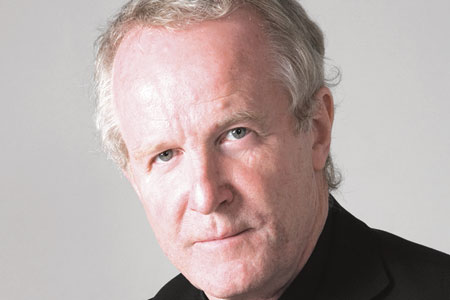
The Bishop of Arundel and Brighton: Even after Summorum Pontificum, the traditional Latin Mass ‘can’t become a regular Sunday Mass’ I went to see Bishop Kieran Conry of Arundel and Brighton at the offices of the Bishops’ Conference at Eccleston Square near Victoria station on a Friday afternoon recently. He was standing at the rather cramped reception by the water-cooler. He looks trim and fit for 57 and sporty. In his nylon zip-up jacket, dark jersey and slacks he might be a dad taking his son to a rugby sevens tournament.
When I first knew Kieran Conry, about 12 years ago, he had recently taken charge of the Catholic Media Office in London, a role he performed adroitly. He was always friendly and informal and known simply as "Kieran".
A monsignor at 33, he has experienced promotion without seeking it. As he says "categorically": "I was quite happy as a parish priest in Stafford."
As we sat down in a committee room he quickly asked: "How long will you need?" He had a few more jobs to do before taking the train back to Brighton. In the end we talked for less than an hour. [It was good of His Excellency take the time!]
He was unsure why I want to interview him: "Is this part of a series?" It wasn’t, I said; I wanted to interview him to find out what a bishop really thought and I remembered him fondly. He was "congenial", I said.
He thanked me and seemed pleased. It’s true that his niceness is what strikes you. Like most Church people he pretends to be above labels like "liberal" and "conservative" but I got the feeling he thinks niceness goes with a liberal tendency. [Well… it is. But "nice" is a certain sense. I have found that many on the liberal side of things tend to perpetuate the myth that liberals are nice and conservatives are mean. But this is a rabbit hole. It was nice of His Excellency to do the interview.]
For instance, he cited approvingly something that Cardinal Hume said – "it was always easier to deal with the loony Left than the conservative Right. He said they were always nicer people." [See what I mean? At the same time, he is right about this. Some of the sourest people I have ever met are on the traditional side of the fence. Sadly, the traditional thing attracts people who are only happy when they are unhappy.] He’s also mentally quick, articulate, polished and full of conviction about the kind of Church he wants to belong to.
Kieran Thomas Conry was born in Coventry and educated in north Staffordshire – at Cotton College, a junior seminary, now closed. You can hear a hint of the Potteries in his voice. Then he went to the English College and the Pontifical Gregorian University.
In the late Seventies he went back to his old school to teach English and RE for a while before coming to London in the Eighties to take an important job as private secretary to two successive Apostolic Pro-Nuncios (Archbishops Heim and Barbarito). He was appointed monsignor at that time.
To begin with I laid out for him a scenario that I’ve heard proposed many times: you have a coterie of liberal English bishops who think the Pope is too conservative and who are privately hostile to his policies.
For example, they’re on a "go-slow" when it comes to implementing the Pope’s letter Summorum Pontificum. (It liberated the centuries-old Tridentine Mass that some Seventies reformers had tried to get rid of, so that it could be celebrated more widely than before.)
Bishop Kieran was adamant: "It’s your classic conspiracy theory, which of course, like all conspiracy theories, is impossible to prove, and for which there is no evidence." [Hmmm… not so sure about that. There are ways, I think, to quantify the number of places/Masses and the number of requests made to parish priests and the number of people making them, etc.]
He fairly hammered the point. "I’ve never refused permission for a Mass. I’ve never refused to meet them. If they’ve come to me for permission I’ve given it. I have never attempted to restrict, shut down, exclude. If anyone could produce evidence that I’ve attempted to stifle or restrict then I’d be interested to see it. Even a letter." Then he sighed. [I must interject that Summorum Pontificum clearly established that priests do not need permission of the diocesan bishop to establish the TLM in their parishes. Perhaps he is talking about the days before the Motu Proprio.]
Did he, for instance, find some of the traditional ceremonial a bit over the top? "Yes. A bit over the top." [So, it is not his preference.] And off he went again: "But I’ve made no attempt to restrict it. I participate in it fully. I’ve made no attempt to change it." [Has full participation included celebrating the older form of Mass?]
I’ve heard it said many times that liberals fear a resurgence of the Tridentine or Extraordinary Form of the Mass because they think it symbolises a retrograde movement and a rejection of the reforms of Vatican II. Did Bishop Kieran think attachment to the old Mass signifies hostility to Vatican II? "I’d never immediately jump to that conclusion. But there is a risk that with some people that’s what it signifies." [Indeed, there is.]
Is liking the old Mass a sort of code? "No. It’s an indicator, it’s a sign, for some people." Which are the reforms you think are not being accepted? "Oh, I don’t know. Some people just blank out the whole of the Vatican Council and say, you know: ‘We either weren’t ready for change, didn’t want change, or didn’t need change.’ "
If the Tridentine Mass became too popular would he worry we’d have a situation comparable to the Church of England where people choose "high" or "low" Church? "I don’t think there will be a big take-up," he said. "It would be a worry because you’d have two Churches really [Huh?] and in the end it doesn’t come down to language or liturgical style, it comes down to your view of Church. Do you accept the reforms of the Vatican Council or not?" [I think the question made sense in the context of the UK. There you find far more tensions between high and low, different classes, the implications of being "high Church". However, His Excellency suggest that widespread or "popular" use of the TLM would creat "two Churches". That implies that there are differing, if not conflicting, ecclesiologies. On the other hand, with Summorum Pontificum the Holy Father is working toward unity and continuity. What’s it going to be? Furthermore, desire for the TLM doesn’t automatically imply rejection of Vatican II. The Holy Father doesn’t reject Vatican II. Most people I know who want the old Mass don’t reject Vatican II. They just want the real Vatican II, and not some chimeric "spirit" redolent of 60’s iconoclasm.]
Is there a strong body of people who want the old form of the Mass? "A strong but very small body. Very small. I’ve had two requests, one from a guy in Horsham who said ‘can we have the 1962 Latin Mass in Horsham?’ And I said according to the terms of Summorum pontificum you can’t because first of all it can’t become a regular Sunday Mass, and there must be a request from a ‘stable group of people’. [There are problems here. 1) Small groups have rights too. What are these people? Half-members of the Church? "Hey, you lot! Go to the BACK of the bus!" All sorts of initiatives and special Masses are implement for small groups of people. 2) Summorum Pontificum openly states that TLM’s can be a regular Mass on Sunday: 5 § 2. "Celebration according to the Missal of Bl. John XXIII can take place on weekdays; on Sunday, however, and feasts there can be also one celebration of this kind." Also, a parish can be established for exclusive use of the older forms. It is understandable that if there is one Mass on a Sunday in a parish, some care must be given as to how to approach requests. But it is simply wrong that the TLM cannot be a regular Sunday Mass. 3) A "stable group" can be very small. A group of three people can receive a law. Also, the parish priest(s) can be counted.]
"Well, we can’t translate the Latin accurately, ‘stable’ means a sizeable group in a parish, [Um… no, "stable" doesn’t mean "sizeable". But I think he is running this together with the next point.] it doesn’t mean you get 50 people from all over Surrey to come together in Redhill and say ‘we’re a stable group in Redhill’ – no. It’s not the site, it’s where they come from. You can’t come to gather at a place and say ‘we’re a stable group’." [I don’t see why not. After all, people come from all over Redhill to go to Mass in Redhill. This is a mobile society. Furthermore, are we going to restrict who can attend a Novus Ordo Mass in this place or that? If not, then we have a double-standard. Furthermore, imagine for a moment that a parish is going to have a Mass for the deaf, with sign language people helping and people come from all over the diocese and beyond. Say Mass is going to be celebrated at St. Ipsidipsy regularly for immigrants from Fredonia in Fredonian. That’s okay isn’t it? Do they have to be from St. Ipsidipsy to count enough to have this consideration? Why the rigidity when considering the older form of Mass but not the newer form? Are these people second-class in the Church?]
Doesn’t that interpretation make it harder for people to have the Tridentine Mass? "No, no, [well… "yes, yes" actually…] if you look at the LMS [Latin Mass Society] news bulletin, it lists at the back the places in Arundel and Brighton where there is Latin Mass regularly: Mary Mag’s, West Grinstead. Again, any permission that’s been sought, I’ve never said no." [With all due respect, according to Summorum Pontificum permission is not needed from the local bishop. The parish priest takes care of this now. Perhaps he is referring to the time when just Ecclesia Dei adflicta of 1988 was in play. These are different times now. We must implement Summorum Pontificum, not Ecclesia Dei adflicta, right?]
What does he really think about it? "It’s exaggerated, first of all. It’s a very small group of very vocal people. In fact the only comment I’ve heard recently is when I went to a place called West Hoathly, in Worth parish. [Small groups still have rights and legitimate needs.]
"A small group, three or four people, came along to me and said: ‘Please tell us you’re not going to bring back the Latin Mass.’ And I said: ‘Look, things are not going to change.’ [This other small group who doesn’t want the old Mass comes and complains and they get a very positive hearing, assurances that the TLM isn’t coming back. If a group of three or four were to come and say "We want the TLM back", would they have the same positive reception? Or is this another case of "Your kind can’t drink out of that water fountain!" all over again?]
If you look at Summorum Pontificum it doesn’t suggest significant change. [Let’s see. All Latin priests have faculties to say the older Mass. Parish priests, not bishops, implement the document. Parish priests and bishops must provide for the TLM when requested. Sound significant to me.] Really because [the Tridentine Mass] does cater for such a small group, it would be inappropriate to stick it onto a Sunday morning in a parish where most people would say: ‘We don’t really want this.’ That’s why the Pope will say: ‘Have it, but not as part of your standard Sunday repertoire.‘" [This is a fair point. There are practical considerations. It is hard to undertake a parish wide initiative, such as changing a Mass schedule, for very few people. However, Summorum Pontificum a) leaves this in the hands of the parish priest and b) provides for a regular Sunday Mass. Also, Card. Castrillon of the Pont. Comm. Ecclesia Dei, the Holy Father’s surrogate in these matters, has stated that the TLM should be made available widely so that people can learn it. In other words, the TLM should be made available even when it hasn’t been requested. I believe it was in London that Card. Castrillon said that the Holy Father wanted the TLM in every parish. Perhaps this more closely reflects "what the Pope will say". Remember: Summorum Pontificum is a major tool in the Pope’s "Marshall Plan" to revitalize our Catholic identity. We need to know who we are as Catholics in order to be effective in our vocations in the world. How we worship is a major dimension of our indentity. Having the old Mass is part of a larger vision.]
A lot of conservative enthusiasm comes from the young. Bishop Kieran thinks there are three reasons for this. They are geopolitical more than theological. [hmmm… geopolitical not theological?]
"I think it reflects a very natural anxiety about the way the world is. We’ve got three massive areas of uncertainty. We’ve got first of all massive climatic change heading our way inexorably. They’re going to have to suffer it so they’ve got that anxiety. Now we’re in the middle of enormous economic uncertainty. And the whole threat of terrorism. Even today in the paper reports say that the US has lost it and that China could wage cyber-war."
[Wow. First, we should immediately deny the premise: "Conservatives are conservative because they are scared about the future". It couldn’t be that they have weighed the factors and made an informed choice. However, let’s go along with His Excellency for a moment. Let’s accept his premise and say that young people are fearful about their future, and that is why they are embracing a more traditional Catholicism, et al. Is that bad? After all, traditional Catholicism is legitimate, right? They are Catholic, right? They have a right to desire legitimate Catholic things and make their legitimate asipirations known, right? Furthermore, if they want the older Mass because they are frightened, then, FOR THE LOVE OF GOD GIVE IT TO THEM! Jesus said: "And which of you, if he ask his father bread, will he give him a stone? Or a fish, will he for a fish give him a serpent? Or if he shall ask an egg, will he reach him a scorpion?" (Luke 11).]
But surely other forces have drawn young people to traditional forms of worship, such as the wild experimentation that went on under the guise of reform?
"Fair enough. But the theology of the Mass never changed." [So… there is theological continuity between the Novus Ordo and the TLM? If so, then what is the problem? Why not happily see the two forms side by side if there is no conflict?] What about a lack of reverence? "It depends how you express reverence. Because reverence doesn’t necessarily imply silence, a sort of liturgical theatricality. There are many ways to express reverence." [I am confused by this. I cannot understand how silence is "theatricality". It might be that in silence you are far more sensible of what is happening in Holy Mass and that may have a powerful effect on the emotions. Or perhaps he means that reverence doesn’t imply either silence or theatricality. Not sure. However, I will say that "theatricality" is precisely the opposite of the experience of Catholic worship. If "theatricality" is a problem, I suggest you will find it more commonly in many celebrations in the Novus Ordo rather than the TLM, where actions and words of the priests and ministers are controlled by the rites.]
The old Mass was more formal, wasn’t it? "Oh yes, absolutely. It was very rigid. They used to say you could commit 26 mortal sins in the sacristy by not complying with the rubrics. Any ritual over the years becomes more and more complicated, you add little bits here and there. I remember serving the old Mass. I remember moving the Missal from the right to the left, from the Epistle to the Gospel. [I cannot count the times I have heard especially priests run down the old Mass because of the way it was celebrated, a rigid or inflexible way. But I respond that the abuse of something doesn’t not mean that it cannot be used properly. With due respect, if His Excellency has baggage from his youth about the old Mass, perhaps because some overly rigid priest with jansenistic inclinations was overly scrupulous, that doesn’t mean that today a new generation of priests and lay people cannot learn from mistakes of the past and celebrate the TLM with the reverent flexibility that comes with wisdom. That was then and this is now. In the intervening years we have learned a great deal about rigidity and creativity, scruples and self-serving experimentation. We have learned a lot about a sound ars celebrandi. We must apply the core of Benedict XVI’s Sacramentum caritatis also the the older form of Mass.]
I was very glad when we had a language to the Mass that we could understand and a simplified liturgical expression of it. I thought this made great sense. [The Council Fathers thought so too. They also thought Latin should be preserved, along with Gregorian chant and the pipe organ.] I could see the argument that some priests gave in to excessive reform experimentation but I wouldn’t say there’s widespread liturgical abuse." [Wow. Really?]
I found myself using a phrase – "awesome contemplation of God" – to describe worship. He latched on to it.
"That’s a moot point: [hmmm] is liturgy supposed to be ‘awesome individual contemplation of God’? And the answer to that is probably ‘no’. Liturgy is an act of the community." [This old chestnut.] He warmed to the theme. He’s not crazy about Latin, but he likes to use Greek words. "Leitourgia: the laos, the people of God, perform an act of worship, not a private devotion." [I suspect he thinks that if people aren’t "doing things" at the same time, then they are engaged in something private. They could be, together, very still and silent … praying.]
But Bishop Patrick O’Donoghue of Lancaster said just the opposite only the other day, didn’t he? "Well, I would challenge him on it." (Smiling.)
Bishop O’Donoghue said worship is not primarily about community. "It is! It’s the action of the people, it’s the action of the community. There are two points at which the person in the community says ‘I’ in the Mass, the rest of the time all the prayers say ‘we’. The opening word [of the Creed] is pistuomen, ‘we believe’, because again the Nicene Creed was expressing the belief of the Church, we believe this, this and this. [ARGH! No. The opening word of the Creed is Credo. The Greek plural of ancient symbols of faith stems from the fact that the council fathers were subscribing collectively to a set of beliefs. That is a conciliar or synodal document. However, we are talking about liturgy and the liturgical text of the Credo.]
"The only time in which the word ‘I’ is used, really, is ‘I am not worthy to have you under my roof’ and at the beginning: ‘I am sorry’." [Yes… "Confiteor… I confess to Almighty God, and to you, ‘brothers and sisters"…". Even there a distinction is made between the individual and the rest of the congregation. There is also a distinction in the Suscipiat. "My sacrifice and yours", the priest says. The fact is that the true "actor" in the sacred action of Holy Mass is Jesus Christ the High Priest. Mass is an act of a community, but not primarily. It is also that. First and foremost it must promote the very object of religion itself, which is nothing other than an encounter with mystery which transforms the individual. Individuals collectively transform the world. We have to make logical distinctions about things which happen simultaneously.]
So there had been a stripping away of accretions in recent times? "Things develop naturally. Certainly the post-Vatican II liturgy would have more in common with the early Church than the post-Reformation liturgy. The Church [after the Reformation] had to re-state its case very strongly in terms of strictly monitored and controlled liturgical practice. The Church became very controlling and controlled." [I think what we are getting here is an strand of the thought that the older something is (for worship) the more "pristine" it must be. That old canard was dealt with when the errors of the Synod of Pistoia were condemned and when Pius XII wrote are false archeologizing in Mediator Dei. The fundamental error in this is the idea that as time progressed, the changes made were degradations rather than expressions of a deepening understanding of who we are, what we believe, and what God’s plan is. Corrections must be made along the way, but always (as Pope Benedict has stressed) in a line of continuity rather than of rupture. In no aspect of the Church’s life is this more true than in her worship, which is the foundation of our Catholic identity.]
We met a few days before National Youth Sunday (Feast of Christ the King). Since the Catholic Youth Services were closed down earlier this year, Bishop Kieran has supervised youth ministry in this country.
A Youth Mass with a liturgy designed to appeal to youngsters had been proposed. The website for it displayed the bishops’ logo. Suggestions included distributing tips on high-energy light bulbs, handing out Fairtrade chocolate and in a list of things to be sorry for in the penitential rite: leaving water in your kettle.
Did the bishop think any of the suggested liturgy was a bit silly?
"Well, it might be. But it’s youth. [But… wait… what about the young people who are traditional Catholics and who want the TLM? Are we to show indulgence to one group and not to another? But wait…. I am falling into a trap. It is legitimate to desire the TLM and it is silly to include "leaving water in the kettle" in a penitential right.] We’re not going to switch light bulbs on in young people’s heads, not at a single event. But it was felt some of that would be appropriate for young people." Leaving water in the kettle? "For young people that’s an issue – energy saving."
Could the Church be more radical? Talk about the serious questions – repentance, salvation?
"You can’t talk to young people about salvation. What’s salvation? What does salvation mean? My eternal soul? You can only talk to young people in young people’s language, really. And if you’re going to talk to them about salvation, the first thing they will understand is saving the planet. You’re talking about being saved and they will say: ‘What about saving the planet?’ " [I simply must restrain myself here.]
Doesn’t Jesus talk in black and white terms, as if we might be in danger? "Shoulder my yoke and learn from me," quotes the bishop, "for I am gentle and humble in heart and you will find rest for your souls. Yes, my yoke is easy and my burden light."
Doesn’t he also say we should repent, beware of sin – a stark message? "Not stark. According to where you look in the Gospel, and again if you go to Matthew 25, the final parable of Jesus, only in Matthew’s Gospel – ‘When I was hungry, you fed me … naked and you clothed me … you visited me in prison.’ That would resonate much more with young people." [UGH… I can’t do it. Okay, Matthew 25: "But he answering said [to the foolish virgins]: Amen I say to you, I know you not." Jesus said in Matthew 25: "And the unprofitable servant, cast ye out into the exterior darkness. There shall be weeping and gnashing of teeth." Jesus said in Matthew 25: "Then he shall say to them also that shall be on his left hand: Depart from me, you cursed, into everlasting fire, which was prepared for the devil and his angels. … And these shall go into everlasting punishment: but the just, into life everlasting." We must teach people the whole thing. The wages of sin is death. Whatever sin we are taking about here, there are eternal consequences.]
Does he think people should have a sense of personal sin? "Yes [firmly]. And I think young people do."
He gives an example: the helpers’ reconciliation service on the diocesan Lourdes pilgrimage. It started at nine o’clock and the last young person left the chapel at 11.15.
Is it a good idea to go to Confession regularly? "No, [No?] because my own experience when we had Confession every day at St Chad’s Cathedral in Birmingham was that regular penitents came back with exactly the same words week after week. So there you would say, actually, there is no conversion taking place." [Look/ St. Augustine used his personal experience as a foundation for his theological reflection. Fine. But I don’t think that is what is going on here. Did I really read that His Excellency doesn’t think frequent confession is a good idea? I think the writer must have misunderstood. I cannot accept this.]
What about the Four Last Things? Has the Church lost the vigour with which it used to talk about Death, Judgment, Hell and Heaven?
"Again it would be inappropriate to say ‘the Church has lost…’ People have lost a sense of sin." [So the Church should teach people about the proper sense of sin.]
So the Church shouldn’t bang on about sin?
"No, not necessarily. Because that won’t necessarily re-instil … and you don’t know whether you want to face people with a primary experience of Church which is sin." Was the Church morbidly obsessed with guilt and sin in the past? "Might have been, but again I haven’t got enough evidence." [I think His Excellency is trying to say that he wouldn’t want a constant and unbalanced emphasis on hell and sin. Fine. I think that is what he is driving at.]
Too much emphasis on sexual morality? "It’s sometimes distorted. For instance, we rarely talk about economic honesty, financial honesty, we rarely talk about greed and wastefulness.
"But to young people, boiling a kettle, wasting water, saving the planet, that’s language they will understand. Then you can move on from there: ‘Right, do you understand what saving means? Do you understand what good and bad is here?’ And they’ll say ‘yes’ and you can say: ‘Right now, if you look at your own life…’ And again I think for a lot of the claims there is simply no evidence." [Uh huh… they are going to receive lessons about sexual morality from the starting point of boiling a kettle. You know… I think if you talk to young people directly about sexual morality they will both listen and they will want to hear what you have to say. We have to say it in the right way. He is right about that. But… kettles?]
People have the evidence of their own parishes, I said. You don’t hear the word "hell" mentioned that often in the average parish church, compared with in the New Testament.
"Why should you? [Why should we talk about hell? Because the whole point of life is trying to AVOID IT?] How many times is hell mentioned in the New Testament? Do a word count." I wanted to pin this down: has the traditional homily featuring fire and brimstone been abandoned for the reason that it puts people off? [Okay, my guess, above, was right. But I must respond that we are not sola scriptura Christians. Also, that chapter His Excellency cited, Matthew 25, is pretty clear about the fate that waits those who were faithful and those who weren’t, and, I don’t know about you, "everlasting fire", "outer darkness", "weeping and gnashing" doesn’t sound very congenial. But… we have to be nice.]
"No, no, it’s not because it puts people off. It’s because the truth is that God loved the world so much that he sent his only son to die for us."
He was speaking from the heart, [I have no doubt. And he is right to stress the salvific message of the Gospel. But the message has a flip side: we can lose what Christ won for us. We need both.] though he couldn’t resist lapsing into Greek jargon: "That is the basic kerygma of the Church. It has always been. It’s not that you are a sinner, but that God loved the world so much, and you see that is the primitive Church’s kerygma, its basic message.
"It’s not about us, it’s about God, and if we put the emphasis on ourselves we become heretical, we become Jansenists. I become the centre of the Church – an anthropocentric model of the Church, it’s all about me and me being saved. It’s not, it’s a theocentric model of Church which is: God loved the world, this is God’s action, stemming from God’s love for us. It is not God’s wish to condemn." [Your Excellency. Perhaps the two different forms of Holy Mass can be examined in light of what you very properly said here. It strikes me that one is more theocentric and the other more anthropocentric. One has God increase (even through our need to obey "rigid" rubrics) and the other is about us increasing (through seemingly endless options and shifting texts and adaptations). One is more obviously about our reception, our still listening. The other is about our constant talking. I could go on. But I think His Excelleny’s point is dead on. If we put the emphasis on ourselves we become heretical.]
Is it possible that this image of God seems bland and boring to young people? "No, I would disagree. Young people want to be loved. We all want to be loved." Can they get that from other sources? "They can, but how many do? They need to be told God loves them. They don’t need to be told: ‘You’re heading for hell.’ No. I would disagree profoundly with that view, profoundly, profoundly."
Time to move on to something else. It is 40 years since Humanae Vitae. It became acceptable, I suggested, for many otherwise loyal Catholics to routinely disobey a key teaching of the Church.
"Well, first of all, I would disagree that it’s a key teaching. The key teachings of the Church are in the Creed. [Which begins "credo" and not "credimus".] It’s not a life issue." [Hmmm… Humanae vitae doesn’t concern a "life issue".] To do with the transmission of life, then? "It’s to do with what family and married life means, being open to procreation. So it’s not a life issue because then you tie it in with abortion. The two are completely different issues."
Does it matter if people disobey that teaching?
"In the great scheme of things I don’t think it’s high up the list. It became a very public issue which affected a significant number of people, not the majority of Catholics. The majority of Catholics are not in that position, where birth control is an issue. Look around on Sunday morning and see ‘is birth control an issue for most people here?’ No, it’s not. [Though it tore the Church apart in the late 60’s early 70’s. Heck. Let’s ad the 80’s and 90’s. Why not add the present decade too?]
But it became the place where the tug of war took place: it was to do with dissent and obedience. Can you be a Catholic and dissent?"
He thinks there should be greater emphasis on the virtues. "Why do people never go back to the Beatitudes, ‘blessed are the poor in spirit’? You know, are you poor in spirit? No. Does that bother you? No. Do you practise birth control? Does that bother you? Yes. We’ve got a very distorted view of what we think Christian morality is." [The writer may have misunderstood this part. The Beatitudes and the virtues are related, but not the same.]
The Church has attempted to codify every detail of our behaviour hasn’t it? [No] "Yes, but it rarely in tradition has attempted to codify charity, for instance. Again the basic commandment of God – love God, love your neighbour. That has been left largely unexplored." [I think making lists to be memorized by all children, such as the corporal and spiritual works of mercy come pretty close.]
Codify charity? "You can’t quantify love. The birth control issue becomes easy because it’s measurable. You do it or you don’t. But love: you do it or you don’t do it, how can you measure that? We fight the easy battles but we ignore the bigger ones."
Was Humanae Vitae a mistake? "I don’t know. I don’t know. But at the same time we’ve seen the disastrous effects of the devaluing of sexual relationships, to say they don’t mean anything, which has had catastrophic effects on society, catastrophic effects on the value of women."
He disagrees with environmentalists who attack the Church’s teaching on birth control. [Back to the environment.]
"You get people like George Monbiot saying: ‘If the Pope changes his position tomorrow, the world would be rid of the scourge of Aids.’ He’s talking nonsense. Because, first of all, what percentage of the developing world is Catholic? The biggest growth in population is among Islam, not among Catholics. The Church isn’t encouraging people to have children, it’s the culture. That’s not why they’re having large families, because the Church is teaching it."
But is the teaching itself wrong? "It could be. It’s not an infallible teaching. Clearly the basic Creed formula, what the Church teaches about the sacraments is infallible but there’s only been one strictly infallible statement."
So in a sense it’s a matter of opinion? "Well, it’s… It is. It’s an expression, however, of something quite profoundly important about human sexuality and relationships. If you really love your fellow human being then you’ll have profound respect for them and that has clearly disappeared from large sections of our contemporary society."
We got up to leave. My mind turned to the bishop taking the Friday night train back to Brighton, sitting in the carriage in his black clerical clothes. Then I realised he wasn’t wearing clerical garb.
He told me a story about how he once came back from a conference in clerical black and two people badgered him with their Da Vinci Code questions. It was a good anecdote. But as an explanation for not wearing clerical clothes, it struck me as only half convincing. [And he lost a teachable moment. I wonder if they were young people.]
I am torn.
I am glad Bishop Conry was so open and frank. I admire that.
At the same time I profoundly disagree with his approach to many things.
However, I think his approach to liturgy is incomplete. In stressing the legitimate and necessary "communal" dimension, at least in this interview, he loses what is more essential, the transcendent. He loses the very object of the virtue of religion and why we gather for worship.
I also differ with him about the reasons why young people, or anyone, might embrace a more conservative or tradition position. He marks it up, at least here, to fear. That strikes me as a little condescending. I think it is entirely possible for people to both fear and reason. It is also possible for people simply to have a preference. In this case of the TLM, it is a legitimate preference. Either way, if it is simply a preference or it is from fear, they deserve greater respect.
I agree that we as a Church should not in an exaggerated way stress hell and sin. But in medio stat virtus right? We need to teach about these things! Not to do so does a horrible injustice to Christ’s own message, the Church’s teaching, and the image of God in each person whom God desires for Himself. Our tone and message must be tailored. But simply to trim certain things away for the sake of putting on a happy face is … just wrong.
Lastly, I write this with respect for His Excellency’s office and person. As a matter of fact, I have the sense from this article that His Excellency is a man I would very much like to have a meal with and hash out these issues through the course of a pleasant evening. I realize that this was an interview and there are strong possibilities of misunderstanding. If I have made any observations that are unjust to him in my comments, I will welcome his correction.


 In another thread of comments, someone opined:


 waalaw on Daily Rome Shot 1118 – Paddywhack!: “1. R-h1+ . . . B×h1 2. R×h1× If . . . . . . . . . K-g2 3.…”




























