Request to UK readers

I have been alerted that in the recent issue of England’s The Catholic Times there is a profoundly deficient article by a Msgr. Loftus with all sorts of dopey comments on Summorum Pontificum.

If one of you kind readers would provide me with the text, I will post my observations about it.

Perhaps you might chime in here, so as to help other readers avoid unnecessary work.

Posted in SESSIUNCULA |
6 Comments

CNS: “Implementation of Tridentine ruling frustrates some”

This article by my friend Mr. John Thavis was posted on the site of Catholic News Service.

My emphases and comments.

Mixed reviews: Implementation of Tridentine ruling frustrates some

By John Thavis
Catholic News Service

VATICAN CITY (CNS) — A year after Pope Benedict XVI opened the way to wider use of the Tridentine Mass, implementation of the papal directive is drawing mixed reviews from its target audience.

Catholic traditionalists [And just who they are can be considered, must be considered, fairly broad I think.  For example, there are people who don’t always want to attend TLMs but a glad to have that option.]  remain grateful for the pope’s document and say it has given them a certain legitimacy [Which they should always have had.] in local church communities, as well as greater practical access to the old rite.

But some — backed by a Vatican official — have complained that bishops and pastors continue to place obstacles in the way of groups seeking the Tridentine liturgy.

On a long-term issue, traditionalists are pleased at new efforts to instruct priests in celebrating Mass in the older rite. Meanwhile, those who envisioned Tridentine Masses popping up in every parish are somewhat frustrated.

"We’re only looking at one calendar year, and we know that in the church these things take time. But the problem — dare anyone say this? — the problem is the bishops. Because you have bishops who aren’t on board," said John Paul Sonnen, [Our friend at Orbis Catholicus.  It is interesting to note that he is originally from St. Agnes parish in St. Paul, MN, as am I.  Another priest at the conference also had a connection there.] an American Catholic who lives in Rome.

Sonnen and about 150 others attended a small but significant conference in Rome in mid-September on the theme: "’Summorum Pontificum’: One Year After."

"Summorum Pontificum" was the title of the pope’s 2007 apostolic letter that said Mass celebrated according to the 1962 Roman Missal, commonly known as the Tridentine rite, should be made available in every parish where groups of the faithful desire it. In his letter, the pope said the Mass from the Roman Missal in use since 1970 remains the ordinary form of the Mass, while celebration of the Tridentine Mass is the extraordinary form.

The response to the papal letter varied around the world. In the United States, many bishops — even those not enthusiastic about the new policy — took steps to explain it to their faithful and put it into practice.

But in Europe and Latin America, conference participants said, there’s been less favorable reaction.

"In Italy, with just a few admirable exceptions, the bishops have put obstacles in the way of applying (‘Summorum Pontificum’)," Msgr. Camille Perl told the Rome conference.

"I would have to say the same thing about the major superiors of religious orders [An important point to remember!  A large percentage of priests in the world belong to orders and institutes.] who forbid their priests from celebrating Mass in the old rite," Msgr. Perl said.

Msgr. Perl is vice president of the Pontifical Commission "Ecclesia Dei," which oversees implementation of the papal document, so his words carried weight. Italian newspapers reported his comments under the headline "The bishops are boycotting the pope."

Two Brazilian priests attending the conference complained that they’re facing a similar situation in their country.

"I think there’s a great desire on the part of young priests to learn the older rite. But we don’t study it in seminaries, and the bishops don’t cooperate on that," said Father Giuseppe Olivera of Sao Paolo.

Msgr. Perl said letters received by his commission indicate considerable interest in setting up local Tridentine Masses in France, Great Britain, Canada, the United States and Australia. He said there have been fewer requests for the older Mass in Latin America, Africa and Asia.

Cardinal Dario Castrillon Hoyos, who heads the "Ecclesia Dei" commission, said recently that Pope Benedict would eventually like to see the Tridentine rite offered in every parish. But for now, in the pope’s own Diocese of Rome, a single church, Santissima Trinita dei Pellegrini, has been designated as a "personal parish" for traditionalists.

That’s a solution that appeals to some dioceses, especially those that include large cities, but it tends to separate traditionalists from other local parishes. It also seems to put bishops in charge of the decision of where and when a Tridentine Mass is offered, instead of the local pastor, as indicated by "Summorum Pontificum."

Father Joseph Kramer, pastor at Rome’s Santissima Trinita church, said that so far his parish is attracting a lot of younger people and those over 50, but not many in between and few young families.

In general, he said, it’s important for traditionalist Catholics to make it clear that they accept the changes of the Second Vatican Council, in order not to frighten off "normal" Catholics who might be attracted to the older rite.

U.S. Father John Zuhlsdorf runs a blog — "What Does the Prayer Really Say?" — that’s become a sounding board for reaction to "Summorum Pontificum" among traditionalist Catholics.

One recent comment on the blog began: "Frankly, I’m sick and tired. Tired of waiting. ‘Summorum Pontificum’ has been in force for one year now and, in spite of the fact that I live in a huge metropolitan area, there is no TLM (traditional Latin Mass) to which I can go" without driving at least an hour.

Father Zuhlsdorf, who attended the Rome conference, said he understands some of these frustrations but takes a generally positive view of the first year of "Summorum Pontificum."

One good thing, he said, is that the papal directive has deeply affected priests, especially younger priests, and their perception of "who they are at the altar." As time goes on and older priests and bishops retire, this interest will have a ripple effect on parish life, he said.

Another plus is that resources for the older rite, including beautifully bound missals, are being produced and published. These could appeal to Catholics and "help change the culture of participating at Mass," Father Zuhlsdorf said.

In addition, he said, some U.S. seminaries are beginning to introduce courses in celebrating the Tridentine rite. Private training programs for priests, workshops and Web sites also have been established.

He compared it to the Ford Motor Co. putting a new model into production.

"It takes a long time to construct the assembly plant, but once you get the thing built you can get the product out more quickly," he said.

In the more-to-be-done category, Father Zuhlsdorf said there are still some priests and bishops who have "a bit of a stingy attitude" about the legitimate requests of traditionalists.

He said Latin proficiency is an example of where a double standard seems to be used to create an obstacle to the wider offering of the older Mass. While it’s true that a priest celebrating in Latin has to know what he’s saying at the altar, he said, one could also ask about proficiency in English among priests coming from a foreign country to serve in the United States.

In any case, he said, the Code of Canon Law requires that all seminarians be well-trained in Latin. If that isn’t being done today, seminary officials should be addressing the problem, he said.


Many thanks to Mr. Thavis for the cordial interview… a good tone from CNS in this article.  He addresses important issues and got a range of comments.
Posted in SESSIUNCULA |
22 Comments

QUAERITUR: changing from altar “servers” to altar boys

A priest reader sent this.

Perhaps some of you can post concrete experiences.  We don’t need rants against altar girls here, just concrete help.

I would be interested if any of your readers have any resources that would be helpful to a pastor who is trying to move his parish back to training only boys to serve at the atlar.  I don’t anticipate a huge backlash, but I would be particularly interested in some ideas on how to explain the reasoning, especially to 4th and 5th graders. 


I remember how one pastor got rid of altar girls by starting to have only father and son teams serve.  Then the fathers were phased out and more boys phased in.

I think the standard explanation is that service at the altar is an extension, to an extent, of ministerial service.   These days many push the idea that everyone is somehow a "minister".   There are ministers of greeting, napkin folding, bulletin distributing, etc.  

Since the server is really a replacement for an officially installed acolyte, who must be male, the servers should be male.  An interpretation of canon law shockingly allowed that females could also substitute for males in this service, and so that law must be respected.   At the same time, the Church also very much prefers male service, and states clearly that service of boys at the altar should be fostered as a great tradition and as a starting point for priestly vocations.

So, in the theological side there is a argument from the idea that this is an extension of the service of the other, truly ministerial ministers.

Practically speaking, it helps vocations and… from a psychological/developmental point of view, boys tend not to want to serve when girls are around. 

I often wonder about a sound theological defense of altar girls.  I muse about whether or not one could get any mileage out of the parable of the wise and foolish virgins with their lamps, who were to accompany the Bridegroom in to the banquet.   But I only get so far with that, and then I hit a wall.

So… I am interested in concrete stories from people about how parishes shifted from mixed service back to male only service at the altar.

Posted in "How To..." - Practical Notes, ASK FATHER Question Box, Classic Posts, Mail from priests |
60 Comments

A Roman supper: Da Fortunato

Now that I am back in London, and I have better internet access, I can catch up.

You wouldn’t believe how many e-mails I have.

The friend with whom I was staying in Rome had put in his order for internet on 1 September, if you can imagine…. but anyone with experience of Rome doesn’t have to imagine.  

Given my connection, I can fill you in on some of my doings in the Eternal City, including …

… more food photos.

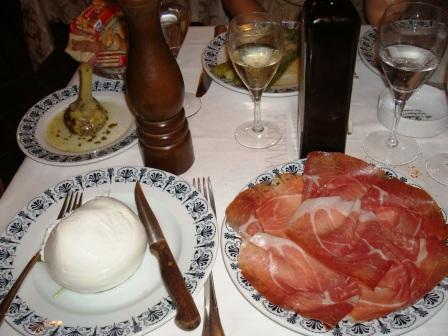
Here are a few shots of some goodies from supper the other night at one of my favorite places in Rome, Da Fortunato near the Pantheon.  It is also not the sort of place you have to get a second mortgage to pay for.

This is one the those few spots that has retained the old fashioned style of the classic Roman restaurant.  And the food is always good.

A Roman supper: Da Fortunato

My first course was rigatoni all’amatriciana, which is pretty standard fare.    I didn’t feel like too much meat or fish that evening, so I opted for a few simple things I cannot get at the Sabine Farm.

Thus, I ordered up some mozarella di bufala, prosciutto, and an artichoke in the Roman style.

A Roman supper: Da Fortunato

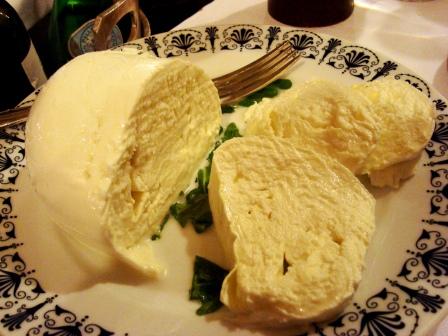
Let’s just have a closer look at that mozarella as it oozes all over the plate.

A Roman supper: Da Fortunato

The stuff they call "mozarella" in the US?    Uh uh….  tisk.

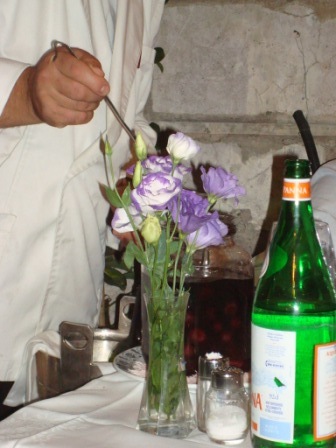
I am not one for sweets, but I did want to have a house specialty.  They make their own grappa infusion with grapes.

Happily the waiter left it with us on the table.  Being a regular has its perks.

Sorry, I didn’t think to take a photo until after we let the waiter take it over the next table, for people who were profoundly curious about what we were having.   Much conversation about its qualities ensued.

A Roman supper: Da Fortunato

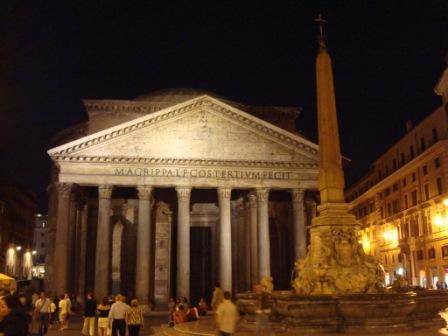
A wonderful meal with good company can’t be beat, especially when you walk out the the place and see this.A Roman supper: Da Fortunato

Posted in My View |
11 Comments

At least lunch went well today… very well!

The day was really awful, but there was a great moment… lunch.

I was out with a friend at a fairly new place I really like on the Borgo Pio… Ristochicco.

At least lunch went well today... very well!

At least lunch went well today... very well!

At least lunch went well today... very well!

At least lunch went well today... very well!

Posted in SESSIUNCULA |
42 Comments

GRRRRRR

I am pretty frustrated today.  Rain, people out of town I wanted to see, really humid.

One of the people I saw today, someone close, is ailing and getting close to the end, I am afraid.

I am guessing I will have just enough access today to post this.

Posted in SESSIUNCULA |
16 Comments

Bishop Levoir! Ad multos annos

From the blog Catholic Journey about the consecration of a friend, H.E. Most Rev. John Levoir as Bishop of New Ulm, MN.

I have now begun to say the Memorare each day after Mass for him, as well as several other bishops (and two cardinals).

I wish I could have been there.

Mass of Ordination for Bishop John LeVoirBishop Levoir! Ad multos annos

UPDATE: Pictures of the event can be found here.

Today was a big day for the Diocese of New Ulm. Today our fourth bishop John Marvin LeVoir was ordained and installed. I mentioned in an earlier post that the timing was so bad for me that I could not attend. Well, I took some time off work and went.

The Mass was held at the civic center in New Ulm. This is to say we had Mass in a hockey arena. In the 50 year history of our diocese this is the first time a bishop as been ordained here. There were about 2,100 people in attendance and there is no way we could have gotten that many people into the cathedral.

The arena was sparsely decorated. Red and white streamers covered the ceiling to try to make it look less like an athletic facility. The bishop’s chair was brought from the cathedral and sat to the left of a long altar. The altar was covered in white and had a dark red covering in the middle. Four candles were lit in front of the altar and the two large processional candles sat one on each side of the altar. The only crucifix was the processional cross. To the right of the stage on which the altar sat was a brass ensemble, and organ, and a large choir made up of members from all around the diocese.

Prior to the start of Mass the choir sang several music pieces including my favorite Ave Verum Corpus. A Bell choir also performed. The only problem was that I could not hear the music because the 2,100 people were talking so loud they drowned out the music. Bummer.

Mass began with a long processional. At the beginning of the processional three women ministers for other ecclesial communities vested in their particular vestments entered. There was nothing I could find that told me what community they belonged to so I can’t tell you that. The procession continued with priest and deacons from both our diocese as well at that of St. Paul and Minneapolis. There were about twelve to fourteen other bishops who entered including: H.E. Pietro Sambi, the Papal Nuncio for the United States, H. E. John Nienstedt, the Archbishop of St. Paul and Minneapolis, who was today’s principal consecrator, Co-consecrators H.E. Peter Christensen, Bishop of Superior and H.E. Fredrick Campbell, Bishop of Columbus, Ohio. The only other bishop that I recognized was H.E Richard Pates, Des Moines, Iowa. I would love to know who the other bishop attending were so if anyone knows please leave me a comment.

After the processional, Archbishop Nienstedt incensed the altar and then made the sign of the cross to begin Mass. At the beginning he asked if there was a papal mandate to consecrate Fr. LeVoir as a bishop. Archbishop Sambi then read a letter from Pope Benedict elevating Fr. LeVoir to bishop. After the letter was read it was shown to the college of consultors for the diocese of New Ulm, the assembled bishops, and the people who gave their assent to the document with applause.

Mass began. The deacon of the word chanted the Kyrie, the Gloria was sung, and the Archbishop Nienstedt chanted the opening prayer. The first reading was read in English, the psalm was sung in both English and Spanish. The second reading was read in Spanish and the Gospel was proclaimed by the Deacon of the Word.

The first reading was from the Book of Jeremiah Chapter 1 where the Lord speaks to Jeremiah about being a prophet. This reading was selected by the new Bishop. The second reading and the Gospel follow the readings selected for the Feast of Our Lady of Sorrows.

Archbishop Nienstedt began his homily by singing O Sanctissima.

O Sanctissima

O Sanctissima O Piissima
Dulcis Virgo Maria
Mater amta intemerata
Ora ora pro nobis

English Translation:

O most holy, O most lowly
Sweet Virgin Mary
Beloved Mother, undefiled
Pray, pray for us!

Other verses:

Tota pulchraes O Maria
Et macula non est in te
Mater anmata intemerata
Ora ora pro nobis

Sicut lilium inter spinas
Sic Maria inter filias
Mater amata intemerata
Ora ora pro nobis

In miseria in angustia
Ora Virgo pro nobis
Pro nobis ora in mortis hora
Ora ora pro nobis

As he sang many of the priests and bishops joined in with him. Singing to open and close his homily is a sort of signature for the Archbishop. I truly hope that the Archdiocese of St. Paul and Minneapolis enjoys him. In his homily,the Archbishop essentially passed the keys to the diocese over to Bishop LeVoir. He closed his homily with another verse of O Sanctissima.

After the homily, the archbishop questioned Fr. LaVoir about his willingness and readiness to be Bishop, then the Litany of Saints was sung by the choir and Fr. LaVoir lay on the floor prostrate. After the Litany, it was time to get down to the business of consecrating a bishop. Archbishop Nienstedt, seated at the cathedra of New Ulm (for the last time) prayed the prayers and then began with the Laying on of Hands. Fr. LeVoir knelt as the Archbishop placed both hands on his head and prayed. When he was done each of the co-consecrators did the same. Finally, each of the bishops attending also laid their hands on him.

After the laying on of hands, the Book of Gospels was opened and held pages down over his head, while the Archbishop prayed payers of ordination. What a wonderful image this was. It was as if they were pouring the words of God right into his head. When this was finished, the Archbishop anointed him with a generous amount of sacred Chrism oil.

After the anointing, it was time for the Bishop to receive the symbols of his new positions. First his ring, then his miter, and finally, his crosier. With the new bishop fully vested, Archbishop Nienstedt got up from the cathedra of New Ulm. The new bishop took his place on the cathedra of New Ulm.

Bishop LeVoir then celebrated the Eucharist for the first time as Bishop of New Ulm. He used Eucharistic Prayer #1 which is my favorite. I may have mentioned that before. He has a wonderful chanting voice. Some things that really struck me were that there were so many priests taking part in this Mass that when the words of consecration were spoken you could hear them all praying. It was very powerful moment. I find it almost electrifying when a large group of priests celebrate Mass together. The Lord’s Prayer was chanted by everyone and it was beautiful. Another powerful moment

Communion took a long time with some 2,100 people and it was offered under both kinds which surprised me. I figured that we would only receive the Body of Christ with so many people there. By the time it was my turn, however, the Blood of Christ was gone.

When communion was done the Bishop was escorted around the room to offer his first blessing to the people. When this was done the closing prayer was chanted, the Bishop took some time to thank everyone and then offered the final blessing and dismissal.

Posted in SESSIUNCULA |
18 Comments

Rome 8 October: Card. Castrillon – Pontifical TLM for Pius XII

I was just out to lunch with a priest friend and also Orbis Catholicus – Mr. John Sonnen, who always posts fun photos from Rome and environs.

Orbis got a phone call during our post-lunch coffee and… well… I am posting it first, but you should go to his blog for details.

It seems that Card. Castrillon Hoyos on 8 October with pontificate with the Extraordinary Use in the Borgehese Chapel of the Basilica of St. Mary Major in honor of Pope Pius XII.  If I understood correctly, the FSSP will be seeing to the ceremonies.

You will be sure to go visit Orbis for the details. 

I also want you to remember that John Sonnen works a bit as a tour guide. He knows Rome well and is very Catholic on the traditional side of things. 

Posted in SESSIUNCULA |
Comments Off on Rome 8 October: Card. Castrillon – Pontifical TLM for Pius XII

Reflecting on Card. Castrillon’s remarks the other day

Reflecting on Card. Castrillon's remarks the other dayI haven’t been online much lately, due to connection problems.  But I have been busy listening, conversing and thinking about many issues having to do with Summorum Pontificum, the older and newer forms of Mass, the people who adhere to them, etc.


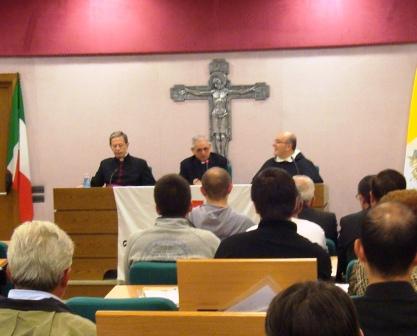
There has been a bit of a flap about what His Eminence Card. Castrillon Hoyos said in off-the-cuff remarks to a conference meeting in Rome on the occasion of the first year of the Motu Proprio Summorum Pontificum.

My photo shows Card. Castrillon during these very comments.  He is seated between Msgr. Perl and the moderator of the conference Fr. Nuara.

What really got people’s attention it seems is His Eminence’s statements that some people are not satisfied with what has been done for them.

Well… yes.   He said that and what he said is true in some cases.

But I think His Eminence was speaking as much to an attitude with which people express themselves as to the concrete things they want.

Sure, many are frustrated that more isn’t being done in some places to offer celebrations of, for example, the older form of Mass.  This frustration is understandable.  Others are frustrated that they have some Masses available, but not more Masses.  Still others, a small group, will express bitter impatience and frustration that the Novus Ordo hasn’t yet been suppressed.  

I think we all know that isn’t going to happen any time soon, right?  And making requests along these lines… actually writing and then sending them… really doesn the whole project harm.

Indeed, there are some for whom, no matter what you do, it will never be enough.   I remember once driving hours to say Mass for a group and not only did not a single person bother even to thank me for coming, but I even heard griping about m biretta and the vestments (which weren’t mine), etc.  

Most of the time, I think, these expressions of frustration come from decades of being deeply hurt by their priests and bishops and other Catholics who showed contempt for their aspirations about the older form of Mass and the Sacraments and the expressions of doctrine and devotion that go hand in hand with them.  Now, when they do have greater recognition of their rights, they are venting a little, of course… but when they sense that old treatment rearing its ugliness, when they receive that blow upon the bruise, they lash out as they did of old.

And there are, simply put, also some people are happy only when they are unhappy.

That said, we can take a look at an article by CNS writer Cindy Wooden on what Card. Castrillon said.

Cardinal: Some not satisfied even after pope’s Tridentine Mass decree

By Cindy Wooden
Catholic News Service

ROME (CNS) — Rather than being grateful, some people have reacted to Pope Benedict XVI’s wider permission for the celebration of the Tridentine Mass with further demands, said Cardinal Dario Castrillon Hoyos.  [This sets a bit of a sour note at the start.  Sure, as I said above, there are still some difficult folks out there.  But there are also many who are grateful and irenic.  I wish they would write to the Commission and their bishops to express gratitude!]

The cardinal, president of the Pontifical Commission "Ecclesia Dei," spoke Sept. 16 at a conference marking the first anniversary of "Summorum Pontificum," the document by which Pope Benedict expanded access to the Tridentine rite, the Mass rite used before the Second Vatican Council.

Cardinal Castrillon, whose commission works with communities using the old rite, said his office continues to receive letters requesting the Tridentine rite be used not just at one Mass a week but at every Mass, and that such Masses be available not just at one church in a town but at every church.

He said he even got a letter demanding that Rome’s Basilica of St. Mary Major be dedicated exclusively to the celebration of the Tridentine-rite Mass.  

Such people, he said, are "insatiable, incredible."

"They do not know the harm they are doing," Cardinal Castrillon said, adding that when the Vatican does not accept their demands immediately "they go directly to the Internet" and post their complaints.  [Well… YAH!  This is called freedom of expression.  This is also the 21st century. The internet is now something that must be taken into consideration.  It isn’t going away… any more than the Novus Ordo is going away.  Alas, sometimes people make unreasonable requests and they can be pesky.  They often don’t think things through very well.  They often say things they shouldn’t.  But let’s turn the sock inside out and see the other side. I don’t see the Holy See acting with lightning speed to respond to some serious concerns that need to be addressed.  Some of the frustration being expressed through the alternative media and means of communication is rising because there is a perception that not a lot is being done to carry forward what we have been told is a desirable thing: …. Didn’t we hear from someone that the Holy Father desired that the older Mass be widespread, indeed that perhaps even many…. even every… parish might have it?  So is it a surprise that people express themselves about that? ]

The cardinal and officials in his office have been saying for more than a year now that they were preparing detailed instructions responding to questions about how to implement the papal document, which said the Mass in the new Roman Missal, introduced in 1970, remains the ordinary way of Catholic worship.  [And so the question is… where’s the document?]

Asked about the status of those detailed instructions, Cardinal Castrillon told Catholic News Service that his office had completed its work and passed the draft on to the pope, who would make the final decision about its publication.

In addition to responding to the desire of Catholics who wanted more frequent and easier access to Mass celebrated in the old rite, the pope’s 2007 document was seen as a major step toward reconciliation with the followers of the late French Archbishop Marcel Lefebvre, who was excommunicated when he ordained four bishops against the express wishes of Pope John Paul II.  [I suspect that on the list of those who are not satisifed with what has been given, you might find some members of the SSPX.]

But the process of reconciliation broke down in late June when Bishop Bernard Fellay, superior of the Society of St. Pius X and one of the four bishops ordained by Archbishop Lefebvre, failed to meet four conditions posed by Cardinal Castrillon for moving the process forward.  [Hang on… I am not sure that they absolutely refused.  Didn’t Card. Castrillon express a measure of qualified satisfaction that he received a response?]

"The Eucharist should never become a point of contrast and a point of separation," Cardinal Castrillon said at the Sept. 16 conference. "What is more important: the mystery of God who becomes bread or the language by which we celebrate the mystery?"

The cardinal said the Mass — in whatever language it is celebrated — must be a service motivated by love and "never a sword" used against other Christians.

By making it easier for priests to celebrate the older liturgy and for the faithful to have access to it, he said, "the vicar of Christ (the pope) was not just exercising his task of governing, but was exercising his task of sanctifying" the people of God.

"When we are before the greatest expression of love for humanity — the Eucharist — how can we fight?" Cardinal Castrillon asked.  [While I agree entirely with that, it is not really too hard to grasp why people fight about it.  It the Eucharist, the Sacrament and its celebration, are trully the fons et culmen as we have been told incessantly since Vatican II, then we shouldn’t be surprised that people get worked up over it, especially in climate where a venerable rite was virtually supressed, those who loved it were marginalized, and liturgical abuses reigned far and wide for years.]

Posted in SESSIUNCULA |
88 Comments

Mass tomorrow

BTW… I will say Mass at San Pietro tomorrow, Thursday, with the 1962MR. I think our friend John Sonnen of Orbis Catholicus will be there to serve.

I will remember all those who have helped me so generously using the donation button and who have recently sent things from the wish list.   It is an honor to pray for benefactors and you folks are the best!

Posted in SESSIUNCULA |
Comments Off on Mass tomorrow