From a reader…
QUAERITUR:
Father, I had a conversation with someone who said that we were all kneeling and standing at the wrong time in the traditional Latin Mass that we have. Instead, we are supposed to be doing what priests would do when they are in choir. That doesn’t seem right to me. Besides there are directions in the booklets we used and we follow them. He said they were wrong. What’s the real story?
I’ll bet that the “booklet” is the famous… infamous?… “red booklet” used in very many places.
This’ll probably get things going!
Two things, right off the bat. I once heard about the origin of the “red booklet”, which was put out originally, I think, by the Coalition in Support of “Ecclesia Dei”. Back in the day, when resources for the traditional Mass were in short supply, this booklet was created. I was told that the rubric for the laity in the booklet were based on the memory of the priest they were working with. But he got it wrong. His memories wound up enshrined in the book and are now pretty much everywhere. At least everywhere where the “red booklet” is used, which is pretty much everywhere.
Also, there are no official rubrics for lay people at the traditional Mass. Do it this way. Do it that way. Fine.
It is interesting to note that the Novus Ordo imposes behavior on the congregation, while the Traditional Mass does not. And yet the libs who hate the TLM say that it’s rigid and demands uniformity. Ironic.
That said, perhaps is something is going to be done, there are better ways and less good ways. Iron control of people is not good. However, complete chaos is not good either.
If the “red booklet” isn’t the best source, is there a better source?
It seems to me that the principle of following what the clergy would do in choir is a good place to start. Lay people aren’t clerics, but by their baptism they nevertheless share in their own way in Christ’s priesthood. They aren’t priests in the same way as priests are priests, but Christ has shared his priesthood with them in their own mode, so that they, too, can offer pleasing sacrifices to God. Priesthood is for sacrifice. So, reflecting how the clergy compose themselves in choir is not a bad starting point.
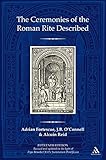
What is a good source for how clergy stand, sit and kneel in choir? We can start in English with Alcuin Reid’s reworking of the famous Fortescue/O’Connell classic, The Ceremonies of the Roman Rite Described. US HERE – UK HERE Reid, who is now helping to build a monastic community in S. France, reworked the old classic in 2009 after Summorum Pontificum was issued in 2007. It isn’t cheap. But not everyone has to have it. Priests should have it! Get one for your priests. And seminarians. And bishops, too!
That said, there is a longish essay about body postures assembled by a fellow named Richard Friend. It is online and available in a PDF.
He has extreme detail about this issue, way too much for most people. However, he distills his findings into handy tables. He compares the directions in various rubric sources, including hand missals. NB: This is not for, for example, participation in Rome. In Rome you would kneel just before the consecration and perhaps even stand up afterward.
He gives variations for places where it is not customary to kneel for the whole Canon. The “red booklet” is in the right column.
And… this table follows Fortescue/O’Connell/Reid for 1962MR.
I wouldn’t get overly worked up about this. There are no official rubrics assigned by the Church for the laity at the TLM. However, there are customs based on what the clergy are to do in choir. Variations are okay, even within a congregation.
Variations, yes. However, if you are trying to stand out, to be different, I’d examine your conscience.





 I think that Jesuit homosexualist activist James Martin is probably pretty bright. He has found a niche wherein he excels. He has carefully cultivated an image. Since his message perfectly dovetails with “the wisdom of this world”, adored by the MSM, and since it also has the support of the Enemy of the soul, how could be fail but to be a celebrity? He makes people feel good about behaviors and inclinations that they shouldn’t feel good about.


 Today I received an email with an interesting liturgical note.
 At
At  From a reader…