ASK FATHER: Must the priest wear the cassock to celebrate the Traditional Latin Mass

priests cassock surplice jpgFrom a reader…

QUAERITUR:

Is the cassock required for a priest to wear a cassock under his vestments when celebrating the Extraordinary Form Mass?

I did not think so, and I know other priests who celebrate the 1962 Mass without it, but I was kindly told the other day it was a defect to go without it. I could not find an official determination of this question. Obviously a thorough-laced alb would look funny over anything but a cassock, but my question is about what is actually required.

I am a newly ordained priest, still figuring many things out and I appreciate your help!

First, congratulations for your ordination.  Be brave and be prudent. Ad multos annos.

The Ritus Servandus in the front part of your traditional Missale Romanum has a section entitled De Præparatione Sacerdotis celebraturi… “Concerning the preparation of the priest who is going to celebrate (Mass).    In paragraph 2 of that section we read:

Quibus ita dispositis, accedit ad paramenta, quæ non debent esse lacera, aut scissa, sed integra, et decenter munda, ac pulchra, et ab Episcopo itidem, vel alio facultatem habenti, benedicta; ubi calceatus pedibus, et indutus vestibus sibi convenientibus quarum exterior saltem talum pedis attingat, induit se, dicens ad singula singulas Orationes inferius positas.

That is…

Once these things are arranged, he goes to the vestments, which must not be ripped or torn, but undamaged and decently clean, and beautiful, and also blessed by the Bishop or by another having the faculty; whereupon, his feet being shod, and having dressed himself in appropriate attire which outwardly reaches at least to the ankle, he vests himself, saying with each (vestment) the individual prayers given below.

Latin talus means “ankle”.  One Latin term for the cassock is habitus talaris.  In Italian we say “talare” for a cassock.

So, from the Ritus Servandus we see that it is foreseen that the priest should wear the cassock for Mass.

However, I admit that I often dispense myself from the cassock when it is hot.  In that case, I always use a plain alb with no lace.  Even when I do have the cassock on, I usually wear a plain alb unless it is a feast, but that’s another matter.

Posted in "How To..." - Practical Notes, ASK FATHER Question Box, Liturgy Science Theatre 3000, Mail from priests | Tagged ,
22 Comments

ASK FATHER: What is a “privileged altar”?

From a reader…

QUAERITUR:

I’ve occasionally seen high altars inscribed with the phrase, “altare privilegiatum.”

1) What does (did?) this mean and how did an altar become privileged?

2) Does this still apply today?

Sometimes you will find in older churches a plaque or inscription at an altar that says ALTARE PRIVILEGIATUM, or “Privileged Altar”.   It used to be that when, usually -rubrics permitting – a Requiem Mass was read at that altar, a plenary indulgence was granted to the person for whom the Mass was said.  This was primarily for the sake of the Poor Souls in Purgatory.  On feasts days, etc., another Mass could also gain the indulgence.  The “privilege” was attached to the place, not to the physical altar,  Also, the privilege could also be given to a certain priest, so that no matter where he celebrated a plenary could be gained!  Very cool.

Alas, this is no long in effect.  Pope Paul “The Suppressor” VI abolished all these privileges attached to altars in 1967 with his Apostolic Constitution Indulgentiarum doctrina.


Posted in "How To..." - Practical Notes, ASK FATHER Question Box, Four Last Things, Liturgy Science Theatre 3000 | Tagged
5 Comments

How does Pope Francis choose bishops of important dioceses?

BishopMcElroyItalian vaticanista Andrea Gagliarducci writes regularly a column at his place called “Monday Vatican”. You should read him.

Today, however, he has a piece at CNA about how Pope Francis seems to approach the selection of and translation of bishops. HERE

Among other things, Andrea wrote:

Over the past year, Pope Francis has appointed 16 U.S. bishops, most of them in smaller dioceses or as auxiliaries. The major pending question is that of the successor of Cardinal Donald Wuerl, the Archbishop of Washington, D.C. Cardinal Wuerl is already 76 years old, more than a year beyond the normal retirement age.

The post in Washington, D.C. is a key post, as it involves both pastoral care and institutional relations with the U.S. political establishment. What will Pope Francis do?

An insistent rumor says that Bishop Robert W. McElroy of San Diego might be at the top of the list.

Bishop McElroy recently grabbed headlines for jumping into the discussion on LGBT issues that followed Fr. James Martin’s book, “Building a Bridge.” Bishop McElroy has defended the book, and Martin, in the face of criticisms of his work. [I wrote a response to McElroy’s statement that anyone who opposes a homosexualist agenda is like a “cancer” in the Church and that they should be “purged”. HERE]

He also recently took part in a Boston College conference on Amoris Laetitia, hosted by Cardinal Blase Cupich and Father James Keenan, SJ. During the conference, Bishop McElroy reported on the diocesan synod he launched on Amoris Laetitia, and said that Catholic teaching must take seriously the complexity of adult moral life.  [More on that Agitprop Conference HERE]

Among observers, he is considered a figure similar to Cardinal Blase Cupich, who was personally chosen by Pope Francis in 2014 to lead the Archdiocese of Chicago. This seems to suggest that he is a fit for Pope Francis’ model of episcopal leadership.

Of course, his appointment is simply a rumor, just as another rumor in Rome says that the Pope will soon call Cardinal Cupich to lead an important Vatican office in Rome.

Just so that you know what is going on behind the scenes.

The moderation queue is ON.

Posted in The Drill | Tagged , , , , ,
19 Comments

Fr. Murray on the Jesuit-run Boston “Amoris laetitia” Agitprop Workshop

scorpionThe other day I read of and wrote of the recent Jesuit-run Boston College conference on the reception of Amoris laetitiaHERE and HERE  and HERE  In the balance, this confab was really an Agitprop Workshop.  The participants in this closed-door strategy practicum were feed talking points and language useful in uprooting truth and planting weeds.

For example, I remember my initial reaction when I read the statement, uttered during the Workshop, that Jesus “disfavored” adultery.   One of the tactics of the Left will be to replace clear, sane language with slippery weasel words such as that.  Another trick is to describe an adulterous union as an “irregular” union, which shifts the situation out of the realm of sin and morality and into the realm of mere man-made rules or regulations, which of course can be easily changed according to our needs.

My friend Fr. Gerald Murray has a keen sense of smell for this sort of B as in B and S as in S.  He also has a sharp quill.   Fr. Murray take aim at this diabolical assault on the intelligence of Catholics through the Orwellian twisting of words.   You don’t want to miss his piece at The Catholic Thing today.

Here’s a sample:

More Bad Defenses of “Amoris Laetitia”

The claim was widely made during the two Synods on the Family that the innovation of allowing persons living in adulterous second unions to receive Holy Communion, as proposed by Cardinal Kasper and others, was not a change in doctrine, but simply in discipline. [B as in B.  S as in S.] I did not believe this to be true then (or now) and, apparently, neither did many of the supporters of this innovation. [Which makes them duplicitous squared.]

The first evidence of that was the seemingly universal refusal to identify these unions as adulterous in fidelity to Christ’s words: “Every one who divorces his wife and marries another commits adultery.” (Lk 16:18) Instead of adulterous these sinful relationships were called “irregular” unions. This tactic reduces Christ’s teaching to the level of a regulation. The use of scare quotes further diminished the stature of Christ’s teaching by casting doubt on whether we should really consider these unions to be irregular at all.

A conference on the Apostolic Exhortation Amoris Laetitia was recently held at Boston College. Further evidence of the rejection of Christ’s plain teaching on marriage, divorce and adultery is found in the reported comments of two speakers: Professor Cathleen Kaveny and Fr. Antonio Spadaro, S.J.

Kaveny used curious language to describe Our Lord’s teaching on marital fidelity: “Jesus clearly disfavored adultery.”No, Jesus forbade adultery. One can disfavor things that are good in themselves, but simply do not appeal to one for a variety of reasons. One can never claim as good and right something that God has clearly forbidden.

Kaveny continued: ”It’s clear that he rejects divorce and remarriage as contrary to the original will of God. But nothing in Jesus’ words or conduct demand that the sin involved in divorce and remarriage must be conceptualized as a sin that continues indefinitely, without the possibility of effective repentance.”

Well, the original will of God remains in force unless God himself has indicated otherwise. Jesus clearly reaffirmed the prohibition of divorce and remarriage, harkening back to God’s original plan for man and woman as revealed in the Book of Genesis.

Understanding the sin involved in divorce and remarriage requires making distinctions. The responsibility for the break-up of marital life falls upon one or both parties, depending upon each one’s degree of culpability. The obtaining of a civil divorce is likewise to be evaluated as to the motives and responsibilities involved: is a divorce sought to free one to enter a new union, or is it sought to obtain legal protection of the financial and other interests of the offended spouse and children?

The decision to enter into an adulterous second union, however, is a public violation of the nature of indissoluble Christian marriage, and of one’s wedding vows. It involves the sin of adultery and the public scandal of living in opposition to Christ’s commandments.

[…]

Kaveny adds: “We do not need to disturb Jesus’ teaching in order to refine and develop it in these ways, in ways that moral theologians and canon lawyers have always done.” [Slithery wickedness.] Jesus’ teaching cannot be disturbed, however, but it can be ignored or falsified. The admittance of invalidly married couples to Holy Communion is not a refinement or development of that teaching, it is a betrayal.

One can claim to uphold a teaching by refining and developing it in a way that totally changes its meaning, but such a claim is false. Either adultery is always wrong, or it is never wrong. There can be no middle ground. To redefine some forms of adultery as not adultery is an offense against the plain meaning of Christ’s words. It’s wishful thinking that endorses immorality and would have the effect of destroying the unity of faith taught by the Church.

Fr. Antonio [2+2=5] Spadaro, S.J., who also spoke at the conference, uttered an incredible statement that dovetails with Kaveny’s remarks. He said: “It is no longer possible to judge people on the basis of a norm that stands above all.” This is a direct contradiction of how the Church has always understood Christ’s teaching.  [Poison.]

[…]

Do you see what is going on?

The left is changing language and introducing new labels and terms.  Watch for their linguistic maneuvers.  They are astute and sly.

And which of you, if he ask his father bread, will he give him a stone? or a fish, will he for a fish give him a serpent? Or if he shall ask an egg, will he reach him a scorpion?


Posted in B as in B. S as in S., The Drill | Tagged , , , ,
24 Comments

New PRINTS from Daniel Mitsui: Of Awe, Whimsy, and Serious Head Bashing

An image from a coloring book by Daniel Mitsui

The distinguished Catholic artist Daniel Mitsui sent me three prints of saints whose feast days are not very far off.  As usual, in his inimitable style, his images present both awe and whimsy.

BUT FIRST… a touching story…

After Mass last Sunday a fellow stopped in at the sacristy to say hello and to bring news, since I have been away quite a bit with travel and the like.  He and his wife have been giving special attention to a highly educated woman, now badly reduced with Parkinson’s together with other complications.  She has not been terribly open to the Catholic Church over the years, to put it mildly.  However, my friend slowly but surely introduced religious matters as points of discussion.  Moreover, as part of her therapy, they have been using Daniel Mitusi’s coloring books … which are decidedly not just for children.  Some of the images are remarkably complex.   Go and look!   The imagery of the coloring books is a great entry point into any number of discussion topics about the Catholic Faith.   To make a long story brief, she was received into the Catholic Church recently.  Works of mercy and great patience played their roles, as did Daniel Mitsui’s marvelous coloring books.

Now, let’s have a look at the new prints Daniel sent.

Please note that I left the prints in their plastic covers.  You can find more about the images at his site.  HERE

St. Nicholas has a feast day on 6 December.   The lightning and storm are given more shock value by the clear state of mind of the passengers in the boat.  And is that an Anglerfish I see?   Note that Nicholas is revered as a great patron by fisherman and others who go by sea.

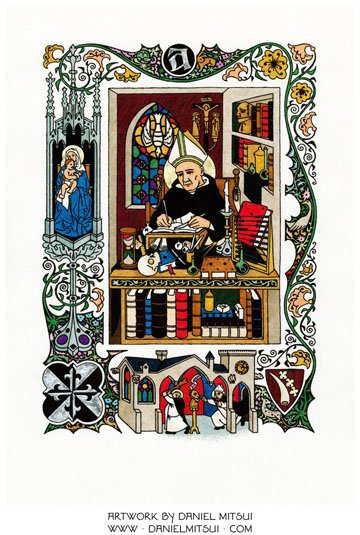
15 November brings us St. Albert the Great, Doctor of the Church and a mentor to St. Thomas Aquinas… who has a cameo appearance in this print.   Note that, on the shelf above the saint, is a strange “bust” that looks like Frankenstein.   It reappears at the bottom in a scene of violence!

That’s St. Thomas, about to smash a mechanical head that St. Albert had made that could answer questions.

MY INTERPRETATION:

Here, the head, let’s nickname the head… “Laetitia“… is saying “SIC!… NON!”, which is to say, “Yep!… Nope!”.  I take this to mean that Laetitia says “Yes” and “No” at the same time in the same respect, thus violating the Principle of Non-Contradiction.  That would certain horrify Thomas to the point of bashing “Laetitia” in with a handy club.  No?  Imagine what the Angelic Doctor would do were the talking head to say, “5!” when asked what “2+2” equals?

Well… that’s my take.

That’s hilarious.  Daniel wrote to me that, “That story captures the way I feel as a traditional Catholic using the internet – sometimes like one saint, and sometimes like the other.”

Surely he is right.

That said, I’m sticking with my own eisegetical version.

There are COLOR versions, too.  But he doesn’t send those very often.

Also in November, 22 November to be exact, is the Feast of St. Cecilia, patroness of Church music.  Here she is in a very dignified pose, with her little portative organ.  The bellows are a nice touch.

These prints are not huge.  They would be easily framed and would make beautiful gifts.


Posted in Just Too Cool, Saints: Stories & Symbols, The Campus Telephone Pole | Tagged , , , , ,
6 Comments

The Germans are revolting.

And so it begins.

When Magnum principium came out (which increased the role of bishops conferences in the preparation of liturgical translations), I mentioned that the Germans are usually the problem.  HERE

Now there’s this from the Catholic Herald.  My emphases and comments.

Cardinals Marx and Sarah disagree on Magnum Principium

Two cardinals have disagreed over how much authority the Pope’s motu proprio Magnum Principium gives to local bishops’ conferences.

The papal document gives bishops’ conferences greater say over the translation of liturgical texts, changing the role of the Congregation for Divine Worship from one of recognitio to confirmatio. However, two senior cardinals have disagreed over the exact meaning of this difference.

Cardinal Reinhard Marx, president of the German bishops’ conference, welcomed the document, implying that it was a clear break with the 2001 document Liturgiam authenticum, which he called a “dead end”[Marx is wrong.  Magnum principium did not cancel out the norms of Liturgiam authenticam.]

“Rome is charged with the interpretation of dogmas, but not with questions of style. Now, thanks to Magnum Principium, episcopal conferences enjoy a much greater freedom,” he said.  [But they are not free to make inaccurate translations.]

He also hinted that the German bishops had dropped a proposed new translation of the Mass that was more faithful to the original Latin text, with much of the controversy centring around how to translate the words “pro multis”.  [The problem is that they are not free in the matter of translations of sacramental forms.  That is reserved to the Holy See, indeed to the Pope.]

The words appear as part of the phrase “qui pro vobis et pro multis effundetur in remissionem peccatorum” in reference to the Precious Blood during the consecration of the wine in the Roman Canon.

The most accurate English translation is “for many”, but many translations, including Spanish, Portuguese and German, initially rendered it [inaccurately] as “for all”.

In 2006, the Holy See gave instruction that all vernacular editions of the Roman Missal should translate the words as “for many”, pointing out that it is also the most literal translation of the original Greek “περὶ πολλῶν” in Matthew 26:28.  [While that is the case, it must also be noted that the Roman Catechism has a paragraph explaining why we cannot say “pro omnibus”.  Moreover, its perennial use in Mass also constitutes its own theological locus.]

The change met with opposition from the German bishops, however, prompting Pope Benedict XVI to write a personal letter in 2012 explaining why they should adopt the new translation. [They ignored him.]

Now Cardinal Marx has signalled the German bishops will use Magnum Principium as an opportunity to drop the new translation and keep the old, less literal version. [It will not, cannot be approved if it doesn’t adhere to the translation norms which are, still, in Liturgiam authenticam.]

Cardinal Robert Sarah, on the other hand, has said ultimate authority still lies with the Vatican, which must still approve all new translations, and can veto proposals that are not faithful to the original text.

The Prefect of the Congregation for Divine Worship said the new motu proprio does not reduce the body to a mere rubber stamp.

“Like the recognitio, the confirmatio is by no means a formality,” the cardinal said.

Instead, it “presupposes and implies a detailed review on the part of the Holy See” including the ability to refuse assent unless certain modifications are made.

“So, for example, if, in the Creed of the Order of Mass, the expression: ‘consubstantialem Patri’ is translated in English by: ‘one in Being with the Father’, the Holy See may impose – and even must impose (cf. n. 6) – the translation: ‘consubstantial with the Father’, as a condition sine qua non of its confirmatio of the entirety of the Roman Missal in English.”

Magnum Principium, then, is simply a question of making “collaboration…between the Apostolic See and Episcopal Conferences easier and more fruitful.”

“… easier… more fruitful…”

Yeah, this will easily be a lot fruitier.

Posted in Liturgy Science Theatre 3000 | Tagged , , , ,
31 Comments

PODCAzT 158: Catholicism and Capital Punishment

noosePope Francis recently made statements about capital punishment which are the cause of much discussion.  While invoking “development of doctrine” he seems to contradict established Church teaching about the death penalty.
It is as if His Holiness would harmonize these two statements:

  • Capital punishment is intrinsically evil.
  • Capital punishment is not intrinsically evil.

The principle of non-contradiction suggests to me that these statements cannot be reconciled.  But I’m a simple guy.

In my effort to understand the parameters of the issue, I have turned to a 2001 essay by Avery Card. Dulles in First Things called “Catholicism and Capital Punishment.

Take note especially of his point about the virtually unanimous consensus of the Fathers and Doctors of the Church on capital punishment.  Also, Dulles makes the observation that opposition to the death penalty has risen in direct relation to the decline in belief in an afterlife.   There are many other informative points in his clear piece.

Card. Dulles comes down strongly against application of the death penalty, but in a way that is consistent with the Church’s perennial teaching and in accord with reason.  I find him convincing.

This paragraph merits great consideration:

Arguments from the progress of ethical consciousness have been used to promote a number of alleged human rights that the Catholic Church consistently rejects in the name of Scripture and tradition. The magisterium appeals to these authorities as grounds for repudiating divorce, abortion, homosexual relations, and the ordination of women to the priesthood. If the Church feels herself bound by Scripture and tradition in these other areas, it seems inconsistent for Catholics to proclaim a “moral revolution” on the issue of capital punishment.

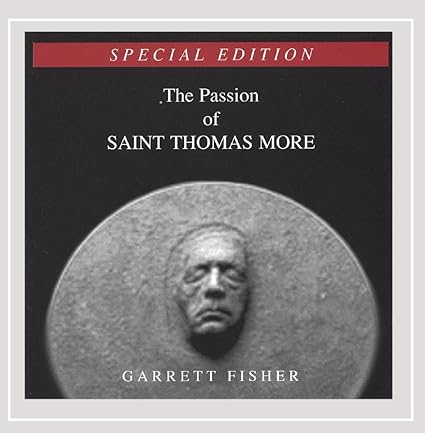
Along the way you will hear a snip of music from a fascinating modern piece by Garret Fisher called The Passion of Saint Thomas More.  It seemed appropriate to use it.

US HERE – UK HERE

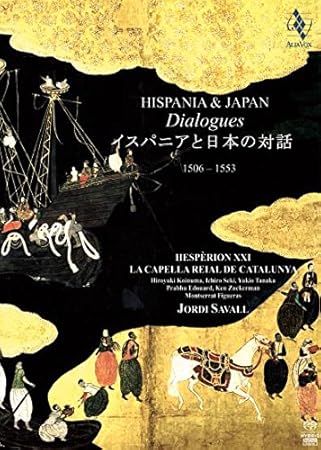
Also, I include at the end a snip of a lovely and soothing Chinese pentatonic rendering of the Ave Maria.  It is on an amazing disc.

US HERE – UK HERE

Posted in PODCAzT, The Drill | Tagged , ,
18 Comments

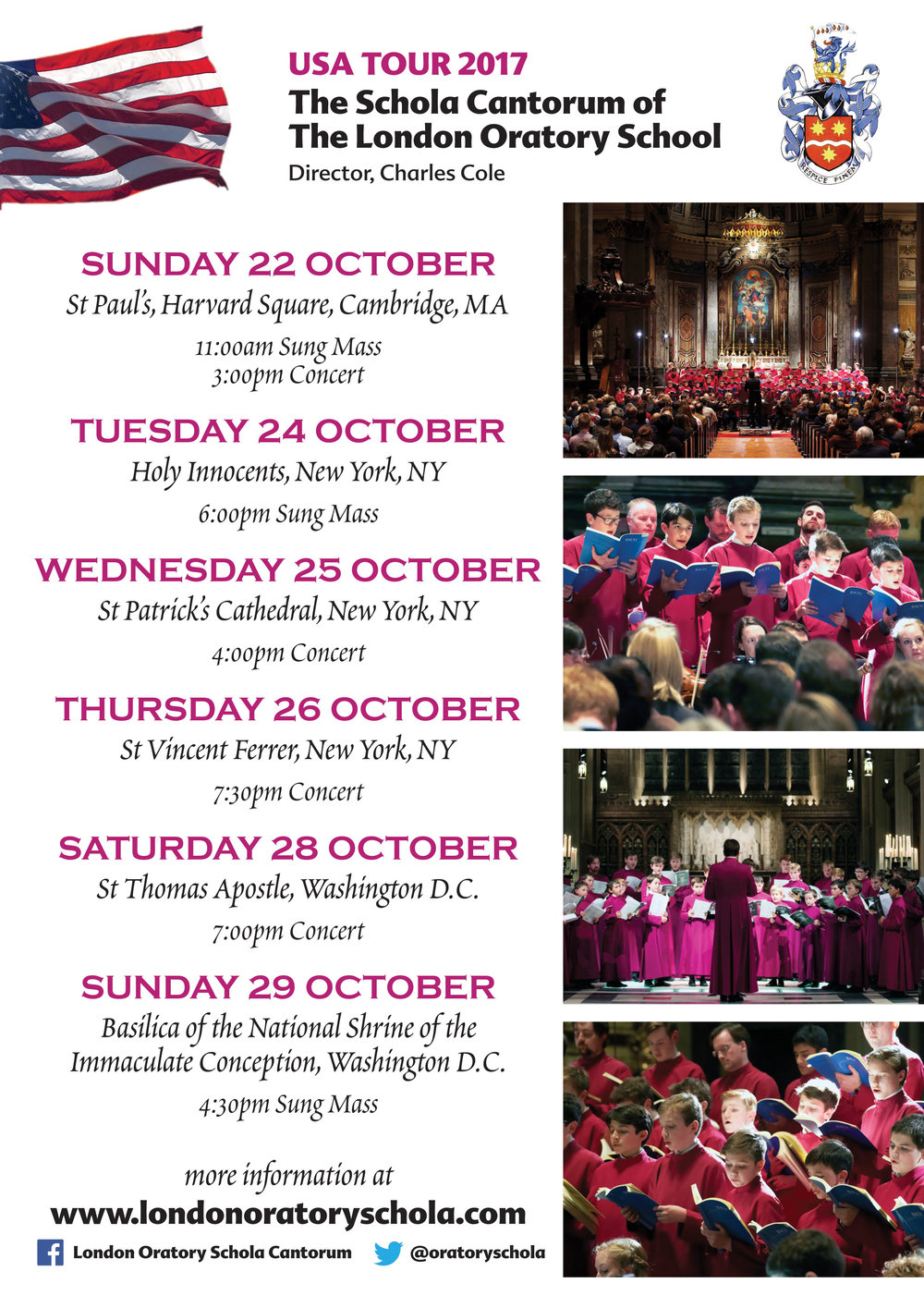
London Oratory School Schola – USA TOUR – 22-29 October 2017

Here is a great opportunity, not only to experience a great Catholic boys choir, but also to SUPPORT a great Catholic boys choir!

There are both Masses and concerts.  Take note.

The Schola Cantorum of The London Oratory School

Posted in Events, The Campus Telephone Pole | Tagged
4 Comments

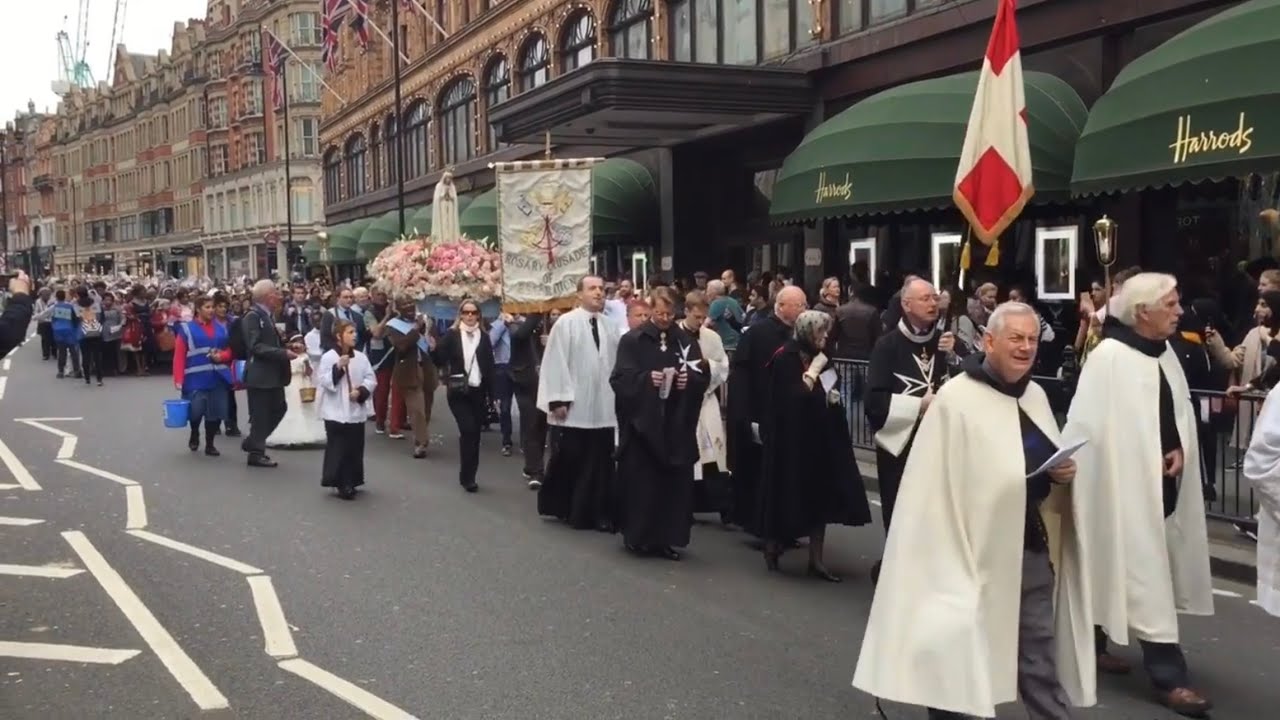
VIDEO: London Rosary Crusade 2017

This is a marvelous video sent by a friend in London, who wrote:

Here’s how Fr Tim Finigan described it a couple of years ago.

This occasion must rank as one of the most splendid manifestations of Catholic faith in our country in recent years. The numbers have been swelled by the immigrant Catholics who have come to form part of the Catholic Church in London. At the same time, the clipped tones of the English middle and upper classes demonstrated that the Church is truly Catholic. There was no snobbery here – and no inverted snobbery. All were as one, witnessing to the faith they love, taking Our Lady onto the streets of London, and filling a Church that represents the high-point of English Catholic restoration – and not only in the 19th century.
I would encourage anyone who is dismayed by the falling numbers of clergy, or mass goers, or marriages, to come next year. This event neither seeks nor receives any official encouragement or support. If any ecclesial activity could be said to be of the people of God, it is this. You want to see the Church alive and kicking? Here is where the action is.


YouTube thumbnailYouTube icon

Posted in ¡Hagan lío!, Just Too Cool, Our Solitary Boast | Tagged , ,
12 Comments

PHOTOS: Pontifical Mass at the Throne – 13 Oct 2017 – @MadisonDiocese

On Friday 13 October, we had a Pontifical Mass at the Throne with the Extraordinary Ordinary of Madison, His Excellency Most Reverend Robert C. Morlino at the little church of St. Mary in Pine Bluff where Fr. Richard Heilman is pastor.

Here are some images from the Mass.  NB: Some of you readers helped to buy the vestments!   HERE

IMG_2898

Out Lady of Fatima has been in the church during the anniversary months.

IMG_2904

IMG_2908

The size of the sanctuary required us to find a Roman solution for the sacred ministers.  We seated them on the steps of the altar, which worked well.  We’ve done this before.

IMG_2923

We are getting good enough at these Masses that we were able to proceed with about 20 minutes of practice of a few rough spots.  The priests, who rotate through roles when we have these Masses, are pretty familiar now with the sacred action.

IMG_2931 IMG_2933 IMG_2939 IMG_2953 IMG_2954 IMG_2957  IMG_2958

There were people standing along the sides and in the back, and we put more chairs in the narthex.

IMG_2967

Turning the housling cloths.  At this parish, even for the Novus Ordo Masses, everyone uses the rail and I don’t believe anyone receives in the hand anymore.

IMG_2982 IMG_2991 (2)

IMG_3005

Fr. Heilman was one of the Deacons at the Throne.

IMG_3014

Posted in "How To..." - Practical Notes, Liturgy Science Theatre 3000 | Tagged , , , ,
18 Comments