Cri de Coeur: What recourse do we laypeople have?

Jules-Alexis Muenier Catechism Lesson 1890 smThis cri de coeur comes from a comment under another entry.

And what recourse do we laypeople have?  Do we just have to sit around and remain silent because we do not have proper authority to speak up?

Priests and bishops are doing and saying every crazier things right now.

What to do?

In the religious services for the important eschatological feast of Tabernacles in the ancient Temple service in Jerusalem, there was a moment when one priest had to pour water from the pool of Siloam simultaneously as another poured wine into two drains near the great altar.  It happened in about 95 BC that a Maccabean priest with Sadducee leanings poured the water on the ground instead of the prescribed place.  The outraged people pelted him with their fruit offerings, his bodyguards intervened and, at the end of the day, 600o Jews had been killed in the Temple.  That’s how they reacted to liturgical abuse.

In the time of the Arian controversy, people rioted in the streets over theological terms such as homoousios and homoiousios.  That’s how they reacted to theological ambiguity.

In Augustine’s time in North Africa, a translation of Scripture with which the people were unfamiliar (Jerome’s!) provoked civil unrest.  That’s how they reacted to sudden innovation.

These example serve to show how important the Faith was to people whose lives were still integrated, before faith and .. well… the rest of life were sundered and compartmentalized as they so often are today.

While no one around here will advocate physical violence in the face of heterodoxy or the sheer cowardly ankle-grabbing of some clerics in the face of secular pressure, lay people do not have to simply sit on their hands and worry.

I have been advocating for some time now that you start to form small “base communities” to study the Catechism of the Catholic Church and other helpful catechisms and sources.  It’s one thing to scratch your head and wonder if something is right or not.  It’s another to know the content of your faith well.   I gave a conference a while back at the end of which, during some Q&A, a sincere and clearly pious woman made a couple statements about something being in the CCC that simply is not in the CCC.  Sincerity is not the same as being well-prepared.

And once you are well-prepared, and you know your sources, and you know how – this is important – how to look things up, the start asking questions.  Start asking and keep asking.  If you don’t get answers, ask and ask and ask, Catechism in hand.  If you get a question that is inadequate, go back and ask more questions.  Don’t let your priests or bishops off the hook… not for a moment.  Be the “troublesome widow” at their closed door.  They are, after all, ordained and placed precisely with the mandate of teaching and explaining the Faith for the sake of the salvation of souls.

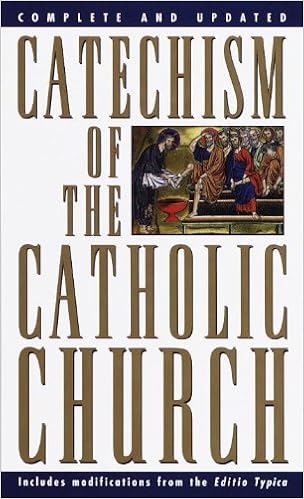
Read, review, study the Catechism of the Catholic Church.

US HERE – UK HERE (There are many editions.  Look around.)

I am a huge fan of Kindles (US HERE – UK HERE), but you should also have the BOOK, the material volume which you can hold in your hand and write in.  Get the book, which you can flip around in and hold spots in with a couple fingers as you cross check.

Read it.  Pick it up. Read portions every day.

Posted in ¡Hagan lío!, "How To..." - Practical Notes, Be The Maquis, Cri de Coeur, Hard-Identity Catholicism, New Evangelization, The Coming Storm, The future and our choices | Tagged , , ,
34 Comments

ASK FATHER: Holy Spirit or Holy Ghost?

spirit_Vatican_IIFrom a reader…

QUAERITUR:

My brother and I were having a discussion about the use of
the terms ‘Holy Ghost’ vs ‘Holy Spirit’. We both attend the
traditional Latin Mas, and are interested to know the origin of why ‘Spiritu Sancto’ is often translated as ‘Holy Ghost’ in traditional missals and books. I am sure there’s a good reason, but I don’t know what it is.

As far as I’m concerned we can use both, interchangeably.

Well… maybe not…

Come, Holy Ghost, Creator blest,
and in our souls take up Thy rest;…

or

Come, Holy Spirit, Creator blest,
and in our souls take up Thy rest;

Nope.  Ghost, hands down.

I’m pretty sure that we English speakers have traditionally used Holy Ghost because of early translations of Holy Writ, namely the King James Bible and the Douay Rheims, even though both those Bibles use both Ghost and Spirit (fewer times).  The KJV capitalized “Ghost” when it was certain that the Third Person of the Trinity was involved.

Ghost, related to German Geist (which is used today for the Holy Spirit), in its roots is any sort of spirit.  “Ghost” often translated Bible Greek pneuma and Latin spiritus.

It became a matter of common parlance. People memorized traditional prayers with Ghost.  We sang hymns with Ghost.

I think we should also use archaic words in our prayers, private and congregational.  Prayer should be from and of the heart, but we can use he richness of our language to express ourselves, even in solidarity with our forebears.

Also, over time it seems that translators had a strong feeling for “ghost” as a personal being, though not in the sense of a phantasm that needed “busters”.  I wonder if, today, with the way “spirit” has become so diluted in meaning, “ghost” might not make a profitable comeback.

Any way, I don’t like the idea that we have to surrender to contemporary fashion in language.  Old language is also good, so long as it communicates what it is intended to communicate.  I don’t think all the old words are about to give up the ghost quite yet.

Posted in "How To..." - Practical Notes, ASK FATHER Question Box, Liturgy Science Theatre 3000 | Tagged
29 Comments

ASK FATHER: Latin misspelling? “eundem” or “eumdem”?

IMG_5357From a reader…

QUAERITUR:

Father, I recently saw “eundem” in a misallette. My missal uses “eumdem.” I was wondering if these are different cases of the same word (like German den/dem) or if they are just different spellings of the word (or misspellings?).

Eumdem is a legitimate form, though not preferred in the Classical period.   The predominate form, even well into Mediaeval Latin, is eundem.

Be mindful that, in classical times, Latin was more “nasal” sounding than it is in our Italian/Roman ecclesiastical pronunciation.   Endings with “m” were strongly up in the nose, as it were.  This is a reason why endings started to drop off in late Latin and early Italian.

That said, the eundem form is the older, more classical and preferred form.  The m of eum at times morphed into an n in the presence of the voiced dental.  In post-Classical Latin the m reasserts itself now and then, perhaps because eum is the accusative which is being slammed into the indeclinable suffix –dem.

I find eundem attested first in Ennius, Plautus, etc.  I find eumdem attested much less frequently and first in Cicero De legalibus and Celsus De medicina and, after that, in early Christian writers such as Cyprian of Carthage Ad Quirinum and Lactantius De ira Dei.  Augustine uses both forms, but I didn’t look to see if he uses the n form in quotations.

I don’t see any pattern of preference.

It could be that there were regional preferences.  If could also be that orthography variations and the helpful “corrections” of copyists played a role.  Either way, both forms are legit, though eundem is correcter than the other.


Posted in "How To..." - Practical Notes, ASK FATHER Question Box, Liturgy Science Theatre 3000 | Tagged ,
6 Comments

Italian Bishop praises Luther and Revolt as work of the Holy Spirit

luther galantinoOne of Pope Francis’ very most favoritists of the Italian bishops, personally raised by the pontifical hand to power in the episcopal conference, Bp. Nunzio Galantino, gave a talk at my old school, the Pontifical Lateran University (“The Pope’s University”) for their LutherFest2017, sponsored by the theology faculty.

I read in Il Timone

“I’ve deployed against all the papists, against the Pope and indulgences but only by preaching the word of God.  And when I was sleeping the word of God was working such things that the Pope is now fallen.”  [Bp.] Nunzio Galantino, Secretary General of the Italian Episcopate, read at full voice this passage from Luther which for 5 centuries was considered offensive to Catholics.  “The reform started by Martin Luther 500 years ago was an event of the Holy Spirit“, the bishop affirmed while speaking at the Pontifical Lateran University to a conference promoted by the Pope’s school to celebrate the anniversary.

“The Reform”, Galantino underscored, “responds to the truth expressed in the formula ecclesia semper reformanda.”  “It was the same Luther,” the Secretary of the CI reminded, “who didn’t consider himself the author of the Reform, writing: “while I was sleeping, God was reforming the Church.”  “Even today,” the prelate commented, “the Church needs a reform.  And today, too, it can be fulfilled by God alone.”

[…]

One thing I’ll agree on with Galantino is that the Church is in need of a reform.

The moderation queue is ON.

Posted in Hard-Identity Catholicism, Liberals, You must be joking! | Tagged ,
28 Comments

NIGERIA: Sun “event” on 13 Oct 2017?

Are any of you reading stories about an event in Nigeria on 13 October 2017, the 100th anniversary of the Miracle of the Sun?  Apparently the bishops of Nigeria consecrated Nigeria to the Immaculate Heart of Mary.  After the Mass, the Sun supposedly… did things….

There are videos on YouTube.

I don’t know what to make of this.  I haven’t heard anything official.


Posted in Look! Up in the sky! | Tagged
14 Comments

Polish Soldier

On the Feast of the Holy Rosary, Poles went to the borders to pray in a great Rosary chain for the protection of their nation.

Today, on rising, I was greeted with this great image of a Polish soldier burning an ISIS flag.

Polish soldier burns ISIS flag

Good morning everyone!

Posted in ¡Hagan lío!, Just Too Cool, The future and our choices, The Religion of Peace | Tagged , ,
5 Comments

Nebraska parish going “ad orientem”

Unless and until we get our act together regarding sacred liturgical worship, no initiative we undertake in the Church at any level will bear the fruits we hope for.

ad orientem cartoonWe need widespread, generous use of the older, traditional form of the Roman Rite.  We need the Novus Ordo to be celebrated faithful, according to the rubrics and in harmony with the tradition which we reclaim from the use of our traditional forms.

One of the most important things that we can do, please God as soon as possible far and wide, is to preach and teach about reception of Communion on the tongue as well as switching to ad orientem worship.

There is a good article at the National Catholic Register on the important issue of ad orientem worship.  Shall we have a look with my usual treatment?

Ad Orientem Posture Given New Life in Nebraska

by Nicholas Wolfram Smith

WAHOO, Neb. [I LOVE the name of that town!] — Sudden changes in the life of a parish come rarely. [Depends on where you are!] But on the first weekend in October, at St. Wenceslaus in Wahoo, Nebraska, Father Joseph Faulkner announced an unexpected decision on the liturgy: The parish would celebrate Mass ad orientem — both the priest and the people facing the altar in the same direction — for a year.

St. Wenceslaus joins a slow [but steady] stream of parishes that are experiencing liturgical renewal through returning to the ad orientem (facing the east) position in the celebration of the ordinary form of the Mass. While the movement has gained ground slowly, many priests credit last year’s remarks from Cardinal Robert Sarah with jump-starting further interest in it.

At the 2016 Sacra Liturgia conference in London, Cardinal Sarah, the prefect of the Congregation for Divine Worship and the Discipline of the Sacraments, asked priests to face ad orientem when saying Mass, as a means to ensure that “in our celebrations the Lord is truly at the center.” While the Vatican quickly issued a statement that “new liturgical directives are not expected,” and emphasized the unofficial nature of Cardinal Sarah’s remarks, many priests were inspired by his words.

Father Faulkner, the pastor of St. Wenceslaus, told the Register that his parish is the largest in the diocese so far — at 700 families — to implement ad orientem.

“There’s no place you can’t do it,” he said, if ad orientem can be introduced at a parish his size.

Ad orientem, which means “to the east,” refers to the practice literally of saying Mass facing the East, but has also come to refer to the priest and people facing the same direction during some parts of the Mass. Cardinal Sarah wrote in L’Osservatore Romano that “the penitential rite, the singing of the Gloria, the orations and the Eucharistic Prayer” could all be occasions when priest and faithful face East together, while some priests who have adopted the ad orientem posture do so only during the Eucharistic Prayer.  [Remember:  Liturgical East doesn’t have to be literal East.]

Turn Ad Orientem AgainFather Faulkner was not always a supporter of the ad orientem posture. He “intensely” resisted the idea of Mass ad orientem during his time in seminary, and only gradually came to accept the arguments for it[So, he has an open mind. Kudos.]

Among the arguments made by proponents of celebrating Mass ad orientem is the unity of the community in awaiting the coming of the Lord and the visible sign it gives of the whole parish community addressing God.

While he acknowledges that he will miss some aspects of celebrating Mass versus populum (facing the people), Father Faulkner believes it will be better for the prayer and worship of his community.  [On the other hand, Father still is directed in the rubrics to turn around toward the people at times.]

He has asked his parish to undertake celebrating Mass ad orientem as a “spiritual exercise” for a year.

“We’re giving it a shot. We’re trying it for a year and then will re-evaluate,” he said.

Discovering Ad Orientem

Even if their parishes don’t celebrate ad orientem on a full-time basis, the Diocese of Lincoln has a significant number of priests who use it at least during Advent. Much of that is due to the example of Bishop James Conley, who in 2014 decided all Sunday Masses at the cathedral during Advent would be celebrated ad orientem. The practice has been renewed every year since, and priests in the diocese have been given permission to institute ad orientem worship in their parishes, provided there has been appropriate preparation.

Father Karl Millis, of St. Joseph’s in Auburn, Nebraska, told the Register that when his parish switched to saying Mass only ad orientem a year ago, he went through a learning experience along with his parishioners. He said ad orientem worship brings a physical clarity to the liturgy, showing that when the priest addresses God the Father, he faces him, and when he speaks to the people, he faces them.

Father Millis said that for him and for other parishioners, praying ad orientem has allowed for deeper reverence and understanding of their prayers.

Father Steven Thomlison, at St. Stephen’s in Exeter, Nebraska, echoed other priests when he told the Register that while initial reactions in the parish ranged from skeptical to intrigued, there has been a widespread embrace of celebrating ad orientem in the three years since he introduced the parish to the practice.

“It’s wonderful to celebrate Mass oriented toward Our Lord,” he said.

Harvest of Vatican II

The slow return of interest in ad orientem worship finds a mirror image in its precipitous decline after the Second Vatican Council. Christopher Ruddy, associate theology professor at The Catholic University of America, told the Register that the Council documents never mentioned an end to ad orientem celebration of the Mass[RIGHT!  A fraud was perpetrated.]

Instead, the Vatican issued a liturgical instruction after the Council, which stated, “The main altar should preferably be freestanding, to permit walking around it, and celebration facing the people.”

Ruddy said that there was a Vatican and papal impetus behind versus populum, which did not mandate it, but permitted and encouraged it.

“It’s sort of striking how readily this change was accepted by the vast majority of Catholics,” he said.

Father Joseph Illo, who in the past year introduced ad orientem worship to Star of the Sea parish in San Francisco, California, told the Register he did not think this kind of change would have been possible a decade ago.

While Cardinal Sarah’s remarks were the immediate inspiration for him to ask permission of the archdiocese to try ad orientem, the work of Benedict XVI had articulated clearly the reason and direction of the liturgical renewal envisioned by Vatican II. His principles had been popularized and spread through the Church, so that people were prepared to do what Vatican II had asked, [which is exactly what my long-time mentor, the late Msgr. Schuler implemented at my home parish, founded on the work of his predecessor who had been a peritus at all the sessions of the Council.] including a recognition of the importance of ad orientem worship.

Father Illo said the two poles of the Council were aggiornamento and ressourcement, “bringing up to date” and “return to the sources.” While aggiornamento had been predominant after the Council, “now we’re discovering the other axis of the Council and the reform, which is getting back to the sources,” he explained.

Oriented to the Cross

Dominican Father Vincent Kelber of Holy Rosary parish in Portland, Oregon, told the Register that ad orientem worship being a year-round part of the ordinary form hads “brought a lot of focus, brought a lot of peace and brought a lot of prayer” to his parish community.

At the same time, he cautioned against letting a particular orientation distract the faithful from the presence of Christ in the liturgy. Citing Benedict XVI, Father Kelber said that no matter which way the celebration is oriented, all Masses have to be ad crucem, focused on the sacrifice on the cross. [Thus, the “Benedictine Arrangment” of the altar… which is a, IMO, a transitional solution.]

“We need to emphasize that, so whatever form or whatever orientation we use, the better off we’ll be, and the more unified we’ll be.”

Fr. Z kudos to all these priests.
Posted in "How To..." - Practical Notes, Fr. Z KUDOS, Liturgy Science Theatre 3000, Turn Towards The Lord | Tagged ,
9 Comments

ASK FATHER: Assistant priest wonders what to do if pastor won’t speak to adulterous couples who receive Communion.

17_06_27_AAS_AmorisFrom a priest…

QUAERITUR:

Here is a question which perhaps you could answer for those of us who are parochial vicars.

What should we do if people regularly present themselves for communion who are married outside the Church?  Ordinarily, we have the very clear teaching of Canon 915.  But what should we do if they are married outside the Church, the pastor knows they are married outside the Church, and yet he still gives them communion anyway?  My pastor’s attitude is that they should just know that they shouldn’t present themselves for communion.  He refuses to confront them.  He won’t let them be sponsors but he also won’t turn them away from receiving communion either.  The Diocese tells me to follow the pastor’s lead.  What is one to do?

GUEST PRIEST ANSWER: Msgr. ___  [This priest has a lot of experience in diocesan administration and priestly personnel issues.]

This is difficult and almost insolvable on a practical level given the admixture of the obedience issue with the pastor and the diocese.

Can the pastor be convinced, through Amoris Laetitia, to “encounter, accompany, and dialogue” with these couples to convince them not to present themselves for Holy Communion under canon 916 (if my memory is correct on the canon number)?  Would the pastor allow the parochial vicar to do this, and maybe start a small ministry to those in adulterous second unions?

It seems these couples need catechesis and formation so they voluntarily do not present themselves for Holy Communion (or alternatively seek to live together as brother-sister, etc…).

Ultimately, I think the pastor should confront the couples on the issue and ask them to be witnesses by not receiving Holy Communion in the current state.  If they don’t comply, canon 915 would come into play, although I think the pastor should have a confidential discussion with each couple so they can avoid the embarrassment of being denied Holy Communion and make sure they’re “obstinately persisting”.

The couples should also know that they can’t receive sacramental absolution in the confessional without the requisite sorrow for sin/firm purpose of amendment in regards to the adulterous second union.

It is very difficult for the parochial vicar in conscience.

However, I suppose if the pastor really doesn’t address the issue in a serious and full way with each couple, then is the couple really “obstinately persisting” in manifest grave sin?  I really appreciate the situation of the parochial vicar, since the pastor is somewhat holding them in a “strategic ignorance” to afford them the reception of the sacraments.

Fr. Z adds:

Yes, the “parochial vicar” (aka assistant) is in a tough spot.  He isn’t the pastor, so he doesn’t get to make the call.  On the other hand, he is a priest and he is concerned for souls but also about profanation of the Blessed Sacrament in sacrilegious Communions as well as the potential of scandal.

The pastor has the care of souls and is responsible for these couples before God.  If he is willfully keeping them ignorant of their spiritual peril – because do we really think that they don’t know that they should go to Communion? – then I tremble for the pastor who will answer for this before the Just Judge, the King of Fearful Majesty.

Sadly, I suspect these situations will multiply and worsen as the controversies over Amoris laetitia are allowed to go on and confuse people.  As the controversies first erupted, I opined that sound priests would interpret Amoris in the best possible, faithful light and that less than faithful priests would use the document as cover to continue to do what they have been doing all along.

To the parochial vicar: Bide your time, Father.  You are not the pastor.  However, you might take on some penances in reparation for the sacrilegious Communions and you might pray also to the Guardian Angels of the couples.  Perhaps you might also choose occasionally to preach about what it means to be “properly disposed” to receive, including also the physical disposition caused by fasting (since we are both body and soul).

Posted in "How To..." - Practical Notes, ASK FATHER Question Box, Canon Law, Liturgy Science Theatre 3000, Mail from priests, One Man & One Woman, Our Catholic Identity | Tagged , , , ,
21 Comments

Card. Burke’s smashing @Buckfast_Abbey talk on Message of Fatima

cardinal burke smThere is a video of the talk, but the audio is really bad.  So, I extracted the audio from the video and cleaned it up.

Wanna hear it?  It’s classic Burke and hard hitting.

There is a LifeSite story about the talk.  HERE  It includes a way to download the text of the Cardinal’s speech.  HERE


Posted in ¡Hagan lío!, Just Too Cool, New Evangelization, Our Catholic Identity, Our Solitary Boast, The Coming Storm, The future and our choices | Tagged ,
2 Comments

ASK FATHER: Must the priest wear the cassock to celebrate the Traditional Latin Mass

priests cassock surplice jpgFrom a reader…

QUAERITUR:

Is the cassock required for a priest to wear a cassock under his vestments when celebrating the Extraordinary Form Mass?

I did not think so, and I know other priests who celebrate the 1962 Mass without it, but I was kindly told the other day it was a defect to go without it. I could not find an official determination of this question. Obviously a thorough-laced alb would look funny over anything but a cassock, but my question is about what is actually required.

I am a newly ordained priest, still figuring many things out and I appreciate your help!

First, congratulations for your ordination.  Be brave and be prudent. Ad multos annos.

The Ritus Servandus in the front part of your traditional Missale Romanum has a section entitled De Præparatione Sacerdotis celebraturi… “Concerning the preparation of the priest who is going to celebrate (Mass).    In paragraph 2 of that section we read:

Quibus ita dispositis, accedit ad paramenta, quæ non debent esse lacera, aut scissa, sed integra, et decenter munda, ac pulchra, et ab Episcopo itidem, vel alio facultatem habenti, benedicta; ubi calceatus pedibus, et indutus vestibus sibi convenientibus quarum exterior saltem talum pedis attingat, induit se, dicens ad singula singulas Orationes inferius positas.

That is…

Once these things are arranged, he goes to the vestments, which must not be ripped or torn, but undamaged and decently clean, and beautiful, and also blessed by the Bishop or by another having the faculty; whereupon, his feet being shod, and having dressed himself in appropriate attire which outwardly reaches at least to the ankle, he vests himself, saying with each (vestment) the individual prayers given below.

Latin talus means “ankle”.  One Latin term for the cassock is habitus talaris.  In Italian we say “talare” for a cassock.

So, from the Ritus Servandus we see that it is foreseen that the priest should wear the cassock for Mass.

However, I admit that I often dispense myself from the cassock when it is hot.  In that case, I always use a plain alb with no lace.  Even when I do have the cassock on, I usually wear a plain alb unless it is a feast, but that’s another matter.

Posted in "How To..." - Practical Notes, ASK FATHER Question Box, Liturgy Science Theatre 3000, Mail from priests | Tagged ,
22 Comments