Pope Francis GOES TO CONFESSION!

I see at Vatican Insider that there was a penitential service at St. Peter’s Basilica.  We have once again the image of a Pope making his confession, not hearing confessions.

confession-Francis

Meanwhile, Francis addressed a gathering of the extremely-helpful annual workshop for confessors held by the Sacra Penitenzieria Apostolica.

Among his remarks, the Pope said:

In fact, the confessor is called daily to go to the “peripheries of evil and of sin” – this is an awful periphery! And his work represents a genuine pastoral priority. To hear confessions is a pastoral priority. Please, let there not be those notices: “Confessions are heard only on Mondays and Wednesdays from this hour to that hour.” You hear confessions every time they are requested. And if you are there [in the Confessional] praying, keep the Confessional open, which is God’s open heart.

I would add to that, expand your times for confession and, Fathers…

GO TO CONFESSION!

Posted in GO TO CONFESSION, Liturgy Science Theatre 3000, Priests and Priesthood |
16 Comments

WDTPRS 3rd Sunday of Lent (1962MR): “When the priest’s hand extends over you, you are sheltered from the attacks of Hell.”

In ancient Rome on this 3rd Sunday, catechumens who desired to enter Holy Church and be baptized at Easter would be lead in a great procession to the Basilica of St. Lawrence “outside-the-walls” where they had been on Septuagesima Sunday.  They would be “scrutinized”, tested.

They were tested during Lent about their faith seven times, usually on Wednesdays and Saturdays, the climax of which came during the fourth week.

This Sunday the catechumens were exorcised of the evil enemy of the soul.  Today’s Gospel, in fact, presents the story of Jesus expelling a demon from a man who could not speak.

COLLECT (1962 Missale Romanum):

Quaesumus, omnipotens Deus, vota humilium respice: atque ad defensionem nostram, dexteram tuae maiestatis extende.

A prayer very similar to this is used in the Novus Ordo on the Saturday after Ash Wednesday.  It is ancient, from the Veronese and Gelasian Sacramentaries, and so it represents the best of the liturgical tradition of the early Church in Rome, formed out of the cultural, intellectual, spiritual milieu of the era.

The dictionary we call Blaise/Dumas reveals that a votum can be a “prayer” but it signals also “praise”, something due.  The mighty Lewis & Short Dictionary will show you that respicio is Respicio here means “to look at with solicitude, i. e. to have a care for, regard, be mindful of, consider, respect”.  Keep in mind that maiestas can be used like a title, as in “Your Majesty”, but it is also a divine characteristic, much like gloria, in the presence of which we will be transformed for all eternity.

LITERAL VERSION: 

We beseech You, God Almighty, regard with solicitude the prayers of the humble: and extend the right hand of Your majesty unto our defense.

As I hear of the mighty “right hand of God’s majesty”, I remember that soon, during Good Friday, both Christ’s hands will be pierced with nails for my sins.  He who is God became humbler than the humble creatures He fashioned in His likeness and, leaving Himself no defense, gave us His eternal freedom from the Enemy.

This majestic right hand is a way of talking about God’s power and authority.  In ancient times for example, a solider might commit an error or a crime for which he could be put to death by being flogged with the horrible scourge.  The imperator, the commander in chief, could remit the punishment of the legionary by extending his right hand over him in a sign of forgiveness.  Extending a hand over a slave was also the sign of manumission, a formal symbol of setting a slave free: extending the right hand had juridical effect.

Christ gave His own right hand of power and authority to the Catholic Church He founded and entrusted to Peter and the Apostles in union with him.  Until the end of time the Catholic Church will wield Christ’s own authority to teach, govern and sanctify.  We who are weak and humble benefit from this sheltering, liberating attribute of the Church.

In this prayer, I therefore reflect on how I, as a priest, extend my right hand of power and authority, Christ’s own right hand, over a penitent in the confessional.

When the hand of the priest is extended over you, you are sheltered from the attacks of hell.  You are freed from the unending flame that would consume you, liberated from the eternal bondage to the enemy which would for ever separate your from God’s sight.

Take that thought and now read through the other two major orations of Sunday’s ancient Mass.  The formulary is one of the most ancient we have.

SECRET: 

Haec hostia, Domine, quaesumus, emundet nostra delicta: et ad sacrificum celebrandum, subditorum tibi corpora, mentesque sanctificet.

Daily Liturgical Missal (Baronius Press):

May this Victim, O Lord, we beseech Thee, cleanse away our sins: and by sanctifying Thy servant in body and mind, make them fit to celebrate this Sacrifice.

POSTCOMMUNIO: 

A cunctis nos, quaesumus, Domine, reatibus et periculis propitius absolve: quos tanti mysterii tribus esse participes.

Daily Liturgical Missal (Baronius Press):

In Thy mercy, we beseech Thee, O Lord, do Thou from all guilt and peril absolve us, whom Thou grantest to be sharers in so great a Mystery.

QUAERITUR: When was the last time you sought out “the right hand of God” in the confessional? 

How long has it been since, after confession all your mortal sins in both number and kind, you have heard the words of absolution?

Deus Pater misericordiarum… God the Father of mercies…” or in the older form:

Dominus noster Jesus Christus te absolvat; et ego auctoritate ipsius te absolvo ab omni vinculo excommunicationis (suspensionis) et interdicti in quantum possum et tu indiges. Deinde, ego te absolvo a peccatis tuis in nomine Patris, et Filii, et Spiritus Sancti. Amen.  

May our Lord Jesus Christ absolve you; and by His authority I absolve you from every bond of excommunication (of suspension) and interdict, so far as I am able and you require. Thereupon, I absolve you of your sins in the name of the Father, and the Son, and the Holy Spirit. Amen.

How long has it been?

GO TO CONFESSION!

Posted in GO TO CONFESSION, LENT, Liturgy Science Theatre 3000, WDTPRS | Tagged , ,
1 Comment

CQ CQ CQ – #HamRadio Saturday: ZedNet possibility and June Field Day potential

ham radio badassOne of our frequent commentators here, WB0YLE, who is my online Elmer, has been lavishly generous with technical knowledge and skills.   He is the one who set up the Echolink node for our use.

WB0YLE is taking our networking possibilities to a new level, with the possibility of creating what he calls “ZedNet”, which might be activated on a regular basis.  It would be a net that connects, say, at 8 PM EST (or perhaps a bit earlier for those of you in different parts of the world).

ZedNet will be available on Wires-X room 28598, if any of you ham readers are near a Wires-X repeater.  It will also be available on DMR Talkgroup 31429 for those near a Brandmeister multimode repeater.  I am also pretty sure that you can join through Echolink, which he has patched in.  That means that even if you are out and about, you could access the net through your smart phone if it has an Echolink app.

I guess that that would make participants ZedHams rather than ZedHeads.

He is working on all the mechanics.  However, people can monitor the network now:

http://hose.brandmeister.network/31429/

There is pretty cool stuff going on with the digital side of things.

Also, we had a discussion about the upcoming warm weather Field Day at the end June.   Something needs to be done.  It would be quite the thing were priest hams (and lay hams) to descend on Madison, and on St. Mary’s in particular, for a combination of Field Day, potential ultra-blognik, Solemn Masses in the Extraordinary Form for the participants (and maybe even coaching in how to say the traditional Mass) along with good cheer and lots of real life and radio QSOs.  Just thinking out loud.

So, on my slate of things to do are 1) finally get those QSL cards made (along with my challenge coins), and 2) figure out Field Day, which will coincide with the Vigil of St. John the Baptist with its blessing of fire and perhaps even the joy of the old tradition of burning (in effigy of course) a witch, 3) form the club/society and 4) sort the new shack. Yes, Morse is in there too.

To refresh:

For those of you who are digitally active, WB0YLE set up the Echolink node available to us (554286 – WB0YLE-R  – Thanks! – Remember: You must be licensed to use Echolink.

I created a page for the List of YOUR callsigns.  HERE  Chime in or drop me a note if your call doesn’t appear in the list.

73!

W9FRZ


Posted in "How To..." - Practical Notes, Ham Radio | Tagged , , ,
Comments Off on CQ CQ CQ – #HamRadio Saturday: ZedNet possibility and June Field Day potential

An argument and call for ‘ad orientem’ worship

ad orientem direction drawingFrom the increasingly valuable Crisis Magazine with my emphases and comments:

Re-turning to the Lord: A Call for Ad Orientem Worship
FR. JACOB S. CONNER, V.F. [a priest of the Diocese of Lake Charles]

Lent is a season of conversion. During this time, it’s common to encounter readings, orations, and teachings from the saints in the Mass and the Breviary that direct us to “turn away” from sin and error and “turn to” God. An example is Joel 2:12-14, which happens to be the First Reading of the Mass on Ash Wednesday:

Now, therefore, saith the Lord. Be convertedto Me with all your heart, in fasting, and in weeping, and mourning. And rend your hearts, and not your garments and turnto the Lord your God: for He is gracious and merciful, patient and rich in mercy, and ready to repent of the evil. Who knoweth but He will return, and forgive, and leave a blessing behind Him, sacrifice and libation to the Lord your God?

Another example comes from the (Ordinary Form of the) Mass  [I like how he makes the distinction…] from Wednesday of the First Week of Lent. In the Book of Jonah (3:8), the King of Nineveh, hoping to be spared from God’s impending wrath, makes this decree to all the citizens of his city:

Let every one turn from his evil way and from the violence which is in his hands.

Invariably, texts such as these affirm and respect the relationship of the outward, physical posture of the body and the inward, spiritual disposition of the soul (or heart). The purpose of this physical or bodily turning is to demonstrate the interior conversion (also presumably) happening within the soul. “Be converted to Me with all your heart.” I was pleased to find these same sentiments in the 2017 Lenten Pastoral Letter of the Most Reverend Glen John Provost, Bishop of Lake Charles, read at each Mass in the
Diocese on the First Sunday of Lent.

In a few of the observations from his Pastoral Letter, Bishop Provost teaches his flock about the relationship between this external physical turning of the body and the internal, spiritual turning of the heart to God in prayer. Let me now highlight a few of these:

  1. Ad-Orientem-Cartoon-Meme-640x578“When we worship [God], we turntowards the object of our adoration—God.  This turningtowards God is both a spiritual and physical.
  1. “Sacred Scripture permeates our Catholic worship.  Not long ago (i.e. Wednesday of the Third Week of Advent) the first reading for Mass was taken from Isaiah 45.  The
    passage struck me profoundly.  The verse read, ‘Turn to Me and be safe’ (Isaiah 45:22).  The reading continued, ‘To Me every knee shall bend; by Me everytongue shall swear’ (Isaiah 45:23).  Clearly a physicalorientation was implied.”
  1. “Literally Isaiah meant, ‘Face Me and be safe,’ a fitting admonition for not only Advent but any moment we enter the Lord’s presence.”

The bishop mentioned at the conclusion of his Pastoral Letter that this teaching was not new. When speaking about physically turning to God in prayer, he wasn’t proposing some unheard of novelty. Today, many Catholics know nothing (or very little) of ad orientem [liturgical worship]. Yet, the Catholic Church has consistently taught of its importance through the centuries and likewise practiced it in her prayer (both liturgically and devotionally). The reasons for this are manifold, but one of them is that ad orientem [liturgical worship] respects the integrity of the human person; that is, that man’s nature is both physical and spiritual. Both of these natures, moreover, are involved in conversion.

An example of this teaching is that of St. Augustine. The practice at Mass during his time was for the Deacon to announce to all present just after the homily: Conversi ad Dominum. (“Turn towards the Lord.”) Being the dutiful shepherd of souls that he was, St. Augustine explained the meaning of this admonition and gesture in a homily:

Does not God say, ‘Be converted to Me’? The scriptures are full of it: ‘Be converted to Me, be converted to Me.’ For what does this mean: “Be converted to Me”? It does not just mean that you, who were looking toward the west, should now look toward the east—that is easily done. If only you did it inwardly, because that is not easily done. You turn your body around from one cardinal point to another; turn your heart around from one love to another. (Sermo Dolbeau 19.)

As the body turns from one direction to another, so should the heart turn from sin and error to the true and living God. “Turn to Me and be safe,” says the Lord. Agreed. Conversion and ad orientem are the kinds of “safe spaces” our world and the Church really need.

In my own life, I have tried to put these teachings into practice. Beginning with the First Sunday of Advent, I expanded ad orientem from the principal Sunday Mass to every Mass at our parish. It is now firmly established here at St. Joan of Arc Catholic Church. I sincerely thank God for this blessing. Having several uninterrupted months of “turning to the Lord” at holy Mass has been one of the great blessings of my life. Though my own imperfections remain, ad orientem is deepening my union with God and helping me to pray the Mass with more recollection and devotion. In this way, it is also a blessing to the parishioners here and to all Catholics, because the sanctity of the priest and the people are interrelated.  [As I have been saying for years, there is a knock on effect.  When the priest’s ars celebrandi changes, so too does the congregation’s attitude of prayer. ]

Experiencing the positive effects of ad orientem has convinced me more than ever that there is something profoundly good and altogether reasonable about turning both the body and the soul to God when praying. Based on this experience and reflecting on the seasonal texts, I have come to question how anyone could doubt that the ad orientem celebration of Mass possesses an integrity that cannot be found when the priest offers Mass versus populum. [It is precisely for the reasons that Father gives that some priests and bishops will fight ad orientem worship: they insist that they be in control, at the center, the focal point of the enclosed circle.  They are uncomfortable with the truth that priests are for sacrifice and that what they are doing at the altar is renewing the Sacrifice of Calvary, rather than merely presiding at a pleasant collective meal.] Granted, a statement such as this could be taken as incendiary. Such is not my intention, and I would hope to allay any concern with an explanation.

In the early days of the Church there was a heresy known as Gnosticism. While more expansive, at its foundation Gnosticism denied the goodness of the physical order. It posited that all physical realities were either evil or not important. While of ancient origin, this error continues in our day under many a subtle guise. With respect to ad orientem, it is not unusual to hear someone say that the physical direction of the priest is of no relevance. [Wrong.] What matters is his spiritual orientation. While spiritual orientation is indeed important, so too is the physical. But when the latter is diminished and said to be “not important,” can we not see Gnostic tendencies at work?

In writing this, my hope is that our appreciation for the integrity of the body and soul, a relationship ordained by God himself, will be strengthened and better appreciated. I am not in any way accusing priests who offer Mass versus populum as being neo-heretics. At the same time, I unhesitatingly affirm that offering Mass ad orientem is superior to versus populum, given that the former more fully respects the hylomorphic nature of the human person, whereas the latter can easily (perhaps even naturally) give the impression that the physical realm is of no consequence. [Do I hear an “Amen!”?]

Drawing on the divine inspiration of Sacred Scripture; rooting ourselves in the truths enshrined in the Sacred Liturgy; and taking to heart the wisdom of the saints, my hope is that we—all of us—will aspire to observe practices at holy Mass which are consistent with our beliefs. [Lex orandi – Lex credendi!  There is a reciprocal relationship between what we believe and how we pray.  Change one and you change the other.] Such a conversionto the Lordneeds to happen. As Bishop Provost stated in his Lenten Pastoral Letter: “He [God] expects more of us.” While not a direct exhortation to his priests to employ ad orientem, I was happy to see His Excellency speak so favorably about turning to God in prayer. It is a welcome encouragement.

Click

We need to be serious, more serious than we have been in recent years about divine worship. [Do I hear an “Amen!”?] We also need to be rationally consistent. As Catholics, we believe in the integrity of the human person. The time has come that we align this truth of the faith with our practice at the altar. Lest we too are to fall into “old” errors, we should stop pretending (by our current practice) that the direction of liturgical prayer has little or no bearing on belief. The bodily postures we employ at Mass matter, and a universal re-turning to the Lord would be a tremendous blessing for the entire Catholic Church. As a priest, I pray that all bishops and priests would turn to the Lord at Mass, not just for Lent, but for life! Such an orientation would be for our own good as priests, [Definitely.] and, in the words of the Suscipiat, “for the good of all His holy Church.”

Fr. Z kudos.  I think this fellow deserves some Z-Swag.

Click!

Posted in "How To..." - Practical Notes, Fr. Z KUDOS, Hard-Identity Catholicism, Liturgy Science Theatre 3000, Our Catholic Identity, Priests and Priesthood, Turn Towards The Lord | Tagged , ,
9 Comments

ASK FATHER: Wedding of Catholics with a non-priest out in Mother Nature

traditional marriage certificateFrom a reader…

QUAERITUR:

My son and fiancee are Catholics and considering having a non-priest perform the ceremony in the Outer Banks, NC. We have two family members saying that as Catholics, they can’t attend the wedding because it is outside of the church. Is there some rule that is keeping them from attending the wedding?

Once again we wade into the harsh waters that flow between the permissible and the prudent.

Catholics are obliged to marry in the presence of a duly delegated official witness of the Church, almost always a priest, deacon, or bishop. When a Catholic marries a non-Catholic, the Catholic’s bishop can (if certain conditions apply) give a dispensation, and permit the marriage to take place without the presence of such a duly delegated cleric. If two Catholics wish to marry without the presence of a duly delegated official witness, the only one who can grant that dispensation is the Holy Father himself. Quite rare, but it does happen. There would have to be some serious conditions for that to take place (the Catholic Duke of Grand Fenwick is marrying the Catholic Archduchess of Unst, and the Lutheran bishop of Grand Fenwick must officiate at the wedding for some obscure constitutional purposes…).

The Pope is not going to grant a dispensation for two Catholics who simply want a pretty backdrop for their wedding pictures.  And that is 99% of the reason for this sort of folderol, these shenanigans, this tomfoolery.

First question that needs to be asked: Why are your son and fiancee not getting married in a Catholic church by a duly delegated priest?

Let’s see what is permissible.

Nothing in the law prevents Catholics from attending invalid marriages. There is no prohibition, there are no penalties, nothing prevents this from happening.

There is also nothing in canon law that prevents Catholics from

  • sticking their heads into the mouths of sharks,
  • running with scissors,
  • eating processed cheese-flavored products, or
  • rooting for the Yankees.

The fact that something is not prohibited by law does not, thereby, make that something a good thing to do.

Prudence, that queen of all virtues comes in to play here.

Does a Catholic, who attends a wedding he knows to be invalid, show support for something that is patently wrong?  Does his presence give the couple and their guests the impression that, “Hey, this apparently is not a big deal!”?

Or would it, as it does in some cases, mean that the couple, who know that what they are doing is wrong, conclude that Aunt Betty still loves them and maybe is even leaving the door open for them to come to their senses and return to the practice of their faith once their marriage situation is resolved?

We must return to the other question: Why is this couple not following the laws of the Church, which their Catholic baptism obliges them to follow? Were they poorly catechized? Do they not care about their faith and hence, about their eternal destiny?

As a parent, you are presumably quite concerned about their well-being.

Have you, or someone else close to them, taken them aside and said, “You need to get yourself married in the Church. It’s not just about window dressing. It’s about the state of your souls. Here’s Fr. Gelasius’ phone number. Please call him.  Talk this over with him. Please.”

The moderation queue is ON.

Posted in ¡Hagan lío!, ASK FATHER Question Box, One Man & One Woman, Our Catholic Identity | Tagged , ,
48 Comments

Sr. Simone “the Contemplative” Campbell

Simone CampbellI read a story about Sr. Simone Campbell, of Nuns on the Bus fame.  You will remember how she lobbies constantly and vocally for the platform of the Party of Death (aka Democrats) including abortion-promoting Obamacare (aka Unaffordable Care Act).
Sr. Campbell was at a conference in Rome, talking.  Talking, she said, inter alia:

[…]

Sister Campbell, whose religious congregation is rooted in the Benedictine tradition, said that “the biggest problem is mistaking spiritual leadership for rule enforcement; they don’t know the real spiritual high, the journey of the contemplative way of knowing what the Spirit who is alive in our midst is about.”

At the conference, after listening to women refugees from Rwanda, Syria and Burundi, a millennial woman from Australia and two older women from India and England talk about their struggles for justice and what their faith has meant to them, Sister Campbell remarked, “I really believe that the church needs a contemplative renewal, and maybe that’s what women are going to bring to it.

The contemplative way has been an integral part of her own life journey. It was so back in 1978 when, after gaining her doctorate in law, she founded the Community Law Center in Oakland, Calif., and for the next 18 years was its lead attorney, serving the poor. It has been so also since 2004, when she began her work as executive director of Network and a lobbyist on Capitol Hill. “I lobby from a contemplative stance in D.C., and it’s about the deep listening to the Spirit moving among us, to the deep needs of our people, and letting your heart be broken. That’s what we’re called to do,” she said.

[…]

Contemplative, eh?  For a contemplative listener she sure talks a lot.

“Contemplative”… her word, repeated, not mine.

If Sister thinks world needs a “contemplative renewal” from women, especially women religious, perhaps she should set the example and… pipe down and contemplate.

Am I getting this wrong?

The moderation queue is ON.

Posted in Liberals, Women Religious | Tagged ,
30 Comments

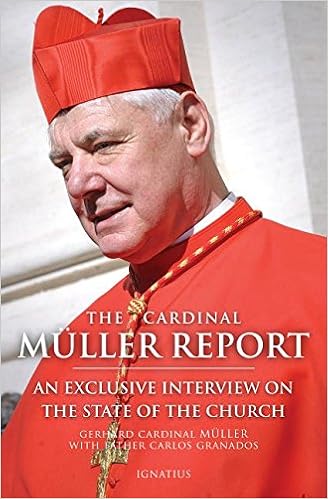
NEW BOOK: The Cardinal Müller Report: An Exclusive Interview on the State of the Church

I bring to the attention of the readership a new book from Ignatius Press. It is clearly meant to hearken to the now-classic and still relevant Ratzinger Report (US HERE – UK HERE). Joseph Ratzinger was Prefect of the CDF then, as Card. Müller is Prefect now.

The Cardinal Müller Report: An Exclusive Interview on the State of the Church

US HERE – UK HERE

I have yet to read this.  It’s going on my wish list for now.  While I don’t expect that it will have quite the impact that The Ratzinger Report had, I suspect it will add interesting insights.

Posted in REVIEWS, The Campus Telephone Pole | Tagged
7 Comments

UPDATE – Book recommendations as things fall apart

US CLICK!

UPDATE:

Today I saw at First Things a review of three books along a common theme.  Guess which three books they were.

Here is an interesting point (for links to the books, scroll down):

All three of these books make reference to the decline and fall of Rome. Esolen’s Out of the Ashes begins with a quote from Livy lamenting the eclipse of the Roman Republic, followed by lines from St. Jerome after the sack of Rome in 410. Esolen writes that America, like Rome, declined not ultimately “from without,” but instead fell by “sagging into lethargy and indifference from within.” Both Dreher in The Benedict Option and Archbishop Chaput in Strangers in a Strange Land devote pages to the famous closing lines in Alasdair MacIntyre’s sweeping critique of liberal modernity, After Virtue….

_____

Originally Published on: Mar 13

I suspect that many of us are acutely aware that things are not going well in the world and in the Church.   Structures are toppling, literally.  What to do?

I bring to the attention of the readership a couple of books I am presently into.  I alternate for the sake of variety.   My Kindle is getting a work out.  US HERE – UK HERE for an entry level option.

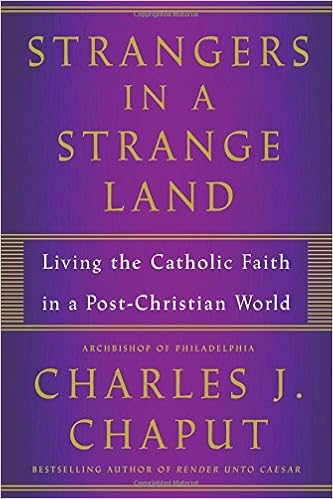
Strangers in a Strange Land: Living the Catholic Faith in a Post-Christian World by Archbp. Charles J. Chaput of Philadelphia. US HERE – UK HERE

I’ll have more to say about this one in the future. And, no, it isn’t a science fiction book. (Some of you will get that reference.)

Along the same line … which goes to show that great minds think alike…

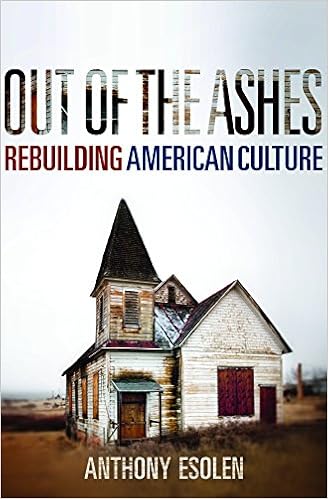
Anthony Esolen’s Out of the Ashes: Rebuilding American Culture  US HERE – UK HERE

What to do?

Do we rebuild?  Do we walk away from the wreckage and withdraw?  Do we engage?  De we retreat?

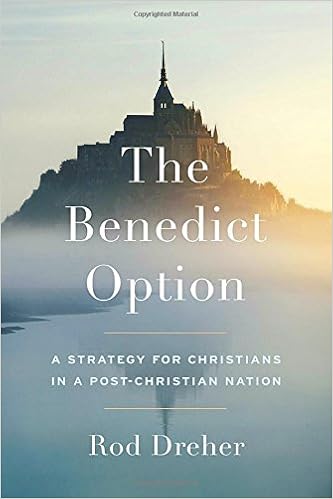
I’ll be attending soon a talk about this very matters with Rod Dreher, who will spark some conversation about these matters in The Benedict Option: A Strategy for Christians in a Post-Christian Nation– US HERE – UK HERE  This is to be released on 14 March (tomorrow, as I write), and so it is available now, today, at a greatly reduced pre-order price.   I’m putting it on my Kindle Wishlist.

BTW… “Benedict” here refers to St. Benedict, the 6th c. abbot.

Meanwhile, let’s have some Yeats:

Turning and turning in the widening gyre
The falcon cannot hear the falconer;
Things fall apart; the centre cannot hold;
Mere anarchy is loosed upon the world,
The blood-dimmed tide is loosed, and everywhere
The ceremony of innocence is drowned;
The best lack all conviction, while the worst
Are full of passionate intensity.

Surely some revelation is at hand;
Surely the Second Coming is at hand.
The Second Coming! Hardly are those words out
When a vast image out of Spiritus Mundi
Troubles my sight: a waste of desert sand;
A shape with lion body and the head of a man,
A gaze blank and pitiless as the sun,
Is moving its slow thighs, while all about it
Wind shadows of the indignant desert birds.

The darkness drops again but now I know
That twenty centuries of stony sleep
Were vexed to nightmare by a rocking cradle,
And what rough beast, its hour come round at last,
Slouches towards Bethlehem to be born?

Posted in REVIEWS, The Campus Telephone Pole, The Coming Storm, The future and our choices | Tagged , ,
19 Comments

ASK FATHER: Only the Sorrowful Mysteries during Lent?

Combat Rosary right to bear armsFrom a reader…

QUAERITUR:

Someone told me that during the Lenten season, every day one would pray the Sorrowful Mysteries of the Rosary. True?

The wonderful, indulgence-laden prayer of the Most Holy Rosary is prayed in different ways in different places. There are variations from country to country, ethnic group … community… etc. The most important element that they have in common is that they all PRAY the Rosary, however it is done. We don’t have to force unity in the matter of these devotions.

Keep in mind also that the sets of mysteries themselves – while not exactly arbitrary – are, well, a bit arbitrary.  We have the sets of Mysteries which have developed over the centuries.  Their number developed to parallel the number of the Pslams (150).  The Rosary was for a time seen as a substitution for the Psalms.  Our Lady of Fatima asked the recitation of “one third” of the Rosary (150/3=50 “Aves”).  The introduction by John Paul II of another set of Mysteries (the Luminous) goofed that up a little.  (When the Luminous were issued, some people freaked out because one third became 66.6 “Aves”.. get it?  666?  Get it?)  You are not obliged to use the Luminous Mysteries.  You aren’t obliged to use the other sets of the Mysteries either, strictly speaking.  The requirements to fulfill the work of an indulgence, however, ask for the recitation of the prayer along with pia mysteriorum meditatio… pious meditation of the mysteries.  The Enchiridion doesn’t specify the mysteries, or the day they are pondered.   Local devotion takes care of that.   So, were you on a Friday of Lent to meditate, while saying your beads, instead of the standard Sorrowful Mysteries, upon l. The Lord’s Betrayal by Judas 2. The Mocking by the Soldiers 3. The Help of the Cyrenian 4. The Last Breath 5. The Piercing of His Side… would you have said the Rosary. Sure.  Would you get the indulgence?  Probably.   For my part, I don’t see many good reasons to change anything.  But, hey, someone might slip and use one of the Stations of the Cross in place of a Mystery.

So… if you really wanted to meditate for the entire year on just the Joyful Mysteries… go for it.

You can pray which ever of the sets of Mysteries that it occurs to you to pray. Yes, there is an order which seems to have become standard, to the point of being called the “traditional” order. That order makes sense. It is time tested. It works. Hence, it makes sense to pray the sorrowful Mysteries on Friday, because the Lord’s Passion occurred on Friday. Since every Sunday is a “little Easter”, it makes sense to pray the Glorious Mysteries. Given a couple fixed points, and having the desire to play all the mysteries regularly, the order developed. It might make sense to someone to pray the Sorrowful Mysteries on a Sunday of Lent. Fine. Even every day during Lent. Fine.

That said, I find it consoling to think that so many other people are praying using the same Mysteries that I am, and that this is relatively predictable.

The paramount thing is that you pray the Rosary with attention and devotion.

And please reserve a couple of the beads for me.

Posted in "How To..." - Practical Notes, ASK FATHER Question Box, Our Solitary Boast | Tagged , ,
23 Comments

ASK FATHER: “Disposing” of the Eucharist and the Sacrarium

Typical sacrarium in an American sacristy with a sign warning never to pour away the Precious Blood.

Typical sacrarium in an American sacristy with a sign warning never to pour away the Precious Blood.

From a reader…

It is my understanding that if a Communion host or the precious blood has to be disposed, it is to be poured into water to dissolve/mix with the water, then poured into a sacrarium or into the earth. My question is, what if there is an underground perforated pipe (such as for water drainage) that leads to a sewer? The contents poured into the ground could get into a perforated pipe and drain to an unwanted area. I’m not sure of any cases were this occurs, but i suppose it is a possibility. Thanks.

For those of you in Columbia Heights, the sacrarium is a special sink in a sacristy whose pipe drain goes down into the earth rather than into a septic or sewage system.   Anything that has to do with the Eucharist or other blessed objects shouldn’t be put into the sewage system.  Rather, it should be put onto or into the ground.  Hence, priests would themselves rinse sacred linens for Mass (because their hands are consecrated).  After they are rinsed then others can take care of them.  The water for the first rinsing would go down the sacrarium or, sacrarium lacking, onto the ground.

There are a couple things to consider.

First and foremost, the Eucharist must never never never be “thrown away”, simply disposed of.  That crime incurs an automatic excommunication, the lifting of which is reserved to the Holy See or those confessors to whom the Holy See grants the faculty.

In the Latin Code of Canon Law we find:

can. 1367: Qui species consecratas abicit aut in sacrilegum finem abducit vel retinet in excommunicationem latae sententiae Sedi Apostolicae reservatam incurrit; clericus praeterea alia poena, non exclusa dimissione e statu clericali, puniri potest … A person who throws away the consecrated species or takes or retains them for a sacrilegious purpose incurs a latae sententiae excommunication reserved to the Apostolic See; moreover, a cleric can be punished with another penalty, not excluding dismissal from the clerical state..

The word abicit, abicere, means here “throw away”, and this was clarified by the Pontifical Council for the Interpretation of Legislative Texts, at their plenary session on 4 June 1999, as not … not… being restricted to “throw away” in a spirit of contempt, or intent to do dishonor.  It really does mean “throw away”, which is what happens when you put a consecrated Host or the Precious Blood down a sacrarium without first making sure that the substance of the same is first broken down (by dissolving).  Precious Blood, of course, should be consumed.

That said, in the case of any objectively sinful act which incurs an excommunication (e.g. throwing away the Eucharist), there are always the circumstances to be considered (e.g., the person’s will and knowledge, external compulsion, fear, etc.).

Redemptionis Sacramentum distinguished different levels of liturgical abuses.  The worst are in the category graviora delicata (graver crimes).  Among the graviora delicta is throwing away the Eucharist (cf. RS 172).   This grave crime is reserved to the Congregation for the Doctrine of the Faith.

To the question.

You have to trust that the sacrarium was made properly and that it is functioning in the intended way.

We are not obliged to tear the church building apart and excavate to verify that the sacrarium pipe is doing its job.  Nor do we have to send optics down the pipe.  If there is a sacrarium, we can be morally certain that it is doing its work.


Posted in "How To..." - Practical Notes, ASK FATHER Question Box, Canon Law, Liturgy Science Theatre 3000 | Tagged , , ,
18 Comments